Asymco

Asymmetric Intelligence

Services

  1. Where are Maps going?

    Research · 311 comments

    At the 2015 WWDC Apple stated that it receives 5 billion requests per week for its maps service. It also said that Apple maps is used 3.5 times more frequently than "the next leading maps app."

    These two data points are the total number of data points we have about the global maps market. Neither Google nor Nokia provide usage or share or performance data. Regardless, commentary on the usage, share and performance of Apple Maps has been abundant for the three years since its inception.

    The data presented allows us to make a few estimates for the first time and we can hope that additional data can allow a picture to emerge of where maps are going.

    With these first two data points we can finally make some estimates. But some assumptions are still needed: We need to assume that the "next leading maps app" is Google Maps. Although there are other maps apps on the iOS platform they are probably insignificant and it's a two-horse race between Google and Apple on iOS.

    This means that the 3.5:1 split in usage results in a 78% share for Apple Maps and a 22% share for Google. If we assume that there are about 400 million iOS users of maps ((Note that not all iOS users are maps users. Maps are not used by all users)), it leads to about 90 million Google Maps users on iOS and about 310 million Apple Maps users on iOS.  This includes iPad. ((We are excluding OS X use of Maps.))

    Given that Google also reported 1 billion downloads in 2014 ((though not necessarily all of these downloads lead to active use, obviously)) we can assume between 25% to 33% Apple Maps "market share" of usage.

    At the minimum, 25% share is not insignificant and it's easily sustainable. To understand why, we should note that there is one more data point. In December 2012 I posted an analysis on the the cost of maps. It showed that maintaining maps requires an investment of between $1 billion and $2 billion/yr. With the addition of new features such as 3-D mapping, transit maps and thousands of new cities, the cost is likely to have increased. $2 billion/yr is probably the norm today.

    Apple then could be seen as spending about $6.5/user/yr on maps and Google could be spending about $2/user/yr. To be profitable Google would need to find ad revenues of $2/user/yr and Apple would need to find $6 of profit on each phone/yr. Clearly, each of these targets is achievable.

    In contrast we can see why Nokia's HERE Maps business is now worth a lot less than it was in 2007. The asset has been for sale for some time and the latest bid  has been for $3 billion, making the $5 billion lost in market value and $7 billion of investment since seem like a catastrophe. Without a business model the data is worthless--with only 30 million users the cost per user reaches $66/yr. A buyer needs to find an appropriate model for sustaining a $2 billion/yr burn rate.

    So the question of where maps are going depends on the business model for maps. In a world where maps are sustained by device value, 300 million users makes it sustainable. In a world where maps are sustained by advertising, 1 billion users makes it sustainable. What else is there?

    How about a world where maps are sustained by transportation services?

    Uber's and other auto makers' interest in HERE shows a third business model. Accurate maps are a key to making vehicles autonomous. More so even than the value of the algorithms, precise imaging of roadways enables vehicle autonomy and the value of location gathering systems should grow to meet that future.

    It's highly likely that Google's maps efforts are going to continue because they are fueled by a business model. That is also true for Apple's maps efforts, though they are fueled by an entirely different business model. Each of these business models fuels the improvement of the maps product but also of the maps gathering process. As these processes are expensive and licensing options are few there is little incentive to share the data. As a result the processes remain integral to the businesses.

    This integrated-while-fueled nature means that maps makers will find it compelling to pursue adjacent business models, i.e. transportation services. It's not a matter of whether they will or won't. It's only a matter of when and where.
  2. iPhone, killer

    Research · 253 comments

    Screen Shot 2015-05-13 at 5-13-8.20.01 AM


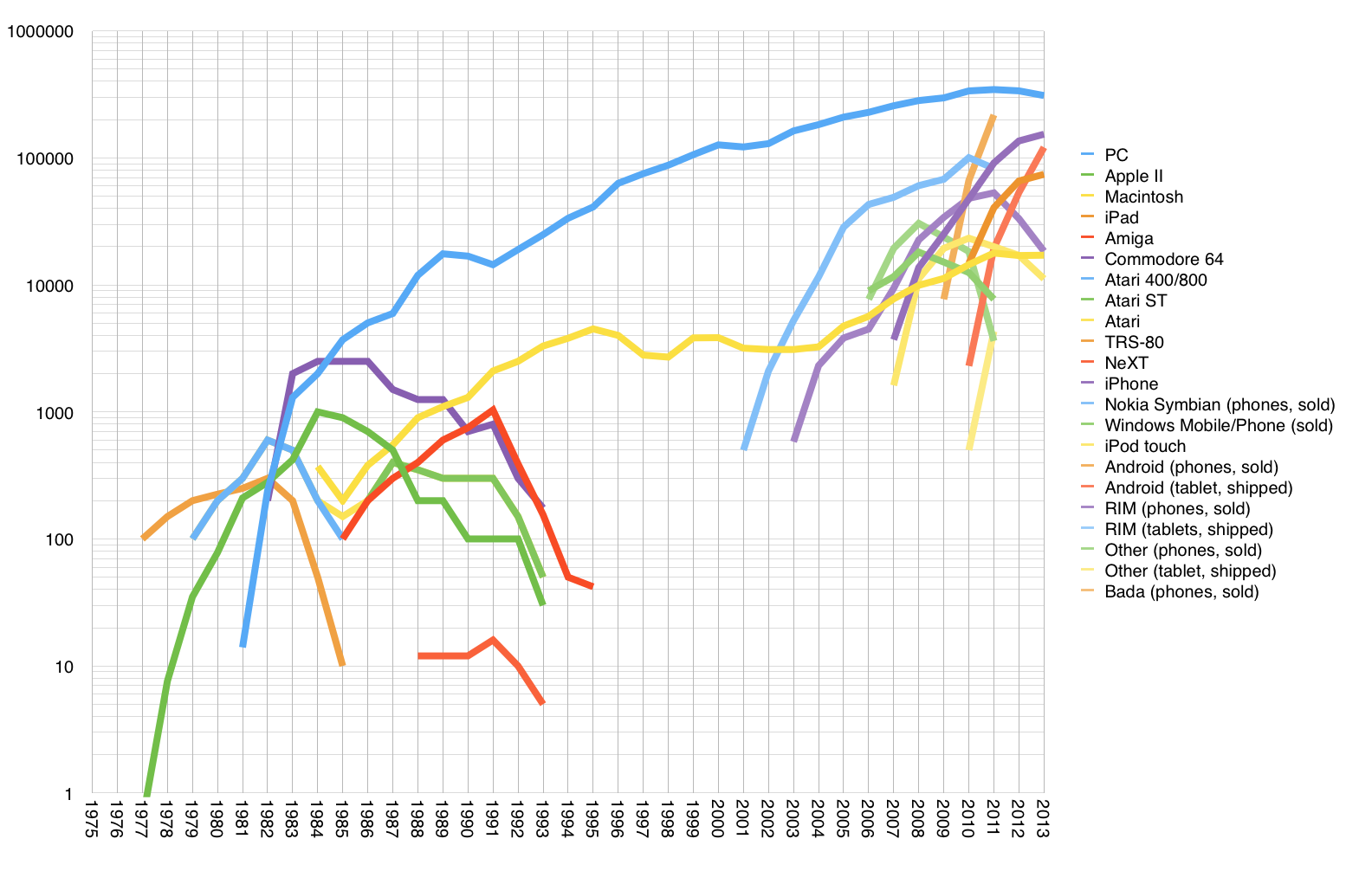
    Searching for "iPhone killer" returns millions of hits. It's hard to remember any phone/product/service/platform/initiative/merger/startup which was not at some point considered an iPhone killer. A sampling is offered here.

    In reality, the killers seem to have all faded away while the iPhone continues. We could just shake our heads and move on, but a deeper analysis is possible. Take a look at the graph above. Note that iPhone's (and hence Apple's) ascent has not caused decline in its nominal competitors. When seen in the context of the graph above, the success of the iPhone has in fact been complementary to those companies who would be its killers.

    Consider that the iPhone drives a large portion of Google's revenues as it is the home to many Google services and engagement through the iPhone is higher than any other platform, including Google's own. iPhone users tend to make better customers. In exchange Google pays a great deal for traffic acquisition on iOS devices. The placement of search on Safari is probably the biggest single cost item on Google's income statement ((Estimates are a few billion dollars a year.))

    The iPhone example drew Google to build Android as a facsimile and that, coupled with Brobdingnagian spending on marketing, led to Samsung's Galaxy success. That success seems to have peaked and the brand is now a victim of low-end disruptors which copied it and the iPhone in turn. However, Samsung electronics benefits from the iPhone in terms of its semiconductor division. Apple is Samsung's biggest customer and the semiconductor division is now the largest source of operating profits.

    The explosion of Android has led to IP licensing revenues for Microsoft and now Microsoft is extending its software applications to iOS, hoping to participate in the iOS ecosystem rather than competing with it. The time may come when Microsoft shows growth from the iPhone.

    Finally, although it may seem oblique, Amazon is benefiting from the iPhone. Instead of killing it with the Fire ((presumably as a low-end disruption)), the iPhone and iPad offered much more mobile shopping opportunities to the Amazon store. Data shows that iOS leads in shopping traffic and order size precisely at a time when Amazon obtains its largest volumes. Amazon's AWS also handles a great deal of iOS-originated traffic.

    This alternate reality shows that the benefits from the iPhone revolution are broad and deep. It's not just the direct revenues (($25 billion paid so far)) from app sales on the App Store but also the creation of entire new communications modalities (Instagram, Snapchat, WhatsApp) new services (Uber, Airbnb) and the multi-billion dollar accessories markets. These benefits are largely unmeasured and therefore not visible in accounting systems. They are perceivable however.

    Users perceive the value, developers perceive the value and, in the end, the only account that matters, the brand, accrues these perceptions to grow in value.

    As the brand flourishes, the perception of vulnerability dissipates and the narrative shifts from Apple getting killed to killing it.

    It's taken eight years and 500 million loyal users but, perhaps, just perhaps, this change in perception is entering the collective consciousness.


  3. The Analyst's Guide to Apple Category Entry

    Research · 46 comments

    Understanding Apple’s intentions seems to be a popular parlor game and there are many attempts at divining intention from data and market study. These attempts at market research for answers are futile because Apple does not compete in existing markets but rather it creates new markets. For instance, the market for the Apple II could not have been assessed from research into the computing market of 1974. The intention for Apple to enter into music devices and services could not have been predicted through an analysis of MP3 player market in 2000. The iPhone was also not predicated on the market for “Internet Communicators” in 2006 or 2002 when the iPad was first contemplated. ((The market for phones was large but the iPhone pricing and features made it incompatible with any reasonable segment of it.))

    Instead of measuring the size of pre-existing markets, surveying the functionality of existing products, or weighing toxically financialized ratios like margins and market shares, I recall this ad (Our Signature, first seen at 2013 WWDC):

    This is it
    This is what matters

    The experience of a product
    How it will make someone feel
    Will it make life better?
    Does it deserve to exist?

    We spend a lot of time on a few great things
    Until every idea we touch
    Enhances each life it touches

    You may rarely look at it
    But you will always feel it
    This is our signature
    And it means everything

    My interpretation of these lines, coupled with additional public statements can be used to create a “litmus test” for new product categories:

    1. The experience of a product. Read: They will work on things to which they can make a meaningful contribution. To me this means that they will build things which require an integrated approach. As Apple is "the last integrated company standing” it means they will work on problems where the system is not good enough. This means that they will not work on problems where an individual modular component is not good enough. By system I mean, in the largest sense: production, design, distribution, sales, support and services must work in a seamless way. Systems analysis implies a broad understanding of the causes of insufficient performance along the dimensions of “experience”. The experiences are what differentiate the products (and lead to high margins) and these experiences are possible only through the control of interdependent modules.

    2. Does it deserve to exist? Read: They will work on very few things. They will say no to many things. It’s still true that all of Apple’s products can fit on one table. That may not be true forever, but their product space will not grow as quickly as sales grow. This means that there is no notion of “marginal value” or portfolio theory where products are added because they can be justified as “moving the needle” or balancing demand. Rather, the few things which will be worked on will address non-consumption. Non-consumption of experiences.

    3. Enhance life. Read: The things they release are inevitable even though nobody asked for them. The reason this is possible is that there are unmet and unidentified “jobs to be done” which are powerful sources of demand and whose satisfaction leads to unforeseen rewards. The problems that can be addressed are uncovered through a process of conversation with a few people. They are not uncovered through surveys or large n statistical studies. Without the ability to ask the right questions, big data only leads to big misdirection. In contrast, good taste in questions allows small n to lead to big insight. Apple’s ability for finding the right problem to solve comes from this greatness of taste in questions.

    So given this litmus test, will Apple build a Car?

    I believe the problem of transportation and its proxy, the automobile, provide all the requisite demand for Apple's attention. Technical questions abound and they may still prove unsurmountable before a launch happens, but there are no doubts in my mind that this is a problem Apple would see fit to address.

    Non-consumption of unmet and unarticulated jobs to be done can and should be addressed with systems solutions and new experiences.

    The poetry is pretty clear on the matter.


  4. Bigger than Hollywood

    Research · 72 comments

    Apple paid $10 billion to developers in calendar 2014. Additional statistics for the App store are:

    • $500 million spent on iOS apps in first week of January 2015
    • Billings for apps increased 50% in 2014
    • Cumulative developer revenues were $25 billion (making 2014 revenues 40% of all app sales since store opened in 2008)
    • 627,000 jobs created in the US
    • 1.4 million iOS apps catalog is sold in 155 countries

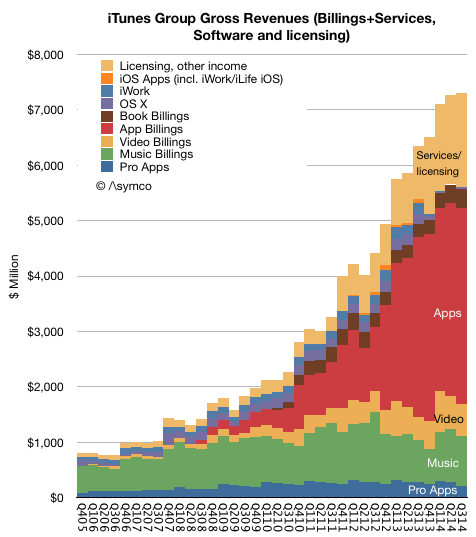
    Putting these data points together with others from previous releases results in a fairly clear picture of the iTunes/Software/Services ((soon to be renamed Services and encompass everything under the heading of iTunes software and services today including content, apps, licensing and other services and beginning Q4 2014 it will also include Apple Pay.))

    Screen Shot 2015-01-22 at 1-22-10.38.39 AM

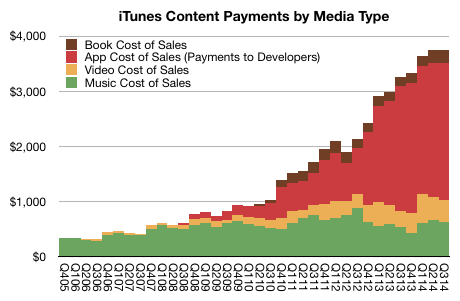
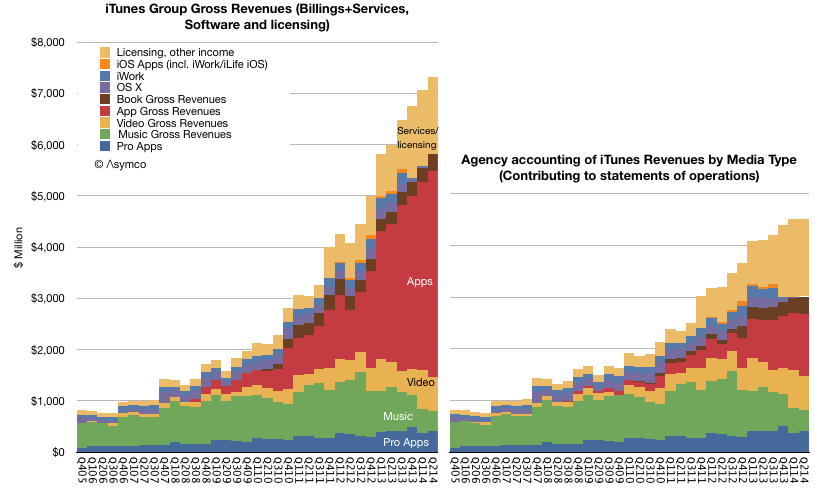
    The App ecosystem billings (what consumers actually pay) is shown in the red area above. 70% of those payments are transferred directly to developers and Apple reports the 30% remaining as part of its revenues. This view of the iTunes ecosystem shows the impact of Apps relative to the other media types. When we measure the payments to the content owners we can see that Apps also dominate: 

    Screen Shot 2015-01-22 at 1-22-10.44.16 AM

    The red area above adds up to the approximately $25 billion total paid to developers. This view of the payments to ecosystem contributors shows how apps are now a bigger digital content business than music (( Music payments due to iTunes Radio streams are not shown as part of Music cost of sales. Streaming revenues are included in the services/licensing income and payments come out that cost structure.)) and TV programs and Movie rentals and purchases put together.

    This is quite a story.

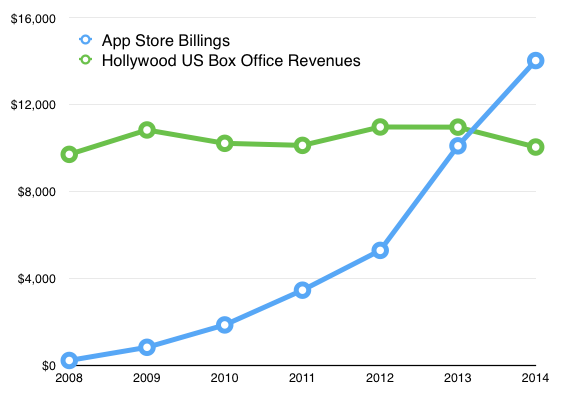
    Put another way, in 2014 iOS app developers earned more than Hollywood did from box office in the US.


    Although the totals for Domestic (US) Box Office are not the complete Hollywood revenues picture, Apple's App Store billings is not the complete App revenue picture either. The Apps economy includes Android and ads and service businesses and custom development.  Including all revenues, apps are still likely to be bigger than Hollywood.

    But there's more to the story. It's also likely that the App industry is healthier. On an individual level, some App developers earn more than Hollywood stars ((so do YouTube stars, but that's another story.)) and I would guess that the median income of app developers is higher than the median income of actors. ((A large majority of actors earn less than $1,000 a year from acting jobs)) The app economy sustains more jobs (627,000 iOS jobs in the US vs. 374,000 in Hollywood) and is easier to enter and has wider reach. As the graph below shows It's also growing far more rapidly.

    Screen Shot 2015-01-22 at 1-22-11.30.06 AM

    The curious thing is that even though the medium of apps is swamping other forms of entertainment in all measurable ways, comprehension of the phenomenon is lagging.

    Information asymmetry is a wonderful thing.

  5. The Monopolist

    Research · 36 comments

    When the Apple Watch will begin sales, there will have been dozens of "smart watches" released. At CES this week at least 56 "wearables" were on display. One could be forgiven for thinking that Apple's Watch will compete with at least that many alternatives. Those alternatives don't even include the entire existing mechanical and electronic watch market, which, surely, is also filled with competitors.

    When analyzing competition, it's easy to get caught up in one-on-one competitive comparisons, each posited as a decisive life-or-death battle. Consider the list of competitors that Apple has been declared as being in a death-match with:

    • Real Networks. Yes, there was a time when Apple's survival depended on success vs. alternative media encoding technologies.
    • Adobe. Remember Flash? No Flash support meant that Apple's fledgling phone would fail.
    • "The Music Industry". Unhappy partners could surely shut down the iTunes music store, and their insistence on DRM would surely cripple the experience.
    • IBM. In nearly every aspect, their business/strategy/inclination and glimmer of intent was an existential threat the Apple.
    • Microsoft. In nearly every aspect, their business/strategy/inclination and glimmer of intent was an existential threat the Apple.
    • Google. In nearly every aspect, their business/strategy/inclination and glimmer of intent is an existential threat the Apple.
    • Samsung. Obviously. But not just phones or tablets. They have control over key components that Apple used in many of its products, before the iPhone even.
    • Palm/BlackBerry/Nokia/HTC/Huawei/Xiaomi et.al. Every phone maker (and every phone) was/is an existential threat to Apple.
    • Dell/HP/Asus/Lenovo et. al. Every PC maker was a threat to Apple. Some of them made MP3 players. Some of them make tablets.
    • Amazon. Obviously. Not only as an iTunes killer but as a device disruptor. They are working on drones, after all.
    • Sony. Remember them? No longer a PC maker but they moved in many circles Apple moved in. While we're at it, add all the consumer electronics companies in Japan.
    • Dropbox. "If Apple can't do iCloud right, they're doomed".

    This is a very short list (feel free to suggest more) and it becomes clear that the total count of competitors that Apple has to counter "or else" seems to number in the thousands. Practically every hardware, software and service company is positioned as an "Apple Killer". in fact, the more interesting question might be which companies are not competing with Apple.

    Another interesting question relates to why there is no transitive property of competition. I.e. if company A competes with Apple and Apple competes with company B then it does not follow that company A competes with company B.

    To wit, whereas HTC competes with Apple and so does Dropbox, it does not follow that HTC competes with Dropbox. So it's entirely possible that it's axiomatic that

    "Most companies compete with Apple but few of them compete with each other".

    Recognizing a pattern, one could build a model of the technology world where Apple is the focus of all competitive efforts. But this starts to sound absurd.

    Indeed, the flaw in the logic is that these competitive pairings are based on the overlap of features of products/services being offered. The features become the attributes of a product which supposedly defines their competitive power. But this is false for the same reason that the attributes of a buyer do not determine their buying behavior. Buyer attributes ((E.g. demographic, sociographic))  are easy to measure and they may correlate to purchasing behavior but they don't cause it.

    Similarly, product or company attributes are easy to measure and they may correlate to competitive behavior but they don't cause the substitution of a purchase.

    Therefore, appealing to Apple to change its strategy, operations or even its core beliefs in response to a competitor's behavior is deeply misguided. The cause of success and failure in the marketplace is based on being hired by the customer to get a job done. Once hired, the chances are that the trust is secured and the relationship continues even if alternatives are available. There is comfort in the knowledge of whom you're working with.

    This aspect of trusted relationship between the buyer and the product and the interweaving of 'brand' (aka intentions) of the hired is the root of loyalty. Of course, loyalties can be betrayed and trust can be lost. But that implies that the primary responsibility of the manager is the creation and preservation of trust. When seen in this light, an alternative axiom becomes clear:

    "Great companies don't have any competition."

    Great companies are "monopolists of customer trust" and are unaffected by alternatives. They are positioned on and nailing the job their products and services are hired for. The alternatives must not only duplicate the exact job (which they almost never do), but they must also overcome the switching costs.

    Remember this when analyzing the impact of yet another competitor and considering the "Apple must fix/do X or else" assertions.


  6. Biggest news of 2014

    Research · 72 comments

    As corporate romances go, IBM and Apple's must rank among the most unexpected. As I wrote on the date they changed their Facebook status, the two companies were antagonists for the better part of twenty years and their rapprochement was met with a shrug mostly because yet more decades passed since.

    Screen Shot 2014-12-26 at 11.28.03 AM

    Nostalgia aside, this new union is profoundly important. It indicates and evidences change on a vast scale. The companies' antagonism was due to being once aimed at the same business: computing. Since the early 1980s, "computing" came to be modularized into hundreds, perhaps thousands of business models. It is no longer as simple as selling beige boxes. IBM was forced out of building computers and into services and consulting while Apple moved to make devices and the software and services which make its hardware valuable.

    The convergence of interests which was consummated into a deal this year stems from the migration of computing around what has come to be called "mobile". Apple intends to accelerate the adoption of its mobile platforms among the remaining non-adopters: enterprises–a group which, by now, qualifies as laggards. ((There was a time–when Apple was young–when enterprises were the innovators, early adopters. That role ended approximately in the year 2000)) Simultaneously IBM intends to connect data warehouses at those same enterprises to their employed users.

    Both can achieve their goals better if they join forces: Apple offers assistance and expertise while obtaining access and lubrication for orifice entry. IBM offers modularized access to databases through its own APIs and obtains credible client experiences. The combination increases adoption of mobile (i.e. intuitive) solutions and an increase in productivity, benefiting the buyer.

    The recent apps release showed just how transformative this relationship could be. We were witnesses to apps which appeared to be designed for users[!] They were not designed for committees that prepare checklists of requirements.

    We must applaud IBM for having the courage to resist the featuritis which plagues enterprise software design. This resistance requires saying No to those who specify and are thus authorized to purchase software and hardware. IBM has had to essentially say no to those who buy and yes to those who are paid to use. The quality of the experience is evident at first sight. The number of user actions, the number of screens to wade through have been ruthlessly culled. These are concepts and ideas which now permeate app design best practices. Yet they are practices which still elude the spec-driven enterprise software wastelands.

    Simultaneously we must applaud Apple for accepting that there are throngs of unwashed masses laboring in cubicles which deserve to be served. They may be employed by laggards but they are people too. Apple management has made clear that they are being more inclusive and open minded. Extending that open hand to the downtrodden salaried masses must surely bring a tear to one's eye.

    Being unexpected and yet explanatory of the state of technology today, the partnership between IBM and Apple is, in my opinion, the most significant technology news of 2014.

    As a romance, it is at least as newsworthy as the divorce of Wintel was in 2012.

  7. How big is iCloud?

    Research · 24 comments

    Apple has declared that what used to be "Other Music Related Products and Services" ((Includes revenue from sales from the iTunes Store, App Store and iBookstore in addition to sales of iPod services and Apple-branded and third-party iPod accessories.)) plus "Software, Service and Other Sales" ((Includes revenue from sales of Apple-branded and third-party Mac software, and services.)) which was formerly known as "iTunes/Software/Services" ((Includes revenue from sales on the iTunes Store, the App Store, the Mac App Store, and the iBooks Store, and revenue from sales of AppleCare, licensing and other services)) is about to become "Services".

    "We'll also have a category that we refer to as services and this will encompass everything we report under the heading of iTunes software and services today including content, apps, licensing and other services and beginning this month it will also include Apple Pay."

    "Services" will therefore encompass a massive amount of revenue. The reported revenues for the fiscal 2014 were $18 billion. Including all billings, the turnover in sales is over $28 billion. For next year, assuming that Apple Pay, which is just getting started, is unlikely to contribute greatly to revenues, Services turnover will top over $35 billion. That figure would make Apple Services alone one of the top 90 companies in the Fortune 500.

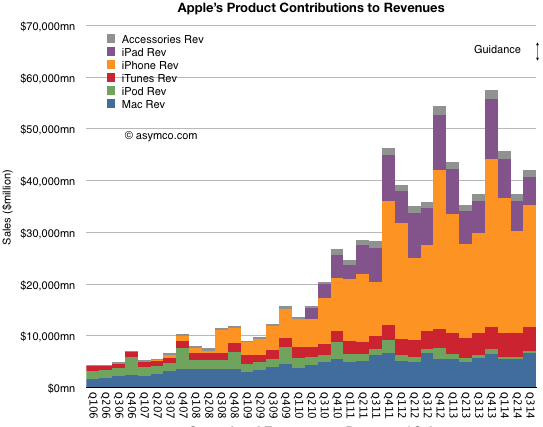
    Screen Shot 2014-11-14 at 5.11.47 PM

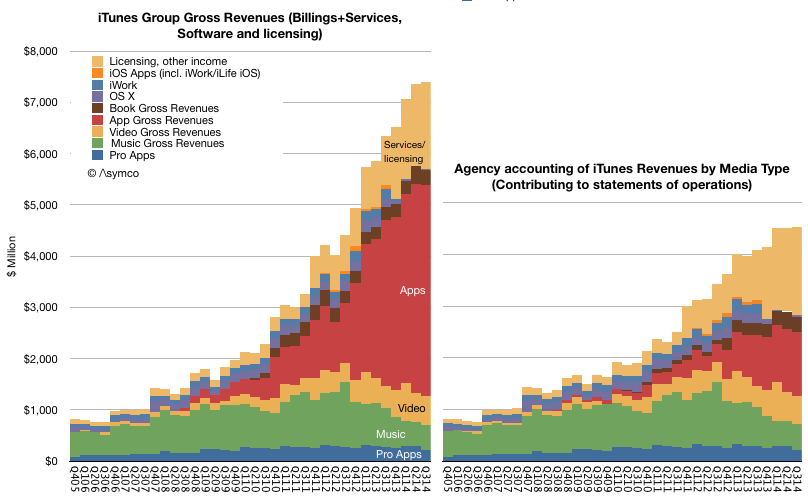
    Regardless, as a component of overall sales, the group formerly known as iTunes/Software/Services (shown in red above) was a modest 7% of total sales in the last quarter. Using all available information regarding downloads, payouts and reported financials, an estimate can be obtained on how this 7% is itself divisible into nine sub-segments:

    Screen Shot 2014-11-14 at 5.15.08 PM
    • Pro Apps
    • Music
    • Video
    • Apps
    • Books
    • OS X
    • iWork
    • iOS Apps
    • Licensing and other income

    These are shown above as either contributing to statement of operations (i.e. as reported, on right) or using billings (or the actual "cash register takings", on left). ((The primary distinction is in Apps billings where the 70% paid to developers is not shown as revenue.))

    What would be ideal in understanding this Services segment would be to break the "Licensing and other income" into its component parts. Namely:

    • Licensing revenues including Google's payments for traffic acquisition (TAC)
    • AppleCare
    • iTunes Match
    • iTunes Radio
    • iAd
    • iCloud
    • (and soon, Apple Pay)

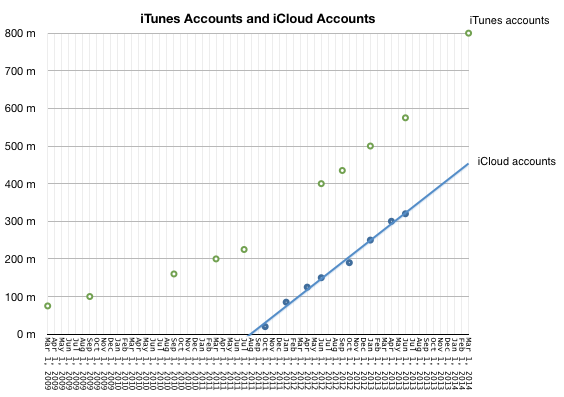
    In particular, it would be very interesting to know exactly how much revenue could be coming from iCloud. We have not heard from Apple on iCloud user numbers since mid-2013 and this was the data at the time:

    Screen Shot 2014-11-14 at 5.30.27 PM

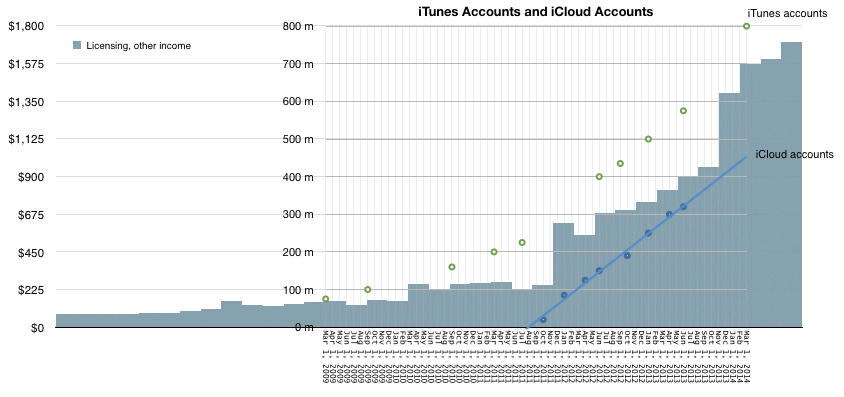
    Couple that to "Licensing and Other Income" as deduced from Services accounting yields the following picture:

    Screen Shot 2014-11-14 at 5.38.30 PM

    It would appear that iCloud accounts are growing in proportion to "Licensing and Other Income". Note that at the point that iCloud accounts were zero, revenues from Licensing were about $225 million/quarter and growing slowly. The real growth kicked in when iCloud accounts started ramping up. Since revenues from iCloud has to be in the "other income" and since no then it is, I believe, reasonable to assume that the iCloud user base growth is a principal driver of growth ((Of course, AppleCare could also be a driver but AppleCare should follow overall device sales patterns and this is not clearly evident in the Licensing/Other curve))

    Also, bursts in the Licensing and other income line occurred after several iCloud-specific marketing events:

    Mobile Me migration started in October 2011 and on September 30, 2013 the complimentary iCloud storage plans expired and were automatically adjusted to the free 5 GB plan (with an offer to upgrade to a paid plan). Correspondingly, Q1 2012 and Q1 2014 showed the largest increases in Licensing and Other Income.

    This is a multiplication of many assumptions, but there is some intuitive logic. The only place iCloud can be found seems to be growing in proportion to iCloud users and plan marketing.

    So how much does iCloud contribute to Apple's sales? My guess would be about $1 billion per quarter. That would be spread over 500 million iCloud accounts and therefore an average revenue per account of $2/user/quarter or $8/user/yr.

    The lowest non-free iCloud pricing is about $12/yr (5GB plan is free). This would imply that two thirds of iCloud users are paying users (and one third are opting for the 5G plan).

    I realize that this attach rate to a paid service is astronomical. Anything over 10% is unheard of. I would say the error in my estimates could be 20% but that still leaves a huge gap to what seems reasonable.

    [Put another way, if the attach rate were only 10% then iCloud revenues would have to be in the $600 million range and thus only about 10% of what Licensing and Other income seems to be. This would force the question of what could be generating the remaining $5.6 billion/yr.]

  8. On the trajectory of successful companies

    Research · 159 comments

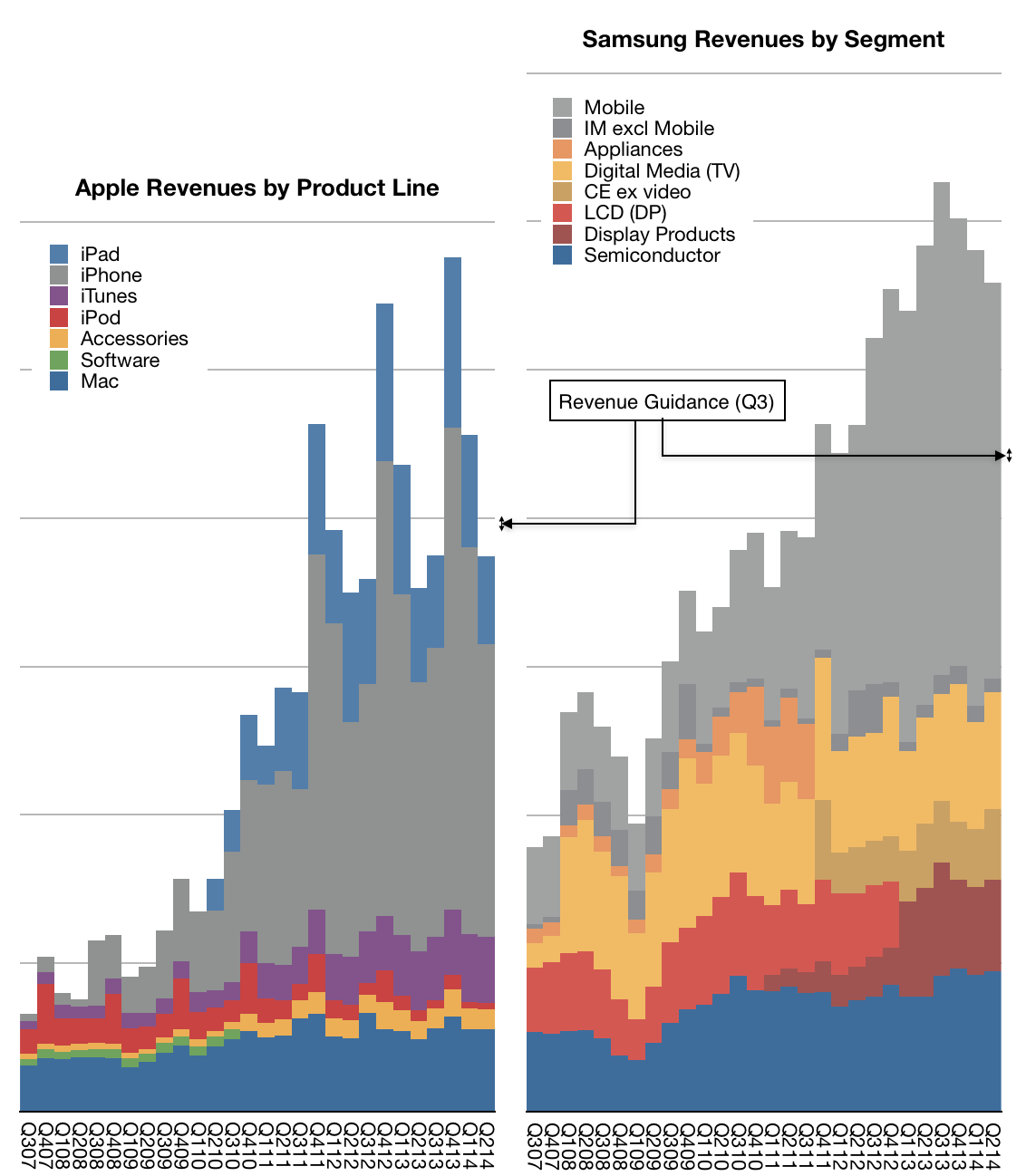
    Samsung Electronics warned Tuesday that its third-quarter earnings would fall below market expectations. It did not cite a decrease in shipments but an increase in marketing expenses coupled with an unfavorable mix (i.e. more low-end units and fewer high-end units).

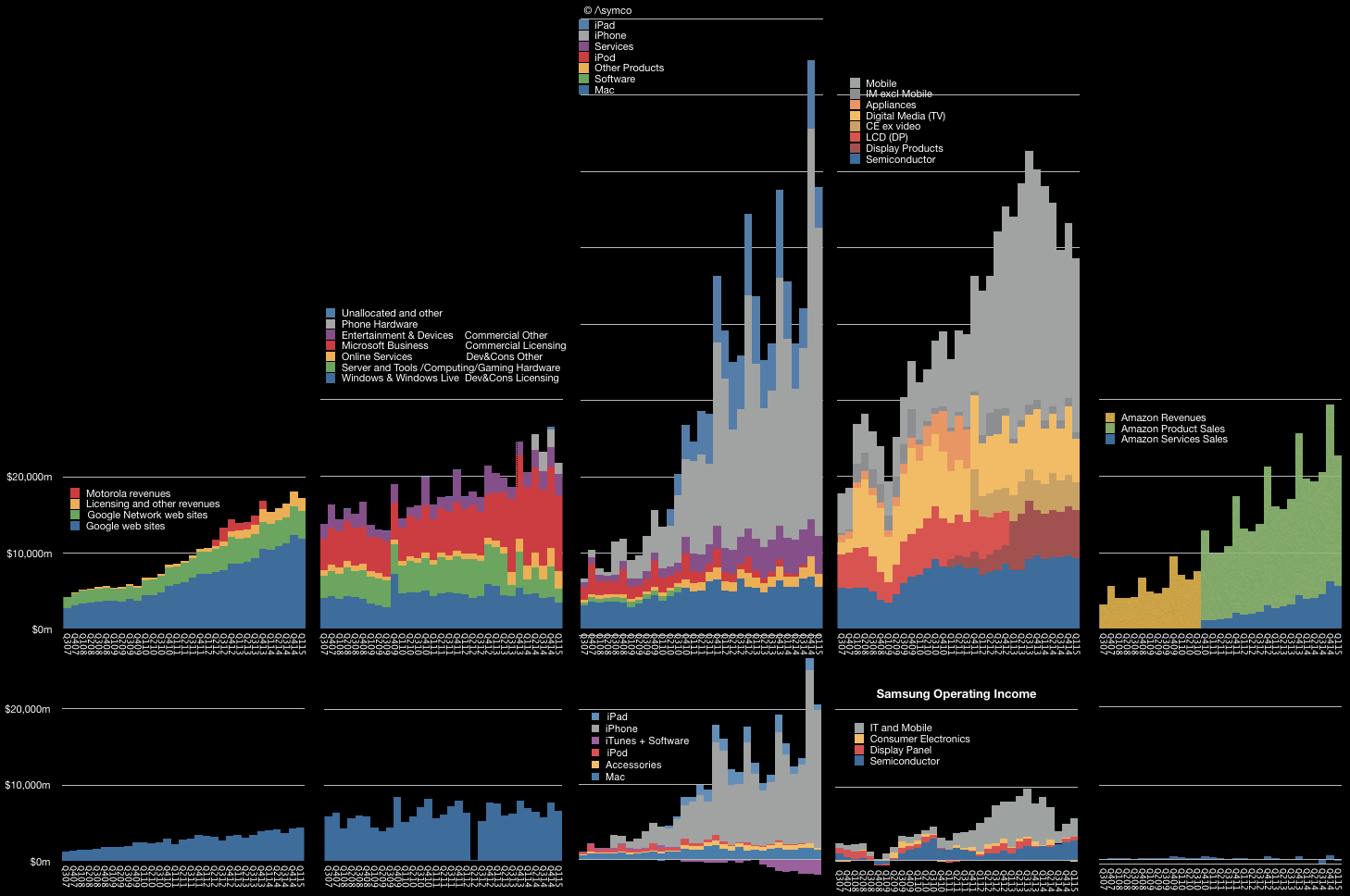
    The headlines reporting the news emphasized the 60% forecast drop in operating income but the company also provided sales figures. Adjusting for exchange rates, the forecast revenues are shown in the following diagram:


    Screen Shot 2014-10-07 at 8.51.05 AM

    Note that I also included Apple's revenue history and forecast. Samsung's revenues are shown on the right and Apple's on the left using the same scale (each horizontal gridline represents $10 billion/quarter.

    The explicit cause for the drop is a decline in prices and "increased competition". ((Though one can't be sure when there was ever decreased competition in its markets.)) However a few more questions need to be answered regarding long-term success in the markets Samsung competes in.

    Namely:

    • The absence of a software platform fully within its control
    • The absence of control over an ecosystem of content and apps
    • The absence of services
    • The lack of integration of software, services and hardware
    • The absence of differentiation vis-a-vis other vendors
    • The indefensibility of its low end offerings from low end disruptors
    • The pattern of commoditization in all its markets

    Samsung is a very big company but many very big companies came to become small companies. They all followed similar roads.

  9. Open always wins

    Research · 54 comments

    ABI Research estimates that AOSP (or forked Android) is the fastest growing mobile operating system with a total share of units shipped of about 20%. This is not surprising considering that most Chinese vendors don't include standard Android into their products. Indeed the current leader in China, Xiaomi has its own take on Android and includes a unique UI and set of services. This is also not a new pattern, Amazon's fork of Android has been in development for many years and powers the second most used tablet in the US.

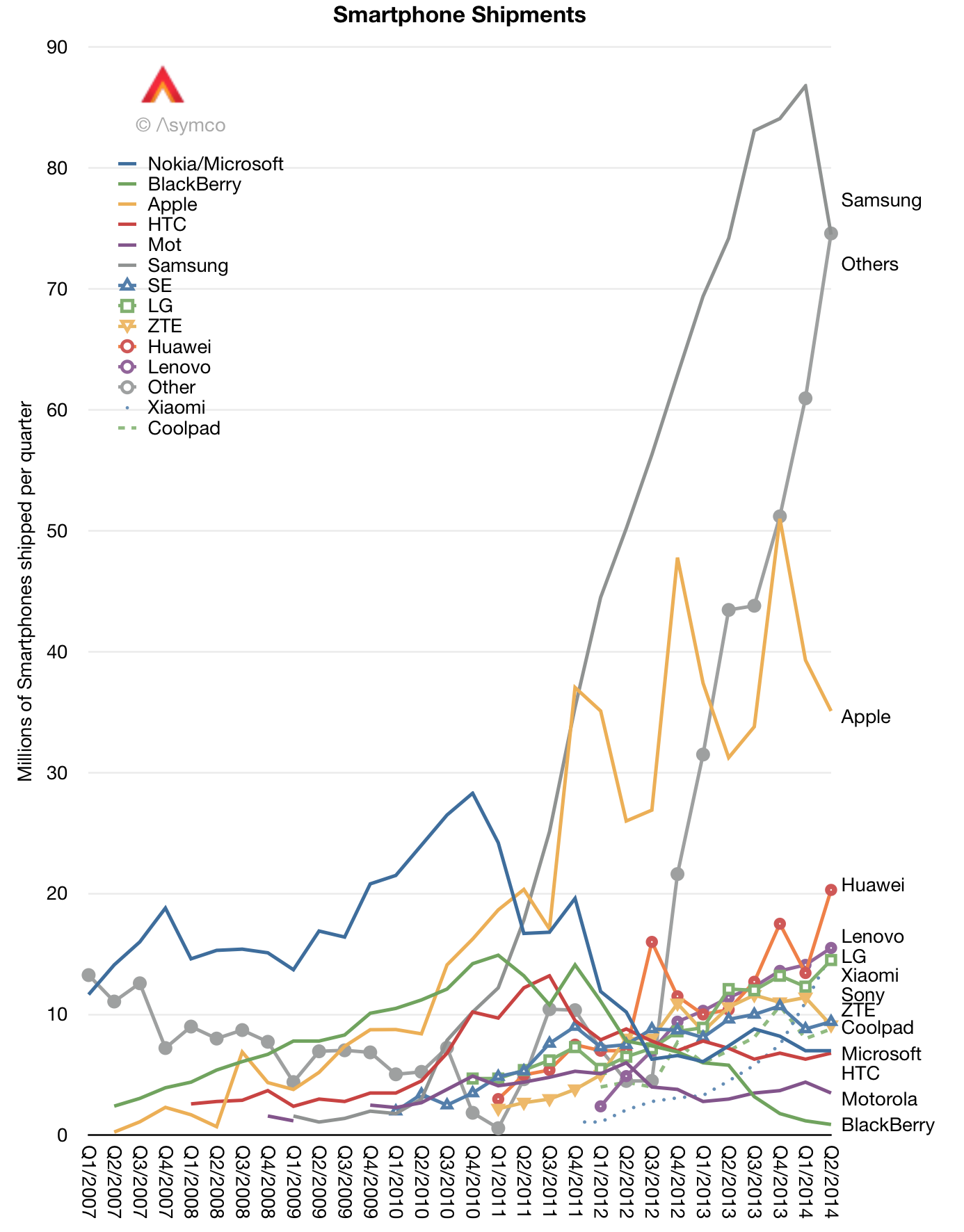
    If one looks at the volumes of smartphones shipped by vendor, the most rapidly growing (Huawei, Lenovo, Xiaomi, ZTE, Coolpad and "others") are likely to be using forked versions of Android.

    Screen Shot 2014-08-07 at 7.06.09 PM

    The reasons for this are many: a reluctance to deal with Google's obligations,  Microsoft's IP licensing costs ((which even Samsung seems to be eschewing)) , potential litigation, politics (including bans on Google services in certain markets), etc. But the most likely reason is flexibility. Vendors competing on price and localization are looking to move quickly against each other and can't wait for blessings from above. Belonging to some "Alliance" and all that it entails is just too much to ask for companies that are, so to say, delicate.

    The result is that the "more open" version of Android is beginning to threaten the "less open" version of Android. China is already lost to OHA but India where penetration is still very low is up for grabs. Into this fray Google launched "One" a more low-end friendly version of sanctioned Android, hoping to retain opportunity.

    The value of a singular Android version is not just being Google-friendly but also being better managed and more BOM-friendly. Google is trying to solve the control issue with ease of use, but still retaining control There will be alternatives however which are both easy and "open" ((or Free as in speech)). It seems that there is an opportunity for a hardware-independent vendor to take AOSP and provide a complete solution to local phone brands so they don't need to expend efforts on integration. A non-Google One, so to speak.

    Why it's likely is that openness in software makes sense when parts of the stack become commoditized. Google took advantage of the commoditization of operating systems (i.e. Linux) to deliver non-open services on top. However, it's inevitable that some of those very services will also be commoditized and therefore that the portions of the stack which sustain Google will be forked as well.

  10. How big is Apple's Ecosystem?

    Research · 38 comments

    iTunes/Software/Services revenues grew at 12%. This was the second fastest segment growth last quarter, with the Mac growing at a slightly faster 13% rate. Apple mentioned in the quarterly earnings conference call the for the first nine months of its fiscal year (i.e. since September) the line item iTunes/Software/Services has been the fastest growing part of the business. The following graph shows the growth scorecard for Apple's line items and it shows how the iTunes store is the only line that has been consistently green (growing above 10% for at least seven years.

    Screen Shot 2014-07-29 at 8.58.53 PM

    In addition to its revenues, iTunes can also be measured in terms of billings (or gross revenues). The billings growth rate is even higher at more than 25%. This is mostly to the more rapid growth of apps relative to a decline in music. As Apple only records the 30% it keeps as "revenue" for apps the overall growth in apps is less visible in its accounts.

    The relative performance of billings vs. reported revenues is shown in the following graphs:

    Screen Shot 2014-07-29 at 9.02.13 PM

    Note the estimated split between media types and software and services. The software and services portion of the business had sales of $1.9 billion while the revenues from third party content/apps sales reached $2.6 billion.

    The value of this data is that it encompasses an almost complete view of the Apple ecosystem. As almost all content and transactions are tracked and reported and one can get a very precise view of the economic value of the ecosystem. ((In addition to iTunes/Software/Services Accessories could also be considered as part of the ecosystem. The value of Accessories and licensing as Apple reports it adds another $6 billion to iTunes/S/S)) (( What is missing are ad revenues through apps which don't use iAd )) (( What is also worth asking is what is the size of alternate ecosystems such as those of Microsoft, Google etc. ))

    From the launch of the iPhone the value of Apple's ecosystem has grown more than 600% which is faster than overall sales growth (approximately 400%). If ecosystem value grows more rapidly than underlying hardware sales the question that emerges is when would the ecosystem transaction value exceed that of the business is supposedly supports.

    Today the iTunes/S/S ecosystem is about $20 billion/yr. iPod, iPhone, iPad and Mac sales are about $150 billion/yr. It does not seem likely that the former will overtake the latter. If that were the case then one wonders why build a business entirely predicated on retailing and services without the support of hardware revenues. Something along the lines of Amazon.

  11. IBM and Apple: Catharsis

    Research · 62 comments

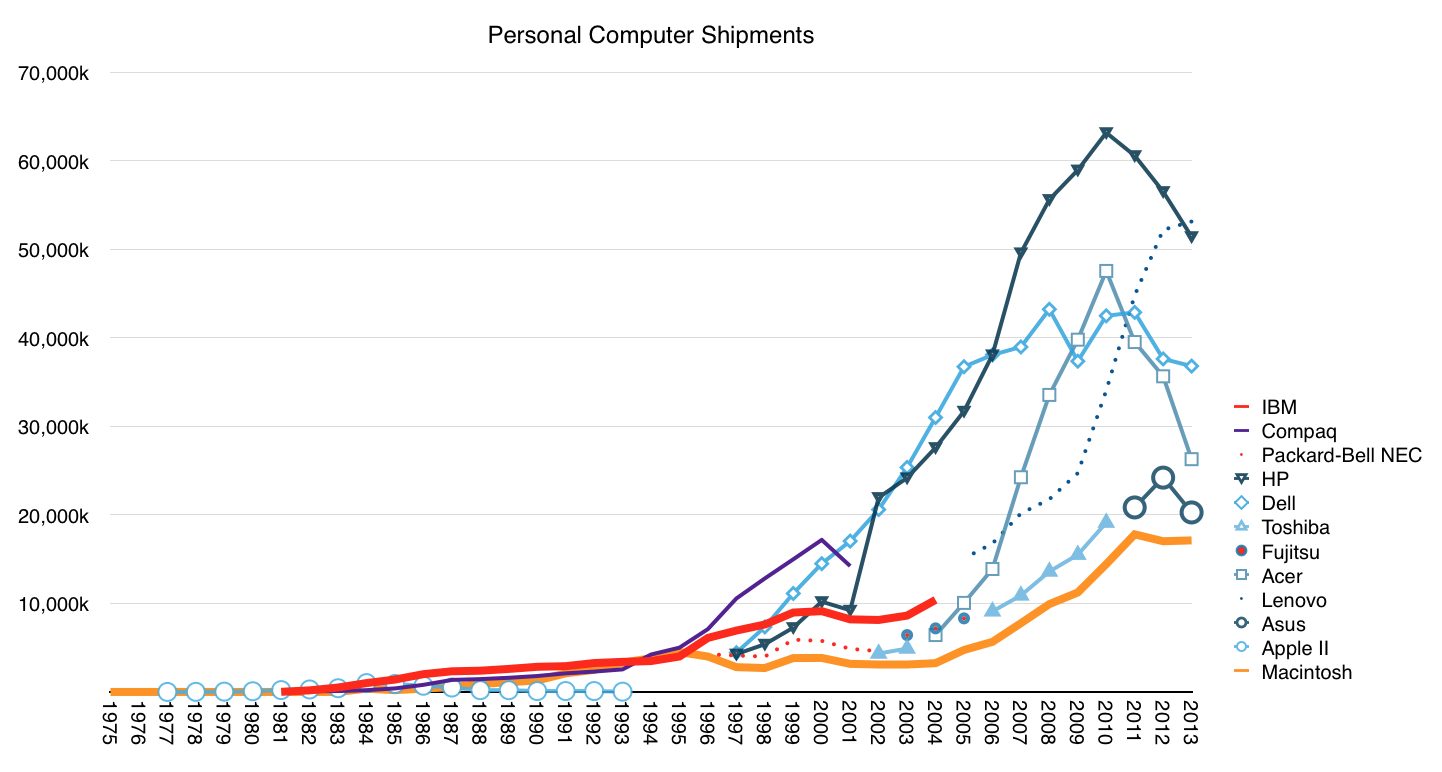
    IBM did not invent personal computing but their "PC" became synonymous with the category. Having entered the market in 1981, the IBM PC quickly became the top selling brand. From 1984 to 1993 IBM sold more PCs than any other vendor, conceding the spot to Compaq which remained on top only until 2000. No PC vendor remained at the top of the sales leagues longer than IBM. HP had the second longest run but that run was broken last year as Lenovo (who acquired IBM's PC business) surged.

    Screen Shot 2014-07-16 at 4.19.11 AM

    As the graph above shows, the period of time when IBM was dominant was characterized by far lower volumes. In 2004, the year IBM exited, they sold about 10 million units. ((as the graph shows, if we consider Lenovo as taking over from there, they did a very good job extending the legacy.)) It was a decent performance but one that did not keep up with the Dell and HP/Compaq race to the bottom in pricing and subsequent rise in volumes.

    However, throughout its position of strength, IBM was a reluctant PC maker. IBM never controlled the PC platform the way they had controlled their mainframe and mini-computer businesses. Their falling out with Microsoft over OS/2 and their attempts at differentiating with the PS/2 architecture show how uncomfortable the situation was. Their exit in 2004 must have come as a relief and, in retrospect, they should be congratulated for having exited the market well before it began deteriorating. First came pricing and margin collapse and later total volumes began to decline. Most of the remaining vendors are today in various states of distress. Lenovo is growing but incumbents like Dell, HP and entrants have come and gone (Fujitsu, Sony, NEC, Toshiba). Potential disruptors  like Asus and Acer have found no long-term success with PCs.

    This is because without control over the platform, PC hardware is nothing more than a commodity, with negligible margins, intense competition and an inability to control one's destiny.

    One company making computers did manage to control its destiny. By continuous refinement, the Macintosh survived and even thrived as the market pivoted toward mobility (and hence requiring integration that values design).  Indeed, Apple now ships over 17 million Macs a year. More than either IBM or Compaq did at their peaks. It's not in the top five globally but has a very profitable niche. ((It's very likely that it captures more operating profit than the top five vendors combined.))

    As a matter of fact, through 2013 Apple shipped a total of 156.5 million Macs,  50% more than all IBM PCs ever shipped. Apple also shipped more than twice as many iPads and five times more iPhones. And it's not just popular with consumers. With iOS Apple manages to reach 98% of Fortune 500 companies and 92% of Global 500.

    At the same time, even though IBM exited the hardware business, it remained a powerful force in computing. IBM pivoted to primarily being a service company with a vast client base and increasing global reach. It essentially moved up the value chain to become an integrated services provider to business customers. IBM's reach in breadth and depth of services is extraordinary.

    This dramatic turnaround–Apple moving to a device leadership position and IBM moving to a service leadership position–created the conditions for today's announcement of a strategic partnership--an event which is astounding to those who witnessed the 1980s and 1990s. Were it not for the tenacious independence of Apple and the business model agility of IBM, neither company would be around today to leverage one another.

    There is drama in this industry and this latest chapter has a plot twist which any poet would envy.