Asymco

Asymmetric Intelligence

smartphone

  1. The Verizon small bang

    Research · 50 comments

    As Verizon has reported iPhone sales for one and a half quarters, it's time to try to discern the impact on the product. There were several hypotheses floating around prior to the "big bang" of Verizon.

    Some assumed that there would be a large migration away from AT&T and that AT&T iPhone sales would slump. Others that there would be no Verizon iPhones volumes at all because there were so many Android users already converted. There were also suggestions that the iPhone would explode in growth with two major operators carrying it.

    What really happened?

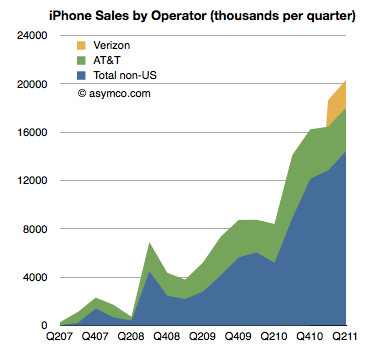
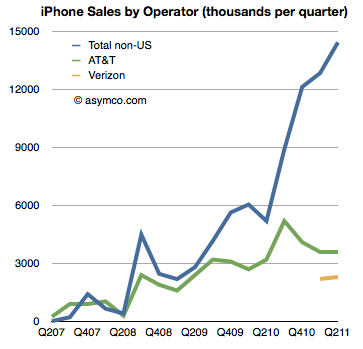
    The first chart shows historic AT&T activation with Verizon activations added. It also shows sales to "none of the above", namely non-US sales of iPhones[1].

    AT&T iPhone activations show no significant impact from Verizon and Verizon itself shows a modest start to sales[2]. What did not happen is an exodus from AT&T. We also did not see a rejection of the iPhone by Verizon customers long exposed to anti-iPhone Droid advertising. We also did not see a considerable impact of Verizon on growth.

    Verizon did contribute (4.5 million Verizon iPhone users is nothing to sneeze at)  but the contribution was to a degree that was nowhere near a big bang.

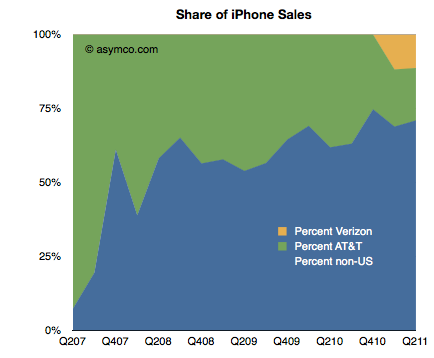
    That was because the real big bang was from the rest of the world. The same data in the first chart is shown below as a stacked area chart and a share chart. Had Verizon not come on board the business would still have grown year-on-year over 100% (and sequentially).

    The US activations have been decreasing as a percent of total iPhones sold. Before Verizon came online, the US share was decreasing (from an average of 45% share in 2008 to 33% in 2010). After Verizon, the US continues to slide to an average of 30% share (two quarters).

     After waiting nearly four years, American observers of the iPhone could perhaps be excused for their obsession on the impact of expirated AT&T exclusivity. But the real impact is that by the time it came, it was moot.

    It would be a mistake to look upon Q1 and Q2 and say that the explosive growth was due to Verizon or the end of US exclusivity.

    The global market is far greater than the US and the iPhone business has simply grown to reflect that.


    ---

    Notes

    1. Non-US sales are total iPhones sold minus activations in the US. There is the possibility that some of the unactivated phones were activated on T-Mobile or that there is some delay between purchase, channel inventory and activation, but the time frame shown should smooth out any of the noise.
    2. What we don't know is what was the impact of iPhone sales start on Verizon's other smartphone platforms. Unfortunately, Verizon does not report overall smartphone sales/activations so we can't conclude directly that iPhone has slowed other platforms on Verizon. Some other data (NPD, Changewave, ComScore) do indicate some slowing in Android growth in the US but we have no definitive data to prove it.
  2. Measuring Mobile Platform Churn in the US Market

    Research · 48 comments

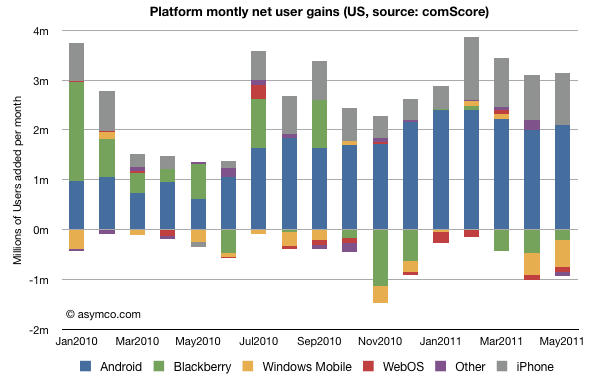
    The following chart shows the net gains in users for the major mobile platforms in the US. The data is derived from comScore's MobiLens report.

    The raw numbers for the last period (ending May) are:

    1. Android gained 2.1 million users
    2. iPhone gained 1.0 million users
    3. WebOS/PalmOS lost 96k users
    4. Blackberry lost 202k users
    5. "Other" lost about 95k users

    The "churn" or percent of smartphone users who switched platforms is 1.22%/month  of the overall users (assuming users to left one platform moved to another rather than to non-smart devices.)

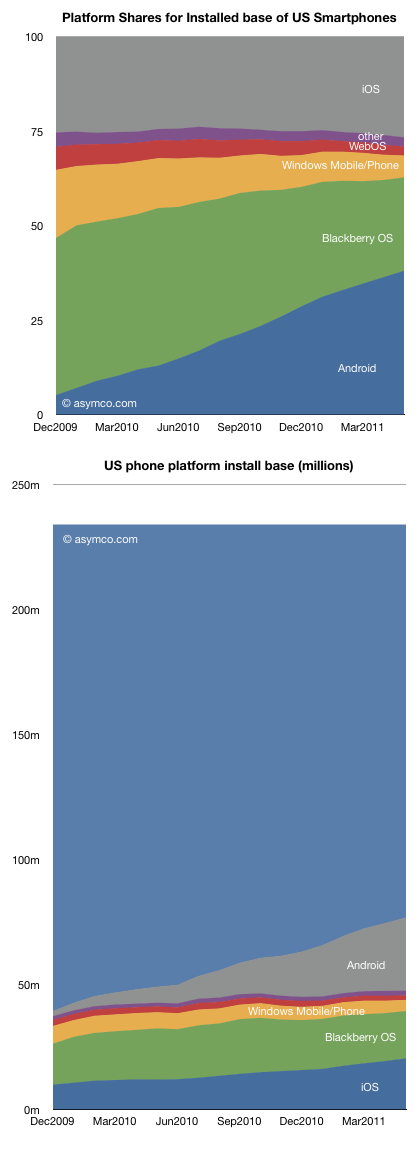
    The share of the platforms and the overall composition of users is shown in the following two charts:

    As usual, caution should be exercised when looking at share (top chart) outside the context of overall growth. The second chart may be more illustrative of what is happening. The light blue area on top is the smartphone non-consuming population.

    Android has been a tremendous accelerant of smartphone adoption while iOS has grown as well but share has not grown significantly. iPhone growth has kept up with market growth. This cannot be said for the other platforms which have been "squeezed" between these two entrants.

    So although the main competition is with non-consuming users and smartphones are winning in general, the loss of users by some of the incumbents is unsettling.

    Microsoft lost just over 2 million users in the US last year while RIM lost a net of 1.5 million. Palm lost about half a million. Contrast this with 8.5 million iPhone additions and 23 million new Android users.

    In particular, Windows Mobile/Phone is down to 5.8 million users (down from 18m in December 2009). With a loss of half a million per month, and share down to 4.5%, a lot is riding on the new platform.

    I've argued that the post-PC era will be a multi-platform era. Although it may seem that the situation in the US is rapidly moving toward a duopoly, it may not end up that way. Note how much non-consumption still exists.

    Note the time frame of the charts is only 18 months. The rapidity with which platforms gain ground could allow for continuing platform churn.

  3. Switching rates for US smartphone users suggest 50% penetration by August 2012

    Research · 21 comments

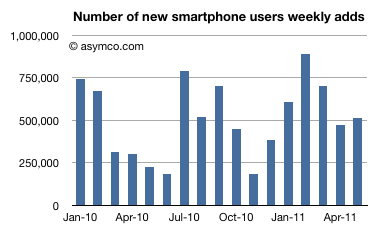
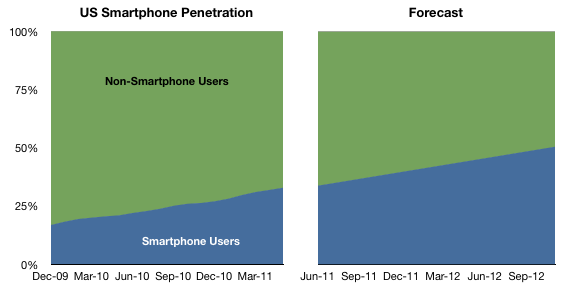
    The latest comScore MobiLens is out and it allows an update to the picture of the US phone using population. Through the three month period ending May 2011, smartphones were in use by 76.8 million or about one in three US phone users. Here are some other highlights:

    • A total of 513k users switched into using a smartphone every week during the period, a rate of switching consistent with the last 17 periods (average of 510k/wk).
    • Penetration of smartphones increased by 940 basis points, slightly higher than the 900 bp increase in the last period but consistent with average.
    • Using a four-period trailing average and linear extrapolation, 50% penetration will be reached by August 2012. "Summer 2012" seems a safe bet as that target has not changed much.

    I've updated the countdown counter (Phone Tipping point at top of right column on this page) to reflect the new date.

    The following charts show the penetration and switching rates.


  4. The Android (in)adequacy: How to tell if a platform is good enough

    Research · 97 comments

    About 10 years ago I met an advertising executive in New York who explained the difficulty of advertising a new brand of deodorant to consumers. “Most people never change their deodorant,” I remember him saying. “They pick one brand when they are young, and stick with it for a long, long time. If it works, why switch?”

    The same theory can be applied to customers who are making the switch to smartphones today. Once they have picked a type of phone, whether it’s Apple iOS, Google Android or something else, it’s difficult, and often expensive, to switch. Consumers become comfortable with the interface and design of the phone and the apps they have purchased on that platform. If it works, why switch?

    Many Smartphone Customers Are Still Up for Grabs - NYTimes.com

    This quote says a lot. The notion that customers remain captive to a platform is well understood. After all, it seems impossible to get people to switch out of Windows (or Mac or iPod). Platform vendors are aware of this as the land grab for users seems to be running at full pitch.

    However, there is a critical condition described in the quote above: "If it works, why switch?"  The condition which keeps users loyal is that the product they chose is good enough--i.e. "it works." That's a symptom of over-service and commoditization. If a product, like deodorant, is good enough you won't be tempted to move to another brand even if it's marginally better since the new brand has switching costs in the form of uncertainties ("Will it be as good? What if I don't like the smell? etc.) People are inherently conservative and you can't compete with comfort and familiarity by launching a marginally better product.

    So with that in mind, why is it that millions are switching mobile platforms?In this blog I've cataloged the massive shifts occurring away from mobile platforms that have been around for years with deeply entrenched user bases. Microsoft's Windows Mobile, Nokia's Symbian, Palm's PalmOS and RIM's Blackberry have collectively lost tens of millions of users. A net of half a million Blackberries are being abandoned in the US every month.

    So we would need to say that the condition of "it works" or being good enough was not met with those platforms. The attraction of something better is clearly greater than the switching cost.

    So this highlights a good test for how to tell if smartphones are good enough: If users are fiercely loyal with a given platform then it's probably good enough but if they are willing to switch (i.e. disloyal) then it's probably not good enough. It seems like a trivial observation but it's a very important clue to the bigger question of whether we can "call the end" of the market. Just like it would have been premature to call the end in 2006 when Symbian and RIM seemed unbeatable, it will seem premature to call the end now in the event that a significant innovation is yet to appear.

    The correct calling of the end has profound investment implications. Do you (like Microsoft) invest billions in a new platform if you know that there is no more room for entrants? Should Samsung bother with Bada or HP with WebOS if the game is already over? Even more, should Apple even bother to improve iOS if they have no shot at switching a billion likely Android adopters. Why not just nurture the current installed base and work on building walls and moats around them?

    So with this hypothesis in mind, it makes sense to analyze whether Android or iOS, the current presumed champions, are "good enough" on the basis of how often users switch out of them. My bet is that neither is good enough and that there will be increasing churn between platforms. I imagine that Android is less sticky (and hence less than good enough) based on app consumption but there is little evidence of churn because most phones in use have been bought less than one device generation ago. More importantly, there have been few opportunities yet for switching as many Android buyers don't even have the choice of other platforms either due to where they live or how much income they have available.

    To really tell where we stand, we would need to collect stats on switchers to know just how satisfactory the platforms may be. Remember that a choice of a new deodorant on the same shelf at nearly the same price is the test for loyalty. For an adequacy test we need to see better distribution and more choices for consumers. It's still very early even in the US for any conclusions to be drawn about the adequacy of Android.

  5. Nokia a trop écouté les réseaux télécoms

    Research · 70 comments

    My thanks to Robert van Apeldoorn, journalist for Trends Tendances Magazine, for asking good questions. My responses are reproduced below. The article (in French) is titled "Nokia a trop écouté les réseaux télécoms" and can be found in the June 23rd edition of the magazine along with more details in the article "Comment Nokia peut-il renaître?".

    -About your post “Does the phone market forgive failure”, that puts forward the idea that all mobile device vendors experiencing losses never really recover… It seems that this possible “rule” is more severe than in the computer industry. If Digital Equipement, Compaq, WordPerfect did fail, IBM and, yes, Apple, did survive failure and rebound strongly. Do you think that there is a difference between the industries? What makes the failures more lethal in the mobile device market ?

    The observation is unique to the mobile phone market and even there it's only an observation not a rule. It could be that Nokia will be the first mobile phone company that will recover from severe crisis, but history shows it to be very unlikely. I try to shed some light on the reasons why it's unlikely and what makes the mobile phone market so unforgiving. I think much of the problem rests with the fact that mobile phones are sold indirectly, through intermediaries who are amplifying both success and failure. A company like Apple was able to recover in the computer industry because it launched new products like iPod which could be sold directly to consumers. It had to convince the consumer and only the consumer. Having to convince a distributor, retailer, value added reseller, operator and consumer would be much more difficult. These intermediaries are "institutional" buyers who are risk averse and have low tolerance for untested ideas. Institutional buyers need to think about dealing with other people's money not just their own so they are doing the right thing from their point of view.

    Nokia needs to persuade first operators, then distributors and then consumers that its new products are great (even though maybe the old ones were not so great.) That's tough. Apple works in the other direction. It creates consumer demand then "sells" that demand to the intermediaries as needed.

    These intermediaries (which Steve Jobs famously called "orifices" to the market) amplify the success and failure of a company. For a long time after a product may lose favor with consumers, it will still be sold out of momentum of the channel. But it works the other way as well. If you're out of the channel, getting in is much harder even if the product may have favor with consumers. This is Microsoft's problem with Windows Phone. Surveys show that it's well liked by users, but because Microsoft relies on a long chain of intermediaries, it's still very hard to get started. Microsoft (and Nokia) rely on momentum to carry them once they get some traction and they plan to spend a lot of money ($ billions) to ensure they get some traction.

    -You are absolutely not optimistic at all about the Microsoft partnership (see “in memoriam” post). What could be the best solution? To enhance Symbian platform? Go for Android?  To create a new market with a new kind of device (cf book “How new ideas can win fast”)? Or to go back in the tire business ;-) ?

    I only observe and record data and then try to have a theory of why it happens that way. The empirical data shows that Microsoft has been very unsuccessful with mobile. Their partners seem to all have failed and the list is long. So the question is why. Is it just bad luck? Is there something wrong with management? Is it that perhaps there is a failure in strategy or business architecture?  All these are possible hypotheses but I believe the problem is that Microsoft has chosen not to integrate products and to rely on intermediaries at a time when that strategy leads to uncompetitive products. One can understand why they went with this strategy: They believe the scale of the market is so large that they cannot address it like they did with Xbox (building their own complete solution). However, that also means that they are likely to be uncompetitive during the time when integrated products/ecosystems are still not good enough and can iterate more quickly to capture the market. This was true for the iPod where Microsoft tried to license technology to device makers. It was true during the time of Windows Mobile when Microsoft's OS could not compete with either Blackberry or Symbian and it may still be true today with iPad which redefined what a computer could be.

    -What and when, precisely, Nokia did fail to understand how to be remain the market leader and innovator?

    I think the answer goes beyond the failures in execution or software development. Being late or sloppy with Symbian evolution is a symptom not a cause of the failure. What Nokia failed to understand is that software and data-oriented products would be built and sold and valued differently than voice-oriented products. Nokia listened very carefully to its best customers, the operators. Operators saw data as a sustaining improvement to their core business and steered Nokia into building "voice-plus" products. Every technology that came out of the laboratories was used to enhance the phone *as a terminal* in a network. Nokia never framed the product as a computer using the network as an accessory the way modern smartphones are valued (or if they did as with Maemo, it was a half-hearted effort). Users today are glued to apps and local media storage and see network access as a necessary inconvenience. The network is only valued in terms of being available.

    The re-framing of the device from being a terminal to being the center of user's focus is the "disruption" which is sweeping aside all the incumbents in the phone space. They all did what was expected of the best managers: they listened very closely to their best customers. That also leads to blindness when the industry itself is being ripped apart by disruptive forces.

    -In many aspects, Nokia developed many innovations (email on the phone, music store, smartphone with applications, tv on the phone,..). I remember visiting a Nokia exhibition four or five years ago, in Nice, with a broad and incredible new services range that I almost never see on the Belgian market. Many of the innovations were related (dependant) to a deal with telcos, as network device vendor. Blackberry (RIM) or Apple were more successful. Is it because they had nothing to sell as network device vendors ?

    This is answered by the previous answer as well. All of Nokia's services were designed to help operators improve their business. Operators were the best customers and they ensured Nokia would sell large volumes. But consumers did not see it that way. When a competitor came with an alternative, consumers defected en masse. By then it was too late to change the strategy. It takes years. Nokia still perseveres with this operator-first strategy. Elop continues to say they will do what operators need first. The first thing he did when on the job was visit every major operator. The decision on Windows Phone was based on whether operators saw it as a viable third alternative to the iOS/Android duopoly. Strategy is a matter of priorities not capabilities.

    -How is the Nokia strategic problem perceived in Finland ?

    The problem is very deeply felt in Finnish society. Nokia was a source of pride for the country and also a large employer both directly and indirectly. I think the impact is felt more psychologically than financially. There was a sense of betrayal when Symbian was publicly "terminated". Many people criticize present and past management, but I think that anger is misplaced. The failure of a company rarely comes from the failure of character or intelligence. It's usually a failure of being too rational, too reliant on best practices. What Finns need is a dose of independence in thought and a re-assertion of their willingness to take risks.

    The Finnish character is one of independence and perseverance in face of adversity. If Nokia loses its independence then it will need to deal with a lot more adversity. I believe however that innovation will continue. Case in point: Rovio, the maker of Angry Birds is a Finnish company.

  6. Peak RIM

    Research · 37 comments

    In their monthly survey update on US phone usage, comScore reported that by the end of April 74.6 million people in the U.S. owned smartphones. In the same period a year ago only 48.1 million did. The percent of smartphone users out of total phone users has reached 32%.

    The following data points can also be deduced:

    • 2.1 million or 474k people/week became smartphone users during April.
    • 62% of smartphones in use in the US are either Android or iOS. The sum a year ago was 37%.
    • There are about 20 million iPhone users and 27 million Android users in the US today. A year ago there were 12 and 6 million respectively.
    • RIM's US user base peaked at 22 million in Sept 2010. It is now 19 million and dropping.
    • Usage of Microsoft mobile operating systems in the US is in steady decline dropping from 7 to 5 million users in one year.
    • During April 475,000 people abandoned their Blackberries.
    • Android and iOS gained 3 million users in April. One million switched from other smartphones and 2 million switched from non-smartphones.

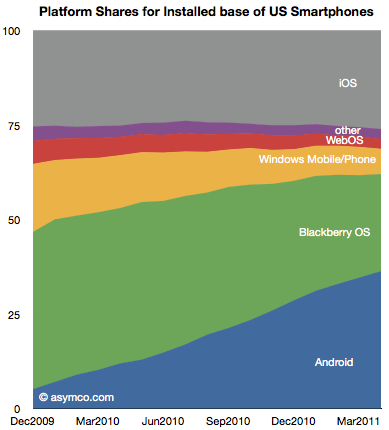
    The following chart shows the evolution of installed base share of platforms among users of smartphones in the US.

    The impressive share gains for Android are apparently at the expense of RIM and Microsoft. Over the period shown, Android gained 25 million users while RIM gained only about 2.8 million.

    Although perhaps comforting to see some growth overall, the situation for RIM is more grim than that. During the first half of the period (December 2009 to August 2010) RIM had gained 4.6 million users. During the second half (Sept 2010 to April 2011) RIM lost 1.8 million users.

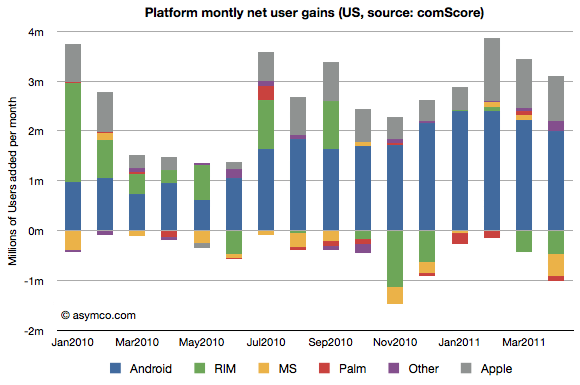
    The net user gains and losses for the various platforms is shown in the following chart:

    Note how RIM (green bars) went from being a consistent net usage gainer to a consistent net usage loser during this 16 month period. In addition, note how Microsoft's platforms (yellow bars) have had a very poor showing with very small gains during four months and moderate losses during the others. The losses in usage even increased after the release of Windows Phone late last year suggesting no traction whatsoever for Windows Phone.

    The other point to be made is that if we assume smartphone users remain smartphone users, then those platform losses are gains by other platforms. In other words, the areas less than zero in the chart above represent smartphone "churn" or switching between platforms (As a percent of all smartphone users that number represents 1.35%.) That number is far lower than the total smartphone gains, so it's safe to say that most of the iOS and Android gains were at the expense of feature phones rather than other smartphones. And since iOS share is consistent (and supplies are constrained), few if any Android gains are at the expense of iOS.

    There are many interesting patterns to observe in the data, but I think the most evocative is the erosion of Blackberry usage. If the Blackberry peaked, and a follower platform not yet in sight, the question is how long will RIM survive?

  7. A new mobile phone market index

    Research · 90 comments

    Measurements of "share" are abundant. There is journalistic value in summarizing performance in a single figure of "share" but it usually is a very limiting view. For example in the global mobile phone market there are at least the following measurements available:

    1. Share of all handset units sold
    2. Share of installed based of handsets (penetration)
    3. Share of smartphones
    4. Share of mobile computers
    5. Share of value (revenues) captured
    6. Share of profits
    7. Share of platforms
    8. Share within a given platform
    9. Share by regions/countries/geographies/demographics

    One could go on. So performance in a market can only be measured if you know to what end is that measure applied. Are you trying to determine current performance or are you assuming that the future will be different and trying to figure out what that future will look like?

    There is no good answer. It depends. But at least we can combine more than one share value into a summary. Mark Hernandez suggested that I put forward a "composite index" to measure vendor performance. I am willing to give it a try. The first iteration can be an unweighted average of four "shares":

    1. Share of all handset units sold (global)
    2. Share of smartphones
    3. Share of value (revenues)
    4. Share of profits

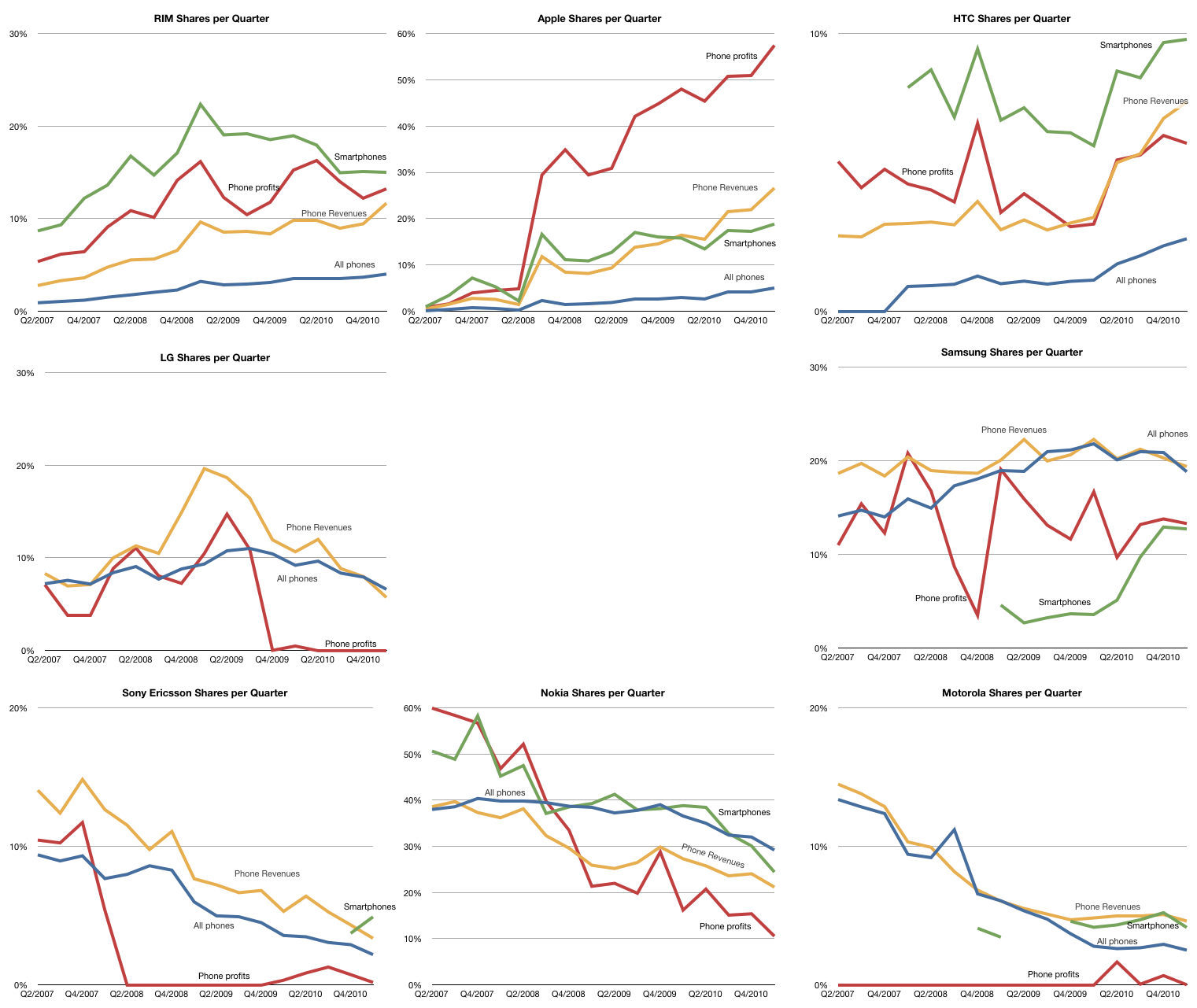
    The raw data for each share is shown in the following charts (note change of vertical scale: each gridline represents 10%).

    Note that the vendors are arranged in a particular way: top row are entrants, bottom row are incumbents with late incumbents from Korea arranged in the middle.

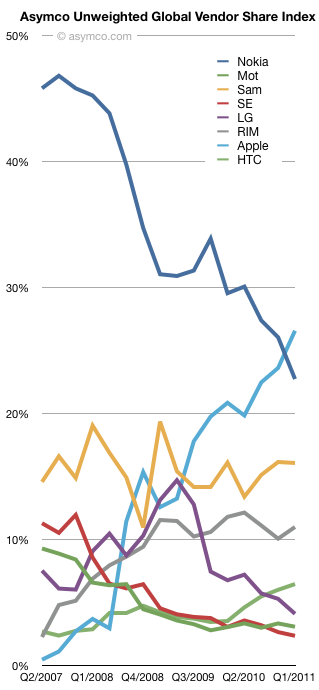
    Taking the average of each of the lines above, the unweighted share index (Units, Smartphones, Value and Profit) is shown below:

    Over the time period since Apple's entry in the market, the index shows interesting patterns:

    • Apple and Nokia trading places
    • Relative stability for Samsung
    • A leveling off for RIM
    • The Peaking for LG
    • Very tightly coupled declines for Motorola and Sony Ericsson
    • Gradual improvement in HTC

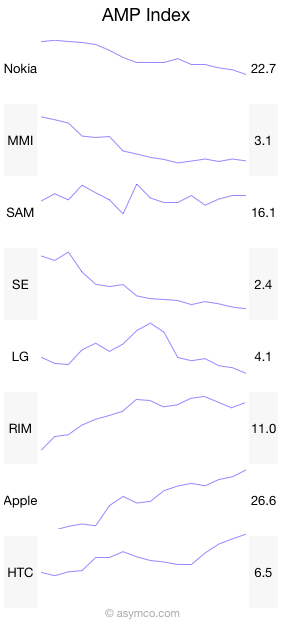
    And here it is in sparklines:

    Like many indices, this is a generalization that measures a section of reality. The value is in its use as a benchmark. If nothing else, it has journalistic value. I'm open to suggestions on how to improve it. Perhaps some form of weighting would be useful. Also, if anyone can suggest good name for it, it might be easier to communicate.

  8. "Other" vendors sell 10% of Smartphones but 30% of voice-oriented phones

    Research · 12 comments

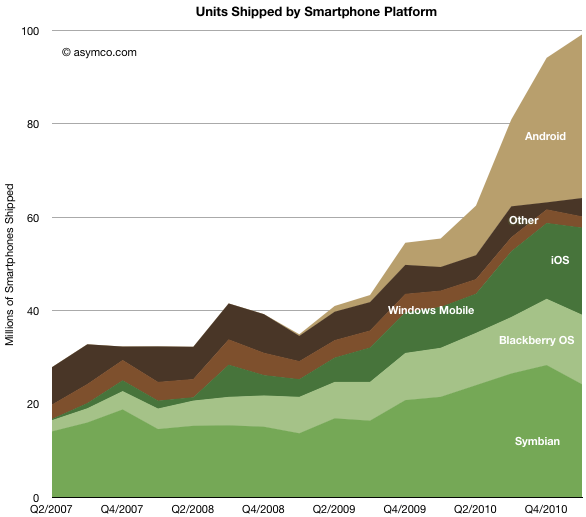
    In the last post, I highlighted the difference between smartphones and non-smart device sales last quarter. The trajectory of share growth for smart devices would appear to have accelerated due to Android.

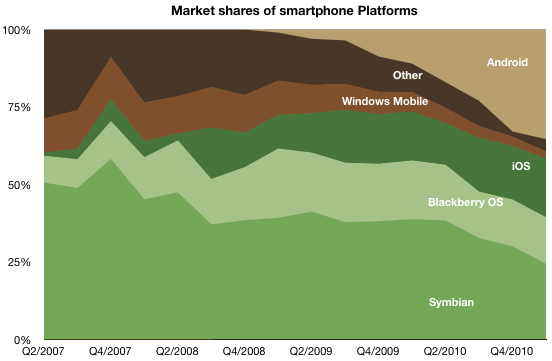
    The following charts show the evolution of smartphone vendors and platforms over the last few years.

    Like in the past, I used color clustering to show the separation between "integrated" (in green) and "modular" (in brown) platforms and their users.

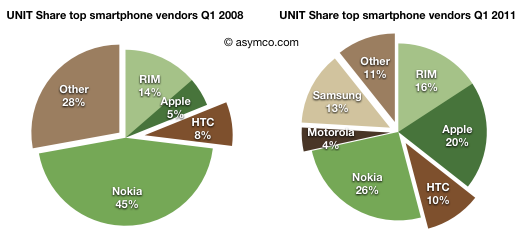
    Unlike the non-smart market where "other" make up 30% of the market, smartphones are still a big brand business. "Other" make up only 11% of units. and that number has been trending down. It would seem that the age of unbranded Android phones is still not upon us.

    Comparing three years "before and after" here is Q1 2008 vs. Q1 2011 by vendors share:


    Apple added 15% of share, Samsung 13%, Motorola 4%, RIM and HTC 2%. Nokia lost nearly 20% of share.

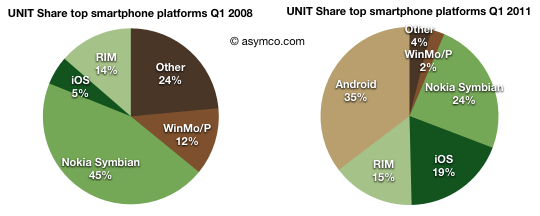
    From a platform point of view, the unit chart looks like this:

    Note that Android's growth came at a time when Symbian had a terrible quarter. The evidence is visible in the share chart:

    Android's gain seems to be at the expense of Other, Windows Mobile and Symbian. In the pie chart snapshot over a three year period the transfer seems clear.

    Android took 35% of share, iOS 14% and RIM 1%. Windows Mobile/Phone has collapsed to 2%.

    But again I would caution about drawing "sustainability" conclusions from looking at this market with a share perspective. As it's growing at a huge rate (73% year/year) it's bound to be become so large that single digit share numbers still amount to vast ecosystems while huge shares of fragmented products don't amount to much of value. To emphasize the point, I would remind that in 2008 Symbian was not just Nokia but a lot of "Other" was made up of Symbian in Japan. The combined fragmented footprint of Symbian was well over 60% of the market. It did not do much good for the platform.

  9. Smartphones: the end of the beginning or the beginning of the end?

    Research · 43 comments

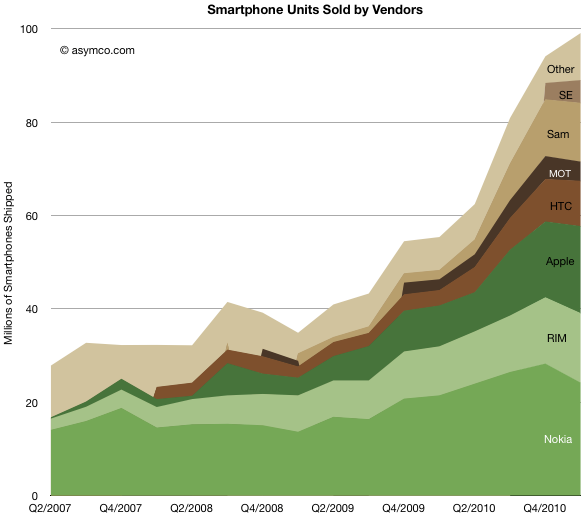
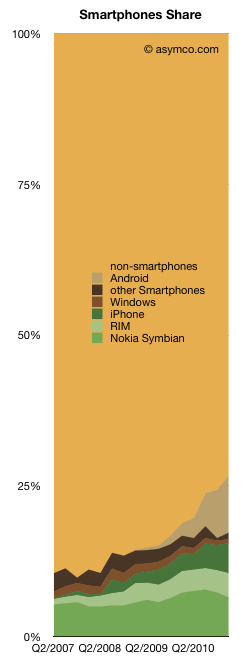
    The smartphone market grew to about 100 million phones last quarter. The volumes grew sequentially and as a result reached a new record share of 27% of total phones shipped. The chart on the left shows how this market evolved over the last few years.

    I've added each platform's contribution.

    While much of the focus will be on who had what share, the better question might be who has the better chance to beat smartphone non-consumption? Non-smart devices are still the dominant competitors. Though it's getting easier to win against them, they still have some compelling competitive advantages.

    What the chart shows is that Android (and phone versions of iOS) have taken share from direct competitors but have taken more from non-consumption. Rather than focusing on rivalry between platforms, minds should be focused on the shape of the smartphone adoption curve.

    The market is largely un-penetrated and yet some argue that "it's too late" to enter or that "the game is over" and winners have already been decided. This is an argument that we are at the beginning of the end. Once the market is predictable it's discountable. Once it's discountable it becomes economically uninteresting.

    I've argued that this is far from certain. In a short span of a few years, a decades old business has been re-defined. But that was just the device side of a larger business. Smartphones have been, so far, sustaining to the telcos who capture the vast majority of revenues and are thus the true incumbents.

    If and how they will be affected by further evolution of smart devices and new business models around them remains to be determined.

  10. Apple, RIM and HTC captured 75% of mobile phone operating profits in Q1

    Research · 32 comments

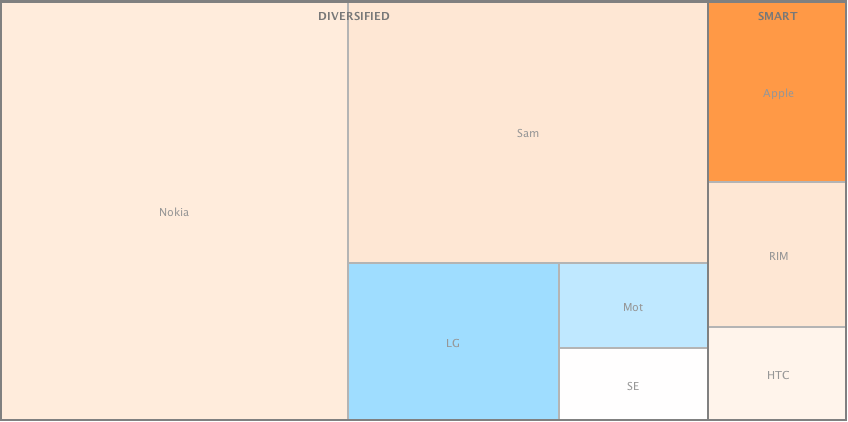
    I produced two alternate views of the primary mobile phone brands in terms of volumes sold and operating profit in Q1.

    These views[1] allow a comparison by categorized competitors. I grouped dedicated smartphone vendors (SMART) vs. diversified and used color coding for profitability (blue colors indicate loss-making vendors).

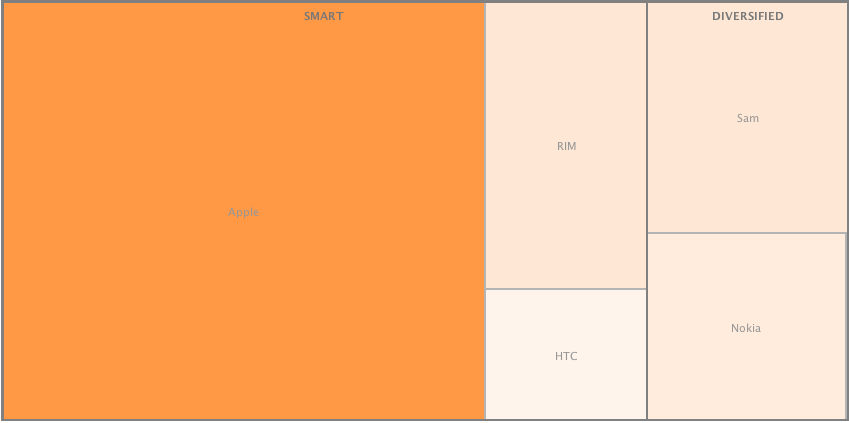
    The same view is drawn for profitability. Loss-making competitors are excluded.

    This view shows how 16% of the volumes for the smartphone vendors generated 75% of total profits. As smartphone penetration grows, those vendors who maintain a diversified portfolio will continue to see their average price and profitability slide.

    I've suggested before that I don't see non-smart devices being interesting to vendors in the near term. Each additional dumb phone added to a portfolio will decrease a company's operating margin. The market dynamics are such that I think non-smart phones will disappear entirely from branded portfolios in 3 to 5 years.

    ---

    Notes:

    1. These are called "tree views". I used Many Eyes experiment from IBM Research to create these charts.
  11. Ascent of the entrants: Taking food from the mouths of giants

    Research · 34 comments

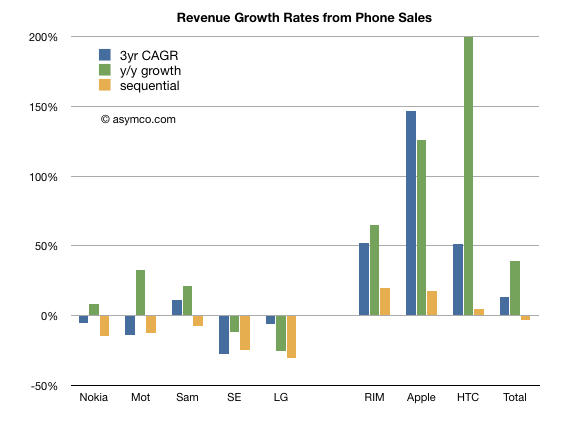
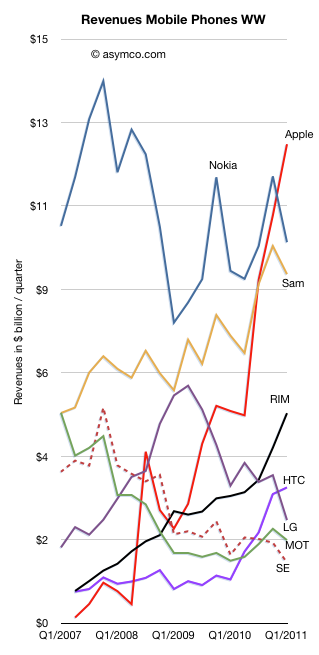
    Revenues for the eight phone vendors I track increased overall during the last three years. The compounded annual growth was about 13%.  However the growth was not evenly distributed. The following chart shows revenue growth across three time frames: Three year compounded, year/year quarterly and sequential quarterly.

    I separated the incumbent companies from the "entrant" smartphone vendors for contrast.

    Looking at individual performance, the following chart shows how each vendor performed over time:

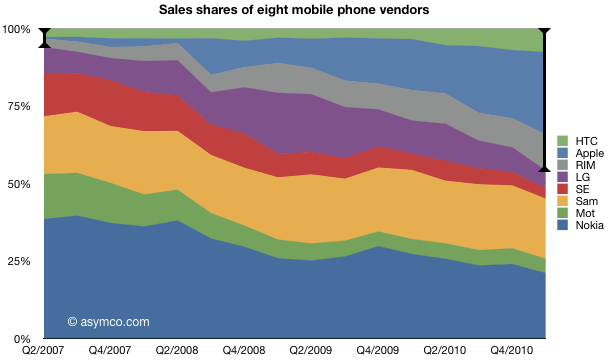
    The share of revenues is shown in the following chart (I highlighted the smartphone cohort):

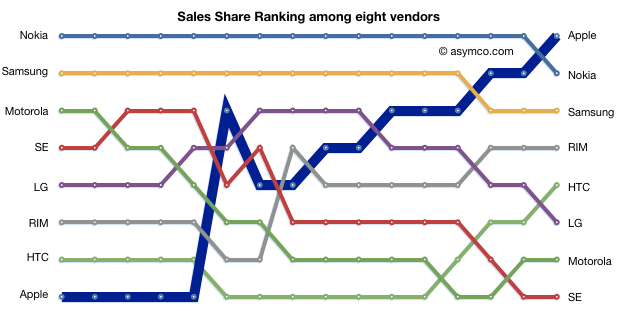
    The ascent of the entrants is shown in the league table below:

    The headline that Apple became the biggest phone vendor in the world by revenue has already flashed across the feeds of the world. It's another straw on the camel's back. But I'd like to take a moment to note that this is not just an Apple story.

    If you look at the league table, RIM, HTC and Apple were at the bottom three years ago and now they are either in the top or the middle. RIM in particular deserves credit for reaching the fourth spot and staying there. HTC also has shown a late surge to fifth passing LG, Motorola and Sony Ericsson in the process.

    Combined, these vendors went from taking in about one dollar in 20 (6%) in Q2 2007 to nearly half the money (46%) in Q1 2011. As the market also grew, the total amount went up an order of magnitude. From $1.8 billion to $21 billion in three years. Not bad for niche players.