Asymco

Asymmetric Intelligence

software

  1. Who's knifing what?

    Research · 147 comments

    Microsoft just declared the Zune end of life. This makes it a good time to look back to some notable episodes in the evolution of digital media distribution. First, an episode from 1997:

    During two days on the stand, Tevanian accused Microsoft of seeking to divide the multimedia market and then "sabotaging" QuickTime's ability to work with Windows computers when Apple declined to go along with Microsoft's plan. Justice also is accusing Microsoft of attempting to illegally allocate the Internet browser market.

    In particularly colorful testimony on Nov. 5, Tevanian described an April, 1997, meeting between two Apple and two Microsoft officials. Tevanian, who was not at the meeting, said Microsoft officials suggested that Apple abandon its business of providing "playback" software that enables users to view multimedia content on the computers. Instead, they offered Apple the much smaller portion of the market for the tools that developers use to create the content. In Apple's mind, though, the playback software was its baby.

    According to Tevanian, Apple executive Peter Hoddie asked Microsoft officials, "'Are you asking us to kill playback? Are you asking us to knife the baby?'" He said Microsoft official Christopher Phillips responded, "'Yes, we want you to knife the baby.' It was very clear."

    Business Week Online/Microsoft Watch on the cross-examination of Apple's Senior Vice-President Avadis "Avie" Tevanian Jr. during the Microsoft antitrust trial.

    Ten years later:

    “We came into the [media player] market, a market in which they are very strong, and we took, I don’t know, but I think most estimates would say we took about 20-25% of the high end of the market,” “We weren’t down at some of the lower price points, but for devices $249 and over we took, you know, let’s say about 20% of the market. So, I feel like we’re in the game, we’re driving our innovation hard and, uh, okay, we’re not the incumbent, he’s the incumbent in this game, but at the end of the day, he’s going to have to keep up an agenda that we’re gonna drive as well.”

    Steve Ballmer on Zune, iPhone (CNBC interview) .

    Four years later the Zune is no more. Besides being interesting anecdotes, what patterns emerge from these episodes?

    The evolution of the bases of competition for media distribution between 1997, 2007 and 2011 is striking.

    • In 1997 the struggle was between specific modules (formats, players and technical standards.)
    • In 2007 the basis of competition was devices integrated with music services (which encompassed formats, standards and players).
    • By 2011 the competitive standard that the iOS ecosystem is putting forward is at an even higher level of integration. Not only are the sub-modules integrated into a whole, but now apps bespoke to a platform are attracting a virtuous cycle of third party innovation.

    Now consider how the two protagonists evolved (or didn't) during this 14 year saga.

    Apple has maintained its attention steadfastly on products while Microsoft has maintained unwavering focus on the distribution and control over value chains. During the 1990s one strategy worked and the other didn't. During the following decade they changed places. The locus of the two strategies did not change. What seems to have changed is what the market values.

    So we have to ask: Is the end of the Zune a matter of poor execution or is the cause for failure something more profound? Is Microsoft's real problem that they have prioritized that which is no longer valued?
  2. Star-crossed partners

    Research · 36 comments

    Until very recently, we believed our competitive position in smartphones could be improved with Symbian, as well as MeeGo, and our strategy based on those platforms. We are now of the view, however, that for the longer term our Symbian platform is not sufficiently competitive in leading markets.

    Nokia's SEC Form 20F.

    The company's fiscal year, which ended in June, was one of the worst to date for the mobile space. Although in development since 2008, the Kin was pulled after just over six weeks of sales and amounted to a $240 million write-off before including the $500 million to buy Danger. Windows Mobile's ramp down is partly intentional as Microsoft is rebooting the platform with Windows Phone 7 and is investing $500 million in marketing to spark new interest.

    Microsoft CEO bonus cut for Kin flop, lack of iPad rival | Electronista One irony is inescapable: the world's largest device company can't build commercially successful software and the world's largest software company can't built commercially successful devices.

    Another irony is that the competitive threats that both companies face came from challengers that were not perceived as such a few years ago.

    Google was not a platform vendor three years ago and Apple was not a phone vendor four years ago.

    The largest incumbents in separate industries sought salvation in each other after the market they strove to build went to unforeseen challengers. All in a span of three years.

    I cannot think of a more succinct testament to the process of disruption.

    One can only speculate about the probability of success of this pairing, however, I struggle to find a historic precedent where this type of relationship succeeded.

  3. The Allegory of Treo

    Research · 35 comments

    The following is a work of fiction.

    The combination seemed unthinkable just a few years ago. Nokia envisioned itself as a substantial rival to Redmond, threatening to head off its computing dominance as the power of desktop computing shifted to pocket-size devices. But a series of miscues substantially weakened the company, leaving it little choice but to team up with the world's largest software maker.

    Although Nokia has pledged to continue using the Symbian OS in both handhelds and phones, the company has now significantly tied its fortunes to the rival it once denounced.

    In doing so, Nokia is making a tough bet. The company is gambling that Microsoft's operating system has advanced far enough to power a decent cell phone, while still having enough rough edges that Nokia can carve out a niche by going beyond the standard Windows Phone software. In doing so, Nokia hopes it can avoid the fate of being just another clone cranking out hardware on Microsoft's behalf.

    Microsoft, meanwhile, has scored a significant win in its decade-long quest to crack the mobile market. In wooing Nokia, Microsoft has brought a one-time rival into its fold and ideally gained a new creative force as it tries to move its PC empire into the burgeoning market for cell phones.

    "Nokia always did great work, and so we lusted after some of those things that they do well," Ballmer told reporters at Monday's launch.

    The partnership is not totally out of the blue, of course. The two companies offered a glimpse at the detente last year, announcing a pact that allowed Symbian OS-based smartphones to connect directly with Microsoft's Exchange servers for corporate e-mail and calendar information.

    In its secret meetings, Nokia execs managed to convince their Microsoft counterparts to build several software hooks they needed into the latest version of Windows Phone. The changes allowed Nokia to add some handy features into the Windows version of the N series phones. One new trick allows Nokia owners to ignore an incoming cell call, instead sending a brief text message to the caller. A second feature allows Nokia owners to navigate multiple voice-mail accounts using VCR-like buttons, rather than having to know that "5" is the key for fast forward or remember that "7" saves voice mail at work, but deletes it at home.

    A key question, though, is whether Microsoft will give Nokia enough room to innovate in the future, now that it has successfully wooed the device maker. By going with Microsoft, Nokia is letting go of one of the key differentiators between its products and those from better-known competitors.

    Elop said he understands the risk and only undertook it with assurances that Nokia would be able to build enough software on top of the OS to make his products stand out.

    "It was the only way we felt it could work for us," he said at the Monday press conference.

    Executives from both companies suggest that the Nokia-Microsoft relationship, forged at those meetings in Cannes and New Orleans, will continue to be close. But it remains to be seen whether Nokia will retain its individuality now that it has the Microsoft imprimatur.

    Wirt acknowledges that there are no formal procedures in place that ensure that Nokia will get the things it asks for the next time, or the time after that. "It's functioned more as a relationship-type thing."

    Elop said Nokia could try to patent particularly strong advances, but in general he said the company believes the best way to stay ahead is to keep cranking out new products.

    "We have ideas about many things that we didn't get to do in this version," he assured reporters.

    But for all its ideas, Nokia is still a relatively small company. And given that it has pledged continued support for the Symbian OS, it must now divide its limited engineering resources between two incompatible efforts.

    Elop acknowledged that the challenges of developing for two entirely different operating systems are enough to keep his firm hopping. He emphatically shook his head back and forth when asked if Android and MeeGo-based Nokia phones might be next.

    "We don't need another operating system," he said, adding later, "It's too much effort."

    This fictional article was created by taking an actual article from 2005 about Palm and Microsoft (Palm's tale of Treo intrigue - CNET News) and changing the words "Palm" for" Nokia", and "Colligan" for "Elop", "Ballmer" for "Gates", "Treo" for N series (or Nokia) and "Symbian" for "PalmOS". A few paragraphs about the mechanics of the deal process were deleted.

    Credit: This tweet from Charles Arthur.

  4. What's a Post-PC device?

    Research · 86 comments

    Microsoft's Steve Ballmer argues that the tablet computers (aka slates, media tablets or iPads) are PCs. Steve Jobs argues that they are post-PC devices. There are analogies to trucks, cars and various metaphors for what these new devices symbolize. Some argue that because the iPad needs a PC, it's not a post-PC device.

    But how to define a new generation of computing? Since the PC is not the beginning of computing, it may make sense to look to the eras of computing that preceded it.

    The first post-mainframe computers worked alongside mainframes and were typically used by engineering departments (vs. the finance and accounting departmental role occupied by mainframes.) They did not require a dedicated (often external) mainframe service team and could be administered by in-department system administrators. Input was not through dedicated data entry personnel and output was not a ream of folded paper. Users could use a CRT terminal to interact with the computer directly. Digital Equipment Corporation, Control Data, HP, Honeywell, Prime, et. al. grew up in the shadow of IBM but thrived. Their products were cheaper and simpler to operate. Initially, the products were not more powerful.

    The first post-minicomputer microcomputers (also known as PCs) were used alongside mainframes and mini-computers. They were typically used for 2-dimensional spreadsheets analysis by individuals in many departments and were easier to justify cost-wise than the time-sharing cost structure of the incumbent computers. Many microcomputers were able to access mini-computers and mainframes through terminal emulation software (and sometimes special hardware boards) so they were still able to work with existing business processes. They did not require dedicated personnel for administration but had a shared support department. Input and data storage were on the "desktop" as was printing. Compaq, Dell, HP, Apple and IBM embraced this new form factor. Their products were cheaper and simpler to operate than the previous generation of computers. Initially, the products were not more powerful.

    The first post-microcomputer tablets are used alongside microcomputers for tasks such as presentations and entertainment. They have software available that allows access to desktop computers and services dependent on PC-architectured servers. They depend on PCs for data backup and software updates. They do not require IT support. They do not require a keyboard or a desk. Apple and many mobile phone vendors are embracing the new technology. They are cheaper and simpler to operate. The new products are not more powerful.

    To define a new generation of computing by its isolation and exclusion of the previous generation is not sustained by the history of computing.

    I would suggest that the definition of a new generation of computing is that the new products rely on new input / output methods and allow a new population of non-expert users to use the product more cheaply and simply.

    I might add that the consequences of each generational shift are:

    1. Consumption increases
    2. Skill required decreases
    3. Support required decreases
    4. There are new applications and use cases
    5. The economics are not favorable for incumbents
    6. The economics are favorable for new entrants
    7. The older generation slowly fades through diminished growth but never disappears
  5. Nokia: We depend on uninformed customers, deception preserves brand value and uncompetitive software will keep us competitive

    Research · 99 comments

    In a previous post I asked whether Nokia's strategy is dependent on a "built-in assumption that end users are inherently stupid."

    Nokia confirmed that this is indeed the case.

    “Millions of consumers are oblivious to the announcements that we have made,” she said. Those consumers value Nokia’s brand, she said, and will continue to buy devices provided the company keeps making competitive products.

    via Nokia's Jo Harlow on the Move To Windows Phone, the Future of Symbian and More | Ina Fried | Mobilized | AllThingsD

    There are three statements being made:

    1. Nokia is counting on uninformed customers, not just end users but the shops and operators which will keep stocking the end-of-life product lines. There needs to be a conspiracy of stupidity for this plan to work.
    2. Nokia's brand will survive even after customers are deceived into buying lame duck products. The idea that buyers value a brand that is offering products that the company does not believe have a future is cynical.
    3. The absurd implication that Nokia's products will be "competitive" even though management asserted clearly and emphatically that the software they run--the very basis of competition for any smartphone--isn't. If a smartphone is expected to be competitive even though its software isn't then it's not competing on the basis of software. If it isn't then how smart is this smartphone?

    One gets the sense that Nokia is undergoing significant ethical decay.

    [UPDATE]

    To paraphrase the ethical dilemma:

    "We want a three horse race. We're not there yet. In the meantime we have a sturdy donkey that can still walk. We expect 150 million people to bet on it."

    [UPDATE 2]

    I take issue with the ethics of jumping off a burning platform while selling tickets to tourists to come visit.

  6. Google and Apple as mobile co-belligerents

    Research · 94 comments

    The relationship between Google and Apple is an interesting one. It's enticing to declare them "at war" with one another, but that type of relationship does not account for the collaboration and partnerships they enjoy. To wit:

    • Google pays Apple for default Search placement on Safari. This means that Google treats Apple as a distributor.
    • We can presume that there is a deal between the two over Gmail and Maps on the iPhone as well.
    • AdMob is available on iOS without hindrance.

    The business relationships between the two companies are self-evident. However, I would suggest that there are more important strategic reasons why Google and Apple are in fact implicitly collaborating against a common goal.

    The concept of "co-belligerence" may describe the relationship: The state of fighting against a common adversary without a formal alliance and without a guarantee of non-agression against each other.

    The common adversary is the telecom industry. It's an industry being undermined by the technological change of mobile computing and its profits are up for grabs. Apple and Google have different approaches in implementing this change but in the end they dismantle and absorb profits from the same target.

    They are also benefiting each other. Apple benefits Google by creating user experience innovations which Google can rapidly copy. Google benefits Apple by increasing smartphone consumption--educating markets to the value of mobile computing and crippling the profitability (and thus the ability to innovate) of Apple's direct competitors.

    If I may belabor the point, it's like the concept of fast food. One company invents the fast food franchise process, another popularizes it and creates demand. Finally, the innovator comes in with a premium brand to split the market.

    Apple innovates in product innovation with Google as a fast follower. Google then innovates on distribution and penetration enabling Apple to follow with a skimming strategy.

    The end result is a more rapid and thorough profit evaporation from incumbents with corresponding condensation around the entrants.

    To visualize it further, consider what the market would look like if one or the other of the co-belligerents was not participating. Could Google have developed their software without the iPhone as a reference design? At the same time, as Android eliminates the opportunity for alternative software investments by competitors[1] could Apple have remained the only integrated vendor with a uniquely high profit margin?

    Of course, this is not a guarantee of success. New platforms may still take root and integration by HP may actually pan out. But the point I'm trying to make is that, for the time being, Google and Apple are not so much adversaries as comfortably busy winning against a rather weak common target.

    ---

    Notes:

    1. Consider how hard it is for OEMs to justify investing in their own OS post-Android. Consider the desperate status of Nokia who abandoned a broad ecosystem and the paucity of alternatives.
  7. In memoriam: Microsoft's previous strategic mobile partners

    Research · 223 comments

    Microsoft's new "strategic partnership" with Nokia is not its first. For a decade the software company has courted and consummated relationships with a variety of companies in mobile and telecom. Here are the ones I can remember:

    • LG. In February 2009 Microsoft Corp. signed a multiyear agreement for Windows Mobile to be included on devices from LG Electronics Inc. LG would use Windows Mobile as its "primary platform" for smartphones and produce about 50 models running the software.

    What happened? LG made a few Windows Mobile devices but with WinMo uncompetitive, they abandoned the platform and moved to Android losing years of market presence and all their profits.

    • Motorola. In September 2003, Motorola  and Microsoft announced an alliance. "Starting with the introduction of the new Motorola MPx200 mobile phone with Microsoft Windows Mobile software, the companies will collaborate on a series of Smartphone and Pocket PC wireless devices designed to create a virtual "remote control" for the Web-centric, work-centric, always-on-the-go mobile professional." In addition, the alliance includes cooperation on joint marketing and wireless developer programs.

    What happened? Motorola launched a series of Windows Mobile phones culminating in the Motorola Q "Blackberry killer". As Motorola hit the rocks in profitability new management reached for the Android liferaft. The company now relies exclusively on the Droid franchise.

    • Palm. In September 2005 Palm and Microsoft announced a strategic alliance to "accelerate the Smartphone market segment with a new device for mobile professionals and businesses. Palm has licensed the Microsoft Windows Mobile operating system for an expanded line of Treo Smartphones, the first of which will be available on Verizon Wireless’ national wireless broadband network."

    What happened? Palm shipped a few Windows Mobile, famously dismissing Apple's potential entry as something "PC guys" could never achieve. A new CEO, a private placement and an acquisition later the company is a division of HP making its own operating system.

    • Nortel. When Steve Ballmer was famously laughing at the iPhone and saying that he likes the Windows Mobile strategy "a lot" he was sitting next to the then-CEO of Nortel (Mike Zafirovski formerly of Motorola) with whom the company had just closed a strategic deal.  "an alliance between Microsoft and Nortel announced in July 2006 ...  includes three new joint solutions to dramatically improve business communications by breaking down the barriers between voice, e-mail, instant messaging, multimedia conferencing and other forms of communication".

    What happened? Nortel declared bankruptcy two years later.

    • Verizon. In January 2009 "Verizon Wireless has selected Microsoft Corp. to provide portal, local and Internet search as well as mobile advertising services to customers on its devices. The five-year agreement will go into effect in the first half of 2009 when Microsoft Live Search is targeted to be available on new Verizon Wireless feature phones and smartphones." The deal would ensure Bing distribution to all of Verizon's smartphone customers.

    What happened? Bing did ship on some devices but in October 2009 Droid came to Verizon.

    • Ericsson. In September 2000, "Ericsson and Microsoft Corp. today launched Ericsson Microsoft Mobile Venture AB. This previously announced joint company will drive the mobile Internet by developing and marketing mobile e-mail solutions for operators. The first solutions are expected to be on the market by the end of the year. The company is part of a broader strategic alliance between Ericsson and Microsoft"

    What happened? Ericsson divested itself of the mobile division forming a joint venture which would go on and make more strategic alliances with Microsoft over Windows Mobile culminating in a loss of profits and eventual flight to Android.

    • Sendo. In February 2001, Microsoft announced a partnership, in which Microsoft bought $12m of Sendo shares and a seat on the board. Sendo was to be Microsoft's "go to market partner" for the Stinger smartphone platform that would become Smartphone 2002.

    What happened? Sendo after litigating IP issues with Microsoft went bankrupt in 2005.

    And finally,

    • Nokia. No, not this OS deal, but in August 2009 "The worldwide leader in software and the world’s largest smartphone manufacturer have entered into an alliance that is set to deliver a groundbreaking, enterprise-grade solution for mobile productivity. Today, Microsoft Business Division President Stephen Elop and Nokia’s Executive Vice President for Devices Kai Öistämö announced the agreement, outlining a shared vision for the future of mobile productivity. This is the first time that either company has embarked on an alliance of this scope and nature."

    The plan was to bring "Microsoft Office Mobile and Microsoft business communications, collaboration and device management software to Nokia’s Symbian devices."

    What happened? One and a half years later the same Stephen Elop announced that Symbian will be deprecated.

  8. Nokia employs as many people to develop its smartphone software as Apple does to develop all its products

    Research · 106 comments

    In a recent post I pointed out that Apple's R&D was about 2.2% of sales in the last quarter. Bernstein took a look at the R&D for Nokia and presented a chart showing the difference between the mobile industry players in terms of total expenditure on R&D.

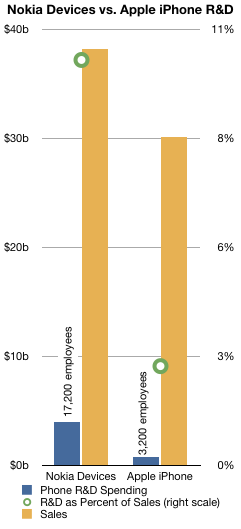
    I took inspiration from that to plot the Devices R&D for both Nokia and Apple over the entire 2010 period. I also compared that with sales and computed the ratio between R&D and sales.

    The result is shown in the chart on the left.

    Bottom line: Nokia spent 10.2% of phone sales in 2010 on phone R&D while Apple spent 2.5%.

    Bernstein goes on to argue that at least for Devices,

    Nokia spent $3.9bn in R&D in 2010, almost 3x the average of its peers, 31% of the industry's R&D total spending, for an output that we can qualify as visibly disappointing.

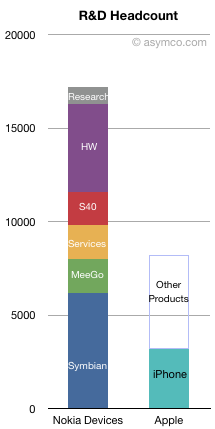
    To relate the $3.9 billion for Devices into head count, they estimate that Symbian projects employ 6,200 people; MeeGo and Qt 1,800; Services 1,800; and S40 1,800. Hardware headcount is assumed to be 4,700 and 900 more for fundamental research.

    So Nokia's total software headcount adds up to 11,600 people. Nokia smartphone headcount adds up to about 8,000.

    Applying a similar formula ($240k/employee[1]) to Apple's estimated iPhone R&D (from Bernstein's chart) yields a headcount of about 3,200 and a total Apple company R&D headcount of 8,200.

    So Nokia employs about the same number of engineers[2] for its smartphone software platforms as Apple does for all its product lines[3].

    In fact, Symbian alone may cost twice as much to develop than the iPhone (including the hardware).

    ---

    Notes:

    1. The cost per employee is obviously different between the companies as they operate in different countries. However there are enough sources of error in these estimates that they probably overwhelm the cost of living/tax differentials.
    2. I know that engineers are not all that R&D headcount covers, but let's assume that the mix of overhead is similar for the two companies.
    3. The total for Symbian + MeeGo is 8000 and the total for Apple overall is 8,200, however one can comfortably allocate 200 out of 900 researchers out of Nokia research to their mobile software effort.
  9. iOS enables 71% of Apple's profits. Platform products power 93% of gross margin

    Research · 17 comments

    As the highly profitable iPhone makes up an increasingly larger proportion of Apple's sales, the overall gross margin would be expected to grow.

    Sure enough that's what's been happening.

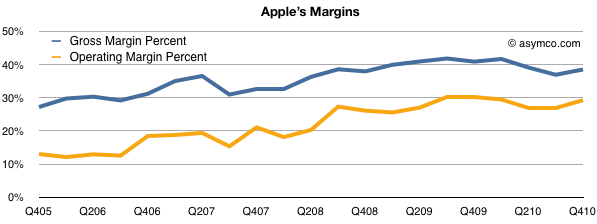
    The gross margin percent, which measures the direct or variable costs of production vs. price, shows a healthy rise in the last five years from slightly below 30% to around 40%. The Operating Margin, which also includes the overhead or fixed costs like R&D and SG&A, shows a similar rise, reaching about 30%.

    Margin expansion while sales quadruple is a good indicator that a company is producing real value not just trading sales volume for profit.

    Focusing attention on individual product lines, it's clear that the iPhone is the largest component of sales and of profits. We don't have specific product line-item gross margins from management, but we can estimate a figure for the iPhone by several means.

    First, we can work out roughly what every other product line's margin is due to their longer histories. (Mac and iPod have reliable profitability estimates). What's left can be deduced to make up the iPhone's margin.

    Alternatively, we can get estimates of the bill of materials and add in some of the other direct expenses like manufacturing, warranties, shipping and incidentals to get an estimate of the cost of production.

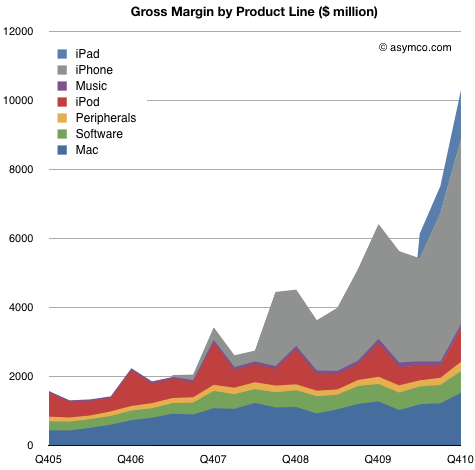
    These methods allow me to guess at a margin for the iPhone of about 50% for the last quarter. Based on these inputs we can plot the gross margins for the entire company's product lines:

    Overall, gross margins have reached over $10.3 billion in the quarter, increasing 543% from five years ago and 61% from a year ago.

    That's great, but by knowing product line profitability we can get a better feel how the company changed strategically.

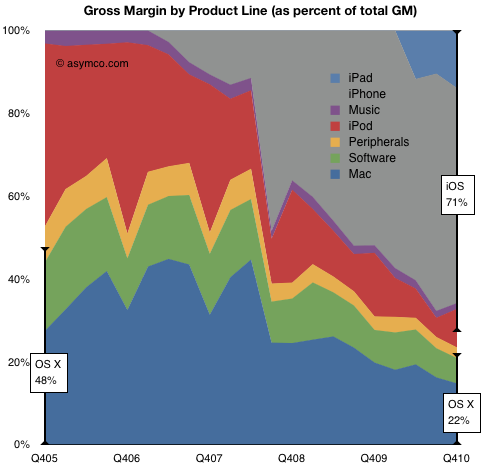
    In the following chart I show the percent of gross profit captured by each product line.

    What we can observe is that at the end of 2005, OS X based products made up nearly half the profits. The rest was mostly the iPod, which was not a software platform product.

    A short five years later, OS X products which, although having grown in volume, made up only 22% of total margin. The rest was mostly iPhone but with significant contributions from iPad and iPod. What's most important to note is that the non-OS X profits are almost all powered by iOS.

    iOS powers about 70% of Apple's current gross profits. Combined with OS X, 93% of profits are from platform products.

    So again the question about Apple being a software, hardware or media company comes back. Perhaps, those categories are not relevant. Perhaps Apple is a platform company.

  10. 65% of Apple's sales came from iOS powered devices

    Research · 46 comments

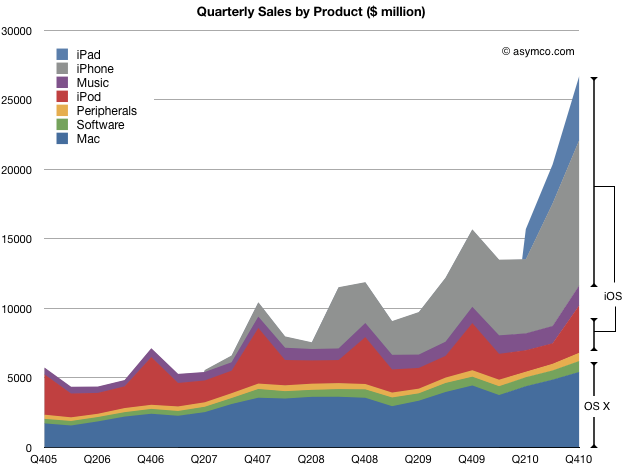
    The iPhone and iPad generated $15 billion of revenue last quarter. In addition, iPod touch generated about $2.3 billion, implying that iOS based devices were responsible for sales of $17.3 billion.

    To put that in perspective I drew this chart which shows not only the sales by products but a rough representation of share of the two OS variants Apple uses to power its products.

    iOS powered products (which did not exist three and a half years ago) generated 65% of all sales in the last quarter. OS X powered products generated 20% of sales. That's a noteworthy combined total of 85%.

    But software is even more important for Apple.

    The sale of OSX software (both the operating system and applications for it) accounted for another $786 million or 3% of total. In addition, I've put forward some evidence to suggest that the proportion of sales due to Apps in the Music store is nearly half, or another $600 million (a bit more than 2%).

    Therefore only 10% of Apple's sales were for products not directly powered by its vengeful operating system. That speaks volumes not only for the importance of software to Apple but for the cohesion of an extensible, flexible architecture that allows it to inhabit a portfolio spanning from a music player and an enterprise server.

    I recently answered a question on Quora on whether Apple is a Software, Hardware or Media company by saying it's all three.

    With 90% of sales dependent on a unique, proprietary operating system[1], perhaps the answer should have been different.

    ---

    1. I know that OS X has a large amount of open source. Proprietary, like Open is a partial definition.
  11. Apple's Growth Scorecard: 63% average earnings growth over 16 quarters

    Research · 30 comments

    In the last quarter Apple's top line grew by 70% and the bottom line by 75%.

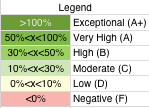
    For a historical perspective, the following table shows year-on-year growth for products[1] and sales/earnings color coded with an arbitrary scoring range.

    The major changes from the last quarter were the acceleration in software sales and the return to growth in iPod sales. iPod benefited from the continuing shift to iOS as the mix is now 50% touch in the portfolio.

    Software growth reached a level not seen since 2008. It's not clear to me yet  which products drove this increase.

    Overall the growth is both wide and deep. I'm most impressed with the iPod as it was a surprise to hear such a high mix of touch.

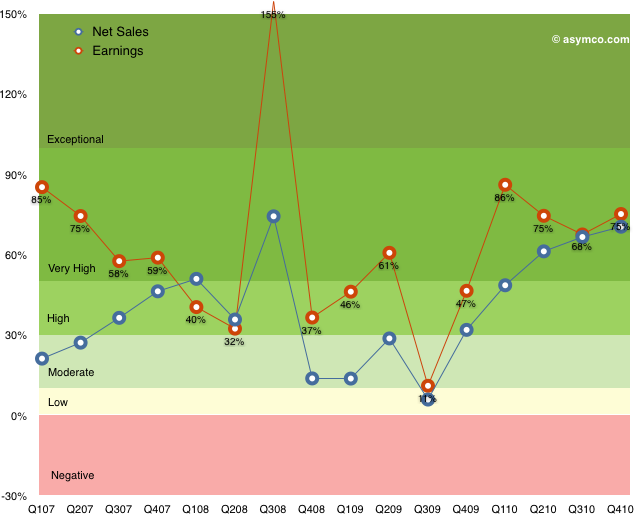
    The following chart shows the top and bottom lines plotted over time with color bands corresponding to the score system in the table above.

    Note how earnings growth has been in the high or very high or exceptional range for all but one quarter over in the last four years[2].

    Apple transcends the mythical "rule of large numbers"[3]. It's not only a mega-cap, but the second largest company in the world by market cap. Not only has this enormously valuable asset just grown in intrinsic value creation by 75% but it has maintained a growth of 70% for the last five quarters.

    If that weren't enough, the average earnings growth has been 63% for the last sixteen quarters.

    ------------

    Notes:

    1. The iPad is not included since we don't have more than one year of sales and this is year-on-year not sequential growth.
    2. The low growth for Q3 '09 was due to the corresponding spike the year before when the iPhone 3G was launched. That launch quarter in 2008 was a seminal turning point in the history of the phone industry when it became clear that the iPhone was not a passing fad. Steve Jobs famously participated in the conference call calling attention to the data which was obfuscated by subscription accounting. Alas, the news was lost in a sea of credit crunch panic.
    3. I have an aversion to this rule as "large" is never defined except in relative terms. For example a $1 trillion market cap may be large because it's unprecedented, but it may be a trifle if the company is priced at book value.