Andy Rubin, the executive in charge of Google’s mobile software effort, said that international expansion lay behind the latest advance. Speaking in an interview with the Financial Times, he also predicted that a boom in sales in India, Brazil, Indonesia and other emerging countries would contribute to the fast growth rate for the foreseeable future.
Quoting independent research suggesting that Android has also come to account for half of smartphone shipments in China, Mr Rubin said that the open-source nature of the software had made it popular there. However, in the wake of Google’s dispute over censorship with the Chinese government, Android handsets shipped by China Mobile, the dominant supplier, do not carry the company’s search or e-mail services.
This was already confirmed by the data published here this morning.
Verizon alone or with the other US operators cannot account for the majority of Android volumes and anecdotal evidence points out that Europe is not contributing much more.
When the iPhone vs. Android rhetorical war heats up, both sides bring up the history of Macs vs. Windows PCs. The commonly held thesis is that Windows triumphed as the PC was commoditized (and modularized). This triumph was at the expense of the over-serving and over-priced Mac.
This is a largely accurate view of what happened during the 90s. But the problem with this thesis is that (1) the PC's job has been slowly changing in the last decade (2) the Mac keeps growing faster than the PC and (3) Apple keeps capturing a vast portion of the profits in the PC industry.
These anomalies or contradictions to the thesis imply that something changed. What changed and can these changes turn the tables on the market and create an opportunity for a new computing disruption?
The PC of the 90s was hired first by companies as a productivity boosting tool and second by consumers as a way to duplicate their work productivity and communications in their personal lives.
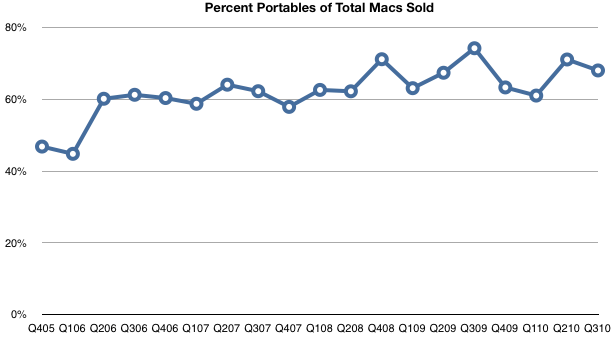
However something changed with PCs when the laptop became "good enough". With portable computing, the job the PC was hired to do evolved. It was more important that the product be well designed (for aesthetic value, usability and reliability) than just fast and spacious. The microprocessors were plenty fast but what mattered more was low power consumption, a low profile and tighter integration with software.
The product was also purchased in a different way. A desktop could be purchased on specs alone, sight unseen, from a catalog. But a laptop had to be touched, hefted and the screen had to be observed and the whole design contemplated before a purchase decision was made. The product had an integrated keyboard, display, touchpad and storage. It was not easily serviced by end users. It was, in a word, re-integrated.
You can see how portability changed the job and therefore everything else as well. Consumer tastes became important, retail distribution became necessary and R&D resources had to be applied to solve what was no longer good enough: the whole package.
Vendors which did not prioritize design, retail and R&D were left flat-footed.
At the same time, systems software became more commoditized and productivity software became portable. The old measures of performance were being over-shot while the new measures of performance were under-served.
While this shift was underway on the hardware side, Microsoft continued to improve their product to serve more demanding business productivity jobs. Their software was not getting optimized for this new portable consumer job. They left the new market open to disruption.
In stepped the MacBook with good enough (and improving) office productivity. With excellent appeal along the dimensions of performance consumers demand most of all. It was priced higher than other laptops but the price points were affordable and, inflation-adjusted, lower than they'd ever been. It should not be a surprise that Apple was one of the first vendors to see its portables line become bigger than its desktop lines. The market evolved to the point where what Apple had was what the buyers needed.
The shift to portability is a compelling story for Apple as disruptor in the PC market. It may not result in a complete reversal of the PC hegemony but it allows Apple to grow a product line at triple the growth rate of the market. A market that was considered completely dominated by entrenched incumbents with an unbreakable profit formula.
But with the iPad Apple is clearly also aiming at disrupting the Mac (and, transitively, the PC as a whole.) The iPad can be seen as an evolution toward seamless portability; the mobile computing paradigm shift.
Several readers pointed out that in my discussion on the market share of modular vs. inter-dependent market shares for smartphones, Nokia was incorrectly classified as having an inter-dependent software architecture since the Symbian platform is/was a modular component.
The problem is that the relationship between Symbian and Nokia is not that of independent modules. Nominally, the two are independent and mutually exclusive, but, in practice, Symbian has always been so heavily dependent and influenced by Nokia that it's never been possible to declare its governance fully independent.
I won't describe the full history since there are many other sources (good example here.) But I will point out that since Nokia licensed Symbian exclusively and Symbian obtained the vast bulk of license fees from Nokia, the relationship was one similar to a bilateral monopoly.
Nokia's bargaining power over Symbian was always high enough to affect its operations. "Ownership" does not only infer a formal control over equity, and many would agree that Nokia "owned" Symbian even when it held less than 50% of the equity. The relationship was so tight, that even though there were other members of the consortium with board seats, the licensing by Nokia's competitors was always very limited. The only significant non-Nokia revenue for Symbian came from Japan where Nokia did not have a presence.
After Symbian was effectively acquired by Nokia, the ownership became both de jure and de facto. The open sourcing of the Symbian code made it no less a Nokia operation than the open sourcing of Android makes it no less a Google operation.
So for all intents and purposes, the relationship between Symbian and Nokia makes Nokia's smartphone hardware inter-dependent on Symbian's software.
Now, given that the way the products are built in practice may be far from integrated, it would seem that Nokia's management captured the worst of both worlds: Modular implementation of an inter-dependent business. Nokia captured all the downside of modularity (poor integration and polish) without any of the benefits (e.g. flexible supply chain or lower R&D.)
After the last earnings report, many noted that Apple's gross margins dipped. Turley Muller noted in a letter to PED that the cause was probably the aggressive ramp in iPhone 4 production which broke new records at 14.1 million units.
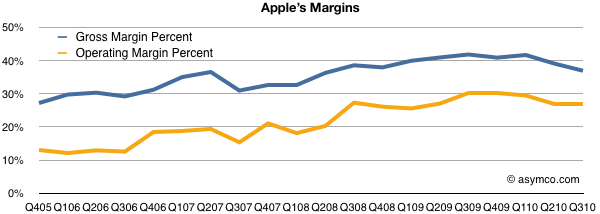
That may be. My estimate of iPhone margin shows it dropping to about 49% from the more usual 55% (sometimes even higher). We'll never know exactly how much, but sometimes margins drop. RIM and Nokia are punished for drops in the GM percent so why shouldn't Apple?
However, there are some other factors to consider: the overall margin is currently historically very high. As the high-margin iPhone makes up more of the total product mix, the overall margin should be growing. And it is. The chart below shows the trend since 2005. GM was in the high 20's five years ago.
Note however the other margin: operating margin. After taking the fixed costs into consideration (which we saw to be shrinking as a percent of sales), Apple's bottom line profitability has been rising slightly more rapidly than the GM. It has plateaued recently but not dipped significantly.
Also note that there have been dips in the past from which GM expansion resumed. One such dip was at the launch of the first iPhone in 2007, though we can't be sure that was attributed to the iPhone itself or to other factors like that most cited by management: components costs.
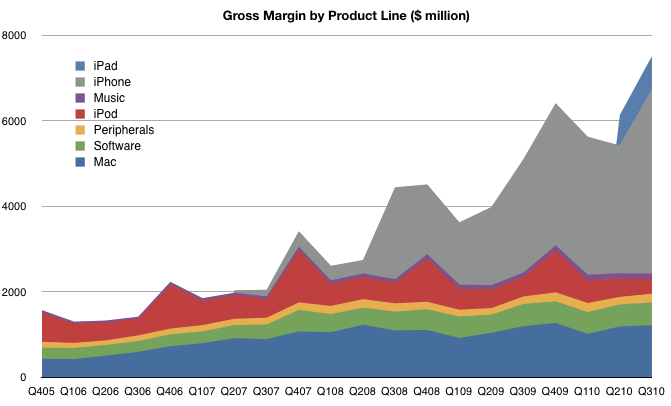
However, the bottom line profitability is only part of the picture. It would be instructive to look at which product contribute how much. You won't see this analysis often because the gross margin by product is not published by Apple and it takes quite a bit of guesswork to get there.
I maintain product-level gross margins and compute the overall GM bottom-up. The product-by-product line profitability is based on several assumptions which I won't detail here, but those assumptions lead to the following contribution chart:
There are several takeaways here:
The iPhone is huge (57% of gross profits). It is far more important than most people assume. Without it, the company would not have materially grown EPS since 2007.
The "Music" which includes iTunes revenues is tiny. Many people assume that iTunes is a large contributor to Apple's operating profitability but operating margins on the store are 10 percent. Peripherals add more to the bottom line than the iTMS/App Store. The benefit of the iTunes/App Stores is in the hardware sold.
Software contributes more now than the iPod. This is completely under everyone's radar but Apple's software business has been growing and with 80% gross margins (assumed) it's a big part of the profit picture.
The iPad margins are lower than the iPhone. As it grows in volume, the profit share will grow, but it's a long way from being the profit share leader.
This picture should also be a warning to Apple's competitors. If they seek to grow shareholder value and shift profits away from Apple they need to see just how much of that profit is captured in hardware. At the same time, they need to realize that it's the non-hardware businesses which make the hardware so desirable. Like it's products, Apple's income statement is very inter-dependent.
What is it that makes the iTunes App Store so compelling? Will the value the App store added to the iPhone be added by the Mac App Store to the Mac?
Here are the characteristics I think make the App Stores valuable:
They redefine software as content. The pricing, marketing, discovery and buying process is identical to that for content like music or video.
They redefine the skill required to create a relationship with customers. They allow a new class of less-skilled and less-capitalized developers participate in selling software directly to the buyer. By "skill" I don't mean engineering skill but marketing skill. A developer can create a product that can reach millions without having to acquire with channels and distribution skills.
From a consumer's point of view, they simplify purchasing and lower the price of software.
These three characteristics of app stores make them disruptive. The disrupted companies are the traditional software publishers. The response from game publishers to the App store were predictable: they condemned it for destroying value, "cheapening" their product, and creating a race to the bottom. They also predicted that it would all end badly as nobody would make any money.
The truth is that they were disrupted by different cost structures. The entrants did not need to spend on market development, and focused on innovating on the essential novelty of the user interface.
So the Mac App Store could be disruptive to traditional software vendors. A large new population of software developers could emerge targeting the Cocoa environment and they may bring new apps that move the jobs that the computer is hired for to appeal to new users.
However there is a problem. The Mac is a small target market relative to iOS. Apple announced that there are 50 million Mac users. This compares badly to the 130 million (or so) iOS users. It won't be long before 50 million iOS users will be added every three months.
So the first thing that Apple needs to do is grow the Mac installed base. Perhaps the new Air and following updated to the MacBooks will do just that. But the growth rate needs to be an order of magnitude faster. And I suspect price is an obstacle to this growth.
Regardless of this obstacle, the Mac App Store has the potential to change the appeal of the Mac. As the first personal computer with an App Store, new uses may emerge and create the same app-platform effect.
Acer chairman J.T. Wang recently predicted that Apple’s share of the tablet market would decline precipitously as new rivals emerge, falling from nearly 100 percent to 20 to 30 percent.
Adobe is one of the last surviving desktop software companies. So is Microsoft. Consolidation happens when an industry matures and excess capacity and excess overhead can be squeezed out of the value chain, giving a temporary burst of earnings growth.
So, in this way of thinking, recognizing that the sun is setting on desktop software, a merger of old schools of thought may make sense. Rather like Sun and Oracle or HP and Compaq.
But then a lot of other things make more sense. Like both companies trying to expand into new growth areas. Like Microsoft talking to RIM or Adobe developing tools for HTML5. Adobe's cash cow products are not going anywhere without a deep reset. Same is true for Microsoft. They will both face these challenges whether standing alone or together.
There would be nothing strange about a Microsoft Adobe merger, but there would be nothing great about it either.
“In all areas of software development, mobile computing is seen as the number-one hottest IT opportunity next year,” said Jim Corgel, an IBM general manager of independent software vendors and developer relations who was involved in the survey. “Not only will mobile spike to the forefront, but by 2015, respondents said it will dominate everything. The cell phone is no longer a gadget – it’s what IT is going to become.”
Developers are usually not very good at predicting specific business winners or losers (to prove this consider why developers don't spend their energy and earn their living picking tech stocks instead of writing code.)
However, developers are very good at spotting long term technology trends. It was developers who championed the early internet and it was developers who saw potential in social networking. To see a survey of developers confirm that mobile devices will dominate IT, in contradiction to most incumbent strategies, is encouraging.
More recently, Chris Whitmore writes for Deutsche Bank:
"We believe Apple's lead in the tablet market will prove difficult to close by the onslaught of competing products coming over the next several quarters," he writes in a note to clients issued early Monday. "Ultimately, we expect the slew of upcoming competition to fall flat from a user experience standpoint while struggl[ing] to materially undercut the iPad on price."
How far ahead is Apple (AAPL)? According to Whitmore:
12-18 months in content (see chart)
2 or more years in terms of other media acquisition and integration via iTunes
The iPad comes with an even bigger value chain [than the iPod] bolted on: the App Store. Apple is flogging not just an “app player” but also a new way to develop and distribute software. If you cut “music” and paste “apps” you see the immediate parallel between iPod and iPad. The app ecosystem will quickly grow to be larger than the music ecosystem with the mobile software business already eclipsing the music business.
...
So the iPad challengers face five daunting obstacles:
Recognition of a threat from a seemingly benign product
Execution on hardware against the best integrator on the planet
Execution on software against a new UI metaphor fortress surrounded by a patent moat
Integration of hardware and software to a sublime whole
Re-building a value chain for which they have no handle vs. a broad and deep existing universe of app/content creation distribution and consumption enjoying logarithmic network effect value.
France Telecom-Orange CEO Stephane Richard has invited the heads of Vodafone, Telefonica and Deutsche Telekom (T-Mobile) to Paris on 8 October to discuss the development of a common operating system for mobile devices. He told Le Figaro that mobile operating systems were the Trojan horse used by Google and Apple to establish relationships with mobile customers. The four operators have nearly 1 billion customers combined and the capacity to influce industry. The initiative could take several forms including a joint venture or a common apps development unit. He added that the operators aim to retake the reigns of innovation, rather than be followers.
In the interview Richard also stated that carriers have decided not to advertise the iPhone any more.
This attempt at operator cooperation in software has been tried before, but it predictably failed (does anyone remember Savaje?) Symbian itself was an attempt at mobile phone vendor cooperation on systems software. There are various consortiums for "open mobile OS" based on Linux (e.g. LiMO which started as a Japanese effort). Even the Open Software Alliance is a rubber stamp body rather than an attempt at development.
Although one can safely dismiss the potential of this effort on the basis of a lack of competence, the arrogance reminds one of the rigidity in response to the disruption under way. The fact that high-speed data networks allow operator disintermediation cannot be changed by "innovation" on systems software.
But the odd thing is why even bother. The solution to taking control over the user experience and services platform is straight-forward: each operator could fork a version of Android as their own and hire a team to integrate white label services. It's much more straight-forward than coordinating a joint effort. China Mobile have already done their own non-Google Android.