Asymco

Asymmetric Intelligence

stock

  1. Valuation in a time of AI

    Research · 1 comment

    Cash flow is a fact, earnings are an opinion and share price is a dream.

    A company's total worth is the number of outstanding shares multiplied by their value. This product is called the market capitalization or Market Cap.

    That's a simplification. If you want to be more accurate, you should take the Market Cap and net out cash and debt--these are not part of the future flows of cash that can benefit shareholders.

    More precisely, there is another measure called the Enterprise Value (EV) which is the total price tag of a company, representing what it would cost to buy the entire business and pay off its debts. EV = Market Cap + Total Debt + Preferred Stock + Minority Interest - Cash and Cash Equivalents.

    This is the precise and complete measure of the firm's value but we use the shortcut of Market Cap since In most cases the Preferred stock and minority interest are negligible and if cash equals debt then the result is EV =~ Market Cap. it's easier to calculate anyways as the shares outstanding and share price are easily available. Not so for EV.

    To get a sense of how much you're paying for the company it makes sense to divide the Market Cap by the company's Earnings so you get an idea of how many years it will take to get back your investment. When dividing both Market Cap and Earnings by the number of shares it becomes the famous P/E ratio or Price per share / Earnings per share.

    But if you want to be fully precise, instead of using Market Cap you should use Enterprise Value. In that case the denominator should be Free Cash Flow or FCF[1]. The ratio becomes EV/FCF. Free Cash Flow is a better measure than earnings because it takes into consideration depreciation, change in working capital and capital expenditures. It measures the actual cash a company generates after paying for its operating and capital expenditures.

    EV/FCF takes into consideration unusual situations such as huge amounts of cash or debt or capital expenditures which removes shareholder access to what the company "earns" on paper. This why the adage of "earnings are an opinion but cash flow is a fact" exists.

    I used EV/FCF years ago to value Apple because at a time when it held huge amounts of cash. This was before it began aggressively reducing its cash through its capital return program. The P/E ratio at the time was very low but excluding the cash, it was even lower. It was a huge red flag indicating that the company was being priced for liquidation, or as some analyst put it, priced like a steel mill going out of business. If at that time you did not believe that its demise was imminent you would have surely been richly rewarded.

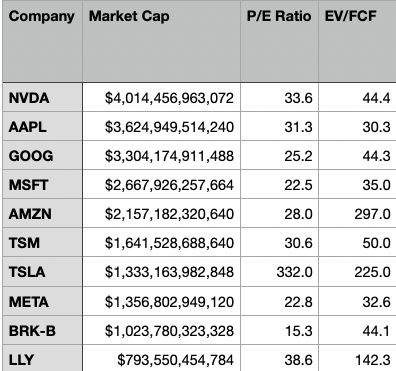
    Today the anomaly that throws the P/E off is not Cash but CapEx. And it's not for Apple but for the other mega caps or AI "hyper scalers". Without worrying who is or isn't in the "Magnificent 7" I compiled the largest 10 market capitalization companies and looked at their P/E and EV/FCF ratios. At time of writing:

    CompanyMarket CapP/E RatioEV/FCF
    NVDA$4,014,456,963,07233.644.4
    AAPL$3,624,949,514,24031.330.3
    GOOG$3,304,174,911,48825.244.3
    MSFT$2,667,926,257,66422.535.0
    AMZN$2,157,182,320,64028.0297.0
    TSM$1,641,528,688,64030.650.0
    TSLA$1,333,163,982,848332.0225.0
    META$1,356,802,949,12022.832.6
    BRK-B$1,023,780,323,32815.344.1
    LLY$793,550,454,78438.6142.3

    As recently as six months ago, there was a lot of talk about an AI bubble. Back then I looked at the data then and by looking at the P/E ratios convinced myself that the valuations were not "bubble" level. They were in the mid-thirties. These were not historical high especially when considering the growth these companies were experiencing (over 30%). Since then prices have come down significantly.

    This is as the CapEx elephant in the room has been making itself known and there is renewed alarm at the scale of capital spending. This is reflected in the EV/FCF number but not in the P/E number.

    The table above shows how much more elevated the EV/FCF ratio is relative to P/E for many of the companies. This "truer" measure of what you are paying as a share buyer is now reflecting in reduced share price and hence reduced P/E.

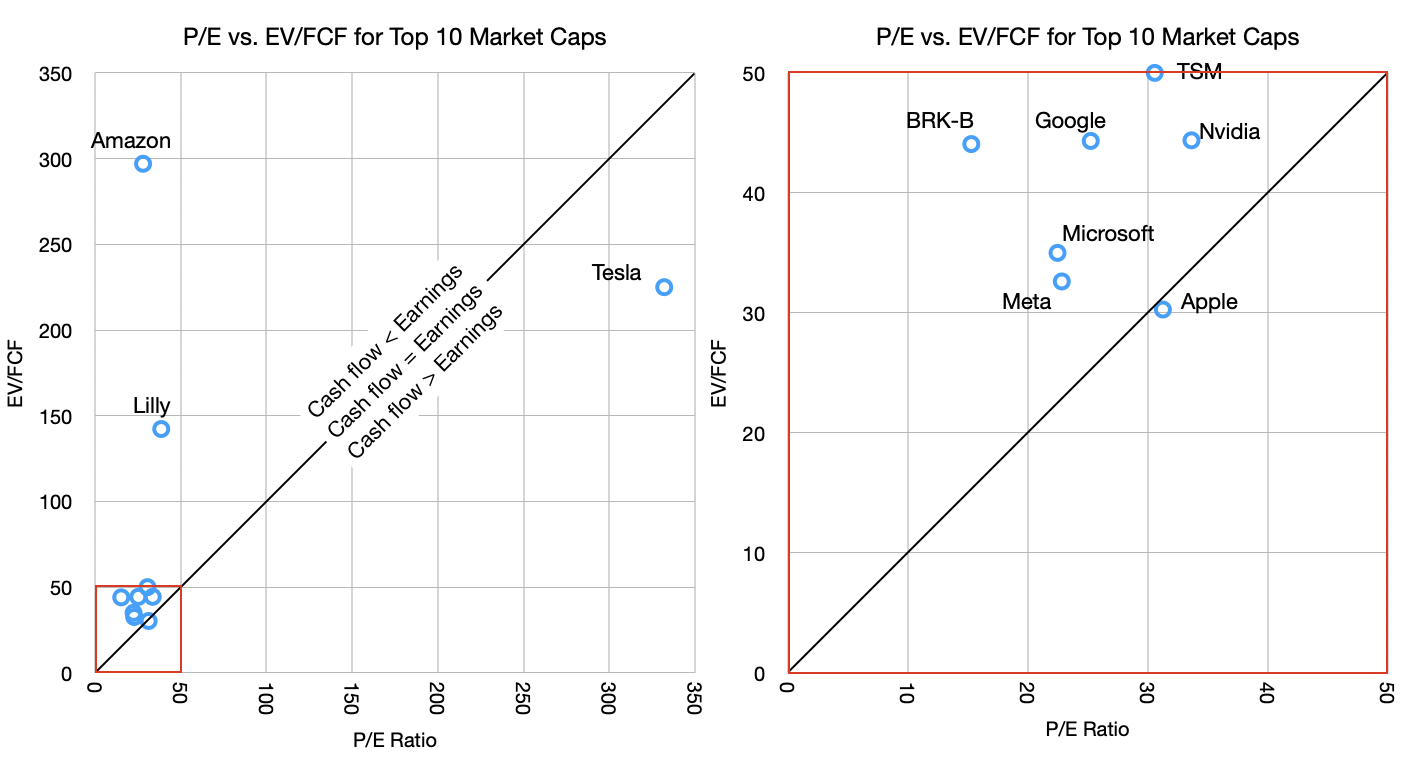
    Of course, this is not true for Apple. Apple's P/E ratio and EV/FCF are nearly identical. To see this more clearly I put together these graphs.
    Valuation in a time of AI

    The graph shows the P/E vs. EV/FCF for the companies in the table. The graphs are the same data but the one on the right is zoomed in on the lower left corner (note the red squares).

    The reason for the zoom is that there are three outliers. Tesla, Amazon and Lilly. Tesla has absurd valuation on both P/E (300 to 400 range in last 6 months) and EV/FCF while Amazon has an outrageous EV/FCF value due to abnormal capital spending. Basically, Tesla has negligible earnings (and negative growth) while holding astronomical share price and Amazon is spending far above its median on CapEx. Amazon's 10-year EV/FCF is much lower, at approximately 55.

    But let's ignore the outliers and concentrate on the other seven in the cluster. These are below 50 P/E and 50 EV/FCF thresholds.

    Note that I drew a diagonal line representing the equation of P/E = EV/FCF. This should, under normal circumstances, hold for most stocks. Just like Market Cap should roughly equal Enterprise Value so Earnings should equal Free Cash Flow.

    Most companies should not stray too far from this line. But what we are seeing, with the notable exception of Apple, is that most tech companies have cash flow far below earnings. This is again due to the CapEx elephant.

    The argument goes that this is a temporary situation with that capital being wisely deployed for returns from AI. Presumably, these companies will swing to the other side of the line, where cash flows will exceed earnings, compensating for the capex that was denied to the shareholders.

    This is where the old adage comes into play: Earnings are an opinion but cash flow is a fact. I added to that "and share price is a dream". Take the free cash flow and multiply it by a "dream" and you get the price the market sets. This dream is the multiple.

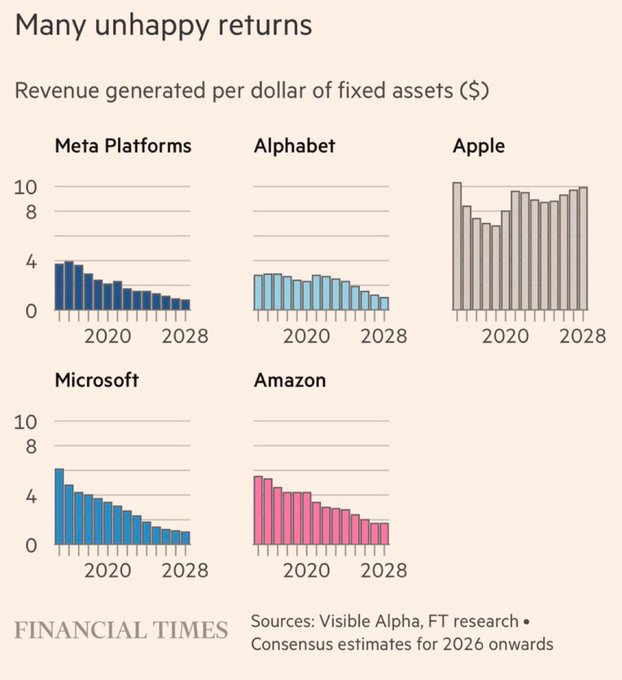
    What makes the AI "bubble" interesting is how it's not fueled by debt[2] but by cash flow. Companies are turning over large portions (almost all and sometimes more) of their cash flows to investing in the dream of AI profits. All but one, of course.

    There is something obviously contrarian in Apple's strategy. Perhaps it's not Apple that is odd but rather there is groupthink on behalf of the others. The question of who's right will rest on whether it turns out that AI is going to commoditize quickly or perhaps never, whether AI turns out to be modular or integrated, whether AI exhibits disruptive or sustaining competitive responses, whether it's an infrastructure subject to regulatory corrosion or whether it will migrate to the edge and iterate freely, whether it's a new experience or simply better existing experiences, whether it creates new markets or just makes existing ones more efficient.

    These are not new questions. They have been applied to all software and hardware innovations of the last 40 years. We have a lot of history to inform us.

    Join me as we learn.

    1. To calculate FCF, look at the Income statement, start with earnings before interest and taxes (EBIT), add depreciation, subtract taxes and CapEx.
    2. There is some debt of course, but the scale is so immense and the risks so high that most lenders would not touch this type of investment.
  2. The Motley Fool asks: Where Will Apple Stock Be in 5 Years?

    Nota Bene · 1 comment

    Not reading this article is probably a wise decision.

    Shares could perform in line with the S&P 500's long-term average

    Investors can follow a straightforward exercise to try and figure out where Apple's stock price will be in late March 2031. It's important to consider both the valuation and profit gains.

    We just released a brand-new report with the full story and the company’s name.

    Apple shares current trade at a price-to-earnings ratio of 31.5. I believe it's reasonable that this multiple could drop to 30 in five years, which is still a premium valuation.

    On the other hand, sell-side analysts hold a consensus view that diluted earnings per share will rise at a compound annual rate of 11.6% between fiscal 2025 and fiscal 2028. If we assume that this pace of growth continues in the years after this explicit forecast period, then Apple's stock price will be around $410 in five years. This translates to a 10.5% annualized gain.

    This is obviously a very rough guide that may or may not prove to be correct. Apple's earnings could surprise to the upside or disappoint to the downside. And market sentiment is also extremely unpredictable, which will impact the stock's valuation. [Seriously?-ed]

    That expected rate of return mimics the S&P 500's long-term average. But if the widely followed benchmark keeps up its performance from the past decade, then Apple will lag the market.

    Source: The Motley Fool

    NB: The Motley Fraud is not a reliable source of anything but bad stock picking advice…

  3. Apple at 50 - Ben Thompson interviews Horace Dediu

    Podcast · 4 comments

    Ben Thompson of the Stratechery interviews Horace on the Stratechery Plus Podcast to discuss Horace's journey to become an influential tech analyst: early career in research, business school under Clayton Christensen, and his time at Nokia during the rise of the iPhone. 

    The conversation further explores Disruption Theory in the context of both smartphones and AI, why Christensen misjudged Apple, and whether AI could challenge today’s tech giants. It also marks the launch of Dediu’s new paid service Asymco One and reflects his continued conviction in Apple Inc. at its 50-year milestone.

  4. Warren Buffett tries to justify his hypocrisy

    Nota Bene · 5 comments

    Shameful.

    "I sold it too soon. But, I bought it even sooner, so," Buffett told CNBC's Becky Quick in an interview Tuesday on "Squawk Box" .

    Apple remains Berkshire Hathaway's largest holding even after the conglomerate trimmed its stake to $61.96 billion at the end of last year, according to InsiderScore.

    However, Buffett said Tuesday that he would continue to add to the position if it gets cheaper. He said the iPhone maker is not yet attractive even after falling more than 14% off its recent high, and dropping more than 6% this month. That's amid turmoil in the broader market, with both the Dow Jones Industrial Average and the Nasdaq Composite in a correction.

    "I'm very happy to have it be our largest holding," Buffett said. "I was not happy to have it be as large as almost everything else combined."

    "It's not impossible that Apple would get to a price, we would buy a lot of it," he added. "But not in this market."

    Buffett said the firm has made more than $100 billion in the stock pretax, and was favorable in his comments regarding Tim Cook's leadership of the firm over Steve Jobs.

    "Tim Cook has done better with the hand. Steve Jobs — he couldn't have done what Steve Jobs did — but Steve Jobs handed him a hand that Steve would not have done as well," Buffett said.

    "Tim was a fantastic manager, and he's a good guy, and somehow he gets along with everybody in the world," he added. "That's a technique I wouldn't have, for example, certainly my partner, Charlie Munger, wouldn't have had it."

    Source: CNBC

    NB: Warren Buffett said he sold Apple stock too soon but clarified he has no actual regrets. Buffett said it is better than any business Berkshire owns outright including its railroad, which is worth more in dollar terms but earns nowhere near the return on capital that Apple does. He also said his railroad might last longer than Apple.

    He said if Apple ever got cheap enough, he would buy a lot more of it. He owned a lot more of it priced a lot lower than what he would have to buy it back at. Complete nonsense.

    Also Warren Buffett:

    Quote: "Our favorite holding period is forever". Action: Trade Apple to realize gain.

    Quote: "Price is what you pay, value is what you get". Action: Trade Apple to make $100 billion pretax, mention that price determines decision.

    Quote: "At a healthy business, cash is sometimes thought of as something to be minimized as an unproductive asset that acts as a drag on such markers as return on equity" Action: Sell Apple and other equities and move $300 billion into unproductive cash.

    Quote: "Investors, of course, can, by their own behavior, make stock ownership highly risky. And many do. Active trading, attempts to ‘time’ market movements..." Action: time decision to trade Apple for cash on the basis of price, tax and market conditions.

    Quote: Apple is "probably the best business I know in the world," "we like to own businesses not stocks". Action: Convert Apple ownership into cash.

    Quote: "I'd love to own 100 percent" of Apple. Action: Sell 60% of Apple holdings.

    Quote: "I don't think of Apple as a stock. I think of it as our third business" Action: Sell Apple, move into unproductive asset cash.

    Quote: "I sold Apple too soon". Action: Also say that you don't regret it.

    Actions speak louder than words. The results will be felt by his shareholders.

  5. Melius highlights FCF while reiterating buy on Apple

    Nota Bene · 3 comments

    Measuring valuation in an era of AI.

    “Given Apple’s free cash flow and we are about to embark on one of its most lucrative product rollouts since the big screen iPhones in 2014 - there is a case for Apple’s stock regaining some ground,” Melius analysts wrote in a note to clients.

    Lately, Apple has announced the iPhone 17e and a refreshed iPad Air, a new MacBook Air, a MacBook Pro, new Studio Displays, the MacBook Neo, and an updated version of its over-the-ear headphones, the AirPods Max 2.

    Apple shares were modestly higher in premarket trading but have lost some 8% year-to-date. Over the past 12 months, shares have gained 12%.

    Source: Seeking Alpha

    NB: Free cash flow (FCF) is the amount by which a business's operating cash flow exceeds its working capital needs and expenditures on fixed assets (known as capital expenditures). It is that portion of cash flow that can be extracted from a company and distributed to creditors and securities holders without causing issues in its operations. As such, it is an indicator of a company's financial flexibility and is of interest to holders of the company's equity, debt, preferred stock and convertible securities, as well as potential lenders and investors. It has come recently into vogue when the bill for AI infrastructures has come due...

    The table above shows the P/E ratios vs. the EV/FCF ratios of the top 10 largest market caps in the world.

  6. Asymco Bulletin 005 - Mar 22, 2026

    Bulletin

    Asymco Bulletin is a digest of all the work we have published for the week ending Mar 22, 2026.

    Research

    How to calibrate executive departures

    Executive exodus explicated.

    In December, the company lost AI chief John Giannandrea, its top lawyer and a key design executive in a single week. Other recent headlines: “Apple faces unprecedented executive exodus”, “Apple rocked by executive departures, with chip chief at risk of leaving next.” “Apple home devices executive leaves for Finland’s Oura” “Lisa Jackson is set to retire late January 2026, while Kate Adams will retire in late 2026”. That’s just the names we hear about. They represent senior executives. But the harsh truth is that Apple lost tens of thousands of talented developers, marketers and mangers last year.

    What's wrong with this analysis? →

    The biggest surprise of the MacBook Neo

    The biggest surprise of the MacBook Neo

    Remembering the PC market.

    Almost 10 years ago I said “Managing the Mac product line must be one of the most challenging problems at Apple. That may not be obvious given the product’s success.” I pointed out that although the company grew the Mac into a redeemed and prosperous platform, “The big change in computing has not been a growing Mac vs. declining PC. It has been a huge surge in mobile device use vs. a decline in PC use overall.” It’s time to revisit this observation. First, a status update: The Mac is in its 42nd year...

    How to read the history of the Mac and how to look at market share gains potential. Also: why the Mac has always been a cheaper alternative for buyers. →


    Nota Bene

    Apple’s China smartphone sales jump 23% as overall market fell 4% to start 2026 → Apple defied market trends with a striking 23% iPhone sales surge in China, outpacing competitors despite broader smartphone shipment declines. →

    Running a data-center AI model on a MacBook

    Running a data-center AI model on a MacBook → The article discusses how Apple's MacBook Pro, with its unique Apple silicon architecture, could revolutionize personal AI by enabling powerful AI models to run locally without relying on cloud data centers, potentially shifting the competitive landscape in Apple's favor despite current perceptions of lagging behind in AI advancements. →

    Tim Cook: Apple just had best launch week ever for first-time Mac customers

    Tim Cook: Apple just had best launch week ever for first-time Mac customers → Apple's MacBook Neo reportedly had its strongest launch week for attracting first-time Mac buyers, hinting at successful customer transitions from Windows. →

    Apple, Samsung Dominate 2025 List of Highest-shipping Models Across Regions → In 2025, Apple dominated premium smartphone markets across North America, Europe, and Asia-Pacific, while Samsung excelled in entry- to mid-tier segments in Latin America and the Middle East and Africa. →

    Apple Is Way Behind in AI—and Still Making a Fortune From It: WSJ → "Apple's billion-dollar AI distribution play highlights its retail prowess but pales against its trillion-dollar ambitions." →

    Lobster Boil

    Lobster Boil → "OpenClaw, a revolutionary open-source AI agent by Peter Steinberger, transforms personal computing by autonomously managing tasks across platforms, sparking a Mac Mini craze and hinting at a future where AI agents are integral to daily life." →

    ‘No Near-Term Catalyst,’ KeyBanc on Apple Stock

    ‘No Near-Term Catalyst,’ KeyBanc on Apple Stock → Near-term catalysts may not sway long-term investors, but if Apple's valuation seems steep, critique the pricing, not its promising 14% revenue growth forecast. →

    Tim Cook squashes retirement rumors, says he ‘can’t imagine life without Apple’ → Tim Cook dismisses rumors of stepping down, emphasizing his enduring passion for Apple and suggesting stability through potential political changes. →

    NVIDIA’s Language Processing Units Shipments Swell 10x+ vs Previous Yr (but how do they compare to Apple Silicon volumes?) → NVIDIA's Groq investment boosts LPU forecasts to 4-5 million, yet Apple's 500 million AI chips dwarf this, hinting at centralized intelligence reminiscent of '1984.' →

    Harmful chemicals found in popular headphones → Apple's AirPods Pro 2 and JBL's Tune 720BT topped the safety charts, while budget brands like Temu raised red flags for hazardous chemical exposure. →

    When does Apple split its stock? → Apple's stock split history shows a pattern of adjusting high share prices to maintain accessibility, with splits occurring around $100-$650 thresholds, potentially hinting at a $300 minimum for future splits. →


    Asymco One gives you full access to our research, analysis, and commentary. Subscribe with code BULLETIN for a discount.

    Feedback: Have questions or comments? Reach out to us at contact@asymco.com. We’d love to hear from you.

  7. ‘No Near-Term Catalyst,’ KeyBanc on Apple Stock

    Nota Bene · 3 comments

    Difficult to draw firm conclusions

    Apple may not have a clear trigger to push the stock higher right now, according to top KeyBanc analyst Brandon Nispel. He reiterated a Sector Weight (Neutral) rating on the stock, saying recent spending data and current valuation leave limited room for near-term upside.

    KeyBanc’s consumer spending tracker showed indexed spending down 9% month over month in February, worse than the three-year average decline of about 4%. On a yearly basis, spending rose 4%, slightly above January’s 3% growth. Nispel said the data from January and February remains mixed, making it difficult to draw firm conclusions about Apple’s demand this quarter.

    KeyBanc also updated its forecasts after Apple’s recent product launches. The firm now expects Apple’s Fiscal 2026 revenue to reach about $466.5 billion. It also raised its Fiscal 2026 earnings estimate to $8.52 per share and Fiscal 2027 earnings to $9.11 per share.
    For the second quarter of 2026, KeyBanc estimates revenue of about $108.7 billion, which would represent roughly 14% year-over-year growth.

    With Apple trading close to its historical valuation levels, Nispel said he does not see a “clear near-term catalyst” that could push the stock higher.

    Turning to Wall Street, analysts have a Moderate Buy consensus rating on AAPL stock based on 15 Buys, nine Holds, and one Sell assigned in the past three months. Furthermore, the average AAPL price target of $305.18 per share implies 17% upside potential.

    Source: TipRanks Financial

    NB: Near-term you say?…

  8. When does Apple split its stock?

    Nota Bene

    Is there a pattern?

    Apple has split its stock 5 times in its corporate history. Here’s a history of Apple’s stock splits and where its price would be now had it not divided its shares.

    After its first stock split in 1987, the tech giant conducted four additional splits, bringing its total to five in its corporate history as of mid-March 2026: 

    On June 21, 2000, Apple conducted a second 2-for-1 stock split.

    Apple conducted its next 2-for-1 stock split on Feb. 28, 2005.

    Apple’s next stock split was also its biggest: 7-for-1 on June 9, 2014.

    The most recent was a 4-for-1 stock split on Aug. 31, 2020.

    Current Apple stock price x 4 x 7 x 2 x 2 x 2 = Apple stock price had the stock never been split

    Based on the March 12, 2026, closing price, Apple stock would be $57,290.24 per share had it never been split.

    Source: TheStreet

    NB: The question on when would be the next split sometimes comes up…

  9. Asymco Bulletin 004 - Mar 15, 2026

    Bulletin

    Asymco Bulletin is a digest of all the work we have published for the week ending Mar 15, 2026.

    Research

    The most brilliant move in corporate history?

    In a bold departure from its Big Tech peers, Apple sidestepped the $650 billion AI infrastructure spending frenzy. While Amazon, Google, Microsoft, and Meta funneled cash into data centers, bleeding cash flow and adding debt, Apple maintained a consistent $14 billion capital budget. This strategic choice reflects Apple’s belief that AI models are rapidly commoditizing, as evidenced by DeepSeek’s $6 million model rivaling $100 million counterparts. Instead of building proprietary models, Apple licensed Google’s Gemini, reserving the option to switch vendors as superior models emerge.

    Apple’s genius lies in leveraging its ecosystem—2 billion devices transforming into a distributed AI powerhouse. Apple silicon on device enables local AI processing, bypassing the need for colossal server farms. This approach not only conserves capital but also amplifies customer loyalty, as Apple uniquely protects privacy. Ultimately, Apple bets on owning the customer experience, positioning itself to thrive regardless of infrastructure ownership. →

    Is Apple Pivoting?

    Apple's recent product launches, including the 17e and MacBook Neo, have sparked speculation about a strategic shift towards low-end markets. However, this view overlooks Apple's fundamental approach to market segmentation, which eschews simplistic price categorizations. Instead, Apple focuses on the "job-to-be-done," understanding that consumer purchases are driven by desired outcomes rather than affordability alone. This perspective reveals that performance and quality are crucial, transcending income levels. For instance, affluent individuals may opt for simpler devices, while budget-conscious consumers might invest in high-performance tools to meet specific needs, like content creation.

    Historically, Apple has aimed to deliver superior experiences to a broad audience, refusing to compromise on quality with budget-friendly products like Chromebooks. While cost can limit access, as seen with the Vision Pro, Apple prioritizes profitability as a validation of its value proposition. The MacBook Neo exemplifies this ethos, leveraging efficient mobile chipsets to redefine laptop capabilities at a competitive price point. This innovation blurs the lines between mobile and traditional computing, underscoring Apple's commitment to crafting products tailored to diverse tasks. Ultimately, Apple's strategic depth, powered by Silicon advancements, positions it to serve an expansive global market by addressing a wide array of functional needs. →


    Nota Bene

    Rosenblatt Lifts Price Target on Apple by $1, Maintains Netural Rating → On March 5, Rosenblatt's Barton Crockett slightly raised Apple's price target to $268 while maintaining a Neutral stance, optimistic about Apple's budget product launches and steady high-end performance, despite trading at a modest premium compared to peers, as analysts foresee robust revenue growth for FY2026. →

    How many employees does Apple have? What do they do? → Apple, despite its marketing reputation, is fundamentally an engineering powerhouse with nearly half its workforce dedicated to engineering roles, driving its substantial revenue growth and global employment expansion. →

    First footage of X-Plane 12 on Vision Pro → X-Plane 12 on Apple Vision Pro leverages ARKit to seamlessly integrate physical controls into a mixed reality flight simulation streamed from a Mac, showcasing advanced professional-grade AR capabilities. →

    iPhone production in India increases by 53% in 2025 → Apple's strategic shift to ramp up iPhone production in India by 53% last year, aiming not just to sidestep tariffs but to cultivate a vast new customer base, underscores a long-term vision mirroring its successful penetration of the Chinese market. →

    Qualcomm faces loss of Apple business, rated ‘Underperform’ by Bank of America → Qualcomm's dominant era in smartphone chips wanes as Apple and others pivot to internal solutions amid costly licensing disputes. →

    MacBook Neo May Boost Revenue By 0.5% While Expanding Into Student Market – Gene Munster → The MacBook Neo, targeting both education and broader markets, could modestly boost Apple's revenue by $2 billion annually without impacting margins, potentially revitalizing the Mac segment akin to Covid-era growth. →

    Apple’s AI Hardware Blitz Could Send The Stock 33% Higher, Says Wedbush’s Dan Ives → Apple's hardware blitz prioritizes product refreshment over AI emphasis, potentially setting the stage for future growth, though its $350 stock target faces external market challenges. →

    China’s Android shipments plunge as inventory builds in contrast to iPhones: Jefferies → "China's Android market faces a perfect storm of rising inventories, soaring memory costs, and renewed iPhone strength, hinting at a potential tipping point." →


    To gain full access to these articles, subscribe to Asymco One.

    Use code BULLETIN for a discount.

    Feedback: Have questions or comments? Reach out to us at contact@asymco.com. We’d love to hear from you.

  10. JPMorgan Says Apple’s Results Should Calm Investor Nerves

    Nota Bene

    On January 30, JPMorgan analyst Samik Chatterjee raised the price target on the stock to $325 while reiterating an “Overweight” rating. The firm is confident on the stock as it sees Apple results as reassuring for investors.

    According to the firm, Apple’s latest financial results should help “calm investor nerves” about memory-related impacts on gross margins and concerns regarding a Services slowdown. This is despite the magnitude of iPhone revenue upsides, which is “noteworthy” itself.

    JP Morgan also highlighted Apple delivering “record Product gross margins” in the December quarter, with the March quarter also anticipated to show record product gross margins.

    This, the firm believes, should help investors be reassured regarding the materiality of the impact that investors have been concerned about related to rising memory costs.

    “Record Product gross margins in the December quarter and an implied March quarter record Product gross margin should help reassure investors around the materiality of the impact that investors have been concerned about in relation to rising memory costs, even though management acknowledged slightly higher impact in March quarter than the December quarter.”

    Read the original article →

    Our Take

    Apple delivering “record Product gross margins” and guiding even higher is a jaw dropper. Especially as memory prices are soaring.

  11. Apple stock price today: AAPL climbs at the open as $315 target meets earnings week - TechStock

    Nota Bene

    Apple stock price today: AAPL climbs at the open as $315 target meets earnings week  TechStock

    JPMorgan analyst Samik Chatterjee bumped his Apple price target to $315 from $305, according to MarketScreener. Keep in mind, a price target reflects where an analyst expects a stock to land within a year—it’s not a guarantee.

    Jefferies analyst Edison Lee remained cautious, maintaining a Neutral rating while cutting his price target to $276.47 from $283.36. These mixed calls highlight just how close the debate is ahead of earnings.

    Read the original article →

    NB:

    It's not that close. False precision on Jefferies' target belies a grand failure.