Asymco

Asymmetric Intelligence

web

  1. Talent follows where business models lead: The Media Business Disruptions

    Research · 46 comments

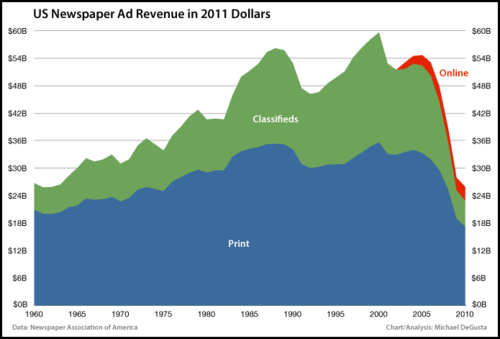
    Michael DeGusta created beautiful and informative charts on how The Newspaper Business Implodes.
    With charts, he also told the story of how the recorded music industry followed a similar path:

    Image (media.tumblr.com)

    He writes:

    As in the music business, digital revenue is failing to make up for the loss of traditional revenue. Ominously, online revenue is largely flat, basically unchanged from 5 years ago and still below its 2007 peak.

    What I find fascinating is how both industries reacted to the crisis of old media. They embraced the new "digital" distribution model, earnestly tried to transplant their business models and found no succor.

    Many observers may say that both print and music businesses were "foolish" and that they ignored the new medium of web. That somehow management dithered and missed the new wave blaming failure on incompetence. Putting aside the fact that all industry participants seem to have conspired to be foolish at the same time, this is not supported by the data. As the charts show, both industries built digital businesses. Newspapers have some of the most desirable web properties and digital music is a growing business with clever new distribution deals. They became quite smart in their respective adaptations of web distribution.

    They may have started slowly but there are many cases where incumbents reacted slowly to technological change, and won.

    But it's not working.

    The reason is that what we have here is a disruption. Unlike a sustaining technological shift, the new medium of the web did not permit the same business models to continue. Money was being made, just not in the same way and thus could not support the cost structures of the incumbents. Consumption of news and music is increasing but the way that it is valued is changing.

    Furthermore, it's become modularized. All the objects contained in a newspaper could, with the web, be offered independently of one-another (opinion, news, classifieds, lifestyle can each be built by specialists.)

    This is because the technology of the printing press benefits the integration of content while the technology of the web benefits the disintegration of content (similar phenomenon to the music industry's bundling into albums, vs. unbundling of digital downloads.)

    Now I'm going to take a leap and suggest that a re-birth of the container of the newspaper in the tablet medium will require a re-integration once again. As I've pointed out before in The integrated iPad news daily: Read all about it! the answer is not in integration or disintegration per se. It's in approaching the question of value chain evolution with an eye toward what is good enough and what isn't. Integrate when the product is emerging and unsatisfying, modularize when the product is mature and over-serving.

    We're observing the same phenomenon with television. Netflix, a distributor, is vertically integrating by entering production with an exclusive top talent series.

    Developers are not the only innovators that see disruption happening. Just like in "The Daily", in music and television, talent follows where business models lead.
  2. The Asymco way

    Research · 49 comments

    When I started Asymco.com I did not have a plan. I did not have a policy or vision statement. I wrote what I found interesting. I knew nothing of blogging or of web publishing as a business. Over the following nine months I learned a few things. I also learned a bit about how web publishing (and publishing in general) works.

    My observations were brought into clear focus by this brief overview of the core values of web publishing summed up by this leaked document form AOL: "The AOL Way".

    AOL tells its editors to decide what topics to cover based on four considerations: traffic potential, revenue potential, edit quality and turn-around time.

    AOL asks its editors to decide whether to produce content based on "the profitability consideration."

    The documents reveal that AOL is, when the story calls for it, willing to boost traffic by 5 to 10% with search ads and other "paid media."

    AOL site leaders are expected to have eight ideas for packages that could generate at least $1 million in revenue on hand at all times.

    In-house AOL staffers are expected to write five to 10 stories per day.

    AOL knows its sites are too dependent on traffic from AOL.com, and it wants its editors to fix the problem by posting more frequently, with more emphasis on getting pageviews.

    This codification of values has inspired me to put in writing my own priorities for Asymco:

    • Learn by writing. Teach by listening.
    • Improve. Move the intellectual ball forward.
    • Illuminate topics which are bereft of analysis.
    • Be notable. "The proliferation consideration." How likely is the idea to being widely re-published?
    • Review. Encourage participation by reading all comments and reply to as many as possible. Police comments with zero tolerance.
    • Repair. Declare and correct errors.
    • Select. Publish only when the contribution is unique. Avoid redundancy, clutter and noise. Don't waste reader time.

    Many have asked: What about the business model? I'm afraid there isn't one. I'm still naive enough to think that if I build a great product then everything else will take care of itself.

  3. Is HTML5 a Flash in the pan?

    Research · 31 comments

    When Apple promoted HTML5 as an alternative to Flash, the value was said to be in being an open standard, and in having better efficiency for device-based execution.

    The problem is that there are no authoring tools for HTML5. Flash is popular because it's fairly easy to kick start the creative process. You buy the tools from Adobe for a few hundred dollars and begin to tinker. With HTML5 you need to be a programmer, read arcane documentation, search for sample code and manually integrate results into publishing systems. That's bush league.

    iAd Producer narrows the gap a bit.

    The bigger question that I struggled with is whether web apps are competitive enough. The absence of tools is a damning accusation that they aren't. Note that Apple is first introducing production tools for iAd, not for web apps in general nor web content in particular.

    So why isn't there an iWeb-like tool to allow consumers to design web sites (for MobileMe Galleries for example) which benefit from HTML5? At the other end of the spectrum, where are the Apple equivalents to Adobe's Flash Professional (with CS5 integration)?

    The tools for HTML5 are just not there. Tools are the first things needed to build an ecosystem. Is their absence due to a lack of demand or are there no skilled toolmakers outside of Adobe?

    When the market is failing to deliver a solution, I question the need for the solution in the first place. It's also worth while to follow the money: Adobe makes money only on the tools for Flash, not on distribution of content. For anyone to disturb Adobe's franchise, it's tools that need to be put forward as alternatives. Tools are not easy to build. Are the incentives simply not there?

    I hope iAd producer is the first in a series of tools from Apple to build an HTML5 ecosystem. Whatever the future of web apps is, it's coming very slowly. No wonder Flash is still a viable business for Adobe.

  4. The asymmetric competition between Google and Apple app stores

    Research · 56 comments

    In the latest version of Android, Google shifted from bitmaps to vector rendering for maps.  The shift is probably more a function of available processing power on the device than a strategic shift to position value on the device rather than in the cloud. Vector maps, which are much more efficient in terms of bandwidth and local storage, have been the choice for in-car navigators but Google has always been using bitmap tiles which are fetched from a server and delivered only if the device is using a data connection. The downside for vectors is that they require a bit more local processing power.

    I doubt that Google's move to vectors is part of a shift to more app-centered/edge-of-network strategy.

    How is this relevant?

    Google has been riding a wave of re-centralization of value toward the center of the network as broadband made the cloud feasible. Keep in mind that Microsoft rode a wave of de-centralization as value moved to the PC and away from the mainframe. As intelligence was pushed to the edge, Microsoft accrued value from enabling the edge as a locus of productivity. This is no small thing.

    Then came apps.

    The supernova that is the App Store illuminated the possibility that apps are perhaps a "pushback" on the center. Like all good disruptions this was unforeseen: Apple built the store and the apps sold; by the billions. Apple joined the world in a scramble to react. Something profound was happening, but the very brightness of this explosive growth blinds us to what is actually going on.

    My hypothesis is that there is a tug-of-war going on between the mobile cloud and the device-at-the-edge. Both will become better and neither is good enough. Technology roadmaps point to both higher availability of local storage/processing power as well as faster, cheaper and more ubiquitous mobile broadband. So technology insight by itself is not enough to give us a clue to the outcome.

    What I would focus on is what is more natural for the user.  Note that Twitter and Facebook both have better interfaces with their apps than they do with their browser interfaces. That and innovations in game interaction points out that apps are as much a disruption of UI metaphors as they are of the locus of power in the network. It would not surprise me if people end up spending a larger part of their lives tethered to device-enabled social media, "firing" the PC from the job of social interaction.

    If we believe the app will grow as the preferred interface for the web (and I'm leaning in that direction) then the implications are potentially harmful to Google. Google does not "do" interfaces. Their strategic assumption has been that interfaces are commodities. The browser is the universal interface. Perhaps HTML5 will offer sustenance to the concept, but it's not a panacea. Web apps have a long way to go to become competitive with hand-crafted app UIs. (While web apps have been possible for iPhone since its inception, developers vote en-masse for apps and almost zero popular web apps exist. Ditto for Flash-to-app interface ports.)

    This brings us to focus on the asymmetry of business models.

    the App Internet

    What we end up with is the "app internet": a potential disruption of the browser-as-interface and the re-integration of the user experience around the device. Because the iTunes store allows money to be attached to new interface innovations, developers follow and compete on better interfaces rather than on access to the back end.  The asymmetry ensues from the fact that by attaching profit to the point where the user touches the screen, Apple took the basis of competition for developers away from the cloud.

    In other words, the point where the electrical charge of the human skin is detected is suddenly the exact location of value capture from mobile computing.

    Of course, Google is responding, but since they did not focus on seamless and curated experiences, developers are not seeing returns for investment in interfaces at the touch point. As a consequence, Google apps developers seek ad revenues. In turn, this is a road that leads to less innovation in interfaces and more innovation in network-dependent services.

    I sense a distinct asymmetry in app trajectories between the platforms due to core business model choices. Asymmetric competition causes the great fortunes to be made and great fortunes to be lost.

  5. iPad: IT gets it

    Research · 27 comments

    In the last article on the share of PCs highlighting the unwillingness of market analysts to categorize the disruptive iPad as a PC I imply that Gartner does not "get it".

    This is partly willful and partly instinctive. The willful ignorance is due to a belief that their customers (IT managers mostly) do not want to hear about the iPad as a viable technology. Certainly there is a lot of anecdotal evidence that the iPad is unworthy of consideration as a business tool.

    However, there is also increasing evidence that IT does in fact get it. I have met several senior IT managers who are whispering that the iPad will change everything. For us to decide which way the wind blows, we need to think harder about the process by which technology gets adopted in large IT organizations. Understanding how the technology is hired by IT managers to improve their career prospects unveils who wins and who loses in IT.

    The main hypothesis I put forward is that IT is an example of "rule of man" not "rule of law". The idea that law or "standards" (as doctrine is known by the jargon,) defines the products in use is a conventional myth. Standards change and they change quite dramatically based on who's in charge. The "standard" during the 70's was the Mainframe, the "standard" in the 80's was the DOS PC and the "standard" in the 90's was client-server and in the 2000's it was the web. Each new standard was a violation of the previous standard. So how did this change happen?

    Each evolution of technology standards affects the career of the IT manager. The adoption of technology is the primary driver for advancement in the profession. In most cases the technology being adopted is sustaining. In rare cases it's disruptive and can cause unforeseen re-distribution of IT power (and wealth).

    As IT is a cost center, naturally, organizational behavior (or, in the vernacular "politics") dominates the decision process. Senior managers look at each technology and ask: how can this help me achieve my career goals? Let's try this exercise with various innovations that have come along in the last few years.

    1. The Web in 1998. As IP based networking was catching on, the new technology offered a new way to tie existing assets together. It was also a completely new communication channel with customers. This was a great opportunity to increase IT consumption. It would lead to more work, more budget, more visibility and even a strong link between the profit centers of the company and the IT world. The web was an opportunity. It led to a firestorm of adoption.
    2. OSX in 2004. As Windows PCs were widespread and, given the support infrastructure behind them, worked well enough, an IT manager would look at a Mac and see no opportunity to increase their value add. They could not offer new software tools with it, and the old tools would probably not work without debugging. They could not move a Mac to new use cases and could not increase headcount to support it. The Mac was not a career opportunity.
    3. The iPad in 2010. As an IT manager looks at the iPad (and smartphones in general), he sees a similar opportunity to the Web ten years ago. The company users love their devices. Top executive love their devices. They see consumerization happening and there is no denying the explosive growth. There are challenges with integration but these devices are not a direct threat. The iPad is an opportunity to migrate to a completely new form factor and increase IT consumption.

    What this means politically is that the manager who figures out a way to roll out mobility in the organization will get the same uplift in his career as his predecessors did when they brought in disruptive waves. Those periods have become the stuff of lore and legend. Every IT manager with ambition is looking to create and ride a new wave. If the person is a mid-level manager, they will scramble to be the champion of the new technology and become a rising star. If the person is a high-level manager, they will see it as a way to protect their empire by co-option. Jostling for a vehicle to bring in the technology will begin. These vehicles are typically vendor relationships. Small vendors (example) have a better chance as the traditional vendors (for example SAP) and integrators are not quick enough with product development and don't have the products to sell.

    This IT manager's job-to-be-done analysis is crucial to understanding the adoption of IT technology.  Sustaining IT products do not sell themselves even if they are superior. Conversely, new products cannot be kept out of an organization even if they violate standards. What matters is whether they help the decision maker to achieve personal goals.

    My own intuition, having worked in such an organization (albeit briefly), and after a few conversations, is that the iPad and the mobile devices it represents is going to influence a generation of IT spending.

    Even though Gartner doesn't, IT goes get it.

  6. Is Android share of Web lagging iOS share of Web?

    Research · 12 comments

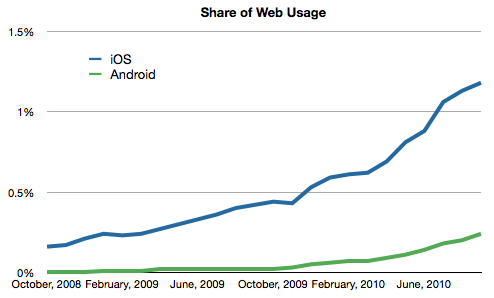
    Of all the public statistics about platform share, Share of web use must be the most important measure for Google. The more browsing people do, the more searching they do and if Google search is most likely for a platform then the more income Google derives from that platform.

    NetMarketshare.com has offered an insight into the split between Android and iOS as search platforms and it shows how iOS is still five times more likely to yield search revenue than Android. That multiple is likely to shrink as the gap narrows, but it still demonstrates the power of iOS to drive Google's bottom line. It's no wonder then why Google has renewed their default placement of Google search in mobile Safari (a guarantee they don't seem to share with all Android licensees.)

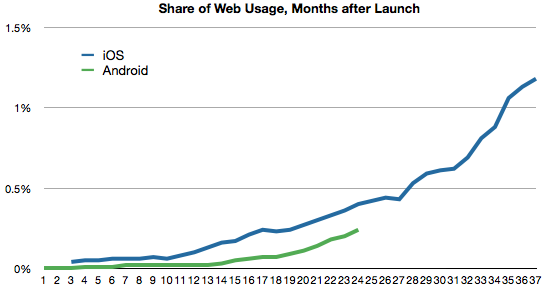
    But Android launched later than iPhone, so everyone should be asking how rapidly the share of Web has grown since the start of each platform. When iPhone launched in 2007 it was almost competing with mobile web non-consumption. The alternative mobile browsing experiences were so bad that it's hard to remember anyone putting up with them. A year later, the bar was set higher and Android filled a vast chasm of demand for mobile browsing for people who could not buy an iPhone.

    At the same point in the life of each platform, Android seems to be exploding in units sold. With this proliferation of Android licenses, it should be interesting to see if their unit share numbers are reflected in web share numbers. So far the story is not convincing. The growth in Web share is not pacing faster than iOS achieved at a similar point in time.

    So far, 24 months into the life of each platform, iOS leads by almost 50% higher share.

    iOS/mobile Safari has the advantage of iPod and iPad for distribution but that does not explain the relative lag of Android with respect to Web share as Android has a large number of SKUs.

    It may be too early to draw conclusions, but anyone trying to analyze Google's strategy with Android should be paying close attention to this.

  7. FaceTime and the elevation of emotion over function

    Research · 8 comments

    With 50 million clients installed likely this year, FaceTime is a service which may have potential.  By potential I mean, of course, its potential to make a dent in the universe, the universal goal Jobs has set for Apple so many years ago.

    It's entirely possible that FaceTime will be an inconsequential nice-to-have enhancement to the iPhone platform that sustains and improves the iOS (and OSX) franchise. But it's also entirely possible that FaceTime could become a disruptive challenger to the functional voice-oriented telecom network.

    What you choose to measure determines what you know

    The thing that jumps out at me is the service's under-performance along metrics that the industry defines as critical but over-performance on dimensions that the industry considers non-critical.

    It suffers from poor coverage (WiFi only), a limited network of possible users, high bandwidth requirements which are still hard to match and a steep price point for initial entry.

    But I would say data-oriented devices were similarly met with poor performance 4 to 5 years ago. No 3G, poor coverage, few services and high prices. Even today there are many telecom skeptics who think smartphones are toys for the well-to-do or IT types and not something for the mass market.  As can be easily seen however, all the shortcomings of the mobile-data-oriented-device (aka smartphone) turned out to get ironed out with time. You just need to plot a historic graph of network performance and device price points to see where they're going to go.

    On the other side of the equation FaceTime offers huge performance on the dimension of emotional attachment to a device and to a conversation. The FaceTime experience is qualitatively distinct from either desktop video chat or device-based VoIP. It's intimate, emotional and stirring, (just look at the commercial) not to mention accessible by just about anyone. These new measures of performance cannot yet be quantified with spreadsheets and measuring the effect will not be a priority for anyone in the industry for a long time to come. Therefore, the asymmetry is there implicitly.

    So here we have classic Apple: shifting of the basis of competition so subtly that it's almost imperceptible while under way yet glaringly obvious after the fact.

    So what does FaceTime have to do with FaceBook?

    When FaceBook launched, I don't recall observers predicting that a site allowing college students to keep track of their friends after graduation would grow into the stickiest site by time spent online ever seen. Nor that it would become a site that swallowed all online communications including IM and email. Nor a site that would possibly challenge search consumption. The performance attributes that FaceBook relied on were not in algorithms but in the emotional hooks that relationships have with people. FaceBook was personal, emotive and private, the exact opposite of what the Web offered a decade ago.

    So, like the names imply, both these services are about Faces, the first objects we as humans recognized after birth. That's a powerful image to have a handle on.

    The pattern that emerges is that Web 2.0, Telecom 2.0 and Personal Computing 2.0 will pivot on the elevation of emotion over function. That may be a banality but empires have been built on less.

  8. Gartner's Nick Jones on Symbian: Abandon ship

    Research · 2 comments

    Market share is an existential threat to Symbian, it imperils the very existence of the platform. And the main reason Symbian is losing share is the user experience which isn’t competitive with Apple or Android. Based on the early previews I’ve seen Symbian 3 looks to have polished a few of the rough edges, but doesn’t fix the problem. So if the weak UI is threatening Symbian’s very survival the Foundation ought to be seriously worried, right? Wrong. I just looked on the Foundation web site and blogs at the roadmap and features for future releases. What I see is too much effort on stuff that really doesn’t matter. For example: Audio policy packages for Symbian, WIFi direct, support for an “open cloud manifesto”, an accredited Symbian developer program for China, better multitasking, multiple personalised home screens, HDMI connection to external TVs, better web runtime support, better internal architecture and so on.

    Forget elegant architecture, forget better multitasking, forget Chinese developers, forget release schedules that don’t deliver S4 devices with a new user experience until 2011. None of these matter. People will never use the features if they don’t buy the phone. The situation is now serious enough that any developer who isn’t working on something directly related to a new UI is wasting their time. The S4 UI is a “bet the platform” project. For any organisation to be in a situation where its survival depends on one project is very dangerous, especially when their track record in the area isn’t outstanding. I think the Foundation needs a contingency plan in case the planned S4 interface isn’t radical enough or good enough. Maybe redirect some developers and start a couple of skunkworks projects to create new competing UIs for S4, or perhaps announce a competition with a $1M prize for a new Symbian UI to encourage some radical ideas.

    I think the Symbian foundation is just re-arranging the deck chairs on the Titanic and ignoring the Android iceberg ahead.

  9. Deagol: iPad web usage 20x iPod

    Research

    So my prediction from six and a half weeks ago came through, with a couple of days to spare. iPad has surpassed iPod in web traffic. It took only two months and two million units, compared to almost 3 years and about 40 million iPod touches out there. That means iPads use the web roughly 20 times as much as iPod touches.

    Also, not only has iPad more than doubled Android 2.1's share, it's now past all Android OS's combined. .

    via Deagol's AAPL Model: iPad web usage passes iPod.

    Good call.

  10. The Mobile Web vs. the Objective-C Web

    Research

    At one point in time, J2ME (now Java ME) and WAP were the starting points for a discussion on mobile strategy and the web. Then, for a brief period of time, you talked about HTML/CSS. Now, for a growing majority of mobile strategies that don’t require a global presence on widely varying devices, the discussion begins with iPhone. Smart client is now iPhone app, and in many cases, the app is primary to the experience, not secondary to the browser. And iPad app may soon replace iPhone app as the starting point.

    Frankly, as the adoption rate of iPhone increases and if iPad follows suit, it will become increasingly difficult to argue in favor of a starting point other than iPhone OS. The NPR iPad app, for one, provides a much more pleasant user experience than NPR.org.

    via Cameron Moll: Designer, Speaker, Author The Mobile Web vs. the Objective-C Web.

  11. Headroom

    Research · 2 comments

    On a planet with around 6.8 billion people, we're likely to see 5 billion cell phone subscriptions this year.

    http://www.itu.int/net/pressoffice/press_releases/2010/06.aspx

    ITU expects to see the number of mobile broadband subscriptions exceed one billion globally during 2010, having topped 600 million by the end of 2009. With current growth rates, web access by people on the move — via laptops and smart mobile devices – is likely to exceed web access from desktop computers within the next five years.

    Mobile broadband is a good proxy for mobile computing so it’s very likely that these 1 billion subs will use advanced devices if not smartphones per se.