Asymco

Asymmetric Intelligence

Windows Mobile

  1. Android vs. Windows Phone: Which vendors benefit?

    Research · 32 comments

    Who is Winning the U.S. Smartphone Battle? | Nielsen Wire.

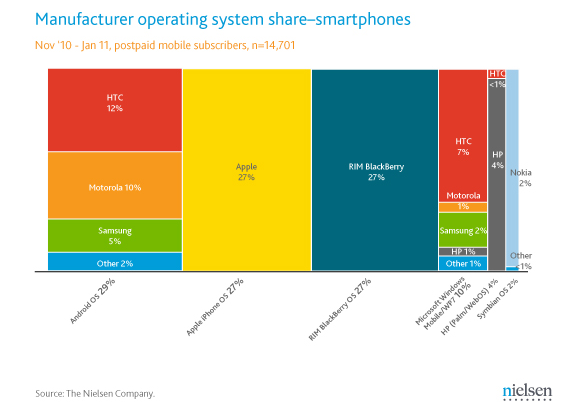
    This is a great chart from Nielsen showing the split in manufacturer share by OS in US installed base. What I consider significant is how the modular software platforms Windows Mobile and Android worked out for the licensees.

    Whereas in the case of Windows Mobile HTC took a significant, nearly dominant share, the Android ecosystem was more balanced between HTC and Motorola. However, HP and Motorola left the Microsoft camps, Motorola going exclusively for Android and HP buying Palm. That leaves Microsoft with HTC, Samsung and Other (mainly LG I presume).

    The question of how Windows Phone will shape up vs. Windows Mobile and Android remains. Motorola has signaled they are not interested in WP7 for the time being and so it's likely that they will stick with Android. Samsung is always hedging its bets so it will probably balance its portfolio. One could conceive of Nokia stepping into the US with significant WP volumes, but there are many hurdles on the way.

    One can see the challenge individual modular vendors have to edge the overall volumes of the integrated vendors. As Nielsen points out:

    But an analysis by manufacturer shows RIM and Apple to be the winners compared to other device makers since they are the only ones creating and selling smartphones with their respective operating systems

    Not only are the volumes higher, but so are the margins and hence profit share.

  2. Platform sunk (cost): What is the value of a quarter billion Symbian users?

    Research · 38 comments

    In the quarterly smartphone summary published here, I noted the significant acceleration of Android sales at the expense of "other" and Windows Mobile/Phone. Some share was also lost to Symbian. This might be seen as justification for the "platform jump" that Nokia undertook.

    In a second discussion, I published the history and life cycles of the smartphone platforms, identifying 10 platforms (out of 16) still in the market. This challenged the view that it was a two horse race today and that it will become no more than a three horse race in the future.

    Questions came up about the "quality" of these platforms. Clearly some are barely viable while some are thriving. To explain the value of a platform, one metric we can use is the cumulative sales which allows us to derive the installed base.

    The following charts do just that.

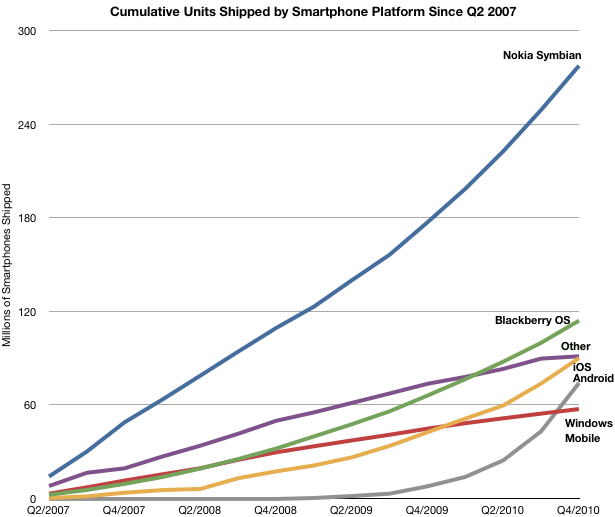
    This first chart shows the cumulative total of units sold since Q2 2007. This is the sum of all smartphones sold in the last 3.5 years. There are some interesting patterns here, but right now we want to focus on the installed base.

    3.5 years of cumulative sales is an upper bound on the installed base. We can get a better estimate the phones in use by subtracting from the base phones older than 2.5 years. This is shown in the second chart below:

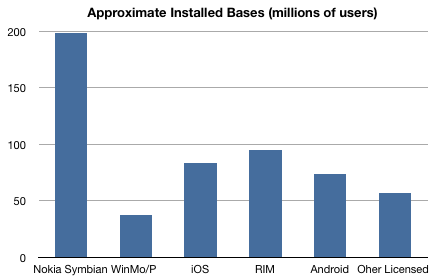
    As of the last quarter, Nokia's Symbian is likely to have 200 million in use. Apple may have about 85 million iPhones in use (this excludes iPod touch and iPads) and Android about 75 million. RIM is around 95 million and Windows Mobile less than 40 million.

    What's interesting is that of these installed bases, the largest is the one that's just been abandoned, and the smallest was chosen as its replacement. Even that's not quite fair since Windows Mobile is not a valid replacement. It's Windows Phone that was chosen and that probably has an installed base of about 1 million [Unlike the measurement of units shipped, Microsoft reported two million licenses were sold to OEMs who had to build those into phones which would be shipped to carriers and distributors. One million may be a generous estimate.]

    The bottom line is that there are about 5 Windows Phone users for every 1000 Symbian users. In other words, Nokia jumped from the "burning" 200 million user Symbian platform to the "ice cold" 1 million user Windows Phone platform.

    The disposal of such a large installed base must count among the largest divestitures in technology history and, when coupled with the adoption of the least-tested alternative as a replacement, elevates platform risk-taking to a new level. It may seem bold, but there is a fine line between courage and recklessness.

    I'll do my own "dive" into the possible justification for this in a future posting.

  3. In memoriam: Microsoft's previous strategic mobile partners

    Research · 223 comments

    Microsoft's new "strategic partnership" with Nokia is not its first. For a decade the software company has courted and consummated relationships with a variety of companies in mobile and telecom. Here are the ones I can remember:

    • LG. In February 2009 Microsoft Corp. signed a multiyear agreement for Windows Mobile to be included on devices from LG Electronics Inc. LG would use Windows Mobile as its "primary platform" for smartphones and produce about 50 models running the software.

    What happened? LG made a few Windows Mobile devices but with WinMo uncompetitive, they abandoned the platform and moved to Android losing years of market presence and all their profits.

    • Motorola. In September 2003, Motorola  and Microsoft announced an alliance. "Starting with the introduction of the new Motorola MPx200 mobile phone with Microsoft Windows Mobile software, the companies will collaborate on a series of Smartphone and Pocket PC wireless devices designed to create a virtual "remote control" for the Web-centric, work-centric, always-on-the-go mobile professional." In addition, the alliance includes cooperation on joint marketing and wireless developer programs.

    What happened? Motorola launched a series of Windows Mobile phones culminating in the Motorola Q "Blackberry killer". As Motorola hit the rocks in profitability new management reached for the Android liferaft. The company now relies exclusively on the Droid franchise.

    • Palm. In September 2005 Palm and Microsoft announced a strategic alliance to "accelerate the Smartphone market segment with a new device for mobile professionals and businesses. Palm has licensed the Microsoft Windows Mobile operating system for an expanded line of Treo Smartphones, the first of which will be available on Verizon Wireless’ national wireless broadband network."

    What happened? Palm shipped a few Windows Mobile, famously dismissing Apple's potential entry as something "PC guys" could never achieve. A new CEO, a private placement and an acquisition later the company is a division of HP making its own operating system.

    • Nortel. When Steve Ballmer was famously laughing at the iPhone and saying that he likes the Windows Mobile strategy "a lot" he was sitting next to the then-CEO of Nortel (Mike Zafirovski formerly of Motorola) with whom the company had just closed a strategic deal.  "an alliance between Microsoft and Nortel announced in July 2006 ...  includes three new joint solutions to dramatically improve business communications by breaking down the barriers between voice, e-mail, instant messaging, multimedia conferencing and other forms of communication".

    What happened? Nortel declared bankruptcy two years later.

    • Verizon. In January 2009 "Verizon Wireless has selected Microsoft Corp. to provide portal, local and Internet search as well as mobile advertising services to customers on its devices. The five-year agreement will go into effect in the first half of 2009 when Microsoft Live Search is targeted to be available on new Verizon Wireless feature phones and smartphones." The deal would ensure Bing distribution to all of Verizon's smartphone customers.

    What happened? Bing did ship on some devices but in October 2009 Droid came to Verizon.

    • Ericsson. In September 2000, "Ericsson and Microsoft Corp. today launched Ericsson Microsoft Mobile Venture AB. This previously announced joint company will drive the mobile Internet by developing and marketing mobile e-mail solutions for operators. The first solutions are expected to be on the market by the end of the year. The company is part of a broader strategic alliance between Ericsson and Microsoft"

    What happened? Ericsson divested itself of the mobile division forming a joint venture which would go on and make more strategic alliances with Microsoft over Windows Mobile culminating in a loss of profits and eventual flight to Android.

    • Sendo. In February 2001, Microsoft announced a partnership, in which Microsoft bought $12m of Sendo shares and a seat on the board. Sendo was to be Microsoft's "go to market partner" for the Stinger smartphone platform that would become Smartphone 2002.

    What happened? Sendo after litigating IP issues with Microsoft went bankrupt in 2005.

    And finally,

    • Nokia. No, not this OS deal, but in August 2009 "The worldwide leader in software and the world’s largest smartphone manufacturer have entered into an alliance that is set to deliver a groundbreaking, enterprise-grade solution for mobile productivity. Today, Microsoft Business Division President Stephen Elop and Nokia’s Executive Vice President for Devices Kai Öistämö announced the agreement, outlining a shared vision for the future of mobile productivity. This is the first time that either company has embarked on an alliance of this scope and nature."

    The plan was to bring "Microsoft Office Mobile and Microsoft business communications, collaboration and device management software to Nokia’s Symbian devices."

    What happened? One and a half years later the same Stephen Elop announced that Symbian will be deprecated.

  4. Smartphone users still prefer branded phones

    Research · 23 comments

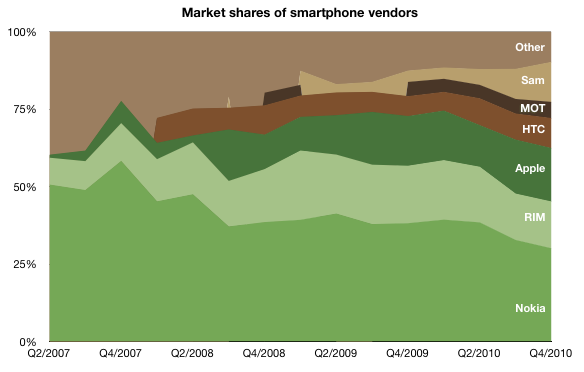
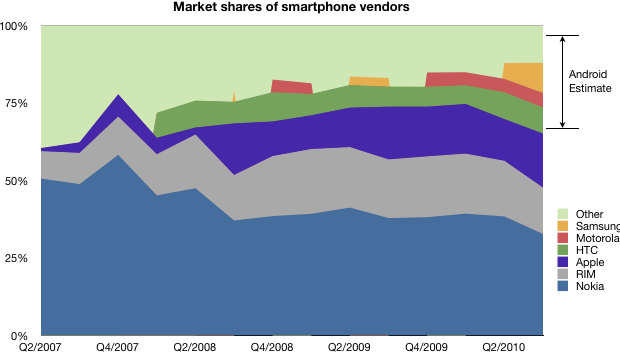
    The smartphone market has grown threefold in the span of three years. However, as noted previously, the share of units running a licensed OS has not grown dramatically. The following chart shows the vendors' shares with the same brown/green dichotomy between licensed and unlicensed OS's.

    In order to gain some insight into this licensed OS area (and who the "others" are) we need some visibility into which OSs are being licensed and what their shares are.

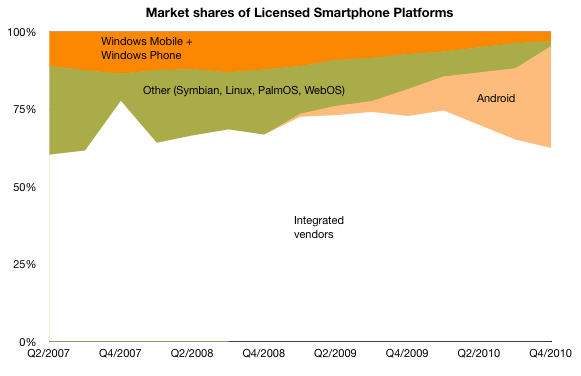
    The following chart shows the share of the various licensed platforms[1]. (I blanked out the Integrated vendors.)

    Before we dive in to understand the effect of Android, we have to understand the licensing of OSs in 2007.

    The chart shows Windows Mobile and "Other" splitting the market. Windows Mobile is rather easy to understand. It was still growing as a platform and Ballmer was famously quoted in 2007 as saying he liked their strategy "a lot".

    But "Other" is something of a mystery. What "Other" actually mostly meant was Symbian[2]. But not only the Symbian that Nokia was shipping and licensing to some vendors. At the time, Symbian also had a version called MOAP "Mobile Oriented Applications Platform" which was in use in Japan (somewhat analogous to the variants of Android now in use in China).

    Fujitsu, Mitsubishi, Sony Ericsson and Sharp developed phones for NTT DoCoMo, using an interface developed specifically for DoCoMo's FOMA "Freedom of Mobile Access" network brand. This UI platform was based on the UI from earlier Fujitsu FOMA models[3]. The user could not install new C++ applications and therefore these were not platform devices, however the industry still included these units as "smartphones" .

    So what we've witnessed in the last two to three years is the replacement of MOAP and Windows Mobile share with Android TAPAS and OMS.[4]

    But, more significantly, when looking at the rise of Samsung and Motorola and HTC we were also witnessing the demise of Palm, Fujitsu, Mitsubishi and Sharp (plus a myriad of Windows Mobile licensees even larger than the Android army).

    The significance here is that "other" in smartphones is still mostly about branded vendors. This is in stark contrast to the low-end of the phone market where “others” are quickly replacing branded vendors.

    So we can conclude that the smartphone market is so far showing a distinct preference for branded vendors. The value of the brand is still evident. But ZTE and Huawei are quickly developing Android competencies. How long will it be before the branded vendors feel the pressure from the upstarts?

    ----

    Notes:

    1. The Other category includes WebOS which was not licensed during this time frame but is not material enough in terms of share.
    2. A few million units running flavors of Linux were also on the market in 2007/2008.
    3. FOMA was also implemented with a Linux OS and the same UI.
    4. It should be noted that except for Windows Mobile, all the licensed mobile OSs including LiMO and Symbian are now open source. Android's success is not therefore due to being the only OS that is "open".
  5. Microsoft's mobile effort: back to the future?

    Research · 41 comments

    Windows Phone 7 launched on 10 devices over 60 carriers in over 30 countries with 1.5 million of channel inventory in 6 weeks. Given the breadth of distribution, that number is not huge, amounting to less than 10k phones per operator.

    Curiously, Windows Mobile was still selling in significant volumes last quarter. Maybe even higher than WP7 is selling now. In Q3 2009 Canalys reported 3.6 million WinMo units sold. In Q3 2010  Gartner estimated 2.3 million were sold through to end users. Even nine months ago Windows Mobile was running at 3.7 million units or over 1.8 million every six weeks.

    Microsoft also announced they have 18,000 developers with 4,000 apps on the WP7 marketplace. That's one developer for every 83 devices in inventory.

    Microsoft's Achim Berg:

    our numbers are similar to the performance of other first generation mobile platforms...

    We're comfortable with where we are, and we are here for the long run; Windows Phone 7 is just the beginning.

    In terms of first generation platforms, I assume he is referring to Android and iPhone. That claim of similar volume growth is perhaps a bit too optimistic. However, he's very wrong about WP7 being the beginning for Microsoft's efforts in mobile. Not even close.

    Microsoft has had mobile software products in the market for over a decade. In 2003 Gartner declared that Microsoft would sweep Symbian aside. In 2006 they were the odds-on favorites to win the mobile platform game on the basis of developer support.

    Microsoft's Windows Mobile was selling more in 2003 than Microsoft's Windows Phone is selling in 2010. At the time, Microsoft also boasted of having a huge developer base (larger, in fact, than the number of users of the product; their .NET developer base being counted as mobile developers.)

    Furthermore, prior to the launch of iPhone's App Store, Microsoft spokespersons scoffed at the idea that Apple could field a catalog larger than Windows Mobile which led with over 13,000 apps in August of 2008.

    Dragging out these old figures isn't meant to deride Microsoft. They were not alone in failing to capitalize on early leads in mobile. Palm, Nokia, DoCoMo and Qualcomm all failed. RIM is arguably failing as we speak. Some have argued that Apple is also about to be undone by Android.

    The point is that dramatic, violent change was possible even five years after foothold markets were established.

    The question for today is: Is it still possible? Can a new platform still gain traction?

    Microsoft is clearly betting that it can. Their seemingly quixotic attack on the market can only be justified on the basis that it's still early days. They must reason that un-penetrated markets are huge and that the existing platforms are not sticky enough to prevent switching.

    At least one analyst agrees. IDC made the forecast that 32 million “Windows Mobile/Phone” devices will sell during all of 2011. I took issue with those forecasts at the time but if they deliver that volume they will get around 10% share, enough to stay on the map. If they don't then Microsoft will look more like Mobile Zune than Mobile Windows. The stakes are high.

    So even though they may have airbrushed Windows Mobile from history, Microsoft's current strategy is a direct consequence of them having failed with a seemingly strong platform.
  6. Visualizing smartphone platform growth

    Research · 55 comments

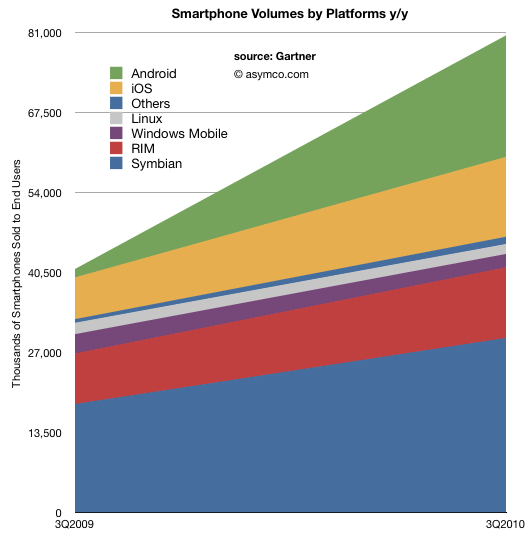
    None of this should come as major surprises, but Gartner's data allows for a bit more granular detail in the overall view of the market. Here are new points derived from Gartner's sell-through data:

    • The smartphone market is growing at nearly 100% (96%).
    • The overall market is growing at 35%.
    • The non-smartphone market is growing at 25%.
    • Android grew at 1,340% y/y. iOS grew at 92%, Symbian at 61% and RIM at 40%.
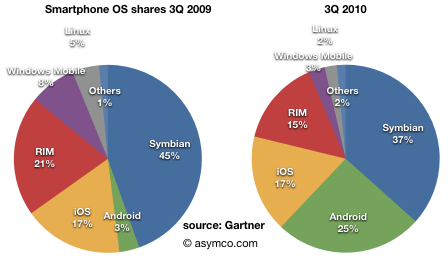
    • Platform market shares (below) shows a more even distribution of platform volumes between four main platforms:
    • Non-branded mobile phones grew to 33% of the market, with 141% unit growth. This is an alarming figure for the low-end of the market. The unbranded market excludes ZTE and Hauwei which grew below the overall market growth (9.8%, 27% respectively). The implications were most dire for Motorola (-36% units growth), Sony Ericsson (-23%) and LG (-14%). Nokia grew but, at 3.5%, well below market growth.
    • In 3Q 2009 41 million smartphones were sold. In 3Q 2010 80.5 million were sold. If we were to split the growth among platforms, nearly half the growth was Android. 27% of the additions were Symbian and 16% were iOS. Only 8.3% of the growth was RIM devices.
    • Windows Mobile and Linux were the only smartphone platforms to shrink volumes. However, even though the platform is deprecated, 2.2 million Windows Mobile devices were still sold last quarter -- more than Android sold a year earlier.
  7. Android remains the only mobile OS still patterned after Microsoft's 2002 vision of the mobile value chain

    Research · 52 comments

    Belfiore wasn’t shy about criticizing Google’s Android OS. Even though Google currently dominates the mobile OS market, its strategy of licensing the Android OS to manufacturers is similar to Microsoft’s previous approach with Windows Mobile: It’s open-ended, and there are few restrictions on how manufacturers can use or modify the OS.

    As a result, Android is suffering from some of the same issues as Windows Mobile did: Android works better on some phones than others, manufacturers are shipping different versions of the OS on different phones, some Android phones are shipping with bloatware made by carriers, and some app developers complain that it’s difficult to make software because of the hardware and OS fragmentation.

    via How Microsoft Hit CTRL+ALT+DEL on Windows Phone | Gadget Lab | Wired.com.

    Android was initially an attempt to commoditize Windows Mobile with a symmetric but "free" alternative. The idea was to conform to OEMs and operator business models. This was directly copied from Microsoft's early 2000's playbook for entry into mobile.

    Trouble is that Microsoft realized their purely modular, operator and OEM centric approach was failing to be competitive on the user experience and decided to move into a more integrated approach, closer to Apple's integrated model.

    But while Microsoft dropped their vision, Android was still patterned after their approach.

  8. HTC to re-bone Android?

    Research · 10 comments

    Peter Chou, chief executive of HTC, had previously said he saw “little value” in HTC running its own application store. But he has also said that it was no longer enough for HTC to simply customise the standard Android user interface with its own “skin”: “It is not enough to be skin-deep. We need to go bone-deep.”

    via FT.com / Technology - HTC to target online app store.

    HTC was the world's biggest Windows Mobile vendor, at one time claiming to have sold over 80% of all WinMo phones ever made.

    I always considered them to be the natural leaders in the Android licensing cohort. First, because they are the most agile and second because they had the operator relationships that allowed white-label operator phones.

    HTC aspired to differentiate itself by "skinning" Windows Mobile and have carried their Sense UI over to Android offering a brand image distinct from competitors.  However, HTC's branded strategy may have upset their operator partnerships (no evidence of this, just hypothesis). In the event, HTC, though prosperous, is not the largest single Android vendor.

    Now the comment above from Peter Chou indicates that HTC is going to integrate the experience further. Building its own APIs, store and perhaps more. Not satisfied with "re-skinning" perhaps it will "re-bone" as well.

    Going "bone-deep" sounds a lot more integrated and inter-dependent than modular to me.

  9. Estimating Android market share for the third quarter

    Research · 10 comments

    Take a look at this chart. It combines the known shipment data with the total market size for smartphones as defined by Canalys.

    Knowing the platform/vendor make-up we can estimate the percent of the market that was Android.

    Note that the major unknown is still how much the platform hedgers (Samsung, Other) split their volumes between Android and Windows Mobile (yes, it's still being sold).

    Given this information, I would estimate Android share was around 30% globally. Canalys estimates 25%, which makes this analysis look reasonable.

    On a platform basis, Android gains were mostly at the expense of RIM, Symbian and Windows Mobile as we know that the iPhone share remained steady.

    Note that in years past the licensing vendors predominantly opted for Windows Mobile, a market that Microsoft wants to regain.

  10. Escape from license-land: Measuring phone vendor commitment to licensed mobile platforms

    Research · 29 comments

    Windows Phone had its day in the sun yesterday. After discarding its previous seven-year effort with Windows Mobile, Microsoft started with a clean sheet of paper. However, whereas the software has been re-built, the business model has not. WP is still a licensed operating system whose primary customers are mobile phone vendors. With Symbian mostly out of the picture, WP becomes only the second viable commercially licensed mobile OS, after Android.

    So with two licensed platforms in the running, how do we measure success in the licensing business? Units sold to end users is one metric. But that data will have to include the performance of vendors and operators and other distributors. And it will take a year to do valid comparisons. The only indicative metric we have available today is how many devices have been committed by vendors.

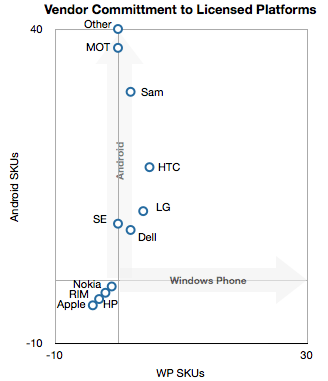
    As WP is out of the gate with device announcements, we can actually measure this. We can plot each vendor's commitment to various platforms as an early indicator of strategic success. To that end, here's the methodology: I took all smartphone vendors and tallied how many SKUs they have announced or leaked for either the WP or Android platforms (source: pdadb.net). I then plotted each vendor on two "commitment axes" (see notes below).

    The more to the right a vendor lies, the more committed they are to Microsoft's platform. The more to the top a vendor lies in the chart, the more committed they are to Google's platform. The vendors which don't have any licensed products lie below the origin.

    What we can observe is that Microsoft has pulled several, though not all vendors partially to its side. The level of commitment is not yet very high and it has not likely reduced their commitment to Android. In other words, points are moving to the right but not (yet) down.

    Framing the platforms this way helps us discuss how the market might evolve with these questions:

    1. Is Microsoft's re-entry going to peel vendors away from Android. In other words, will points move down as well as to the right.
    2. Is there motivation for some vendors to move to their own platforms like the non-committed? We've shown that profits accrue disproportionately to the vendors below the origin. As a result, is the pool of available top tier vendors going to shrink?
    3. Will vendors commit to single platforms or maintain this split OS loyalty strategy? Will we see LG migrate to WP exclusive and will Others remain exclusive in Android?

    I'll throw out my predictions to start:

    Microsoft's strategy is aimed at top tier vendors more than to the "others". This is due to a lesson they learned with Windows Mobile: having a ton of SKUs does not guarantee a healthy ecosystem (a lesson that Android has not acknowledged as true). There are positive and negative consequences. The positive is that Microsoft control the experience better, create a better brand and can participate in an effective dialogue with operators. The negative is that they are going to deal with a diminished licensee pool.

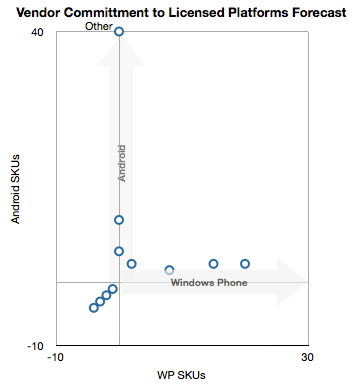
    On the second question my prediction is that vendors are going to move "down and to the left" away from the licensing model. If they can't go direct to that quadrant, vendors will consolidate portfolios around one licensed platform. The distribution of commitment I forecast will look like this:

    Maintaining multiple platform development teams is expensive. Branding is also confused. The upside is that you get to play the operator's divide-and-conquer game of platform dilution (aimed at the non-licensing players in the lower left corner).

    In particular, Samsung, with Bada, is likely to find ways out of license-land. Sony Ericsson may stick with Android and LG may move to Windows exclusively. That really leaves only HTC and Dell as licensees with multiple licenses.

    This axial alignment is not a healthy thing if you are a platform vendor. Having one or two dedicated customers means the power of the buyer is much higher and their wishes become your command.

    Which leaves only one true prize in the game: the "others". Android is clearly the darling of "Others" who are being shunned by Microsoft. Can "Others" become the lever for Google to pry open the market? History and the tangled web that is operator distribution does not point in that direction.

    ------

    Notes:

    1. I considered products announced only since Jan 1, 2010
    2. I did not consider any Windows Mobile legacy commitments
    3. "Other" vendors are off the scale with over 100 SKUs but represented as having 40 SKUs so as to be kept on chart
  11. Microsoft suits target Android phones

    Research · 18 comments

    Microsoft Corp. said Friday it has filed patent-infringement lawsuits with the International Trade Commission and in the U.S. District Court for the Western District of Washington against Motorola Inc., targeting Motorola mobile phones based on Google Inc.’s Android software

    via Microsoft suits target Android phones - MarketWatch.

    This follows infringement suits by Apple against HTC targeting Android and by Nokia against Apple targeting GSM patents (with obligatory counter-suits, of course.)

    There was a time when Motorola was a key design win for Microsoft and their Windows Mobile in 2003 with the MPx series. In fact, Motorola still ships Windows Mobile devices like the ES400 and FR68. These are for industrial applications but there were many mainstream Motorola Windows Mobile volume products. The most famous perhaps was the MOTO Q in 2006.

    I'm sure part of the value pitch for Windows Phone is indemnification from IP infringement. Windows Phone will be the only licensed OS that offers this coverage and it's a non-trivial selling point.