"Interest in Windows Mobile 5.0 has grown steadily, and it now attracts far more developers than any rival mobile operating system. This should improve the likelihood of IT directors being able to buy line-of-business mobile applications for the Microsoft platform. More than 10,000 developers are currently working on applications for Windows Mobile 5.0. Part of the reason for this developer momentum is Microsoft's programming model. Nick Jones, vice-president at analyst firm Gartner, said, "Every device using Windows Mobile 5.0 has the same interfaces, but that is absolutely not the case with other operating systems, such as Symbian."
A piece by Gartner that has a typical Gartner conclusion: WM 5 is going to grow the WM Developer community because of device-by-device similarities, and more freedom than RIM or Nokia devices can give.
Love the "every device using Windows Mobile 5.0 has the same interfaces" dig at Symbian. That was four years ago. This week Gartner predicts the fragmented but magically open Android will dominate four years from now.
A few years ago I read a book called "Breaking Windows" which was the story of the DOJ investigation into Microsoft's abuse of monopoly. The book was written by a journalist who tried to summarize some of the findings from the published internal emails.
One of the takeaways was the logic of Microsoft's entry into the Office market. The main internal justification was not that it would be a hugely lucrative new business, but that it was a necessity to the maintenance of the Windows business.
The story was that Lotus, having a huge installed base, could (and did) arbitrarily refuse to upgrade their software to the latest Windows version and in so doing, could kill the franchise. Lotus owned the "killer app" and could hold Windows hostage. Users would rather keep their applications than upgrade a largely invisible OS.
Another way to read this was that Microsoft needed to "vertically integrate" Windows so that it encompassed not only the OS but also the key applications that ran on the platform. A purely horizontal OS platform was obviously not viable as a business even back in the early 90s.
What reminded me of this story was the news that Dell is launching a new smartphone in the US. Called Aero, it will run Android 1.5, an ancient version released in April of 2009, 18 months ago.
Now think about the idea of Adobe coming to market next week with a new version of Photoshop that ran only on Windows XP. Or even more poignantly, if Office were not part of Microsoft, seeing a *new* version of Word that only worked with Vista.
Through an aggressive acquisition plan twenty years ago, Microsoft avoided this scenario. Google today is faced with the prospect that not only the devices (which sit on its OS) but also services and apps on top would choose to remain on old versions of Android. There is nothing to stop them from doing just that. Unlike Microsoft, Google does not enforce licensing terms for Android. It is at the mercy of the value chain.
Couldn't Google crack down and deprecate Cupcake? It's not as easy as that. Not only do they not have license terms that permit that but in the phone business, development lead times are so long and global distribution can be so elastic that a low volume vendor like Dell has no choice but to sell multiple OS versions of their own products. Microsoft has almost the same problem with Windows Mobile, with a variety of given-up-for-dead Windows Mobile 6.5 powered devices still in the pipeline while Windows Phone 7 is imminent.
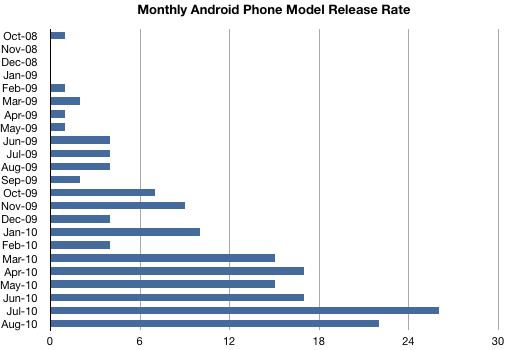
Next month will be the 24th since the first Android device launched in October 2008. The G1 was followed by another HTC device in February of 2010 and a few others in the spring. The summer of '09 showed a steady release of up to four new phones every month. Since then the number of Android phone stock keeping units (SKUs, uniquely identifiable stockable products) increased dramatically, with the release rate increasing to 26 per month during July of this year (source: pdadb.net).
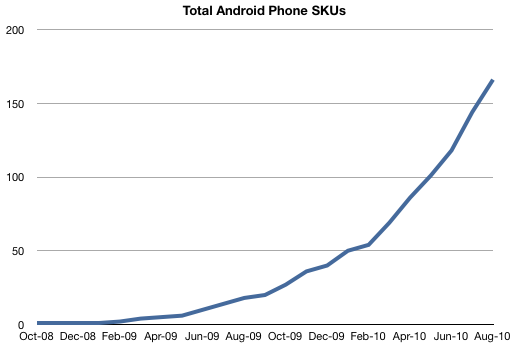
Altogether, there are have been 166 Android phone SKUs in the market with another probable 25 or so ready to launch in the next few months.
Now this may seem like a large number of different phone models in a short time, and it is, but Windows Mobile was even more proliferated as a licensed OS. At its peak over 50 new devices were released every month. The total now is over 1700 and it's still growing.
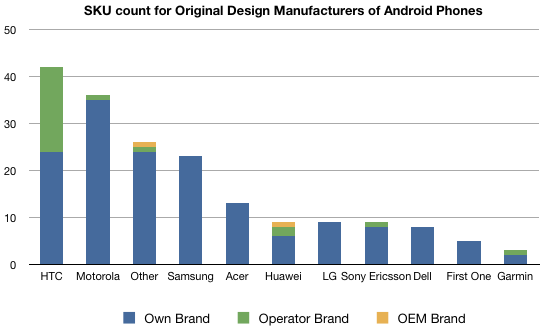
The 183 known Android devices are distributed among 10 principal vendors with another 18 minor vendors. The 18 "other" vendors (see footnote 1) have either one or two devices in the market.
The vendors or original design manufacturers list ranked by most devices follows:
I broke out the devices also by the number of operator branded devices designed by the same manufacturer (green) and any devices designed and built by one vendor but sold under a different vendor's brand (orange). It shows how, excluding "other", HTC is the most prolific Android builder (and seller) but also how it still depends a lot on Operator branding.
The proliferation of Android devices is indeed striking, but as I've pointed out before, the licensing model for Android is symmetric with that for Windows Mobile with the exception that Android is both open source and cost-free to license. This should make it highly disruptive to the paid-license model that Microsoft worked so hard to implement. It should be no surprise then that the adoption dynamics for the platform are very similar, with the same licensees that took Windows Mobile a few years ago embracing Android today.
The proliferation still has a while to go. There is production capacity for over 2000 SKUs among all the vendors in the market (especially the "other" category) and it's only been two years since a stable version of the OS has been available. So it would not be surprising if the total number of licensed Android products will overtake the 1700 or so Windows Mobile SKUs.
So what's the paradox?
The question that should jump out from this data is what's the value to the participants in this, or any mobile OS licensing model? When I analyzed the Windows Mobile field in 2007 or so, it was pretty evident that very few vendors other than HTC shipped enough volumes to make a product profitable. In fact, I coined the phrase Pocket PC Paradox to describe the situation where hundreds of vendors would line up to make undifferentiated products competing for a shrinking pie. This went on first with Pocket PC PDAs, then repeated with Windows Mobile and is now repeating with Android. Nobody ever made money except for HTC, not even Microsoft.
It's still a mystery to me why any manager would decide to make the (n+1)th Android/WinMo phone. It must be difficult to make market projections that justify the cost of developing and marketing this new product.
But here's some help: The total number of Android phones sold through the end of last quarter was about 23 million units. The total number of SKUs launched to date then was about 118. That means that the average Android phone SKU sold 200k units (2).
Now this may seem comically low, but I will again bring up history and point out that while the WinMo bubble was in its zenith, the average Windows Mobile SKU had 50k units sold. With the SKU count increasing more rapidly than the sales rate (40% more SKUs since June) it's very likely that the average units per SKU is dropping. So by my reckoning there's plenty more in the Android bubble to go.
-----
(1) The "other" category includes the following vendors:
Lenovo
Gigabyte
Highscreen
Notion Ink
WayteQ
Forsa Posh
Inventec
Kyocera
Pantech
TechFaith
Saygus
Sharp
Ziss
Alcatel
General Mobile
(2) I'm fully aware that the distribution of sales over the products is not even and very likely exponential, but there is no way to predict whether a given new product will be a "hero" or DOA. The dream for every manager must be that his product will be a star, but the odds get worse and worse over time and the average units sold has to be considered as including these odds.
The OS market in the mobile space is dominated by other players. Is that a cause of worry?
I think it’s a temporary issue. I don’t put a lot of face and snapshot and time into what is going on. On a global basis, I see what is growing and what is shrinking. Text messaging is the fastest-growing on simple phones part of the mobile market. That’s where growth is. The smart phone part of the market, or the premium market, is in the downward part of the market. It will not be there for a long time in the future.
People want something that’s simple. The design goal for the Windows Phone 7 is that with rich experience you get simple stuff easily. Great keyboard or touch or both – so you can have that. It is too early to talk about dominating, but I’m excited about it. Android coming into the market says there is room for more innovation and we see ourselves playing a role in that space. People talked about the iPhone and thought that was the end of the world for OS. Windows Phone 7 will prove there is more room for innovation.
In other words, Android's entry in the market and remarkable growth, there is room for Windows Phone. And because Windows Phone is easy to use and has a keyboard and touch it will have a chance at dominating.
Microsoft's enthusiasm for yet another mobile platform joining the fray (along with iOS, Android, RIM, Symbian, Windows Mobile, Meego, various sundry Linux and Bada) is not just delusion. I'm sure that they gathered positive feedback from operators. By this time next year there will be dozens of Windows Phone devices on the market. After all, Windows Mobile attracted 1700 licenses.
I did not include all vendors for various good reasons. The first survey (market share) did include an "others" category that made the volume data complete, but in the financial data sets, I chose to include the top 7 vendors that make up 80% of device volumes.
One noteworthy vendor that was not included was HTC. HTC is an important vendor for several reasons:
it's a pioneer in smartphones having made the first Windows Mobile devices and the first Android devices
at one point it sold 80% of all Windows Mobile devices
even if it did not brand its devices, it was the name behind many re-branded or white-label operator branded phones
it has a brand of its own today and is expanding its reach
HTC has been around building devices since 2001 and so it would be a pity to exclude them from any analysis of the effect of iPhone on the market or any discussion on the effect of smartphone disruption on feature phones.
The challenge with HTC was that historically their branded devices and white label devices were not reported by the company separately. This matters because white label devices are valued differently. Typically these devices are not marketed by the original manufacturer so SG&A is not applied to their cost base. Operating margins, ASPs and hence profitability is not directly comparable with other OEMs.
But HTC has recently changed its reporting. Thanks to a reader I discovered that, since 2008, HTC has been listing its ASP and Operating Margin making direct comparisons possible. I still don't have all the data, but enough to add HTC to the analysis.
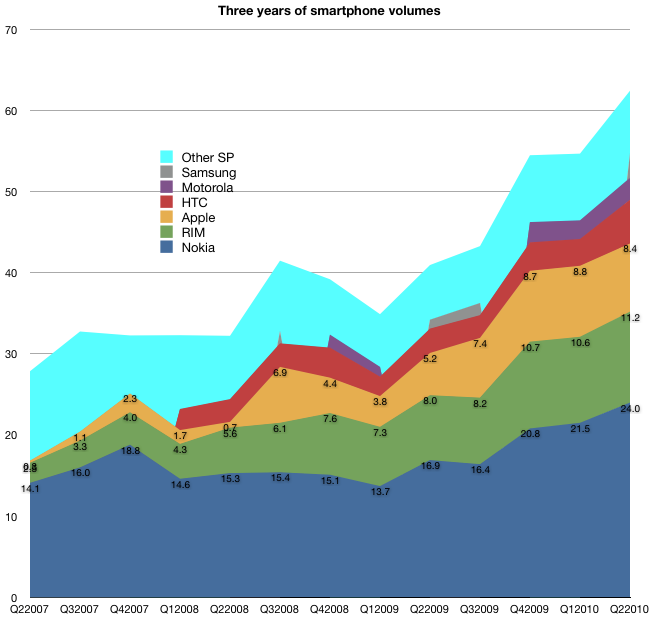
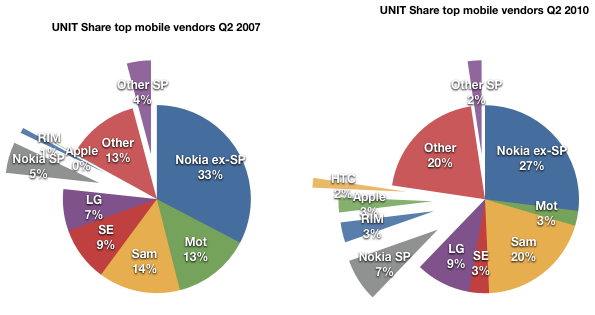
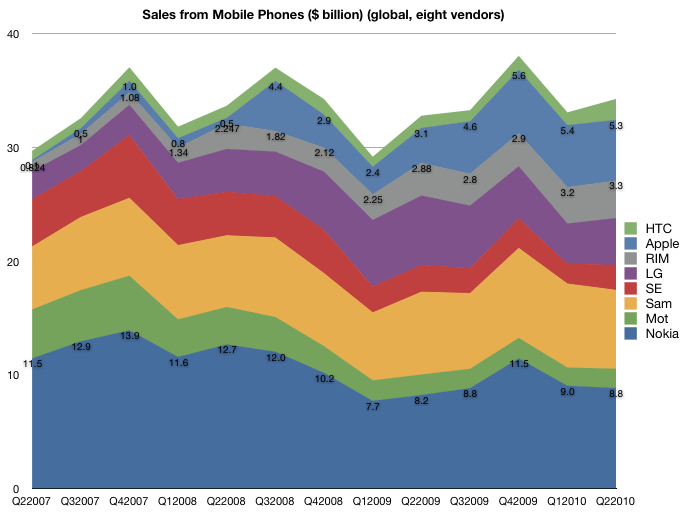
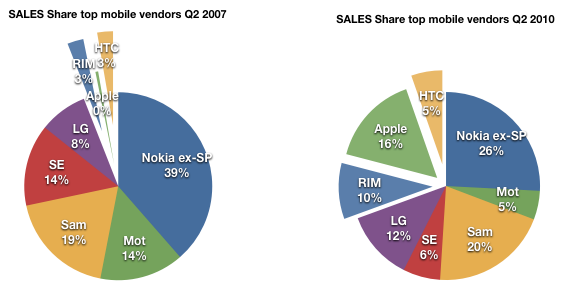
So, here are the 5 industry performance criteria, now with eight vendors listed.
Volumes
Note that HTC volumes start in 2008.
The volume of units HTC sold has been increasing at about the rate of market growth.
As a result, HTC's share has not increased as dramatically as those of the other smartphone entrants.
Sales
A similar story in the sales picture. Although a consistent performer, the growth has not matched that of RIM and Apple.
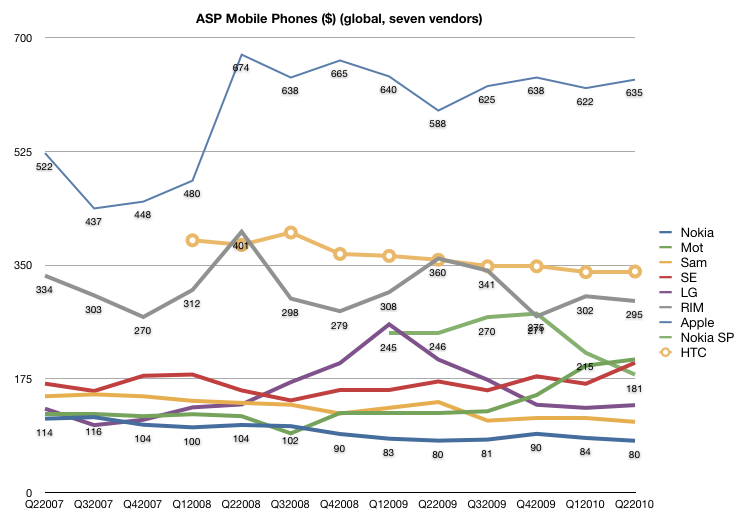
ASP
The pricing story is also a mixed one. Although HTC lies between RIM and Apple in price, the erosion is more consistent with RIM and the rest of the industry.
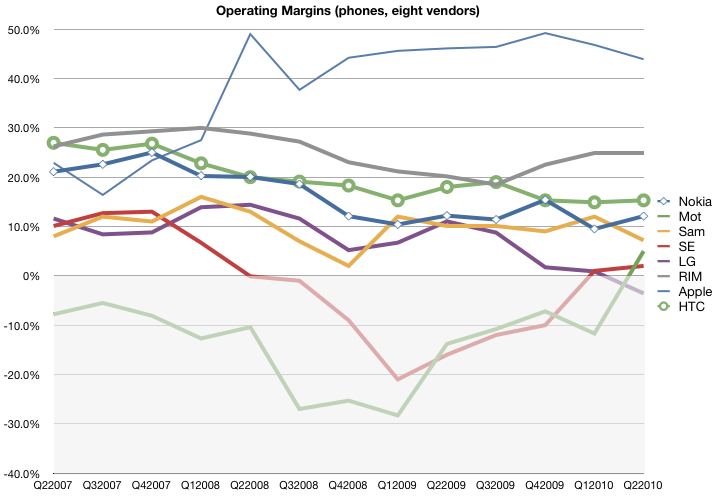
Margin
The margin story is also not as positive as one might expect. The margins for HTC started out above Apple and RIM but have dropped to closer to industry average. This is not what one might expect from an exclusive smartphone vendor.
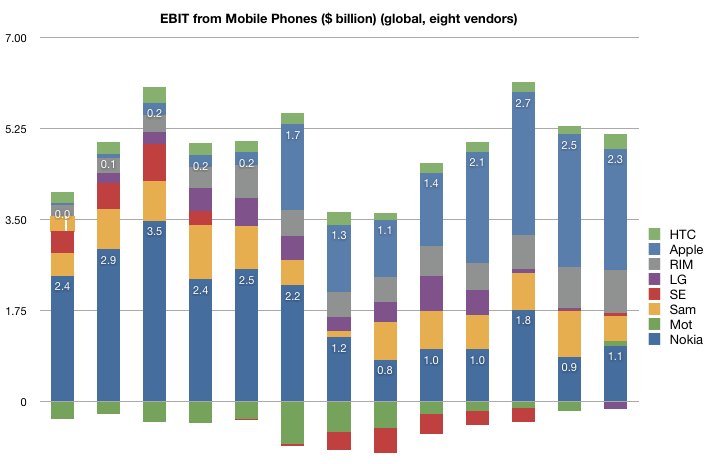
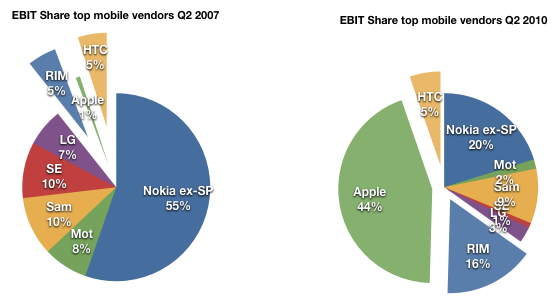
Earnings
The share of earnings has remained unchanged at 5% over the period of iPhone presence. It's perhaps a credit to HTC that they did maintain their position in the market with the massive change that has come to pass.
However, here we also have to ask if HTC is riding a disruptive wave.
When I wrote the last series, my definition of “loser” was a company that had faced a long series of operating losses and has no viable software assets of its own, making it vulnerable to Android (and Windows Mobile). Motorola first, Sony Ericsson second and LG now coming into the picture. Nokia is not a loser in this sense since it has remained profitable and does maintain an investment in software. Same with RIM and Samsung (now with Bada). When/if they do have the near death experience, they might opt for the Android lifeline (flimsy as it is).
However HTC does not fit the mold of either "winner" or "loser". It's the Goldilocks company, not too hot, not too cold.
But I would add that HTC is not an example of a winner because of its adoption of Android. HTC’s dependence on Windows Mobile made their move to Android the most desperate of all. Unlike the larger OEMs, who had their low end devices to fall back on, they are completely dependent on a smartphone OS vendor. When WinMo was showing the first signs of crisis in 2007, they were the first to flee to Android (think of why they would risk the wrath of Microsoft for something so fragile as Android in 07). They are also trying hard to escape the dependence by building up their own UI (SenseUI) and I would not be surprised if they move to their own OS in the future. Being associated with Android does not confirm them as "winners" but in fact, shows their vulnerability.
What does this all say about Android?
Again here my thesis is that Google chose to sustain the industry rather than try to upend it. I don't judge their motives, but the fact is that with Android, Google is not in a position to disrupt telecom. There were high hopes dashed with the Nexus One and hearts broken with net neutrality and now there are patent wars to be fought. Android, with its licensees, is still at the mercy of operators.
As of the end of the second quarter, Samsung’s global smartphone share was 4.8 percent, according to IDC. But LG’s presence was negligible.
[Update] From early 2009,
LG, the third-biggest phone maker, will produce about 50 models that run Windows over the next five years, said Scott Rockfeld, a director in Microsoft’s mobile business. Seoul-based LG will use the software as its primary program for smart phones, devices that can send e-mail and browse the Web.
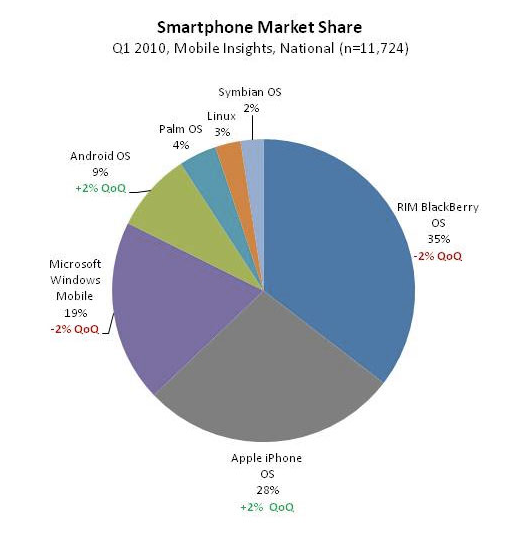
Data tracking firm Nielsen Co.’s quarterly survey found that, in the U.S. the iPhone added two percentage points for a 28% market share in the three months ended in late March compared to the previous quarter. RIM still had the biggest market share at 35% but it lost two percentage points in that period.
Phones that run on Google Inc.’s Android operating system also gained two percentage points for a market share of 9% over the same period, while Microsoft Corp.’s Windows Mobile phones lost two percentage points for a 19% share.
Although Android is often considered in competition with the iPhone, as we've shown in the past, the two are seldom competing for the same purchase decision. From a distribution and business model point of view, the platforms are mostly non-overlapping.
The installed base data above shows that in their respective areas of competition: in the US, with the current operator channel, the iPhone is taking share from a similarly positioned platform (RIM) while Android is taking share from a similarly licensed alternative (Windows Mobile).
A few eyebrows were raised when Microsoft presented a slide at a French event where they made the claim that 30 Million Windows Phone devices would be sold by the end of 2011. Given that the first Windows Phone won't ship until October 2010 at the earliest, or, according to Mr. Ballmer, "by Christmas," count me among the skeptics.
However, the claim was later retracted by Microsoft stating that they mis-quoted IDC, the original source for the forecast. The correction was perhaps meant to put an end to the credibility crisis.
However, the actual forecast from IDC was even more preposterous. Apparently IDC makes the forecast that 32 million "Windows Mobile" devices will sell during all of 2011--a combination of both Windows Mobile and Windows Phone devices.
Instead, the research company forecast 2011 sales of 32 million devices running all Windows Mobile operating systems. This includes expected sales of devices with Windows Mobile 6.5, which is already on the market. IDC has not given any sales estimate for Windows Phone 7, which Microsoft has said will be available in the fourth quarter.
Their report showed about 16 million Windows Mobile devices shipped in 2009, with a forecast of 22 million this year and 32 million next year.
Windows Mobile shipped a total of 3.7 million phones in 1Q10, so in order to reach 22 million this year they need to ship 18.3 million for the rest of the year or, on average, 6.1 million phones a quarter. That's a higher number than what Android shipped in Q1 with BOGO promotions (5.2m units). That's almost as high as the launch quarter for the iPhone 3G. And all this (mostly) with WinMo 6.5!
Alternatively perhaps IDC foresees a huge launch for Windows Phone. Assuming an erosion of the WM6.5 to 2.7 m this quarter, 2 million in Q3 and 2 million in Q4, then Windows Phone would somehow need to ship 12 million units during the last quarter. This number is higher than what iPhone sold in its highest ever quarter.
This sounds sillier than 30 million Windows Phones in 2011. By claiming that Microsoft's combination of deprecated Windows Mobile (6.5) and unreleased Windows Phone 7 will continue to sell at a growth of 38% this year, they are actually suggesting an acceleration in sales going into the second half at a rate higher than what the market is likely to grow at.
In other words, they are suggesting that Microsoft will gain share during the rest of this year. Share gains for a platform that has declined in share in Q1 from 10.2% to 6.8% with 3.7 million units sold on the back of further share losses the quarter prior. Share gains against Android that competes with a free license. Share gains with a new platform that has no clear differentiation vs. the iPhone.
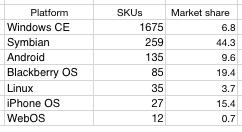
The number of Android devices is rising steadily; it's already up to 135. Android devotees should rightly rejoice. However, Android is not the first mobile platform with an open licensing strategy. A quick visit to pdadb.net lets us count the number of devices that shipped for every mobile platform in history. We can also see the current market shares as listed by Gartner for these platforms.
The numbers of SKUs (stock keeping units) that have shipped historically vs. the market shares of the mobile phones running those platforms are (see Footnote below for some caveats):
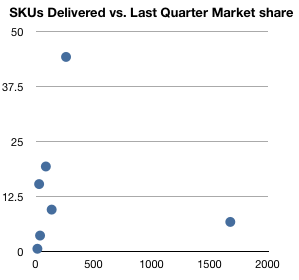
The same data in a scatter plot:
(SKUs on the x-axis and share on the y-axis)
The thing that jumps out is how uncorrelated the two quantities are. The Windows Mobile/CE number is such an outlier that it breaks any attempt to link the two variables.
What's likely to happen is that since the licensing of Android is even less problematic than it was for WinCE (i.e. it's both free as in beer and free as in speech) the number of Android SKUs is likely to overtake WinCE. In other words, we're very likely to see Android grow from hundreds to thousands SKUs.
However, the real question for the Android platform isn't whether it will have licensees. WinCE proved that there is vast demand from many companies to build cloned and undifferentiated devices. The real challenge is whether Android can achieve significant volumes without fragmentation to keep the platform/network effect going.
The WinCE platform was actually less fragmented through its life than Android is today. This is understandable since the source code was decidedly not open and thus not modifiable and new versions were released far less frequently. And even with a high price tag, it was wildly popular with licensees. Nevertheless, the volumes never came and Microsoft was forced to abandoned the whole strategy. The next version of Windows Mobile (Windows Phone 7) will follow an "iPhone lite" model of highly restricted configurations and device and ecosystem specification.
So will Android follow the fate of Windows Mobile with an even more fragmented, bazaar-like licensing model? Or will thousands of undifferentiated Android devices swamp their integrated competitors?
Footnote: The total SKU number includes non-cellular devices whereas the market share number includes only cellular devices. Omitting non-cellular devices will not detract from the pattern or change the correlation meaningfully. The argument can also be made that the "platform" value lies in both cellular and non-cellular devices (e.g. iPad) and they should both be counted. Unfortunately there are no market share statistics that blend both device types into one market.
Vague justifications about under-performance of Windows Mobile or cancelled Courier miss the whole point. The chronic problems with Microsoft’s consumer businesses cited as causes for dismissal have roots in core processes and priorities which management changes will not address. The failure of Zune was evident long ago. Windows Mobile has not been competitive with RIM for years, and failed to take significant share from Symbian, never mind iPhone. Tablets were the responsibility of the Windows team. Kin is a rogue project based on a bone-headed acquisition. From a P/L point of view, Entertainment was mostly Xbox, which although deep in the hole over its lifetime, was starting to break even.
No, the reason I believe Bach lost his head is that HP bought Palm.
Bach lost a key account; in fact, he could be responsible for having lost the biggest account that Microsoft ever had. Ballmer is a sales guy and he knows the importance of these relationships. A customer like HP must be managed carefully and their strategy must be steered to fit with yours. If HP felt they needed to go somewhere else for their mobile OS, it's a slap in the face, but if they buy the asset and IP and internalize a competing platform, then that is a dagger to the heart for Ballmer.
Consider Google's seduction of Dell. Microsoft can tolerate Dell's affairs (Dell even fooled around with Linux back in the day.) But in contrast, HP is effectively filing for divorce.
The blow could not have been more obvious and more cruel.
The iPhone represents nearly 90% of all non-laptop connections in Boingo’s airports. The iPad registered 5.4% of all device connections, while Android tallied 2.5%. Blackberry phones and iPod Touch MP3 players accounted for less than 2% each of total visits. Windows Mobile was less than 1%.
Remarkable statistics, through a narrow sampling. The above data represents all Wi-Fi enabled non-laptop devices in Boingo’s managed network, which includes 58 airports, the Washington State Ferries, and several sporting arenas and convention centers.