Asymco

Asymmetric Intelligence

Windows

  1. Measuring iPad enterprise use

    Research · 25 comments

    I've noticed that there is a lot of speculation on the prospects for iPad use "in the enterprise". Business users could sure benefit from the device and anecdotal evidence does point to many cases of use in business.

    But anecdotes are not conclusive evidence. How can one make a better guess? Based on reader input, I thought I'd test this hypothesis directly on my own stats.

    As pointed out a recent posting on my stats, the iPad has been a popular device in accessing this site. 102k out of 1.06m views came from iPad users. A statistically interesting number.

    One way to check enterprise use is to measure the ratio of use of the product during weekends vs. use during weekdays. The logic being that weekend use is almost strictly consumer use and weekday use is mixed. Any normalized significant difference between the two measures should indicate a bias toward consumer use or vice versa.

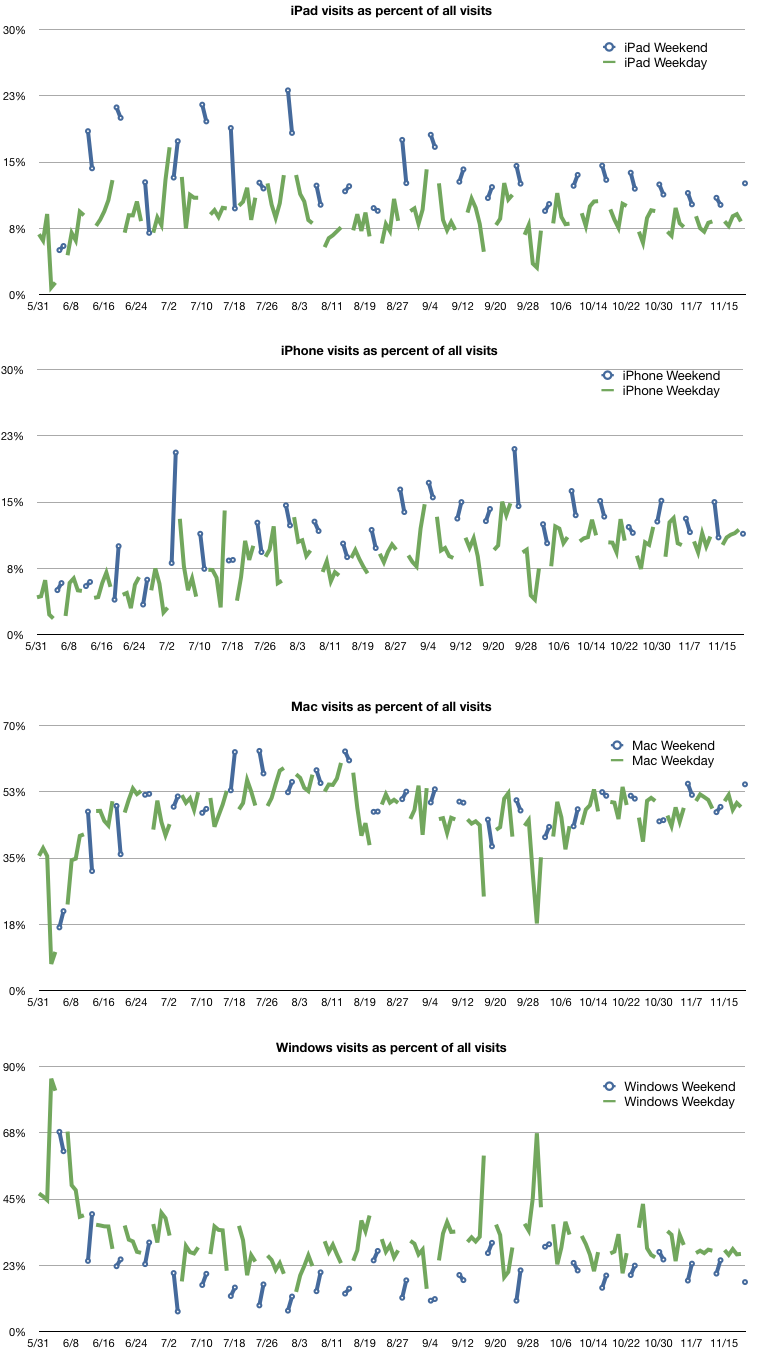
    The following charts show the percent of each platform's use with weekends separated from weekdays.

    The larger the delta the more likely the more the bias one way or the other. To that end I measured the average percent of visits from iPad (as a total of all visits) for weekends and weekdays and measured the delta between the two. On the weekend the iPad was accounting for 13.3% of visits. On weekdays it was 8.8%. A difference of about 4.5% in favor of weekend use.

    To calibrate that figure I did the same for iPhone, Mac and Windows use.

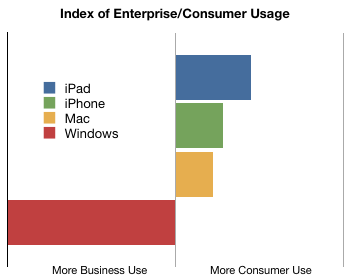
    The following chart shows this ad-hoc index of "enterprise use".

    Essentially the data is inline with assumptions. The iPad is the most likely to be hired by consumers. The iPhone is more than the Mac and they're all far more likely to be consumerized than Windows.

    The average consumption of Asymco.com through Windows was 32% of during weekdays but only 22% during weekends.

    In order to make this measure more meaningful, the evolution over time of these figures should be tracked. If the Blue bar above moves more toward the center then the chances are that iPad will be more adapted by business users, or at least more in use at work.

    Does this seem like a valid method for measuring relative enterprise use?

  2. Why the Mac keeps growing

    Research · 63 comments

    When the iPhone vs. Android rhetorical war heats up, both sides bring up the history of Macs vs. Windows PCs. The commonly held thesis is that Windows triumphed as the PC was commoditized (and modularized). This triumph was at the expense of the over-serving and over-priced Mac.

    This is a largely accurate view of what happened during the 90s. But the problem with this thesis is that (1) the PC's job has been slowly changing in the last decade (2) the Mac keeps growing faster than the PC and (3) Apple keeps capturing a vast portion of the profits in the PC industry.

    These anomalies or contradictions to the thesis imply that something changed. What changed and can these changes turn the tables on the market and create an opportunity for a new computing disruption?

    The PC of the 90s was hired first by companies as a productivity boosting tool and second by consumers as a way to duplicate their work productivity and communications in their personal lives.

    However something changed with PCs when the laptop became "good enough". With portable computing, the job the PC was hired to do evolved. It was more important that the product be well designed (for aesthetic value, usability and reliability) than just fast and spacious. The microprocessors were plenty fast but what mattered more was low power consumption, a low profile and tighter integration with software.

    The product was also purchased in a different way. A desktop could be purchased on specs alone, sight unseen, from a catalog. But a laptop had to be touched, hefted and the screen had to be observed and the whole design contemplated before a purchase decision was made. The product had an integrated keyboard, display, touchpad and storage. It was not easily serviced by end users. It was, in a word, re-integrated.

    You can see how portability changed the job and therefore everything else as well. Consumer tastes became important, retail distribution became necessary and R&D resources had to be applied to solve what was no longer good enough: the whole package.

    Vendors which did not prioritize design, retail and R&D were left flat-footed.

    At the same time, systems software became more commoditized and productivity software became portable. The old measures of performance were being over-shot while the new measures of performance were under-served.

    While this shift was underway on the hardware side, Microsoft continued to improve their product to serve more demanding business productivity jobs. Their software was not getting optimized for this new portable consumer job. They left the new market open to disruption.

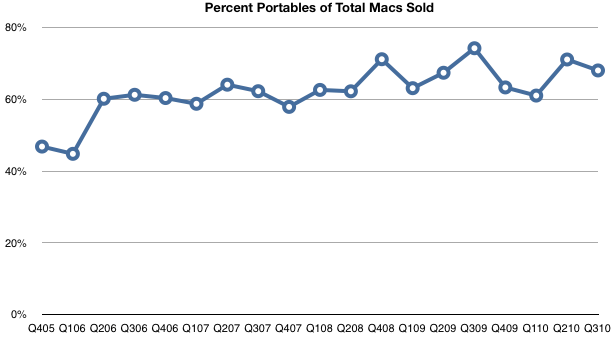
    In stepped the MacBook with good enough (and improving) office productivity. With excellent appeal along the dimensions of performance consumers demand most of all. It was priced higher than other laptops but the price points were affordable and, inflation-adjusted, lower than they'd ever been. It should not be a surprise that Apple was one of the first vendors to see its portables line become bigger than its desktop lines. The market evolved to the point where what Apple had was what the buyers needed.

    The shift to portability is a compelling story for Apple as disruptor in the PC market. It may not result in a complete reversal of the PC hegemony but it allows Apple to grow a product line at triple the growth rate of the market. A market that was considered completely dominated by entrenched incumbents with an unbreakable profit formula.

    But with the iPad Apple is clearly also aiming at disrupting the Mac (and, transitively, the PC as a whole.) The iPad can be seen as an evolution toward seamless portability; the mobile computing paradigm shift.

  3. What job is a Blackberry hired to do?

    Research · 15 comments

    When mobile platforms are discussed, the conversation frequently turns to market share battles between Android and iOS. I've pointed out before that the problem with this reasoning is that market share in a market that's growing at 90% is a false measure of performance.

    The more important measure is how much of the non-smartphone market is being taken by smartphones and how fast the whole phone market is growing. Competition with non-consumption is very different from platform warfare.

    But even when discussing the rivalry between current platforms, the Blackberry and Symbian are often overlooked as contenders. Windows Phone and iOS come in and out of discussion only on the basis of press releases. The truth is however that Symbian, Windows, Blackberry are not going to disappear anytime soon.  Why is that?

    The reason is that when you stop framing the market as rivalry between platforms, you see that many buying decisions are driven by specific device value propositions or jobs that the products are hired to do. For many years smartphones were purchased because they had the best cameras or the best keyboards and users never downloaded any apps or even used data plans.

    Later, smartphones were purchased because they allowed for browsing and gameplay. Very rarely did buyers opt for "iOS" or "Symbian". Most buyers don't even know what these words mean. Phones are rarely advertised according to their platforms. (As an aside, the mention of Windows in a PC ad is made possible by Microsoft funding, the same as "Intel Inside." So for platform recognition, someone needs to fund the promotion and that implies some revenue to justify it.)

    To illustrate, consider the Blackberry: A product that continues to grow despite a completely different basis of competition from the large screen touch competitors. It comes down to being good at some very specific jobs. RIM continues to grow in certain markets like Latin America and the Middle East on the basis of BBM (RIM’s sales outside the U.S. climbed 94 percent last quarter from a year earlier.)

    “A 15-year-old boy who likes a 15-year-old girl, sends her a BBM and he’s able to measure how important he is to her based on the speed of response after the letter turns to an R,” meaning it’s been read, he says. “No one else runs an end-to- end service plan like we do. That’s killer and is why it’s almost a social phenomenon.”

    or

    BBM is also popular in socially conservative Saudi Arabia where its speed -- messages are typically sent in less than two seconds, according to Morgan Keegan -- has made it a way for teenagers to communicate in a country where religious police bar unmarried couples from meeting in public.

    You could argue that the other platforms also allow for free messaging (through free texting apps) but the combination of a low cost device, a data plan and attention to detail (like Message Read notification) gives the Blackberry an edge.

    The general purpose smartphone that Google and Microsoft and Apple promote is still not the prevailing view of mobile usage for most buyers. One could also argue that many if not most Nokia smartphones are still being "hired" to do feature phone jobs.

    The fact that all these devices are classified as smart and therefore competing misses the point that they are hired for different things.

  4. Postcards for Asymco: metropolitan distribution of views by operating system

    Research · 26 comments

    Based on a reader query, I tried to find out where, by city, my readership is concentrated. I also sought to break this audience down by operating system.

    Here are some observations:

    For the last 30 days, here are the top operating systems used to reach Asymco.com, with the number of views from each.

    1. Macintosh 153,768
    2. Windows 101,329
    3. iPhone 78,716
    4. iPad 34,878
    5. Linux 7,262
    6. iPod 5,516
    7. Android 4,869
    8. (not set) 1,236
    9. BlackBerry 447
    10. SymbianOS 396

    Looking at each OS, I can list the top cities where readers came from.

    Macintosh 153,768

    1. London 6,513
    2. San Francisco 5,316
    3. New York 5,089
    4. Cupertino 4,293
    5. Austin 2,589
    6. Sydney 2,182
    7. Helsinki 2,131
    8. Los Angeles 1,918
    9. Seattle 1,847
    10. Portland 1,482

    Windows 101,329

    1. London 3,827
    2. New York 3,275
    3. Helsinki 1,598
    4. San Francisco 1,504
    5. Seoul 1,409
    6. San Jose 1,260
    7. Chennai 1,226
    8. Sydney 1,116
    9. Seattle 1,100
    10. Melbourne 1,035

    iPhone 78,716

    1. San Francisco 5,203
    2. New York 4,406
    3. London 4,053
    4. Chicago 2,328
    5. Seattle 1,836
    6. Los Angeles 1,638
    7. Melbourne 1,430
    8. Seoul 1,402
    9. (not set) 1,376
    10. Sydney 1,261

    iPad 34,878

    1. London 1,759
    2. New York 1,060
    3. San Francisco 1,020
    4. Chicago 857
    5. Melbourne 739
    6. Outremont 694
    7. Santa Rosa 585
    8. Seattle 555
    9. San Jose 456
    10. Santa Clarita 440

    Linux 7,262

    1. San Francisco 376
    2. London 233
    3. Helsinki 180
    4. New York 131
    5. Cambridge 126
    6. Bangalore 109
    7. Nantes 109
    8. Sydney 107
    9. Perchtoldsdorf 93
    10. Paris 86

    iPod 5,516

    1. Eau Claire 471
    2. Melbourne 396
    3. Seattle 290
    4. Abuja 248
    5. San Jose 214
    6. Hudson 197
    7. Sydney 195
    8. Budapest 109
    9. Boston 95
    10. London 86

    Android 4,869

    1. Seoul 761
    2. (not set) 325
    3. Dallas 248
    4. New York 169
    5. Amsterdam 148
    6. Calcutta 131
    7. San Francisco 81
    8. London 74
    9. Los Angeles 74
    10. Bergen 72

    BlackBerry 447

    1. New York 121
    2. (not set) 78
    3. Waterloo 56
    4. London 50
    5. Buenos Aires 16
    6. Hong Kong 9
    7. Oldsmar 9
    8. Fairfield 7
    9. Wappingers Falls 6
    10. Boston 5

    Symbian OS 396

    1. Helsinki 216
    2. Kauniainen 23
    3. London 21
    4. Seoul 13
    5. Tehran 10
    6. Frederiksberg 6
    7. (not set) 4
    8. Chennai 4
    9. Krakow 4
    10. San Francisco 4

    The first surprise for me is that Seoul is the most popular source for Android views.

    The second is that London is so prominent. Although the US is the biggest source of traffic by far, London is a very concentrated source from the UK.

    The third is how there seem to be no Blackberry readers in the SF area.

  5. Back to the PC

    Research · 67 comments

    Apple's "Back to the Mac" was a clever play on words. Everyone expected it to mean that the event was going to focus back on new Mac products.  As we had been so steeped in iDevice news the Mac was feeling neglected. It was time to take the discussion "back to the Mac."

    Instead Apple told us that the Mac and OSX were going to become more like Devices and iOS. iOS innovations were what's going "back to the Mac"

    So it wasn't "back to talk about the Mac" it was "OSX went to iOS and iOS is going back to OSX." The strategic upshot of it is that "the Mac is an extension of the device portfolio." Heady stuff. We'll need to chew on this for a while.

    But some implications are easy to foresee. For example, the consequences for competitors. When Apple launched the iPhone, competitors followed suit, powering their phones with a variety of "open" operating systems. When Apple launched the iPad, competitors followed suit, powering their devices with a variety of "open" operating systems. These reactions to Apple's initiatives by dozens of "open-wielding" competitors are all being touted as the inevitably winning strategies.

    So, as we've observed all of Apple's strategies being copied, I can't wait to see the competitors follow its "back to the Mac" strategy:

    • It won't be long before Dell takes UI and hardware design elements from the Streak "back to the PC." Think of the magic that will happen when Android Froyo "hooks up" with Windows 7.  Both Android and Windows being "open", if I squint hard enough I can just visualize the tweet from Andy Rubin of the command line to build a new Windows  8 with Android mojo. The Android Market selling Windows Apps. It will be beautiful.
    • Or perhaps we'll soon see "back to the Blackberry" as RIM takes QNX interface elements back to their core business. Not so sure about the command line make statement there.
    • Or maybe Nokia will announce "back to Symbian" as they take gestures from the ultra-open MeeGo to do an evolution of their majestically open Symbian.

    These initiative will surely be helped by the vast community of open developers surging to support the great open merged PC/tablet/device future.

    As a clue to the sarcasm challenged: The power of Apple's integrated approach across its product lines goes deeper than the user experience.

  6. Unix's Revenge

    Research · 98 comments

    With QNX now firmly roadmapped at RIM and Android spreading among vendors like a virus, I wanted to point out that these operating systems share one ancestor: Unix.

    A technical triumph

    Technically Linux, which underlies Android, among others, is walled off from Unix from an IP point of view, but the philosophical and architectural lineage goes back to 1969's Unix. It was an amazingly well thought-out operating system which has stood the test of time mostly due to its modular architecture. It was not always clear that Unix would make it this far, and in many ways it was written off.

    There is some poetic justice in its comeback. Unix could have become a default for desktop computers. When Windows emerged from the shadow of DOS, Microsoft had the option to base NT on a flavor of Unix. But Bill Gates, no doubt motivated by license fee considerations, hired a group of developers from Digital Equipment Corporation and many elements of the NT design reflect earlier DEC experience with VMS and RSX-11. Microsoft went with that new architecture rather than Unix and that code lives on even in the current Windows 7.

    So Unix missed a chance to become the core of the desktop experience throughout the 1990's. It was relegated to the perilous high end: Sun workstations, servers and supercomputers. It seemed to be at a dead end. Fortunately, in stepped open source. Linux picked up the pieces and forged ahead to become a serious server operating system but never got beyond a toehold in the desktop.

    The death of Unix(tm) was also forestalled because of the efforts of others. Sun, IBM and even a startup called NeXT kept development alive. When NeXT was acquired by Apple, OS X was born and in 2000 Unix was once again on the desktop.

    Meanwhile, the Linux kernel also became device friendly and it was embedded into an increasing number of vertical applications while powering most of the new web servers that fed the dot com era.

    Now we've entered a new decade of devices where Unix(-like) operating systems will, on a CPU basis, probably out-install Windows. Not only is iOS based on Unix, but Android and MeeGo and even Bada are based on Linux as are QNX and WebOS. Google, Apple, HP, RIM, Samsung and Nokia are all now betting heavily on Unix or Unix-like implementations. The success is so overwhelming that there are really only two hold-outs: Microsoft and the rapidly depreciating Symbian.

    Value Chain Evolution

    There is more to this than a sentimental technology riches to rags to riches story. The history of kernel adoption is evidence of the evolution of value chains and the tension between modular and integrated business architectures. It also supports a hypothesis of why Microsoft could not respond to a tectonic shift of power.

    As a kernel, Unix was modular which allowed it to scale both down to devices and up to mainframes. It could conform to the applications above it (like being a server or being an embedded controller) and did so far more readily than Windows. In fact, Windows could not conform to applications outside its core PC and server domain.

    For Unix, the point of modularity was reached early in the 1990's and, through the Linux implementation, it allowed the lowest layers of the software to become commoditized (and free). This commodity status was actually what Microsoft tried to avoid by integrating Windows with the layers above it. This was a conscious and deliberate decision which also led to trouble with anti-trust regulators. The decision seemed to have paid off. Microsoft won.

    However, the very strategy which Microsoft used to maintain a monopoly caused its rigidity of response to a new, post-PC market. Unix fit right in with the new shift in the basis of competition: toward more personal, portable and conformable computing. Windows did not. Microsoft had to build a completely new OS to deal with devices (Windows CE has little if any shared code with Windows NT et. al.). The dual OS strategy continues to hobble Microsoft as each is stretched into new dimensions: the desktop Windows being dragged into the high end and into tablets while the device Windows is re-written to accommodate new input methods.

    The modular Unix just keeps conforming to new applications. It helps that it's open source but the open sourcing is a result of the modularity not the cause for it. So far, it looks like there is no stopping the revenge of Unix. It's been a long journey for Unix and I, for one, am cheering the comeback.

  7. Gartner Predicts Mobile OS Market Share

    Research · 15 comments

    Lots of people apparently think it’s a big deal that Gartner is predicting Android will surpass iOS for second place. But why is that necessarily a good thing, given that they’re predicting Symbian will remain in first place? Who thinks Symbian is actually doing well? Nokia’s board sure doesn’t.

    via Daring Fireball Linked List: Gartner Predicts Mobile OS Market Share.

    I also noted with amusement that by 2014 "other" is slated to sell 85 million units or nearly 10% share, up from 6.1% in 2009. These "others" will be selling more than twice what Apple is expected to sell this year. Is "other" WebOS, Bada, MeeGo, LiMO? If so they're in for a healthy future.

    But dwelling on details like these is missing the point. To see how improbable this prediction is, let's go back to 2006 and ask what Gartner was forecasting would happen now.

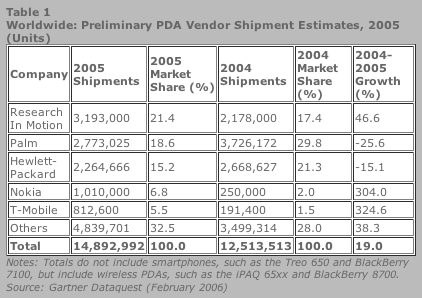
    First thing to note is that in 2006 Gartner was busy tracking PDA sales. You might wonder why this is relevant. The reason is because a significant proportion of RIM's Blackberries counted as wireless PDAs and were therefore considered to compete with Palm's Treos, HP's iPaq and Dell's famous Axim. Nokia was in the running with its Communicators. Here is how Gartner characterized the equivalent market in early 2006:

    So I'll just come out and say it: In 2006 Gartner did not have a clue what a smartphone was. By their admission:

    Gartner defines a PDA as a data-centric handheld computer weighing less than one pound that is primarily designed for use with both hands. These devices use an open market operating system supported by third-party applications that can be added into the device by end users. They offer instant on/off capability and synchronization of files with a PC. A PDA may offer WAN support for voice, but these are data-first, voice-second devices.

    In other words, in 2006 Gartner was splitting phones with operating systems into two separate markets: data-oriented wireless PDAs and voice-oriented smartphones. The split was mostly based on the judgement of the analyst on whether a device was "voice" or "data" oriented. I suppose they used the primary input method as a proxy: numeric keypads meant the device was one-handed and therefore voice-oriented. If the device had a full keyboard and/or a stylus-actuated touch screen then it was a two-handed data-oriented device. But even this proxy was not quite enough, sometimes devices were classified whimsically.

    To make it more complicated, they bundled non-cellular but Wi-Fi enabled PDAs with wireless PDAs. This made some sense from a corporate IT point of view (their primary customer base) as these data-oriented devices would be used either on a LAN or a WAN (Wide Area Networks: what Gartner anachronistically called cellular networks.)

    The presence or absence of a cellular radio did not enter into their view of these devices. So if you asked Gartner in 2006 to forecast smartphones (as we know them now) in 2010, I suppose you'd get what they forecast for "data-centric" devices.

    So assuming that today's smartphones are mostly "data-centric" we would have to look back on their view of that market and not the voice market which was seen as an entirely different thing. Their answer should have had something to do with the market leaders and participants in 2006. As the table above shows Gartner showed that RIM, Palm and HP led in 2005 with Nokia and T-Mobile[1] pulling up the rear.

    However, from a platform point of view, at the beginning of 2006

    Microsoft Windows CE was the No. 1 PDA operating system (OS) in 2005 as 7.05 million PDAs were loaded with the OS, up 33 percent from 2004 shipments of 5.28 million units. Palm OS PDA shipments declined 34 percent to 2.96 million units in 2005.

    In late 2006, Gartner made further predictions for the year:

    In 2006, Gartner expects the PDA market to increase by 6.3 percent to 16 million units. The market will continue to be driven by broader availability of cellular-enabled PDAs from wireless carriers. Gartner estimates that 53 percent of all PDAs shipped in the first half of 2006 featured integrated cellular capability, up from 46 percent during the same period in 2005. “The share of PDAs purchased by enterprises will continue to increase; it accounted for 49 percent of all PDA shipments in the second quarter of 2006 and Gartner expects that the enterprise market will account for 52 percent of all PDA shipments in 2006,” said Todd Kort.

    At this time I have not yet dug up a Gartner "Wireless PDA OS" four year forecast from the year 2006 but I suspect it would not show devices running Google's Android operating system or any running something called iOS.

    I also seem to remember that they were suggesting that Windows would be the leading mobile platform. Although it was trailing in 2006, Gartner was quite bullish on the disruptive challenger from Redmond.

    [1] T-mobile is in the list because it was common practice in 2006 for operators to market Pocket PC Phone Edition devices made by HTC under their own name. Orange, Vodafone and Verizon also had own-brand HTC Windows touch-based devices. Now what does that strategy remind me of?

  8. Breaking Android: How Google's lack of control affects their value chain

    Research · 27 comments

    A few years ago I read a book called "Breaking Windows" which was the story of the DOJ investigation into Microsoft's abuse of monopoly. The book was written by a journalist who tried to summarize some of the findings from the published internal emails.

    One of the takeaways was the logic of Microsoft's entry into the Office market. The main internal justification was not that it would be a hugely lucrative new business, but that it was a necessity to the maintenance of the Windows business.

    The story was that Lotus, having a huge installed base, could (and did) arbitrarily refuse to upgrade their software to the latest Windows version and in so doing, could kill the franchise. Lotus owned the "killer app" and could hold Windows hostage. Users would rather keep their applications than upgrade a largely invisible OS.

    Another way to read this was that Microsoft needed to "vertically integrate" Windows so that it encompassed not only the OS but also the key applications that ran on the platform. A purely horizontal OS platform was obviously not viable as a business even back in the early 90s.

    What reminded me of this story was the news that Dell is launching a new smartphone in the US.  Called Aero, it will run Android 1.5, an ancient version released in April of 2009, 18 months ago.

    Now think about the idea of Adobe coming to market next week with a new version of Photoshop that ran only on Windows XP. Or even more poignantly, if Office were not part of Microsoft, seeing a *new* version of Word that only worked with Vista.

    Through an aggressive acquisition plan twenty years ago, Microsoft avoided this scenario. Google today is faced with the prospect that not only the devices (which sit on its OS) but also services and apps on top would choose to remain on old versions of Android. There is nothing to stop them from doing just that. Unlike Microsoft, Google does not enforce licensing terms for Android. It is at the mercy of the value chain.

    Couldn't Google crack down and deprecate Cupcake? It's not as easy as that. Not only do they not have license terms that permit that but in the phone business, development lead times are so long and global distribution can be so elastic that a low volume vendor like Dell has no choice but to sell multiple OS versions of their own products. Microsoft has almost the same problem with Windows Mobile, with a variety of given-up-for-dead Windows Mobile 6.5 powered devices still in the pipeline while Windows Phone 7 is imminent.

  9. 70 percent of college freshmen are entering school with Macs [Updated 2]

    Research · 2 comments

    Increasingly, companies are giving their employees a choice to either use Microsoft Windows PCs or Apple Inc.'s Macs, the analyst said. And, increasingly, employees are choosing Mac over Windows. To boot, Chowdhry said 70 percent of college freshman are entering school with Macs, up about 10 percent to 15 percent from a year ago.

    via Microsoft shares retreat after downgrade.

    Remarkable indeed.  I remember when in 2007 40% Macs was headline news at Princeton, having quadrupled from 10% in 2003.

    [Update] Chowdry’s estimate seems an exaggeration but Mac share on campus seems to be growing. The most current data shows a probable 50% penetration in private colleges (my estimation is 70% is accurate for Ivy League schools) but a probable 20% penetration at public schools.  Still way above retail share in the US (10%) and way above corporate share of practically naught.

    [Update 2] According to survey data from Student Monitor, among those who planned to purchase a new computer, 87% planned to buy a laptop. And among those students 47% planned to buy a Mac.
    47 percent of 87 percent is a lot more believable. The chart from Fortune Tech shows that intent to buy for Apple went from 14% to 47% since 2005.

    More data, some courtesy of Macobserver readers:

    Macs at Harvard:

    • 2005: 32% (of total computer purchases)

    Mac share at Princeton (freshman class):

    • 2003: 10%
    • 2007: 40%

    George Fox University provides a laptop as part of the tuition.  Here are their numbers for Mac usage:

    • 2006 1% (Actively discouraging Macs)
    • 2007 40% (Change in IT support policies)
    • 2008 100% (Only option offered)

    The U.S. Coast Guard Academy.

    • 2008: 0% (Dell)
    • 2009: 25% (15” Macbook Pro issued, incoming freshman subsidize half the cost and 100% of any optional upgrades including printer
    • 2010: 50% (plus juniors and seniors allowed to replace older Dell with Mac if desired, not sure the financial arrangement).

    University of Virginia (survey data):

    • 2001: 3%
    • 2002: 4%
    • 2003: 4%
    • 2004: 8%
    • 2005: 13%
    • 2006: 20%
    • 2007: 26%
    • 2008: 37%
    • 2009: 43%

    UC Davis:

    • 2006: 7%
    • 2009: 23%
  10. Microsoft's 7 Mobile Operating Systems

    Research

    Adding this all up, Microsoft has several mobile OS products in various stages of production, including

    Windows Mobile 6.5

    Windows Phone 7

    KIN

    Windows Embedded Handheld

    Windows Embedded Handheld 7

    Windows Embedded Standard 7

    Windows Embedded Compact 7.

    As ZD blogger Mary Jo Foley noted recently, this fact is somewhat amusing in the wake of Microsoft CEO Steve Ballmer's criticism of Google for having two different mobile OSes (Chrome OS and Android.)

    via Microsoft's Mobile Strategy Isn't A Strategy. It's A Mess.

    That's not version 7 of an OS, that's 7 different OS's in the market at the same time.

  11. Palm Minnow is Swimming with Sharks

    Research · 2 comments

    Palm CEO "I've never used an iPhone" Rubinstein quoted in the earnings conference call:

    "We had an arrangement with Sprint that when we launched with Sprint that they would invest in marketing and carry the product and for that they would get an exclusive for a period of time. That really determined when we could do our launch at Verizon. I agree with your premise that if we could have launched at Verizon earlier, prior to Droid, that we would have gotten the attention that the Droid got and since I believe that we have a better product, I think we would have even done better."

    So we are led to believe Droid launched into a window in Verizon's launch schedule. A window which was shut to Palm due to their exclusive with Sprint. It's a matter of timing.

    Then again, Droid got $100 million in advertising and marketing budget from Verizon and Motorola. It's unlikely that Palm could leverage that kind of muscle, and their product ended up being positioned on a female demographic.

    Palm was either late or under-funded or mis-positioned or all of the above.

    Essentially, Palm's problem is not the quality of the product (which is arguable) but their ability to market and distribute in a highly competitive market. In other words, it's not that they're not smart enough, but that they're not strong enough.

    Sadly, it's not enough to be smart or good. They're in the wrong market if they think having a clever product is a winning strategy. Mobile Computing is the toughest technology market today. Because the stakes are so huge, it's a market that is targeted by enormous resources.  This is no place for start-ups.

    Palm is simply too weak to make it.