Asymco

Asymmetric Intelligence

Horace Dediu

  1. Mobile device OS upgrades: How hard can it be?

    Research · 45 comments

    Until the iPhone's arrival in 2007, upgrading the software on a mobile phone was a rare experience for users. So rare that effectively it was not done. Few people were bothered though since they did not see the product they used as a software product.

    This was even true for Windows Mobile and Symbian which were licensed platforms. Microsoft tried several times to offer upgrade paths, but more often than not the device vendors did not push out updates or the process required to perform an upgrade made it the reserve of either those who were paid to do it or those who enjoyed the challenge.

    In the era of the modern smartphone, upgrades are more common. Certainly with the iPhone the process is easy enough that opting out of an upgrade is more challenging than opting in. But it's still not as common with other platforms. Even with all the resources and experience behind them, Microsoft is still stumbling with Windows Phone upgrading.

    UPDATE 1-Microsoft explains phone software update delay | Reuters

    But is it really a matter of blundering or is there evidence of nominal partners working at cross-purposes?

    Upgrading a mobile device is technically challenging. There are many things that can go wrong. Integration helps, but it is also possible for a modular solution to be implemented. There are harder things to coordinate.

    However, things go wrong and as the linked article above shows, fingers get pointed. Device vendors who have no stake in a platform can easily interpretan upgraded OS as one fewer hardware upgrade. Platform vendor's lament that device guys want to proliferate unique versions and act with passive aggression. Device vendors see the software upgrade cycle as increased support and engineering costs with no upside. Consumers don't know whom to blame and often turn to the operators since that's who they pay every month.

    The problem of upgrade failure is a symptom of a deeper dysfunction inherent in immature modular business architectures. It's not just that the brightest at Microsoft or Nokia or Google can't make an upgrade stick. It's that the upgrade is not universally beneficial to the value chain. To remedy this, licensors have to resort to contractual obligations to ensure upgrades, but enforcement is non-trivial and can lead to aggravated relationships.

    Unless all licensees of a platform find compelling value in shouldering the burden of upgrades, they will continue to be really hard. This leads to increasing fragmentation and a corrosion of platform value for licensed platforms vis-à-vis their integrated alternatives.
  2. Pattern recognition for smartphone investors

    Research · 42 comments

    I spent the last few days in Hong Kong at a conference discussing the smartphone industry. The participants were mainly investors or investment managers. One of the most frequently asked questions was how to spot investable trends in this notoriously unpredictable sector.

    The data I presented did not offer much of an answer. If anything, it showed just how much the industry has changed and how unlikely it is to remain a facsimile of what it is today.

    But theory allows us to still make some bold claims. Grounding your investment thesis in pattern recognition rather than extrapolation should be the better strategy. So here are the telltale signs I recommend watching for investable ideas.

    1. In hardware look for what's not good enough. The smartphone is great. But it's not good enough for many jobs that we can recognize with little effort. For example, smart devices never seem to have enough battery life. Storage, screen quality and speed are pretty good, but battery life is worse than what voice phones offered years ago. Companies dedicated to improving battery technology or charging technology should be worthy of a bet. Breakthroughs in power saving will be much more valuable than breakthroughs in storage or processing speed or screens.
    2. Pricing needs innovation. Phone pricing is opaque, user unfriendly and often leaves buyers confused and angry. I use the word innovation instead of reduction because it's not about making prices necessarily lower, but removing complexity and defining value clearly through price. The challenge is not just for devices but for service providers as well. Companies innovating by abstracting pricing complexity will do very well. Interestingly, pricing innovation is not as easily copied as it may seem. It is often coupled with business model innovation and cost restructuring.
    3. Applications currently conform to platform needs but there will come a time when platforms will need to conform to application needs. By applications I mean not just apps but the app/service bundle that will drive consumer purchasing behavior. If we consider social media, entertainment and shopping as applications, it will make sense for those applications to eventually take some control or equity in the platforms. Android is the first sign of this: search and services associated with search and advertising sought control over platforms. Perhaps Facebook, Amazon and Baidu will feel a similar need.
    4. As a new medium, apps will eventually be more valuable than the tools used to render them. The global app brands are probably not yet born, but some day they will be as important as Disney, News Corp and Universal Pictures in their heyday. The App Store is the incubator for these embryonic megabrands.

    I realize that these are not specific enough investable ideas but casting your eye on patterns should yield better returns than selecting winners from a set of "current players".  After all the great returns from smartphones to date have come from bets on entrants (HTC, Apple, RIM) and not from incumbents (Nokia, Microsoft or Motorola).


  3. HTC and self-determination

    Research · 74 comments

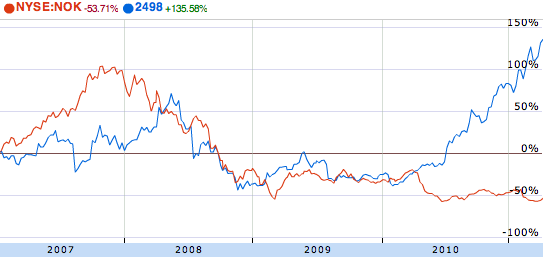
    HTC's market cap has just overtaken Nokia's. While market capitalization is a fickle thing, shifting with sentiment, this is still a remarkable feat. Nokia's market capitalization has almost halved in the space of a year while HTC has more than tripled from $10 billion to over $33 billion.

    If you roll back to 2007 and the start of the modern era of smartphones, you can see how the two companies stocks traded places:

    (source: Google finance)

    The recession was hard on everybody but HTC soared during 2010 while Nokia never recovered. Markets reward unforeseen growth and typically that means above-market growth.

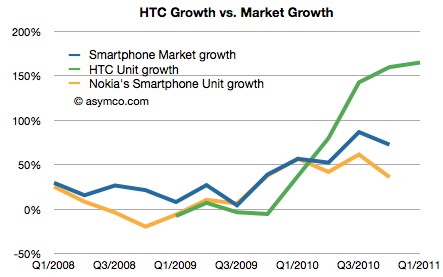
    That's reflected in the following chart (admittedly units and not profits, but pricing and margins for both have remained relatively steady.)

    As Nokia's growth lagged the market the stock was punished. As HTC's growth exceeded the market's growth, the stock was rewarded.

    But there are a few more observations to make:

    • HTC's smartphone business was under-performing the market for most of 2009. In fact, it was even in negative growth for three quarters.
    • The surge in growth coincided with HTC adding Android to its portfolio and given no other changes, seems to be causal.
    • Although not within the time range of the charts above, HTC had another period of rapid growth in the mid 2000s.

    A year ago HTC was making excuses and apologizing. Today they are more valuable than the largest phone vendors. All thanks to Android.

    But why no thanks to Microsoft?

    HTC was the primary Windows Mobile vendor a few years ago. They claimed at one point to have shipped over 80% of all Windows Mobile devices. They were also the leader in the Pocket PC franchise as they were the ODM behind the iPaq brand from HP/Compaq. HTC would not exist today were it not for Microsoft.

    The relationship is such that HTC is paying Microsoft for protection from (potential) Android IP infringements. HTC has also licensed Windows Phone though the relationship between Nokia and Microsoft must give them pause.

    But that's the whole problem. Those who live by the sword shall die by it. HTC was a Microsoft dependent and now they're a Google dependent. As the basis of innovation shifted, HTC was agile enough to make the transition. Perhaps they can execute a portfolio switch yet again as their upstream suppliers change whims or business models.

    But then again, as we saw with Windows Phone, perhaps not.

    If HTC wants to control its destiny it needs to control its suppliers. Now that its power and brand have grown, it needs software because in their market software is self-determination.

  4. Divinely inspired analysis

    Research · 103 comments

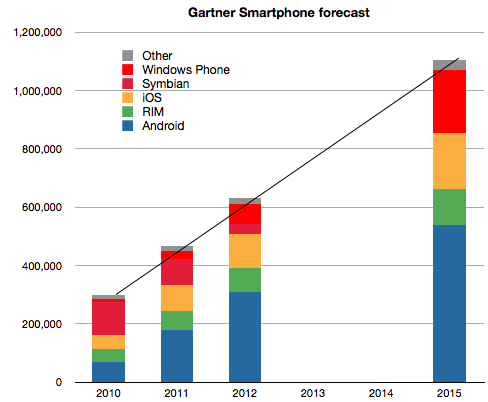
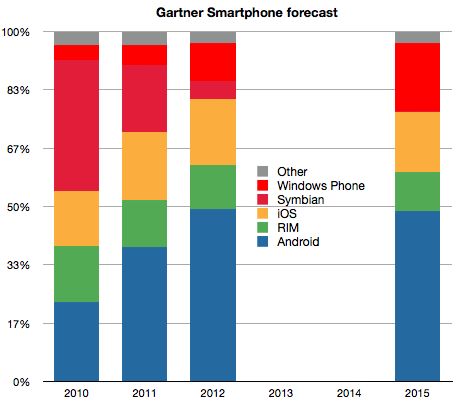
    Three things stand out from Gartner's latest smartphones forecast:

    1. They published a four year forecast with seven significant digits of precision (implying a margin of error of 0.00001%).
    2. There is a linear growth in total market size.
    3. There are no significant share changes after 2012.

    The latter two claims are illustrated below:

    Notwithstanding the defensibility of these claims Gartner analysts makes some further assumptions (quoted verbatim).

    1. "Apple will be interested in maintaining margins rather than pursuing market share by changing its pricing strategy"
    2. "RIM’s migration from BlackBerry OS to QNX which is expected in 2012"
    3. "Nokia will push Windows Phone well into the mid-tier of its portfolio by the end of 2012"

    These assumptions may be valid, but from where I'm sitting, the first assumption contradicts Apple's COO, the second would be an engineering marvel and the third would be an organizational miracle.

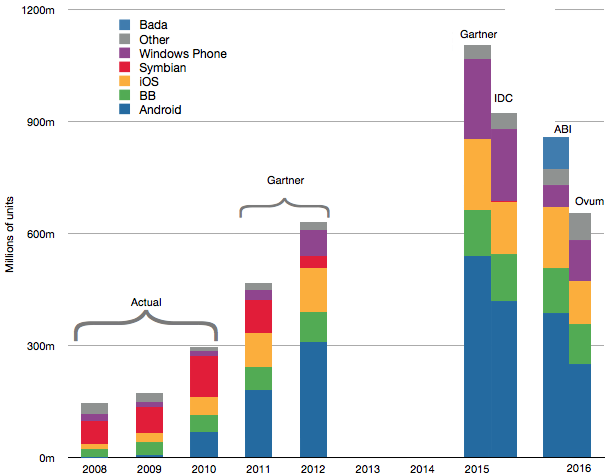
    Putting together all the long term forecasts with what is already known about the market history gives the following combined forecast.

    At the risk of repeating myself, the only thing I can summarize from this collective wisdom is that the over-riding assumption in forecasting seems to be that the future is an extrapolation of the present. That would indeed be a miracle.


  5. Expert system

    Research · 16 comments

    Since starting this blog, I've receives several requests for career advice. I am most heartened and humbled by these requests, especially when they come from young people just starting out. I've responded as best I can and tried to offer specific advice, but it's very hard to be specific when the task is so grand.

    But here are some pieces of advice that I can offer, which although not specific, may be interpreted into something useful.

    On becoming an expert

    The path to becoming an expert is never clear. The way to think about it is this: Ask your parents what it was that they did to make you a great son or daughter. Most parents don't have a clear map on how to build a family. Building great families, careers or businesses are similar empirical endeavors in that it takes constant trial and error and infinite patience.

    Similarly, ask an athlete what is the formula for athleticism. It's has something to do with talent but more than likely it's constant practice and attention to detail. Most overnight successes took a lifetime of preparation.

    On getting the motivation to practice

    In all cases, the path to greatness lies in passion. Without passion there is never the energy to continue doing something when there is no clear benefit in sight. Passion is a relation of faith so many who have faith find it easier to have passion and vice versa. If you have neither for the task at hand, you need to look for something else to do.

    On communication

    Understanding and communication are inter-twined in many ways. Usually, if you cannot communicate something effectively, it's likely you haven't understood it completely. Likewise, if your understanding is weak it's because you have not communicated enough. Practice one and the other will get better.

    On learning

    Formal learning if not sufficient but it is something you should seek as much as possible. Think of a degree program like a language class. As someone said once, gain a new language and gain a new soul.

    If you passionately practice, learn and communicate, expertise just follows.


  6. When will smartphones become phones?

    Research · 31 comments

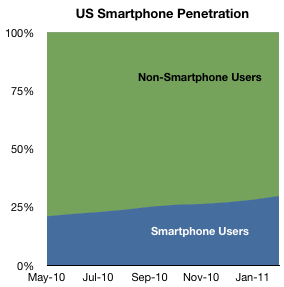
    The US smartphone penetration continues to accelerate.

    ComScore has been reporting the estimated absolute number of  smartphone users and the last month saw a significant increase of 1.58% in penetration. About 30% of the 234 million US cellphone users (above age of 13) use smartphones. That number was 21% in May of last year.


    That means that over 20 million people stopped using voice-only or feature phones in the last 10 months. Equivalent to a rate of 2 million per month.

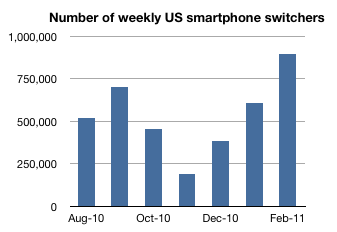
    However, the rate of switching has not been steady. The following chart shows the number of switchers per week. In February it's been about 900,000 per week and it's quite possible that in March we've seen 1 million per week.

    To bring the point home, I have put together a countdown timer which will be updated monthly with my estimate of the date when 50% of US cell phone subscribers will be using smartphones. (There is a link to the timer at the top right of every page on this blog).

    I pinned that 50% figure because by then I hope people will stop calling them smartphones and begin calling them phones.

  7. The pitfall in platform predictions

    Research · 52 comments

    It's a great misfortune that we don't have data about the future. It makes it hard to tell what's going to happen.

    It's even harder because although sometimes we have data about the past, the past and the future don't always look the same.

    Clearly that's what makes predictions about mobile computing platforms tricky. Nothing that has happened recently had been predicted by those who had tried to do so in the past.

    The difficulty is compounded if trying to forecast in the long term like 4 or 5 years ahead. The tendency is to extrapolate what has been happening to date.

    It's tempting to project whatever trends one sees into the future. The problem is that some trends are more visible than others.

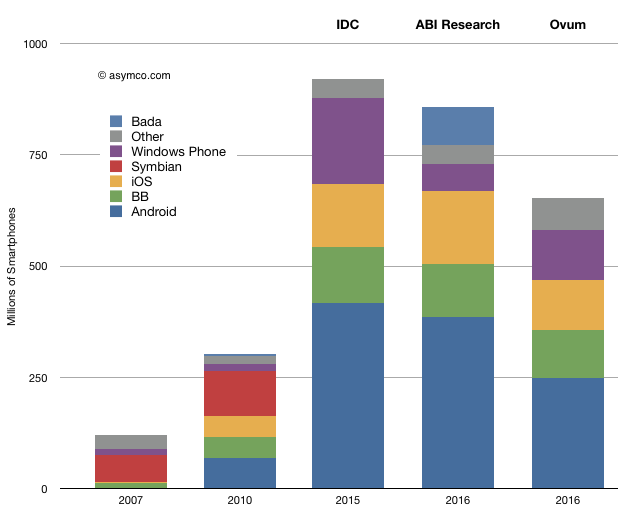
    For example, let's look at the following three forecasts (IDC, ABI Research and Ovum) projecting platforms for 2015 and 2016. Although there are some differences in magnitude of the entire market, there is a strong similarity between the forecasts and with the current trends[1].

    However, when comparing what was happening in 2007 with the market three years later[2] it's clear that most of the change was from the entry of iOS and Android (and a large expansion in RIM as well.)

    So how are we to be sure that there won't be another entrant between now and 2016? I presume the argument is that the market is "too big" for a newcomer to make an impact. This argument is equivalent to saying that some organizations are "too big to fail". That might has a right of its own.

    However, the evidence has shown that no Goliath has ever stood for long against a suitably equipped David, especially in technology.

    Given this knowledge, the pattern or trend that I see more than any other is that the future will be dramatically different than the past. This invalidates any forecast which assumes otherwise, including all those above.

    ---

    Notes:

    1. The primary difference seems to be with how to treat Symbian. Some forecasters are replacing it with Windows Phone while others are mixing in a bit of "other" and Bada into what used to be Nokia's share.
    2. It's quite pointless to try to compare 2005 with 2010 as on this chart's scale (bounded by 1 billion units/yr), the size of the market and the size of each participant's share are indiscernible. As pointed out earlier, predictions from that era focused on PDA market shares and there was no agreed-upon definition of mobile computing competitors.
  8. Google vs. Android Part V

    Research · 145 comments

    When I began the series of posts on Google vs. Android I put forward some questions about the business logic of Google becoming an operating system supplier, especially as that role can be seen as being counter-productive to Google's strategy.

    I noted three strategy costs associated with a zero priced systems software bundle.

    1. A opportunity cost with other platform vendors, namely Apple who might retaliate against Google's core business.
    2. Versions of the software being usurped and modified to provide distribution to Google's competitors.
    3. Damage to Google's brand and positioning and negotiating power in relation with other members of their value chain.

    More fundamentally, Google-as-systems-software is asymmetric to Google-as-cloud-software and contradicts the value proposition that Google enables value in the web not in accessing the web. Android appears to be a nod in the direction that systems software still matters.

    In my numerous posts on the need for integrated development in the era of mobile computing, I also criticized any device vendor that chose to rely on a software stack from an external supplier as foolish. I claimed that they would end up creating uncompetitive products. I thus labeled Google's pursuit of them as ultimately futile.

    More than a year has passed since I began this critique of Android. It seemed quixotic as Android volumes exploded and a mad rush to the platform spun it into becoming the biggest mobile platform by units.

    However those costs did not go away. As the platform grew, they compounded. At first I wondered whether Google management was seriously considering the cost or whether it was giddy with the semblance of success.

    Well, finally, it seems that Google management has begun to acknowledge that these costs exist. In a recent Bloomberg story there are many claims that Google is reversing many of the operating principles of Android. Namely:

    • Restrictions on who gets what version of software when
    • Restrictions on what changes can be made to the software
    • Requirements for approval for source code changes

    These changes, if feasible, will affect the ecosystem dramatically. It will also reduce the second type of cost associated with the platform (the cost of enabling competitors.)

    Good news for Google then.

    There are still the other problems (disconnect from business model, loss of goodwill, damage to negotiating power). But there is actually a more sinister new problem brought about with the new crackdown: Android will no longer be disruptive.

    I also wrote a few posts (e.g. What has Android done for Apple?) where I claimed that Android has the power to accelerate smartphone adoption, especially in the "Wild East." The power of Android was with the little vendors--the ZTE and Huaweis of the world. They could finally make smartphones cheaply--almost as cheaply as voice phones--and not have to negotiate licenses and pay for software IP.

    It would be these smaller "unbranded" vendors that would really disrupt and, with them, Android would become ubiquitous for the billions of mobile broadband non-consumers.

    However, with the new policies, it's much harder for this to happen. Smaller vendors will look at the new hoops they have to jump through and probably say "no thanks." In a beauty contest, they don't look so good next to the big brands.

    They may turn to homebrewed versions of Linux or new forked Androids. This redefinition of openness will essentially remove Google from the disruptive trajectory of mobile computing.

    So we're back to the old question: Google vs. Android, who wins? If Android still has hidden costs to Google and, with its sheep's clothing cast aside, no longer offers significant distribution to the low end then how will Google benefit? The answer that there will be additional ad revenue does not cut it. That revenue would have come from placement deals with other incumbent platforms (just like Google manages to compete on PCs without having to provide its own OS).

    As Google figures this out, its licensees are at the mercy of the ensuing decision. Good luck with that.


  9. Disruptive failure: How Acer Took Aim at Dell and HP and missed

    Research · 72 comments

    Two years ago:

    With new netbooks, laptops, desktops, and, yes, a smartphone, Acer CEO Gianfranco Lanci explains why he expects to soon overtake No. 2 PC maker Dell

    via Acer Boss Lanci Takes Aim at Dell and HP - BusinessWeek.

    Today Acer CEO and President Gianfranco Lanci resigned with immediate effect. Acer is in trouble. You can read more on Acer's current problems in the wake of the downward revision of its sales targets for two quarters here: Acer Should Overhaul Its Operation: Stan Shih | CENS.com - The Taiwan Economic News

    In a nutshell, whereas Acer under Lanci took aim at Dell and HP, it seems that Apple took aim at Acer. And whereas Lanci missed, Apple's aim was true.

    What is interesting here is that Acer had a very disruptive approach. They used the low end "netbook" concept to take share from incumbents motivated to move up-market.

    But what went wrong? Part of the answer is that "low end" does not just mean "cheap". Low end disruption is about also offering simplicity and performance along a new dimension or trajectory of improvement.

    Mobile computing could not be implemented as a low-end strategy because the modules available to portable computing could not be used to make it expand into new contexts of consumption. Windows and keyboards and all the input methods associated with portables could not be adapted to mobility. You could not use a netbook in places or at times when you did not use any other laptop.

    In addition the business model was not a good match. Low margins could not support development or new integration that could improve that which was not good enough. Acer did not have the means to tackle the problems of not-good-enough mobile computing. They did not build software and low margins meant that they could not even try to build software.

    Competitors also were motivated to respond. HP and Dell built their own netbooks which, arguably, were just as good (or, perhaps more accurately, just as bad) as Acer's. But more problematic was the fact that regular notebook prices dropped to netbook levels and the category came to mean "cheap" not "convenient".

    Finally, Acer's strategy did not have the time horizon necessary for true disruption. It takes many years to polish a product and nurture it up the trajectory. Acer was too impatient for growth and not patient at all for profit.

    Contrast this with Apple's tablet strategy:

    • It dealt with complexity of computing by removing it. This was not easy as simplification required a new platform altogether--something that portable computers could not benefit from.
    • It priced low but held on to margins because removal of complexity also reduced cost
    • The margins allow it to rapidly iterate on integrated development and improve the product
    • Competitors initially were not motivated to respond. They did not have the tools at hand to respond: no integrated operating system for PC vendors, no distribution for phone vendors.
    • Apple is also patient enough to wait for several product cycles. Even though demand is astronomical, the iPad still has a long way to go to become a new computing standard. Time is on Apple's side.

    Apple is effectively disrupting the PC with asymmetry. It contrasts with Acer's reliance on a sustaining, symmetric approach. The market was showing clear signs of over-service, declining margins, in-absorbable features and performance and complexity.

    Calling the winner in 2009 may have been tough given no iPad was visible, but knowing Apple's resources, processes and motivations should have guided observers to the right answer.

  10. The controversy of playing it safe: What's IDC's Smartphone Market Message?

    Research · 53 comments

    IDC released a new forecast for the worldwide smartphone market which included a long range forecast--all the way to 2015.

    Most people fixated on the share data in 2015. Not hard to do since whoever wrote the press release highlighted this flashy headline. Putting aside the three significant digits of accuracy on every data point and the hard to swallow declaration that a painfully underperforming (in more ways than one) Windows Phone will overtake iOS and BlackBerry to become the second largest platform by units/year in 2015, there is much more to the report.

    Using only the public data from the press release we can put together a pretty good picture of the transition being forecast and determine some of the (unstated) assumptions being made. It's these assumptions about the underlying market dynamics which illuminate far more than the falsely precise share data.

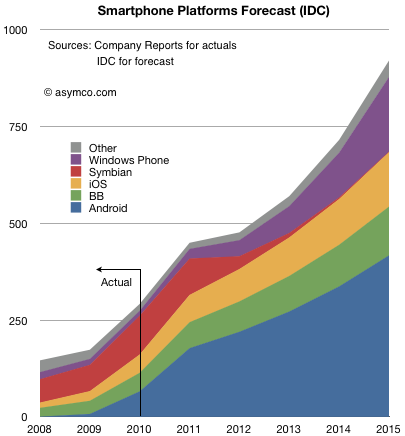
    The following chart shows both historic platform performance (which is detailed in the Asymco Interactive data sets on a quarterly basis) and the forecast based on the given compound growth rate published.[1]

    I see three main assumptions being made:

    1. Nokia (or more precisely Symbian) share will be swapped for Windows Phone. The transition period 2011 to 2015 shows approximately 150 million Symbian devices will be sold which is the stated goal for Nokia. IDC is making an assumption that the hardware vendors will roughly maintain their respective shares irrespective of platform dynamics and that Nokia will switch its share of users from one platform to another in a predictable way.
    2. iOS and BlackBerry will maintain share. Presumably this is also driven by hardware channel dynamics and relationships with carriers.
    3. Android will grow share slightly but the vast bulk of growth will come from market growth.
    4. Market growth is strong but undramatic.

    Overall this is not a controversial set of assumptions.

    Except perhaps that it assumes that the basis of competition in the market is unchanging. Of course it's well understood that the basis has shifted during the tumultuous 2007 to 2010 and forecasts made before the iPhone was launched sound absurd today.

    But IDC says that the unpleasantness won't happen again. From listening to the conversations going on today on this blog and elsewhere, their assumption that things will not change (again) is fairly deeply ingrained, indeed conventional wisdom. In that sense IDC is not taking any liberties with the future. The projections of current realities onto the future leads to this type of forecast and status quo defenders should be satisfied, if not rejoice.[2]

    However, there are a few more consequences of even this uncontroversial forecast which should make keen observers sit up and notice.

    If we look at more than the before and after snapshots and comfortable pie-splitting sound-bites there are some profound seismic things being implied.

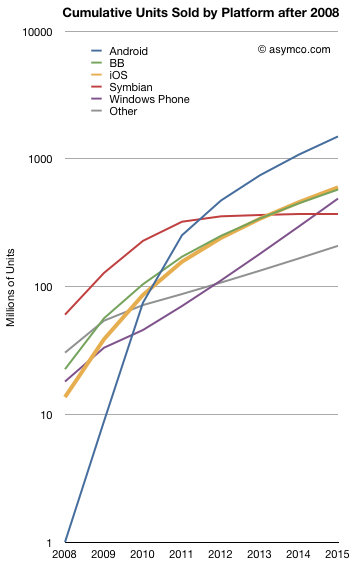
    For example the entire market will be nearly 1 billion smartphones a year (in four years!). Even more startling, considering the "race to a billion" discussion we've been having, some of the platforms seem to be reaching that threshold rather quickly. The following chart shows the cumulative unit sales for the candidate platforms on a log scale:


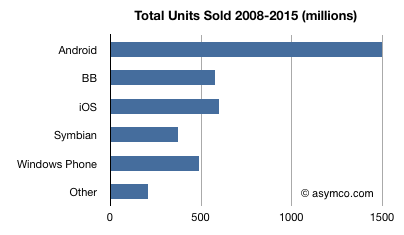
    Android is considered likely to break one billion units in five years post-launch. Windows Phone will sell nearly half a billion units and Blackberry will be well over that number.

    I tallied the cumulative platform unit totals below:

    No less than four platforms will have sold half-billion units by 2015. The suggestion that Android will "win" by having the most units sold seems as hollow as the suggestion that Symbian "won" by having the most users in 2008. Not so much because it will go on to lose them, but because there were plenty of viable alternatives for users to buy and developers to build for. Half a billion users cannot be easily ignored.

    So even "safe" assumptions can lead to astonishing results in this market. Namely, IDC is saying that the smartphone market will not have any platform losers.

    There is one more thing the report implies. If you look at the ranking of leading platforms (by units/year) in 2008,  2015 and, with a little extrapolation, 2016/2017 you get:

    Rank in 2008Rank in 2015Rank in 2016/2017
    SymbianAndroidAndroid
    OtheriOSWindows Mobile
    RIMRIMiOS
    Windows MobileWindows MobileRIM
    iOSSymbianOther
    AndroidOtherSymbian


    In other words, there is a complete reversal being projected. An almost perfect flip: those on top end up at the bottom and those on the bottom end up on top. That's about as controversial as it gets. Pretty impressive for a set of safe assumptions.

    --

    Notes:

    1. You should ignore the shape of the curve between 2011 and 2015 as it assumes the CAGR is applied to every year. Although the press release shows a CAGR, the actual report may include various fluctuation in yearly growth. The starting point of 2011 and the end result in 2015 however should be the same.
    2. If, on the other hand, you believe that exponential growth, rapid gains in communications speed, new breakthroughs in interaction with devices, and entrants winning with new business models are causes for a disruption, then perhaps extrapolation may not be the way to forecast this market.
  11. The Post PC era as explained by developer events

    Research · 38 comments

    The World-Wide Developer Conference is an event for developers. It is not a trade show and it is not a consumer show or an enterprise show for salespeople. Except for the keynote, all events are subject to Non-disclosure Agreements so it's not even an event whose proceedings can be discussed openly.

    It's also expensive. Registration is at least $1,500. Attendants are there to learn and ask detailed questions about development. It's not for deal making. People not familiar with development would not be well served by the event. Registrations are therefore somewhat limited to about 5000.

    After the iPhone SDK was launched, the WWDC took on a new dimension. It became a mobile development event. As a result, 2008 was the first year when WWDC sold out. Attendance tripled over the Mac-only event the previous year.

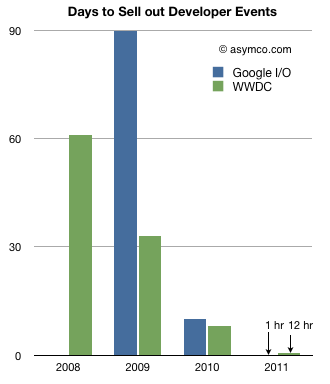
    Every year since, not only has WWDC sold out but it has sold out quicker every time. The following chart shows the days it took to sell out WWDC. I also added Google I/O data for comparison.

    In the era of the iPhone, the limited resource of attendant seats has always been exhausted at accelerated rates: from 60 days in 2008 to 0.5 days in 2011. A similar pattern emerged for the Android event.

    What should be noted is that these events are focused on post-PC development[1][2]. Clearly the increased interest among developers is for the mobile side of the business.

    Developers certainly seem to sense the way the wind is blowing. They are, as humans, prone to over-confidence but they are also often accused of being hard to please. The most common lament among new platform builders is "How do we attract developers?"  The platforms showcased here had no trouble attracting developers in the tens of thousands three years after being launched.

    The Post-PC era is evident in all kinds of data. This set (developer attendance to mobile development) is particularly stark. It's a proxy for investment and IT interest. There is a non-linear nature to this growth and history shows that non-linearity leads to unpredictable or unforeseeable change.

    ---

    Notes:

    1. WWDC still has Mac OS X tracks but that track was there pre-2008 and did not sell out the event.
    2. Microsoft hosts several developer events (PDC, MIX, and Tech·Ed) some of which also sell out, but they have a far wider focus.