When Apple promoted HTML5 as an alternative to Flash, the value was said to be in being an open standard, and in having better efficiency for device-based execution.
The problem is that there are no authoring tools for HTML5. Flash is popular because it's fairly easy to kick start the creative process. You buy the tools from Adobe for a few hundred dollars and begin to tinker. With HTML5 you need to be a programmer, read arcane documentation, search for sample code and manually integrate results into publishing systems. That's bush league.
The bigger question that I struggled with is whether web apps are competitive enough. The absence of tools is a damning accusation that they aren't. Note that Apple is first introducing production tools for iAd, not for web apps in general nor web content in particular.
So why isn't there an iWeb-like tool to allow consumers to design web sites (for MobileMe Galleries for example) which benefit from HTML5? At the other end of the spectrum, where are the Apple equivalents to Adobe's Flash Professional (with CS5 integration)?
The tools for HTML5 are just not there. Tools are the first things needed to build an ecosystem. Is their absence due to a lack of demand or are there no skilled toolmakers outside of Adobe?
When the market is failing to deliver a solution, I question the need for the solution in the first place. It's also worth while to follow the money: Adobe makes money only on the tools for Flash, not on distribution of content. For anyone to disturb Adobe's franchise, it's tools that need to be put forward as alternatives. Tools are not easy to build. Are the incentives simply not there?
I hope iAd producer is the first in a series of tools from Apple to build an HTML5 ecosystem. Whatever the future of web apps is, it's coming very slowly. No wonder Flash is still a viable business for Adobe.
I am preparing a productization of the data underlying the models I use. I am working with Timetric.com to build the product and we are considering several options for packaging and pricing/access.
The first question I have is about how readers would like to see the data. I put up a poll to the right.
One of the most popular themes running through the mobile phone industry this year has been the unprecedented growth in Android adoption. I've argued that the adoption was initiated on the supply side by vendors and operators, but demand has certainly manifested itself.
Android is almost viral in the way it spreads. With no constraints on intellectual property, pricing, contracts, modification or terms of distribution, the incentives to push product out are phenomenal. It even works, mostly.
One hypothesis of the consequences of this viral adoption is that there will be a "commoditization" of smartphones with rapid price erosion to follow. This in turn might even lead to lower margins for Apple and RIM and most major vendors, including those selling Android itself.
In order to test this hypothesis, we need to look at what has been happening to prices. If prices have started tipping down at more than their usual rate then maybe commoditization is happening.
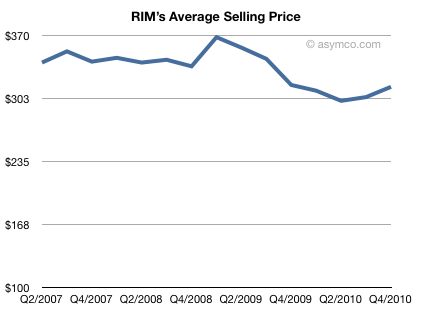
We can begin this test with the industry's canary in the coal mine: RIM. RIM has been struggling for growth in the very market where Android has been growing the fastest. Is RIM's pricing under pressure?
Interestingly, no. Their ASP (average selling price) decline, from an average of $350 to $310 in late 2009, came before the Android avalanche. During this year, the ASP has held steady, even rising in the last two quarters to $315 while Android activations reached 300k/day.
So I don't see a big problem with RIM, yet.
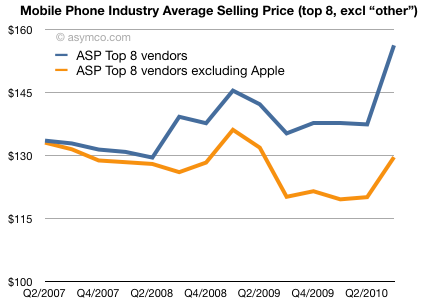
What about the industry as a whole? Can we see patterns that suggest imminent commoditization? Using the top 8 vendors (Nokia, Motorola, Samsung, Sony Ericsson, LG, RIM, Apple and HTC) and using volume-weighted ASP (total device sales divided by total units sold) we have the following chart:
Since the second half of 2007 the "industry ASP" (blue line) has actually increased. This is even though there was a huge recession in the middle of the time period.
This should be only slightly surprising. If you suspected that the iPhone may have a lot to do with that, you would be right. If you remove Apple from the mix, the second line (in orange) shows that the top vendors (ex-Apple) had some, but quite quite mild erosion (from an ASP of $133 to $129)[1].
This is far milder than what's been happening in the PC sector where prices are dropping catastrophically (According to NPD the average selling price of all Windows portable PCs has fallen from $659 in Oct. 2008 to $519 in Oct. 2009).
So Apple was a big contributor to the industry increasing its pricing power.[2] but even without Apple the industry has been holding on.
But is this just a lull?
Is Android going to stop the growth?
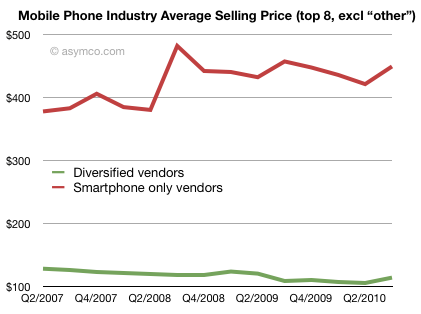
We can look at the pricing data one more way: If we separate the eight companies into two cohorts, the "diversified" vendors who sell both smartphones and regular phones vs. the "pure play" smartphone-only vendors, we get the following price history.
What is happening is that the diversified (Nokia, Samsung, LG, Sony Ericsson, Motorola) saw modest price declines (from $128 to $114) while the pure-players saw price appreciation (from $378 to $449). This is with the early impact of Android priced in. Unfortunately I don't have a chart showing non-smartphone prices in isolation, but I would be willing to bet it would be a significant negative slope.
In these two lines Android is not an independent variable. Android was adapted by some of the diversified vendors (all but Nokia), but in different ways. The thing is that Motorola and Sony Ericsson had great increases in ASP with Android. Among the pure-play vendors only HTC adopted Android and its performance is undistinguished vs. RIM which didn't.
So what, if anything, has Android done to pricing?
I argue that there is no evidence in the pricing data of a coming commoditization of smartphones. Android vendors were able to use the platform to move to higher pricing and the more they switched their portfolio to Android the more they got a better average price. At the same time those vendors who built smartphones without Android also saw strong price supports.
The only correlation with pricing power is whether you build smartphones or dumb phones. The more smartphones you build, the more price you can charge. This is regardless of platform.
The reason for this is that the smartphone market is growing so rapidly (90% y/y). There is limited direct competition between smartphones and a lot of competition between non-smartphones and smartphones--a battle smartphones are winning handily, irrespective of price. Smartphones seem to be what everyone wants.
So the real question that should be asked is:
Why do vendors bother making any dumb phones at all?
If you look at the third chart above you can see how attractive it must be for the diversified vendors to abandon the non-smart market to ZTE, Huawei et. al. Perhaps Nokia can still make a small profit there but to do so you need to run faster and faster toward extraordinarily low costs and prices. A point where phones cost less than everyday consumables. What keeps Samsung and LG in that game? Motorola and Sony Ericsson left once they hit profit warnings. Is that what it takes to drop what seems to be a loser business? I think not.
My bet is that by the end of 2012, it will be hard to find any branded phones which won't run a smartphone OS. Demand and supply of smartphones will race each other to overwhelm portfolio logic at the largest companies. The zero (visible) cost of Android will snowball this effect. What's even more provocative is that I believe the "others" will follow and abandon voice-oriented phones for smartphones almost immediately after the larger group.
I've long argued that the phone market should be studied as a whole because the competition is not between platforms but between smart and non-smart. Pricing is a leading indicator of what drives decision making inside vendors and it leads margin, and thence portfolio discussion. Android is expanding the market without crushing pricing. The margin expansion is what attracts more vendors and creates more demand. It's a virtuous cycle.
In a way, this is all good news--even for Apple. A world full of smartphone users is a better addressable market for iPhones than one filled with voice products. iPhone's traction was always in markets which had been seeded by some smartphones: the US with RIM and Europe with Symbian. Such a smartphone-soaked world will have better mobile broadband infrastructure, users with more demanding tastes and awareness of the value that a smart device can bring.
---
[1] The effect of "other" vendors not among the 8 listed is a big unknown. It's been estimated that they now make up as much as 30% of total volumes and that they are beginning to ship significant volumes with Android. Without visibility into that part of the market, we should be cautious. However, the eight vendors sampled here are still a significant cohort and the conclusions still appear reliable.
[2] This industry had, until 2007 suffered from chronic price erosion. Each sustaining innovation drove a mild burst of pricing power but it never seemed to last. From color screens to bluetooth, to 2.5G to 3G to MMS, to cameras to music playback, each hardware advance was not enough to keep the erosion away. The tipping point seems to be the iPhone and the shift to software as the component that drives price power.
14.2 million devices shipped, sell-through: 12.3 million
expect to ship 14.5 to 15 million units in the next quarter
ASP of approximately $315
US, UK and Canada are 56% of sales
US represented 34% of the total revenue
Last year US represented 57% of revenue
BlackBerry Torch launched in over 75 new markets, Torch launched with the $99 pricing from AT&T
BlackBerry Curve 3G launched with 118 carriers in 48 countries
China Mobile introduced BIS for small-to-medium sized businesses. The service starts at $14 per month
App World applications grew 60%
More than 16,000 applications available
2 million downloads daily
1,000 vendors registered for PlayBook apps
Revenue: $5.5 billion
Net subscriber additions: 5.1 million
Top three customers: 12%, 9%, and 9% of revenue
The same quarter a year ago: 25%, 13% and 10% of revenue
Service revenue in Q3: $835 million
Software revenue: $78 million
Gross margin in the quarter was 43.6%
Cash: $2.5 billion
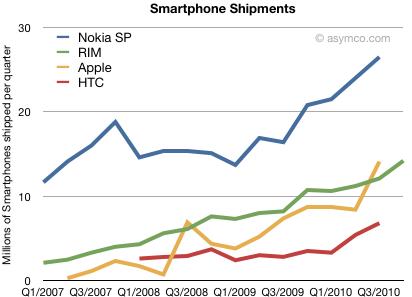
For comparison, here are a select few vendors' smartphone reported shipments. RIM is the first to report and we'll be hearing the the rest by the end of January.
The number most RIM "bears" focus on is the new subscriber additions. At 5.1 million out of 14.2 million units sold implying that the new subscribers added per unit sold is 0.34, a new low.
The bulls will argue that the gross margin is healthy and slightly higher than anticipated.
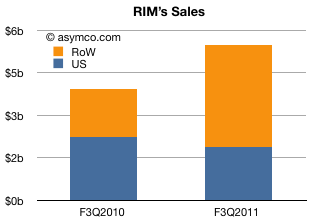
My observation is that the company is finding growth outside its traditional markets. Given the figures above, the US went from $1.65b in revenue to $1.87b; a mere 13% growth while the company experienced 89% overall growth in revenues.
The following chart illustrates the situation:
Of the total increase in sales ($1.6 billion), the US contributed -15% while the rest of the world accounted for 112%.
This can be seen as positive news since RIM has been weak internationally for many years and they really need to penetrate world markets. However, a -15% growth in the US is implies significant share loss in a rapidly growing and traditional stronghold.
Apple will invest in a portion of the investment for the factory, the Nikkei said.
This is one of the more interesting news items I've seen for a while.
[UPDATE] Toshiba denies rumor Apple will invest in mobile display subsidiary
There was a time when Apple designed and owned factories. From an interview with John Sculley:
That went all the way through to the systems when he built the Macintosh factory. It was supposed to be the first automated factory but what it really was a final assembly and test factory with a pick-to-pack robotic automation. It is not as novel today as it was 25 years ago, but I can remember when the CEO of General Motors along with Ross Perot came out just to look at the Macintosh factory. All we were doing was final assembly and test but it was done so beautifully. It was as well thought through in design as a factory--a lights out factory requiring many people--as the products were.
During the 90s the manufacturing function moved outside Apple's ownership umbrella. It was more economical, more flexible and more scaleable to outsource manufacturing to Asia. The time has come to rethink this.
For the past few decades outsourced manufacturing has grown in scale and scope as prices fell and quality increased. However there are signs that this global web of suppliers and assemblers is reaching a point of disruptive change.
Press attention has focused on labor practices, pay structures and the enormity of factory towns where literally millions of workers are employed and housed. As is often the case press attention only hints at some causality and as such misses the point. Journalists looking for a story about child labor or suicidal workers might serve us better by putting the spotlight on the fact that factory towns are not competitive.
centralized Manufacturing is not good enough for the coming mobile computing disruption
The real problem with Chinese factory towns is that they are not flexible enough. By concentrating facilities and workers, electronics manufacturers have improved on measures of scale and quality but are still only able to ramp up and down on individual products once or twice per year. This does not meet the need to increase responsiveness to markets and the pace of development and design. It also reaches some critical overweight mass. Capacity cannot double or triple again to meet the need of six billion consumers. There are signs that the business model must change.
Typically a product is born in Product Marketing, progresses through Design, R&D and then to Manufacturing and finally to Sales. Each of these stages of development has to be re-started for each new product, often in a pipeline fashion. However, some of these stages are increasing their cycle times while others are at their limits. This limits the throughput of the whole chain. If, for example, R&D can put out two product designs in the space it takes for one Sales cycle then they need to be tasked with different product while they wait for "capacity" in Sales to catch up.
My contention is that the bottleneck in device product development is now manufacturing. The evidence is that Apple (among many others) cannot meet demand. Sometimes it's a lack of components, but often there is a forecast error and capacity is simply not allocated. What I also see is that this bottleneck is not solvable with the current value chain architecture. When there are 5 billion consumers of platform devices, centralized factory town manufacturing does not match the cycle time of either design or of consumption.
The answer to low capacity is more investment in more lines of production, more workers and more suppliers. However the problem is that this takes time. The window of opportunity for a product is less than six months.
Consider the iPhone product cycle. A new variant goes into development 18 months to two years before it's launched. It's ready for manufacturing a few months before launch. The R&D team is off making the next version long before the product hits any shelves. The cycle time for R&D changes unpredictably. Sometimes it slips, sometimes it may be shorter because the changes are minor. Perhaps marketing sees the need to react to changing market conditions. However, manufacturing plods along at an inflexible rate.
How can it be fixed?
I'm not an expert in this area, but as a student of disruption I see signs of opportunity to re-engineer the manufacturing business model. The patterns from history are plain to see: Centralized systems get broken down and re-aligned with new bases of competition. Value chains disintegrate and re-integrate as profit algorithms change.
The new algorithm says you need to ramp production quickly (up and down) and to increase "product turns" from one to two each year. Each ramp needs to be even bigger than they are now. Maybe by a factor of two. Products should be built closer to where they are consumed to drive costs and delays out of transportation and tariffs. Carbon footprints need to be reduced.
Sounds daunting. But the rewards could be enormous. The business model may need re-definition. By owning the means of production, the value added can be shifted to another point (i.e. production can be run at a loss in exchange for higher margins elsewhere.)
All this requires capital. Lots of it. Apple has it. I see no better use for it than to re-define production as a synchronized development module.
Andy Rubin, the executive in charge of Google’s mobile software effort, said that international expansion lay behind the latest advance. Speaking in an interview with the Financial Times, he also predicted that a boom in sales in India, Brazil, Indonesia and other emerging countries would contribute to the fast growth rate for the foreseeable future.
Quoting independent research suggesting that Android has also come to account for half of smartphone shipments in China, Mr Rubin said that the open-source nature of the software had made it popular there. However, in the wake of Google’s dispute over censorship with the Chinese government, Android handsets shipped by China Mobile, the dominant supplier, do not carry the company’s search or e-mail services.
This was already confirmed by the data published here this morning.
Verizon alone or with the other US operators cannot account for the majority of Android volumes and anecdotal evidence points out that Europe is not contributing much more.
[Goldman Sachs analyst Bill] Shope also expects both iPad and iPhone sales to exceed expectations in 2011; he sees sales of 37.2 million iPads next year, “which could potentially make Apple one of the largest vendors in the global personal computing market,” if you include both tablets and PCs.
Apparently, it's not just the crazy ones who dare to think the iPad is computer.
My forecast for iPad in calendar 2011 was set at about 33 million since last summer. I may raise it if Q4 units top 6 million.
Meanwhile...
He re-launched coverage of the stock for Goldman this morning, setting a Buy rating and $430 price target, while placing the stock on the firms “America's Conviction List.”
I don't make stock price forecasts as they are based on a random number called 'sentiment'. But by forecasting earnings and assuming a range of P/E multiples between 15 and 20 (essentially in-line or below the S&P 500) values Apple's stock at between $360 and $480 by this time next year.
Goldman's target of $430 is about in the middle of this range so I don't see it as requiring much in the way of conviction.
[ITG sent an explanation of their methodology and there is no indication that the data represents inside information.]
ITG Investment Research analyst Matthew Goodman is forecasting monthly sales record for all of Verizon's devices "based largely on our proprietary daily point-of-sale data from thousands of independent wireless retailers across the US."
Assuming the data is accurate, we are going to dive into it but I will state up-front that without confirmation, the conclusions below should be taken with a grain of salt. All statements should be read with a preceding "if the data is accurate..."
So, if the data is accurate, here is what I conclude [1]:
Verizon Has three strikes against them:
The iPhone has stolen their growth
They are facing the prospect of a single OS platform supplier
Android is not competitive vs. iOS
The iPhone has stolen Verizon's growth
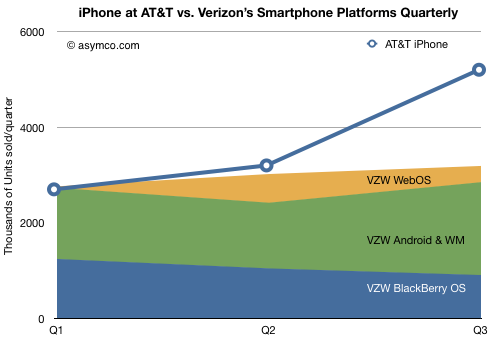
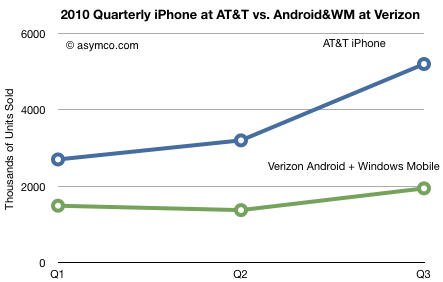
The chart below shows the performance of all of Verizon's smartphones vs. the iPhone at AT&T. The area chart shows how Verizon's volumes grew from 2.7 million in Q1 to 3.3 million in Q3. Not a bad story in itself. However, the iPhone at AT&T went from 2.7 million to 5.3 million in the same time frame. Relative to just the iPhone, Verizon has been underperforming over the last quarter.
Those additional 2.4 million iPhone/AT&T activations in Q3 could be due to replacements but the same could be said for Verizon's volumes. The fact remains that iPhone alone is nearly twice the volume of all of Verizon's smartphone activations.
Just to be clear, this is a direct, apples-to-apples comparison. AT&T and Verizon smartphone performance figures are highly comparable. The two operators are highly representative of the US market. AT&T and Verizon Wireless raked in 75% of all mobile data revenue in Q2 of 2010 and account for 62% of the U.S. wireless customer base.
In addition, Verizon enjoys a larger customer base (has 92.1 million subs vs. AT&T's 90.1 million.) Over the time frame of the data the overall market did not increase dramatically therefore the conclusion that AT&T's win is Verizon's loss is plausible.
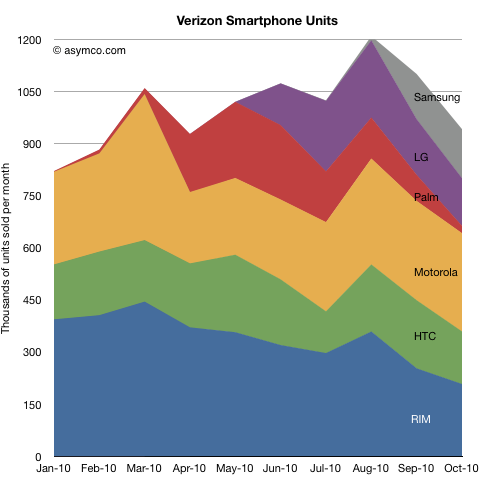
I used quarterly data so that iPhone at AT&T could be compared. But if we look at monthly data, the story gets worse:
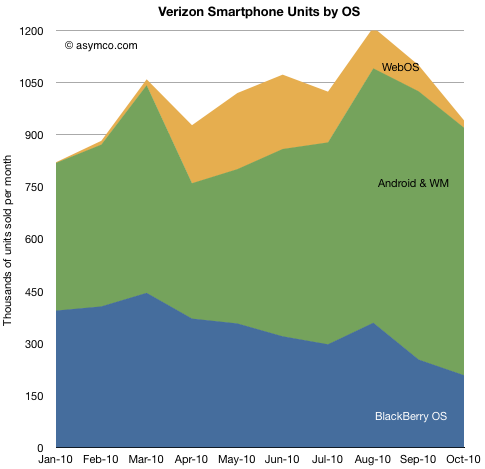
These are absolute volume figures. You can see how RIM's fade was replaced to some degree by new vendors. However, growth hit a wall in August. Following widespread iPhone 4 availability, sales dropped. Coincidence? Perhaps, but the drop happened even with the addition of Samsung volumes.
That's strike one.
Verizon is facing diminished degrees of strategic freedom
The other notable is that even though Verizon doubled the number of vendors selling smartphones, it seems they are growing their smartphone base slower than the overall market.
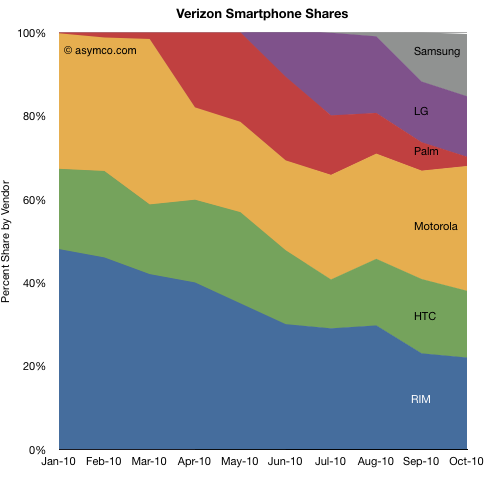
Consider each vendor's share is shown below:
From three vendors to six. Shares are roughly evenly split (except for Palm) but none of these vendors are able to drive volume growth.
Consider that Motorola Droid is outselling RIM. This should be rightly noted as amazing. It plainly shows the power of Android. However that power is not something Verizon will benefit from. Quite the opposite.
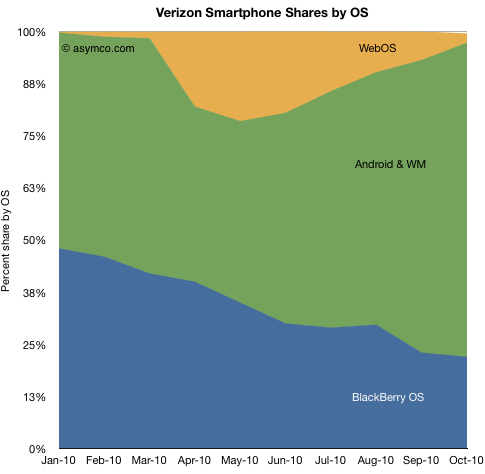
Consider the share map by units and share of each OS:
Android (and WM, though that's likely to be a very tiny part of the green area) made up 75% of all smartphones sold in October. It's possible that the share could grow to 90% as RIM continues to fade.
For Verizon this would be a serious problem. Although Verizon used to have a disproportionate share of RIM's products, that OS was not enabling an ecosystem like Google's. It was a product narrowly defined around messaging. Verizon is facing the prospect of a single OS supplier who may or may not maintain alignment with Verizon's core profit algorithm. If they diverge, Verizon's bargaining power will be strictly limited.
Strike two against Verizon.
Android is barely enough to keep the battle with AT&T from becoming a rout.
In an apples-to-apples comparison, in Q3 the iPhone at AT&T outsold Android at Verizon (remember, same addressable market) by a factor of 2.5. This is with a variety of devices and vendors thrown in the market. We hardly ever get to see this finely grained a comparison when looking at platforms.
I wrote this up as a lack of competitiveness. It may seem provocative, but I define competitiveness narrowly: the competition is for a purchase decision on equal terms. These purchase decisions are fiendishly complex to predict, but the data speaks: whether it's due to brand, visibility or performance and in spite of "antennagate" the iPhone is cleaning up.
That's strike three.
The devil they know
By 2009, Verizon was probably optimistic that they could head off AT&T (and Apple) at the pass. With the vast array of vendor Android roadmaps laid out in front of them they saw a way to stem the flood of defections. I think that optimism dissipated sometime this year and was replaced by a more dreadful prospect than what iPhone presented in 2007.
It is perhaps coincidental that the rumors of a Verizon deal with Apple seem to have started in earnest right after August. It's thin, circumstantial evidence, but the only evidence we have to corroborate the data above is that Verizon has been signaling more desperation.
Reading further into the data, I would say Verizon faced these problems and decided that they had to throw in the towel. Apple may be the devil, but so could be Google. Apple was predictably evil. But Google? The devil you know is perhaps better than the one you can't predict.
What's more, the devil Apple seems to be helping your worst enemy way too much and the unpredictable one does not seem to help all that much.
Final question: how many iPhones will Verizon sell
I think this data shows that Verizon has another reason to sell the iPhone. The underperformance of their smartphone franchise is not the only determinant, but it is perhaps another straw on the camel's back.
What would happen if (or more likely when) Verizon sells the iPhone? I believe they will sell them at the same rate as AT&T does.
The data shows that Verizon sold, on average, about 3 million smartphones per quarter during the first nine months. That's about 1 million a month. That was based on three platforms, six vendors and widespread promotion.
The iPhone sold almost 4 million a quarter over the same time period.
Verizon users bought smartphones at a lower rate than AT&T users bought iPhones. This is even though the two carriers have approximately the same subs base which churns very slowly. Since a mass-market product will appeal equally to statistically equivalent populations the product should be taken-up with similar vigor.
So the question is not whether Verizon can sell iPhones at the rate of 4 million a quarter. The question is only whether these 4 million will be in addition to the 3 million that are currently buying non-iPhones.
My guess is that the 3 million run rate for non-iPhones will drop, but not to zero.
The impact on the other vendors supplying Verizon may be strongly negative depending on the level of promotion Verizon puts on the product. That promotion budget is usually fixed as a percent of sales. What Verizon applies to iPhone will be taken out of what is spends on Droid. I have always said that operators will be motivated to balance their supplier power. The promotion budget is the primary instrument to meet that end.
On the other hand, the overall market will grow so 2010's 3 million/Q will be 2011's 6 million/Q. There is plenty of room for multiple platforms.
So my conclusion remains that iPhone will find at least 8 million new users with Verizon. The analysis above give me confidence to increase the upper bound to possibly 12 million.
Verizon striking out means they need to change the way they play. The iPhone is a new ball game.
------
[1] To assemble this discussion I used only the data provided in the article linked above and the officially published iPhone activation numbers from AT&T. Obtaining specific smartphone vendor volumes is a matter of reverse engineering the share chart and cross-referencing it to the table of vendor sales.
When comparing smartphone platforms it's tempting to consider the global market as unified and commonly addressable. However, when you look at individual countries some strange patterns of behavior emerge:
Indonesia, the fourth most populous country in the world (230 million people) loves Nokia's Communicator. It's the ultimate mobile status symbol.
Japan had one of the largest installed bases of Symbian phones. The version running in Japan is not compatible with versions elsewhere. Famous for its Galapagos mobile culture, the iPhone is changing what the Japanese consider the basis of phone performance.
The iPhone just became Korea's favorite smartphone even though hegemonic Samsung and LG are doing a roaring trade selling Android phones elsewhere.
The US has four incompatible 3G network technologies in widespread use. No widely distributed smartphone phone works with any two. Blackberry ruled supreme until AT&T started promoting the iPhone and Verizon started promoting Android.
Latin America loves BlackBerry. BBM is wildly popular as an SMS alternative.
Saudi Arabia loves BlackBerry. When face-to-face conversations are taboo, the BlackBerry is a social lubricant.
Australia loves the iPhone. Android is almost non-existent.
Italy has more smartphones per capita than the US. The majority are made by Nokia.
China uses two incompatible 3G technologies. The most popular (TDSCDMA) is not available anywhere else. WiFi was illegal in phones until this year.
Germany has a disproportionally large installed base of Windows Mobile
There are no Blackberries in Finland.
Although some of these idiosyncrasies may be cultural (like the Indonesian penchant for large devices) most of them are due to operator decisions. In some cases operators choose incompatible network technologies to protect from competition. In others they promote local vendors or price certain products out of reach.
Sometimes big bangs take place and demand explodes for "banned" technologies or vendors. However, it's just as easy to see how the pendulum can swing against free market choice.
Ultimately users and device vendors are at the mercy of operator decisions. In the long term operator control over platforms might diminish but it will take many years.
In the latest version of Android, Google shifted from bitmaps to vector rendering for maps. The shift is probably more a function of available processing power on the device than a strategic shift to position value on the device rather than in the cloud. Vector maps, which are much more efficient in terms of bandwidth and local storage, have been the choice for in-car navigators but Google has always been using bitmap tiles which are fetched from a server and delivered only if the device is using a data connection. The downside for vectors is that they require a bit more local processing power.
I doubt that Google's move to vectors is part of a shift to more app-centered/edge-of-network strategy.
How is this relevant?
Google has been riding a wave of re-centralization of value toward the center of the network as broadband made the cloud feasible. Keep in mind that Microsoft rode a wave of de-centralization as value moved to the PC and away from the mainframe. As intelligence was pushed to the edge, Microsoft accrued value from enabling the edge as a locus of productivity. This is no small thing.
Then came apps.
The supernova that is the App Store illuminated the possibility that apps are perhaps a "pushback" on the center. Like all good disruptions this was unforeseen: Apple built the store and the apps sold; by the billions. Apple joined the world in a scramble to react. Something profound was happening, but the very brightness of this explosive growth blinds us to what is actually going on.
My hypothesis is that there is a tug-of-war going on between the mobile cloud and the device-at-the-edge. Both will become better and neither is good enough. Technology roadmaps point to both higher availability of local storage/processing power as well as faster, cheaper and more ubiquitous mobile broadband. So technology insight by itself is not enough to give us a clue to the outcome.
What I would focus on is what is more natural for the user. Note that Twitter and Facebook both have better interfaces with their apps than they do with their browser interfaces. That and innovations in game interaction points out that apps are as much a disruption of UI metaphors as they are of the locus of power in the network. It would not surprise me if people end up spending a larger part of their lives tethered to device-enabled social media, "firing" the PC from the job of social interaction.
If we believe the app will grow as the preferred interface for the web (and I'm leaning in that direction) then the implications are potentially harmful to Google. Google does not "do" interfaces. Their strategic assumption has been that interfaces are commodities. The browser is the universal interface. Perhaps HTML5 will offer sustenance to the concept, but it's not a panacea. Web apps have a long way to go to become competitive with hand-crafted app UIs. (While web apps have been possible for iPhone since its inception, developers vote en-masse for apps and almost zero popular web apps exist. Ditto for Flash-to-app interface ports.)
This brings us to focus on the asymmetry of business models.
the App Internet
What we end up with is the "app internet": a potential disruption of the browser-as-interface and the re-integration of the user experience around the device. Because the iTunes store allows money to be attached to new interface innovations, developers follow and compete on better interfaces rather than on access to the back end. The asymmetry ensues from the fact that by attaching profit to the point where the user touches the screen, Apple took the basis of competition for developers away from the cloud.
In other words, the point where the electrical charge of the human skin is detected is suddenly the exact location of value capture from mobile computing.
Of course, Google is responding, but since they did not focus on seamless and curated experiences, developers are not seeing returns for investment in interfaces at the touch point. As a consequence, Google apps developers seek ad revenues. In turn, this is a road that leads to less innovation in interfaces and more innovation in network-dependent services.
I sense a distinct asymmetry in app trajectories between the platforms due to core business model choices. Asymmetric competition causes the great fortunes to be made and great fortunes to be lost.
The difficulty in analyzing the smartphone market lies in its extremely rapid growth. With the market growing at 90% (and 400% in some areas like China) the forces of demand and supply are disconnected. It's impossible to discern whether a purchase decision is made from a choice of comparable alternatives or if it's made from a choice between buying nothing and some alternative.
Furthermore, another problem lies in distribution inefficiencies. The global phone market is nominally serving 4.6 billion consumers but they are not all participating in the same market. Devices and the services they are bundled with are not fungible globally. You cannot buy a phone is one country and easily couple it with service in another. You can't even transfer one bundle from one owner to another within the same country. Products are available only in some countries or some operators and not in others.
Commentators focusing on mobile OS platform shares assume a zero sum game and a liquid, efficient market. Both assumptions are false. They also assume that the platform is a basis for the choices made (rather than the device, the pricing illusion attached to the device, the service plan, availability, point of purchase and network switching costs, etc.)
There is data where competition for a single purchase decision by two comparable products with comparable specs and price plans can maybe show a preference. However that data is not public. Only an operator like AT&T who sells both Android and iPhone through the same channel has that data and they're not sharing.
The closest I came to analyzing this was in a blog post last May. However, that data is obsolete. Since then Android growth has accelerated rapidly as vendors who were not making smartphones (Samsung, Asian second tier, Motorola and Sony Ericsson in that order) began making smartphones in volume. Their only choice in entering the market was Android. This supply-side view of the market is much more relevant than demand-side assumptions because the market is supply constrained.
Another way to see it is this: If there is a shortage of bananas, you can't make a case for Costa Rican bananas being preferred over Honduran bananas. People will buy whatever bananas they can get (even if one may be preferred over the other). If Honduras can produce twice as many as Costa Rica then they will sell them all and it says nothing about their quality or end user preference or whether that volume advantage will be sustainable once the shortage abates.