Asymco

Asymmetric Intelligence

Horace Dediu

  1. The symmetry of share shifts in mobile phones

    Research · 49 comments

    Thanks to a reader's suggestion, I took another look at the profit and market share data from the mobile phone market overview posted last quarter. This time to compare the vendors on two dimensions at the same time.

    I plotted the vendors on share of market and share of profit axes in two different points in time: Q2 2007 and Q2 2010. I further broke the chart into four quadrants as shown:
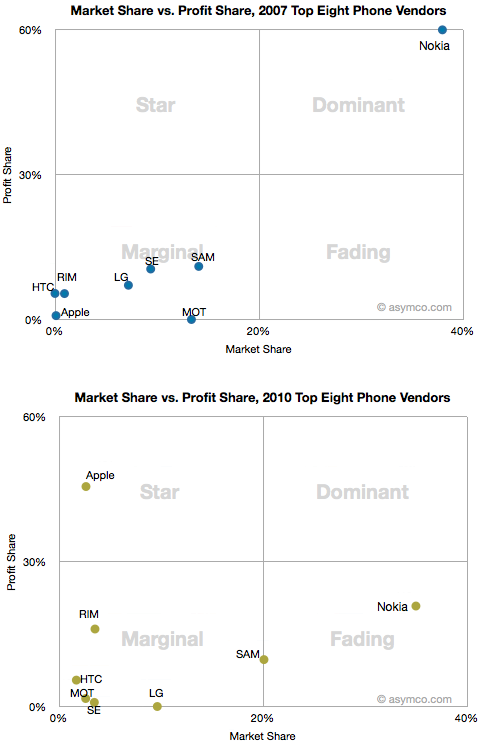
    I chose to label the quadrants to indicate the possible categorization of the companies.

    • Dominant: large market share and large profit share
    • Star: low market share with large profit share
    • Fading: high market share with low profit
    • Marginal: low market share and low profit

    It's interesting to note the shift over the time period of the eight vendors. Whereas Nokia moved from Dominant to Fading, only Apple rose from Marginal to Star. The Marginal players dispersed their placement with Samsung moving laterally toward Nokia while RIM followed in the Apple trajectory and increased profit share while maintaining relatively low share.

    Thinking about motion around these two dimensions could be reduced to a vector model. If each vendor is represented by an arrow showing direction and distance moved, we can compare each vendor vs. a symmetric competitor which might account for the loss or gain of share.

    The vectors can be paired as follows:
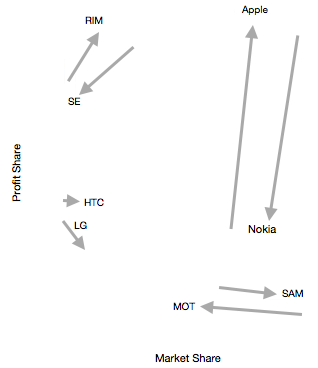
    Although the data does not contain all market participants, the shifts in share are quite closely conserved with the vector magnitude (arrow length) and angle (direction) paired. Note how Nokia and Apple swapped Profit without too much impact in Units volume. Similarly, RIM and Sony Ericsson traded profits and volumes quite symmetrically. Samsung also took volume while Motorola lost it. HTC and LG did not change positions dramatically.

    Finally, moving all vectors to the same origin leads to this view of share gain/loss over three years in two dimensions:
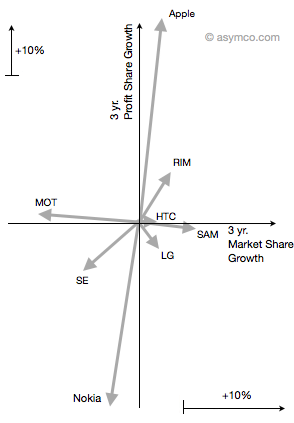
    It becomes quite easy to see who the winners and losers are and by how much.

    This model is only an observation of the shifts in market power and is not conclusive about where share was gained or lost, however there is compelling symmetry which also matches the intuition of  observers.

  2. New Comment system in use

    Research · 23 comments

    I activated IntenseDebate comments. This allows many features (see below) including the editing of comments.

    There might be some issues or bugs that will be discovered only once the system is in use so let me know what you observe.

    The key features claimed are:

    • Reply By Email
    • Users Reputations
    • RSS Feeds
    • Widgets
    • Threaded Comments
    • Tracking and Notifications
    • Profiles
    • Comment Voting
    • Social Traffic Drive

    Readers will be able to follow the conversation within the comments better with comment threading. Comment threading makes reading comments manageable and returns the value of insightful comments to your site. Not only will your readers be more likely to comment, but they'll be more likely to return to leave multiple comments as the debate gets going. Comment notification emails alert your readers when someone has responded to their comment and makes responding a piece of cake with our Reply By Email feature.

    In addition, your readers will be able to vote on the comments made, and gain reputation points giving their comments more authority. Readers can subscribe to comments through our support of various RSS readers. Readers can follow their friends as they comment their way across the Internet. Not to mention that Intense Debate is a great tool for promoting their own blogs.

  3. Ticonderoga sees over 15 million iPads in 9 months

    Research · 13 comments

    White contends iPad could be “one of the most coveted gifts” this holiday season; he sees the company selling 7.1 million units in the September 2010 fiscal year, with 19.9 million in 2011, and 25.8 million in 2012.

    The analyst said his target is based on 20x his interest expense/income adjusted calendar 2011 pro forma EPS estimate, plus net cash of $49.43 a share.

    via Apple: Ticonderoga Starts With Buy, Street-High $430 Target - Tech Trader Daily - Barrons.com.

    If Apple hits 5 million in the just ended September quarter and 7 million in the December quarter, we're looking at over 15 million iPads in nine months of sales. The iPhone took about 20 months to reach the same level.

    If the iPad is ramping up more than twice as fast as the iPhone, (aka the Jesus Phone) what does that make it?

    See also: iPad Death Watch : AAPLinvestors

  4. AT&T Set to Release Multiple WP7 Devices, T-Mobile anchors launch event

    Research · 6 comments

    As of two weeks ago, AT&T was to be the launch partner for Windows Phone. AT&T had been expected to unveil phones from HTC, Samsung and LG, according The Wall Street Journal.

    Windows Phone Thoughts: AT&T Set to Release Multiple WP7 Devices.
    Today we hear that the invitations for the October 11 launch event have gone out, without mention of AT&T:

    "T-Mobile reps will be present for device showing and their service offering discussion," according to the invite.

    Can't wait for the spin.

  5. iPad lead seen as 'overwhelming'

    Research · 37 comments

    Chris Whitmore predicted 2.0 million iPads would be sold in 2010 soon after the product launched. (asymco | Analysts predict iPad sales)

    More recently, Chris Whitmore writes for Deutsche Bank:

    "We believe Apple's lead in the tablet market will prove difficult to close by the onslaught of competing products coming over the next several quarters," he writes in a note to clients issued early Monday. "Ultimately, we expect the slew of upcoming competition to fall flat from a user experience standpoint while struggl[ing] to materially undercut the iPad on price."

    How far ahead is Apple (AAPL)? According to Whitmore:

    12-18 months in content (see chart)

    2 or more years in terms of other media acquisition and integration via iTunes

    Untold dollars in terms of component pricing

    via iPad lead seen as 'overwhelming' - Apple 2.0 - Fortune Tech.
    Compare this fresh (re-)assessment with the following points I made in May of this year:

    The iPad comes with an even bigger value chain [than the iPod] bolted on: the App Store. Apple is flogging not just an “app player” but also a new way to develop and distribute software. If you cut “music” and paste “apps” you see the immediate parallel between iPod and iPad. The app ecosystem will quickly grow to be larger than the music ecosystem with the mobile software business already eclipsing the music business.

    ...

    So the iPad challengers face five daunting obstacles:

    Recognition of a threat from a seemingly benign product

    Execution on hardware against the best integrator on the planet

    Execution on software against a new UI metaphor fortress surrounded by a patent moat

    Integration of hardware and software to a sublime whole

    Re-building a value chain for which they have no handle vs. a broad and deep existing universe of app/content creation distribution and consumption enjoying logarithmic network effect value.

    asymco | Will Apple rule the iPad market? (part II)

    Welcome to the club, Chris.

  6. Goldman downgrades Microsoft, blames iPad

    Research · 22 comments

    "We believe the intrinsic value of shares cannot be unlocked if the status quo remains, and we have increased caution near term on a more elongated PC refresh cycle, combined with the newer threat of notebook cannibalization from tablets, where Windows does not yet have a presence," write Goldman Sachs analyst Sarah Friar and associates in the introduction to the report.

    More advice about what to do about this in the linked article: Goldman downgrades Microsoft, makes case for major overhaul.

    I'd skip over the recommendation to break up the company but the observation that Microsoft might face earnings threat from iPad is provocative. Usually it takes a few years for the incumbent to feel pain and react. The pain might be sooner than expected though the reaction might still take some time as the Windows Phone response to iPhone is taking its sweet time.

  7. Updated estimates for Apple's fourth quarter earnings

    Research · 12 comments

    We expect revenue to be about $18 billion compared to $12.2 billion in the September quarter last year. We expect gross margins to be about 35%...

    We are targeting EPS of about $3.44.

    via Apple Inc. AAPL Q3 2010 Earnings Call Transcript.

    I've updated my estimates from the July forecast as follows:

    • iPhone units: 12.2 13 million (65% 77% growth)
    • Macs: 4 million (30% growth)
    • iPads: 3.3 5 million
    • iPods: 9.4 9.7 million (-5% growth)
    • Music growth: 26.7% 25%
    • Peripherals growth: 21% 15%
    • Software growth: 8%
    • Total sales: $19.0 $20.5 billion (56% 69%y/y growth)
    • GM: 42.3% 40.4%
    • EPS: $4.78 $5.00 (73% 81% y/y growth)

    The main news items that affected the changes in estimates were:

    1. iPhone continues to be supply constrained.
    2. iPad supply nearly matching demand though not yet rolled out in all markets
    3. new iPods look compelling though offset by back to school promos

    Follow other estimates at Deagol's site:
    Deagol's AAPL Model: Fiscal 4Q 2010 Final Estimates

  8. iOS users are ten times more likely to download apps than Symbian users

    Research · 13 comments

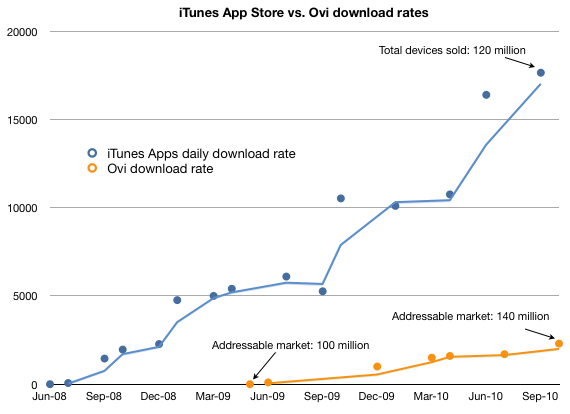
    With the number of active Nokia service users now reaching 140 million worldwide, the company today announced that more than 200,000 people are currently signing up daily to Ovi, and that Ovi Store has reached the milestone of 2.3 million downloads per day. Available in more than 190 countries,

    via Nokia Ovi Services Continue to Grow.

    Nokia updated its tally of download rates so we can put the numbers side-by-side with Apple's iTunes.

    The slope of the Ovi curve does not yet compel one to get excited over the platform's prospects in the near term. However to get a true picture, one needs to not only look at absolute download numbers but also the probability of any one user or device being used to download an app.

    For this we need to note how the number of devices relates to the download rate. Apple announced recently that they sold 120 million devices running iOS. Not all those devices are still in use.  If we remove 20 million from that total we get approximately 100 million iOS devices. Nokia, on the other hand, specified exactly how many devices can access the Ovi store: 140 million.

    Therefore 100 million iOS devices download at a rate of 17.7 million per day while 140 million Symbian devices download at the rate of 2.3 million per day.

    That puts the weekly download rate per device at 1.24 for iOS users vs. 0.12 apps (or whatever is the appropriate content item for Ovi) every week for Symbian users.

    As the table below details, the rate of downloads per device for iOS is more than 10x higher. This is the more interesting number if you are a developer.

    If someone can point me to Android Market download rate (historic and/or current) I can add it to the mix.

  9. Is Android share of Web lagging iOS share of Web?

    Research · 12 comments

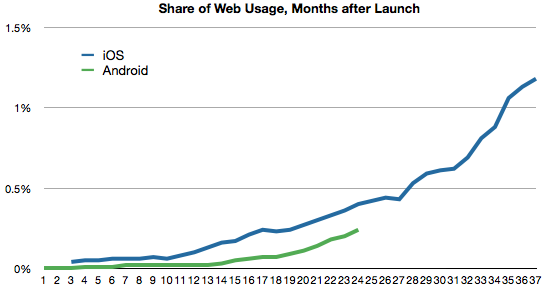
    Of all the public statistics about platform share, Share of web use must be the most important measure for Google. The more browsing people do, the more searching they do and if Google search is most likely for a platform then the more income Google derives from that platform.

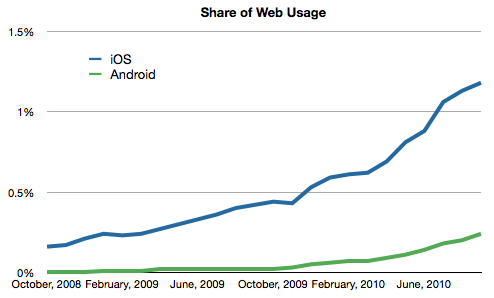
    NetMarketshare.com has offered an insight into the split between Android and iOS as search platforms and it shows how iOS is still five times more likely to yield search revenue than Android. That multiple is likely to shrink as the gap narrows, but it still demonstrates the power of iOS to drive Google's bottom line. It's no wonder then why Google has renewed their default placement of Google search in mobile Safari (a guarantee they don't seem to share with all Android licensees.)

    But Android launched later than iPhone, so everyone should be asking how rapidly the share of Web has grown since the start of each platform. When iPhone launched in 2007 it was almost competing with mobile web non-consumption. The alternative mobile browsing experiences were so bad that it's hard to remember anyone putting up with them. A year later, the bar was set higher and Android filled a vast chasm of demand for mobile browsing for people who could not buy an iPhone.

    At the same point in the life of each platform, Android seems to be exploding in units sold. With this proliferation of Android licenses, it should be interesting to see if their unit share numbers are reflected in web share numbers. So far the story is not convincing. The growth in Web share is not pacing faster than iOS achieved at a similar point in time.

    So far, 24 months into the life of each platform, iOS leads by almost 50% higher share.

    iOS/mobile Safari has the advantage of iPod and iPad for distribution but that does not explain the relative lag of Android with respect to Web share as Android has a large number of SKUs.

    It may be too early to draw conclusions, but anyone trying to analyze Google's strategy with Android should be paying close attention to this.

  10. Android licensees: If you're not paying, you're being sold

    Research · 34 comments

    The latest litigation lollapalooza over Android reminds one of the old web adage that if you're not paying for content, you're the asset being sold.

    That's certainly one of the consequences of the Android licensing model. The mobile phone vendors with no software intellectual property are pawns in a game between IP holders. It's clear that Microsoft and Apple and Oracle (and perhaps Nokia) have IP issues with Google. But it's the licensee device vendors which are most often the accused. Whether Google indemnifies or not is an open question, but the evidence is that the vendors are exposed.

    The proof is in the fact that HTC is paying Microsoft for the use of Android. It's conceivable that Microsoft also asked Motorola for Android royalty payments but were rebuffed. It's also possible that since HTC is still a large scale Windows Mobile licensee, they were given a way out of the Android IP trap by Microsoft. We don't know if there were confidential deals between LG and Samsung on this issue (as they are both committed to the Windows Phone platform but shipping Android). In either case, Motorola may be forced to do the same and pay (Microsoft) for Android.

    It's understood that Google gains some value from Android but also has hidden costs from it as well. Now the licensees have to recognize their hidden costs of the platform as well. There is the IP tax but also the question of control over one's destiny. Google is selling the vendors as an asset class to advertisers. Is that a positive consequence for their brands?