
Asymco

Asymmetric Intelligence

Horace Dediu

  1. Escape from license-land: Measuring phone vendor commitment to licensed mobile platforms

    Research · 29 comments

    Windows Phone had its day in the sun yesterday. After discarding its previous seven-year effort with Windows Mobile, Microsoft started with a clean sheet of paper. However, whereas the software has been re-built, the business model has not. WP is still a licensed operating system whose primary customers are mobile phone vendors. With Symbian mostly out of the picture, WP becomes only the second viable commercially licensed mobile OS, after Android.

    So with two licensed platforms in the running, how do we measure success in the licensing business? Units sold to end users is one metric. But that data will have to include the performance of vendors and operators and other distributors. And it will take a year to do valid comparisons. The only indicative metric we have available today is how many devices have been committed by vendors.

    As WP is out of the gate with device announcements, we can actually measure this. We can plot each vendor's commitment to various platforms as an early indicator of strategic success. To that end, here's the methodology: I took all smartphone vendors and tallied how many SKUs they have announced or leaked for either the WP or Android platforms (source: pdadb.net). I then plotted each vendor on two "commitment axes" (see notes below).
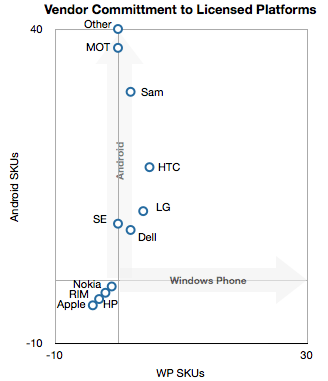
    The more to the right a vendor lies, the more committed they are to Microsoft's platform. The more to the top a vendor lies in the chart, the more committed they are to Google's platform. The vendors which don't have any licensed products lie below the origin.

    What we can observe is that Microsoft has pulled several, though not all vendors partially to its side. The level of commitment is not yet very high and it has not likely reduced their commitment to Android. In other words, points are moving to the right but not (yet) down.

    Framing the platforms this way helps us discuss how the market might evolve with these questions:

    1. Is Microsoft's re-entry going to peel vendors away from Android. In other words, will points move down as well as to the right.
    2. Is there motivation for some vendors to move to their own platforms like the non-committed? We've shown that profits accrue disproportionately to the vendors below the origin. As a result, is the pool of available top tier vendors going to shrink?
    3. Will vendors commit to single platforms or maintain this split OS loyalty strategy? Will we see LG migrate to WP exclusive and will Others remain exclusive in Android?

    I'll throw out my predictions to start:

    Microsoft's strategy is aimed at top tier vendors more than to the "others". This is due to a lesson they learned with Windows Mobile: having a ton of SKUs does not guarantee a healthy ecosystem (a lesson that Android has not acknowledged as true). There are positive and negative consequences. The positive is that Microsoft control the experience better, create a better brand and can participate in an effective dialogue with operators. The negative is that they are going to deal with a diminished licensee pool.

    On the second question my prediction is that vendors are going to move "down and to the left" away from the licensing model. If they can't go direct to that quadrant, vendors will consolidate portfolios around one licensed platform. The distribution of commitment I forecast will look like this:
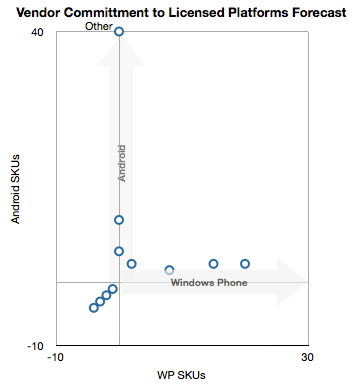
    Maintaining multiple platform development teams is expensive. Branding is also confused. The upside is that you get to play the operator's divide-and-conquer game of platform dilution (aimed at the non-licensing players in the lower left corner).

    In particular, Samsung, with Bada, is likely to find ways out of license-land. Sony Ericsson may stick with Android and LG may move to Windows exclusively. That really leaves only HTC and Dell as licensees with multiple licenses.

    This axial alignment is not a healthy thing if you are a platform vendor. Having one or two dedicated customers means the power of the buyer is much higher and their wishes become your command.

    Which leaves only one true prize in the game: the "others". Android is clearly the darling of "Others" who are being shunned by Microsoft. Can "Others" become the lever for Google to pry open the market? History and the tangled web that is operator distribution does not point in that direction.

    ------

    Notes:

    1. I considered products announced only since Jan 1, 2010
    2. I did not consider any Windows Mobile legacy commitments
    3. "Other" vendors are off the scale with over 100 SKUs but represented as having 40 SKUs so as to be kept on chart
  2. What did Andy Rubin mean by saying WP7 was created for political reasons?

    Research · 24 comments

    In an interview with PCMag, Rubin said,

    "Look, the world doesn't need another platform. Android is free and open; I think the only reason you create another platform is for political reasons. Why doesn't the whole world run with [Android]? They don't like the people who developed, or "not invented here [NIH]"

    I note some irony in the suggestion that Windows Phone is superfluous when the acquisition of Android was an attempt to limit the growth of Windows Mobile. But that historical footnote is not entirely relevant here. The point Rubin raises is that WP is politically motivated. And by political he suggests two things: that there is mistrust of Google or NIH among potential licensees.

    The NIH argument falls flat because anyone considering WP7 would also have NIH issues with Microsoft. So that really leaves only the question of trust.

    Why would anyone mistrust Google when they offer operating systems software? How about these reasons:

    It's clear that Microsoft is buying its way back into Mobile (it went so far as to pay incentives and guarantees to established developers to convince them to port existing apps or write new ones for WP7), but that is not a political ploy. It's just good old fashioned brute force.

    The mistrust that Google earned for itself with operators, device vendors and potential content partners is rooted in its business model with Android. Hiding the costs of "openness" behind a veneer of freedom. In addition, putting forward competing products like Nexus One threaten the entire value chain.

    I'd say the politics of Microsoft licensing are a lot more transparent. Redmond is the devil they know.

  3. Acer chairman predicts iPad market share

    Research · 30 comments

    Acer chairman J.T. Wang recently predicted that Apple’s share of the tablet market would decline precipitously as new rivals emerge, falling from nearly 100 percent to 20 to 30 percent.

    via Apple Will Retain At Least Half the Growing Tablet Market, Says Analyst | John Paczkowski | Digital Daily | AllThingsD.

    So let me get this straight: A PC vendor...

    • that did not consider building tablets because they failed to see an opportunity
    • that, once introduced, dismissed the iPad as a failure
    • that has no software assets to couple to an alternative offering
    • that cannot license software assets that compete because none exist
    • that does not understand what jobs the device is hired to do vs. what his current products do
    • that has no ecosystem to couple to an offering
    • that cannot market products any cheaper than the incumbent

    ...should be taken seriously when predicting share for products that do not exist?

  4. Daring Fireball Linked List: Andy Rubin Talks Android

    Research · 29 comments

    What value have the carriers brought? Seriously. What software on Android phones have the carriers added that’s any good at all?

    Things you don’t hear iPhone users say: “Man, this iPhone would be even better if my carrier could ‘add value’ to it.”

    via Daring Fireball Linked List: Andy Rubin Talks Android.

    Good questions.  I would seriously like to hear any answers to these questions as I have never used any of these operator software phones.

  5. Adding CDMA increases iPhone addressable market by 16 percent

    Research · 18 comments

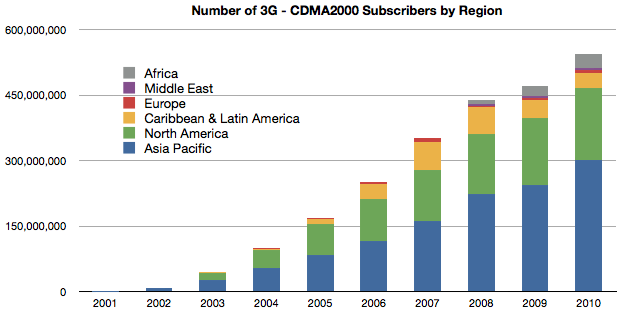
    Now that NYT and WSJ were both tipped off about the coming of a CDMA iPhone, I think it's a safe bet. Is this significant? What is the CDMA addressable market?

    Here is a chart showing  for the "CDMA 3G" subscribers (source: CDMA Development Group.)

    (includes CDMA2000 1X, 1xEV-DO Rel. 0 & 1xEV-DO Rev. A )

    Here are the data for various subsets.

    • CDMA2000 543 Million includes CDMA2000 1X & 1xEV-DO
    • CDMA2000 1xEV-DO 145 Million includes CDMA2000 1xEV-DO only
    • CDMA 547 Million includes cdmaOne, CDMA2000 1X & 1xEV-DO (includes non-3G)

    For comparison, the GSM data for Q2 2009 is:

    • GSM 3,450, Million
    • WCDMA 256 Million
    • WCDMA HSPA 133 Million

    It would be safe to assume that the iPhone will be able to address 543 Million additional users.  They represent about 13% of all mobile subscribers but the increase in addressable base is about 16%.

  6. The imminent demise of killers

    Research · 36 comments

    Before proclaiming the death of a company or product it's important to understand what makes it live. I'll illustrate with a personal experience.

    I was once asked to comment on a product designed to be a "Blackberry killer". Much like the latest Droid Pro, the product looked like a Blackberry. It had a monoblock keyboard and a nearly square screen. It was, in other words, a product designed for thumb typing emails.

    The backstory is that, like many phones, the requirements came from operators. At the time, RIM was growing extremely quickly and was causing some consternation at operators over an upstart's increasing reach into the relationship with end-users (sounds familiar?)

    The rigidly predictable response was to call all phone vendors and task them with developing Blackberry alternatives (aka killers). Of course, each vendor was called independently so they all got excited about having this opportunity to be assassins.

    So when I looked at the product my employer was building as a "killer" I asked: "Well, what makes Blackberry live?" This was not just rhetorical. I felt it was critical to the success of the product. Unfortunately it was not a question on anybody else's list. My cursory review of RIM's business would show that the product Blackberry was popular because it enabled a service, not because of the design of the device.

    RIM was like a barkeeper who enabled socializing on his premises by selling beer. The product he sold was not really beer but meeting services. A brewer looking enviously at the high margin beer being sold there might try to compete by launching "Pub-style beer" but the product won't help people socialize any more if they drank it at home. Bar patrons were paying the high price of bar beer because it had an implicit rent attached for using the meeting site.

    So no matter how much a brewer tried, unless they got into the business of managing taverns, they won't ever put the barkeeper out of business.

    But the rush to copy the design was in full force. Not only Nokia (E 61), but HTC (T-Mobile Dash), Motorola (Q), Samsung (Blackjack) and even Sony Ericsson (M600) rushed similar products out. And they all reached the market at about the same time. (Evidence that not only were they all asked to make products by operators at the same time, but that their product development cycles were roughly the same.)

    The deluge of keyboard monoblock Blackberry killers led to lots of comments predicting the imminent demise of RIM by way of powerful entrenched incumbent responses.

    RIM's market share actually grew after these launches.

    This is because none of the products addressed the real question of what makes Blackberry live and thrive. They were just pub-style beer, not thinly disguised meeting places.

    So next time you hear about the imminent demise of an upstart due to the reaction of suddenly awakened incumbents, ask whether the reaction is to the product or to the way the product makes money.

  7. Adobe and Microsoft sitting in a tree

    Research · 16 comments

    Adobe is one of the last surviving desktop software companies. So is Microsoft. Consolidation happens when an industry matures and excess capacity and excess overhead can be squeezed out of the value chain, giving a temporary burst of earnings growth.

    So, in this way of thinking, recognizing that the sun is setting on desktop software, a merger of old schools of thought may make sense. Rather like Sun and Oracle or HP and Compaq.

    But then a lot of other things make more sense. Like both companies trying to expand into new growth areas. Like Microsoft talking to RIM or Adobe developing tools for HTML5. Adobe's cash cow products are not going anywhere without a deep reset. Same is true for Microsoft. They will both face these challenges whether standing alone or together.

    There would be nothing strange about a Microsoft Adobe merger, but there would be nothing great about it either.

  8. The cognitive illusion that is iPhone n-1

    Research · 28 comments

    How do you think about the iPhone 3GS after the iPhone 4 is out? I have a hypothesis that it's not what it seems.

    The standard logic is that the 3GS (which I will call the n-1 where n is the current phone version) is a lower-priced leftover that covers a lower price point and expands the market.

    I think it's designed to give the illusion that the iPhone 4 is actually more desirable steering more potential buyers to the new (nth) phone.

    To illustrate I'm going to call upon the wonderful example given by behavioral economist Dan Ariely at the TED talks.

    Imagine I give you a choice: Do you want

    • (a) "a weekend to Rome, all expenses paid" or
    • (b) "a weekend in Paris, all expenses paid"?

    They are different but compelling choices. Perhaps a survey would find these two choices equally popular.

    Now imagine I added a third option to these two that nobody wanted:

    • (c) having your car stolen.

    It seems a strange choice, because how could having your car stolen in this set influence anything? Obviously (a) or (b) would be the only compelling options. But what if the option for having your car stolen was not exactly like this. What if the third option was

    • (a-) "a trip to Rome, all expenses paid but no free coffee with breakfast."

    Given that you can have Rome with coffee, why would you want Rome without coffee? It's an inferior option just like having your car stolen.

    But, the moment you add Rome without coffee as an option, Rome *with* coffee becomes more popular and people choose it much more often. Having Rome without coffee makes Rome with coffee seem superior, not just to Rome without coffee but even to Paris.

    Adding (a-) to the set of choices (a) vs. (b) makes choosing (a) much more likely.

    He goes on to describe a subscription offer from The Economist which, by inclusion of an inferior option, steered people to choose a more expensive option.

    My point here is that I hypothesize that the iPhone n-1 (Rome without coffee) is an inferior option to the iPhone n (Rome with coffee) and that it steers more people to choose iPhone n not just over iPhone n-1 but over the competition (Paris). Of course the inferiority of iPhone n-1 is offset by its lower price, but I put it that the difference of $100 is not that great in the eye of most users when they see the difference with the new model. The price difference does not make the iPhone n-1 look all that great. It's still Rome without coffee.

    We don't have precise stats to prove that iPhone n-1 is ignored as an option, but the ASP numbers never seem to drop. They seem to indicate that the overwhelming number of iPhones sold are the top of the line. Therefore the presence of an inferior option does not dilute the average selling price, but, in fact, increases overall volumes of the top product.

  9. IBM Survey: The cell phone is no longer a gadget – it’s what IT is going to become

    Research · 3 comments

    “In all areas of software development, mobile computing is seen as the number-one hottest IT opportunity next year,” said Jim Corgel, an IBM general manager of independent software vendors and developer relations who was involved in the survey. “Not only will mobile spike to the forefront, but by 2015, respondents said it will dominate everything. The cell phone is no longer a gadget – it’s what IT is going to become.”

    via IBM Survey Says Mobile Apps Will Dominate Enterprise - Venture Capital Dispatch - WSJ.

    Developers are usually not very good at predicting specific business winners or losers (to prove this consider why developers don't spend their energy and earn their living picking tech stocks instead of writing code.)

    However, developers are very good at spotting long term technology trends. It was developers who championed the early internet and it was developers who saw potential in social networking. To see a survey of developers confirm that mobile devices will dominate IT, in contradiction to most incumbent strategies, is encouraging.

  10. How many iPads next year? Analyst Sees 45 Million IPads In 2011

    Research · 19 comments

    The contact, says [Ticonderoga's] White, shipped more than 6 million parts to Apple during the third quarter of the year and expects to ship 7 million more in the fourth quarter.

    Since Apple uses one unit of this particular component in each iPad, that adds up to shipments of 13 million iPads in the second half of 2010. For 2011, the contact believes Apple will sell as many as 45 million iPads

    via Analyst Sees 45 Million IPads In 2011, Next Gen IPad Launching Soon - Elizabeth Woyke - Mobilized - Forbes.

    These numbers are not unreasonable. I expect about 35 million next year, though that could go up considerably depending on what we hear about last quarter.  We only really have one data point so far meaning the data set is to double in a few days.

  11. The strategic tension inherent in the iPhone franchise

    Research · 25 comments

    I don't write product reviews and I don't pass judgement on individual products but I do own and test various products. For example I have the Android powered Samsung Galaxy 5 (GT-I5500) and the experience is, in my opinion, better than for recent Symbian phones but not as smooth as for Apple's products.

    But that's not what this article is about.

    It's about the price. The price for the Samsung is one third that of the iPhone 4 (both devices unlocked and sold in Europe with a 23% VAT). It was also purchased in a department store with as much hassle as buying a pair of gloves.

    When it comes to the product, it may be a fair trade-off: one third the price for one third the product. The specs are not only worse but the whole experience is rougher and cruder. But that "one third the product" may be just good enough for a large population of users who are now satisfied even with "one tenth the product". The price point should be evaluated as a valid threat.

    But Apple can respond. It's not like this is asymmetric competition. As the iPod shows, Apple can make money with low end products. Easily. Is this entry price point (€200 unlocked) something Apple should cover? My answer would be an unqualified yes.

    For operator distribution, the subsidized price combined with a high-end offering is by far the best marketing mix (price, promotion, positioning, etc.) However, for non-operator distribution, a lower spec unlocked device sold through tens of thousands of points of purchase (like the iPod, and soon, iPad) makes a lot of sense from a platform point of view.

    These two channels are often in conflict due to subsidy and exclusivity clauses. This conflict makes the decision to ignore the non-operator channel compelling. The economics for the operator channel are always going to trump the non-operator channel. But as the platform expands across geographies and income segments not covered by the operator-subsidized channel, these populations will need to be addressed.

    So this is the inherent strategic tension for the iPhone franchise: Whether to use the iPhone brand to enable ubiquitous mobile computing outside operator channels, or use iPod/iPad as a complementary but separate brand to engage in an orthogonal attack.

    I suspect the decision has been made. We will observe the consequences next year.