Asymco

Asymmetric Intelligence

Horace Dediu

  1. Microsoft suits target Android phones

    Research · 18 comments

    Microsoft Corp. said Friday it has filed patent-infringement lawsuits with the International Trade Commission and in the U.S. District Court for the Western District of Washington against Motorola Inc., targeting Motorola mobile phones based on Google Inc.’s Android software

    via Microsoft suits target Android phones - MarketWatch.

    This follows infringement suits by Apple against HTC targeting Android and by Nokia against Apple targeting GSM patents (with obligatory counter-suits, of course.)

    There was a time when Motorola was a key design win for Microsoft and their Windows Mobile in 2003 with the MPx series. In fact, Motorola still ships Windows Mobile devices like the ES400 and FR68. These are for industrial applications but there were many mainstream Motorola Windows Mobile volume products. The most famous perhaps was the MOTO Q in 2006.

    I'm sure part of the value pitch for Windows Phone is indemnification from IP infringement. Windows Phone will be the only licensed OS that offers this coverage and it's a non-trivial selling point.

  2. Is Google's income from the iPhone offsetting its losses from Android: Cataloging Google's non-Google Phones

    Research · 27 comments

    Google has created a partial list of phones that run Google services.

    Google Phone Gallery.

    I notice with interest that it's called a Google Phone Gallery not an Android Phone Gallery.

    What's more, there is a distinction of All Phones and Phones "with Google". Of course that implies that we can get a list of Google Phones "without Google" (or maybe more accurately, "with partial Google").

    To clarify, according to Google there are three categories of Android Phones:

    • Google Phones "with Google" have been optimized for use of Google Mobile Services, providing easy access to Search, Voice Search, Google Talk, Google Maps, Gmail, Sync, YouTube and Android Market (where available).
    • Google Phones "without Google" list includes Android phones that have the Android market, Search, Maps and Gmail. You can get this list by subtracting the Google Phones "with Google" from all the Google Phones.
    • Non-Google phones. Android phones that have no Android market or any Google services. You can get this list by taking a list of all Android phones (e.g. from pdadb.net) and subtracting all Google Phones.

    I would also add a fourth category of Google phones:

    • Non-Android phones that serve up Google services just fine.

    Since the list is not complete, I won't tally it here, but it suggests a large number of Non-Google phones is possible.

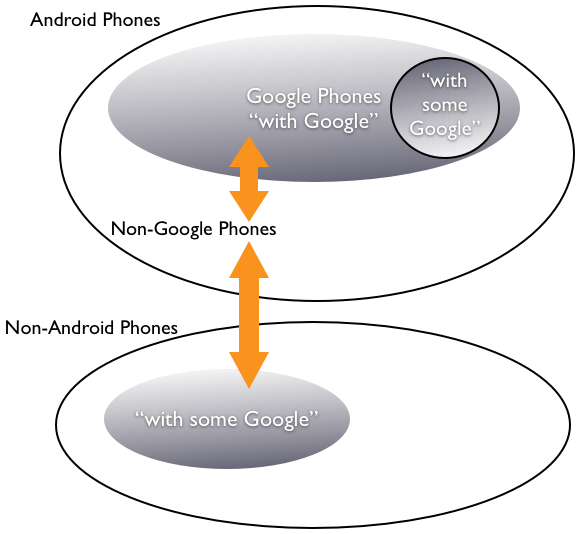
    [I drew the following Venn diagram to help explain the situation. The shaded areas are those which generate revenue for Google. The interesting struggle (marked with arrows) is between the non-Android Phones with some Google and the Android Phones without any Google.]

    Now the question that needs to be asked is: How many of the Non-Google Android phones are built to compete with Google (e.g. on Search, Voice, Maps, Media and App sales)? And a second question: How are the Non-Android phones "with some Google" competing with the Non-Google Android phones.

    In other words, from Google's point of view: how successful are companies other than Google at delivering Google services in spite of competition from companies with Android phones delivering services that compete with Google?

    The classic example being: how effective are iPhones with Google services at competing with Verizon Droid Android phones that deliver Microsoft services? In this scenario Apple is delivering value to Google shareholders while Verizon (using Android) is taking it away.

    Is this trade-off a net positive?

    In other words, is Google's income from the iPhone offsetting its losses from Android?

  3. Apple's segmentation strategy, and the folly of conventional wisdom

    Research · 5 comments

    This mindset is compelling because it is simple and familiar, but it also leads to blind obsequiousness.

    Historical edifices are held as indelible fact. "It's Microsoft v. Apple all over again." "There has to be one absolute, dominant leader." "Open will always prevail -- and should prevail -- over proprietary systems." "Market share matters above all else. Even profits."

    ...it helps to see the continuum of connected devices from the perspective of their means of mobility; namely, whether they are wear-able, pocket-able, bag-able or portable.

    [Apple] target specific user experiences, and build the product around that accordingly.

    via Apple's segmentation strategy, and the folly of conventional wisdom - O'Reilly Radar.

    Lots of concepts that readers of this blog should find familiar ground.

  4. Unix's Revenge

    Research · 98 comments

    With QNX now firmly roadmapped at RIM and Android spreading among vendors like a virus, I wanted to point out that these operating systems share one ancestor: Unix.

    A technical triumph

    Technically Linux, which underlies Android, among others, is walled off from Unix from an IP point of view, but the philosophical and architectural lineage goes back to 1969's Unix. It was an amazingly well thought-out operating system which has stood the test of time mostly due to its modular architecture. It was not always clear that Unix would make it this far, and in many ways it was written off.

    There is some poetic justice in its comeback. Unix could have become a default for desktop computers. When Windows emerged from the shadow of DOS, Microsoft had the option to base NT on a flavor of Unix. But Bill Gates, no doubt motivated by license fee considerations, hired a group of developers from Digital Equipment Corporation and many elements of the NT design reflect earlier DEC experience with VMS and RSX-11. Microsoft went with that new architecture rather than Unix and that code lives on even in the current Windows 7.

    So Unix missed a chance to become the core of the desktop experience throughout the 1990's. It was relegated to the perilous high end: Sun workstations, servers and supercomputers. It seemed to be at a dead end. Fortunately, in stepped open source. Linux picked up the pieces and forged ahead to become a serious server operating system but never got beyond a toehold in the desktop.

    The death of Unix(tm) was also forestalled because of the efforts of others. Sun, IBM and even a startup called NeXT kept development alive. When NeXT was acquired by Apple, OS X was born and in 2000 Unix was once again on the desktop.

    Meanwhile, the Linux kernel also became device friendly and it was embedded into an increasing number of vertical applications while powering most of the new web servers that fed the dot com era.

    Now we've entered a new decade of devices where Unix(-like) operating systems will, on a CPU basis, probably out-install Windows. Not only is iOS based on Unix, but Android and MeeGo and even Bada are based on Linux as are QNX and WebOS. Google, Apple, HP, RIM, Samsung and Nokia are all now betting heavily on Unix or Unix-like implementations. The success is so overwhelming that there are really only two hold-outs: Microsoft and the rapidly depreciating Symbian.

    Value Chain Evolution

    There is more to this than a sentimental technology riches to rags to riches story. The history of kernel adoption is evidence of the evolution of value chains and the tension between modular and integrated business architectures. It also supports a hypothesis of why Microsoft could not respond to a tectonic shift of power.

    As a kernel, Unix was modular which allowed it to scale both down to devices and up to mainframes. It could conform to the applications above it (like being a server or being an embedded controller) and did so far more readily than Windows. In fact, Windows could not conform to applications outside its core PC and server domain.

    For Unix, the point of modularity was reached early in the 1990's and, through the Linux implementation, it allowed the lowest layers of the software to become commoditized (and free). This commodity status was actually what Microsoft tried to avoid by integrating Windows with the layers above it. This was a conscious and deliberate decision which also led to trouble with anti-trust regulators. The decision seemed to have paid off. Microsoft won.

    However, the very strategy which Microsoft used to maintain a monopoly caused its rigidity of response to a new, post-PC market. Unix fit right in with the new shift in the basis of competition: toward more personal, portable and conformable computing. Windows did not. Microsoft had to build a completely new OS to deal with devices (Windows CE has little if any shared code with Windows NT et. al.). The dual OS strategy continues to hobble Microsoft as each is stretched into new dimensions: the desktop Windows being dragged into the high end and into tablets while the device Windows is re-written to accommodate new input methods.

    The modular Unix just keeps conforming to new applications. It helps that it's open source but the open sourcing is a result of the modularity not the cause for it. So far, it looks like there is no stopping the revenge of Unix. It's been a long journey for Unix and I, for one, am cheering the comeback.

  5. Correlating Innovation and Share Prices

    Research · 12 comments

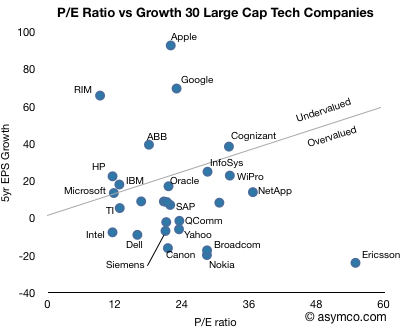
    In the last article on the P/E ratio vs. Growth for some of the largest companies, the question of PEG came up. PEG is the P/E over Growth and it's a good way to index valuation relative to growth. Usually Growth is measured as the forward twelve months consensus and a PEG of 1 is, as a rule of thumb, considered "fair value". However, forward growth is based on possibly inaccurate analyst consensus. If we instead look at historic growth, we have some actual performance to evaluate. Let's call this PEhG for P/E over historic Growth.

    The following chart shows 30 large cap technology companies[1] and their five-year compound EPS growth vs. their current P/E multiples. If we draw a line at the PEhG of 1, i.e. when the P/E ratio is equal to the historic growth rate and split the pack into PEhG > 1 (overvalued)[2] and PehG < 1 (undervalued), we have the following split:

    The chart makes for an interesting point of view over what the best positioned companies in the sector are doing and how business model innovation shows up as investment opportunity[2].

    Apple, RIM, Google stand out for their business model innovation. Ericsson, Nokia, Yahoo and Dell show poor value for their lack of innovation. Microsoft, IBM, HP, TI and Oracle show in-line value for in-line or sustaining innovation.

    [1] I omitted Baidu from the chart as it's off the scale: Growth is 151, P/E is 108. It would classify as undervalued. These are also not a complete set of all large caps. It's meant to be indicative.
    [2] Notions of value are completely subjective. This does not constitute financial advice.

  6. WebOS: HP, and HP Only. QNX: RIM and RIM Only

    Research · 14 comments

    WebOS: HP, and HP Only.

    With the launch of RIM's tablet computer based on QNX and HP's confirmation that WebOS will not be licensed, we have

    • Apple the largest tablet and music player company,
    • HP the largest PC company,
    • RIM the largest smartphone company in the US, and
    • Nokia largest smartphone company in the world

    avoiding Android.

    These are the companies which today are profitable and enjoy large market shares. Why did they choose integrated (aka "closed") software with their hardware vs. the modular (aka "open") approach offered by Google and Microsoft?

    See also: asymco | Android’s Pursuit of the Biggest Losers

  7. Morgan Stanley analyst predicts Microsoft will buy its way to triple smartphone market share in 2 years

    Research · 13 comments

    "You could buy your way in, if you are Microsoft," he said. "This is a market where a deep balance sheet will help Microsoft determine where they want to go."

    He notes a good marketing campaign can do wonders for adoption, with Ehud predicting Microsoft will hit 15% market share in 2012 (about the same as the iPhone’s share now)

    "With [Microsoft's] resources, I think they can sustain double-digit market share," he said.

    He notes Microsoft, with $36.8 billion in the bank, could win market share in multiple other ways, including subsidizing phone costs.

    He still however predicts Android will lead the pack with 30%, Apple next with 25%, and RIM, Nokia and Microsoft all having 15% of the market.

    via Morgan Stanley analyst predicts Microsoft will triple smartphone market share in 2 years.

    There you have it: users are so easily persuaded that a platform purchasing decision can be acquired via small outlays of cash for ads and subsidies for vendors and operators.

  8. The Symbian open source experiment has failed

    Research · 17 comments

    ZDNet reports Sony Ericsson are abandoning Symbian for Android, and Samsung headed down the Android and Bada road a while back. There are precious few device manufacturers remaining as foundation members, e.g. ZTE, Sharp and Compal, none of whom are exactly trend-setting industry leaders.

    via The Symbian open source experiment has failed [Gartner].

    I was going to ask what happened to 'Open always wins?' but decided against it.

    What I will say is that open sourcing Symbian was not a new beginning for the platform but the beginning of the end. I don't think anybody seriously considered it a viable multi-vendor platform, least of all Nokia.