Q: You recently calculated Apple’s CAGR at an impressive 26.6% over the last twenty years. Without giving stock advice, what do you make of Apple’s forward prospects?
The point of my article was that more than half of analysts have a hold, a sell, or no opinion on Apple, and I found that surprising. I aggregated the ratings myself, and it settled to about fifty firms actively covering, split roughly half Buy, half Don't Buy. A “hold” says the stock is fairly priced, and if a company is growing twenty percent a year, it doubles its revenue in three to four years. So if that’s the growth, why would you not buy?
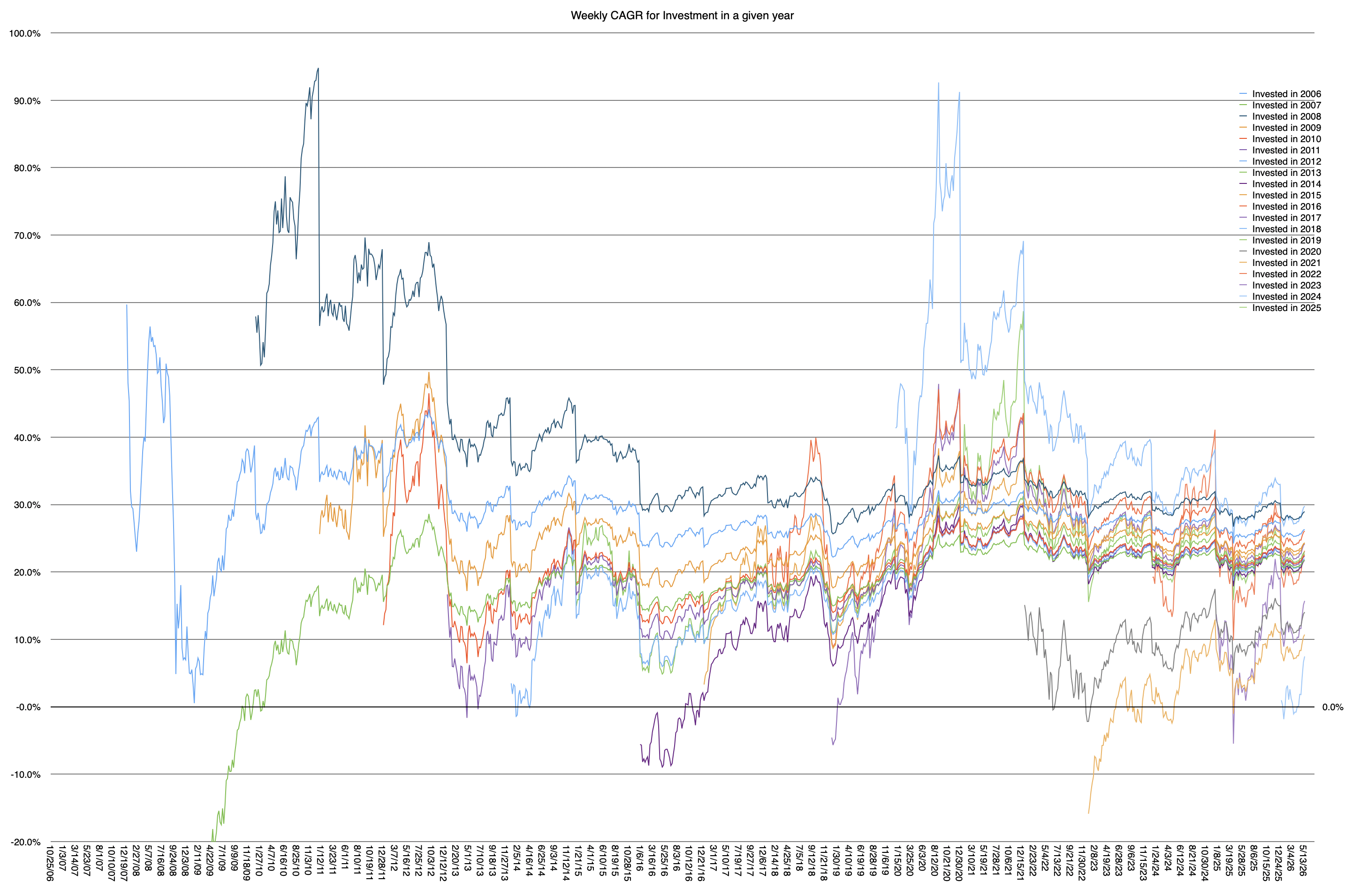
Computing the CAGR from each year forward to the present, over twenty years shows the curves are volatile early but then settle around twenty to twenty-five percent. So why are these analysts so cautious? Because they’re making one-year calls, swamped by near-term noise, while the CAGR is a multi-year return: lots of short-term volatility, lots of steady long-term growth.
I’m only dumb enough to assume that twenty years of history is long enough to see a pattern. I know history doesn’t guarantee the future. But we could have had this same conversation every day for the last fifteen years, and the flywheel just kept spinning and it also kept getting more massive. It’s actually extraordinary to assume that a massive flywheel with this much momentum suddenly stops. That’s, for me, the harder thing to argue than that it won't stop.
You can do the same with GDP. Countries compound at two to three percent for two hundred years, and the most likely future is more of the same, not utopia or catastrophe. Extrapolating a long-term trend a few years out is not an extraordinary claim. The extraordinary claim is that it stops: that Apple loses its place as the interface to the most valuable devices in the world, that customer satisfaction evaporates, that all the threats we’ve heard a hundred times finally land. I’ve heard them before. They never happened. So why should I believe them now?
"I’ve never seen a shortage without a subsequent glut, but I’ve seen gluts never followed by a shortage." -Nassim Taleb
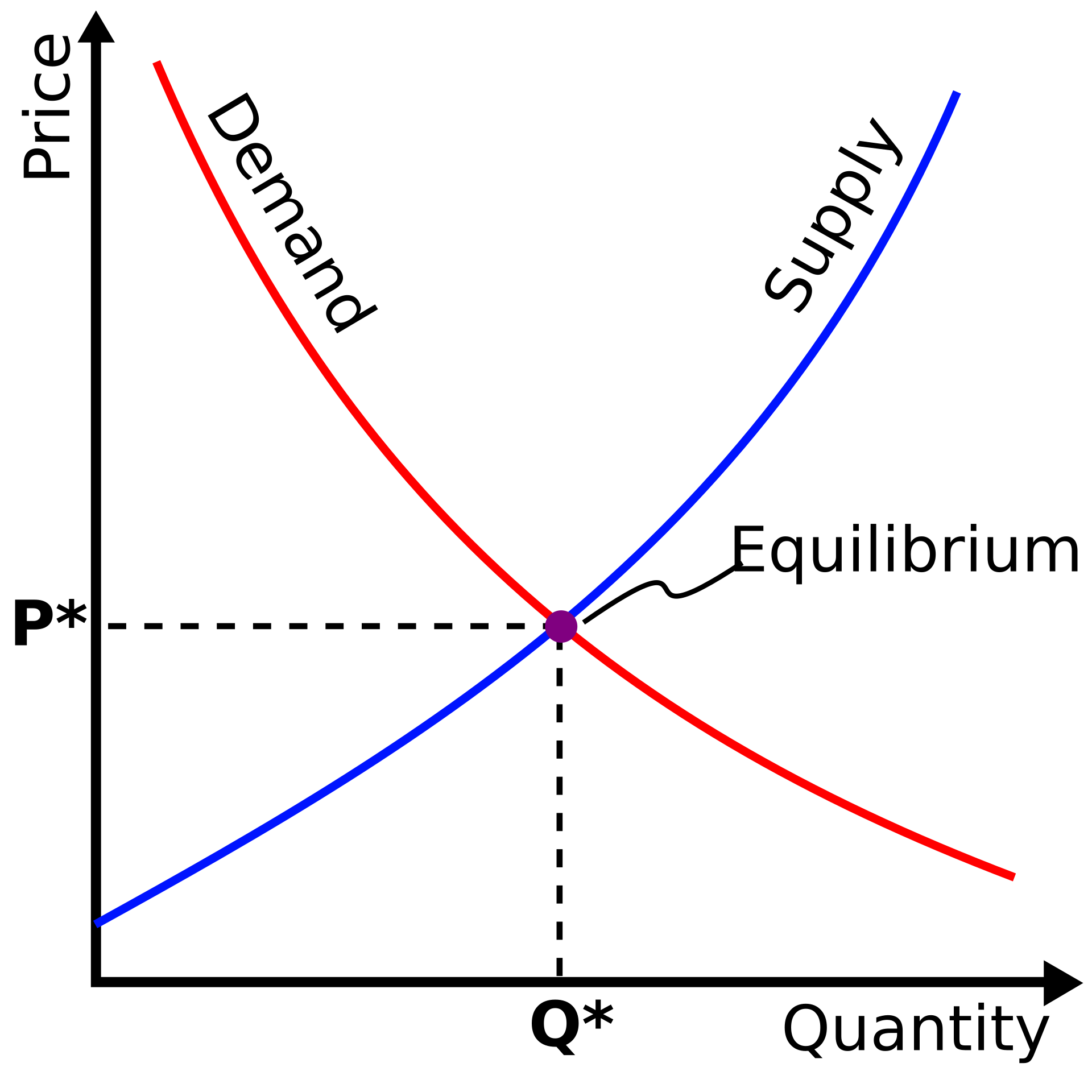
A commodity is a product or service which does not increase in price if its performance increases.
In a typical commodity exchange (coffee, pork bellies, iron ore, oil, etc) an offer of a "better" batch would not result in a higher price. The market treats all instances as equivalent with no regard to who produced them or how they were produced.
That does not mean that commodities prices cannot rise. Although not determined by quality or performance or sourcing, commodities respond to supply/demand imbalances. These are unpredictable and are affected by externalities and multitudes of factors.
Because performance is not differentiable, businesses trading in commodities are not responsive to innovation in the product. They may benefit from production and distribution innovation however. This is why scale, consolidation, regulation and legislative action are primary drivers of value.
That is also why Apple doesn’t design or build memory. Pricing will oscillate but, as a producer, Apple would be locked into their own cost structure and wouldn’t be able to negotiate with multiple vendors, nor have flexible responses to surges or drops in demand.
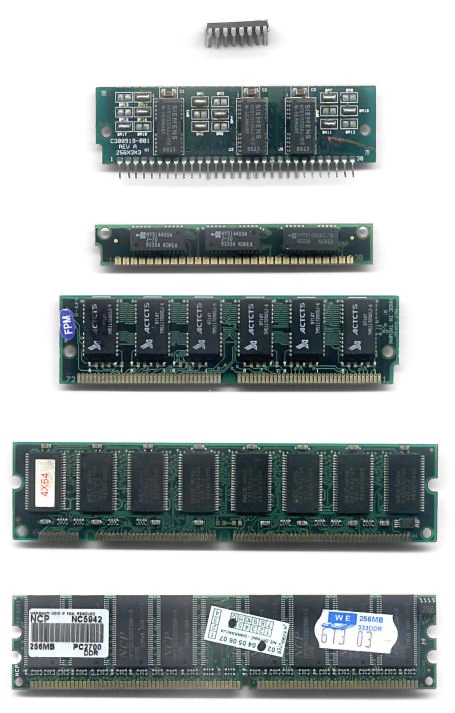
As a commodity, memory chips from any manufacturer are effectively interchangeable and pricing is not determined by producer. Therefore, the only way memory makers can make money is by lowering their own cost, which they do by increasing density (bits per wafer.)
The design isn’t the hard part or the limiting function for density and thus cost for DRAM or NAND chips. As Joe Lion pointed out in a Mastodon thread:
By far, the single most important thing for increasing bits per wafer is shrinking the process nodes which decreases cell size, where a DRAM cell is "1 transistor, 1 capacitor."
The design of the DRAM cell is the same as laid out in Robert Dennard's original DRAM patent from 1968. The design of the interface and periphery circuits, while important for performance, are nearly insignificant for decreasing overall die-size, which is, again, the critical factor in $ per bit.
Lion continues,
This is different than CPU/GPU/logic chips, which are not a commodity, and therefore pricing can be set by the manufacturer based on whatever the manufacturing cost happens to be, plus their desired gross margin.
To put another way, TSMC and Intel have never sold a CPU chip for a loss because they set the pricing themselves, and they will never price their own product below their own manufacturing cost, whereas memory makers frequently go through years-long cycles of selling chips for a loss because memory prices are set by global supply and demand.
Into this emerged a political dimension. The Chinese government declared memory as a strategic commodity and spent hundreds of billions of dollars developing its own memory suppliers over more than a decade. These investments take many years to bear fruit. A new fab would take five years before the first wafer, 10 years before high volume yield, and 15 years or more before cost competitiveness with incumbent DRAM vendors. It may not ever become profitable. China is 12 years in and its state-sponsored memory industry may only be reaching profitability due to the market imbalance just experienced.
The current situation is a demand shock. There isn't a shortage due to a loss of capacity but a surge in demand fed by a rush to spend on AI infrastructure. The buyers of memory are in a race to secure capacity in the belief that it's either first to reach some critical mass or they assume a logic of winner take all. [The fact that there are open source alternatives that are nearly the same performance does not seem to deter investors.]
Price insensitive demand is causing a windfall for producers who are effectively feeling as if they are in control and will remain so forever. But at the Taleb quote in the heading suggests, all this will pass. There has never been a situation where a commodity shortage has resulted in a perpetual undersupply (unless a cartel forms--and even that is hard to keep going indefinitely.]
The reason commodities balance in price is by their definition. Unless memories can be differentiated on performance, their price will float. If their price will float, high prices will attract investment and thus production and thus a glut and prices will fall.
Will Apple and indeed the entire set of industries using memories endure this shock? You would have to believe that unlike every other time, this time it's different.
An Office Hours question asked by Dave Emery, June 9, 2026.
Q: Are we heading for an AI bustfor the large hyperscalers? Or will the spending eventually produce the revenue the advocates promise? And if it's a bust, how does Apple adjust?
There is already revenue — there’s just not much profit, and not much free cash flow, because everything’s being reinvested. This feels like the early days of Amazon, another infrastructure play, when CapEx was huge, margins were thin, and the P/E looked absurd because earnings were almost nothing. Eventually they recorded earnings, and AWS became the savior. Remember: earnings are an opinion, cash flow is a fact. You can declare software development as R&D and manage the earnings opinion. Cash you cannot.
Is there a bust coming? Look at the hyperscalers — their P/E ratios are fairly modest, lower than Apple’s, and their top lines are growing fast. They’re so hungry for cash that some are doing private placements, diluting investors. But if they raise equity, I don’t worry. Equity is non-contagious. If you get hurt, it only hurts you.
My concern is debt. Almost every crash has come from debt, not equity, being mispriced. The dot-com crash was an overvaluation with no earnings and no revenue behind it, and it was short-lived. A debt-fueled crisis takes a long time to unwind, with repercussions across the economy. So far, AI hasn’t become a debt story. The bubble only bursts if people stop using it, run out of money to pay for it, or decide it’s a productivity mirage. Every indicator I see is the opposite: we wish we had more compute. That doesn’t scream crisis.
There is a subtler issue, though. The old machines of capital — looms, mills, lathes — compounded value and ran for years. These new machines are fragile. Unlike dark fiber that sits in the ground, this compute capital has an unpredictable lifespan and real externalities: cooling, energy, water, and popular opposition to data centers, an unrealized liability that planners are only now confronting. The economics of industrial capital took a century to understand. We’re trying to figure this one out in three years. But as far as Apple is concerned, all of this is an externality.
Overall smartphone shipments in Africa dropped 12%
According to Counterpoint Research, overall smartphone shipments in Africa dropped 12% year-over-year in Q1 2026. Factors like rising fuel prices, memory cost-driven price increases, and the region’s extreme price sensitivity contributed to the slowdown. Yet, iPhone sales bucked the trend, growing a robust 44% year-over-year.
NB: Apple does not adapt to markets. Markets evolve to become Apple markets. It's only a matter of time.
It's a myth that poor countries do not consume quality products. The cost of poor products is borne more severely by those who cannot afford quality. When the chance presents itself to escape to quality, it's taken.
This chance is helped by expanding availability through authorized resellers and carrier partnerships. Also trade-in programs and financing options making premium phones more accessible.
"Africa represents a massive long-term opportunity for smartphone makers, with a young, increasingly connected population. Apple’s ability to grow significantly faster than the market suggests its strategy of focusing on premium segments is paying dividends, even if overall volume share remains small for now."
20 more years at 24%? If we use the rule of thumb that long-term investments in Apple have yielded about 24% then the rule of 72 means you double your money in three years, every three years.
The question has always been about sustainability.
This is the question at the heart of Warren Buffett’s investment thesis. He called it a moat. It’s at the heart of management theory and it’s called sustainable competitive advantage. And it’s at the heart of Apple investment. Especially as the company was known as a hit-driven business. Hits are nice but they are not likely to be consistent. It’s why it’s had a low P/E ratio even though it was booming. →
Exponential increase in performance at a flat price. Is the formula about to change? The iPhone price structure is very carefully constructed. One could even say it’s engineered. It has operated under many constraints: segmentation, margin, scale and market windows. The balance between these and other constraints has been managed for 19 years. Until 2021 inflation was not a major factor but following the Covid perturbation the iPhone pricing fell dramatically. To see the →
Nota Bene
Only one in eight smartphone users uses a smartwatch. What’s the problem? → Counterpoint has Apple Watch shipments up 21 percent, the fastest among the top ten, yet pegs the whole category at 3 percent growth through 2030. That treats the market as mature when only one in eight smartphone users wears a watch. With roughly 650 million users against nearly 6 billion phones, the constraint is non-consumption, not demand. The catalyst that finally unlocks that headroom will be a health and wellness killer app, cheaper than GLP-1 drugs and far better at changing habits. →
‘China’s Apple’ is in free-fall → Xiaomi, the company everyone insists on calling China’s Apple, is down 63 percent in a year, with revenue off 11 percent and profit cut by more than half. The market blames memory prices and the EV selloff, but the real cause is a lack of discipline. Xiaomi fast-followed Apple into cars and then refused to follow Apple back out when the project was cancelled. Phones and cars overlap in nothing, and a century of carmakers trying to diversify shows every version of this mix fails. →
The Memory Shock: Six Readings from a Supply-Chain Conversation → Singling out memory as strategic makes little sense when the supply chain is a global train, and qualifying an alternative supplier takes a year or two, not months. Apple’s old leverage of prepaying for hundreds of millions of devices is being undermined by data-center buyers who commit the same cash for a fraction of the units, so suppliers took the money and ran. Tim Cook calling this a hundred-year flood he has not seen in forty years told me he was shaken and out of his element. The phone market may fall 12 to 20 percent this year, the worst on record, but if Apple sneezes everyone else gets the flu and Apple quietly gains share. →
Office Hours
Why is the most expensive thing you own the dumbest? → Home has waited years for its missing ingredient, which is inference, because setting up a smart home today turns you into a programmer and it still fails. Apple TV is the hub only by convenience, and as an appliance you replace like a refrigerator it withers, so whatever comes next has to be a software object that keeps evolving. The real embarrassment is that the most expensive thing you own, a house worth millions, is the dumbest thing you own, with less intelligence than a $300 watch. The answer is not a humanoid robot that unsettles people but a little speaker with a screen that turns to greet you. →
Here is a summary of wide-ranging conversation about the 2026 memory-price shock and its consequences for Apple. Six of my answers worth separating out.
1. Why pick on memory? The politics of a commodity
My estimate is that Apple will increase by about $100 the average price of iPhones. Beyond that, I can’t analyze politics. What I do know is there are plenty of suppliers, and the memory is sourced from Asia anyway, which raises the question of why it matters so much that it not be Chinese. The memory makers are in South Korea, Taiwan supplies the processors, Japan is in there with lenses and batteries and camera modules, and there’s plenty of US content too. It’s a global train. If the decision is to pick memory out and call it "strategic", I don’t see the logic, because the penalty for not doing something is simply that there’s no supply. How does that benefit Americans? Apple is a multinational with good customers everywhere, and of all the components you could single out, memory is a peculiar one to choose.
2. How long it takes to qualify a memory supplier
When people ask how long it would take Apple to qualify a new memory supplier at meaningful volume, the answer isn’t months. Apple works on a two-year cycle for its own products. The camera lens, the battery system, the screen are all planned that far out, with targets set for suppliers to hit the quality and scale for a launch window two years away. Memory is a slightly different case, because there’s on-chip memory and there’s storage; files versus DRAM. The on-chip part has to be designed together with the system-on-a-chip, so that’s at least a year in advance. The storage memory can wait a little longer, but not much less than a year. Pricing might not freeze until six months out, which is exactly what we’re seeing now: the prices have come up because of what they’re going to be shipping late in the year.
3. Apple’s purchasing power, undermined
Apple’s strength was always that it prepaid, bought years in advance, and bought in enormous quantity, with contracts spanning hundreds of millions of devices. Nobody came close, not even Samsung [due to their far broader mix of products]. That leverage is now being undermined by new buyers willing to commit the equivalent amount, except they aren’t serving hundreds of millions of devices, they’re serving data centers measured in the single tens of millions of processing units. Orders of magnitude fewer devices, but far more memory per device. It’s been a lot of money dangling in front of a few suppliers, who decided it was better to take the cash and run. But this may pass. Two years from now, the ones who screwed Apple may find that Apple has a long memory and a grudge.
4. The hundred-year flood
Tim Cook said he’s never seen anything like this in forty years. A hundred-year flood. So when his warning came through the Wall Street Journal, it surprised me, because it suggested things may not be lining up into next year. His phrasing was careful: running out of options. Part of that could be cover for John Ternus, framing the trouble as on Tim’s watch so John can take over in the fall and look like the hero, though I won’t read it that far. What I will say is that Tim is the man who works on exactly this, the planning and predictability and negotiating in advance, and it’s his forte. It felt like he was shaken. It sounded unprecedented to him, and he wasn’t in his element.
5. Memory is the new gold
Price-insensitive buyers are purchasing everything in sight and skewing the entire market. This was supposed to be a settled issue, a commodity nobody worried about, and yet here we are. It belongs in the same family as the battery and rare-earth and quality crunches we’ve weathered before. It’s a moving target, and the memory case shocked everyone precisely because we thought it was long gone. Even Tim said he hasn’t seen anything like it in forty years. A hundred-year flood, and we’re all out of our element.
6. If Apple sneezes, everyone else catches a cold
The analysts watching the whole industry think the phone market collapses 12 to 20% this year, which would be the worst year for smartphones on record. We’ve never seen a double-digit decline, not even during COVID. Profits will evaporate. The number-three vendor globally is already down around 60% on the year, and Oppo and Vivo will almost certainly be in the red. That leaves Samsung, who happens to be a huge memory maker and whose stock has actually benefited. If Apple sneezes, everybody else has the flu. The silver lining is that Apple may gain share in a shrinking market, which has already happened in the first half, helped by the supplier inventory it carried over.
An Office Hours question asked by Lalit, June 9, 2026.
Q: Could some future Apple TV morph into a data center for the family? And what about all the talk about Home and AI?
I’ve anticipated the Home story for years, and maybe this is the year. Home needed a big upgrade in intelligence, because today it’s constrained by configuration. Anyone who’s set up a smart home feels like they have to be a programmer — set up events, triggers, scenes — and then it doesn’t work. I don’t want to tell it every single thing to do. I need it to be aware of my needs. The missing ingredient was always inference.
Where it gets interesting is the rumor of a new device type — think of a HomePod with a screen, a display that follows you and creates eye contact, something more anthropomorphic, more like the Pixar lamp. Right now Apple TV is the hub by convenience: it has a display, enough horsepower to act as a gateway, and the security to do the integration. The question is whether it stays the hub, or whether a new home hub arrives, or the two split the job.
Here’s my worry. With AI, the hardware will get obsoleted faster, so you’d need to upgrade more often — but the Apple TV withers, because it’s tied to the TV, and a TV is an appliance, like a refrigerator which you replace only when it breaks. I still have a TV from 2008. Nobody rushes out for a new Apple TV because it’s cool. So whatever they build has to have a reason to be a software object that evolves, not a static box.
Step back and the real problem is this: the most expensive thing you own is a house, possibly three million dollars, and it’s the least intelligent thing you own. We put more intelligence in a $300 wristwatch than in our homes. Cars are the second-worst offender — stupid by every metric, and they resist software, partly because many people don’t want them to be smart. Home and health are the great holdouts, unpenetrated by software for decades, and AI is the chance to take another run at them. And by the way, the dream of humanoid robots in the home baffles me. People don’t want a robot that freaks them out and does the job worse. We like approachable, single-purpose appliances. A little speaker with a screen that turns to greet you beats a faceless robot every time.
Exponential increase in performance at a flat price. Is the formula about to change?
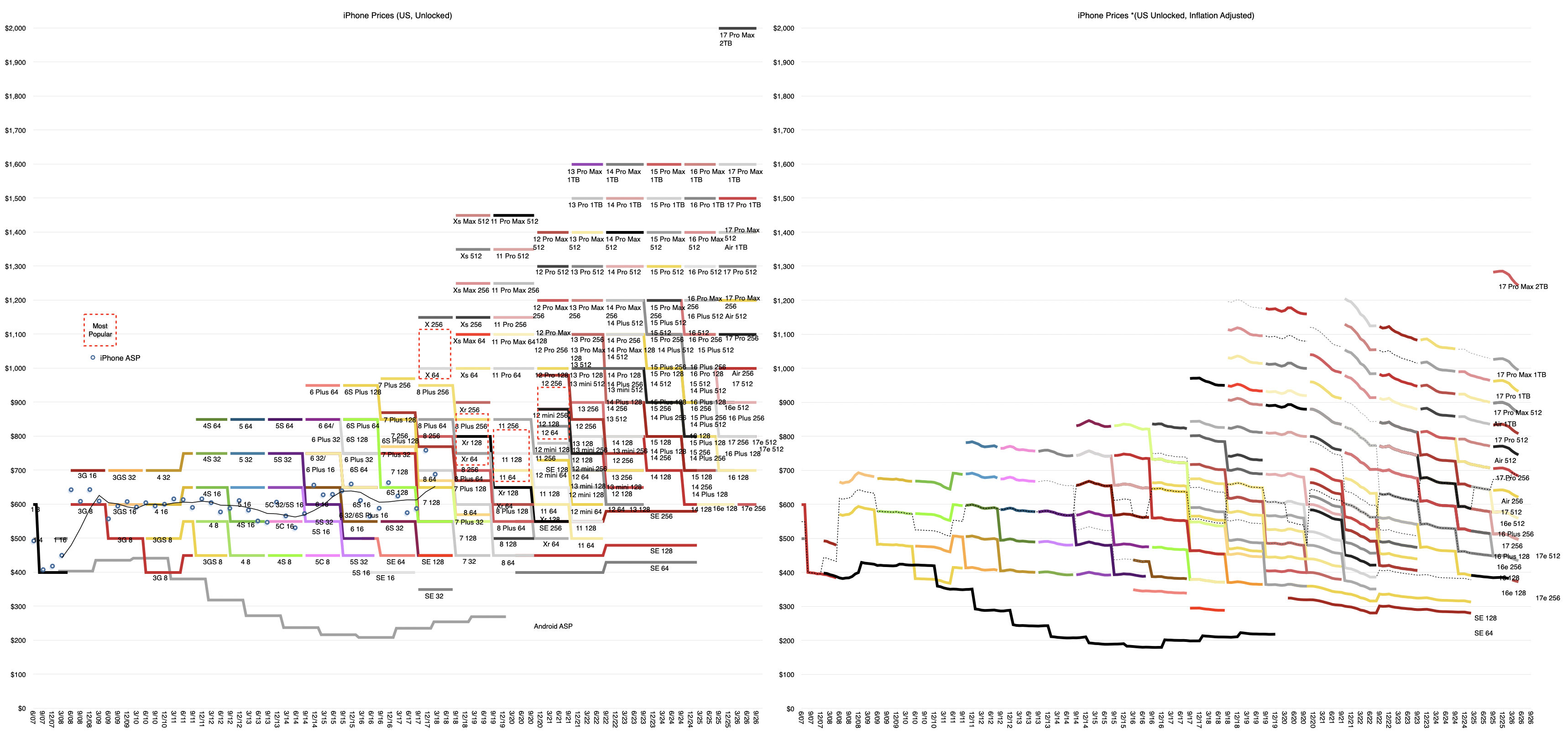
The iPhone price structure is very carefully constructed. One could even say it's engineered. It has operated under many constraints: segmentation, margin, scale and market windows. The balance between these and other constraints has been managed for 19 years. The left-hand graph above shows the pricing of all iPhones ever sold in constant dollars. The right-hand graph shows the pricing adjusted for US (CPI) inflation.
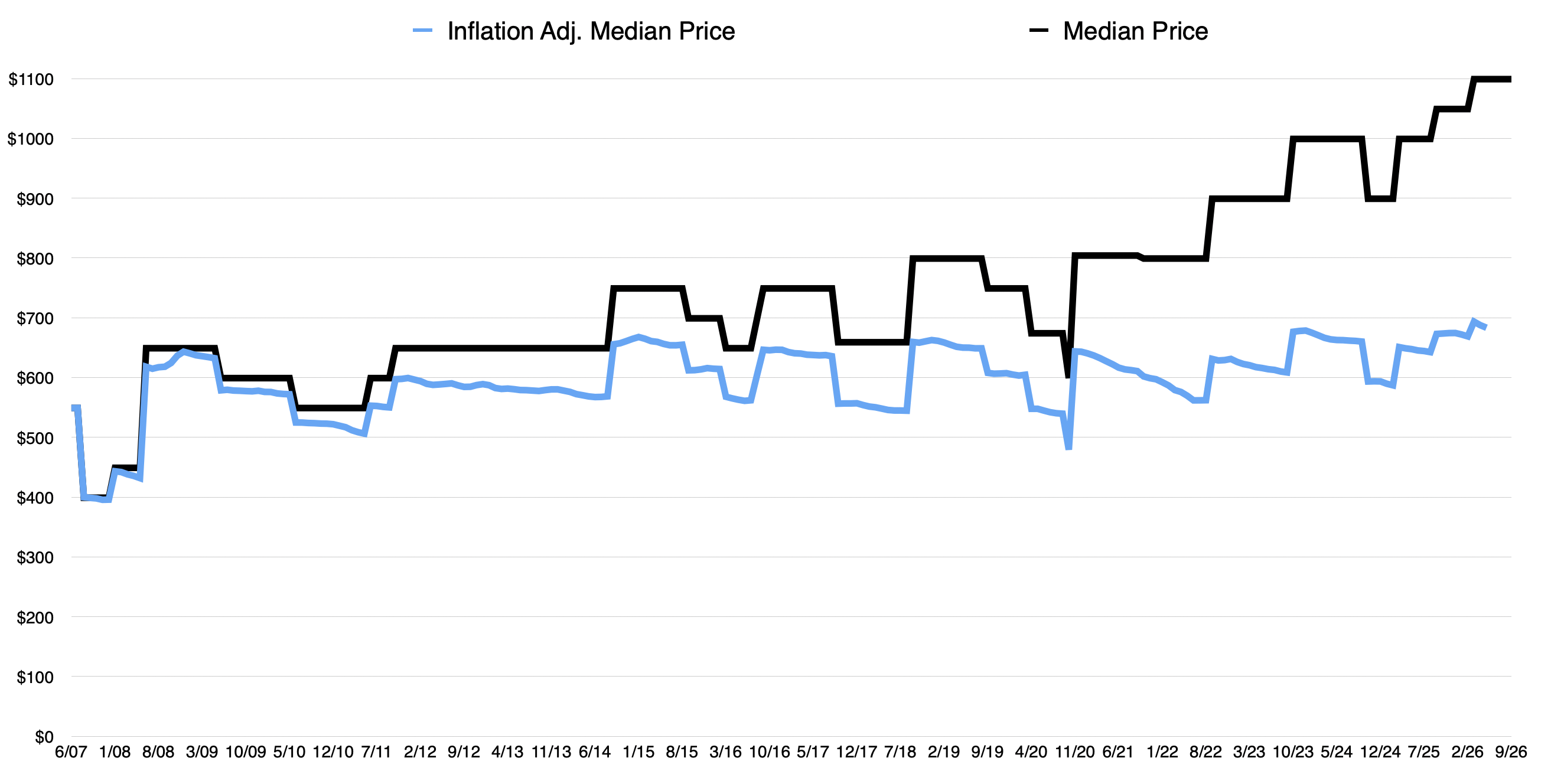
Until 2021 inflation was not a major factor but following the Covid perturbation the iPhone pricing fell dramatically. To see the picture more clearly, I show the median price below:
The median is the point where half the prices are above and half are below. It's not the average selling price (ASP)1. The black line is the constant dollar median and the blue is the inflation-adjusted median.
Note that the inflation-adjusted median has remained in the $500 to $700 point since 2012. In fact the average median is $597 over the entire 19 years.
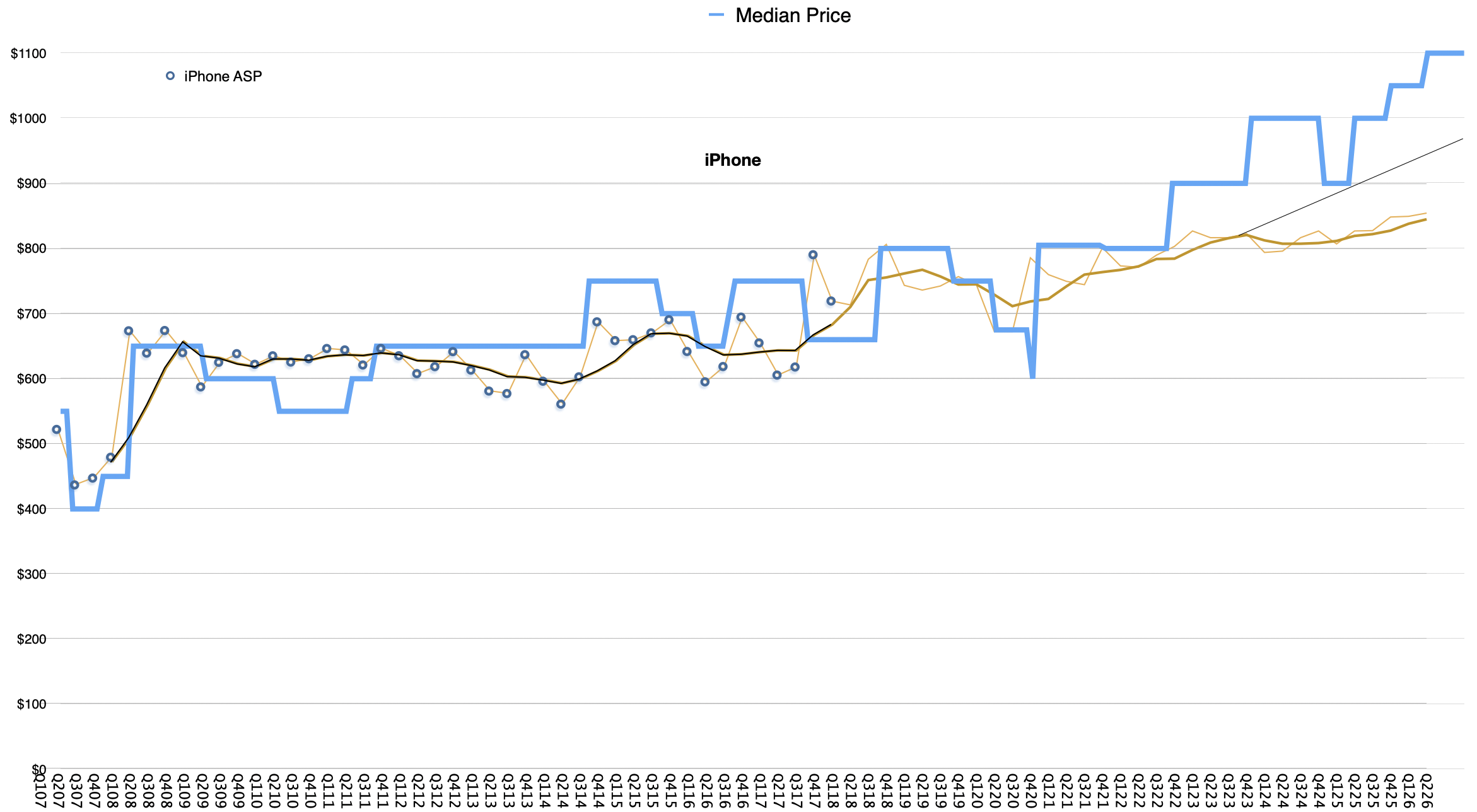
But what does the median represent? It's the midpoint of the price range. It's not adjusted by volume. If more people buy the expensive models then the ASP is higher and vice versa. To test this, I compared the known ASP data with the median to see the relationship.
The dotted line represents actual data and the un-dotted yellow line is my own approximation of the ASP since then. Clearly the data shows that until 2018 the median was a good proxy for the ASP. Perhaps since then the ASP has been lower than the median price but it's predictable.
But if adjusting for inflation, the ASP should be also quite flat over the entire period. It's a remarkable observation.
The iPhone has grown in capabilities exponentially but the price has remained the same.
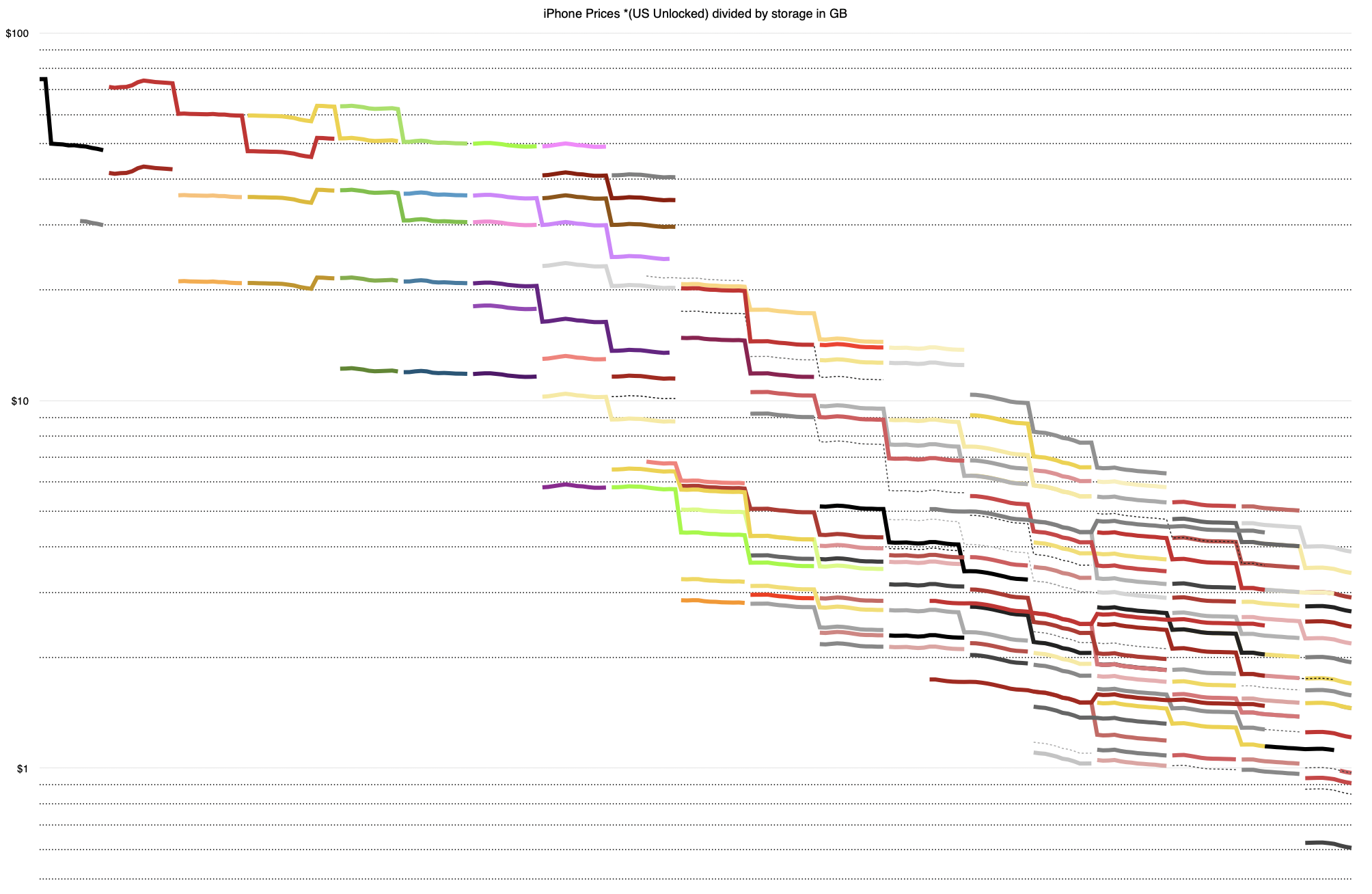
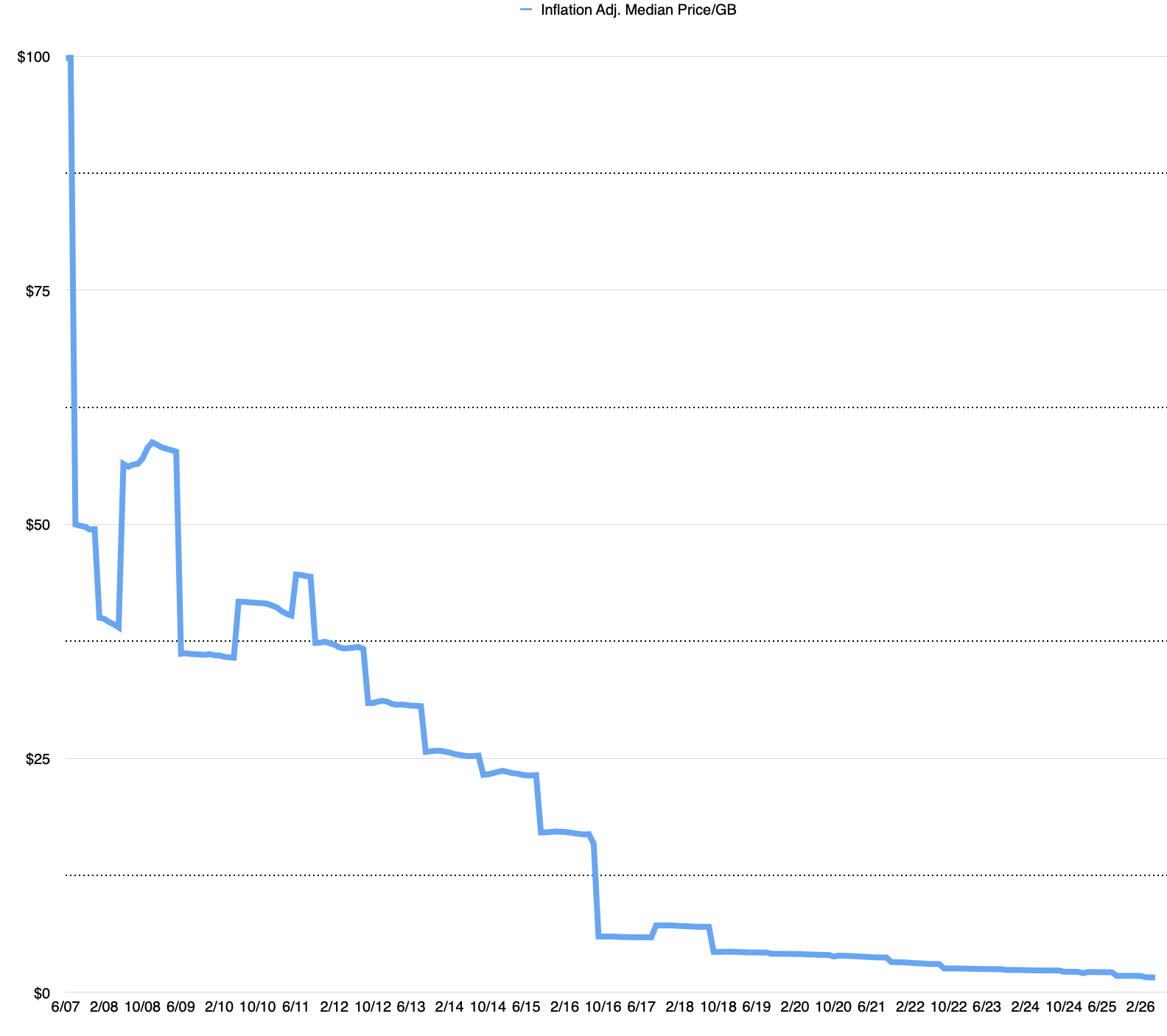
To illustrate, I considered the storage provided by each iPhone in the list (all 160 models). They span 4GB to 2048GB. If we divide the inflation-adjusted price by the storage we get adjusted dollars/GB and the graph for all iPhones is shown below
Note that this is a logarithmic scale. The pricing went from $75/GB with the iPhone (1) to about $1/GB with iPhone 17. A two-orders-of-magnitude reduction.
Taking the median of these prices per GB and plotting on a linear scale gives the following picture.
One of the accusations against Apple is that the iPhone is not much more than a storage device and Apple just charges a mark-up on memory. The higher prices are just deeper gouging of not-much-more expensive memory. The graph above shows how improbable this is. Though storage is one measure of performance, there are many others and the increases in density are passed through to the consumer.
The appetite for memory has grown exponentially and fortunately the pricing has dropped exponentially, yielding essentially a flat price for an exponentially improving product.
Which brings me finally to the point.
The latest warning from Tim Cook is that pricing on many Apple products will "inevitably" increase because memory costs are going through the roof.
The increases are likely to be in the 10% to 15% ($100 to $150 on the median price). But even if they are 30%, the pricing will only begin the deviate from inflation for the first time. I believe there is a reason why the pricing has been so consistent. Apple is pricing at what consumers are valuing (think cost/day including resale value) and are "marking their territory" with a price point few competitors can match.
Over the medium term. the supply/demand crisis in memory will be dealt with as with any economic imbalance: capital allocation chasing returns. Over the long term I believe Apple will expand their footprint to capture more Android users. This means more aggressive packaging (think Mac Neo) and, yes, pricing.
What might be visible in the long term is a blip in the historic "stairway to heaven" graph at the top of this post. The disturbance in the force is that a price might cause a product to change price mid-cycle and do so in a more significant way.
There is a precedent. In June 2011 there was a $50 increase across-the-board on all iPhones. This was because U.S. customers could then buy an iPhone 4 directly from Apple that was free of any carrier lock. Because Apple wasn't guaranteed a share of monthly carrier fees, they passed the true, unsubsidized cost of the device on to the buyer.
This even is almost completely forgotten. The transitions from subsidized to unsubsidized and from carrier-focus to Apple-focus on brand and retail distribution and global expansion are far more profound.
The iPhone has succeeded even though it's the most expensive phone brand. That is because it's more than a phone. It's the portal to one's life. A forced increase in price won't affect this.
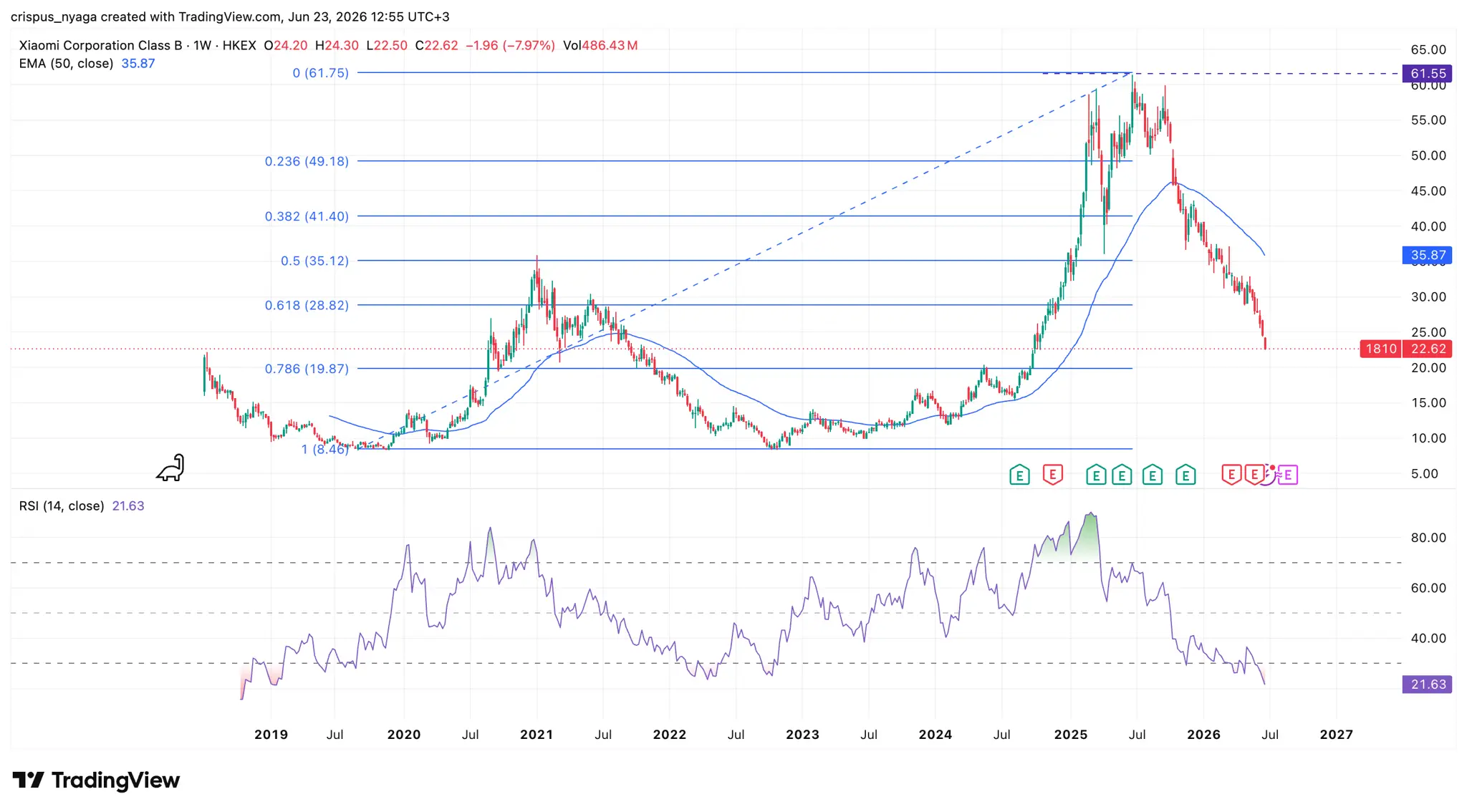
Xiaomi stock price has suffered a major reversal in the last 12 months, moving from a high of H$61.55 to H$22.62 today, its lowest level since September 2024, with its market cap falling from H$1.53 trillion ($192 billion) to $74 billion. This retreat has happened amid the soaring memory prices and the ongoing retreat in EV stocks.
Xiaomi has also struggled because of its electric vehicle business. While its EV sales are rising, there are concerns that demand will wane after Beijing ended its subsidies earlier this year. All EV stocks have plunged sharply this year.
The most recent results showed that Xiaomi’s business is going in reverse gear. Its revenue dropped by 10.9% to RMB99.14 billion in the first quarter from the previous year’s RMB111.2 billion.
Its profitability metrics were worse. Its profit for the period declined by 56.5% to RMB4.7 billion, while the operating profit fell by 60% to RMB5.3 billion. These declines were mostly driven by the smartphone segment whose shipments dropped to 33.8 million units from 41.8 million in the same period last year.
The same slowdown is happening across its other segments. Vehicle deliveries dropped to 80,856 from 145,115 in the fourth quarter.
NB: Selling cars, eh? 19% phone unit sales drop contributed to the story but cars are a disaster. A phone maker selling cars is a bad idea. Almost as bad as a car maker building robots.
Xiaomi is being dubbed "China's Apple" but unlike Apple Xiaomi is undisciplined about what segments to enter. Xiaomi initially decided to "fast follow" Apple into cars but when Apple cancelled their project, Xiaomi either could or would not do the same. So they plunged into a capital intense, slow to evolve, highly regulated and indefensible market.
Of course, the phone business is not great for them but they had a chance to differentiate with design for those who would insist on a Chinese phone.
Mixing phones and cars means mixing two completely orthogonal businesses. There is zero overlap in design, manufacturing, distribution, capital allocation, cycle time of product launch, and brand risk/reward.
Car makers have had more than a century to diversify. Every attempt failed.
Portrait of Luca Pacioli attributed to Jacopo de' Barbari, circa 1500 which may have been (at least partially) painted by Pacioli's collaborator Leonardo da Vinci.
Summa de arithmetica, geometria, proportioni et proportionalita (Summary of arithmetic, geometry, proportions and proportionality) is a math book written by Luca Pacioli. It is a compendium of the mathematics that was known in Renaissance Italy. This included practical arithmetic, basic algebra, geometry and accounting. Written as a textbook and reference work, it was first published in 1494, two years after Columbus landed in the new world.
As Venice was an early adopter of the newly invented printing press, it was originally published there with a second edition printed in 1523 in Toscolano. About a thousand copies were printed, of which roughly 120 still exist. This was an extraordinary large run for the time and, in contrast to pre-press era when maybe 10 copies would be hand-made, it was a bestseller.
Why was a math book so popular?
First, because it was in Italian rather than Latin. Second, within the chapter on business, a section entitled Particularis de computis et scripturis (Details of calculation and recording) describes the accounting methods then in use among northern-Italian merchants, including double-entry bookkeeping, trial balances, balance sheets and various other tools employed by professional accountants to this day. The business chapter also introduces the rule of 72 for predicting an investment's future value.
Regarding this rule, the quote is:
In wanting to know of any capital, at a given yearly percentage, in how many years it will double adding the interest to the capital, keep as a rule [the number] 72 in mind, which you will always divide by the interest, and what results, in that many years it will be doubled. Example: When the interest is 6 percent per year, I say that one divides 72 by 6; 12 results, and in 12 years the capital will be doubled.
What it says is that if you want to know how long you need to wait for an investment to double, divide 72 by the interest rate. If the (compounded) interest rate is 6% then wait 72/6 or 12 years and you double your money.
This is a great rule of thumb and was devised before logarithms were invented which are more precise but harder to calculate. Even today this is a great rule and should be used instead of relying on spreadsheets or AI to get a quick answer. The accuracy is highest at interest rates above 5% which is well within investor rates of return.
Once you develop an intuition about time to double the interest (or rate of return) becomes a measure of time which is much more relatable. The investment thesis then becomes one of duration which rewards patience rather than gratification.
The problem is however that this rate of return must be maintained and compounded throughout the period. When it comes to returns on share prices, the rate of return can vary greatly and does so instantly and continuously during trading.
Balanced portfolios, index funds, etc. attempt to smooth out the variability and provide a predictable rate of return. For instance, the S&P 500 index, since its adoption of 500 stocks in 1957, has had compounded annual growth rate of 10.56% (excluding inflation). The 10% rule of thumb has been used to encourage investors to hold fast through long periods. At this rate the rule of 72 means you double your money every 7.2 years.
This is also used to discourage "stock picking" because individual stocks are both more volatile and more susceptible to disruption, exiting the index at an alarming rate. Indeed, disruption theory suggests that companies are surprisingly fragile insofar as they succumb to mismanagement with uncanny regularity.
Think of it another way: if it were not for disruption, a public company is a remarkable money printing machine. If it gets to a point of success, it should deliver constant growth consistently. Even 15% growth would mean investors would double their money every five years. That would allow $2000 to become $1 million in 50 years. A single stock purchase at age 15 would provide the individual a fully funded retirement.
The answer is that innovation theory is a theory of competitive behavior and that external factors force time horizons to be not long enough to preserve sustainable compound annual growth rates beyond a few years. Technologies change, people change, tastes change and management is distracted or unable to adjust to these changes.
Let's look at Apple as an example of consistency of return.
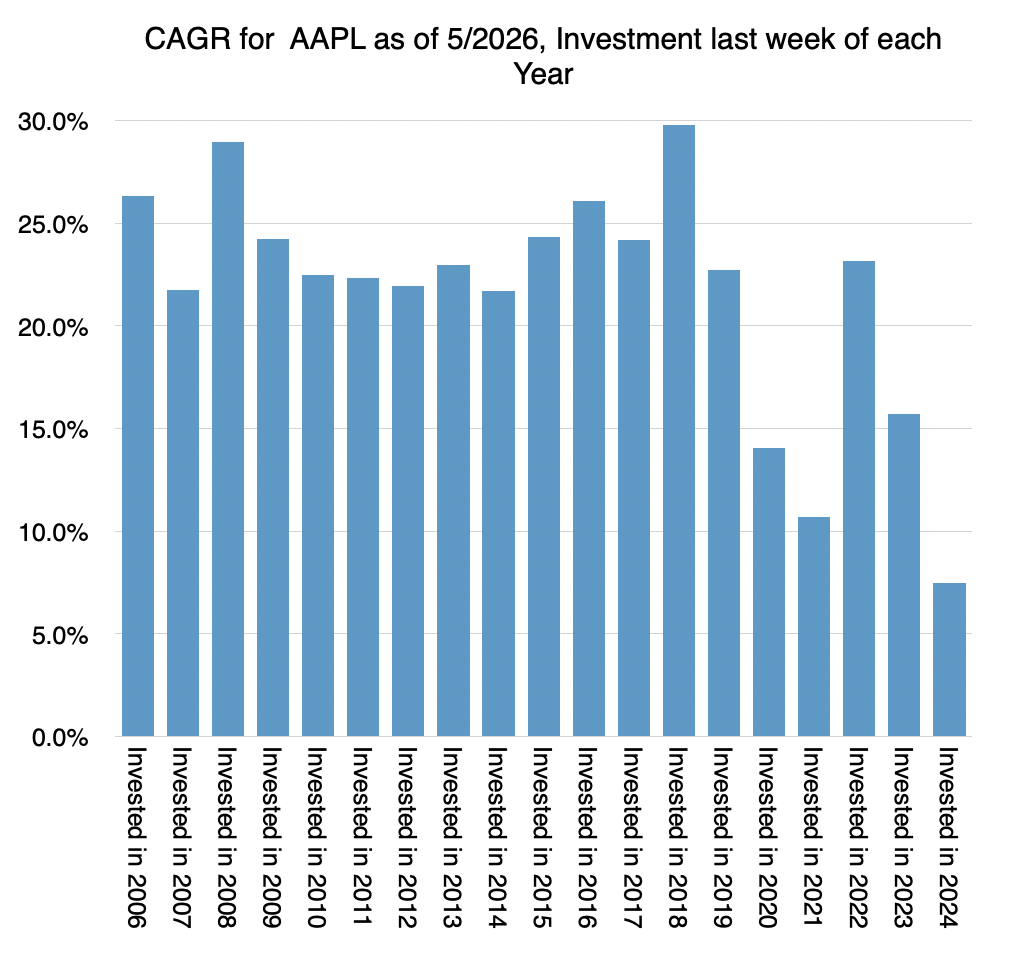
You should ask what is the rate of return on Apple shares in the same way that the S&P 500 index is measured (since 1957) to have a 10% compounded annual growth rate (CAGR). I went through this exercise for the last 20 years: Assuming investment during the last week of each year, what would the compound rate of have been today?
I graphed both the instant return for any point in history (the second graph) and return as of today (the end points of the second graph are shown in the first).
The answer is: For investments longer than 1 year, the average is 21.6%. For holding longer than 5 years the average is 23.6%. For holding even longer, it does not drop much below 24%. Note that as investments are made, short-term they can be far above or far below the median rate of return. they tend to converge on the median over time. And what a median that is!
If we use the rule of thumb that long-term investments in Apple have yielded about 24% then the rule of 72 means you double your money in three years, every three years.
This is extraordinary not just because of the 24% CAGR but that it has been going on for about 20 years.
The puzzle that Luca Pacioli and his students in Renaissance Italy must have considered has been the same as the one we have study today: How do you maintain that interest rate and hence that doubling period for long enough to benefit from it?
The question has always been about sustainability.
This is the question at the heart of Warren Buffett's investment thesis. He called it a moat. It's at the heart of management theory and it's called sustainable competitive advantage. And it's at the heart of Apple investment. Especially as the company was known as a hit-driven business. Hits are nice but they are not likely to be consistent. It's why it's had a low P/E ratio even though it was booming.
Apple has always been a tough thing to invest in.
But there is hope…
…At the time Summa de arithmetica, geometria, proportioni et proportionalita was published, the world had a CAGR of 0.1%. For most of human history, any spikes in productivity or technological innovation (such as the printing press used to print the book) resulted in population growth rather than sustained improvements in living standards. Output per capita had remained practically flat over centuries.
By the Industrial Revolution (1800 – 1913) CAGR increased 10-fold to 1.5% to 2.0%. The advent of mechanized manufacturing, steam power, and trade routes initiated an unprecedented era of sustained economic growth. For the first time, wealth generation outpaced population growth. It was the birth of plenty.
By the late 20th century (1945 to 1973) CAGR doubled again to 4.5% to 5.0%. Following the end of the Second World War, the global economy experienced the most rapid and sustained period of growth in human history. Driven by technological and market innovation, global output soared. Much of the way the world is now governed and planned comes from the lessons learned during this period.
From the 1970s to Present the world's CAGR has reduced to 2.8% to 3.5%. Much of this is due to globalization and the diffusion of innovations that were centered in early industrialized nations. The growth is also bifurcating into riskier technology investment (early adoption) and diffusion of technologies to later adopters.
The opportunity to re-accelerate to 5% global growth might exist if diffusion rates increase. That is, bringing value rapidly to large populations.
That should be the thesis. Apple's 23% growth could be extended and anticipated if it's seen as the distribution of the greatest ideas, which already exist, to a larger audience who, with the gained productivity leverage, return to invest again and again. It requires some degree of global and social stability but if you are willing to be an optimist in that regard, doubling every three to five years seems sustainable.
Apple sustained 20%+ for 20 years and if it holds this rate for another 20 it will be a longer period of prosperity than the post-war era which only lasted 28 years. No pressure, JT.
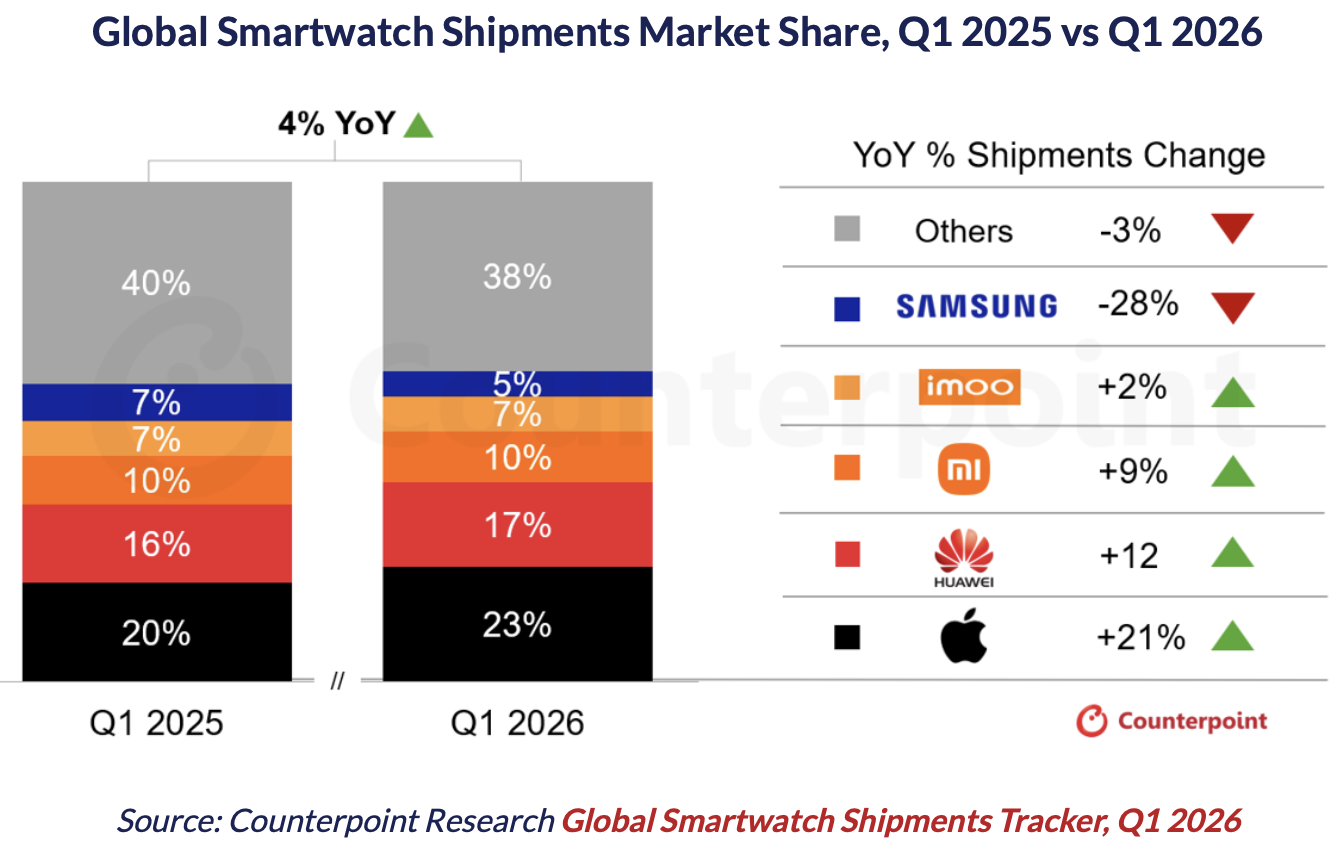
Apple grew at 21%. Global market grew 4% with forecast is 3% growth through 2030
Global smartwatch shipments grew 4% YoY in Q1 2026, driven by continued Apple adoption and the China market’s recovery.
Apple shipments rose 21% YoY, the fastest growth among the Top 10 brands.
Following the extension of the Chinese Government’s electronics subsidy and the rise of local demand, Huawei and other Chinese brands regained momentum.
Rising memory prices are expected to have a more limited impact on smartwatches given their lower BoM costs.
Commenting on Apple’s performance, Counterpoint Research’s Principal Analyst Anshika Jain said, “Apple has captured the highest shipment share of 23% and emerged as the strongest performer in Q1 2026, driven by the continued success of its refreshed lineup. While North America contributed over half of the total shipments of Apple, China and Europe recorded the fastest growth for the brand. The addition of meaningful health upgrades and the affordable SE 3 attracted new buyers.”
Emphasizing the rising ASP, Jain added, “Smartwatches’ ASP rose by 6% YoY in Q1 2026. The major drivers were the integration of improved sensors and advanced technologies to support health monitoring and AI capabilities. In addition, consumers’ transition from basic smartwatches to advanced smartwatches in emerging markets like India is also driving the overall ASP growth.”
The smartwatch market regained momentum in 2025 after a slowdown in 2024. This recovery was driven by brands introducing a variety of new features, such as satellite connectivity, 5G RedCap, AI capabilities, and more advanced health tracking for conditions like sleep apnea and hypertension. This has helped build strong growth momentum in the market. However, recent memory shortages and macro-economic factors are expected to slightly impact the overall growth rate for 2026. Even so, the effect is likely to be less severe than in other consumer electronics segments, supported by comparatively higher margins in premium smartwatches. As a result, the smartwatch market is projected to grow at a CAGR of 3% through 2030.
NB: 3% growth through 2030 is no growth at all. Non-consumption is catastrophically high and yet Counterpoint projects zero growth over four year. Apple's share at 23% roughly matches smartphone share and that may be plausible however the market for watches is still modest relative to the phone market. Something does not add up. Here are the numbers…
…There are an estimated 650 million smartwatch users worldwide. That is super low relative to phones and even estimates that the user base is projected to surpass 740 million by 2029 seem weak. There are approximately 5.78 to 5.83 billion smartphone users making watch penetration by 2030 barely 12%.
Only one in eight smartphone users uses a smart watch. How can 3% growth be acceptable?
There is enormous headroom for Apple Watch and I believe penetration is proceeding at a measured pace (20% growth is above iPhone over longer periods). The opportunity, like that for the Mac, is to address non-users with a compelling new value proposition. Is AI such a proposition? Perhaps, though it will take years.
A more likely catalyst is still a "killer app" for health and wellness. It's cheaper than GLP-1 drugs and has more of a chance to change habits.