Asymco

Asymmetric Intelligence

Research

  1. Nokia bullish on N900: sales substantially above expectations

    Research

    A spokesman for Nokia, the world's top cellphone maker, declined to comment on the sales number, saying the company was pleased with sales, but an executive was more bullish.

    "Sales have substantially exceeded expectations," Alberto Torres, head of Nokia's solutions business, told the Open Mobile Summit trade conference in London this week.

    via Nokia top model N900 sales below 100,000: Gartner | Reuters.

    If Alberto Torres' expectation for a flagship product is substantially less than 100k for a launch quarter, I wonder what disappoints him.

  2. Analysts predict iPad sales (part II)

    Research · 6 comments

    After 12 million units sold in 28 60 days, it’s time to review the analysts’ predictions:

    First year iPad unit forecasts (sourced from TMO Finance Board)

    • Brian Marshall, Broadpoint AmTech 7.0
    • David Bailey, Goldman Sachs 6.2
    • Kathryn Huberty, Morgan Stanley 6.0
    • Shaw Wu, Kauffman Bros. 5.0
    • Mike Abramsky, RBC Capital Markets 5.0
    • Gene Munster, Piper Jaffray 3.5
    • Ben Reitzes, Barclays Capital 2.9
    • Keith Bachman, BMO Capital 2.5
    • Jeff Fidacaro, Susquehanna 2.1
    • Chris Whitmore, Deutsche Bank 2.0
    • Scott Craig, Merrill Lynch 1.2
    • Peter Misek, Canaccord Adams 1.2
    • Doug Reid, Thomas Weisel 1.1
    • Yair Reiner, Oppenheimer 1.1

    Looks like at least half two thirds of these guys have already blown it.

    For the record, in January I forecast 6 million units for calendar 2010 (and 10 million in first year).  It looks like I'll be facing the iPad dunce corner as well.

    See: Analysts predict iPad sales

  3. Subscribe to Asymco One for full access to our research.

  4. IDC: I Dream of Claim Chowder

    Research · 3 comments

    A few eyebrows were raised when Microsoft presented a slide at a French event where they made the claim that 30 Million Windows Phone devices would be sold by the end of 2011.  Given that the first Windows Phone won't ship until October 2010 at the earliest, or, according to Mr. Ballmer, "by Christmas," count me among the skeptics.

    However, the claim was later retracted by Microsoft stating that they mis-quoted IDC, the original source for the forecast.  The correction was perhaps meant to put an end to the credibility crisis.

    However, the actual forecast from IDC was even more preposterous. Apparently IDC makes the forecast that 32 million "Windows Mobile" devices will sell during all of 2011--a combination of both Windows Mobile and Windows Phone devices.

    Instead, the research company forecast 2011 sales of 32 million devices running all Windows Mobile operating systems. This includes expected sales of devices with Windows Mobile 6.5, which is already on the market. IDC has not given any sales estimate for Windows Phone 7, which Microsoft has said will be available in the fourth quarter.

    Their report showed about 16 million Windows Mobile devices shipped in 2009, with a forecast of 22 million this year and 32 million next year.

    Windows Mobile shipped a total of 3.7 million phones in 1Q10, so in order to reach 22 million this year they need to ship 18.3 million for the rest of the year or, on average, 6.1 million phones a quarter.  That's a higher number than what Android shipped in Q1 with BOGO promotions (5.2m units). That's almost as high as the launch quarter for the iPhone 3G.  And all this (mostly) with WinMo 6.5!

    Alternatively perhaps IDC foresees a huge launch for Windows Phone. Assuming an erosion of the WM6.5 to 2.7 m this quarter, 2 million in Q3 and 2 million in Q4, then Windows Phone would somehow need to ship 12 million units during the last quarter.  This number is higher than what iPhone sold in its highest ever quarter.

    This sounds sillier than 30 million Windows Phones in 2011.  By claiming that Microsoft's combination of deprecated Windows Mobile (6.5) and unreleased Windows Phone 7 will continue to sell at a growth of 38% this year, they are actually suggesting an acceleration in sales going into the second half at a rate higher than what the market is likely to grow at.

    In other words, they are suggesting that Microsoft will gain share during the rest of this year. Share gains for a platform that has declined in share in Q1 from 10.2% to 6.8% with 3.7 million units sold on the back of further share losses the quarter prior. Share gains against Android that competes with a free license. Share gains with a new platform that has no clear differentiation vs. the iPhone.

  5. Welcome to the new asymco.com

    Research · 1 comment

    Asymco is now in its third home and fourth design.  After starting in February 2010 with iWeb hosted at me.com, moving a month later to Wordpress.com, I've finally moved the blog to a proper hosting site (dreamhost) and merged the blog with asymco.com.

    One reason I had to leave Wordpress.com was that they required payment for the removal of ads from my pages.  Although I understand their business model, I felt that it's more important that what users see is my content and only my content.

    At the time of moving, the blog had 306 posts, 272 comments, 64 tags, 9 categories and nearly 40k hits.

    Hopefully the transition will be painless to those who came to the old site.

  6. At 135 devices, the Android army marches on but what happened to the Windows Mobile legions?

    Research · 2 comments

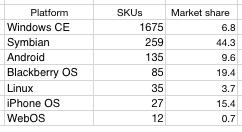
    The number of Android devices is rising steadily; it's already up to 135.  Android devotees should rightly rejoice.  However, Android is not the first mobile platform with an open licensing strategy. A quick visit to pdadb.net lets us count the number of devices that shipped for every mobile platform in history.  We can also see the current market shares as listed by Gartner for these platforms.

    The numbers of SKUs (stock keeping units) that have shipped historically vs. the market shares of the mobile phones running those platforms are (see Footnote below for some caveats):

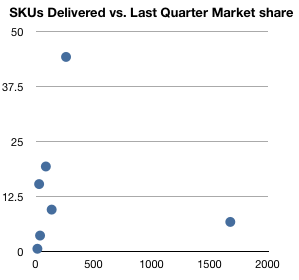
    The same data in a scatter plot:

    (SKUs on the x-axis and share on the y-axis)

    The thing that jumps out is how uncorrelated the two quantities are.  The Windows Mobile/CE number is such an outlier that it breaks any attempt to link the two variables.

    What's likely to happen is that since the licensing of Android is even less problematic than it was for WinCE (i.e. it's both free as in beer and free as in speech) the number of Android SKUs is likely to overtake WinCE.  In other words, we're very likely to see Android grow from hundreds to thousands SKUs.

    However, the real question for the Android platform isn't whether it will have licensees. WinCE proved that there is vast demand from many companies to build cloned and undifferentiated devices. The real challenge is whether Android can achieve significant volumes without fragmentation to keep the platform/network effect going.

    The WinCE platform was actually less fragmented through its life than Android is today. This is understandable since the source code was decidedly not open and thus not modifiable and new versions were released far less frequently. And even with a high price tag, it was wildly popular with licensees. Nevertheless, the volumes never came and Microsoft was forced to abandoned the whole strategy.  The next version of Windows Mobile (Windows Phone 7) will follow an "iPhone lite" model of highly restricted configurations and device and ecosystem specification.

    So will Android follow the fate of Windows Mobile with an even more fragmented, bazaar-like licensing model? Or will thousands of undifferentiated Android devices swamp their integrated competitors?

    Footnote: The total SKU number includes non-cellular devices whereas the market share number includes only cellular devices. Omitting non-cellular devices will not detract from the pattern or change the correlation meaningfully.  The argument can also be made that the "platform" value lies in both cellular and non-cellular devices (e.g. iPad) and they should both be counted.  Unfortunately there are no market share statistics that blend both device types into one market.

  7. 40 percent of US iPhones are sold to enterprises

    Research · 1 comment

    Four out of 10 sales of the iPhone are made to enterprise users. When the iPhone came out, what most people heard in the first year from ‘07 to ‘08 was oh my God, it’s not BlackBerry secure. This is not going to work on the enterprise space.

    At the end of the day, it’s just software. That’s all it is. And by the time the 3G came out in ‘08 they had solved about 80% of the security issues.

    So enterprises today view the iPhone as a mobile computer. It happens to have a voice application on it.

    via AT&T exec: 4 out of 10 of our iPhone sales to enterprises | ZDNet.

    Compare Apple's approach to that of Nokia:

    Microsoft and Nokia have formed a global alliance to design, develop and market mobile productivity, communications and collaboration solutions.

    Under the terms of the agreement, the two companies will begin collaborating immediately on the design, development and marketing of productivity solutions for the mobile professional, bringing Microsoft Office Mobile and Microsoft business communications, collaboration and device management software to Nokia’s Symbian devices.

  8. Subscribe to Asymco One for full access to our research.

  9. The black ships from Cupertino

    Research

    Softbank stopped accepting reservations for the iPad after only three days.

    In one Twitter exchange, Mitsuru Yoshii sent a message to Softbank Chief Executive Masayoshi Son saying that the iPad was the "21st century's black ships."

    In response to the historical reference to the U.S. Naval fleet that opened up Japan to the West in 1853, Mr. Son wrote back: "Indeed!"

    via Japan's iPad Frenzy Signals a Sea Change - WSJ.com.

    In Japan the term "Black Ships" has come to symbolise a threat imposed by Western technology but also the opening of Japan to the West and the awakening of imperial ambitions that lasted for a century.

  10. Who benefits from the shift from business to consumer drivers for technology?

    Research · 3 comments

    Consumer tastes have overtaken the needs of business as the leading force shaping technology.

    via New King of Technology - Apple Overtakes Microsoft - NYTimes.com.

    Why is it that other "consumer-oriented" companies like Sony, Nokia and Phillips have not benefitted from this shift?  As far as I can tell they are no better off (and sometimes quite a lot worse off) than Microsoft has been during this transition.

    Clearly, although the paradigm did shift to consumers, simply being consumer focused is not enough to benefit from this shift.

    Conversely, simply being Enterprise focused (like Cisco or Oracle) has not caused dramatic loss of shareholder value.

    Thus focus is not causal to fortune.

    From personal experience I can also recall that precisely at the time when the shift was beginning (think back to when "IT does not matter" was published) at least one of these companies was looking for ways to create "Enterprise Solutions".

    This hints at the cause rooted in strategy, or, more precisely, priorities and the courage to lead.

  11. Can Google buy consumer competitiveness? Can Apple be an ad giant?

    Research

    Daniel Eran Dilger in fine form after Apple became the world's largest technology company by market capitalization.

    These days, Apple’s primary competitors have all fallen down on their knees while clutching their gutted bellies...

    Who is left? Google, the paid search giant that backers hope will beat Apple in hardware and software platforms… despite Google being neither a hardware vendor (nor marketer nor retailer nor support provider) nor having any real experience in managing a software platform for consumers. Fans of Google suggest that the company will take on Apple by acquiring a competing version of everything Apple has built over the last decade: iTunes, a mobile platform, hardware expertise, user interface design savvy, development tools, and a user base.

    The problem is, they don’t also foresee that Apple could compete against Google in its own home territory of ads.

    via How Apple could slay Google at WWDC 2010 — RoughlyDrafted Magazine.

    The key assumption in the "Google can buy anything Apple already has" is that of the three things that make up a company (resources, processes and priorities) the only thing cash can buy is resources, and, in the tech world, even those are fragile things with legs that can walk out the front door.

    Google's "copy-paste" competitive approach vis-a-vis Apple falls down when you realize that Apple has been successful mostly because of its processes and priorities. It's well known that all of its vanquished competitors could (and did) recruit legions of Apple employees, elevating them to positions of responsibility, with naught to show for it. Grafting engineers and IP onto Google (or Nokia or Microsoft) cannot make it into an Apple.

    Conversely, through a risky, long and arduous path, Apple could become a Google. Success with ad-based search requires resources (mostly CapEx), algorithms and distribution. With the $42 billion (soon to be $100 billion) in the bank and eye-watering free cash flow, there are few no resources that Apple cannot buy.

    With iAd the world will witness an Apple that can make loads of money in Google's home turf, while Google burns cash and bridges with Android trying to defend its soft platform underbelly.  The irony is that Apple can knee-cap Google without even trying to do search. After all, Jobs said plainly enough: On a mobile device Search hasn't happened.

    Judging by the stock prices of the two companies, I suspect investors know this already.

  12. AAPL > MSFT

    Research

    It was bound to be again as it was prior to 1990.

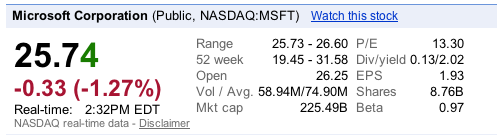
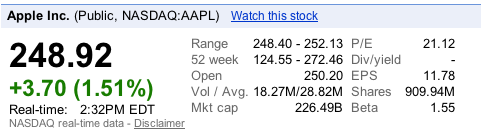
    Apple's Market Capitalization is once again greater than Microsoft's.

  13. Subscribe to Asymco One for full access to our research.