Asymco

Asymmetric Intelligence

Research

  1. The range of options has run out. When will Apple raise prices?
    Research · 4 comments

    Tim Cook warns memory costs to be passed-on to customers

    Apple will not absorb all costs of memory and storage chips, Tom Cook confirms.

    “Unfortunately, price increases are unavoidable,” he said. “We’re doing our best to mitigate the huge increases that are being passed to us, and we’ve been trying to shield our customers from the increases, but the situation has become unsustainable.”

    No further details were provided.

    Tim Cook decided to issue this warning about the price increases in advance through the Wall Street Journal. This communication preempts by at least 2 months of the Fall launch event. Due to this, it's likely that price increases on current products might arrive well before then.

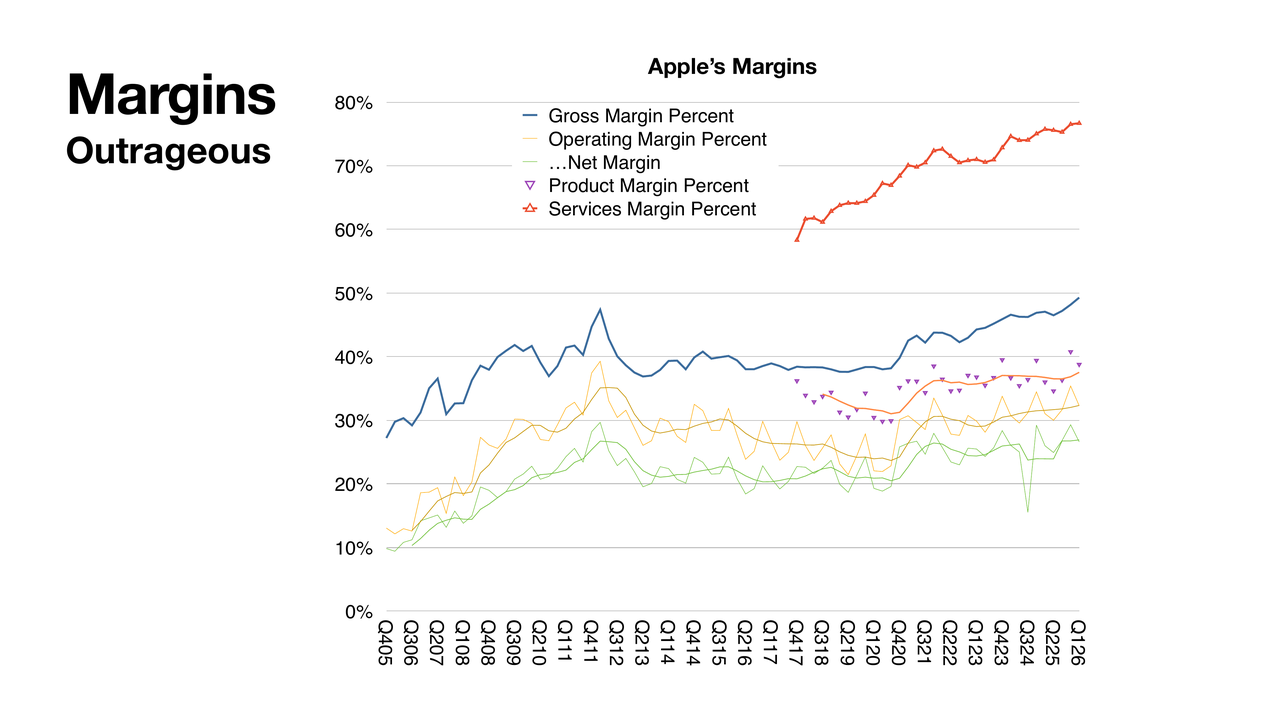
    Recall that guidance for the current quarter (ending June) was issued in April which indicated growth and markings consistent with the last quarter (ending March). The current quarter ends in 12 days and I would assume price increases are likely right after that. The current quarter likely saw increased inventory builds as components in the supply chain purchased at prices set a few months ago were used up.

    This has kept pricing and margins constant but at the last earnings call, Tim Cook warned that cost increases in memory were likely to impact "beyond the June quarter". Here is the exact quote:

    ...let me talk about memory specifically, which I think is the root of the question. And I'll go back to December for a moment and just walk you through the chronology. In the December quarter, we really had a minimal impact due to memory, and you can kinda see that in the gross margin results. We said it would be a bit more in the March quarter, and we did see higher memory costs in the March quarter, and they were partially offset by benefits from carry-in inventory that we had. For the June quarter, and what's embedded in the guidance that [CFO] Kevan went through earlier, we expect significantly higher memory costs. They are also partly offset by the benefit of carry-in inventory.

    Then where we don't give color beyond June, I can tell you that beyond the June quarter, we believe memory costs will drive an increasing impact on our business. We'll continue to evaluate this, and as we've said before, we'll look at a range of options.

    It seems the range options have run out. Tim did say that the situation was unprecedented and not seen in the 40 years he's been in the business. Analysts are busy trying to predict the trajectory of memory pricing.
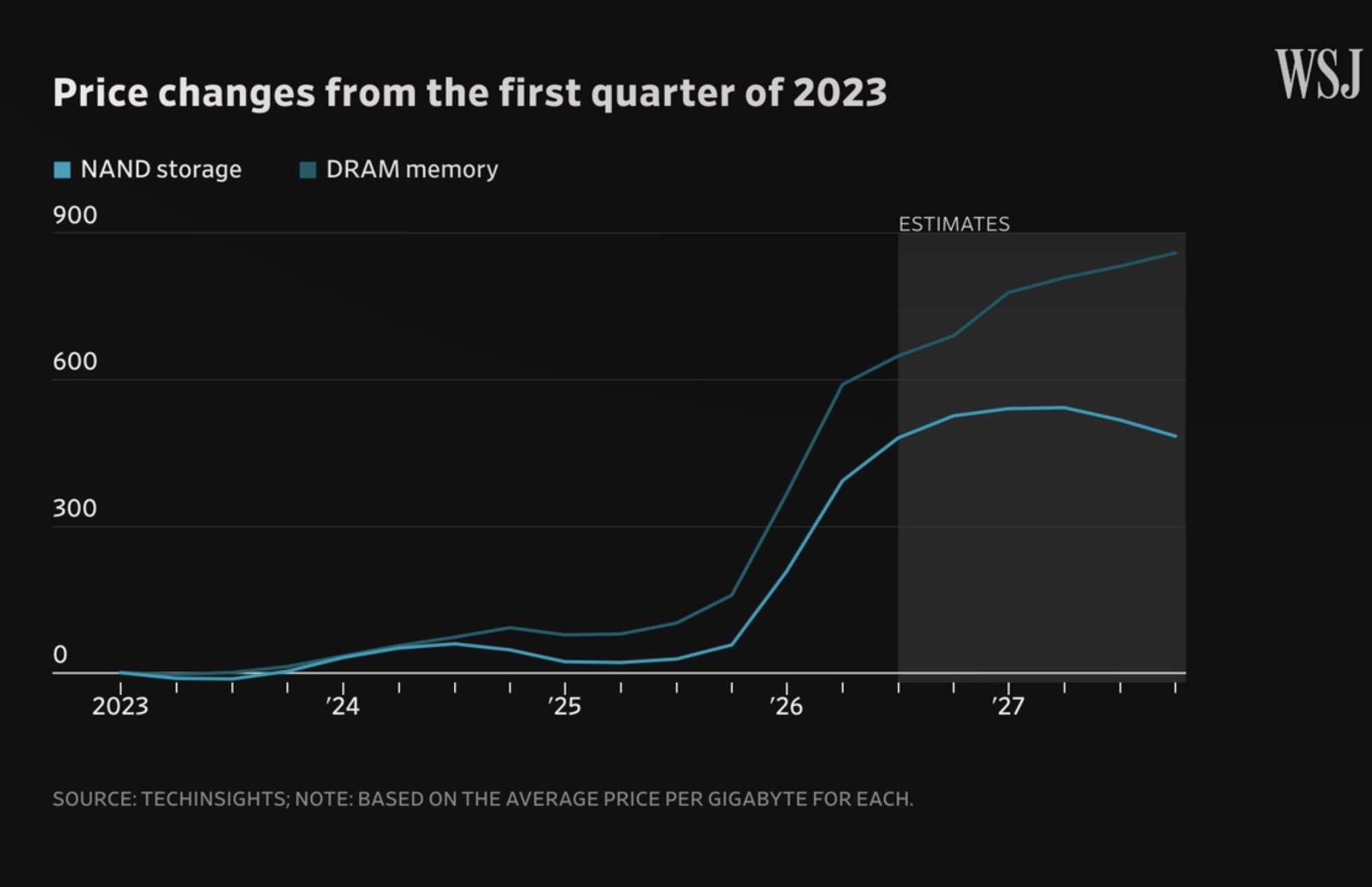
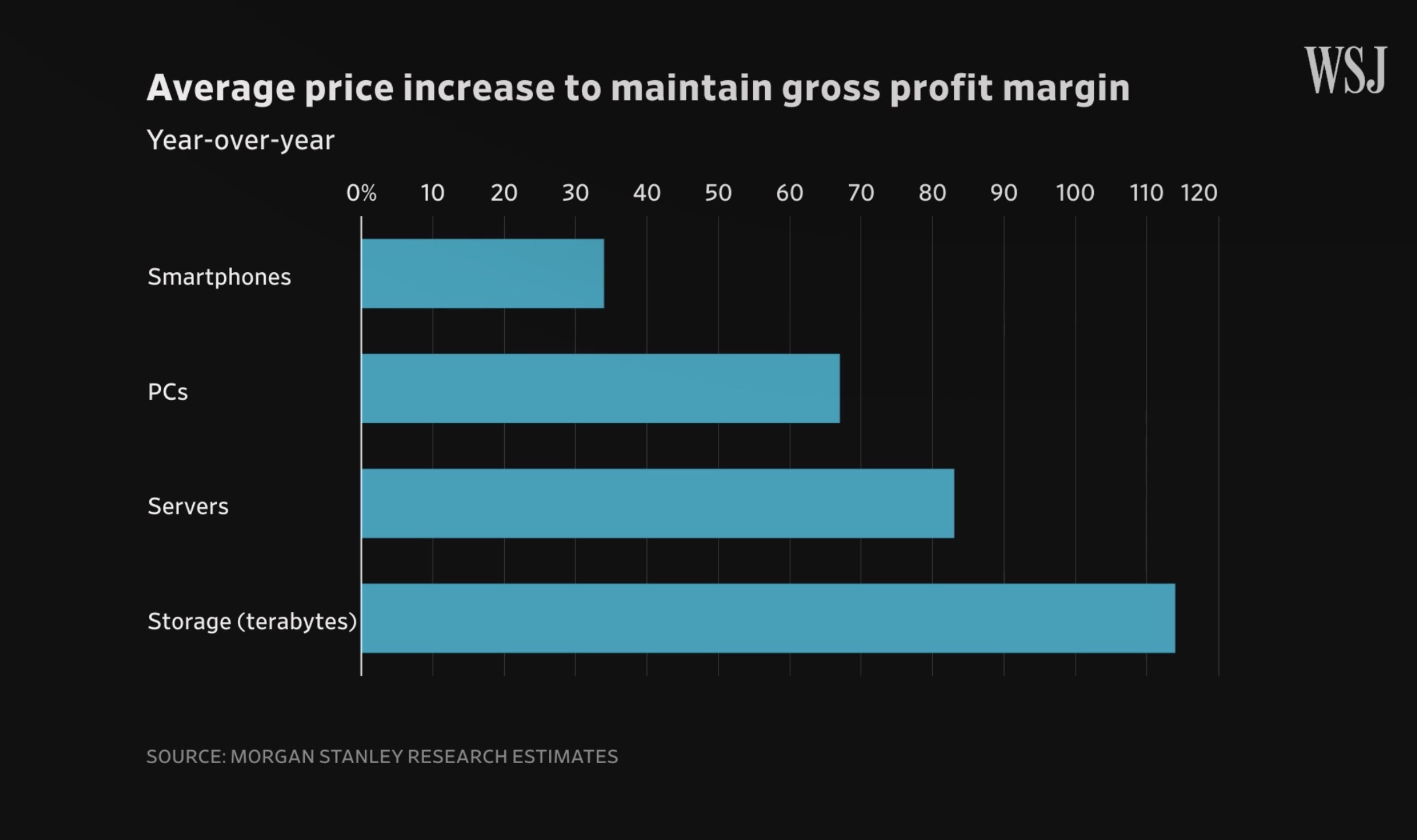
    The Wall Street Journal states "Passing the higher cost on to consumers while maintaining its profit margin would add about $270 to the price of the next iPhone Pro model, estimates research firm TechInsights."

    This is debatable.

    Another estimate suggested that the increase in cost is about $140 per average iPhone. Passing that on without marking it up would obviously be less onerous. Margins would fall as a result but the cash flow would be largely unaffected.

    But what isn't mentioned that these increases would also be worse for other vendors. A $140 or $270 increase on a $300 phone would be more dramatic, even impossible, as memory becomes unobtainable for smaller vendors.

    This is a "100 year flood" and worse than tariffs and Covid. The cause is of course AI hardware demand which may ultimately be beneficial but the near term issue is that supply cannot be built quickly enough to meet demand.

    How could the supply question be addressed? Apple has said they won't build memory as it's not something they are good at. But they might deploy cash, presumably to accelerate supply, as they have with other components. It's still a tenet of semiconductor business that all shortage is followed by a glut since supply reacts to demand with a delay. The problem is that the glut might not come until at least 2028.
  2. What's a billion between friends?

    Office Hours Research · 3 comments

    An Office Hours question asked by Bob V., June 9, 2026.

    Q: The Apple–Google deal for the frontier model is multi-year with no known end date. What happens after — and what is Google really getting out of it?

    When that deal came out, people jumped to conclusions. I talked to Laura Martin {of Needham), who assumed Google would run Siri, and thus get all the data from Apple. Since that data was the real gold mine, even without much revenue from Apple, Google would begin to control the user’s data and experience. This would be check mate to Apple. I was skeptical from the start that Apple would ever release end-user data. That has now been made clear: this is a technology licensing deal including some Google training data but no services from Google and only some cloud capacity from Google using Nvidia chips but running Apple's own Private Cloud.

    The follow-up sessions after the keynote answered most of it. Federighi and his staff have been adamant that Google gets nothing — certainly no data. Only one of the many models accessed through Core AI runs on Google Cloud, outside Apple’s own private servers. It’s the most powerful one, but it’s a world model, and Google has no access to anything. The tools aren’t Google’s either. It’s not Gemini. It’s not their image model. It’s Apple’s own foundation models, several of them, and one happens to run with Google in the cloud, privately and securely.

    People assumed far more than what is actually happening here. Google's contribution is also probably swappable: at some point Apple may decide to do it themselves. And let’s not forget that Google sends Apple more than twenty billion dollars a year. So now Apple sends one back. What’s a billion between friends?

    Apple is not going to give away the single most important thing it has, which is its relationship with the customer.


    Editor’s Note: This was one of the questions asked by participants in Asymco’s June 2026 Office Hours live Q&A session, open to Asymco One subscribers.


    Subscribe to Asymco One for more in-depth analysis and commentary like this.

  3. Meet the System Orchestrator: Toward Intent-centric Computing

    Research · 1 comment

    The end of apps? Not so fast.

    The traditional computing "stack" is usually portrayed as a layered cake where the base is silicon, on top of which are system-level interfaces, followed by the operating system, then core services, and finally applications. The User interacts with the applications only. This is an app-based ecosystem which exposes "tools" for users to use as they try to accomplish tasks. This ecosystem for Apple is approaching $2 Trillion/yr in economic transactional value.

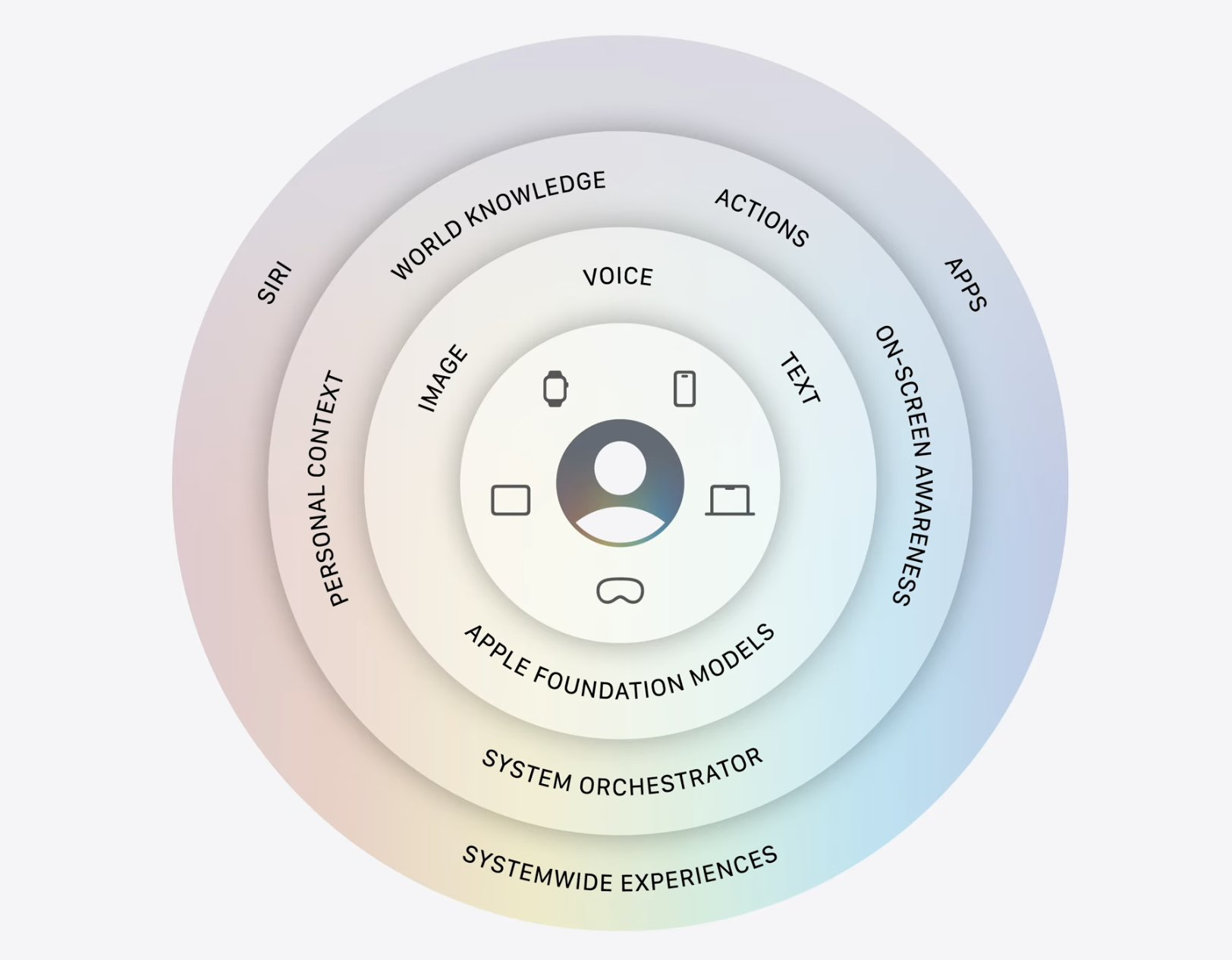
    The diagram above, introduced as the new Apple Intelligence architecture, is quite different. The user is connecting using various devices via various input methods (image, voice, text) to prompt an orchestrator to tap various knowledge bases (local and remote) to initiate either Siri or an App to act on some intent.

    The role of the operating system is now that of "orchestrator' that connects inputs to knowledge and decides how best to fulfill an intent. It sometimes connects to a chatbot (Siri) but also initiates apps to act.

    This might be seen as moving from an app based ecosystem to an intent centric world. For the original Siri, queries were usually routed to apps (calendar, weather, stopwatch, music, etc.) In this new world Siri AI will resolve the intent directly and have the ability to construct & deconstruct interfaces / experiences on demand. There are many tasks that do not need third party applications.

    However, the diagram still shows Apps as equal to Siri in terms of Systemwide Experiences. Apple announced a Foundation Models framework and expanded App Intents. Intent-centrism doesn't deprecate apps. It transforms them them from intent destinations to callable functions.

    Using the nomenclature of integration/modularization and business model evolution, it modularizes what was integrated, subtly shifting the locus of value. The App Store becomes an API directory. That's a business model shift. Classic innovation theory suggests that as the value chain evolves, some profit will evaporate from one point and condense in another point in the chain; usually wherever the new point of modularization has been injected.

    The old points of concentrations were the OS (where Apple captured profit) and the Apps (where developers did.) The new points might be in the orchestrator and in the foundation models.

    But I don't think it's that simple.

    Models might be commodities and orchestrators are not much different than OSs. Intent action requires access to private app data. bank accounts, calendars, messages. Authentication is an app responsibility and thus earned trust. Every app removed or disintermediated becomes a permission the orchestrator needs. Would banking credentials be granted directly to the device/OS? Much peril lurks there. This local data is where app control lies.

    Where the threat for apps lies is in the possible loss of user interaction. It's also a great part of the cost of development. Shifting from a point of contact with the customer to a callable function comes with costs and benefits that are not easily predictable.

    Transitioning the OS from a layer between hardware and applications to a layer between foundation models and experiences fundamentally shifts the architecture, but, in the case of Apple, it preserves its value as the agent of trust and discovery.

    For this the value created and captured remains and perhaps increases.

    It's clear to me that Apple has engineered this quite carefully and thoroughly.

  4. Intent Computing vs. Spatial Computing

    Research · 1 comment

    You don't have to choose.

    In the grand debate on the future of computing, we've been led to believe that there was a choice coming, a new interface to replace the touch UI interface that emerged in 2007.

    One camp believed that the future was ambient or intent computing where conversations and minimal interactions would replace taps and swipes and staring at screens. Apps would disappear as well as almost all visual interfaces. Devices would be not much more than microphones and perhaps earbuds. The initial instance was Amazon Alexa but more recently the quixotic Humane and rumors of a OpenAI pendant or tchotchke that linked us to the great mind in the cloud without messy screens.

    The other camp dove into virtual reality so that everything we see is generated by computing. The world itself would be re-painted by the machine and every photon hitting our retinas would be computed and every move we make, every breath we take would be tracked as forms of input.

    These are opposite ends of a spectrum: from minimal or almost no interaction to full immersion at the exclusion of passivity. From seeing nothing to seeing everything and from barely hinting intent to monitoring every muscle moved.

    The passive computing seemed to be winning. The VR or Visual Computing was not catching on. Device sales are not great and prices too high. Worst of all, devices are too onerous for mass consumption. In terms of wearables, eyes were losing while ears were winning.

    However lost in the WWDC news tornado was the updates of VisionOS 27. The list of updates is long and quite esoteric but it's clear that there was a lot of work involved in expanding the power of Visual Computing especially in the creation of new apps and content. Also all AI advances are being applied to VisionOS and even adapted in clever ways: Siri AI can be activated by just looking at the glowing orb that embodies it in the spatial world.

    Clearly Apple is not deprecating Spatial Computing. It's a remarkable creation and those of us who use it find it irresistible and irreplaceable.

    What the update clarifies most of all is that there isn't an evolutionary branching in the future of computing. The touch UI did not immediately obviate the need for traditional personal computing interfaces. The smartphone brought computing to more people and more contexts but keyboard and pointer computing cannot be fully replaced by touch. We have a situation where there is co-existence between touch and non-touch computing. Indeed we also have sensor computing in the form of Apple Watch and AirPods. Perhaps there were will also be Apple spectacles to expand the compute real estate on the body.

    Intent computing will probably reside primarily with our phones and wearables but Spatial Computing will strengthen their position alongside keyboard computing. Spatial was always a "high commitment" interface. To use it you strapped in, settled down and became acclimated. Then you became productive. A session was going to last at least 20 minutes, perhaps even a few hours.

    Intent computing is a few seconds of use. Perhaps a few seconds strung out in multiple sessions but it was far more "glance" computing than "sit down" computing.

    So why not have all forms of computing?

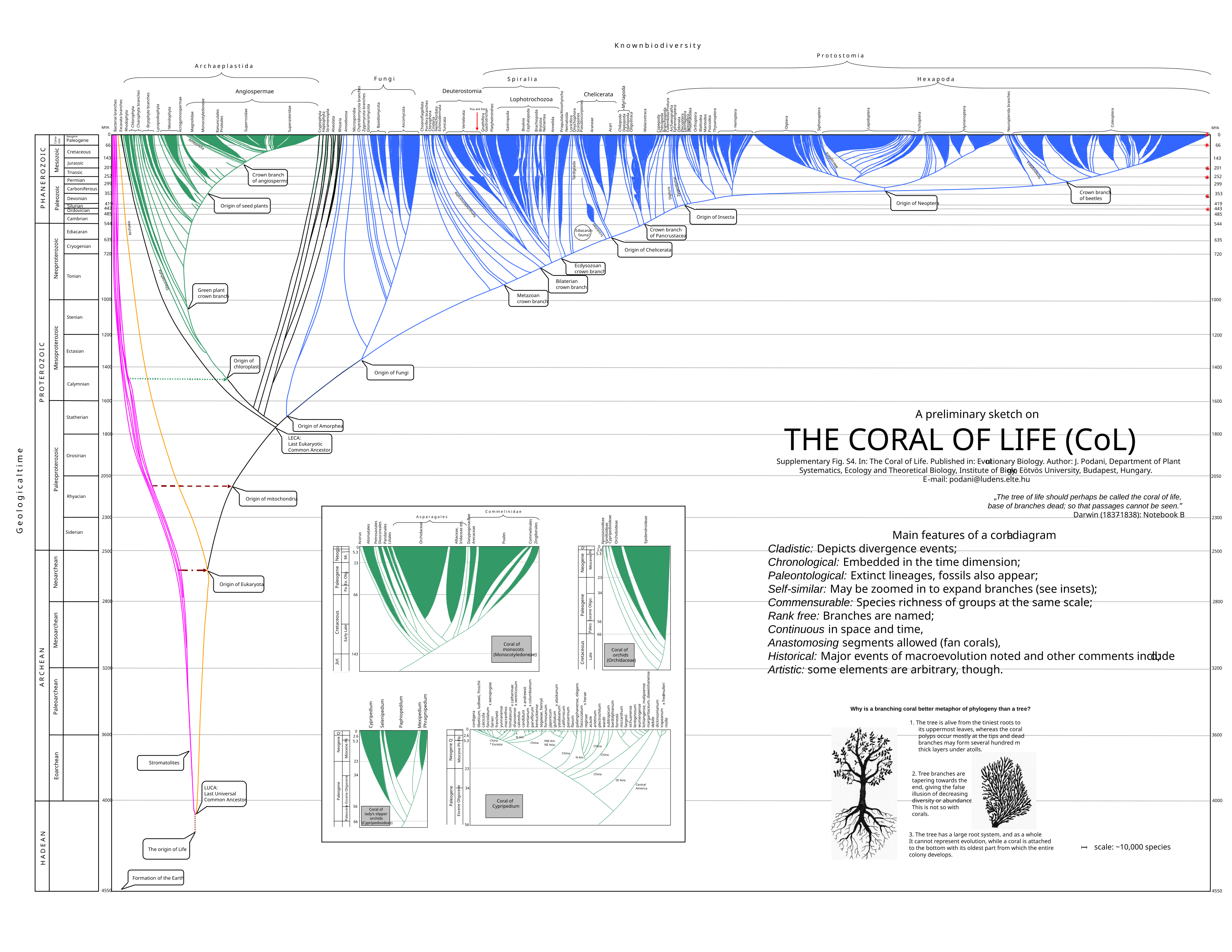
    As the diagram on the coral of life shows, evolution results in a multitude of "form factors". Some do become extinct (see the scroll wheel iPod or the stylus PDA.) But most survive and coexist.

    Spatial Computing is extraordinarily powerful. It will evolve and it will probably become the highest utility for those who create.

  5. Apple Intelligence: Show me the money!

    Research · 3 comments

    AI sales are booming. AI FCF not so much. So what new cash flows does Apple Intelligence unlock?

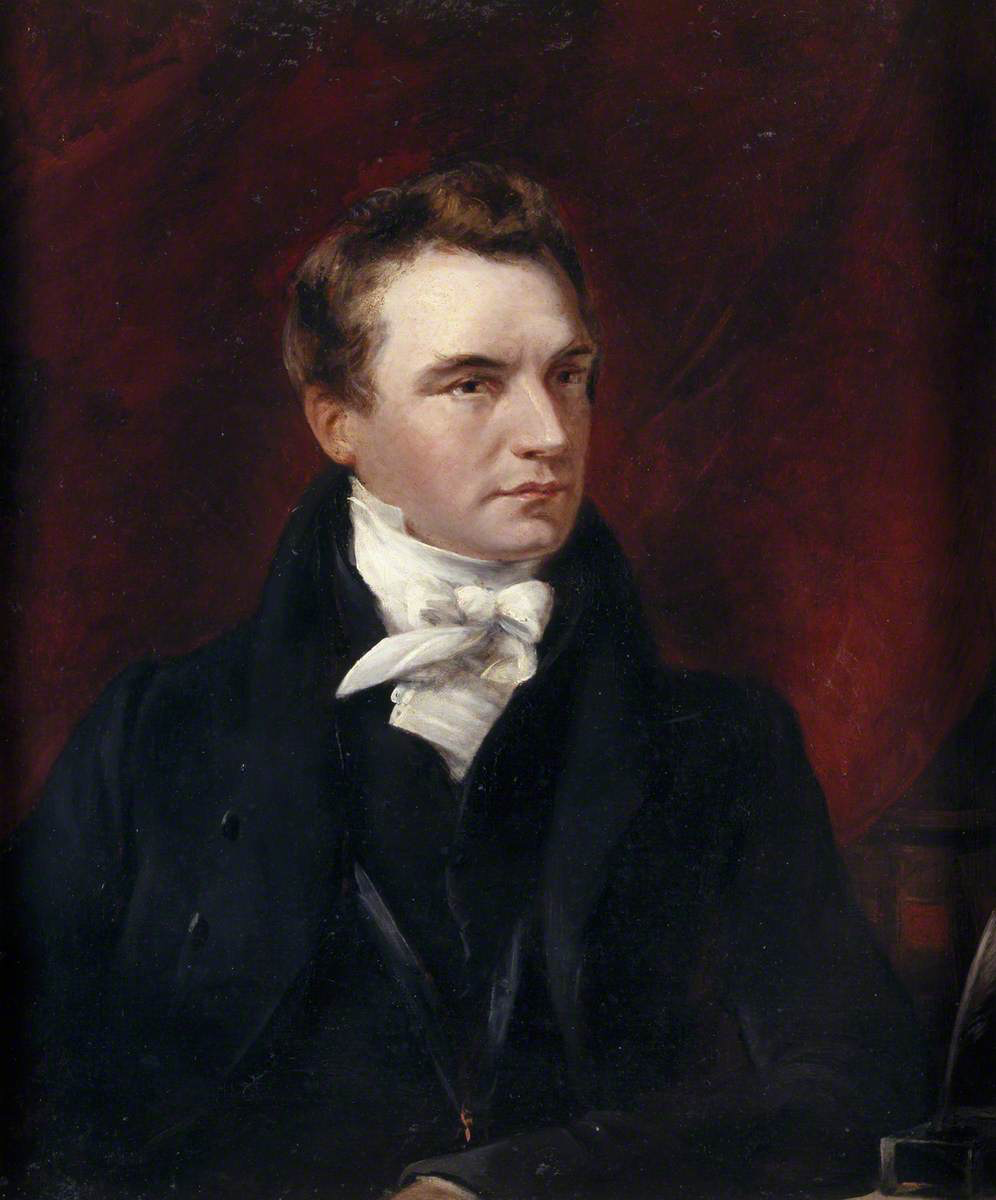
    Portrait of Charles Babbage (c. 1820)

    Apple's release of a new framework for AI at WWDC26, centered mainly on new layers in the device/OS which process intent to either on-device or world models and couple it to experiences which are system-wide, including apps.

    This is how the data and the inferences flow but what about the cash?

    I am writing without a full picture in mind, and perhaps one does not yet exist, but my assumption for at least three years has been that the value of AI will split between the creation of (frontier) models and their distribution. Apple chose to focus on local models, license or partner for frontiers and stitch together the means for distributing both.

    That is until on-device will be good enough to perhaps bring all models in-house.

    But distribution is always where it's at. So how do the new announcements affect this?

    Let's follow the money. The costs of inference will be partly borne by Apple for what they keep in private cloud but mainly by apps and hence subscriptions which will include marginally increasing compute costs. This will lead to increasing or new subscription pricing and the usual commissions for App Store distribution.

    The fact that this is all implied rather than explicitly stated should be seen as a tacit acknowledgment that the Services business will not change much, if at all. It will perhaps benefit from an uplift if the new AI-powered apps are very popular.1 This new AI might create more demand or expand existing demand. That will all depend on the innovations developers come up with.

    But the elephant in the monetization conference room is hardware. AI demands a huge step-function increase in computing resources--both compute and storage and integrated memory. The minimum requirements are already leaving two to three year old hardware behind.2

    Again, if AI is compelling enough, users will need to upgrade. Not just their phones but the Macs, iPads, Vision Pros, Watches, probably AirPods too. Then there is Home which is seeing foreshadows of a significant AI enabled upgrade. This means HomePods but also probably new devices altogether. Rumors of spectacles coming are par for the course. Health will also be revolutionized.

    This idea that AI is monetized through hardware should hardly be a surprise…

    … Right now the greatest beneficiary is Nvidia which won the AI lottery by having the right chipsets at the right time. And with only a market of 5 customers and a few million processors it became worth $5 Trillion.

    Apple has the processes and priorities in place to drive a consumer device AI experience with 1.5 billion customers and a few billion processors over the next decade. Perhaps even longer.

    Apple, let's not forget, also has been monetizing software and services with hardware. Unlike the PC and Android world where software profits (and margins) accrue to software makers while hardware is left to starve, for decades Apple's integration meant that its business model afforded it great margins that could not be replicated.

    1. Services has a lot of headroom for growth as non-consumption is still pretty competitive
    2. But don't worry, adoption curves being what they are, and regional/political obstructionism will imply a decade or more before perhaps half the install base is using Apple Intelligence with some frequency.
  6. How to Measure WWDC

    Research · 2 comments

    How to measure helping others

    René Descartes, who published the phrase I think, therefore I am" in Discourse on the Method, in 1637

    Apple isn't measured by revenue or profit, at least not primarily. The measure is always satisfied customers. The application of services, software and computing hardware to improve lives has always been the modus vivendi and the resulting customer creation has always been the metric of success. Revenues and profits follow customer creation in a 1:1 relationship.

    WWDC seems to attract attention as a catharsis for product and strategy announcements but it was never intended to be this. It's about developers (the D in WWDC) and what matters to them: APIs, operating system updates, languages, SDK, and other tooling. It's also a chance to reveal the economic value proposition for those developers who are following their part of the $2 trillion ecosystem.

    And so the measure of WWDC should be how developers are created and satisfied. The products, which come later, are important but what matters more is developer opportunity, productivity and satisfaction.

    So here is what I'm looking forward to:

    • New developer opportunity with AI. This is via easier integrations, more choices perhaps in terms of back ends and possible hooks into different parts of the ecosystem. To wit: Swift extensions, *Kit extensions with hooks to smart home, exercise/fitness, accessibility.
    • New developer productivity tools: How is AI going to improve the toolchain for developers.
    • New developer business models: how agents can be built and integrated into privacy and safety that only Apple can guarantee.

    As Apple has shown with accessibility improvements (foreshadowing!), AI can be used to make people's lives better especially those who cannot perform due to disability. AI can lift those "below the median" in terms of many forms of ability: below median communications, below median health and below median mobility. Those with more limited ability can be "enhanced" into at least median ability. By definition, half of humans are below the median so helping them is as useful as helping those above the median.

    This is in contrast to the narrative that AI makes supermen. The opportunity is not mainly about taking over high ability tasks and forcing human effort to be displaced. it's much more about making the less able become more abled. (Characteristic of GenAI output is the "averageness" of it. For those of exceptional ability it feels worse/erroneous and irritates. For those of less ability it's empowering. AI pushes toward the median, both from below and above.)

    Below the median here does not necessarily mean below the median income or wealth. Ability is not always correlated with income. There are many Apple customers and potential Apple customers who can use help. I surely can use help in many areas of life.

    So we should look for things which currently are done very poorly by people and machines and seeing how AI can get them done well. A classic example is in health: eating well, sleeping well, exercising and preventing chronic disease is a huge opportunity. Another is what I call life friction. Helping with housekeeping, scheduling, finances, travel planning, administrative tasks--the things which only the wealthy can afford to hire help for. We wait and wait for machines to help us but we only get half-baked, difficult to integrate, compromised in some way services.

    WWDC is about the scaffolding upon which these grand problems can be solved. Scaffolding is not pretty to look at and most look away in disappointment if that's all that is revealed. But no matter how well regarded, no great building has ever been built without scaffolding.

  7. How not to over serve; The machinery of vanity

    Research · 6 comments

    The Asahi Shimbun Interview Part 4

    Godfrey Kneller - Portrait of John Locke, 17th-century British Age of Enlightenment philosopher

    Horace Dediu / Takeshi Narabe & Dylan Weir / Asahi Shimbun Interview, April 2026

    Takeshi Narabe • 22:44
    Japanese companies always follow and concentrate on seeking additional functions so that is very in contrast to Apple so there is a growing concern that Apple might be falling into the same spec trap that runs parallel. Japanese firms you know focusing on incremental hardware improvements like you know iPhone's more thinner and thinner...

    Horace Dediu • 23:34
    It's true. But I will say to the defense of Apple, of course, they need to maintain some improvement. Otherwise, people may not consider buying it. They do think hard, though, about what needs to be improved. And many times they don't improve things that many people ask for. They'll say, "Oh, you need a refresh rate of hundreds of hertz." They don't bother with that. Or they [won't offer] more resolution, more than even the eye can see. They don't do that. But they'll do a lot with the camera.

    And they'll probably do more. They do amazing things with audio. They do really, really interesting things as far as... Like face ID was something that was nobody asked for. But now it's a very, very useful thing. People recognize the value. So I do think there's a roadmap there that's kind of interesting.

    But here's the bottom line, you know, Christensen said, that the trajectory of what performance people expect is not as steep as the trajectory that companies can deliver. And that's why you overshoot. What Apple has been able to do, at least through the lifespan of the iPhone so far, is to cause people's interest in more improvements to rise a little bit.

    And so the theory basically says that there is a flat trajectory to the user demand of performance. But my [observation] is that eventually you do drag people up, just like with non-consumption. People don't ask for a better camera, but once you give it to them, they're like, oh, yeah, I really want an even better camera.

    [The performance demand] it created... I mentioned the short video TikTok format, It was the phone's camera that allowed [average] people to suddenly become filmmakers. And it allowed people to become "vanity machinery"1. It became all about vanity, all about selfies. And [as a result] you have to have a front camera and a back camera and you have to have editing software and you have to have a more powerful processor and you need a huge amount of storage when you're dealing with video.

    So suddenly, the phone needs more and more and more. But the demand for video editing on a phone was created essentially from nothing. It was created by the supply of camera. And so, yes, that is a theory that you have a problem if you overshoot. But I think in the old days, a consumer electronics company would add buttons.

    I was at Nokia for a long time, and we had buttons and buttons and buttons. We had one phone with over 100 buttons on it.2 That wasn't very useful. So the idea of Apple is that they remove buttons. They make it even cleaner in that design, and they make it easier. So face ID is an example, and privacy is important.

    By the way, that's another thing that they sold to people. If you think about it, nobody asked for privacy because everybody was okay with sharing. But the fact is, it's like the automotive industry has safety, and nobody asked for safety either. But you should deliver safety, you should protect the passenger. [Today] it's considered hygiene. [If] you don't have it, it's bad, but if you have it, nobody cares. But in the case of Apple, they're pushing on privacy.

    So yes, it is a concern that you overshoot. However, one more defense of Apple is that they introduce these wearables. So if you take the AirPods, for example, again, not a product anybody asked for. And when they were first introduced, they were made fun of because it was [so funny looking.]

    The AirPods are a very clever new product, [they are] an extension of the iPhone. They're not the iPhone per se, but we have a wonderful must-have accessory. I feel like I'm naked without taking my AirPods with me. The same with the watch. Another product extension. Again, it's an option. You don't have to have it, but once you have it, it becomes addictive.

    There are many things on the watch, which again, from health reasons, from managing information that I only need to look at for a few seconds, all of those things. (I'll give you a simple example. I never check the weather on my phone. I only check the weather on my watch because it's there with the temperature always on the home screen. And if I want to learn more, I tap on it. I don't even know how to do it on the phone anymore. You know, I have to find the weather app and then scroll and things like that. Never do that anymore.)

    So there are things you do now with accessories that the phone has essentially been disrupted by. But it's still at the heart of the network of Apple. It used to be the Mac was at the center. Now it's the iPhone. So again, this is cleverness.

    I was a student of Christensen, and Christensen always thought that Apple was not disruptive, and that Apple would be disrupted by the low end. [I was not so sure.] I was a bit sensing that there was a disturbance in the theory because in many ways Apple's behavior is so atypical to a normal company. And most companies would do the wrong thing, but somehow Apple managed to not step on those mines, not to fall into those traps.

    Why? I'm not quite sure. And we continue to have the discussion. I really think it's culture. I really think that they've solved the Innovators Dilemma. Not by reading a book, not by taking a university class, but by always being extremely nervous, extremely careful and extremely passionate and extremely paranoid. All of these things.

    Which points out the vulnerability of Apple. If that culture breaks, if the management, the next generation doesn't know how to do it, then suddenly it might fail. Because it's held together by such a force that it's hard to write it down. It's public information actually, that they have Apple University, which is meant to teach internally how things are done to the next generation of managers.

    So this is something they are trying to codify and to preserve. And that's an experiment, I would say, because it's not easy. But again, that's a self-critique, an introspection, looking at yourself and asking, why am I good? How do I make sure we continue? Few companies do this. Founder-led companies might, because the founder is the company, in a sense. The founder is the culture. The founder's personality is more or less how everything is done. So those companies, to speak of, let's say, Meta with Zuckerberg, even Google, and those companies, or Amazon a little bit with Bezos, although he's mostly gone.

    [But], that's not an answer, because the founder doesn't last 50 years in that job. And as we talked about one century, no way is it possible. It's beyond the human lifespan.

    Next in series: Part 5: Succession, study of the firm vs. study of the person

    Previous in series: Part 3: Low-end, Game consoles, Secondary Markets, Displays and AI

    Interview as published: 聞 Asahi Shimbun on Apple & Innovation

    1. The word I was looking for was "influencer" but "vanity machinery" came out. Perhaps that's a better term.
    2. I had the Nokia Communicator in mind, which was a clamshell with a full (but tiny) keyboard plus a full numerical keypad on the outer shell. The idea of mechanical keyboards was not only popular with Nokia but with the RIM Blackberry as well.
  8. The Apple Ecosystem Approaches $2 Trillion

    Research · 10 comments

    The iPhone maker is trading at 2.5x its ecosystem value and 1.5x its economic impact

    Apple today announced the global App Store ecosystem facilitated over $1.4 trillion in developer billings and sales in 2025, according to a new study by economists at Analysis Group. For more than 90 percent of the billings and sales facilitated by the App Store ecosystem, developers did not pay any commission to Apple. Since 2019, the size of the App Store ecosystem has nearly tripled, as the App Store remains the safest and best place for users to discover and download apps. .

    Source: Apple

    Bill Gates once said you have a platform when other people make more money from it than you do.

    In other words, success is if there is more value created on top of it than captured from it.

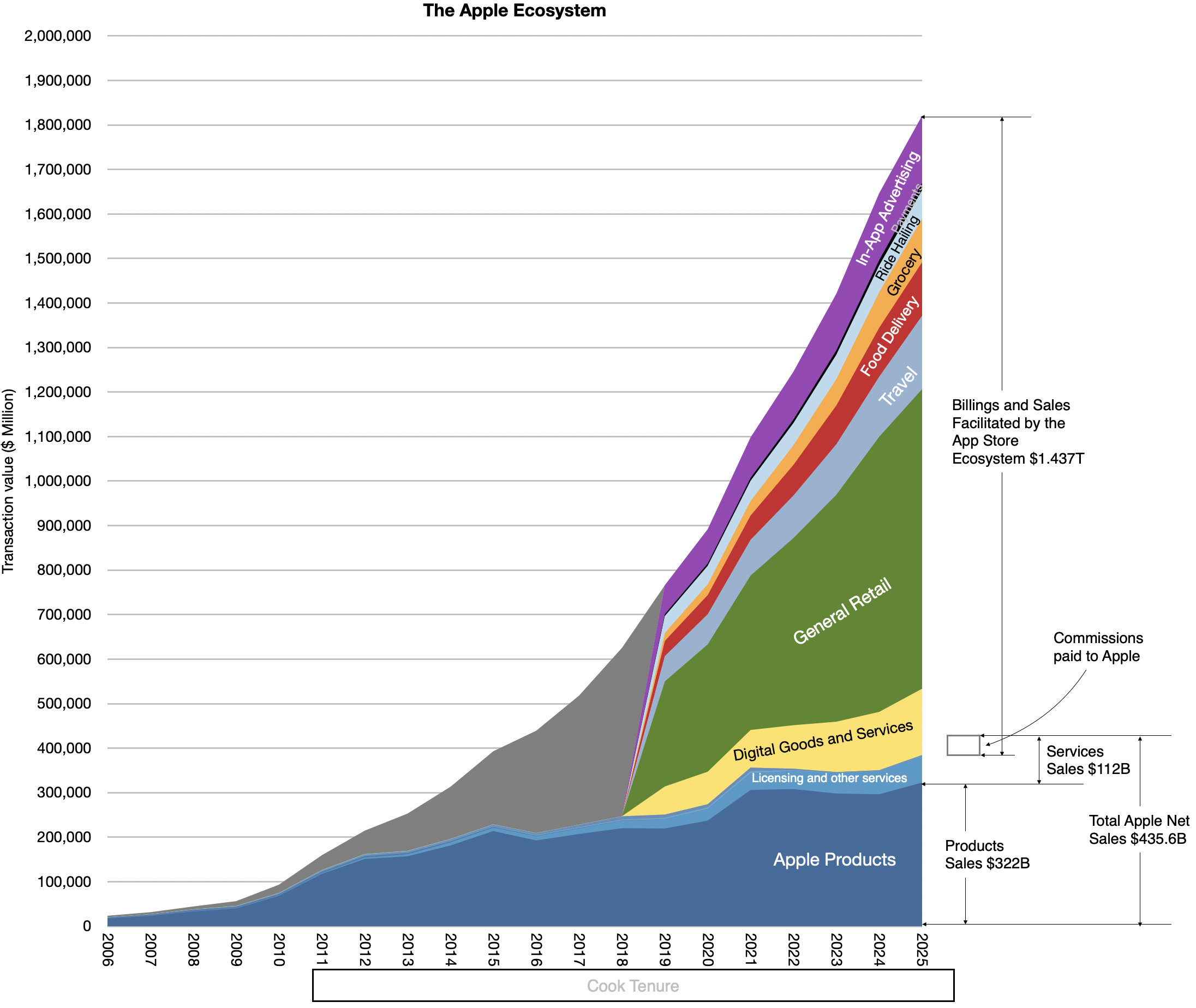
    Few platforms qualify but Apple's certainly does. Apple's ecosystem is shown in the graph below.

    Apple's direct payments to developers were about $126.7 billion but, as the Analysis Group report shows, Apple and the developers enabled transactions dwarfing app store transactions. In 2025 Apple captured a tiny fraction of the economic activity it induced on its platforms (about $57 billion out of $1.437 trillion or 4%).

    Combining the billings and sales facilitated by the App Store and Apple's direct sales of products and services leads to a total of over $1.8 trillion. I call this the Apple Ecosystem (Apple + App Store.)

    But that's not everything. There are lots of economic activities on the platform that do not involve the App Store. Activity on browsing and social media and messaging apps probably add another 50% on top of this, perhaps even 100%. I call this the Apple Economy (Apple + App Store + All other transactions.)

    Ultimately, the 1.4 billion Apple users using 2.5 billion devices are likely inducing as much as $3 trillion of economic activity.

    It seems to me that we need a way to measure a multiple of this activity as perhaps a fundamental metric of value creation.

    At $4.57 trillion current market cap, the value is only 2.5x its ecosystem and 1.5x its economic footprint.

    These activities may not benefit shareholders directly but they are a measure of the resilience of the platforms insofar as other parties are benefiting and relying on the platform for their economic lives. Moreover, the switching costs or absence of frictionless alternatives means there is a huge downside to interfering with the platform. This measure is a carefully worded caution not just a celebratory pat on the back.

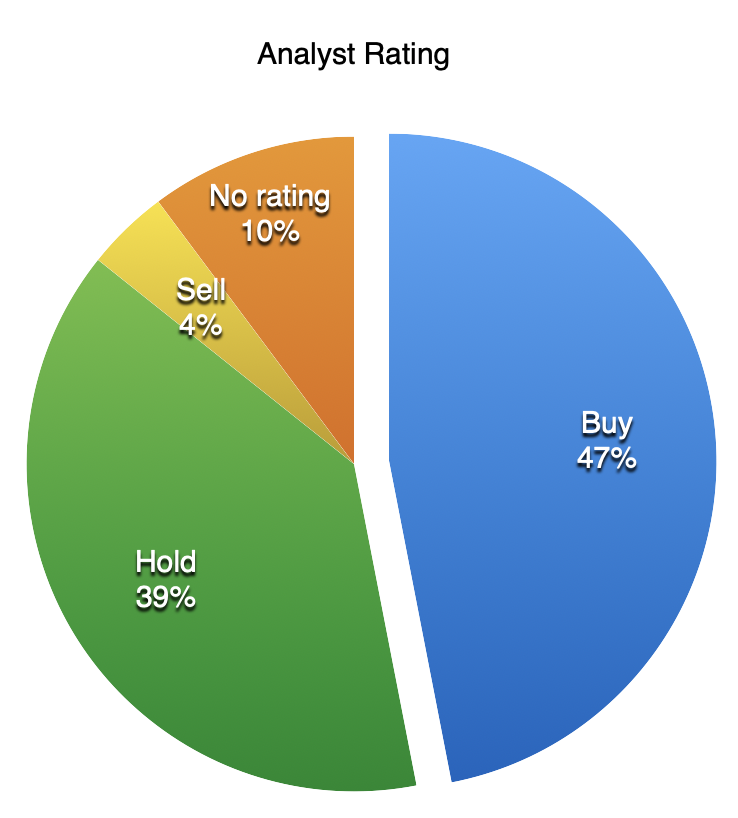
  9. 42% of Apple Analysts rate it a Hold or Sell

    Research · 3 comments

    Another 10% do not provide a rating.

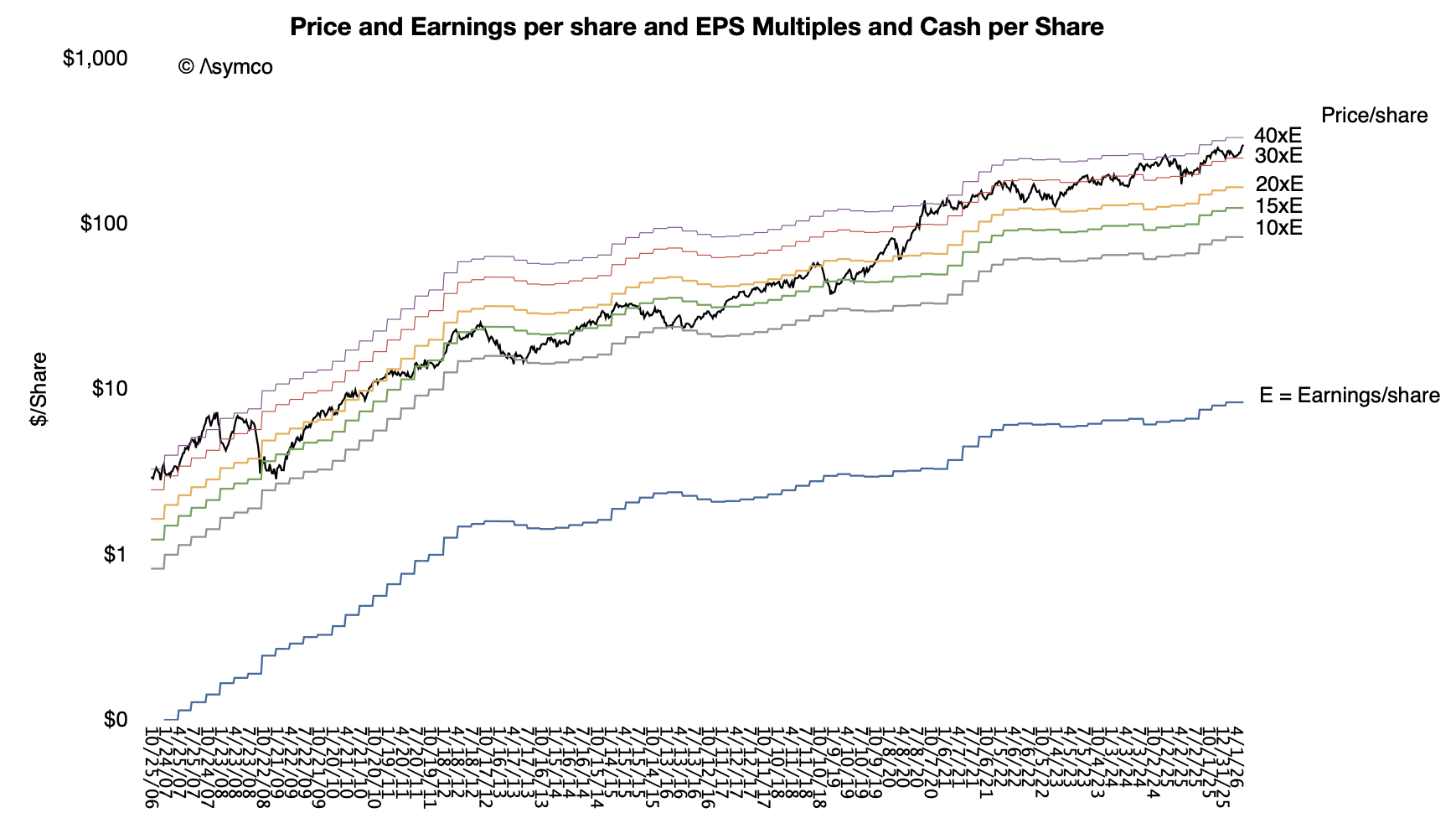
    Over the past 20(!) years, Apple net income has grown at a compounded annual growth (CAGR) of 26.6%, Revenue growth has compounded at 21.5% and share price has compounded at at 27.7%. That means the company has been doubling at least every 3 years for more than 20 years.

    The graph below shows share price and yearly earnings (and multiples of those earnings) since 2006. Note the vertical scale is logarithmic. The Price line has been growing at 27% or doubling every 2.6 years. The exercise of predicting the share price based on extrapolation is left to the reader.

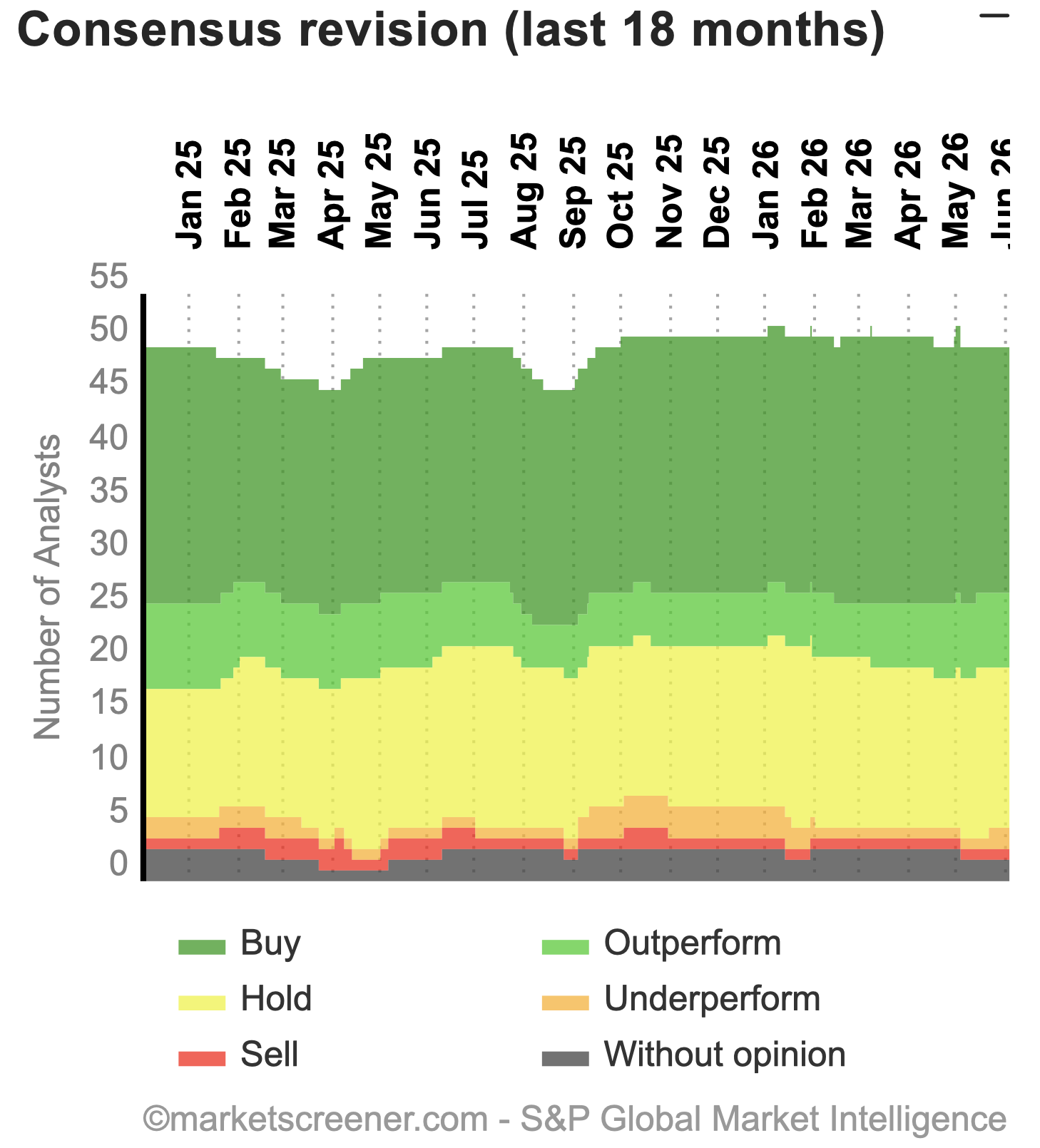
    In spite of this, data shows that 21 out of 49 analysts who follow Apple have the equivalent of a "Hold" or "Sell". An additional 5 follow it but have no opinion.

    It takes significant courage to predict a reversal of a 20 year trend. That a majority of analysis implicitly or explicitly believe Apple is on the precipice of failure may come as a surprise given the recent rise in price and optimism around AI. The graph shows the percent of Hold/Sell/Underperform/no opinion has been rising.

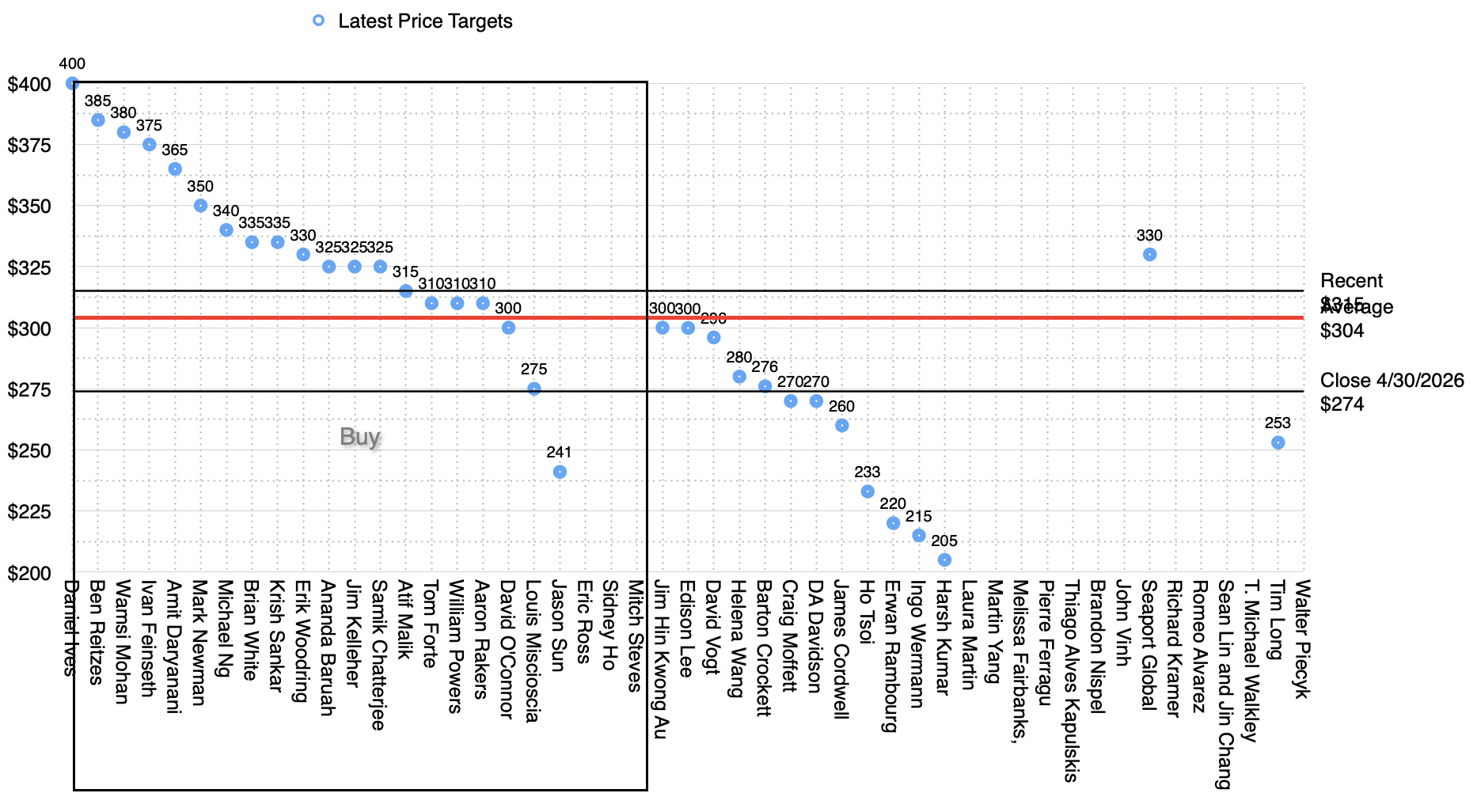
    The graph below shows the targets published recently.

    The targets are sorted by rating and then value. The "Buy" rated are encapsulated, the rest have all the other ratings. The Red line is the average of all ratings. Some of the ratings and targets, especially the lowest, are out of date.

    Extraordinary claims require extraordinary evidence. Of course, a 20 year trend can end, even a 50 year trend can end. But the longer it goes, the more important it is to understand why it has gone on for so long and therefore to understand how it can end. Arguments that it can end because "rising prices and/or delays for AAPL's component supplies, potentially slowing AAPL's rev growth, and/or lowering margins" don't counter a 20 year run of compounding 27% growth. Surely, supply chain management and cost hedging strategies are not a new problem.

    The skeptical claims have not presented extraordinary evidence. The strongest has been that if AI can create an alternative to the user interface Apple pioneered, and if Apple would not be incentivized to embrace this new paradigm, and if enough users would abandon the comfortable and familiar digital life Apple affords them then Apple would slow or stagnate. There are a lot of "ifs" in this argument. Each more dubious than the other.

    In contrast, the "flywheel" or momentum of serving 1.3+ billion users with iris-dilating products and services provided at premium positioning seems self-explanatory.

    That almost 40% of the analysis covering Apple believe that it cannot deliver above-index average growth continues to amaze me.

    We will be discussing this and other Apple-related topics at our upcoming June Office Hours on Tuesday, June 9th, 2026 (day after the WWDC'26 keynote.) Sign up today!

  10. Low-end, Game consoles, Secondary Markets, Displays and AI

    Research · 2 comments

    The Asahi Shimbun Interview Part 3

    Outfit for the Go Game, Polychrome woodblock print (surimono), C. 19th century

    Horace Dediu / Takeshi Narabe & Dylan Weir / Asahi Shimbun Interview, April 2026

    Takeshi Narabe • 16:20
    [Y]ou also mentioned about the Japanese companies, overshooting, performance oversupply was also one of the reason that Japanese electronics giants were outmaneuvered by Apple: the insistence on in-house component manufacturing and a critical absence of software and service-led business as you mentioned now.

    Horace Dediu • 17:02
    It's a tough one. I think I know what you're getting at, but I think the puzzle there is that you try to make things better and you think by making things better you're going to be more successful and that was another observation by Christensen that sometimes you if you listen to your customers they'll ask you to do things better because that's all [the customer] can imagine.

    I think the canonical example for me would be the game consoles. [...]Every new generation was more powerful and the way [the platforms] would decide how to improve it would be by talking to their customers and who are the best customers?

    They are those who spend the most on games and the most on consoles. and they would survey those [customers] and [the customers] would always say "we need more performance in terms of refresh rate or, I don't know, how many dimensions of performance there are in games--i'm not particularly a user.

    So the problem is that it's not just Sony but Nintendo, Xbox, everyone in the gaming industry was listening to the gamers and the most prolific and demanding gamers were those who spent the most money.

    But if you compare mobile gaming to console gaming, it was always worse on all those dimensions. But if you [instead] measure how much time people spend on on mobile games, initially it was quite small, but over time it grew and grew and the number of people using phones for gaming is in the billions. In contrast, the number of people using consoles saturated at most at 30 percent of households in the United States. I don't know what it is in every country and there are many still. That's an okay business but it's not measured in the billions of users and arguably those users are not the ones you want to listen to.

    The only exception was Nintendo with the Wii, which actually tried to expand to non-consumers, tried to expand to elderly people (so that they can do some movement) with the product or to young children. And that was a brief moment of success in the incumbents. But I think fundamentally, even that too gets passed to the phone.

    So this is a classic example. How Apple plays in this game is a very tricky one because...

    ...they don't want to be doing "low end." So what they do is they improve the product and they let the previous generations of products to be passed to people who haven't got the money. There's a huge resale market for iPhones. And this is something that requires much more research, but we're observing that the longevity of the product allows the second or third owner of an iPhone to afford owning one.

    And that improves the user base. It is, in fact, one of those interesting phenomena, that the iPhone is designed to last much longer than the Android phone, typically. And it's supported longer with software updates. And as a result, more people use the product. And that's a very different priority. So in that sense, they are protecting a little bit against low-end disruption.

    But it is a challenge for Apple is to be careful because somebody might introduce something good enough at the low-end. I think in the AI time we live in, it's about something that doesn't even have a screen. And we've seen these challengers appear, which suggest that, it's only an audio interface or it's only something you wear that has perhaps a camera and is perhaps listening and gives you some information, but without a screen.

    That is a very dangerous interface for Apple because they have no incentives to make screenless devices. The AirPods are an exception, but they are connected to the phone. So the challenge for AI is that if companionship through a voice interface is all that people care about, then there is a struggle for Apple because they don't add so much value.

    But I do believe that the visual interface is still primarily what people want. I think the visual interface [through] the optic nerve is much more bandwidth than the hearing nerve. The ear doesn't process as much information as the eyes do. So people will always be interested in seeing.

    And when you look at the social media or you see how automatically people migrate towards short video and less towards text. Because text requires understanding, [encoding]. Reading is hard. And it's also, by the way, language dependent. Video can be independent of language. So you have a lot of interesting experiments there. So I'm still bullish on Apple controlling the screen and becoming dominant or staying dominant in anything with a screen. But there is a challenge in the low end there. And that's why knowing disruption theory is very helpful to predicting some of these potential changes in the market.

    Next in series: Part 4: How not to over serve; The machinery of vanity

    Previous in series: Part 2: The Story of Japanese Innovation

    Interview as published: 聞 Asahi Shimbun on Apple & Innovation

  11. Omdia: Apple grows 9% as European Smartphone Market Grows 2%

    Research · 4 comments

    Market contraction expected for second half of year.

    Omdia reports that Europe (ex. Russia) smartphone market grew 2% to 33 million units in 1Q26.

    Key vendor highlights from 1Q26 include

    Samsung was Europe’s largest vendor as it grew 3% to 12.6 million units. Effective discounting of the Galaxy A16 4G helped Samsung boost volume, offsetting declines related to the delayed launch of the Galaxy S26, A57 and A37.

    Apple grew 9% to 8.8 million iPhones, driven by robust iPhone 17 series demand in addition to benefiting from a wider mid-range coverage from the iPhone 15 and iPhone 16e. Noticeably, Apple’s strong results came despite lower and fewer discounts than in previous years.

    Xiaomi retained third place despite declining 15% to 4.5 million units, as it was more immediately impacted by supply-side difficulties. However, Xiaomi’s ASP grew 21% compared with 1Q25, boosted by a record-strong Xiaomi 17 and 15T series performance, which drove year-on-year value growth despite the shipment decline. Premium sales were particularly strong in France, Germany, and Spain.

    Motorola grew 17% to 1.9 million units, driven by rapid expansion in Spain and Portugal, alongside continued progress in France and Italy.

    OPPO grew 9% to 1.3 million units, largely driven by its comeback in France alongside growth in Romania and Poland. With both realme and OnePlus now under its umbrella, OPPO is restructuring to optimize its portfolio and strategy with ambitions to strengthen its European position.

    HONOR, ranking sixth, was the fastest-growing vendor among the largest players, with shipments increasing more than 60% compared to 1Q25. HONOR’s growth is underpinned by its portfolio being expanded further down the price-tiers.

    Source: Yahoo Finance

    "The average-selling-price (ASP) of smartphones in Europe surged to a record-high level of €580 in 1Q26," added Bjorhovde. "This was largely caused by lower availability of devices costing less than €200, which made up an all-time low of just 25% of shipments. Additionally, the high-end remained resilient thanks to Apple’s growth. The focus from both vendors and channel partners has shifted from volume to value to deliver results and operational sustainability. Many vendors who normally focus on the mass market segments are increasingly concentrating on the mid-to-high-end, hoping to benefit from less price-sensitive and upgrade-willing buyers."

    [My emphasis]

    "The first quarter of 2026 delivered beyond expectations, but the outlook remains bearish as the rapidly escalating memory bottleneck worsens," commented Bjorhovde. "Omdia forecasts shipments into Europe to decline 12% in 2026, but the majority of this will come in the second half of the year.

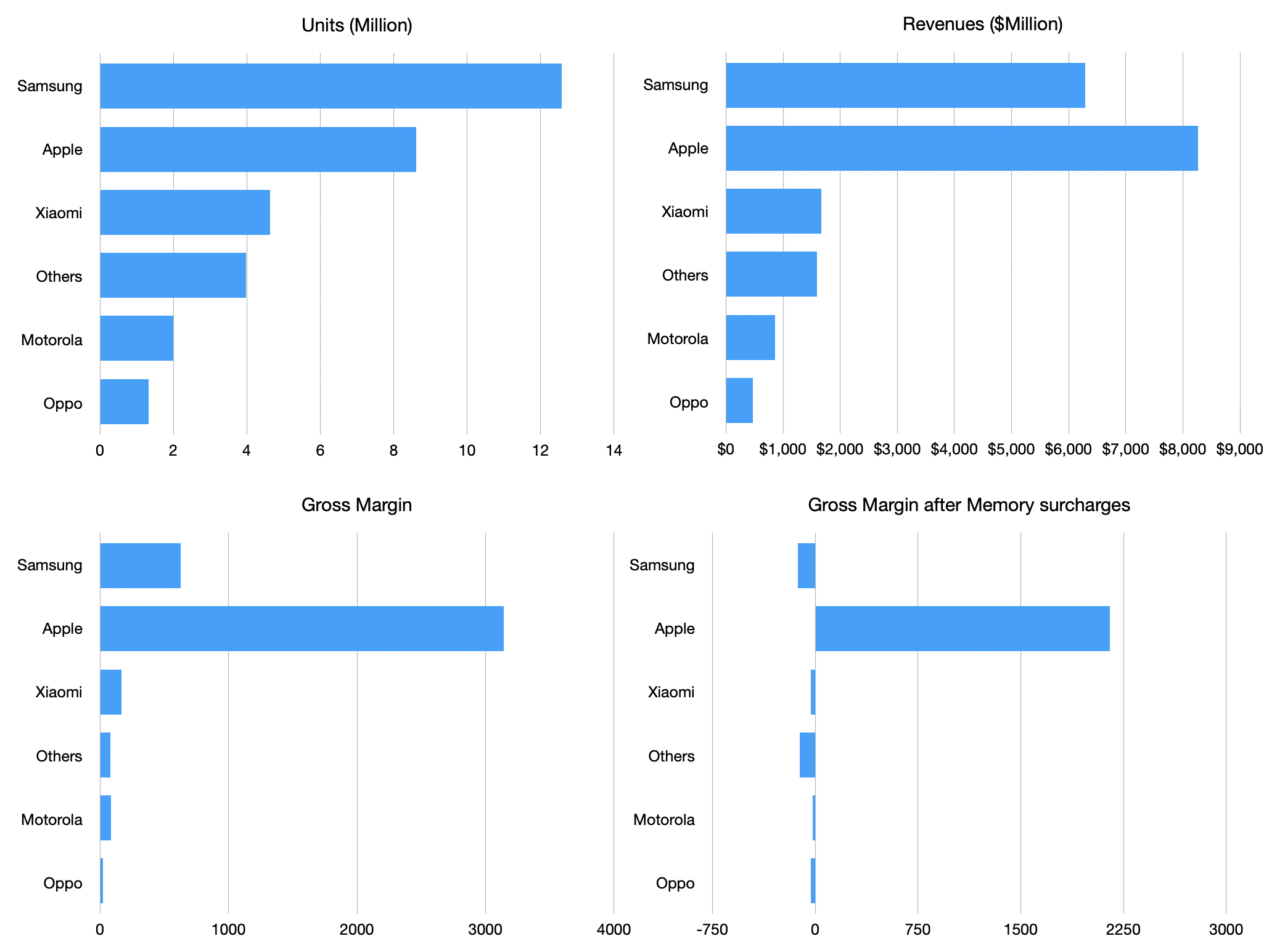
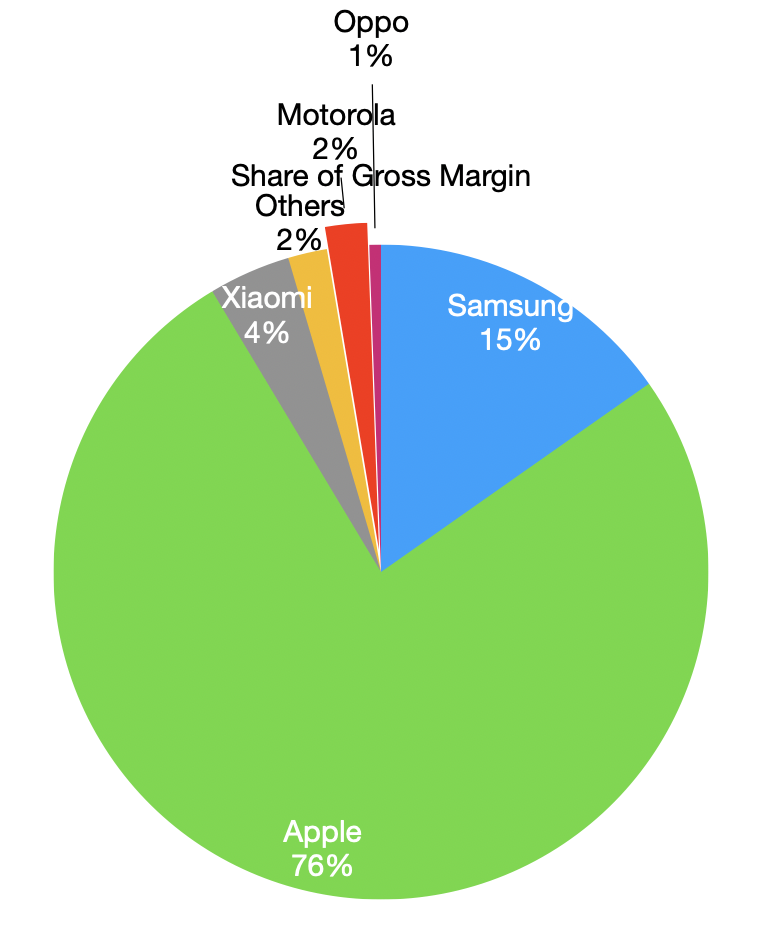
    Applying average pricing per vendor and average gross margins gives the following picture of the market:

    Apple currently captures 26% of unit volume, 43% of ...

    … revenues and about 75% of the gross margin:

    In a contracting market with memory costs increasing, I expect Apple to capture 100% of available margins and to gain share.