Asymco

Asymmetric Intelligence

Research

  1. The problem with the P/E ratio

    Research · 1 comment

    Why the most common measure for valuation is inadequate in an age of AI

    Software and services companies like Google, Microsoft, Amazon, Meta are spending on Capital Expenditures at the rate of heavy industry manufacturing. This defies their description as "asset light" business models which depend on services, distribution or platform economics.

    The problem isn't just semantic. It is that for their entire existence, these companies were valued for their profitability and measured in terms of a P/E ratio and earnings growth. The situation has changed dramatically. Their revenues are up, the earnings are up and growth is up and share prices are way up. But not their P/E ratios. Why is this?

    Consider the graph below showing the (forward) P/E ratios of the Dot Com market leaders vs. the market leaders today.
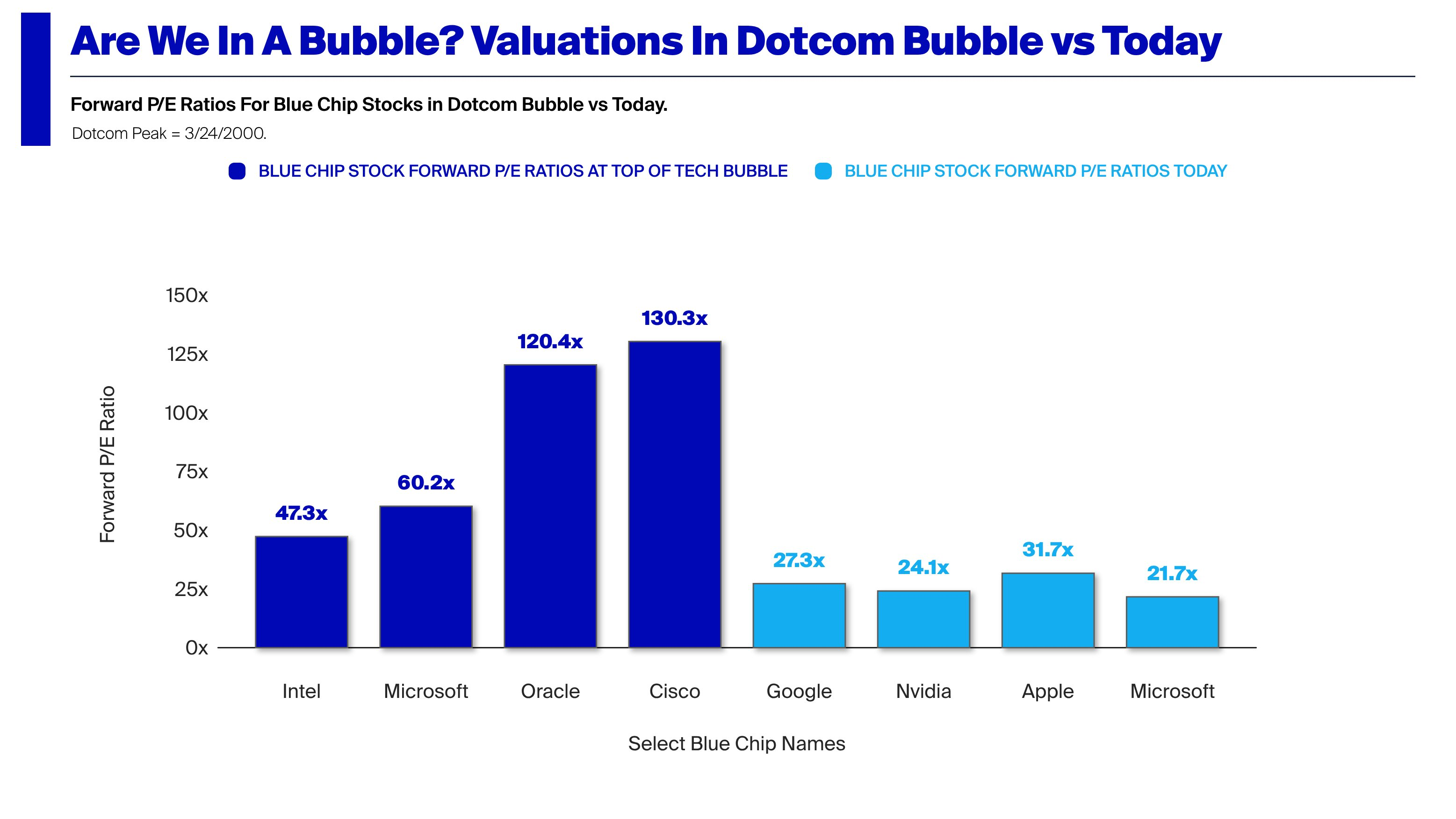
    This even as share prices and value concentration have risen even faster than in the Dot Com era. Seen from the P/E basis, it does not look like we are in a bubble. Earning growth is way up so the share prices are not outrageous on that basis. That is contrary to 1999 when P/E ratios in the hundreds were considered normal. Expectations of an internet fueled boom were speculative. Expectation of an AI earnings boom seem well founded.

    But these companies could still be over-valued. The P/E ratio is not the full picture. It is in fact a simplifying shortcut which ignores significant pockets and omissions of value.

    For this analysis I'll use a sample including some of the largest market caps in the world with two exceptions. The exceptions are Lilly (LLY), Berkshire Hathaway (BRK-B) which are on the list but not in the top 10 (though in top 15) and Saudi Aramco and Broadcom which are in the top 10 but not on the list1.

    CompanyMarket Cap
    NVDA$5,709,746,405,376
    AAPL$4,379,916,369,920
    GOOG$4,811,891,146,752
    MSFT$3,041,424,048,128
    AMZN$2,874,514,866,176
    TSM$2,166,463,135,744
    TSLA$1,664,912,326,656
    META$1,569,837,154,304
    BRK-B$1,044,046,610,432
    LLY$897,716,060,160

    The following diagram shows the P/E ratios of the sample relative to the top 100 US market caps2. Note that, with one exception, the companies are not in the dark red zone with above P/E of 60. The exception is, of course, Tesla, which, at P/E of 400+ is 14x the average multiple.
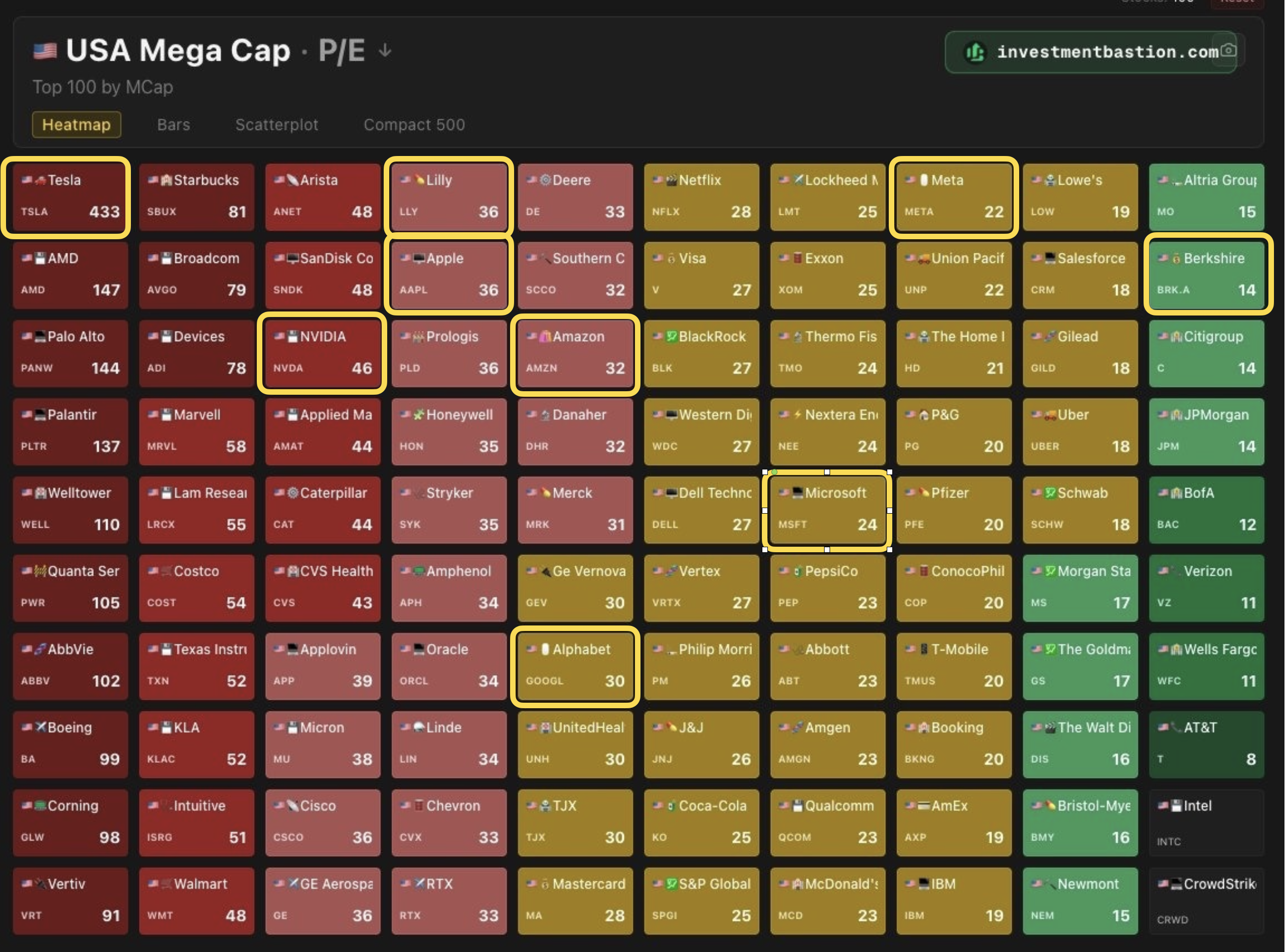
    Moreover, compared with the S&P 500, these P/E ratios are in-line with the median. The following graph shows the sample set with P/E ratio vs. Market Cap.
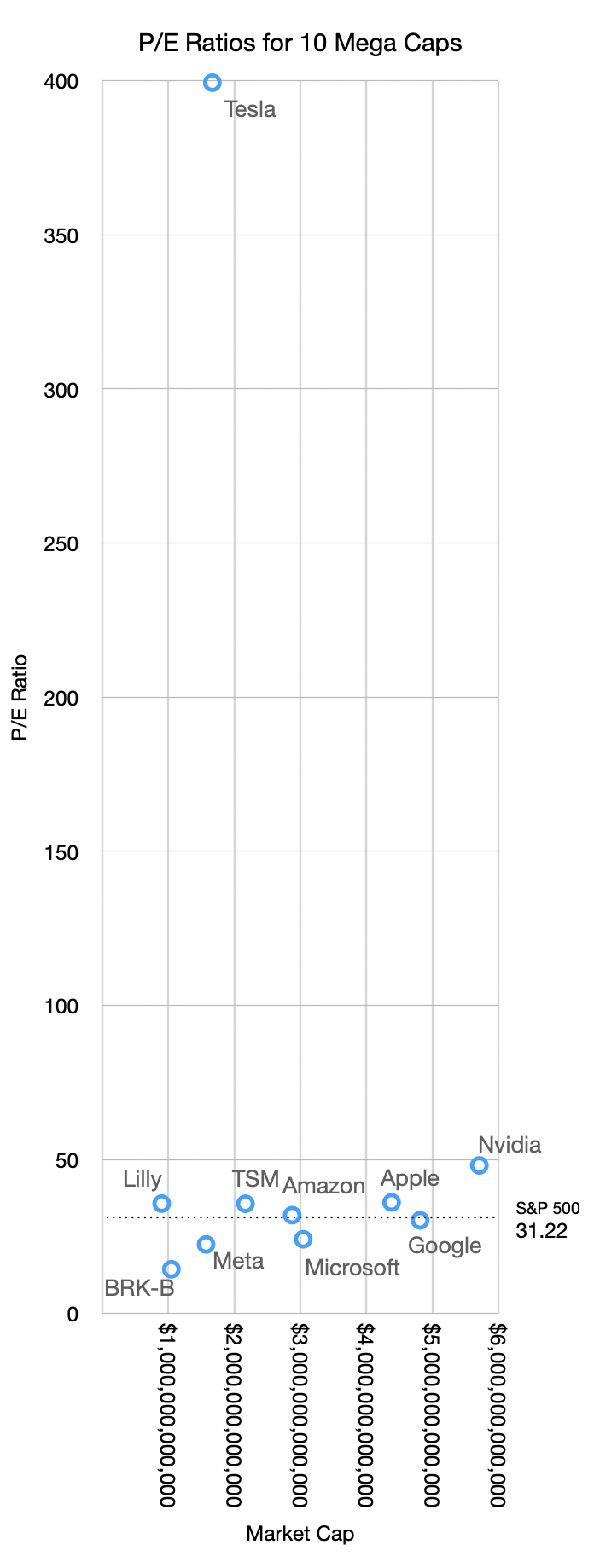
    Excluding the one anomaly the relationship seen is that higher market caps roughly correspond to higher P/Es. Nvidia has a market cap over $5.7 trillion with a P/E of 48 while Meta has a market cap of $1.5 trillion and a P/E of 22.5.

    Higher P/Es should also correspond to higher growth rates. The graph below shows the relationship between P/E and growth, both in the most recent quarter (MRQ) and trailing twelve months (TTM).
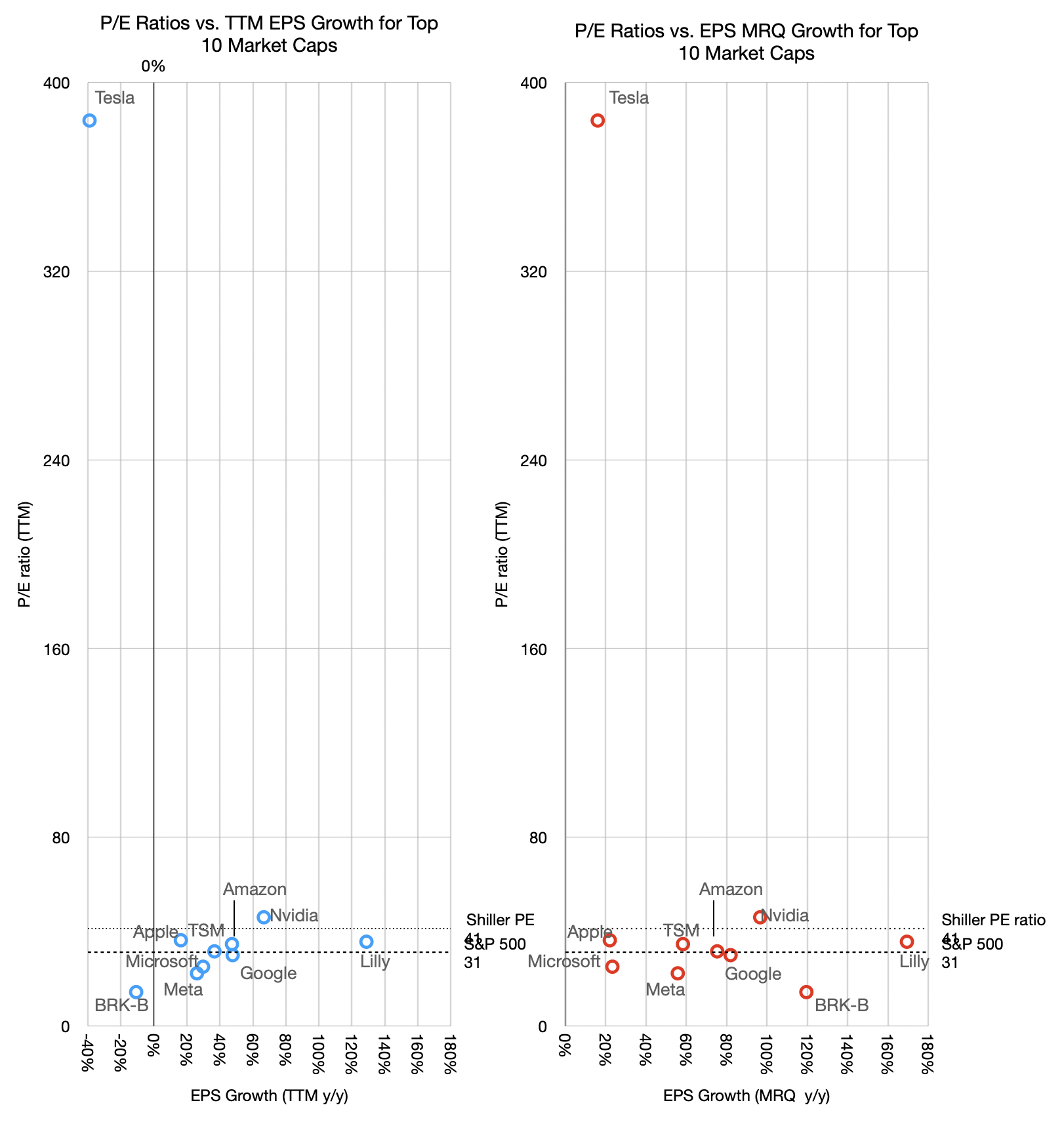
    There is a loose relationship between P/E and TTM growth but not with last quarter's growth. The one anomaly is even more prominent as it shows negative growth with exceptional valuation. Fundamentally however the relationship between P/E and growth is weak. Companies having widely divergent growth show similar P/E ratios. Alphabet for example has seen its P/E ratio in the 20s with growth in the 80s TTM and 50s MRQ.

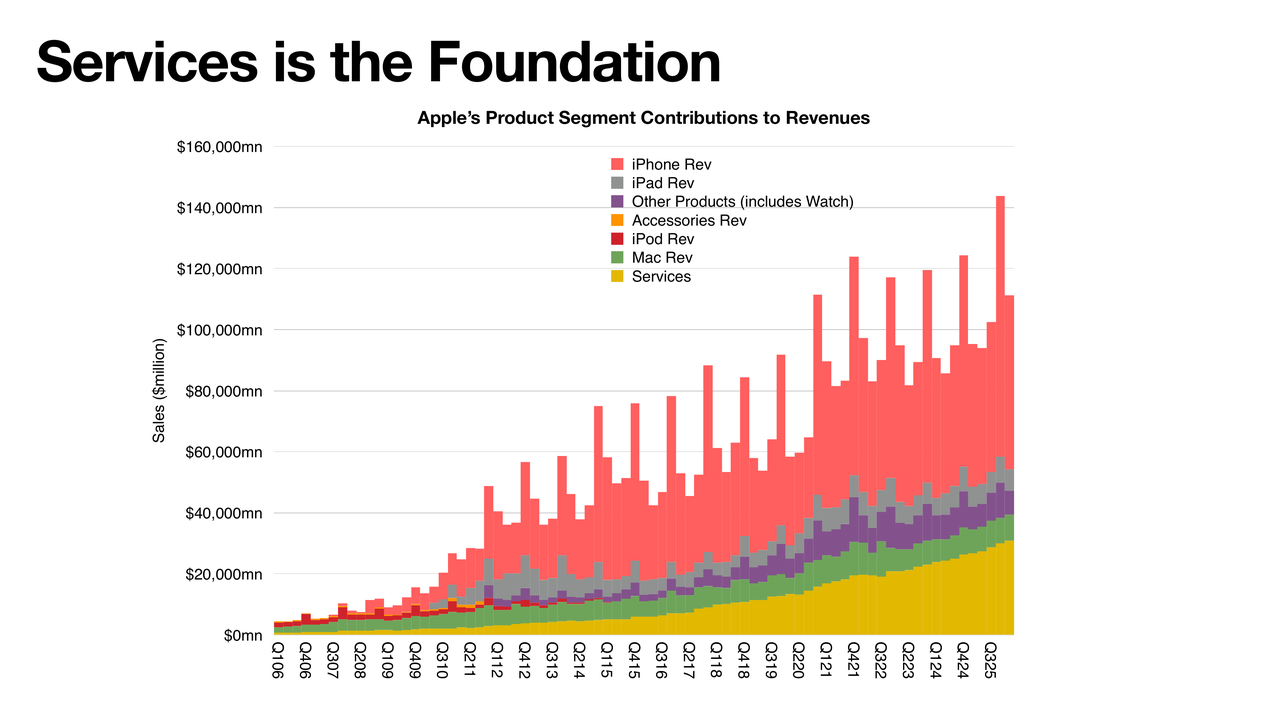
    This might sound familiar. From 2008 to 2020 Apple was trading at a P/E ratio in the teens and low 20s while growing as fast as 80%. The logic was captured by my analogy of the goose that lays the golden eggs. Apple was able to create extraordinary products but the market considered such hits fleeting. It valued consistency over heroism. Getting on base vs. home runs. And so the P/E began to rise only once Services became more prominent. Regardless of how foreseeable this pattern was, it took a decade and is still ongoing for the pricing to catch up.

    But the situation with AI companies (that is, all the big tech companies but Apple) is that their earnings today are somewhat an illusion.

    An old maxim that says "earnings are an opinion while cash flow is a fact.3"

    This is because Net income can be manipulated by accounting abstractions, whereas cash flow is based on bank transactions.

    To wit: Net income (earnings) is calculated using accrual accounting, which relies heavily on judgment calls rather than bank balances. Companies recognize revenues the moment a contract is signed, even if the cash won't be collected for months. Or they can dial in a delay as they desire.

    Because of varying accounting policies, two identical companies with the exact same physical business can report vastly different earnings figures.

    Cash flow is objective and simply tracks the actual movement of money in and out of the business. Real dollars either enter the bank account or they don't. A company can look highly profitable on an income statement but still go bankrupt if its cash is trapped in unpaid invoices or unsold inventory.

    Finally, cash flow can be strongly negative while earnings are strongly positive. This is because investment in capital equipment does not appear in the income statement.

    Therefore true economic value is determined by the cash a company can actually distribute or reinvest rather than how it declares profitability based on accounting abstractions.

    AI companies are not necessarily hiding behind suspect earnings but their extraordinary capital expenditures are draining their cash and thus what investors have access to.

    Earnings seem to be soaring so the ratio P/E suggests a modest valuation. This is based on opinion or at least incompleteness.

    We should look at a better indicator. It's the EV/FCF ratio. We will look at this next.

    1. The top 10 ranking can change rapidly and it makes analysis difficult over longer time periods. The inclusion of LLY and BRK-B allow for visibility outside of the tech sector and they were in the list mid 2025. Saudi Aramco is in a completely different environment influenced by non-economic factors.
    2. TSMC is absent from the table as it is US only companies. It is notable perhaps that of the top 15, three are not US companies (TSMC, Samsung and Saudi Aramco). Furthermore the top Chinese company, Tencent is 25th, valued at $532 billion and the top European company is ASML at 21st and $610 billion.
    3. Attributed to economist Alfred Rappaport.

  2. The Story of Japanese Innovation

    Research · 1 comment

    The Asahi Shimbun Interview Part 2

    Narcissus (1597–99) by Caravaggio 

    Horace Dediu / Takeshi Narabe & Dylan Weir / Asahi Shimbun Interview, April 2026

    Takeshi Narabe • 06:41
    So you also compared [Apple] with the Japanese companies. Actually Japanese companies are very keen on marketing and doing some anchors many times. And I think [historically] they didn't know what consumers want. But you mentioned that is also […] their advantage […] because they only made what [management] wanted. But on the other hand, Apple exceeds the consumer's expectation or make a new market.

    Horace Dediu • 07:37
    The story of Japanese innovation is fascinating and I hope you give me a little bit of time to reflect upon this because I think it is also part of the story of Apple. I have a great admiration for the history of Japanese innovation. And it was something that, again, Professor Christensen taught me and made me appreciate.

    Of course, during the 1970s, and maybe even earlier, but at least from the 70s onward, Japanese innovation was the world leader. It was in consumer electronics, it was in automotive, it was in many heavy industries, it was phenomenal. And the reason a lot of that happened was because Japan was constrained. Japan didn't have access to as much capital or as much land or as much resources as a lot of the industrial nations at the time. And those constraints taught it to be lean and efficient and how to think about "just in time", the Toyota production system, etc. And that wisdom came from a constraint.

    As a result, Japan [began to] teach the world during the 90s and onward about how to do better manufacturing. And they taught Apple. Apple at the time was in awe. Steve Jobs was in awe of Japan. Nobody could come close. Also, Sony was a phenomenon. In fact, in interviews with executives; I was just watching an interview with [Jon] Rubinstein, who was at the time heading the iPod.… He said they were absolutely paralyzed with fear that Sony would beat them at this game. Even though [Apple] were by far the market leader, […] it wasn't Microsoft, it wasn't Motorola, it was Sony that was the worry.

    Now, what happened? I think one of the things that Christiansen doesn't say--[which I do] because I come from a software engineering background--one thing that I think Japan didn't understand starting in the late 90s was the power of software. And I think it's a cultural problem. Software has a different culture fundamentally. The software engineers in general are like cats. You know, managers want to manage dogs because dogs are predictable and they tend to follow the instructions. People who do software tend to be very much more independent, but they need to be coordinated.

    So it's a very difficult management problem, and it doesn't fit so well, perhaps, with corporate culture in Japan, at least at the time we're speaking of. And so one of the aspects, I think, that was critical in the late 90s was this, I would say, cultural crisis. By the way, it's also a problem in Europe. One of the reasons Europe did not succeed with software was precisely because of the cultural aspects as well.

    But that's one element and I think it's not the only element but you address the question of customer understanding and this is very crucial as well. I think the Japanese were for many decades thinking that if you build good things, especially as they were better than what was in the market, then customers will buy. Simply focus on quality and the customer will decide eventually to switch.

    That's a very logical decision, a very logical plan. And you don't have to worry too much about marketing and branding and all of these aspects, which are again, perhaps a cultural difference. Or you could hire someone to do that for you, but fundamentally the management inside Japan couldn't think in the same kind of marketing ways that American marketers would think.

    But as far as the customer discovery problem, this is true. And it is something even American companies don't know how to do, or European companies don't know how to do. […] The way Apple suggested they do it (this is what they've told us,) is that they have to talk amongst themselves. They talk to each other as they did about the iPhone and said: "What do we dislike about our phones? How can we make them so more usable?"

    And this fundamentally is because they always had this inquiry internally about why are things hard to use? Why can't we make things easy? Some of that is evident in Japan, but I think it wasn't thought of through the lens of interfaces. It was thought of more like being compact, being portable, being good [to the touch]. But it wasn't as much about how do you interact visually with something. A lot of things go into that. Obviously, you have to have a different sensibility about the two-dimensional display and so on. 1

    And so my point is that the Japanese weren't stepping back enough and asking these, what Christiansen would call, jobs-to-be-done questions. "What do people really want to accomplish with products", even if we haven't yet envisioned what they are? How do we work, how do we think about these design questions. Designers, by the way, say "we don't just make things look good. We think about how they are to be used". You know that philosophy of deeply understanding the user behaviors that is part of the Jony Ive philosophy. But it wasn't just him. It was before him and after him. [Apple designers] have been thinking the same way.

    So it's a design philosophy. It's a real introspection, asking yourself, how should the world be? How should we improve the lives of people? And that's hard to really be very concise about. So I apologize, I'm [going on] so long about it. But it is part of the decision, part of the culture, again, of Apple, where they are looking at themselves.

    Famously, by the way, this is another anecdote about Apple. It is that they don't do focus groups. They don't obtain that [product] knowledge by surveys. They don't obtain it by asking even indirectly what the customer wants or gathering loads and loads of market data. Lots of [research] companies will sell you market data and tell you all kinds of insights, cutting everything into demographics, into segmentations of various kinds.

    The theory of jobs[to be done] is that usually you need to ask [only] five people. You don't need a large sample. You don't need to survey 10,000 people to find out that there's a desperate need for companionship. Should a machine be a companion? That's a very basic question.

    A question which is, by the way, answered by AI. A lot of AIs are just hired as companions. But you don't discover this by surveying what people own today or what they're buying today, [or] what they ask for. You observe and you maybe do a little bit of inquisition on the spot and you just tease the customer's intentions.

    I said many times, many of the best [product] ideas are taboo2. [For instance] People do things on social media which were once considered not just impolite, but sinful. You know, the idea of being vain is a sin. The idea of bragging and being boastful is considered sinful or [at least impolite]. And I used to say that all the social media can be segmented on the seven deadly sins that were part of the [moral] conversation centuries ago.

    It was the church who would say these are bad things you shouldn't do them. Gluttony or covet thy neighbor. Every single social media is positioned precisely on [one] sin. Now, the discovery of this wasn't because Facebook surveyed what people do as sinful and provided it to them. Rather, they gave options and then the algorithm discovered it in a way. Apple [by the way] chose, I think [wisely], to stay out of there.

    But you can see how the discovery of social media didn't come from a process of surveying people, asking them what would they like. They would have said "I want to have communications" or "I want to have cheap communications." They wouldn't say I want to send selfies, (which by the way didn't exist,) of myself doing everything all day long.3

    Next in series: Part 3: Low-end, Game consoles, Secondary Markets, Displays and AI

    Previous in series: Part 1: Integration, culture and market creation

    Interview as published: 聞 Asahi Shimbun on Apple & Innovation

    1. What I was trying to say here was that the Japanese approach to the display of two dimensional information is different due to the writing style. Japanese visual layouts are denser and more information-rich--some would argue more beautiful. There is less of an expectation by the consumer for simplicity which implies an acceptance or even appreciation of complexity.
    2. By taboo I mean unspoken prohibition, something implicitly forbidden or embarrassing. To which nobody would admit to or request.
    3. Narcissism is an observed behavior predating Christianity and the 7 sins. It was named after the Greek mythological figure Narcissus who fell in love with his own reflection, popularized at least by Ovid before 8 AD.
  3. Apple was fastest growing Latin American smartphone vendor in Q1

    Research · 3 comments

    31% growth in a flat market

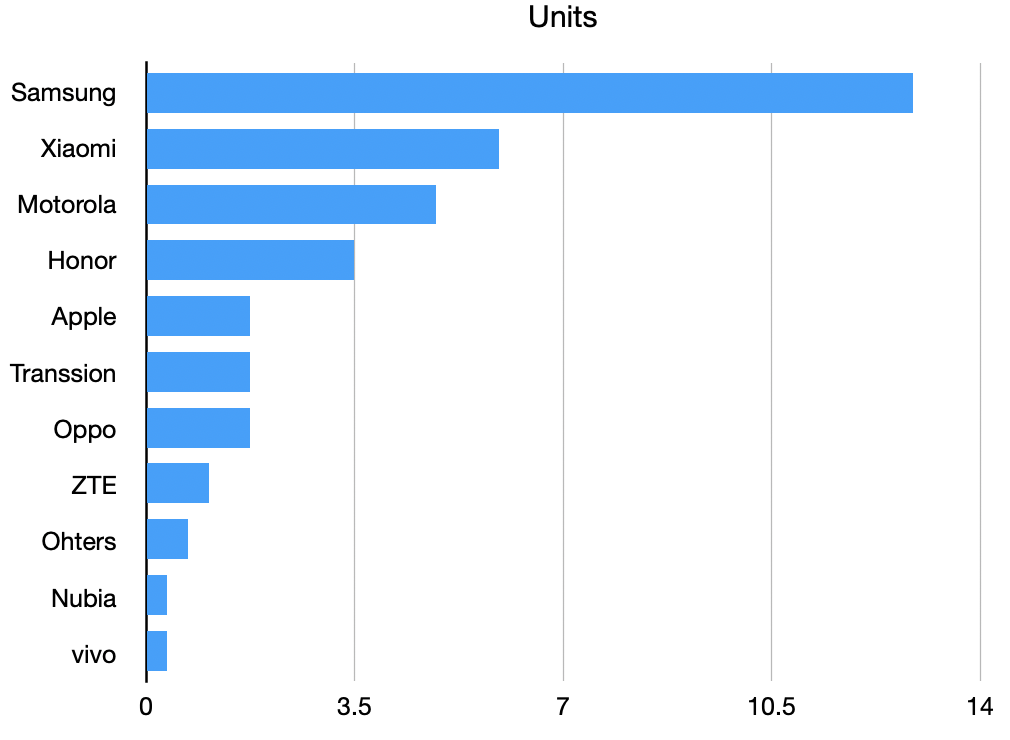
    The Latin American smartphone market grew 3% year over year in 1Q 2026 to 34.8 million units, supported by proactive inventory accumulation and the delayed pass-through of rising memory costs. Omdia analyzes the market’s uneven vendor performance, as Samsung and Xiaomi strengthened their leading positions, while HONOR and Apple saw sharp growth supported by entry-level and premium demand, respectively.

    Samsung led the region, shipping 12.9 million units (+9% YoY) and lifting share to 37%, its highest quarterly level since 1Q 2023, supported by strong performance of A‑series models across low‑end and mid‑high segments. Xiaomi held second, marking a sixth consecutive quarter of growth with 6.0 million units and 17% share, driven by double‑digit gains in Central America and Peru and solid traction of the Redmi Note 15 series in the mid‑high range. Motorola ranked third, contracting 5% YoY to 4.9 million units and 14% share, largely reflecting a 37% drop in shipments of US$100–US$200 devices, where G06 and G17 are key models. HONOR consolidated in fourth with 30% YoY growth to 3.4 million units and a 10% share, propelled by its Play 10 in the entry segment (below US$100), which approached half a million units sold for the first time.

    Apple completed the top five with a 31% YoY increase, supported by an exceptional performance in Mexico (+80% YoY) and robust reception of the iPhone 17 series.

    Source: Omdia

    NB: Apart from Nubia(?) with 1% share, Apple was the fastest growing vendor in a flat market. Note the price points…

    …The entry segment is below $100 and the next is $100 to $200. I doubt the average price is much above $200. The whole market was 34.8 million units suggesting Apple's share is 1.74 million units.

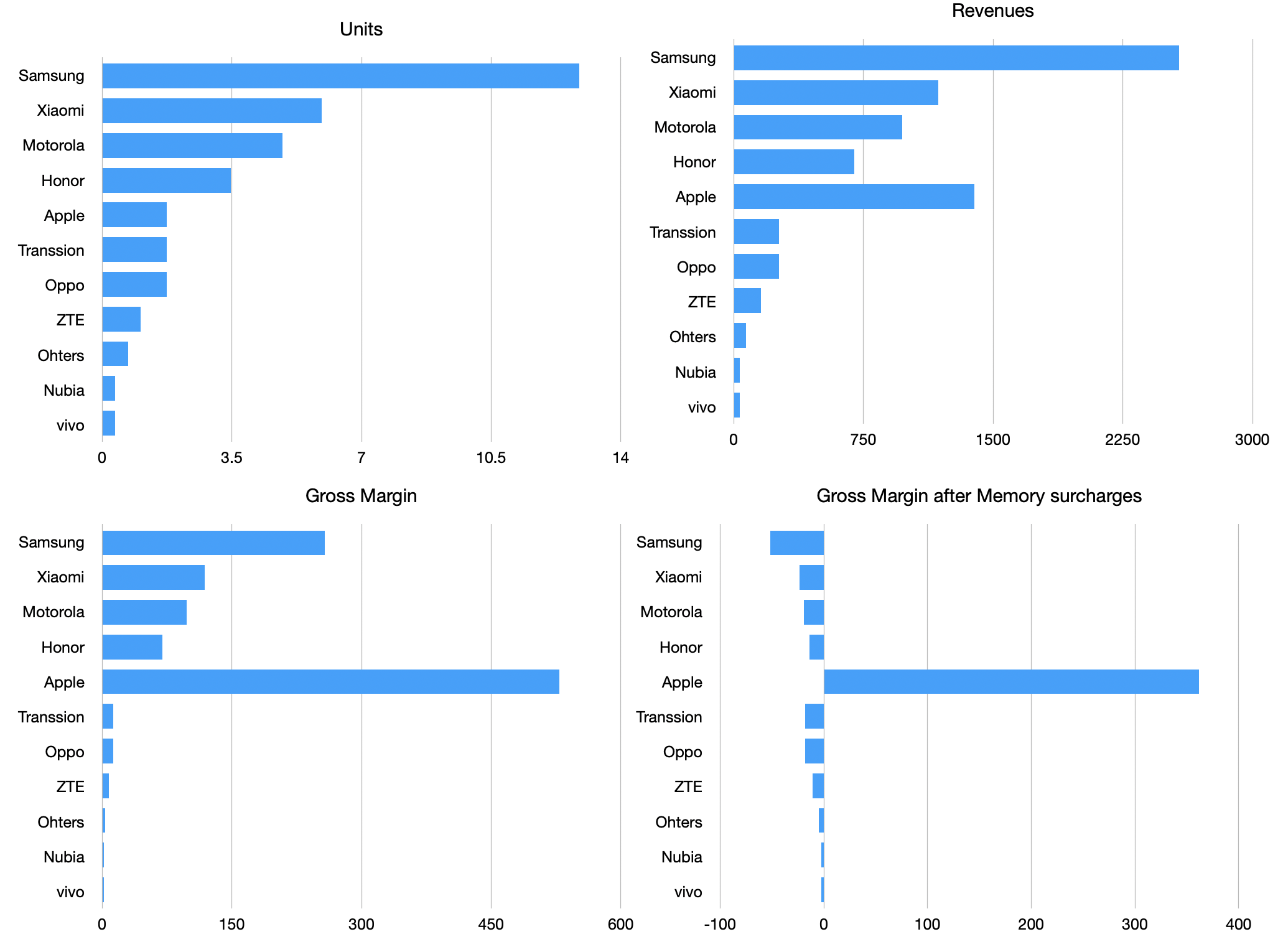
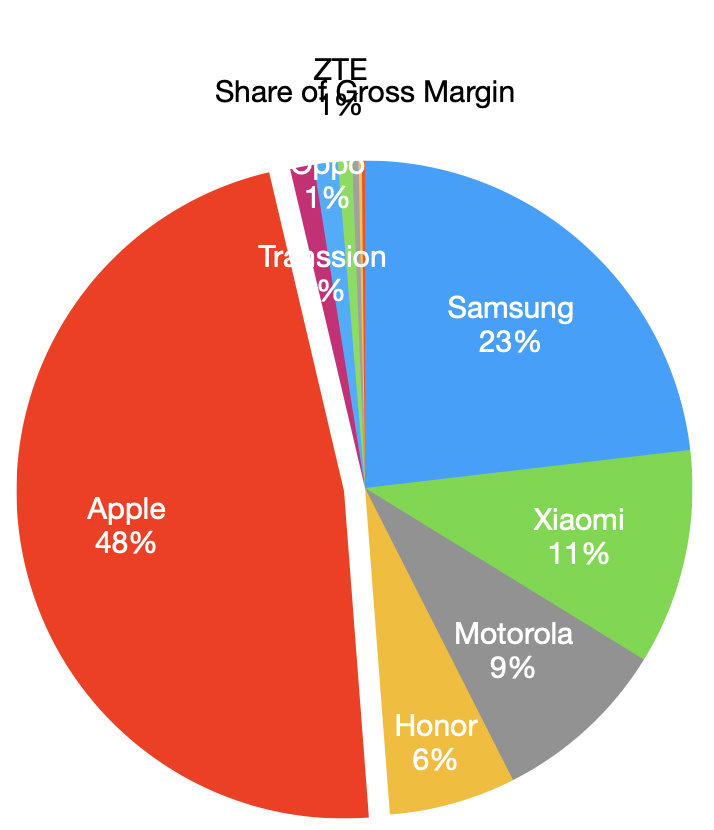
    Given the data, the following graphs suggest how the available profits are allocated.


    I took the liberty of estimating a change in gross margin as memory surcharges are taken into consideration (hence a future-looking estimate for next few quarters.) That is shown in the last graph.

    At present, Apple captures about 50% of available gross margin in the sector.

    Subsequent quarters might show Apple capturing 100% of the profits and a questionable sustainability of the market whereby all other vendors lose money on every phone they sell. Whether they continue to participate under these conditions remains to be seen.


  4. Is a Crash Coming?

    Research · 7 comments

    A Series on Valuation in the age of AI

    Apple recently hit an all-time high. Today the stock is trading at a P/E of 35. The P/E ratio is the current share price P divided by the last four quarters’ net earnings per share E. But we also have a pretty good idea of the earnings for the next quarter, ending June (now almost half-way completed). The guidance very clearly suggests that on a one Quarter forward basis the P/E ratio is 34.

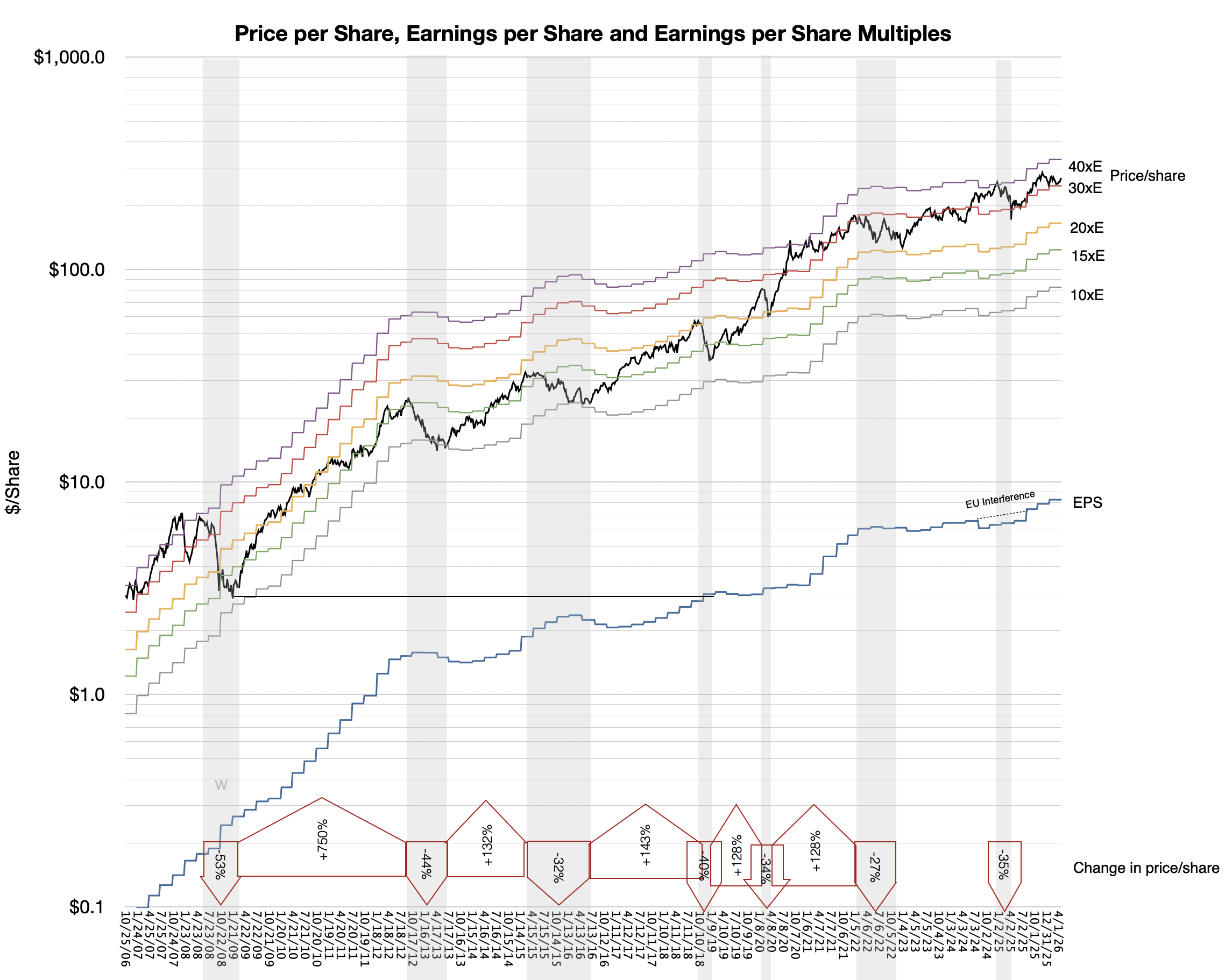
    I’ve maintained for at least 15 years that a reasonable multiple for Apple is 35. This was mainly because other large cap technology companies were also trading around that number. While at this ratio, if a company is growing at 22% it means that an investor will make their money back in about 10 years. Thereafter all free cash flows will go entirely to the investor’s pocket. That seems a reasonable return. It’s not a particularly risky bet to assume 20% growth for 10 years if you look at (a) history and (b) how many people in the world have not yet started using Apple products and (c) assess how well management is doing their job.

    So by this measure, Apple seems to be reasonably priced. Historically it has not been reasonably priced but that is due to the disconnect between understanding the business and falling for the usual false tropes. The following graph shows the share price and where it fell between the bands of Earnings multiples. The grey areas represent periods of significant share price decline.

    But much of the volatility of the stock is also due to overall sentiment collapse. That has happened on many occasions, most notably the 2008 financial crisis and “great recession.” (Another was the Covid crisis.) In these cases, regardless of underlying strength, the shares were available very cheaply.

    Today perhaps we should ask if a bubble is forming due to exuberance around AI which is inflating the market in unsustainable ways.

    There are four reasons why the current asset value explosion is different.

    First, it is highly concentrated in a handful of names.

    2005 S&P 500 top 10% of the S&P index2026 S&P 500 top 10% of the S&P index
    Exxon3.1%NVDA7.8%
    MSFT2.5%GOOG7.3%
    Citigroup2.2%AAPL6.4%
    GE2.0%MSFT4.6%
    Walmart1.7%AMZN4.4%
    BoA1.6%Broadcom3.0%
    J&J1.6%TSLA2.4%
    Pfizer1.4%META2.3%
    Intel1.3%Walmart1.6%
    AIG1.3%Berkshire Hathaway1.5%
    Total18.7%41.3%

    Second it is fueled by equity not debt. Third, it involves disproportionate capital expenditure rather than M&A. Fourth it is accompanies by sharply growing revenues (though not as sharp as investment growth.)

    In other words, whereas the equity value is growing rapidly, so is income and investment without leverage. This is a low-debt with high income scenario. Previous crises were high income with high debt (2008) or low income with low debt. (Dot Com).

    That’s not to say that we have uniform fair equity values. We need to do quite a bit more due diligence to determine the state of the valuations precisely because we have unusual capital allocation strategies.

    To cover this topic I’ll will break the analysis into multiple posts. They are:

    • Why the most common metrics for valuation are insufficient — the problem with the P/E ratio
    • What are the alternatives that into consideration exceptional cash and capital expenditures — The EV/FCF ratio
    • How does the P/E ratio differ from EV/FCF and what does it mean if they diverge one way or another
    • How do the Mag 7 et. al. appear on these Metrics
    • How to complement snapshots like valuation ratios with the time series of fundamentals
    • Why payback measures are the ultimate measure of valuation
    • What are the current payback measures for the Mag 7 et.al.
    • Compare Apple to its peer group
    • Finally assess whether a collapse in confidence is imminent

    Please return to these pages in the next few days to read these posts.

  5. What Are the Mobility Design Surfaces?

    Research · 1 comment

    An Office Hours question asked by Darcy B., May 1, 2026

    Q: Will Apple do more in transportation than CarPlay Ultra? Not just cars — transportation in general.

    Well, there's a lot of modes out there, and I apologize I didn't get into all of them. I had assumed falsely — I think way outside of cars myself, obviously, but it's very rare that others do. My bad that I kind of assumed that. But the answer doesn't change. I don't think Apple will do much in mobility. The reason being — first of all, cars are a lousy business. They are, were, and will be a lousy business forever. Maybe to won't even exist very long. I just find it shocking, that it continues to exist today.

    But the problem is that the other modes are less of a surface for Apple to add value to. In other words, there isn't a lot of design surface on which you can put your design and your ideas. And the reason for the surface problem is that, first, there's modes that are public and shared — buses and public transport, even airplanes. You could imagine, for example, having the back of the seat in front of you be an iPad. Why is it this screen on the plane one you can never comprehend? But you try to figure that [business] out, and you realize it's a dead end. You just can't serve that market as Apple. So there's that design surface in airplanes — you've got the seat back.

    Then you look at other modes, and you look at micromobility. The problem with micromobility is the surface is below your sight line when you're using it. You're looking above typically where the vehicle is. I consider it a heads-up experience, not a heads-down experience. Cars are heads down and becoming more so. They're cocooning the user in a bubble for an hour a day. That's what can be tolerated, typically. Not a great idea. Why? Because an hour is not a significant amount of time that will separate that experience outside of the phone.

    Now, if you're looking at micro, the problem there is that it's a heads-up experience. And unless it's going to be through a wearable — that was my dream for the Vision Pro two, three years ago, was that it would be usable as — even integrated into a helmet. And then you have a visor coming, and then you have a beautiful design surface. In fact, the design surface is the entire world. Because as you see it, whatever you're looking at can be considered a surface upon which you can add a new reality [and new services].

    And that is a dream and vision, that if it were to happen, not only would Apple be a very, very interesting player to create a virtual world on top of existing worlds — outdoor experiences. That's a great, great opportunity. Spatial computing outside of the home. Just put that down as the summary — spatial experiences outside the interior spaces. When that happens, it'll be very exciting. It'll be very much Apple's contribution to repaint the world.

    But it takes time, and this is where we're stuck. We're stuck in this, like, not good enough, not small enough, not light enough, not powerful enough — all those things. And if they get solved, we'll move into that world.

    And that goes back to a lot of debates about whether the Vision Pro is or just not going to continue. I definitely think it's going to continue. Even the latest comments from John and Joz, together, saying — the phrase they used was, "we pulled this from the future into the present." So they are effectively stating that it's too early. It's a future that hasn't come yet. But they're proud of what they achieved, and it is amazing what they've demonstrated is possible.

    It's not the old Apple, though. Old Steve Apple was: you don't release until it's not just market ready, but mass market ready. And that was a risk. Maybe this was another thing that Tim did that was not what John would do. But to work on this problem is exactly what John would do, because solving spatial computing is, like, more important in my mind, because it is the human-computer interface. Which is essentially the physical layer of the entire world. That reconstruction of the physical world and broadcasting it into your retina is the future. It's not audio. It's not some background thing. It has to go through the eyes. And if it goes through the eyes, it's where Apple wants to be.

    So I do believe there's going to be a lot of research to be done there. And maybe it'll still take a couple years once the AI thing runs its course.

    This was one of the questions asked by the participants in Asymco's May 2026 Office Hours live Q&A sessions, open to Asymco One subscribers.

  6. June Quarter Expectations

    Research

    22% EPS growth is implied.

    We expect our June quarter total company revenue to grow by 14%-17% year-over-year, which comprehends our best view of constrained supply. On iPad, keep in mind, we face a difficult compare driven by the launch of the A16-powered iPad in the prior year. We expect services revenue to grow at a year-over-year rate similar to what we reported in the March quarter after removing the favorable year-over-year impact from foreign exchange tailwinds. Keep in mind, during the March quarter, FX was a 2.5 percentage point tailwind to the total company growth rate, and for services, that impact was slightly more favorable.

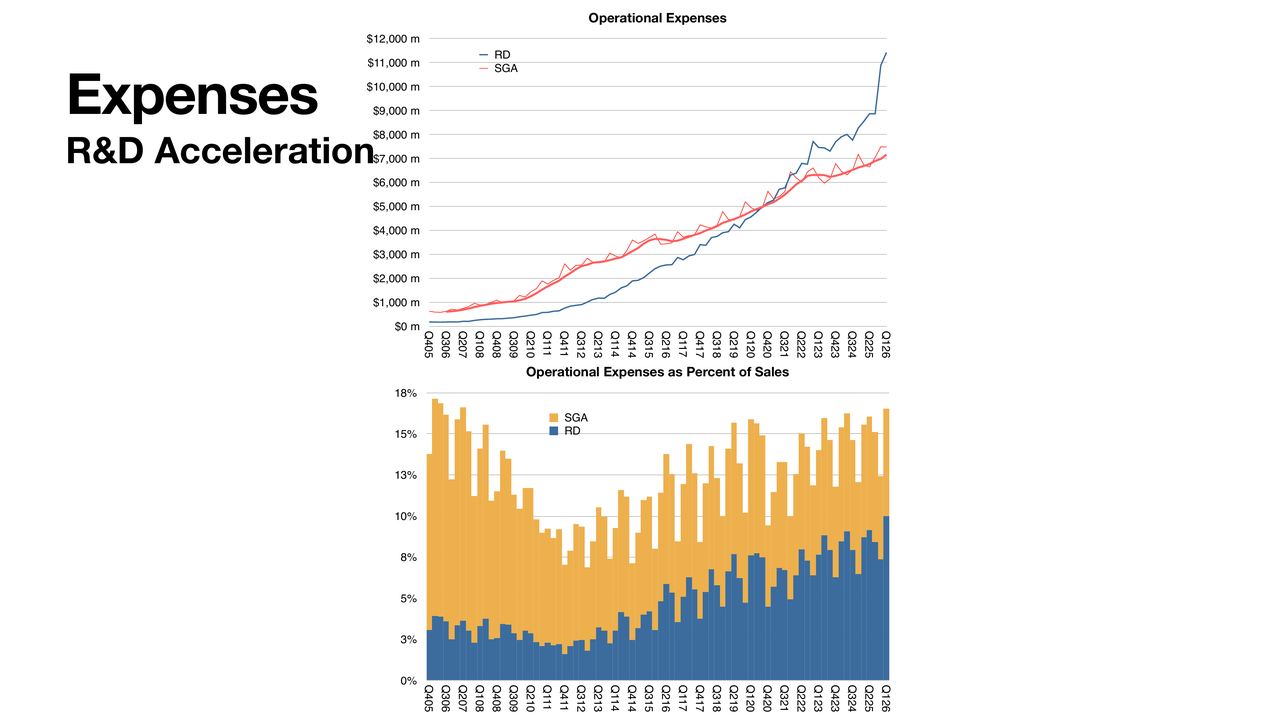
    We expect gross margin to be between 47.5% and 48.5%. We expect operating expenses to be between $18.8 billion and $19.1 billion. We expect OINE to be around $250 million, excluding any potential impact from the mark-to-market of minority investments, and our tax rate to be around 17%. With that, Tim and I will take questions.

    - Kevan Parekh, CFO

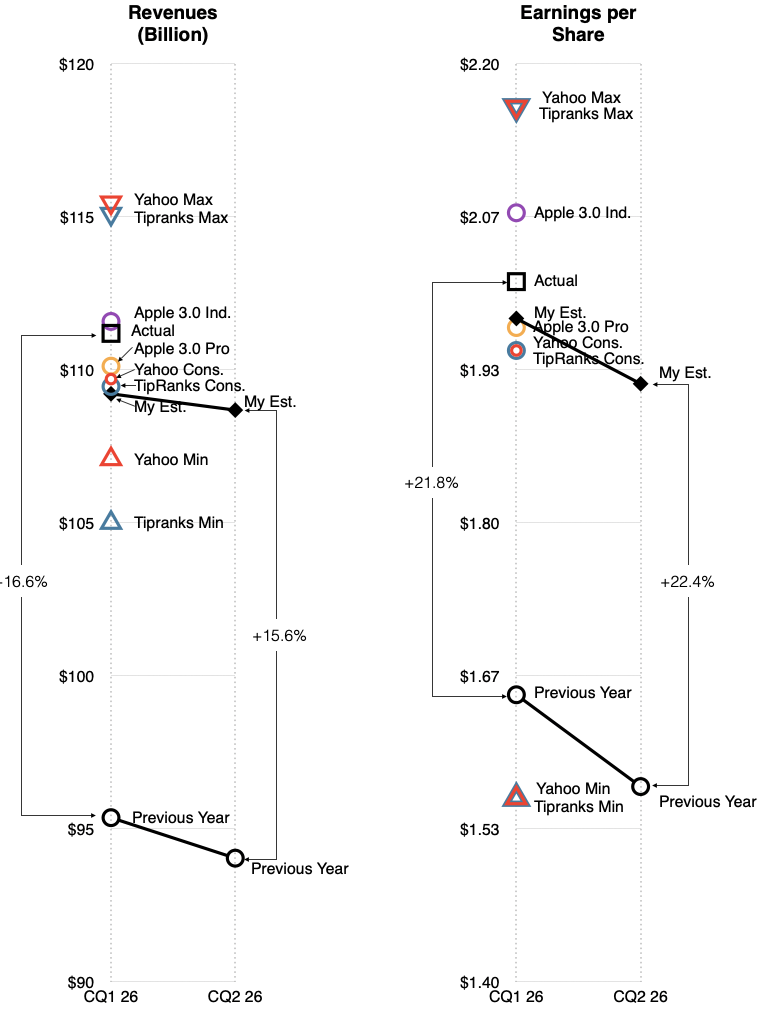
    Based on the above, here are the estimates for Revenues and Earnings per Share

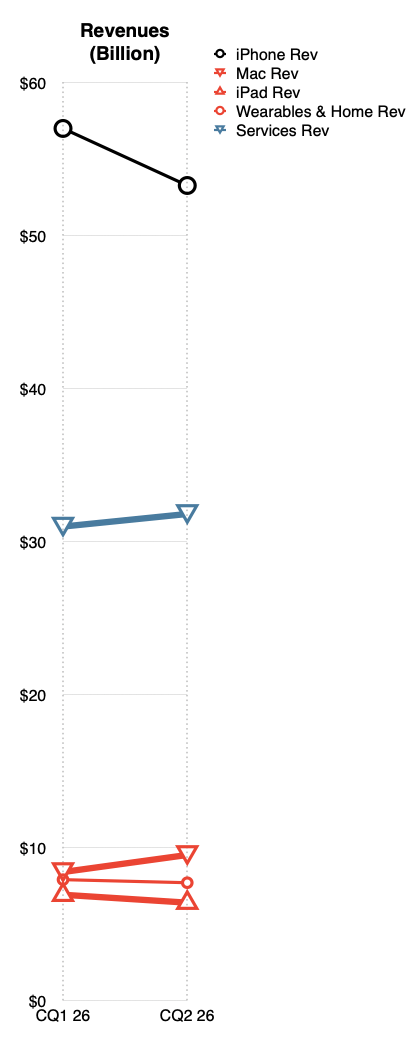
    Sequential change in segment revenues:

    My Revenues and EPS expectations in table form:

    CQ2 26
    Year Earlier Rev94.036
    My Est. Rev109
    Year Earlier EPS1.57
    My Est. EPS1.921
    My Rev. Growth15.6%
    My EPS Growth22.4%

    My segment revenues and growth expectations in table form:

    iPhone Rev53.267
    Mac Rev9.514
    iPad Rev6.396
    Wearables & Home Rev7.700
    Services Rev31.800
    iPhone Growth (y/y)19.5%
    Mac Growth (y/y)18.2%
    iPad Growth (y/y)-2.8%
    Wearables & Home Growth (y/y)4.0%
    Services Growth (y/y)16.0%

    Note that the revenue expectations are for 15.6% growth while guidance is at 14% to 17%. Chances are that they will hit the upper end of the range and I may revise these estimates to reflect that as we get more data.

  7. Will Apple Silicon Tackle Memory?

    Research · 1 comment

    Asked by Ian Hobson

    Q: Will Apple evolve to make their own memory chips, or manufacture compute chips instead of just designing them? Will they go much more vertical?

    It's a possibility — capability is not willingness to do it. They're capable of doing it. They can become vertically integrated on all manners of silicon. I think the decision is a very careful one, because you have to commit years in advance. They did so, as I said, with Qualcomm. They needed to push that dependency out. I think memory may come next. And they need to figure out what they're going to do about TSMC as well, by the way, if you have a single supplier there.

    But this is an ongoing thing. They're always re-evaluating it. And I'm not concerned, because nobody does this better. You see other companies' jealousy. You see other companies wanting to do what Apple did eight years ago with the A series. The fact that you can hire a team and become a chip designer — we hear about Tesla, Google, Amazon. I don't know — probably Microsoft's got a team, and probably Meta's got a team. So I just see these out of the corner of my eye and say, well, obviously, yeah, you can now hire a semiconductor team.

    And one of the things about Srouji, by the way, that was making a lot of news, is that he got elevated to this position. Very likely he is getting a lot of inbounds, saying, hey, if you come and head this up for us, we'll give you half a trillion dollars. And the amount of money people are willing to throw at this is extraordinary. But again, he wasn't the first, he's not the last. There is an importance in good teams, but it is also important to have a deep bench.

    This was one of the questions asked by the participants in Asymco's May 2026 Office Hours live Q&A sessions, open to Asymco One subscribers.

    See also: May 2026 Office Hours

  8. The great memory panic of 2026

    Research · 2 comments

    Office Hours question asked by by Ian H. on May 1, 2026

    Q: Memory prices could move from 15% to 40% of the BOM of a device. This seems incredible. So how can Apple deal with this?

    This has been on people's minds now for what, three, four months? I think since January. I call it the Great Panic of 2026. The great memory panic.

    First of all, you have to understand the scale that Apple operates at. The number of devices in the hundreds of millions. It's not just iPhones, obviously. All of the Apple products consume some memory. And there's a lead time. When you're dealing with scale, there's a lead time. There's usually a couple years of lead time. And every supplier who works with Apple is doing it because they love volumes.

    Now, volumes are good for suppliers because they can also predict things in their own operations. They can plan, they can raise capital. Usually they need loans to do that, and they get good terms on loans if it's a long-term payback. And there's a lot of moving parts there that benefit scale.

    The difference with memory pricing that we're seeing a lot of anxiety around is at the margin. That is to say, there's a base production, and then there's a variable production. That variable production comes when somebody orders, "Hey, can I have something next month?" And the smaller suppliers tend to not have that long-term planning or the volumes that can fill the pipe. And so the marginal pricing on memory has gone through the roof. It spiked, and that's what we're seeing. But that's on the variable bit.

    So Apple negotiates on the base load. Now, of course, that marginal cost is going to eventually infect, if it continues long enough, base price. In fact, suppliers are going to say, well, even if it's two years out, we're going to have to ask for more, because there's so many other players that also we anticipate will be two years out. But then Apple can negotiate on another basis and say, well, if you don't do us a favor here and give us a better rate, then maybe we won't work with you when all this settles down. You know things are going to settle down. These things are always cyclical. There's never been a semiconductor boom that's not followed by a semiconductor bust. Never. And they know it.

    So they're happy to make mint on this volatility right now. So much so that I heard Samsung's making more money now with memory than Nvidia's making with their processors. So memory suddenly is the new gold. A year ago, two years ago, it was about compute. Now it's memory. Who knows what's next?

    But if you're in this business for the long term, and you want to play games, Apple's going to be there a lot longer. You could believe that AI is going to be going at this rate forever. We'll see if the profit model can sustain it. But I just speak from experience. There's a lot of these things that happen in the phone space with all kinds of components. There were always some shortages.

    There was storage. The iPod killed a hard drive supply chain. Apple monopolized the CNC machines that made the aluminum Macs. And these things happen. By the way, that monopoly is no longer in effect. Eventually, somebody built enough of the tooling and sold them to Apple's competitors. And if they want to make an aluminum enclosure, they can do so now. But that's how it is in this game, and nobody plays it as well as Apple does.

    If you read the book on China — Apple in China — there's a lot of anecdotes about this. So I can't get excited about any of these stories about supply crunches, other than there being a windfall for somebody and an anxiety, a panic for somebody else.

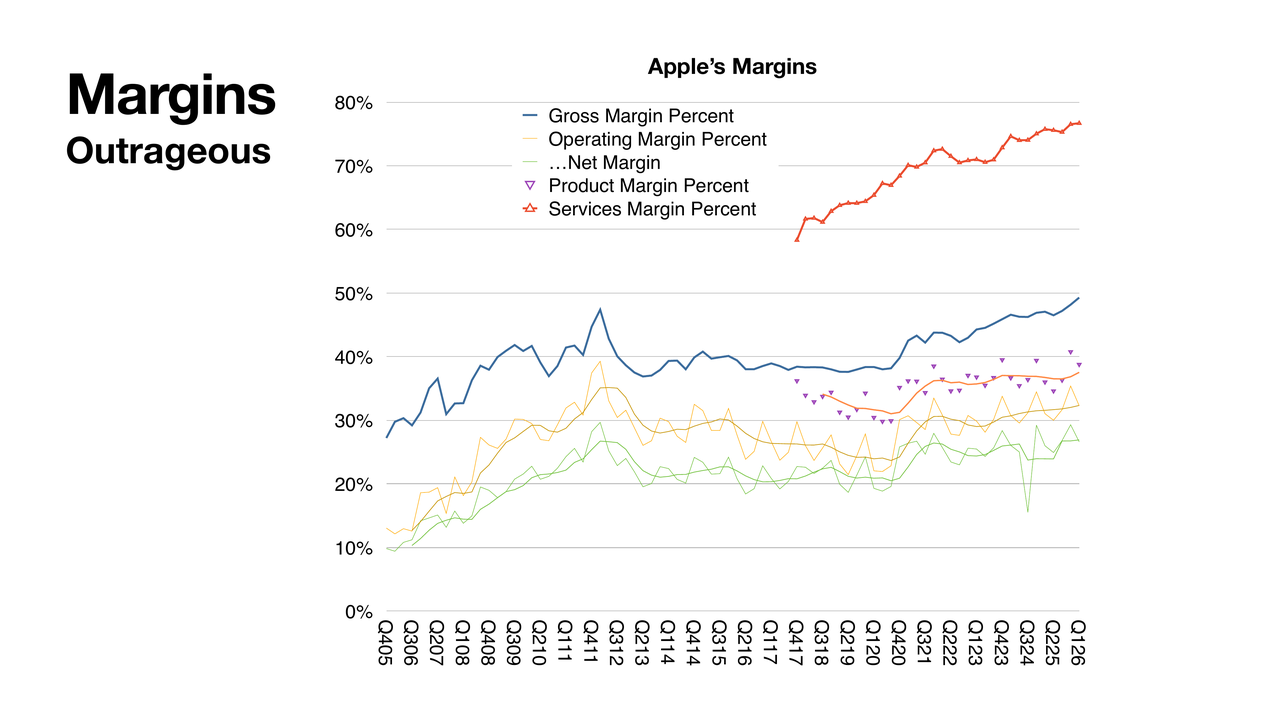
    And again, other analysts are starting to come around to notice that maybe this all settles into Apple gaining a whole lot of share, because all the other competitors won't be able to get any memory. So Apple could also just lock up everything and say, alright, we've got the biggest checkbook in the business, we'll take a hit on margins. As if we care, as if that matters. We go from 49% to 45%. Which is where we were two years ago. And then in doing so, we're going to take out everybody but Samsung. So we get in a situation where a lot of marginal players just disappear. And Apple locks up even more.

    And when you go for the jugular, you do all this, and then you launch a low-end product that's even cheaper, which is what the Neo looks like to me. I mean, Neo might be a prototype. The Neo might be John's trial balloon out there. Maybe he has a theory — I'm just speculating now — that Apple is going to go for the jugular on the iPhone in a couple of years. The iPhone's going to be $499. It'll be as good as the best iPhone today. And they're going to launch that against a landscape where everybody else is losing money at $800 a phone. And so they'll just quit.

    Now, it's uncharacteristic, but it's a low-end disruption coming from Apple. It's completely possible. It's well within their ability. And if they want to, they could. There's a lot going on here with what strategic intent is from John, and I think he comes with a fresh thinking on this. Not that Tim was unwilling, but I think he knew what works, and he was not willing to stray too far from what was reliable. And John may just think that, I know we can pull this off. And we'll go for a different way. Who knows?

    —

    This was one of the questions asked by the participants in Asymco's May 2026 Office Hours live Q&A session, open to Asymco One subscribers.

  9. Integration, culture and market creation

    Research

    The Asahi Shimbun Interview Part 1

    (Sibyl with Tabula Rasa) by Diego Velázquez, c. 1648

    Horace Dediu / Takeshi Narabe & Dylan Weir / Asahi Shimbun Interview, April 2026

    Takeshi Narabe
    On the secret of Apple's success, you have previously noted that the key to Apple's success was its ability to integrate hardware, software, and services to create products that are perfectly hired for a specific job to be done. You also highlighted how they moved beyond mere devices to lock customers into an ecosystem like iOS, iCloud and Apple stores. So this analysis is now very well known. So do you still think this is one of the biggest reasons of Apple's success?

    Horace Dediu
    Yes, we have to recognize Services has only been a story for the last 10 years. And arguably integration of software hasn't been really all that important before 1998 when Apple brought Steve [Jobs] back and with him came NextStep, which was [an] operating system based on Unix. And that was much more robust and much more focused around software engineering than the original MacOS. Or, what I would say [constituted] version 1 of Apple, which began in 1970s until the 1990s.

    Most people tend to think of Apple as one continuous story for 50 years. [But] it's at least two major stories. I would say pre-98 and post-98. And post-98, it's been so different. And it's much more, I would say, something [that can be studied] as a theory.

    I think in the first decades Apple was more, let's say, a story of people. There were people who were brilliant. There were people who were celebrated [as they are] now. But the second half of Apple is much more about building a business that has longevity, [that] can last a long time. It's an unusual priority.

    I think for many companies in the world, they don't think about longevity. And that is why, even Tim Cook recognizes that it's the next 50 years that are more important [than the last 50 years]. So thinking about a century is really important and I think [that] is core to the current culture of Apple. Now, of course, this means, as you said, integration, and that is one of the key things. But fundamentally, beneath all that, there's this point about culture.

    Takeshi Narabe
    Culture?

    Horace Dediu
    Culture in the sense of what are the priorities? What do we concentrate on and to what degree do we need to focus? They [management] repeat these things all the time. Focus, focus. What means this? It means saying no to many things, but it also means saying yes to the things where you can bring great things to bear. It's where Apple has a unique advantage. And that means saying no to a lot of things.

    We know about the car business that they eventually rejected even though they worked on it for many years. I think ultimately that decision was based on a realization that they couldn't bring enough contribution. And that's not just an economic decision. Of course they could have made money. There are even phone companies in China that make cars today. But it isn't what they thought of as important.

    Takeshi Narabe
    All right, thank you. So you also mentioned to what extent do you attribute Apple's dominance to the ability to tap into non-consumption addressing latent demands that consumers themselves hadn't yet realized.

    Horace Dediu
    So this is also one of the keys indeed. i learned about this by listening to my professor Clayton Christensen, who observed that great companies not only compete effectively, but they also create their own markets. They create their own demand.

    [It's an] Extraordinary idea. And when you look at Apple, you do see that they use a different language. They talk about customers not asking for the product. But they also fundamentally build something that compels the user to buy it. When it was something that wasn't conceivable. Steve Jobs famously said, the customer hires us to find out what they want. So this is a fundamental thing.

    And there are many examples. And I think one of the struggles today, for example, is Vision Pro, a product that is very difficult to find how it's going to solve problems. But at the same time, it's an extraordinary product. I think the jury is still out on the Vision Pro, but there are many other examples where I think initially they thought things would go in one direction and they went in another direction.

    But even the iPhone, I like to repeat the fact that when the iPhone was introduced, Steve Jobs said it was three things. That it was a widescreen iPod, that it was an internet communicator, and it was a phone. But I point out that these days, those three jobs of being a music player, being a telephone, and being a browser, are not among the most popular things people do with it.

    So it's fascinating how they introduced it as a blank slate. [It was] software, written by third parties [that discovered the compelling uses], and it developed in its own ecosystem. That is also a very interesting lesson there.

    But it is fundamentally about really being humble. I think, again, it's a cultural trait, being humble and saying, maybe we don't know fully what to do, but to concentrate on quality and concentrate on doing at least something useful for people. And then later, new things will appear.

    —
    This is the first part of a series of excerpts from an interview with Asahi Shimbun newspaper on Apple & Innovation.

    Next in series: Part 2: The Story of Japanese Innovation

    Interview as published: 聞 Asahi Shimbun on Apple & Innovation

  10. Is Apple an Enterprise Gatekeeper?

    Research · 1 comment

    Asked by David Emery

    Q: What's the potential legal regulatory risk to the Apple enterprise combining both products and services? You can make a case that services growth over top of the monopoly in hardware is an illegal monopoly. That seems to be the way regulators are going. And forcing a split between services and products could definitely damage Apple as a whole.

    Sure. So let me take a European — not just point of view, but sort of a language. The language is that of being a gatekeeper, and a gatekeeper has a responsibility not to exclude competitors, because if you're big enough as a gatekeeper, you effectively are a platform for millions and millions. And so it matters how many. It's not just a gatekeeper per se, but a gatekeeper with a sufficient audience. And the logic there is that you can't bundle your own services and therefore exclude — especially by putting yours as a default, then the others have a hard time competing.

    And that is an antitrust logic. May or may not agree with it. I certainly don't, but I'd say it's a clear argument when seen through this gatekeeping phrase.

    Now, the difference — what you're asking is in business. Well, that doesn't fall under the same restriction. Usually, because antitrust is about consumer protections. There's a lot of businesses which get into complex deals that are tolerated because it doesn't affect the mass population. Now, of course, collusion and other things are still illegal. But I think you get a little bit more of a pass if you're solving the problem for businesses. There's one reason why Microsoft got away with what they were doing for so many decades. It's only when, in the late 90s, consumer personal computing became so prominent that there arose an antitrust argument about bundling everything into the operating system that got them into trouble.

    So I think Apple's bundling hardware and services for business users is probably going to be okay for a while. I would just say it's a question of quantity rather than the logic at this moment, so I wouldn't worry about it yet.

    But there are ways around it. Even if you do want to worry about it, there are ways around it which basically deal with providing provisions for alternatives, and that's what Apple's done to comply over and over again. Bending over backwards, providing alternatives, providing options. But then nobody uses those options, because they're far more complicated.

    The law is futile on this, because it doesn't take into consideration user satisfaction. It doesn't take into consideration the ease of things as opposed to the existence of things. It's nice to have options, but if it's complicated and annoying and expensive, you don't use the options. And so they have a very crude mechanism to try to enforce some utopian view of economic benefit. It just tends to create unnecessary penalties for consumers and producers, and as a result, they're just tripping over themselves. It just leads to all kinds of dysfunction.

    Quality is what Apple's always said — quality, experience, ease of use. And bureaucracies are not oriented around either quality, efficiency, or delighting anything. It's incompatible with all of the work people do at Apple. And so it ends up being a net negative, overall, in my opinion.

    This was one of the questions asked by the participants in Asymco's May 2026 Office Hours live Q&A sessions, open to Asymco One subscribers.

    See also: May 2026 Office Hours

  11. Margins or revenue: which matters more?

    Research

    Asked by Dave Emery

    Q: If you had to choose only between expanding gross margins or gross revenue, which one would you choose?

    Always top line, always. There's the only thing that matters. The ultimate measure is the customer. But the next best thing you have is the customer's purchase. You want to maximize the number of customers, and you want to maximize their satisfaction, and if you do that, then you will get good top-line revenue. Then, if you manage your house well, then you do so at a margin, at a good margin. But nothing matters more than getting as many happy customers as you can get. The creation of the customer is the purpose of the firm.

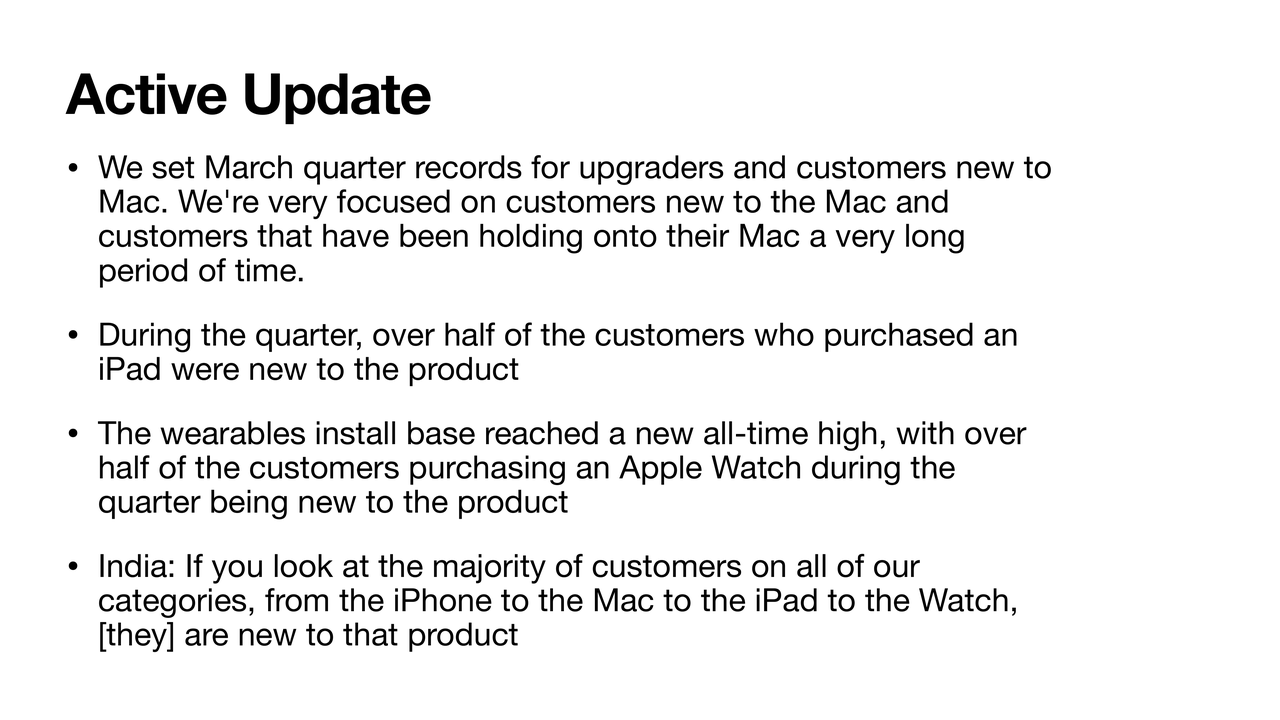
    We didn't get an update on the 2.5 billion actives, but we do get that once a year, unfortunately, no faster than that. We don't get an update on subscriptions either. Maybe, again, if I were to appeal to John, it's give us more data. I know he's an engineer. He knows the value of numbers. But the data that's given to us is out of a mountain of data that Apple has. We're getting a couple of crumbs. And they're chosen carefully. And I think the reason they've chosen to tell us these things is because they're saying that's what they think matters, and we should also probably keep an eye on these things. And that's all I did with Active Devices.

    You got to keep an eye on this. Measure the firm accordingly. It just so happens to be the old adage from Deming that the value of the firm equals this. I don't know if Apple believes that, but they do tell us these numbers, and that seems to be what they measure themselves by.

    This was one of the questions asked by the participants in Asymco's May 2026 Office Hours live Q&A sessions, open to Asymco One subscribers.

    See also: May 2026 Office Hours