Asymco

Asymmetric Intelligence

Research

  1. How to maintain a Sell rating on Apple

    Research · 2 comments

    One simple trick.

    Tim Long of Barclays Bank has an underweight (Sell) rating on Apple shares. Apple shares have just hit an all-time high. Perhaps he's right. Perhaps one should sell high.

    The problem is that Tim Long has had a sell or hold rating on Apple for many years. As far as my data shows, Barclays downgraded Apple shares to a "hold" equivalent on February 20, 2014. In that instance, Barclays analyst Ben Reitzes shifted his rating from "overweight" to "equal weight" due to expectations that upcoming hardware products would not be enough to further move the needle. More recently, on January 2, 2024, Barclays analysts further downgraded Apple shares to "underweight" (a sell equivalent).

    Ben Reitzes with Barclays Capital today stripped away his Overweight rating on shares of Apple (AAPL), a rating he's had for a decade, while maintaining a $570 price target, writing that the various products that one can imagine from the company — a smart watch, or a television set — won't be enough to move the needle, so to speak, for the company.

    via Barrons.1

    The price target in February 20, 2014 was set to $570 which, accounting for a 7 to 1 spent in June 9, 2014 and 4 to 1 in August 31, 2020, would be $20.39 today (On February 20, 2014, the date of the new $20 target and downgrade, Apple shares closed at $16.54. A year later the shares were $28.77.)

    Thus the recommendation from Barclays has been to sell low for 12 years.

    Let's dig in.

    Nearly a year ago, on August 1st, 2025 Barclays adjusted their price target on Apple to $180 From $173. Today the share price is around $317. We still have a few weeks before August 1st so there is time for the price to fall to $180, however, here are additional 30 price targets set by Barclays and the corresponding price of shares a year later allowing us to evaluate performance:

    Date of Target SetTargetPrice one year laterError
    4/30/25$173$271-56.8%
    1/31/25$197$270-37.1%
    1/22/25$183$248-35.7%
    11/1/24$184$269-46.2%
    8/2/24$186$203-9.3%
    7/24/24$187$214-14.3%
    5/3/24$165$199-20.5%
    2/2/24$158$228-44.3%
    1/2/24$160$243-52.1%
    11/3/23$161$222-37.9%
    10/30/23$166$234-40.8%
    8/4/23$167$209-25.3%
    4/26/23$149$170-14.0%
    2/3/23$145$188-29.4%
    1/11/23$133$186-39.5%
    11/7/22$144$182-26.3%
    10/28/22$156$170-9.2%
    10/10/22$155$178-15.1%
    7/29/22$169$196-16.2%
    7/13/22$166$191-14.8%
    4/29/22$167$170-1.6%
    3/11/22$170$15011.5%
    1/28/22$169$14315.4%
    10/29/21$145$153-5.8%
    7/28/21$142$157-10.8%
    5/19/21$134$137-2.5%
    4/29/21$138$158-14.2%
    1/28/21$136$170-25.2%
    1/14/21$116$173-49.2%
    10/30/20$100$149-49.0%

    The graph version of this data is shown below:
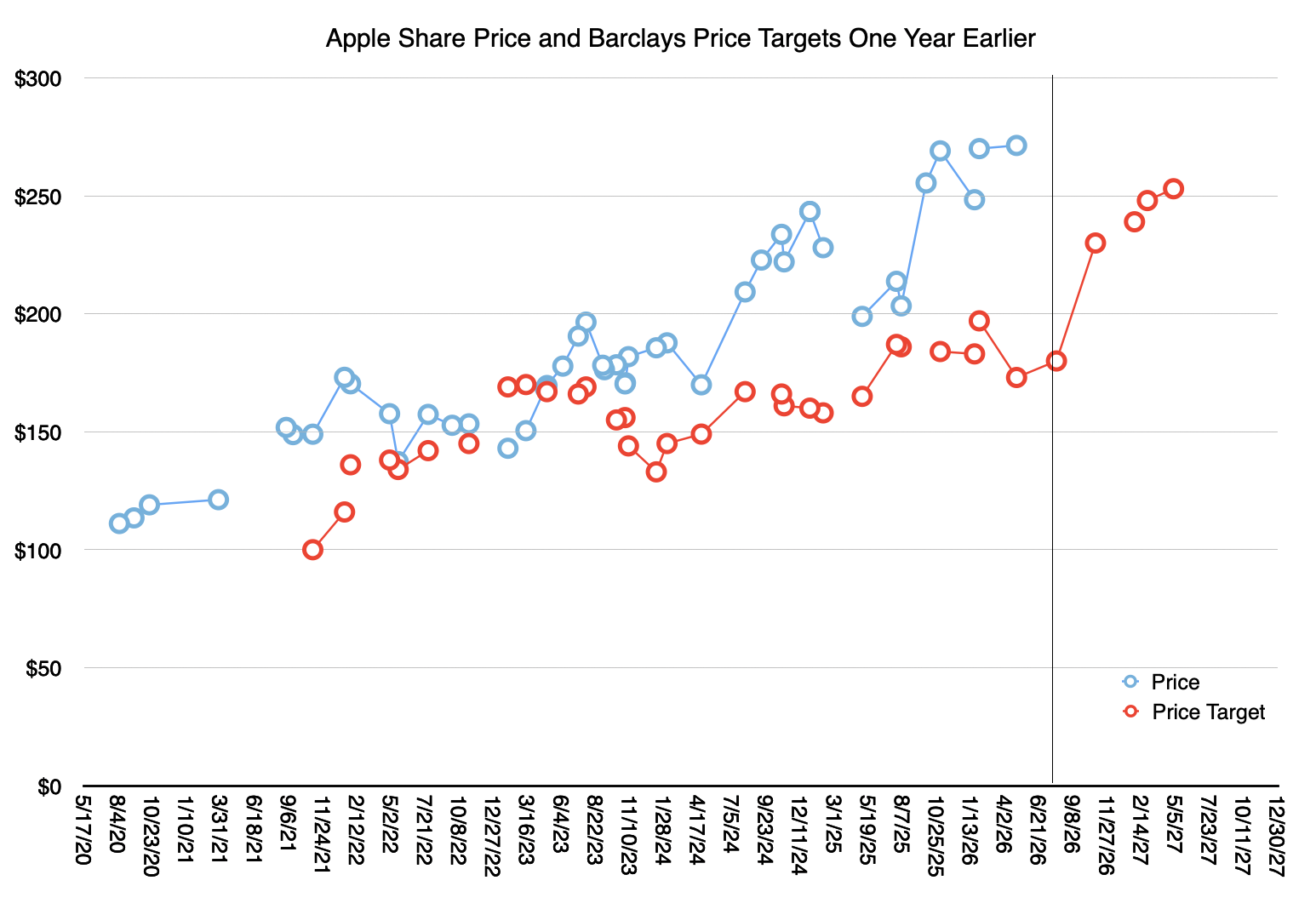
    Today is shown with a vertical line.

    The graph speaks for itself. The average error is 30%. The worst is 57%. Putting aside the gross failure in setting targets, the most curious aspect of this coverage is that the price targets are trending upwards quite consistently while the ratings are coming down.

    Since the Sell->Hold downgrade in 2014, and the subsequent downgrade (Hold->Sell) a decade later, the targets offered by the same analysts have increased from $20 to $253 today (+1,165%).

    The targets have increased while the rating has decreased. You were told to not buy at $16 then continue not to buy until you are told to sell because the shares are going to $160 and then sell again because they are going to $250. This is simply contradictory.

    The only way to accept the raising targets while maintaining a hold/sell rating is by arguing that all previous ratings and targets are moot and should be ignored. But if you suggest ignoring your own commentaries over 12 years published in over 100 reports reiterating your position then your own recommendation is to ignore what you say.

    How long does an analyst insist on being ignored?

    1. The key thesis was resting on a comparison with Microsoft. It might be worth re-reading:
      "Microsoft hit an all-time high market cap of about $620 billion in late 1999 as it was obvious its business model that bet on industry standards was the clear winner in the PC/Internet revolution. In August 2012, Apple beat Microsoft's record of the most valuable company when shares rose past the $660 level and shares continued to rise to an all time high past $700 just after the launch of the iPhone 5 with a market cap of about $650 billion as investors assumed Apple was the clear winner in the mobility revolution.

      The point is that the most dominant tech leaders of their era don't necessarily just regroup from these types of peaks and re-assume a new all-time high market cap after a year or two. They may get usurped in the ensuing decade or two. These observations are easier to see in hindsight – but it shows how hard it is to get to this type of size and stay there, much less regroup – and rise above it again […] Both companies seem to have been re-rated as investors ascribe little probability to a next "big thing" after a series of attempts to reclaim past glory.

      Apple now trades at 12.7x consensus 2014 estimates – down from its P/E of 15.9x in October 2012. Microsoft traded around 20x in 2004 after a strong rebound in 2003, but its multiple has settled in the mid-teens since that time. We don't see evidence that suggests Apple has another product as material as the iPhone or iPad in the pipeline. We are not arguing the nominal multiples here – but the rate and sustainability of the new contracted multiple from peak is worth noting. Once the market decides that your main product will remain slow for a long time, there does seem to be a visible pattern for multiples to sustain lower levels for a long time even if revenues grow –as was the case with Microsoft."
  2. Why all-in and why all are in

    Research · 5 comments

    Take all my money, please.

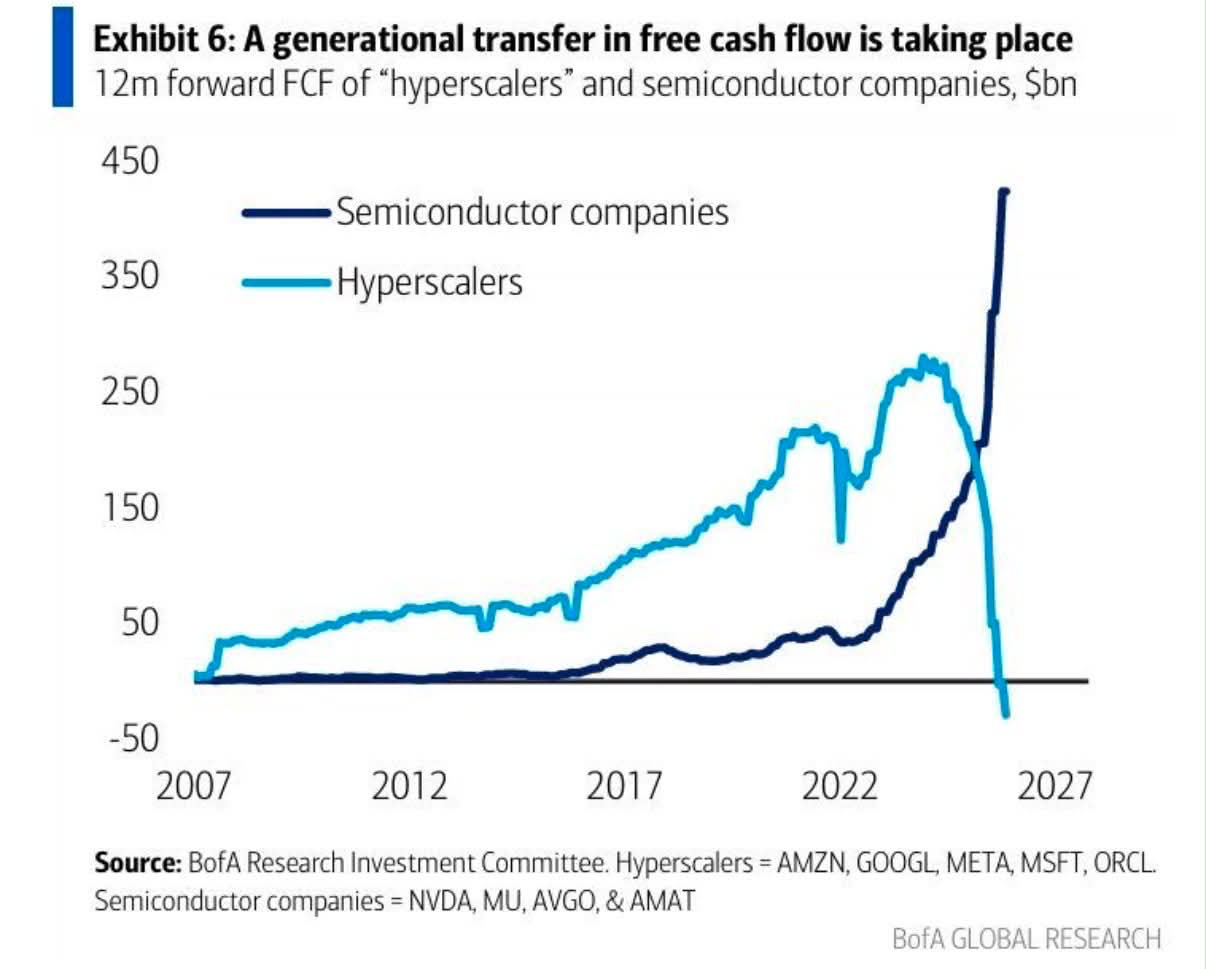
    The graph above shows that Amazon, Alphabet, Meta, Microsoft and Oracle decided to transfer their shareholders' wealth to the shareholders of Nvidia, Micron, Broadcom and Applied materials1. This is not an exaggeration. Free cash flow is wealth and it belongs to shareholders. The transfer is real since the capital expenditures undertaken with this cash flow by these "hyperscalers" have gone directly to create unprecedented windfall profits for semiconductor companies. So much so that the companies receiving these windfalls are scrambling to give it to their shareholders (and employees.) And the scale is astonishing! These companies alone are moving hundreds of billion, more than the profits gained in the semiconductor businesses in decades.

    Prof. Clayton Christensen had a theory he called "the dumb manager theory" to describe what most people use to explain why companies fail. According to this theory when a company is successful it's because its managers are smart. Conversely, when a company is failing it's because its managers are dumb. The problem with the theory is that it's usually the same managers who are there when a company succeeds as when it fails. Believing in the theory implies that you also believe that smart people can turn dumb. But you can't tell when and why this happens so determining success depends on your skill at psychoanalyzing managers.

    The second problem with the theory is that when one company fails, many other companies in the same industry fail as well. Yes, Kodak failed to grasp digital photography and its management has been skewered for it. But so did Fujifilm in Japan and Agfa in Germany. Did all these managers get together at a dumb management conference and agree to do the same dumb things at the same time? Clay Christensen asked if it's possible that they colluded to fail. He noted that he's often heard of collusion in order to succeed but never of collusion to fail.

    So the dumb manager theory of success and failure of businesses is problematic. When successful companies fail, it's not likely due to managers losing their competencies. Indeed, it may be because they are too competent.

    Disruption theory holds that companies fail precisely because managers pay too close attention to targets that are no longer relevant. And the "collusion" aspect is that all managers become fixated on the same target at the same time because they are all trained in the same way. There is group-think but also group-obsession on metrics and best practices and theories of the market that no longer apply.

    In the current wealth-transfer spectacle, managers at companies which are at the "top of the stack" offering complex, multi-faceted, multi-sided marketplaces of services to billions of consumers and businesses and advertiser customers through multiple channels of global distribution chose to give all they have2 to the "bottom of the stack" commodity semiconductor designers and manufacturers. The very businesses that they chose not to participate in and which a multitude of advisors, analysts and academics told them for decades are worthless metal benders.

    This new logic is that by directing all their capital to the bottom of the stack they will ensure continuing success of their complex top-of-the-stack business.

    The irony should not be lost on the reader.

    It's not just a question of "what if they're wrong?" The paradox is why is the plunge so headlong, so reckless. I.e. why is it not calibrated to an abundance of evidence of returns on the risk taken and, moreover, why is the belief so universally held.

    In other words, why all-in and why all are in.

    Of course, there is one anomaly: Not "all" are in. Apple is not all-in and it's the only one of the Magnificent 7 that is conspicuously hedging on this wealth transfer.

    Apple may be the anomaly that answers the paradox. The reason Apple stayed out will not be found in the "wise manager theory" of avoiding failure.

    Apple preserved its shareholders' wealth because they focused on their customers. (Yes, quite an anticlimax.)

    They did not have data centers to serve ads and sell capacity to businesses. They did not assume that customers' data is a commodity to be traded. They worried about privacy and quality of experience. They had to convince each buyer to decide to buy individually. In other words, they had a very simple business model: sell things to people who decide to buy because it works for them.

    But it required a complex execution. They had an integrated business: from retail to distribution to manufacturing and all the way to silicon. They did not sit only at the top of the stack. They sat at the bottom of the stack too. And in the middle. They were aware of the power of silicon and of hardware and of operating systems, APIs, design and everything in between.

    Having this perspective on their own business and customers, making all-in bets on a single technology that may be vulnerable to rapid commoditization3 seemed unwise. When everyone was throwing everything at "infrastructure" they looked at their own infrastructure and asked what the big deal was. When all the "compute" spending went to Nvidia, Apple asked why can't we just build our own, 1000x more processors? When projections of infinite revenues were made Apple asked where it would come from and how will it be segmented and justified and how exactly will consumers benefit and pay for it.

    The head scratching was seen as foolishness or foot dragging or fatal delays but it was genuine prudence. The more alone Apple was the more it was accused of stupidity. Au contraire! The suspicion should have been on the "group" making wild bets not on the skeptic sitting on his hands. Always be suspicious of beliefs in miracles and especially of any consensus in them. But that is how markets work. Overreaction is axiomatic; disillusionment guaranteed.

    1. Not included are the capital flows from investors in OpenAI, Anthropic and SpaceX and recipients such as Samsung and LG and a multitude of data center suppliers.
    2. All the current cash flow is gone, next comes the process of going into debt and thus giving up what they might get in the form of future cash flows.
    3. Open source/Chinese models will clearly be good enough.
  3. Capturing Eyespace: Plotting Apple's disruption of eyewear

    Research

    Getting to 20% CAGR on Wearables

    When Essilor merged with Luxottica in 2018 the eyewear market was $100 billion. In 2021 it was $150 billion. Last year it was $220 billion, this year it's estimated at $245 billion and in six years $463 billion.

    Much of this growth is due to increases in Asia Pacific with 11.5% CAGR. The growth factors are improving competitiveness with non-consumption through expanding distribution mainly through retail and e-commerce. Technologies such as virtual try-on are enhancing accessibility, personalization, and purchasing experiences. Aging populations are also boosting demand for prescription eyewear.

    EssilorLuxottica (EL) is an interesting case study as it represents a significant share of this total market. It’s also a useful proxy because it has a large overlap with segments Apple might target. EL operates in 150 countries, offers 150 brands, introduces 3500 eyewear models new every year, and has over 600 production facilities & optical labs. It sells 113 million prescription frames, 97 million non-prescription frames and 755 million solid and 79 million contact lenses per year. It distributes through 300k optical partners, 20k stores, 89 eye clinics and serves 500 million customers.

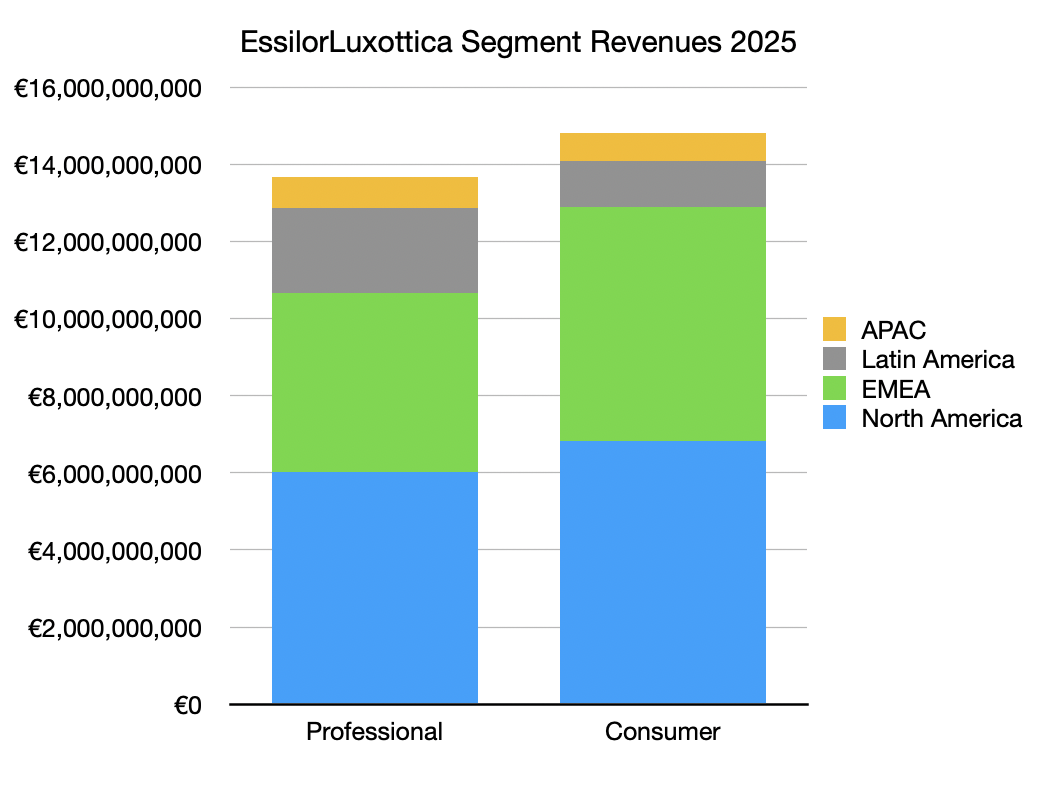
    Through this, in 2025 it generated 28.5B€ revenues, at 16% gross margin, 11% net margin. Geographic segment revenues are shown below.

    Additional consumer categories: 70% Prescription, 21% sunglasses, 6% AI glasses, 3% Apparel. In terms of consumer 77% is sold through Brick and Mortar retail.

    There is a demographic overlap with Apple though they are far weaker in Asia (6% consumer sales). Distribution is also very fragmented as are its brands. Consumer sales are about $17B which I estimate is about the same as Apple Watch revenues.

    On a unit basis i estimate that the wholesale average revenue per frame is $100, average revenue per lens pair is $50 and retail margins at 50% put average selling price per glasses of $300. Price ranges vary widely from $50 to $5000. The $300-$500 segment is expected to record the fastest growth from 2025 to 2030. This price structure allows the entry of a software-enabled frame+lens that is priced at what consumers are willing to pay but adding significant functionality—as long as style, aesthetic and social standards are met.

    This suggests a similar opportunity for Apple to the watch market: approach the mid market and push incumbents into either low end or very high end while iterating rapidly on function and design.

    Unlike the watch market, however the eyewear market is far bigger and growing much faster.

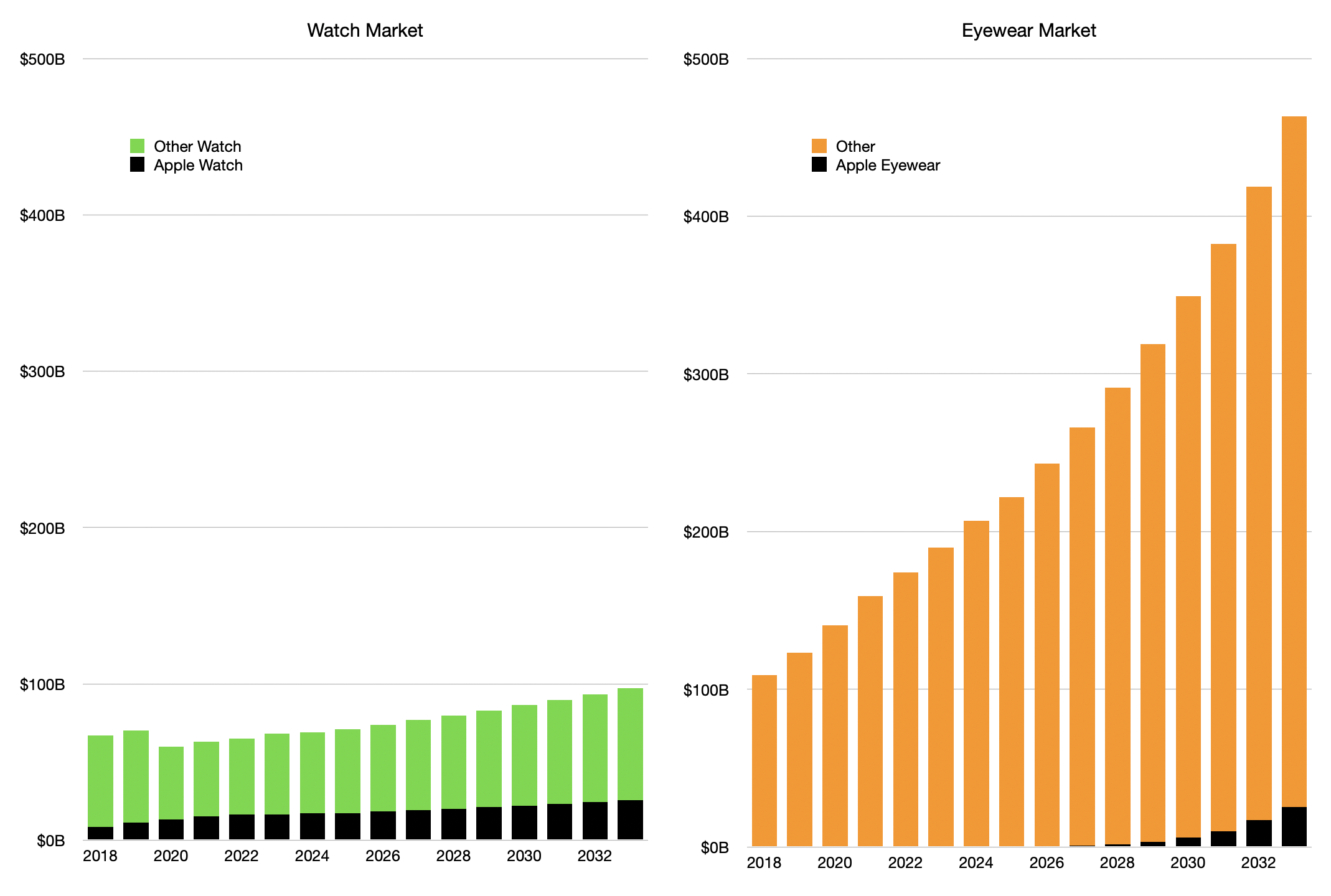
    My estimates for both the watch market and the eyewear market (2018 to 2033) including Apple's share is shown below.

    This scale suggests Apple eyewear could reach to be the same size as the Apple Watch by 2033 and each would be worth about $25 billion/yr.

    By then Apple's share in the watch market would be about 25% but only 5% of the eyewear market. A substantial headroom exists where Apple eyewear could reach as much as $100 billion/yr.

    This is one of the reasons Spatial Computing is so strategic. By the time this opportunity arrives, vision computing technologies will allow the injection of software into eyeglasses that would solve incremental problems for many users on a continuous basis. We call this jobs-to-be-done and as display, input, and capture/sensing data will flood into the eyewear product, consumers will find new jobs to hire the products to do.

    Overall Wearables should growth from $18billion/yr. today to $115 billion by 2035 sustaining a 20% compounding growth rate.

    One important aspect here is not just competition with new features but with new customer experiences: virtual try-on, personalization, and purchasing options. The fact that 80% of the market is still brick-and-mortar and requires typically multiple visits is archaic. In addition there are many non-consumers. There is non-consumption for people who do not have an eye refractive condition (myopia, hyperopia, presbyopia), i.e. children and there are the underserved who may be unwilling to obtain glasses.

    The conversion of 2.2 billion un-served is also worth considering1. When Apple watch arrived, many people had stopped wearing watches since timekeeping was always on their phones. The watch became an accessory to the phone and adoption increased. The same might happen with Apple eyewear. "Eyespace" is perhaps the most interesting and important wearable space after all.

    1. In 2018, an estimated 2.5 billion people, mostly in India, Africa, and China, lack access to eye tests and spectacles. This “visual divide,” as NGOs call it, is a significant global issue. Myopia and presbyopia, common in developing countries, are linked to high road deaths, low educational achievement, and poor factory productivity. Eye-health campaigners refer to it as the world’s largest untreated disability.
  4. More than meets the eye

    Research

    A first look at the eyewear market

    To see the future of wearables, I said look to where jewelry has been worn. The places where people trust metal against skin is where compute inevitably will reside.

    The categories are easily found. https://en.wikipedia.org/wiki/List_of_jewellery_types

    Head/Hair -> AirPods/Beats
    Arms -> Watch
    Hands -> Rings
    Ear -> AirPods
    Neck -> Beats

    My prediction has been more or less fulfilled. Today we wear Beats, AirPods, Apple Watch and (though not Apple) rings containing microprocessors. However, what is missing from this categorization is eyewear.

    In How We Got to Now, Steven Johnson describes the reading lenses of medieval Europe as the first piece of technology “since the invention of clothing in Neolithic times, that ordinary people would regularly wear on their bodies.”

    Though worn and labeled as apparel, glasses are treated as jewelry. Made from semi-precious, fine materials, premium branding and sold through bespoke retail, eyewear is granted a special status in our panoply of products.

    Before we get into how Apple will fill this space, we should learn a bit about how the eyewear industry emerged and evolved.

    Eyeglass frames often have luxury branding: Tiffany & Co., Armani, Brooks Brothers, Ferrari, Burberry, Tory Burch, Chanel, Jimmy Choo, Coach, Swarovski, Dolce & Gabbana, Michael Kors, Versace, Miu Miu, Prada, Ralph Lauren and Burberry are all eyewear brands. There are also eyewear-only brands which define their own luxury, such as Ray-Ban, Oakley, Persol, Vogue, and Oliver Peoples.

    They are sold through a carefully segmented set of retailers such as Sunglass Hut, Óticas Carol, LensCrafters, Vision Express, Apollo, Pearle, Générale d’Optique, Target Optical, Pearle Vision, MasVisión, Mujosh, OPSM, Bolon, Oakley, GrandVision.

    Though eyewear includes non-prescription glasses, prescription lenses are also branded. Lens brands include Crizal, Essilor, Eyezen, Kodak, Optifog, Transitions, Varilux, Xperio and Shamir.

    It may seem like a diverse and broad value chain but all these brands, retailers and lenses are property of one company, EssilorLuxottica.

    It is the result of the 2018 merger two major conglomerates: Essilor (French) focused on lenses and acquirer of 250 companies and Luxottica (Italian) owning a combination of frame factories, designer labels and thousands of retail outlets.

    At time of merger, Essilor had around 45% of the prescription lenses market, and Luxottica 25% of the frames. Combined they sell close to a billion pairs of lenses and frames every year, through 17,740 stores with a workforce of more than 140,000. They have around 1.5 billion customers, mostly in the premium or high-end of the market.

    Since the merger, EssilorLuxottica continued its acquisitions with a set of prescription laboratories in South America and Europe, optician groups in Europe and US and Heidelberg Engineering, a German maker of optical coherence tomography (OCT) diagnostic instruments, confocal microscopy, and scanning lasers.

    In July 2024, EssilorLuxottica bought US streetwear brand Supreme, expanding its brand portfolio beyond eyewear and lenses for the first time.

    It also acquired Israeli startup Nuance Hearing indicating that it may introduce hearing aid technology into its lenses.

    It also owns EyeMed, one of the largest vision insurance plans in the US.

    There is something here more than meets the eye.

    A lenticular species

    Almost everyone wears glasses at some point in their lives. In developed countries, the rule of thumb is that around 70% of adults need corrective lenses. In Japan it's 75%. Including sunglasses, the penetration of eyewear is probably close to 90%.

    We are at an unprecedented moment in the story of human vision – namely, the accelerating degradation of our eyes. For several thousand years, human beings have been operating mostly with unaided vision. But that is coming to an end. No one is sure why but across the world, we are becoming a species that wears lenses.

    There are two things happening. First, there’s a largely unreported global epidemic of myopia, or shortsightedness, which has doubled among young people in a single generation. Scientists once thought myopia was mainly genetic, but about 10 years ago, it became clear that children’s upbringing was also harming their eyesight. The effect is most severe in east Asia, where myopia has always been more common, but the rate of increase has been worldwide. In the 1950s, between 10% and 20% of Chinese people were shortsighted, but now, among teenagers and young adults, the proportion is more like 90%. In Seoul, 95% of 19-year-old men are myopic, many of them severely, and at risk of blindness later in life.

    Across the developing world, a slower process is underway as populations age, urbanize, and move indoors for work.

    In 2013 a paper forecast that half the world’s population will be myopic by 2050 – almost 5 billion people. In the course of a single generation, worldwide, researchers have recorded a rough doubling in the number of people who become short-sighted as children.

    The main reason, as far as anyone can agree, is a reduction in the time that they spend outdoors. Sunlight helps to moderate levels of dopamine, which in turn influence the development of the eye. Too much dopamine means eyeballs grow too long, and become oblong in shape, focusing light in front of the retina, rather than on it.

    Eyewear history shows people don’t start wearing glasses when everything seems out of focus. Instead, they wear them to participate in new forms of entertainment and labor. The mass market for spectacles didn’t emerge when they were invented in 13th-century Italy, but 200 years later in Germany, alongside the exploding availability of printed works, because people wanted to read. The printing press created a new job-to-be-done, reading, for which glasses were ready to be hired.

    Scale and Style

    In 2012, Essilor first publicized the 2.5 billion statistic, highlighting the shift from outdoor living to indoor usage and the resulting demand for eyewear.

    EssilorLuxottica, with its own designers, engineers, factories, supply depots, and retail outlets, currently has almost 18,000 stores and contracts with 100,000 opticians worldwide. This allows it to bring products to market faster and in greater quantities than its rivals, while also retaining a larger proportion of its profits.

    Considering various colors and face shapes, EssilorLuxottica produces about 27,000 models. Its plants produce 400,000 frames daily.

    During the 20th century, the eyewear business transformed a physical impairment into an opportunity to display style. In doing so, optical retailers learned that for something that costs only about $15 to make, customers are happy to pay 10 or 20 times that amount. The gross margins are 60% to 67% for high-volume, online, or budget retail, 67% to 75% for mid-range/acetate) and 75% to 85%+ for branded and premium materials.

    History

    The conditions that have allowed for the rise of Essilor and Luxottica are rooted in the way spectacles were sold. Until the end of the 19th century, you could buy a cheap pair of glasses – for reading or for distance – off the rack in any department store, or from a jewelry shop, or a guy in the street. Eyewear was a craft and unregulated. It was buyer beware. Eyeglass sellers in the 18th and 19th centuries were notorious for scams and faulty lenses.

    The birth of the optometry profession around 1900 changed this. A new profession of respectable spectacle-sellers, similar to pharmacists, sought to standardize eye tests and restrict the sale of glasses to licensed professionals only. Their goal was to raise standards. However, making cheap, widely available product accessible only to a few authorized sellers increased prices, and the potential for new form of corruption.

    The first opticians were disdained by ophthalmologists – proper doctors of the eye, who trained in hospitals and considered selling glasses as an unskilled trade. The first optometry course in the US was taught at Columbia University’s physics department because it was not allowed inside the medical school.

    But the new professionals persevered and found new ways to protect their jobs. Across Europe and in the US, optometry laws and regulations were passed to control the prescription and selling of eyewear. Many of these had a quality of health assurance aspect, but they also had the effect of creating a highly protected marketplace. For instance, opticians fought against advertising which might reveal prices and allow comparison shopping.

    The scams and bribes became legend. Lens and frame makers bribed practitioners to prescribe their products and investigations and convictions forced divestitures and value chain break-ups.

    Into this space the components of EssilorLuxottica stepped in and began to consolidate the market. Luxottica has spent the last 30 years acquiring prominent elements of the optical business, including frames, brands, and retail chains. Essilor, has focused on acquiring lens manufacturers, instrument makers, prescription labs, and the science of sight.

    The strategy for EssilorLuxottica is to obtain the power to decide how billions of people will see and what they pay for it. The company can screen populations and provide eyewear across the globe all the while controlling supply, prices, and margin.

    New technologies such as automated optometry kiosks and online retailing that threaten independent opticians are sustaining to EssilorLuxottica and thus they are investing and acquiring.

    Today humanity is watching the world through screens, in front of them, but not on their eyes. It seems only a matter of time before those screens become lenses. The same lenses that are now an essential product for almost everyone.

    One more thing: Exactly one year ago, in July 2025, Meta acquired a minority stake in EssilorLuxottica with about 3% of the equity as part of its partnership with Ray-Ban. Bloomberg said that Meta had bought a stake worth around 3 billion euros ($3.5 billion) in EssilorLuxottica and is considering further investments that could build its holding to around 5% over time.

    Meta CEO Mark Zuckerberg called it a "symbolic" gesture to cement their long-term partnership.

  5. Memory is a Commodity

    Research · 8 comments

    "I’ve never seen a shortage without a subsequent glut, but I’ve seen gluts never followed by a shortage." -Nassim Taleb

    A commodity is a product or service which does not increase in price if its performance increases.

    In a typical commodity exchange (coffee, pork bellies, iron ore, oil, etc) an offer of a "better" batch would not result in a higher price. The market treats all instances as equivalent with no regard to who produced them or how they were produced.

    That does not mean that commodities prices cannot rise. Although not determined by quality or performance or sourcing, commodities respond to supply/demand imbalances. These are unpredictable and are affected by externalities and multitudes of factors.

    Because performance is not differentiable, businesses trading in commodities are not responsive to innovation in the product. They may benefit from production and distribution innovation however. This is why scale, consolidation, regulation and legislative action are primary drivers of value.

    That is also why Apple doesn’t design or build memory. Pricing will oscillate but, as a producer, Apple would be locked into their own cost structure and wouldn’t be able to negotiate with multiple vendors, nor have flexible responses to surges or drops in demand.

    As a commodity, memory chips from any manufacturer are effectively interchangeable and pricing is not determined by producer. Therefore, the only way memory makers can make money is by lowering their own cost, which they do by increasing density (bits per wafer.)

    The design isn’t the hard part or the limiting function for density and thus cost for DRAM or NAND chips. As Joe Lion pointed out in a Mastodon thread:

    By far, the single most important thing for increasing bits per wafer is shrinking the process nodes which decreases cell size, where a DRAM cell is "1 transistor, 1 capacitor."

    The design of the DRAM cell is the same as laid out in Robert Dennard's original DRAM patent from 1968. The design of the interface and periphery circuits, while important for performance, are nearly insignificant for decreasing overall die-size, which is, again, the critical factor in $ per bit.

    Lion continues,

    This is different than CPU/GPU/logic chips, which are not a commodity, and therefore pricing can be set by the manufacturer based on whatever the manufacturing cost happens to be, plus their desired gross margin.

    To put another way, TSMC and Intel have never sold a CPU chip for a loss because they set the pricing themselves, and they will never price their own product below their own manufacturing cost, whereas memory makers frequently go through years-long cycles of selling chips for a loss because memory prices are set by global supply and demand.

    Into this emerged a political dimension. The Chinese government declared memory as a strategic commodity and spent hundreds of billions of dollars developing its own memory suppliers over more than a decade. These investments take many years to bear fruit. A new fab would take five years before the first wafer, 10 years before high volume yield, and 15 years or more before cost competitiveness with incumbent DRAM vendors. It may not ever become profitable. China is 12 years in and its state-sponsored memory industry may only be reaching profitability due to the market imbalance just experienced.

    The current situation is a demand shock. There isn't a shortage due to a loss of capacity but a surge in demand fed by a rush to spend on AI infrastructure. The buyers of memory are in a race to secure capacity in the belief that it's either first to reach some critical mass or they assume a logic of winner take all. [The fact that there are open source alternatives that are nearly the same performance does not seem to deter investors.]

    Price insensitive demand is causing a windfall for producers who are effectively feeling as if they are in control and will remain so forever. But at the Taleb quote in the heading suggests, all this will pass. There has never been a situation where a commodity shortage has resulted in a perpetual undersupply (unless a cartel forms--and even that is hard to keep going indefinitely.]

    The reason commodities balance in price is by their definition. Unless memories can be differentiated on performance, their price will float. If their price will float, high prices will attract investment and thus production and thus a glut and prices will fall.

    Will Apple and indeed the entire set of industries using memories endure this shock? You would have to believe that unlike every other time, this time it's different.

  6. Why is the most expensive thing you own the dumbest?

    Office Hours Research · 1 comment

    An Office Hours question asked by Lalit, June 9, 2026.

    Q: Could some future Apple TV morph into a data center for the family? And what about all the talk about Home and AI?

    I’ve anticipated the Home story for years, and maybe this is the year. Home needed a big upgrade in intelligence, because today it’s constrained by configuration. Anyone who’s set up a smart home feels like they have to be a programmer — set up events, triggers, scenes — and then it doesn’t work. I don’t want to tell it every single thing to do. I need it to be aware of my needs. The missing ingredient was always inference.

    Where it gets interesting is the rumor of a new device type — think of a HomePod with a screen, a display that follows you and creates eye contact, something more anthropomorphic, more like the Pixar lamp. Right now Apple TV is the hub by convenience: it has a display, enough horsepower to act as a gateway, and the security to do the integration. The question is whether it stays the hub, or whether a new home hub arrives, or the two split the job.

    Subscribe to Asymco One for full access to our research.

    Here’s my worry. With AI, the hardware will get obsoleted faster, so you’d need to upgrade more often — but the Apple TV withers, because it’s tied to the TV, and a TV is an appliance, like a refrigerator which you replace only when it breaks. I still have a TV from 2008. Nobody rushes out for a new Apple TV because it’s cool. So whatever they build has to have a reason to be a software object that evolves, not a static box.

    Step back and the real problem is this: the most expensive thing you own is a house, possibly three million dollars, and it’s the least intelligent thing you own. We put more intelligence in a $300 wristwatch than in our homes. Cars are the second-worst offender — stupid by every metric, and they resist software, partly because many people don’t want them to be smart. Home and health are the great holdouts, unpenetrated by software for decades, and AI is the chance to take another run at them. And by the way, the dream of humanoid robots in the home baffles me. People don’t want a robot that freaks them out and does the job worse. We like approachable, single-purpose appliances. A little speaker with a screen that turns to greet you beats a faceless robot every time.


    Editor’s Note: This was one of the questions asked by participants in Asymco’s June 2026 Office Hours live Q&A session, open to Asymco One subscribers.


    Subscribe to Asymco One for more in-depth analysis and commentary like this.

  7. Why iPhones prices don't change

    Research · 1 comment

    Exponential increase in performance at a flat price. Is the formula about to change?

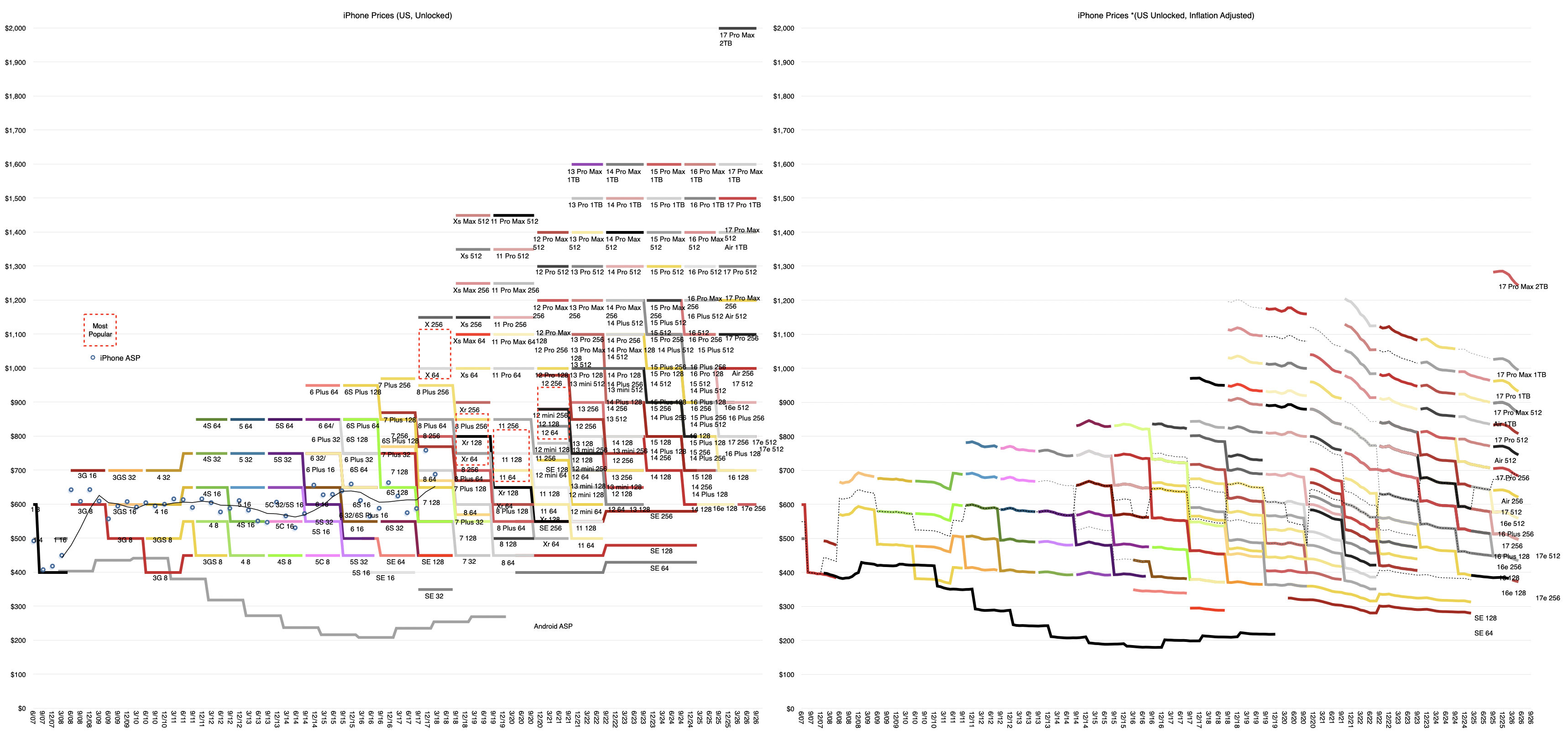
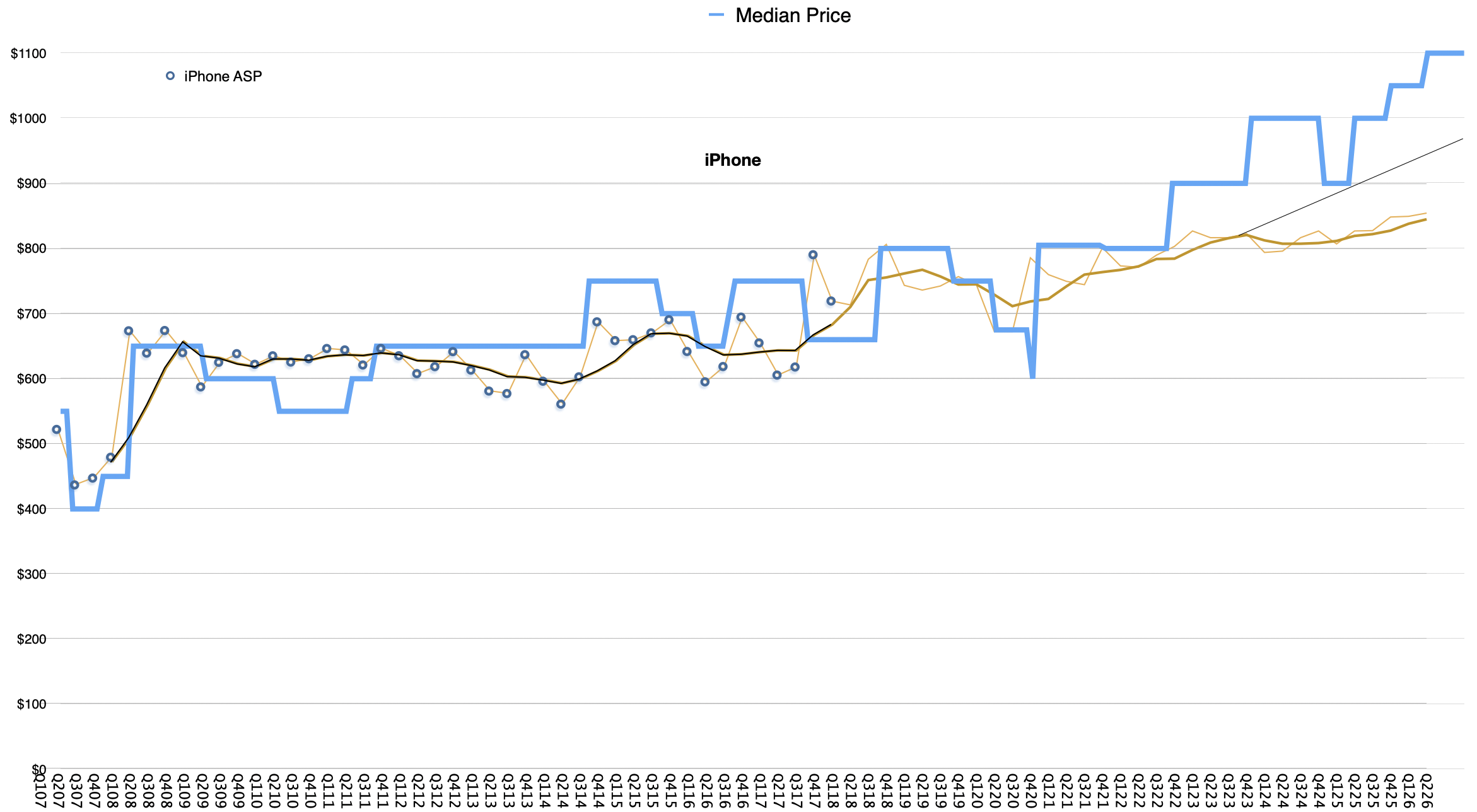
    The iPhone price structure is very carefully constructed. One could even say it's engineered. It has operated under many constraints: segmentation, margin, scale and market windows. The balance between these and other constraints has been managed for 19 years. The left-hand graph above shows the pricing of all iPhones ever sold in constant dollars. The right-hand graph shows the pricing adjusted for US (CPI) inflation.

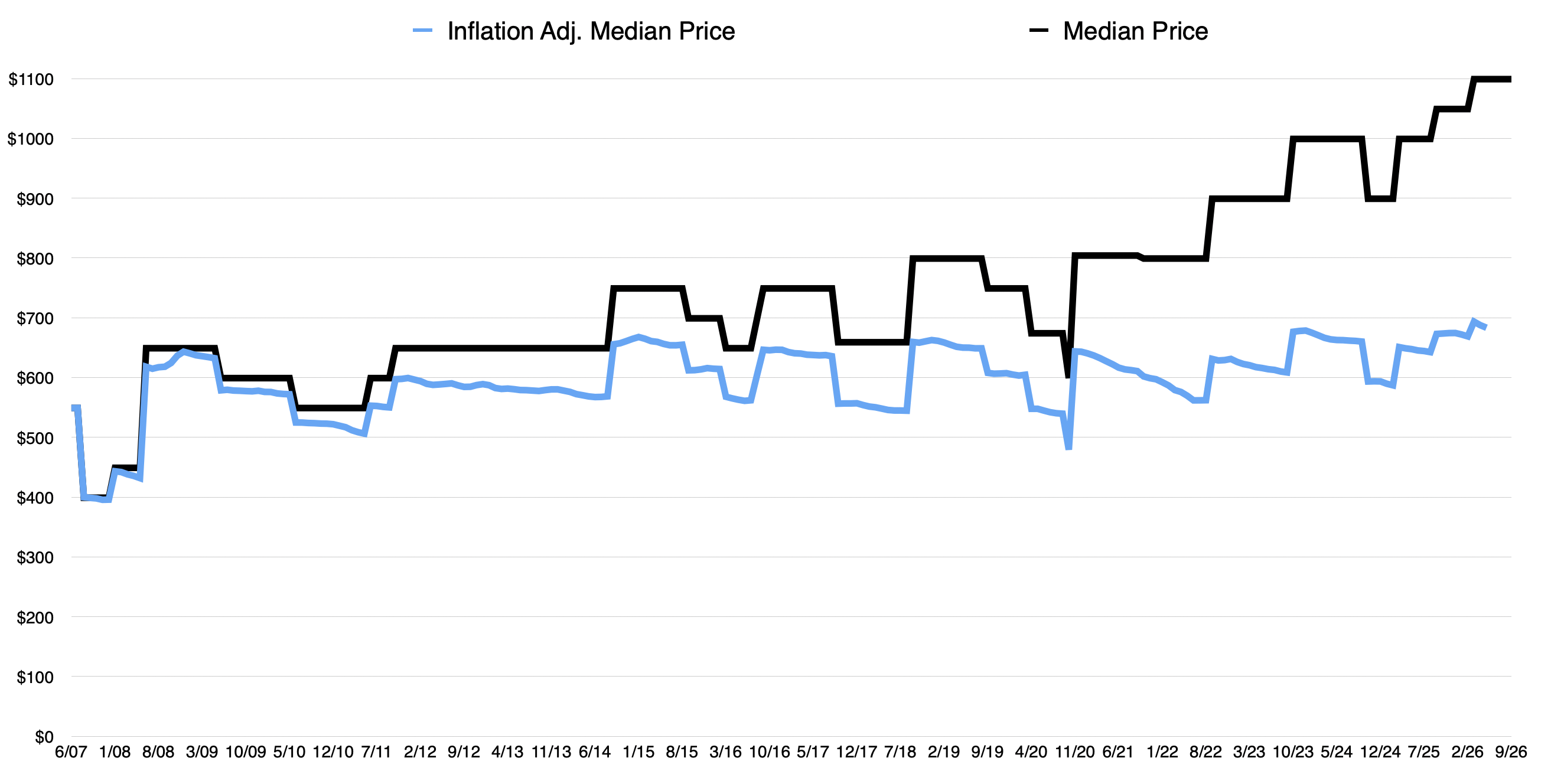
    Until 2021 inflation was not a major factor but following the Covid perturbation the iPhone pricing fell dramatically. To see the picture more clearly, I show the median price below:

    The median is the point where half the prices are above and half are below. It's not the average selling price (ASP)1. The black line is the constant dollar median and the blue is the inflation-adjusted median.

    Note that the inflation-adjusted median has remained in the $500 to $700 point since 2012. In fact the average median is $597 over the entire 19 years.

    But what does the median represent? It's the midpoint of the price range. It's not adjusted by volume. If more people buy the expensive models then the ASP is higher and vice versa. To test this, I compared the known ASP data with the median to see the relationship.

    The dotted line represents actual data and the un-dotted yellow line is my own approximation of the ASP since then. Clearly the data shows that until 2018 the median was a good proxy for the ASP. Perhaps since then the ASP has been lower than the median price but it's predictable.

    But if adjusting for inflation, the ASP should be also quite flat over the entire period. It's a remarkable observation.

    The iPhone has grown in capabilities exponentially but the price has remained the same.

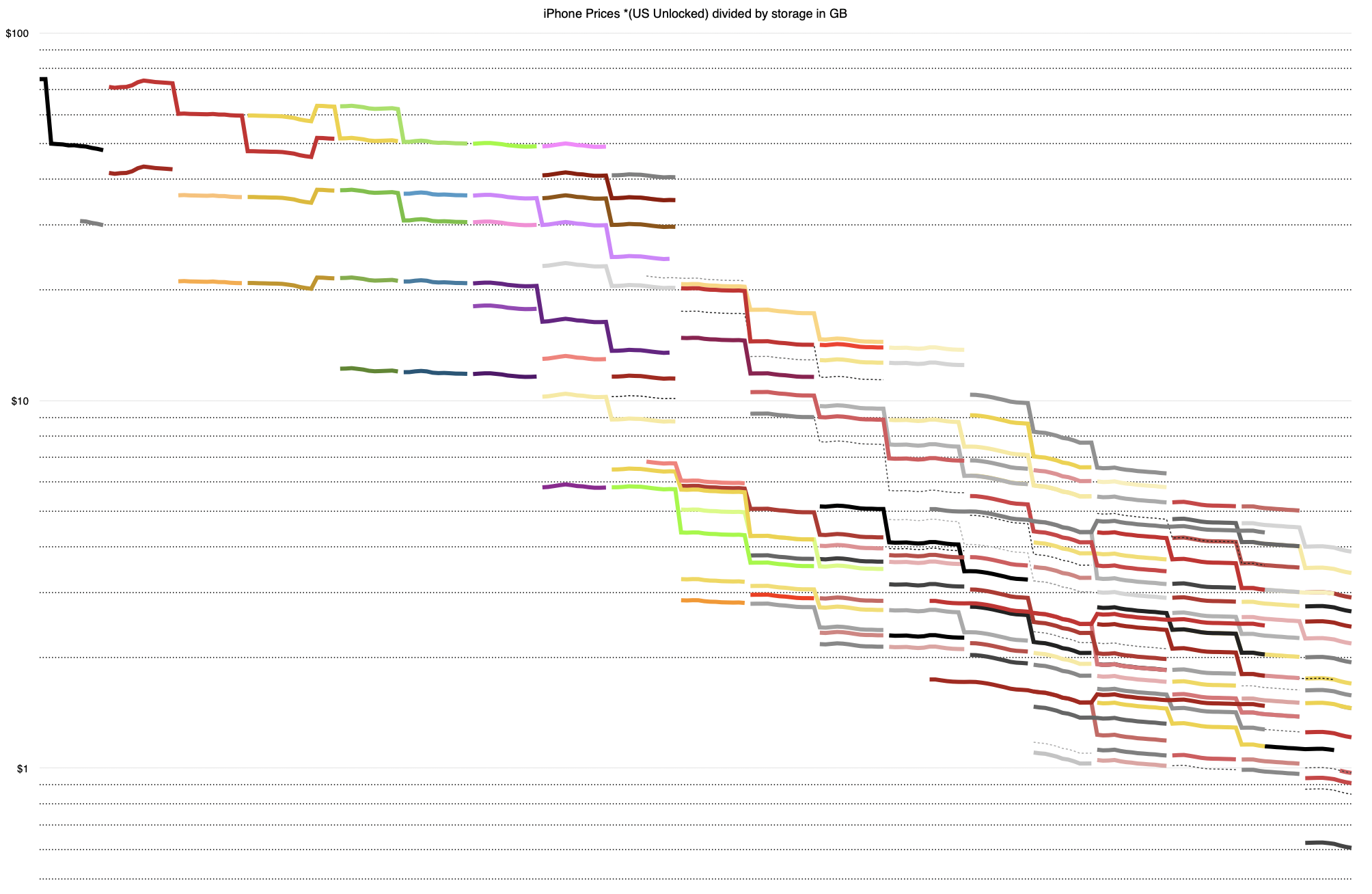
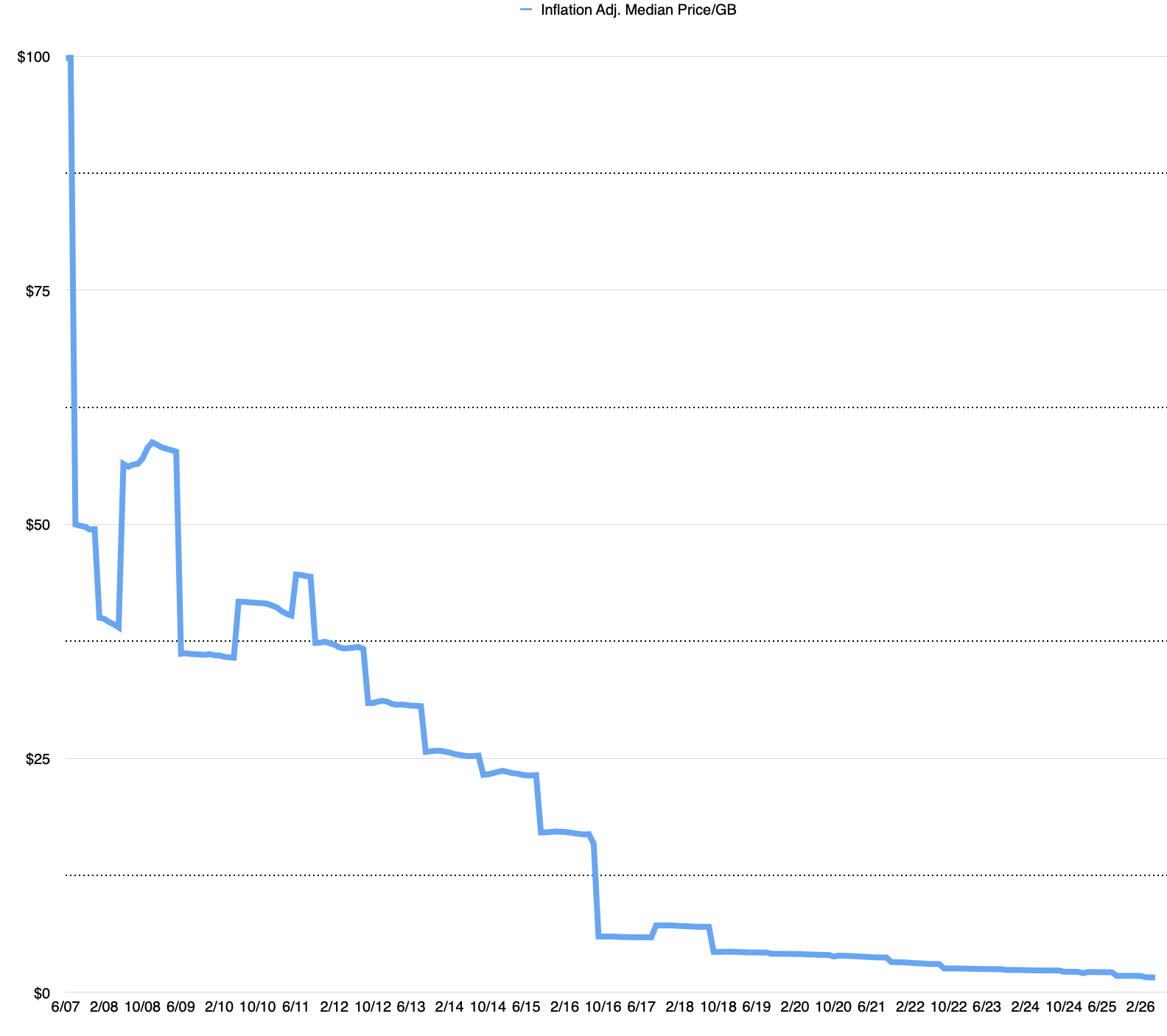
    To illustrate, I considered the storage provided by each iPhone in the list (all 160 models). They span 4GB to 2048GB. If we divide the inflation-adjusted price by the storage we get adjusted dollars/GB and the graph for all iPhones is shown below

    Note that this is a logarithmic scale. The pricing went from $75/GB with the iPhone (1) to about $1/GB with iPhone 17. A two-orders-of-magnitude reduction.

    Taking the median of these prices per GB and plotting on a linear scale gives the following picture.

    One of the accusations against Apple is that the iPhone is not much more than a storage device and Apple just charges a mark-up on memory. The higher prices are just deeper gouging of not-much-more expensive memory. The graph above shows how improbable this is. Though storage is one measure of performance, there are many others and the increases in density are passed through to the consumer.

    The appetite for memory has grown exponentially and fortunately the pricing has dropped exponentially, yielding essentially a flat price for an exponentially improving product.

    Which brings me finally to the point.

    The latest warning from Tim Cook is that pricing on many Apple products will "inevitably" increase because memory costs are going through the roof.

    The increases are likely to be in the 10% to 15% ($100 to $150 on the median price). But even if they are 30%, the pricing will only begin the deviate from inflation for the first time. I believe there is a reason why the pricing has been so consistent. Apple is pricing at what consumers are valuing (think cost/day including resale value) and are "marking their territory" with a price point few competitors can match.

    Over the medium term. the supply/demand crisis in memory will be dealt with as with any economic imbalance: capital allocation chasing returns. Over the long term I believe Apple will expand their footprint to capture more Android users. This means more aggressive packaging (think Mac Neo) and, yes, pricing.

    What might be visible in the long term is a blip in the historic "stairway to heaven" graph at the top of this post. The disturbance in the force is that a price might cause a product to change price mid-cycle and do so in a more significant way.

    There is a precedent. In June 2011 there was a $50 increase across-the-board on all iPhones. This was because U.S. customers could then buy an iPhone 4 directly from Apple that was free of any carrier lock. Because Apple wasn't guaranteed a share of monthly carrier fees, they passed the true, unsubsidized cost of the device on to the buyer.

    This even is almost completely forgotten. The transitions from subsidized to unsubsidized and from carrier-focus to Apple-focus on brand and retail distribution and global expansion are far more profound.

    The iPhone has succeeded even though it's the most expensive phone brand. That is because it's more than a phone. It's the portal to one's life. A forced increase in price won't affect this.

    1. The ASP has not been available since mid-2018.
  8. The Puzzle of Sustainable Growth

    Research · 3 comments

    20 more years at 24%?

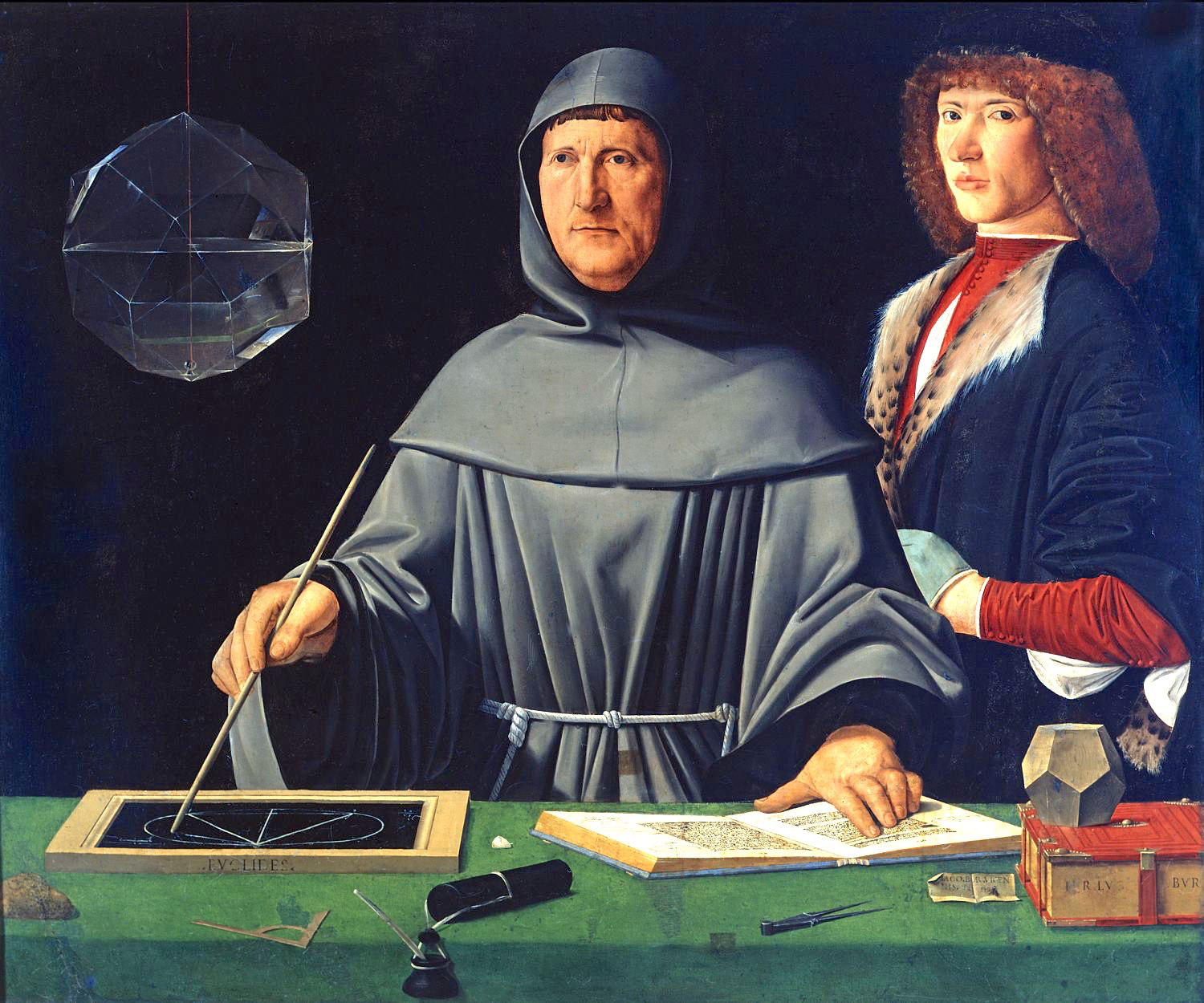
    Portrait of Luca Pacioli attributed to Jacopo de' Barbari, circa 1500 which may have been (at least partially) painted by Pacioli's collaborator Leonardo da Vinci.

    Summa de arithmetica, geometria, proportioni et proportionalita (Summary of arithmetic, geometry, proportions and proportionality) is a math book written by Luca Pacioli. It is a compendium of the mathematics that was known in Renaissance Italy. This included practical arithmetic, basic algebra, geometry and accounting. Written as a textbook and reference work, it was first published in 1494, two years after Columbus landed in the new world.

    As Venice was an early adopter of the newly invented printing press, it was originally published there with a second edition printed in 1523 in Toscolano. About a thousand copies were printed, of which roughly 120 still exist. This was an extraordinary large run for the time and, in contrast to pre-press era when maybe 10 copies would be hand-made, it was a bestseller.

    Why was a math book so popular?

    First, because it was in Italian rather than Latin. Second, within the chapter on business, a section entitled Particularis de computis et scripturis (Details of calculation and recording) describes the accounting methods then in use among northern-Italian merchants, including double-entry bookkeeping, trial balances, balance sheets and various other tools employed by professional accountants to this day. The business chapter also introduces the rule of 72 for predicting an investment's future value.

    Regarding this rule, the quote is:

    In wanting to know of any capital, at a given yearly percentage, in how many years it will double adding the interest to the capital, keep as a rule [the number] 72 in mind, which you will always divide by the interest, and what results, in that many years it will be doubled. Example: When the interest is 6 percent per year, I say that one divides 72 by 6; 12 results, and in 12 years the capital will be doubled.

    What it says is that if you want to know how long you need to wait for an investment to double, divide 72 by the interest rate. If the (compounded) interest rate is 6% then wait 72/6 or 12 years and you double your money.

    This is a great rule of thumb and was devised before logarithms were invented which are more precise but harder to calculate. Even today this is a great rule and should be used instead of relying on spreadsheets or AI to get a quick answer. The accuracy is highest at interest rates above 5% which is well within investor rates of return.

    Once you develop an intuition about time to double the interest (or rate of return) becomes a measure of time which is much more relatable. The investment thesis then becomes one of duration which rewards patience rather than gratification.

    The problem is however that this rate of return must be maintained and compounded throughout the period. When it comes to returns on share prices, the rate of return can vary greatly and does so instantly and continuously during trading.

    Balanced portfolios, index funds, etc. attempt to smooth out the variability and provide a predictable rate of return. For instance, the S&P 500 index, since its adoption of 500 stocks in 1957, has had compounded annual growth rate of 10.56% (excluding inflation). The 10% rule of thumb has been used to encourage investors to hold fast through long periods. At this rate the rule of 72 means you double your money every 7.2 years.

    This is also used to discourage "stock picking" because individual stocks are both more volatile and more susceptible to disruption, exiting the index at an alarming rate. Indeed, disruption theory suggests that companies are surprisingly fragile insofar as they succumb to mismanagement with uncanny regularity.

    Think of it another way: if it were not for disruption, a public company is a remarkable money printing machine. If it gets to a point of success, it should deliver constant growth consistently. Even 15% growth would mean investors would double their money every five years. That would allow $2000 to become $1 million in 50 years. A single stock purchase at age 15 would provide the individual a fully funded retirement.

    The answer is that innovation theory is a theory of competitive behavior and that external factors force time horizons to be not long enough to preserve sustainable compound annual growth rates beyond a few years. Technologies change, people change, tastes change and management is distracted or unable to adjust to these changes.

    Let's look at Apple as an example of consistency of return.

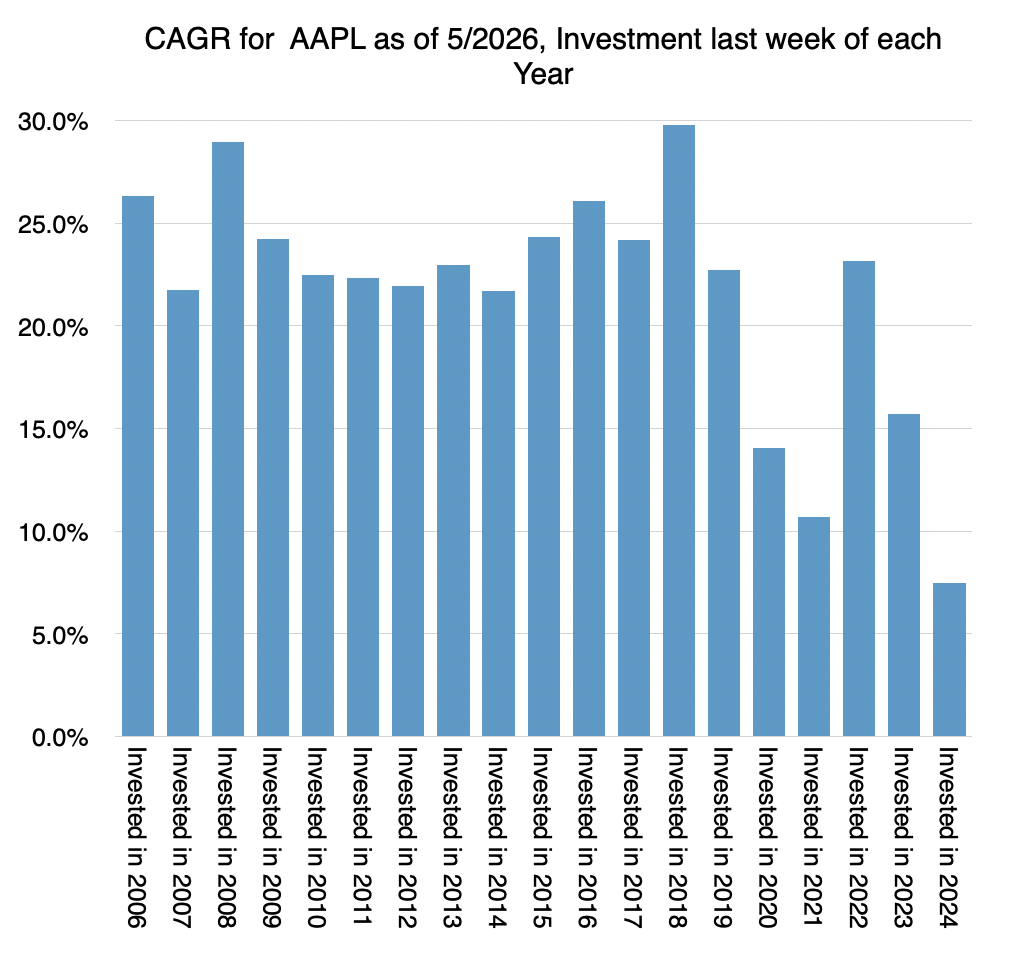
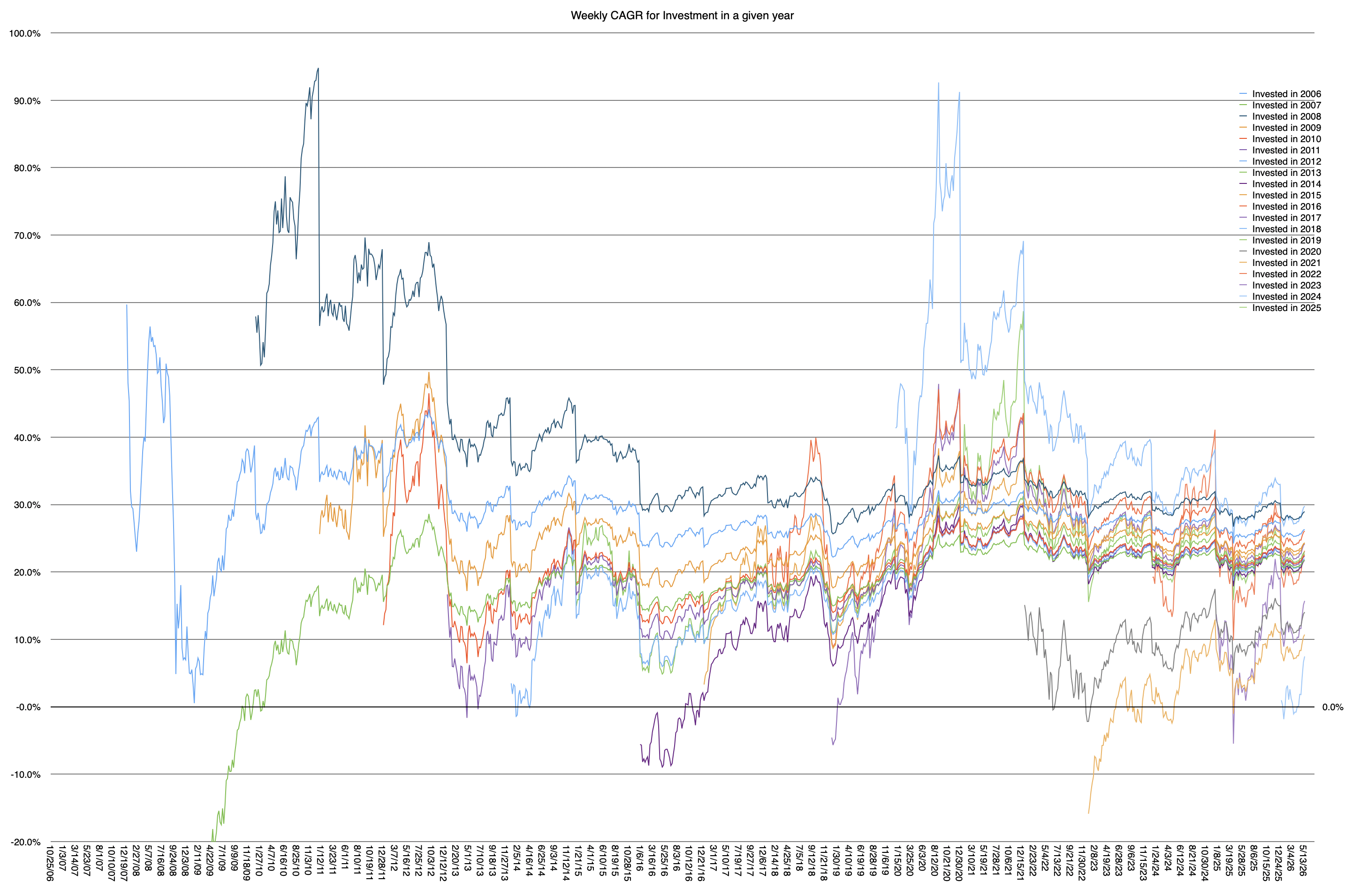
    You should ask what is the rate of return on Apple shares in the same way that the S&P 500 index is measured (since 1957) to have a 10% compounded annual growth rate (CAGR). I went through this exercise for the last 20 years: Assuming investment during the last week of each year, what would the compound rate of have been today?

    I graphed both the instant return for any point in history (the second graph) and return as of today (the end points of the second graph are shown in the first).

    The answer is: For investments longer than 1 year, the average is 21.6%. For holding longer than 5 years the average is 23.6%. For holding even longer, it does not drop much below 24%. Note that as investments are made, short-term they can be far above or far below the median rate of return. they tend to converge on the median over time. And what a median that is!

    If we use the rule of thumb that long-term investments in Apple have yielded about 24% then the rule of 72 means you double your money in three years, every three years.

    This is extraordinary not just because of the 24% CAGR but that it has been going on for about 20 years.

    The puzzle that Luca Pacioli and his students in Renaissance Italy must have considered has been the same as the one we have study today: How do you maintain that interest rate and hence that doubling period for long enough to benefit from it?

    The question has always been about sustainability.

    This is the question at the heart of Warren Buffett's investment thesis. He called it a moat. It's at the heart of management theory and it's called sustainable competitive advantage. And it's at the heart of Apple investment. Especially as the company was known as a hit-driven business. Hits are nice but they are not likely to be consistent. It's why it's had a low P/E ratio even though it was booming.

    Apple has always been a tough thing to invest in.

    But there is hope…

    …At the time Summa de arithmetica, geometria, proportioni et proportionalita was published, the world had a CAGR of 0.1%. For most of human history, any spikes in productivity or technological innovation (such as the printing press used to print the book) resulted in population growth rather than sustained improvements in living standards. Output per capita had remained practically flat over centuries.

    By the Industrial Revolution (1800 – 1913) CAGR increased 10-fold to 1.5% to 2.0%. The advent of mechanized manufacturing, steam power, and trade routes initiated an unprecedented era of sustained economic growth. For the first time, wealth generation outpaced population growth. It was the birth of plenty.

    By the late 20th century (1945 to 1973) CAGR doubled again to 4.5% to 5.0%. Following the end of the Second World War, the global economy experienced the most rapid and sustained period of growth in human history. Driven by technological and market innovation, global output soared. Much of the way the world is now governed and planned comes from the lessons learned during this period.

    From the 1970s to Present the world's CAGR has reduced to 2.8% to 3.5%. Much of this is due to globalization and the diffusion of innovations that were centered in early industrialized nations. The growth is also bifurcating into riskier technology investment (early adoption) and diffusion of technologies to later adopters.

    The opportunity to re-accelerate to 5% global growth might exist if diffusion rates increase. That is, bringing value rapidly to large populations.

    That should be the thesis. Apple's 23% growth could be extended and anticipated if it's seen as the distribution of the greatest ideas, which already exist, to a larger audience who, with the gained productivity leverage, return to invest again and again. It requires some degree of global and social stability but if you are willing to be an optimist in that regard, doubling every three to five years seems sustainable.

    Apple sustained 20%+ for 20 years and if it holds this rate for another 20 it will be a longer period of prosperity than the post-war era which only lasted 28 years. No pressure, JT.

  9. Was Siri just thirteen years too early?

    Office Hours Research · 4 comments

    An Office Hours question asked by Bob V., June 9, 2026.

    Q: When the iPhone 4S came out, the rumor was that Siri was its own operating system running alongside iOS. Watching WWDC, that intent-based OS finally seems to be arriving. Was Siri just thirteen years too early?

    It would seem that there’s nothing really new here but a quality and performance increase--admittedly a quantum one. Siri’s original dream, back when it was a research project at Stanford, was very much along these lines (as was Alexa, et. al.). I started my own career in information retrieval, a natural-language interface to query computers before we even had search. The idea was that you shouldn’t need to know how to program, or how to use a database query; you just ask for what you need and get answers sorted by relevance. All of that existed in the 1980s.

    So what’s new isn’t the chatbot. You can build a neat chatbot that fools people into thinking they’re talking to a human. What we started to see at WWDC is something else: a commitment to re-architect the entire guts of the OS, across all of Apple’s operating systems in order to surface this experience.

    But I came out of it asking: show me the money. None of AI is interesting unless we see economic activity, because if there’s no benefit, people treat it like another unrequested, unloved, unused feature. That’s the bane of product development. An unused feature is a symptom of over-service — you deliver things people don’t take up, and therefore won’t pay for. Christensen put it well: a commodity is a product where an improvement in performance does not allow you to increase its price. Iowa corn might be better than Kansas corn, but on the Chicago exchange it’s all just corn. All commodities have the same performance; a pork belly, a barrel of oil, a kWh, a bushel of corn. You don't want that to happen to your product or service. Improvements must be both used and valued by the customer.

    Apple is a consumer company with about 1.4 billion users. If they treat AI like Memoji — cute, but not life-changing — there’s no economic impact. I do however think Apple Intelligence is coming together into something people will use daily, and then we’ll see how much they’ll pay for this extra power.

    Right now the simple option is to pay for new devices to run it. Eventually, however, it will get repackaged into Services--probably as a subscription to more access, and that’s where the recurring revenue lies. iCloud already bundles a compute allocation; expect those tiers to change, and expect more price elasticity to enter the picture.


    Editor’s Note: This was one of the questions asked by participants in Asymco’s June 2026 Office Hours live Q&A session, open to Asymco One subscribers.


    Subscribe to Asymco One for more in-depth analysis and commentary like this.

  10. Why is Apple selling hygiene?

    Office Hours Research · 2 comments

    An Office Hours question asked by Greg, June 9, 2026.

    Q: That long child-safety section seemed to be championing the walled garden — things Apple can do that companies whose business models depend on selling data can’t. Was that a stance against Facebook or a message for the politicians?

    It’s a super important thing, but the word I’d use is hygiene. I remember this from Nokia: there are features that are pure hygiene. If you have them, most people don’t care; if you don’t, everyone complains, because it’s unusable. Safety is also like plumbing — only noticed when it fails. That’s why safety, even automotive safety, is almost never marketable. Volvo, maybe, but they’re a niche. People don’t want to hear about negative things.

    So here was Apple, in front of millions, talking and implying things sabout child "abuse"— unpleasant things everyone wants to avoid. Any marketer at Apple would have been beside themselves, because that’s a forum you’d normally use to generate euphoria, not dwell on harm.

    Which tells you it wasn’t really aimed at consumers. It was designed to induce a particular feeling in policymakers and authorities who’ve been pressuring Apple: we are custodians, doing our job extremely well, and we’re making it very public. That’s a strange thing to do unless there’s something happening behind the scenes.

    It also fits how regulators think. Engineers work with constraints; regulators work with outcomes and don’t think about how to get there. They are happy with a good intention pursued with the wrong approach. So Apple stood up and spent fifteen laborious minutes on safety as one of the three tent poles of the keynote — uncharacteristic, dull by design, and very carefully calculated.


    Editor’s Note: This was one of the questions asked by participants in Asymco’s June 2026 Office Hours live Q&A session, open to Asymco One subscribers.


    Subscribe to Asymco One for more in-depth analysis and commentary like this.

  11. Where is the monetization? Follow the compute

    Office Hours Research · 3 comments

    An Office Hours question asked by Roger S., June 9, 2026.

    Q: Beyond selling more capable hardware — phones, Macs, iPads — is there real monetization in all of this AI?

    Absolutely. They gave us an architecture: it’s about intent, about orchestration, about routing a request through multiple models and input types, and then deciding whether it goes through an app or back to Siri. Where’s the money? My answer is: follow the compute.

    If this works on-device, the user is happy buying the device, with the memory it needs, and Apple bundles all of that into the purchase price. Developers still sell their apps, but they’re not selling extra compute. But if a result requires heavy computation in the cloud, through an app, then trace it: who sends you the bill? That invoice comes from somewhere. If it’s a developer or a model supplier, it isn’t free — they’ll ask you to subscribe to get the answer, priced as a fixed fee or variable. Apple gets its usual commission, thirty percent or fifteen, somewhere in between.ssss

    If Siri depends on services that don’t go through an app, then Siri charges back through iCloud for the compute. So all they’ve really done is take the exact same business model — Services with subscriptions — and either fold compute into existing subscriptions or add new ones. Apple gets the same distribution commission it always has. Nothing changes. In fact, the absence of any commentary from Apple about new economics is, to me, a tacit acknowledgment that nothing different is needed.

    That means the App Store, and if anything economically interesting happens, you’ll see another kink in its trajectory — the way we saw a kink when subscriptions became dominant. To users, it’s invisible. Maybe the monthly services bill rises ten percent; maybe they add a couple of subscriptions and drop one. It all reflects in Services, at a 72%+ gross margin, with a hardware uptick alongside. I reckon it’s a ten-year cycle before half of the Apple base are AI active daily, paying something for it. Developers will just see more of the same, only bigger.


    Editor’s Note: This was one of the questions asked by participants in Asymco’s June 2026 Office Hours live Q&A session, open to Asymco One subscribers.


    Subscribe to Asymco One for more in-depth analysis and commentary like this.