Asymco

Asymmetric Intelligence

Research

  1. Knowing me, knowing you

    Research · 12 comments

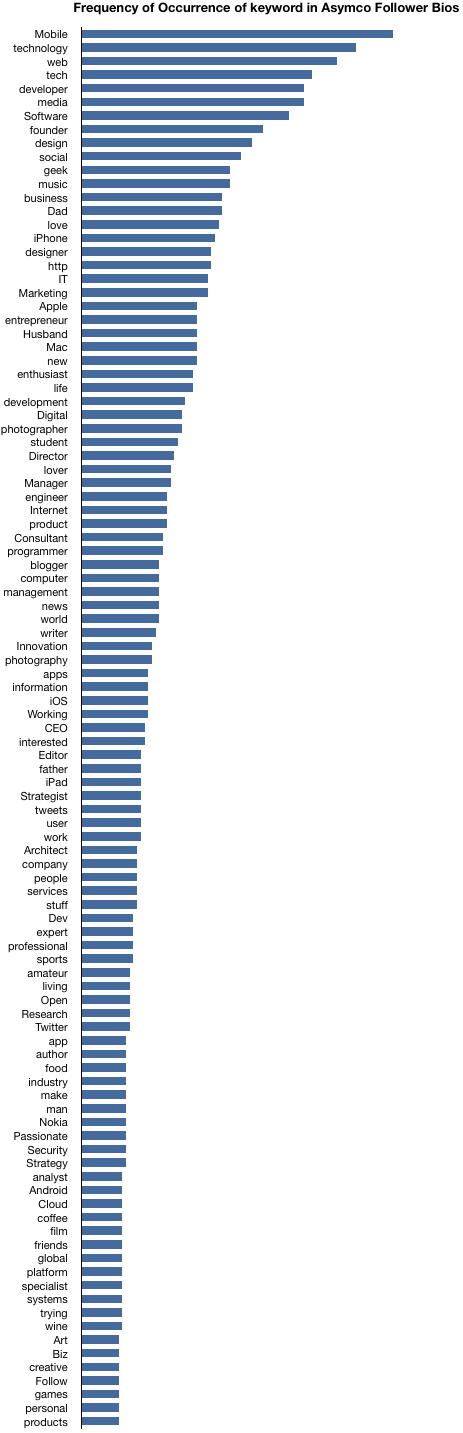
    Among the current (~1800) followers of Asymco on Twitter, about 1000 have published "Bios". In the interest of me getting to know you (and you one-another), here is a list of the most common words present in reader bios:

    Since I believe this is a representative sample of the readers feel free to write a profile of the typical reader in the comments below.

  2. Who killed the Intel microprocessor?

    Research · 76 comments

    The recently announced move by Microsoft to support the ARM architecture with their Windows product, indicates something profound is happening in the market for microprocessors.

    Dr. Hermann Hauser puts in bluntly:

    “The reason why ARM is going to kill the microprocessor is not because Intel will not eventually produce an Atom [Intel's low-power microprocessor] that might be as good as an ARM, but because Intel has the wrong business model,” said Dr. Hauser. “People in the mobile phone architecture do not buy microprocessors. So if you sell microprocessors you have the wrong model. They license them. So it’s not Intel vs. ARM, it is Intel vs. every single semiconductor company in the world.”

    via Intel Microprocessor Business ‘Doomed,’ Claims ARM Co-Founder - Tech Europe - WSJ.

    To make sense of that you have to step back and look at what's been happening in microprocessors and how mobile computing is affecting the whole processor value chain.

    The first observation to be made is that, as Dr. Hauser points out, ARM licensees use a different model than Intel. The development of an ARM-based microprocessor is done in a modular way; in contrast to the integrated way that Intel builds their products. ARM supplies a license, and designers build the chip adding various other circuits like Bluetooth or music decoding on the same silicon as the processor creating so-called SOC (system on a chip). Nokia has been doing this for years and Apple began doing it recently with their A4 SOC.

    The design is then sent to a fabricator who actually manufactures the chip (TI and Samsung are some of the bigger ones), often in smaller batches than what an integrated vendor produces.  SOC fabs need to be much more flexible in their production and are much more sensitive to the needs of their customers, the designers.

    In contrast, Intel has a proprietary microprocessor architecture that is not available for licensing and they have their own designers and their own fabs to build chips that they sell from a catalog to device builders. PC or device vendors only get to use what Intel offers and there is little in the way of customization (In a rare exception Apple famously forced Intel to modify the packaging of the first CPU fitted to a MacBook Air.)

    Because of the differences in business models, the markets for SOC and microprocessors are diverging rapidly with subsequent business model priorities becoming completely asymmetric.

    To illustrate, I draw upon an observation[1] that due to Moore’s Law, every year, through the equipment they deploy (e.g. from Applied Materials) fabs make 60% more transistors available on an area of silicon than were available the prior year. Intel almost always takes advantage of this by making more cores or adding more cache.

    But if you look at the ability of SOC designers to utilize transistors, they are only able to utilize 20% more transistors than they were the year before. The reason is that they have constrained design budgets; they don’t have enough money or time to design circuits that are complex enough to utilize all the transistors that Moore’s Law makes available. Plus, when it comes to devices, they don't need the power.

    What that means is, for most of the volume applications in the world, circuit designers are actually awash in transistors.  They are being over-served by the advances in fabrication equipment. However, Intel designers aren't. Being at the very high end they still need even finer line widths and demand that Moore’s Law take the next step to that next leap of technology.

    What value chain evolution theory would then predict is that circuits which had to be proprietary and interdependent in their architecture are following an over-service path. In contrast, to serve the needs of SOC designers, fabs, as suppliers, will have to change their pitch for winning new business to being fast and flexible and responsive and to being able to deliver systems on chips that offer every device exactly the functionality that they need and none of the functionality that they don’t need.

    Now in the world of mobile computing (and almost any situation where logic gets embedded in a system) it’s the device itself that is not yet good enough and, therefore, you cannot back off from pushing all the components to conform to your device's purpose.  For a device to be competitive it has to be optimized with a proprietary, interdependent architecture.  That means that the processor inside of a BlackBerry or an N8 has to be modular and conformable to allow the system to be optimized.

    This is a quirky idea so I'll repeat it: since the device is not good enough it has to be integrated, including the processor, which being good enough, has to be conformable. The processor has to bend to the will of the device market not vice versa.

    This then puts Dr. Hauser's point in perspective: a modular business architecture for microprocessors is a necessary condition to being successful supplying devices. The corollary is that Intel's integrated business model is obsolete in a device world. No amount of polishing of the Atom will help.

    The root cause for this obsolescence is the over-shooting of Moore's law when processing power (and hence circuit density) is superfluous while power consumption, size and flexibility of design are straining to eke out any improvement.

    So this renaissance of ARM is happening now because Moore’s Law has overshot what most circuit designers can utilize. And that overshooting is happening because mobile computing products don’t need a multi-core multi-gigahertz processor, allowing designers to back away from the frontier of what's possible.

    What it culminates in is that the places in the value chain where attractive profits can be earned are migrating in a very predictable way: away from Intel and toward ARM.

    So in a perverse way, it was Intel founder Moore's law that killed the Intel microprocessor.

    ---

    [1] This discussion is inspired by Clayton Christensen's "Capturing the Upside" presentation at the Open Source Business Conference 2004-03-17. Although taking place nearly seven years ago, Clay's vision regarding the future of the microprocessor was astonishingly, though perhaps unsurprisingly, prescient.
  3. Nearly 75% of iPhones are in use outside the US

    Research · 29 comments

    comScore reported that 15.4 million iPhones were in use in the US as of November. (25% share of 61.5 million total smartphones.)

    We also know that about 75 million iPhones were sold by November since the product launched. With about 17 million units older than two years, and assuming that half of those might still be in use and that all the iPhones less than 2 years old are still in use, we get an upper bound of 66.5 million iPhones in use globally.

    That means 23% of all iPhones are in use in the US and that 77% are in use outside the US.

    Can this be verified?

    The sell-through data we have supports a slightly lower figure.

    October 2010: 63 percent of iPhones were sold outside the US in Q3

    April 2010: Non-US iPhone sales approaching 70% of volumes

    This might indicate that comScore surveys under-represent the iPhone or that device attrition/retirement is significant. However, the data does seem to imply that the US is no more than one third and perhaps as little as one quarter of the iPhone's user base. Perhaps with Verizon, that figure will grow. But at the same time, new international markets (like China) may continue to outgrow the US.

    The 4:1 split could continue. After all, the US represents only 234 million out of about 5 billion mobile phone users globally--a mere 4.7%.

  4. Will T-Mobile's hundred dollar smartphone with ten dollar data plan win subs?

    Research · 21 comments

    Chief Executive Philipp Humm said in an interview that many of his smartphones will eventually be made up of Google-powered phones costing less than $100, half as much as the smartphones typically available at U.S. carriers. In October, to lower the cost of monthly bills, Mr. Humm introduced a limited data plan that costs $10.

    via T-Mobile Smartphones to Head Down Market - WSJ.com.

    T-Mobile seems to be attempting to differentiate on price. In a regular market reaching saturation that might be a viable strategy. However the market is neither regular not saturated. T-Mobile's chances of gaining large share are limited.

    Churn, or the chance that a user will switch networks is still very low. If anything, AT&T and Verizon are more sticky and lose fewer customers than T-Mobile and Sprint.

    Mobile computing saturation (25% to 30% penetration) is also not nearly at a point where competition on price leads adoption.

    Lastly, the $100 price point is being put against the standard $200 price point which itself is an illusion for the user. The drop in smartphone entry price is not as powerful going from $200 to $100 as it is from $300 to $200. Psychologically, $200 is an inflection point. Apple's $100 3GS pricing (now $49) is defensive and probably effective.

    In short, the market for telecom services is not very "liquid" and users are quite trapped in their carrier contracts, pricing is not yet a basis for competition and pricing illusions persist.

    In conclusion:

    Mr. Humm, in an interview at the Consumer Electronics Show in Las Vegas, acknowledged that the likelihood Verizon Wireless getting the iPhone as well could affect his subscriber numbers.

  5. Half of US population to use smartphones by end of 2011: Update

    Research · 10 comments

    Half of US population to use smartphones by end of 2011 | asymco.

    A month ago ComScore reported that in October 2010 25% of Americans above the age of 13 used smartphones. The latest report shows that share to have risen to 26.3%.

    That means there are 24 percentage points of penetration to go until the majority of Americans are smartphone users. In absolute numbers this implies about 56 million additional users (and hence units sold).

    The rate of penetration growth was 1.3 percentage points per month. Assuming no acceleration in this figure and assuming we rely on ComScore (vs. Nielsen which reports higher figures) then majority share is 18 months away, or mid-2012.

    However, assuming some acceleration and a different sampling method, I still believe that we could see this figure by end of this year.

    In either case the tipping point is near.

  6. Resetting Motorola

    Research · 31 comments

    Motorola—like HTC—is thus a bellwether for makers of Android phones, whose sales have now caught up with those of the iPhone—about 300,000 a day worldwide. Some industry analysts doubt that it will be able to create a big market for its devices and make enough profits before cheaper providers move in. If they are right, the smartphone market may eventually become like that for personal computers: a handful of huge competitors with tiny margins. The difference will be that these firms will hail from around the world rather than being mainly American.

    via Motorola: Breaking up | The Economist.

    When I argued that the meek shall inherit Android, the profitability data was the core evidence. That argument, made in August, was:

    So here we have the real challenge to Android:  partnership with defeated incumbents whose ability to build profitable and differentiated products is hamstrung by the licensing model and whose incentives to move up the steep trajectory of necessary improvements are limited.

    In other words, Android’s licensees won’t have the profits or the motivation to spend on R&D so as to make exceptionally competitive products at a time when being competitive is what matters most.

    The surge in emerging market Android entrants has been the latest setback for branded Android vendors. What should be the long term strategy for companies like Motorola and Samsung?

    Paradoxically, Motorola, being the weaker, has the best chance for successful recovery. The clue lies in both what Palm (now HP) and Microsoft did: starting with a clean sheet of paper and building their own platforms.

    This might seem futile given the network effects that current platforms are gaining, and there is a big execution risk, but the alternative is no alternative at all. The big incumbents cannot fight against the clone makers.

    Technically, building a new platform is not as daunting a challenge as it used to be. Palm, a small company, managed to do it in about 2 years. Microsoft, a large company, took 18 months. Google built theirs in about 2 years.

    They all took advantage of existing code bases (Linux or Windows CE). They also rely on web standards for their APIs (.NET or Java or HTML5).

    The challenge is bigger in attracting developers, though again, some core set of apps and developers can be obtained on the promise of brand power alone. Intel and Nokia is using this power for MeeGo.

    Motorola's advantage today is its new autonomy and singular focus on mobility. It has hit the reset button. There is no better time to be courageous and there are no sunk costs to confuse investment priorities. Android was a necessary stop-gap measure and the Droid timing was very good (before the clones and before iPhone distribution expanded). However, now would be a good time to start building a Motorola platform for the future.

  7. This is the most exciting CES ever

    Research · 149 comments

    At this year's CES two unthinkable things happened:

    1. The abandonment of Windows exclusivity by practically all of Microsoft's OEM customers.
    2. The abandonment of Intel exclusivity by Microsoft for the next generation of Windows.

    Many of Microsoft's customers chose to use an OS product from Microsoft's arch enemy. Some chose to roll their own. Microsoft, in turn, chose to port its OS to an architecture from Intel's arch enemy.

    These actions confirm the end of the PC era. Although most people would characterize the era as exemplified by a particular form factor or market, for me the definition of that era is the way the value chain was structured and hence how profits were captured.

    That era was marked by the condensation of profits around two companies, Intel and Microsoft, with the simultaneous evaporation of profits from all other participants in the value chain.

    To achieve this, Microsoft maintained a monopoly on the distribution of operating systems and Intel maintained a monopoly as the single supplier of chip architectures for that operating system.

    These monopolies are both over. And they both ended at the same time. And it happened this week.

    Who says CES is boring this year?

  8. How sticky is Android?

    Research · 204 comments

    There is an assumption floating around the debates in this and other forums that the "battle" between mobile platforms is a land grab. The unspoken implication of this assumption is that once a user is captured she is permanently locked into the chosen platform never to move to another again as long as she lives.

    For example @dutchtender remarked:

    many people's first smart phone will be android. android can take them "cradle to grave." android will be there with a higher end solutions when they can afford it

    This is a strong but untested claim. It may be true but we owe it a bit of thought.

    A long time ago I tried to model platform growth is by using a version of Metcalfe's law. I suggested that the value of a network is proportional to n log (n) where n is number of nodes in that network[1]. This was somewhat based on common sense as it measures the possible links between n nodes with degradation due to the limits of social graphs.

    The value the network creates is what developers as well as all the other participants in the ecosystem are able to tap into. The platform vendor gets to capture a share as well of course. As the value grows it tends to create network effects or a self-reinforcing cycle.

    What I'm saying then is that we can treat a platform as a network, where each node is linked to another node by the commonality of experience.

    The proxy of the model was Windows. Twenty years ago, having Windows meant that you could exchange files with other Windows users simulating a sort of network protocol. You could also ask your peer group for help and get software tips and new consumption ideas. So the more people used Windows the more likely it was that you also had to use it. Avoiding Windows limited your ability to be part of productive society (this is no longer true by the way, which is one reason Microsoft is in trouble).

    If we fast forward to the mobile post-PC world, when it comes to platforms the shared experience is that of apps. People can communicate their app experiences and their usage better if they have the same platform. They can also learn from each other how to better use the products and how to solve problems. The more people that use a mobile platform, them more value it generates for platform participants.

    The other factor determining value is that a platform also creates sunk costs. Usually called "investments" by users these are costs that are incurred and have a potential for future value. This means that the apps purchased and time spent learning and adjusting to the platform are sunk costs which users are reluctant to abandon. (Notwithstanding the fact that as sunk, these costs should be ignored when comparing the value of another platform,--psychology is what keeps users loyal even if it's not in their best interest.) This "sunk" factor of value is not as powerful as the sharing of experiences value since it does not scale with the number of users. That cost is a constant multiplier on top of the n log (n).

    So the overall "value" of a platform is K n log(n). Where K is the stickiness of sunk costs.

    Can this be stated plainly without the math?

    When you compare two platforms you have to ask how contiguous users (n) grows and how stickiness (K) grows. The issue with fragmentation is that it actually cuts n. Many people won't be able to share experiences if their devices don't work the same way. Same with geographic density of a platform. If, as was the case with Symbian, there are few segments that became saturated with the platform then n is reduced.

    The issue with a lack of paid or compelling apps is that it cuts stickiness, so that you don't have any sunk costs. Similarly the presence of ported or common apps means that K is reduced for any single platform. Nokia's Symbian has a serious problem with both consistency and with commonality of experience. RIMM depends too much on the commonality of messaging which is quickly becoming a commodity due to portability of the experience.

    So in the end it's not just about how big the user base n is (which is the only thing that is measurable). It's how contiguous n is and how compelling the content.

    This is too sketchy a model to be practically applied but it offers a thought experiment: does any given platform have

    • A large, contiguous user base with strong concentrations of users in the same demographic or psychographic segments?
    • A significant set of unique content (apps) which require costs from the user (in terms of data, time or cash)

    It's not a clear cut case in my mind that Android benefits from these as much as iOS does. If that's the case, users are more likely to be moving on a one-way street between these two: from Android to iOS and not vice versa. The same thought experiment can be engaged in between any two platform contenders.

    ---

    [1] Metcalfe's law is actually an n*n growth curve but recent research indicates that social networks scale in value as n log (n).

  9. [Updated] Samsung's Android Problem

    Research · 53 comments

    [Samsung] said it has sold around 4 million Galaxy S smartphones in North America, 2.5 million in Europe, and around 2 million in South Korea in the past seven months.

    via Samsung Sells 10 Million Galaxy S Android Smartphones - Digital Lifestyle - Macworld UK.

    Samsung's US Android sales are very similarly allocated to Apple's iPhone sales: 40%. But at 20%, South Korea represents a very large portion of their sales (2 million phones sold in 7 months into a country of 48 million). This is understandable given Samsung's distribution power in its home country. However it also implies that Samsung's [high end] Android sales in Asia excluding South Korea are tiny. Only 1.5 million were allocated to outside Europe, US and South Korea--a market that includes the whole of Asia, Africa, Middle East and Latin America.

    If we believe that Android is activated at the rate of 300k units per day, then Samsung represents around 40k of that. (10 million over seven months, linear extrapolation.) So where are those remaining 260k units/day going? Gartner calculated that in Q3 Samsung was the leading Android brand (about one third of all units). The Samsung figures make these share numbers very obsolete because 40k/300k is only 13.3%.

    It's hard to pin down the market because the share shifts are dramatic and the market's growth is not linear. Nevertheless, intuition and guesswork leads to me believe that Android activations are to a large degree (perhaps two thirds) in Asia. This in turn implies that Samsung is not a major participant in that market.

    Since neither LG (who does not have a strong Android portfolio) nor Sony Ericsson or Motorola which have low volumes, (nor obviously Nokia, RIM or Apple) are supplying the Asian Android market, the question is who is? Only HTC remains a contender but it's not big enough to account for the difference and they too are focused on the established Western markets (except for a modest presence in China).

    We are left again with circumstantial evidence that "Other" lower tier vendors are carrying the Android torch in Asia. Pdadb.net shows 277 Android models available. Brands like ZTE, Huawei, Acer, Notion Ink, Linx, TMN, FirsOne, Ziss, Kogan, Highscreen, Saygus, Haier and Forsa are selling Android devices (though not all in Asia).

    Not that there's anything wrong with that

    If there is a worry it is perhaps that Samsung might find it hard to maintain the top spot in supplying Android once the unbranded vendors make it through the distribution obstacle course (as HTC did when it reached 80% of the Windows Mobile share.)

    If one is to argue that Android empowers the desperate incumbents, then one has to also agree that it also empowers the more nimble entrants--inevitably leading to even more desperation.

    [Updated: thanks to reader @UVStaska who noticed on glaring error in the analysis. I had failed to see the "S" in the original quote and been assuming the 10 million figure represented all Samsung Android sales. The Galaxy brand is the Android brand but the "S" model is only one product within the line-up. Samsung Android sales are likely much higher than the 1.5 million I assumed.

    Back to the drawing board with the question of Samsung's strength in Asia. One does still wonder how well they are doing relative to entrants.]

  10. The PC clones of the post-PC era

    Research · 28 comments

    Since I spend most of my time thinking about what will happen, at the end of each year, rather than looking forward I like to look back to see how wrong I've been. The great thing about being wrong is that you learn something. Especially if you use a foundational theory to tie concepts together. Theory building is all about finding anomalies that adjust and improve it.

    Fortunately, exactly one year ago, on December 30 2009 I wrote an article asking if Android was disruptive. It turned out to be the right question to ask for 2010.

    What have I learned since?

    My main argument in late 2009 was aimed at the reaction of the recently launched Nexus One. A product hailed as disruptive to mobile operators. I did not see it that way. In that respect I was right. The distribution juggernaut any phone platform faces stopped the Nexus One dead in its tracks.

    I wrote:

    Here’s the problem: since mobile broadband is by all accounts not good enough, it cannot be disrupted. Operators are very critical in building out this new mobile computing future and they are investing and will reap rewards. Bitpipe models will only emerge after 4G when there will be ubiquitous high speed networks and competition will shift away from coverage and more to price and convenience of plans.

    What is happening instead of operator disruption is that mobile voice which is more than good enough is being disrupted. Businesses built around mobile voice (e.g. handset vendors who have not developed a viable business model around data) will simply evaporate and their profits will condense around entrants who have mobile computing platforms.

    So the operators are as strong as ever. But the Android platform lived to fight on, regardless of the Nexus one. And it grew in ways I did not anticipate. I had expected integrated players to maintain a large share because they would be able to improve the product more rapidly than modular vendors (and assuming that the product needed improving).

    Google is moving on this opportunity but they are not executing in a way that ensures they control the future platform due to the their being on the wrong side of the modular/integrated dichotomy.

    So Android grew but it's not yet creating profits. It is perhaps laying the foundation for future profits and defending existing profits for Google but it is not yet a big profit center[1]. That is a cause for worry. Disruptors need to be hungry for profits and patient for growth.

    I concluded:

    Android will disrupt but I expect it will take 10 to 15 years. The life cycle of a new global network generation rollout is about 10 years. We’re in the middle stage of the 3G cycle that traces its beginnings to early this decade. 4G will take another 10 years.

    Given what's happened this year does this forecast still hold?

    Mainly yes. I stand by the notion that operators will be in the driver's seat for a few years to come. However Android has grown in an unexpected way: adoption by unbranded or relatively unknown vendors selling in emerging markets.

    The Grey (market) Elephant in the room

    Until 2010, it was very difficult to sell a phone without a recognizable brand. This is because brands helped overcome purchase anxiety for those buying a device for the first time. Brands mean trust and the lack of brand meant risk. Those who cannot afford to make purchase mistakes are more likely to lean on brands than the affluent.

    But 2010 has seen a shift away from device brand value and more toward platform and function value. This shift was largely unforeseen and is very disruptive.

    The fact one in three phones are sold from "other" unbranded vendors like ZTE, Huawei and G'Five is a bombshell. Right now they're all selling voice products, but I predict that will not last long.

    All those vendors are likely to adopt Android and in doing so will explode the low end of the market. They may even crush the branded voice-oriented market.

    This growth can be slowed by operators but market forces will be very strong. These devices sell in grey markets and are often unlicensed, unbranded, untaxed and unregulated (and may even be illegal due to the absence of IMEI numbers).

    So this is the real wild card for 2011: unbranded devices running Android could be the PC clones of the post-PC era. Will this phenomenon last or will the brands fight back? If they fight, the only weapon they could wield is innovation.

    ---

    [1] Mobile efforts at Google are generating over $1 billion in revenues per quarter however these efforts include various other assets including AdMob which was acquired for $750 million. Furthermore, the headcount for Android and these other efforts is not small. I've heard as many as 3000 people are devoted to Google's mobile efforts.

  11. G'Five overtakes Samsung in India: What does this mean for your favorite mobile OS?

    Research · 63 comments

    With a market share of 31.5 percent, Nokia is still the largest vendor of handsets in the Indian market, followed by Chinese brand G'Five with about 10 percent share, IDC said on Wednesday.

    via PCWorld.

    No, I haven't heard of G'Five either. The article goes on to say that there are 68 new vendors in the market accounting for 41% of total shipments. There were only five new vendors with a share of 1% in the first quarter of 2008.

    It was not long ago that Nokia held over 70% of the Indian market. That market is now larger but the share for Nokia has dropped by half at least. The share was not lost to Samsung but to 63 new entrants. They managed to capture 40% of the market, roughly equal to what Nokia lost.

    These new vendors will launch Android phones next year or the year after that. According to IDC, Android obtained 9.4% in the third quarter up from 2.9% y/y. The number of Android models went from 2 to 19 in the same time frame.

    What does this mean for Your favorite mobile OS?

    I'm sure many will use the Indian example as evidence of the inevitable ubiquity of Android. However, I would note that data networks are still very sparse in India and 3G has not reached a level of penetration that makes mobile broadband a common experience [citation needed].

    The funny thing is that this lack of connectivity is not likely to be an obstacle to Android as it wasn't an obstacle to Symbian in the pre-3G era in Europe. More than half of Nokia's smartphones were selling without data plans in Europe well into 2009. Nearly all were selling without data in Africa, Middle East and India. Smartphones without data plans are just high end feature phones. They can be used for picture/video taking, listening to music/video, FM radio and, if they have a keyboard, for more productive text messaging. In emerging markets dual SIMs, FM radio and removable storage are killer features. Mobile browsing isn't.

    A lack of broadband is however an obstacle to the iPhone. Here's why:

    With the exception of those seeking "luxury" phones (a very small minority), the iPhone is too expensive in markets without subsidy. That's because the price Apple sets is very high (€630 or well over $800 at retail). This is not entirely because the product is inherently more expensive. Much of that extra cost is margin for Apple. What makes it popular is that much of that extra cost is paid by the operator who accounts for it as a subsidy. Don't pity the operator though. That subsidy is there for a reason: because the product entices users to data-oriented consumption at a higher monthly service fee.

    The entire business model for the iPhone is to wrap a high-ARPU mobile broadband service plan with shiny metal and glass.

    Put another way, an iPhone without a broadband connection is just a voice phone with an integrated iPod touch. You're better off getting a cheap phone and an iPod, or maybe an Android or Nokia phone.

    When the iPhone 3G launched in India in 2008 with a price near $1000 it flopped. Many were quick to note that Apple did not understand the market. However few pointed out that the "3G" in the product's name was not just a marketing ploy. It was its Raison d'être.

    To study the impact of iPhone in emerging markets you need to first plot out the penetration of mobile broadband.