Asymco

Asymmetric Intelligence

Latest from Asymco

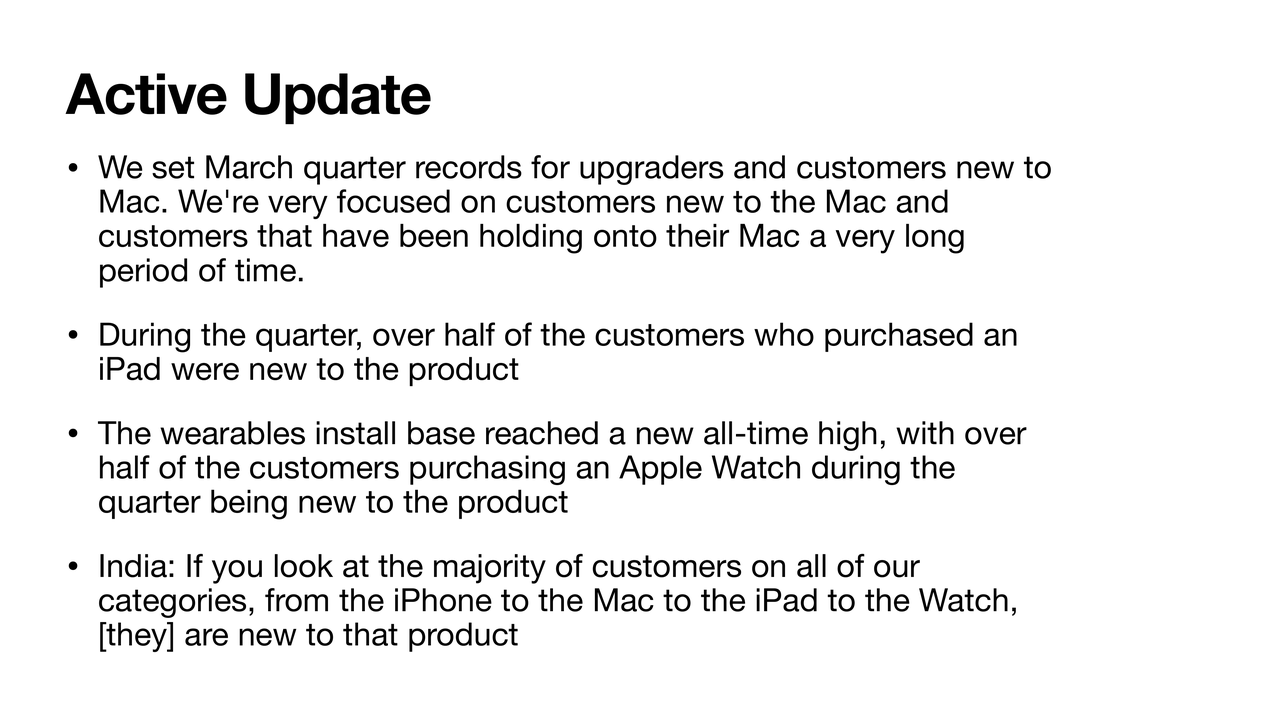
  1. What Are the Mobility Design Surfaces?
    Research · 1 comment

    An Office Hours question asked by Darcy B., May 1, 2026

    Q: Will Apple do more in transportation than CarPlay Ultra? Not just cars — transportation in general.

    Well, there's a lot of modes out there, and I apologize I didn't get into all of them. I had assumed falsely — I think way outside of cars myself, obviously, but it's very rare that others do. My bad that I kind of assumed that. But the answer doesn't change. I don't think Apple will do much in mobility. The reason being — first of all, cars are a lousy business. They are, were, and will be a lousy business forever. Maybe to won't even exist very long. I just find it shocking, that it continues to exist today.

    But the problem is that the other modes are less of a surface for Apple to add value to. In other words, there isn't a lot of design surface on which you can put your design and your ideas. And the reason for the surface problem is that, first, there's modes that are public and shared — buses and public transport, even airplanes. You could imagine, for example, having the back of the seat in front of you be an iPad. Why is it this screen on the plane one you can never comprehend? But you try to figure that [business] out, and you realize it's a dead end. You just can't serve that market as Apple. So there's that design surface in airplanes — you've got the seat back.

    Then you look at other modes, and you look at micromobility. The problem with micromobility is the surface is below your sight line when you're using it. You're looking above typically where the vehicle is. I consider it a heads-up experience, not a heads-down experience. Cars are heads down and becoming more so. They're cocooning the user in a bubble for an hour a day. That's what can be tolerated, typically. Not a great idea. Why? Because an hour is not a significant amount of time that will separate that experience outside of the phone.

    Now, if you're looking at micro, the problem there is that it's a heads-up experience. And unless it's going to be through a wearable — that was my dream for the Vision Pro two, three years ago, was that it would be usable as — even integrated into a helmet. And then you have a visor coming, and then you have a beautiful design surface. In fact, the design surface is the entire world. Because as you see it, whatever you're looking at can be considered a surface upon which you can add a new reality [and new services].

    And that is a dream and vision, that if it were to happen, not only would Apple be a very, very interesting player to create a virtual world on top of existing worlds — outdoor experiences. That's a great, great opportunity. Spatial computing outside of the home. Just put that down as the summary — spatial experiences outside the interior spaces. When that happens, it'll be very exciting. It'll be very much Apple's contribution to repaint the world.

    But it takes time, and this is where we're stuck. We're stuck in this, like, not good enough, not small enough, not light enough, not powerful enough — all those things. And if they get solved, we'll move into that world.

    And that goes back to a lot of debates about whether the Vision Pro is or just not going to continue. I definitely think it's going to continue. Even the latest comments from John and Joz, together, saying — the phrase they used was, "we pulled this from the future into the present." So they are effectively stating that it's too early. It's a future that hasn't come yet. But they're proud of what they achieved, and it is amazing what they've demonstrated is possible.

    It's not the old Apple, though. Old Steve Apple was: you don't release until it's not just market ready, but mass market ready. And that was a risk. Maybe this was another thing that Tim did that was not what John would do. But to work on this problem is exactly what John would do, because solving spatial computing is, like, more important in my mind, because it is the human-computer interface. Which is essentially the physical layer of the entire world. That reconstruction of the physical world and broadcasting it into your retina is the future. It's not audio. It's not some background thing. It has to go through the eyes. And if it goes through the eyes, it's where Apple wants to be.

    So I do believe there's going to be a lot of research to be done there. And maybe it'll still take a couple years once the AI thing runs its course.

    This was one of the questions asked by the participants in Asymco's May 2026 Office Hours live Q&A sessions, open to Asymco One subscribers.
  2. June Quarter Expectations

    Research

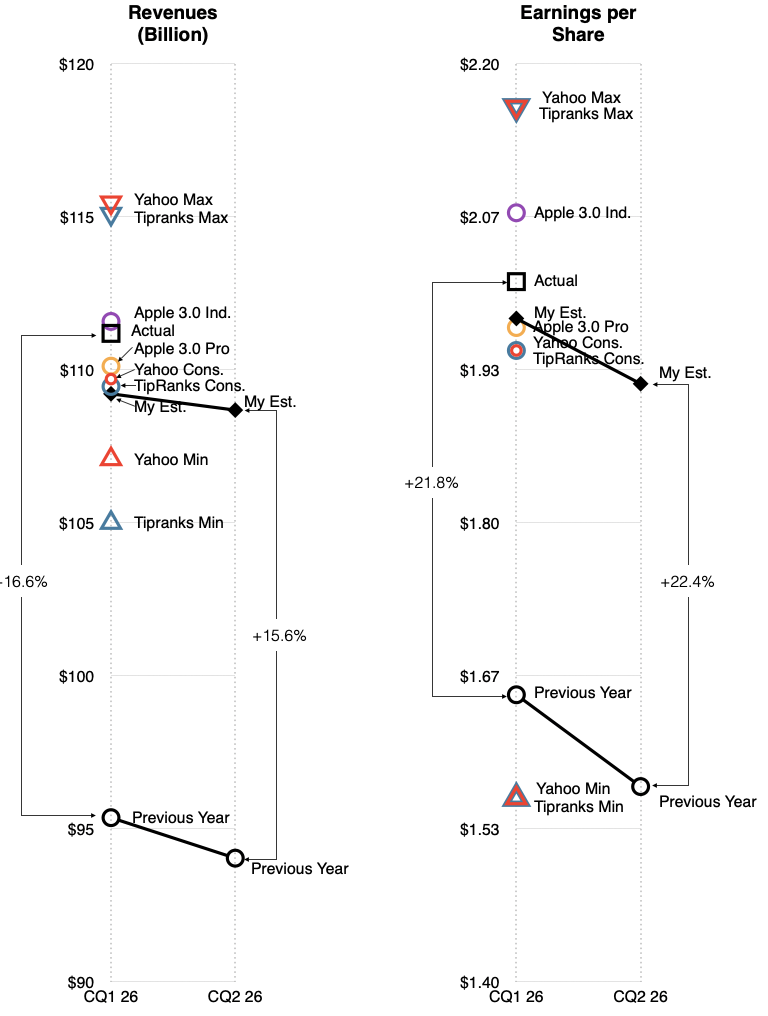
    22% EPS growth is implied.

    We expect our June quarter total company revenue to grow by 14%-17% year-over-year, which comprehends our best view of constrained supply. On iPad, keep in mind, we face a difficult compare driven by the launch of the A16-powered iPad in the prior year. We expect services revenue to grow at a year-over-year rate similar to what we reported in the March quarter after removing the favorable year-over-year impact from foreign exchange tailwinds. Keep in mind, during the March quarter, FX was a 2.5 percentage point tailwind to the total company growth rate, and for services, that impact was slightly more favorable.

    We expect gross margin to be between 47.5% and 48.5%. We expect operating expenses to be between $18.8 billion and $19.1 billion. We expect OINE to be around $250 million, excluding any potential impact from the mark-to-market of minority investments, and our tax rate to be around 17%. With that, Tim and I will take questions.

    - Kevan Parekh, CFO

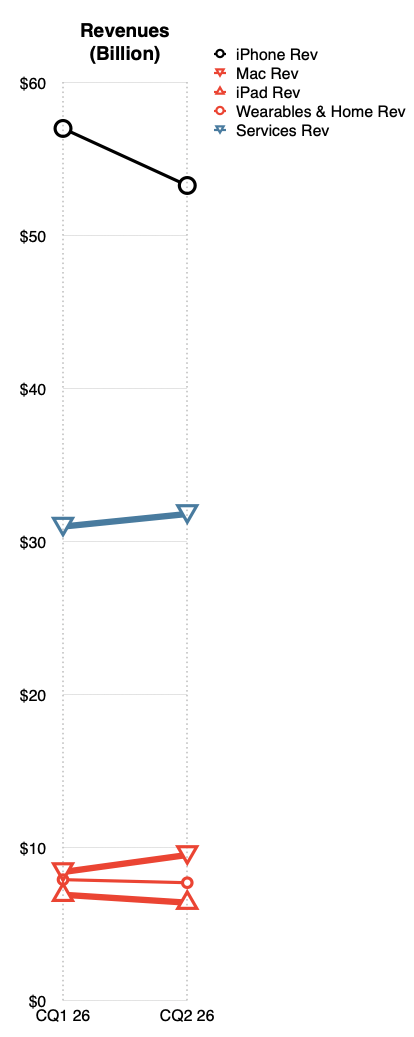
    Based on the above, here are the estimates for Revenues and Earnings per Share

    Sequential change in segment revenues:

    My Revenues and EPS expectations in table form:

    CQ2 26
    Year Earlier Rev94.036
    My Est. Rev109
    Year Earlier EPS1.57
    My Est. EPS1.921
    My Rev. Growth15.6%
    My EPS Growth22.4%

    My segment revenues and growth expectations in table form:

    iPhone Rev53.267
    Mac Rev9.514
    iPad Rev6.396
    Wearables & Home Rev7.700
    Services Rev31.800
    iPhone Growth (y/y)19.5%
    Mac Growth (y/y)18.2%
    iPad Growth (y/y)-2.8%
    Wearables & Home Growth (y/y)4.0%
    Services Growth (y/y)16.0%

    Note that the revenue expectations are for 15.6% growth while guidance is at 14% to 17%. Chances are that they will hit the upper end of the range and I may revise these estimates to reflect that as we get more data.

  3. Will Apple Silicon Tackle Memory?

    Research · 1 comment

    Asked by Ian Hobson

    Q: Will Apple evolve to make their own memory chips, or manufacture compute chips instead of just designing them? Will they go much more vertical?

    It's a possibility — capability is not willingness to do it. They're capable of doing it. They can become vertically integrated on all manners of silicon. I think the decision is a very careful one, because you have to commit years in advance. They did so, as I said, with Qualcomm. They needed to push that dependency out. I think memory may come next. And they need to figure out what they're going to do about TSMC as well, by the way, if you have a single supplier there.

    But this is an ongoing thing. They're always re-evaluating it. And I'm not concerned, because nobody does this better. You see other companies' jealousy. You see other companies wanting to do what Apple did eight years ago with the A series. The fact that you can hire a team and become a chip designer — we hear about Tesla, Google, Amazon. I don't know — probably Microsoft's got a team, and probably Meta's got a team. So I just see these out of the corner of my eye and say, well, obviously, yeah, you can now hire a semiconductor team.

    And one of the things about Srouji, by the way, that was making a lot of news, is that he got elevated to this position. Very likely he is getting a lot of inbounds, saying, hey, if you come and head this up for us, we'll give you half a trillion dollars. And the amount of money people are willing to throw at this is extraordinary. But again, he wasn't the first, he's not the last. There is an importance in good teams, but it is also important to have a deep bench.

    This was one of the questions asked by the participants in Asymco's May 2026 Office Hours live Q&A sessions, open to Asymco One subscribers.
    See also: May 2026 Office Hours

  4. The great memory panic of 2026

    Research · 2 comments

    Office Hours question asked by by Ian H. on May 1, 2026

    Q: Memory prices could move from 15% to 40% of the BOM of a device. This seems incredible. So how can Apple deal with this?

    This has been on people's minds now for what, three, four months? I think since January. I call it the Great Panic of 2026. The great memory panic.

    First of all, you have to understand the scale that Apple operates at. The number of devices in the hundreds of millions. It's not just iPhones, obviously. All of the Apple products consume some memory. And there's a lead time. When you're dealing with scale, there's a lead time. There's usually a couple years of lead time. And every supplier who works with Apple is doing it because they love volumes.

    Now, volumes are good for suppliers because they can also predict things in their own operations. They can plan, they can raise capital. Usually they need loans to do that, and they get good terms on loans if it's a long-term payback. And there's a lot of moving parts there that benefit scale.

    The difference with memory pricing that we're seeing a lot of anxiety around is at the margin. That is to say, there's a base production, and then there's a variable production. That variable production comes when somebody orders, "Hey, can I have something next month?" And the smaller suppliers tend to not have that long-term planning or the volumes that can fill the pipe. And so the marginal pricing on memory has gone through the roof. It spiked, and that's what we're seeing. But that's on the variable bit.

    So Apple negotiates on the base load. Now, of course, that marginal cost is going to eventually infect, if it continues long enough, base price. In fact, suppliers are going to say, well, even if it's two years out, we're going to have to ask for more, because there's so many other players that also we anticipate will be two years out. But then Apple can negotiate on another basis and say, well, if you don't do us a favor here and give us a better rate, then maybe we won't work with you when all this settles down. You know things are going to settle down. These things are always cyclical. There's never been a semiconductor boom that's not followed by a semiconductor bust. Never. And they know it.

    So they're happy to make mint on this volatility right now. So much so that I heard Samsung's making more money now with memory than Nvidia's making with their processors. So memory suddenly is the new gold. A year ago, two years ago, it was about compute. Now it's memory. Who knows what's next?

    But if you're in this business for the long term, and you want to play games, Apple's going to be there a lot longer. You could believe that AI is going to be going at this rate forever. We'll see if the profit model can sustain it. But I just speak from experience. There's a lot of these things that happen in the phone space with all kinds of components. There were always some shortages.

    There was storage. The iPod killed a hard drive supply chain. Apple monopolized the CNC machines that made the aluminum Macs. And these things happen. By the way, that monopoly is no longer in effect. Eventually, somebody built enough of the tooling and sold them to Apple's competitors. And if they want to make an aluminum enclosure, they can do so now. But that's how it is in this game, and nobody plays it as well as Apple does.

    If you read the book on China — Apple in China — there's a lot of anecdotes about this. So I can't get excited about any of these stories about supply crunches, other than there being a windfall for somebody and an anxiety, a panic for somebody else.

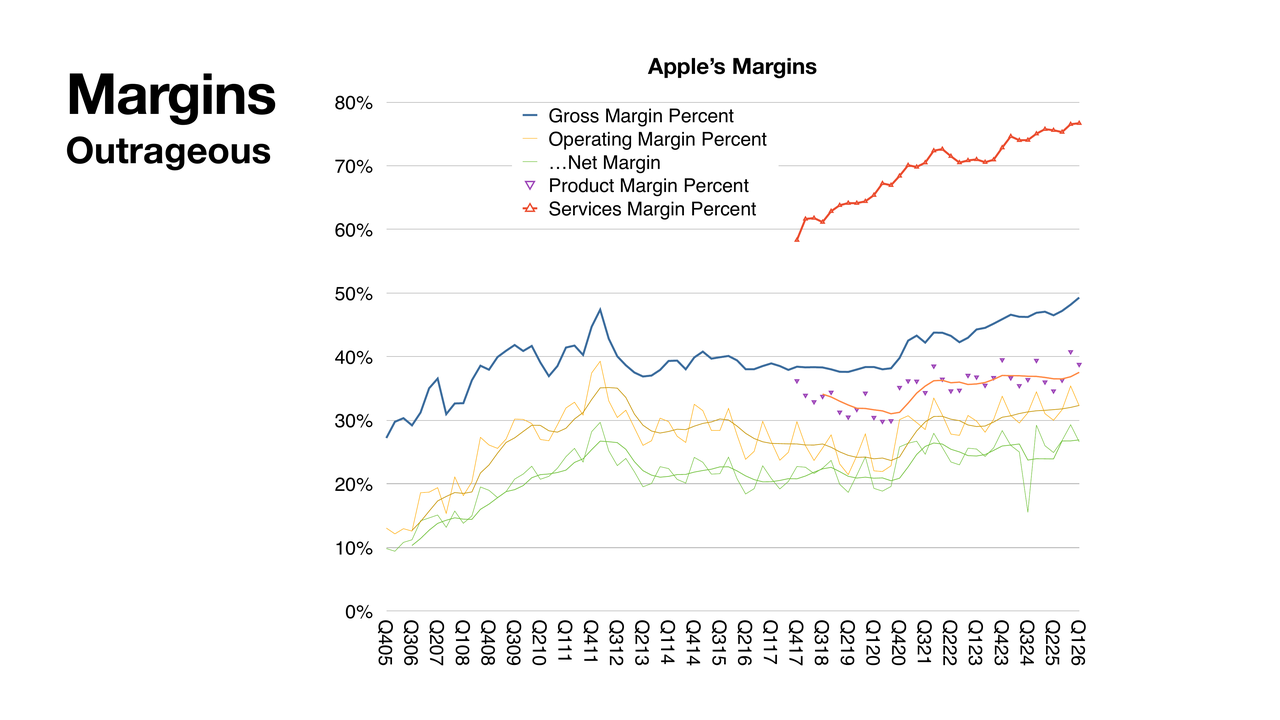
    And again, other analysts are starting to come around to notice that maybe this all settles into Apple gaining a whole lot of share, because all the other competitors won't be able to get any memory. So Apple could also just lock up everything and say, alright, we've got the biggest checkbook in the business, we'll take a hit on margins. As if we care, as if that matters. We go from 49% to 45%. Which is where we were two years ago. And then in doing so, we're going to take out everybody but Samsung. So we get in a situation where a lot of marginal players just disappear. And Apple locks up even more.

    And when you go for the jugular, you do all this, and then you launch a low-end product that's even cheaper, which is what the Neo looks like to me. I mean, Neo might be a prototype. The Neo might be John's trial balloon out there. Maybe he has a theory — I'm just speculating now — that Apple is going to go for the jugular on the iPhone in a couple of years. The iPhone's going to be $499. It'll be as good as the best iPhone today. And they're going to launch that against a landscape where everybody else is losing money at $800 a phone. And so they'll just quit.

    Now, it's uncharacteristic, but it's a low-end disruption coming from Apple. It's completely possible. It's well within their ability. And if they want to, they could. There's a lot going on here with what strategic intent is from John, and I think he comes with a fresh thinking on this. Not that Tim was unwilling, but I think he knew what works, and he was not willing to stray too far from what was reliable. And John may just think that, I know we can pull this off. And we'll go for a different way. Who knows?

    —

    This was one of the questions asked by the participants in Asymco's May 2026 Office Hours live Q&A session, open to Asymco One subscribers.

  5. Asymco Bulletin 012 - May 10, 2026

    Bulletin

    Asymco Bulletin is a digest of all the work we have published for the week ending May 10, 2026.

    Research

    Integration, culture and market creation

    This is the first part of a series of excerpts from an interview with Asahi Shimbun newspaper on Apple & Innovation: The Asahi Shimbun Interview Part 1: Horace Dediu / Takeshi Narabe & Dylan Weir / Asahi Shimbun Interview, April 2026 Takeshi Narabe.

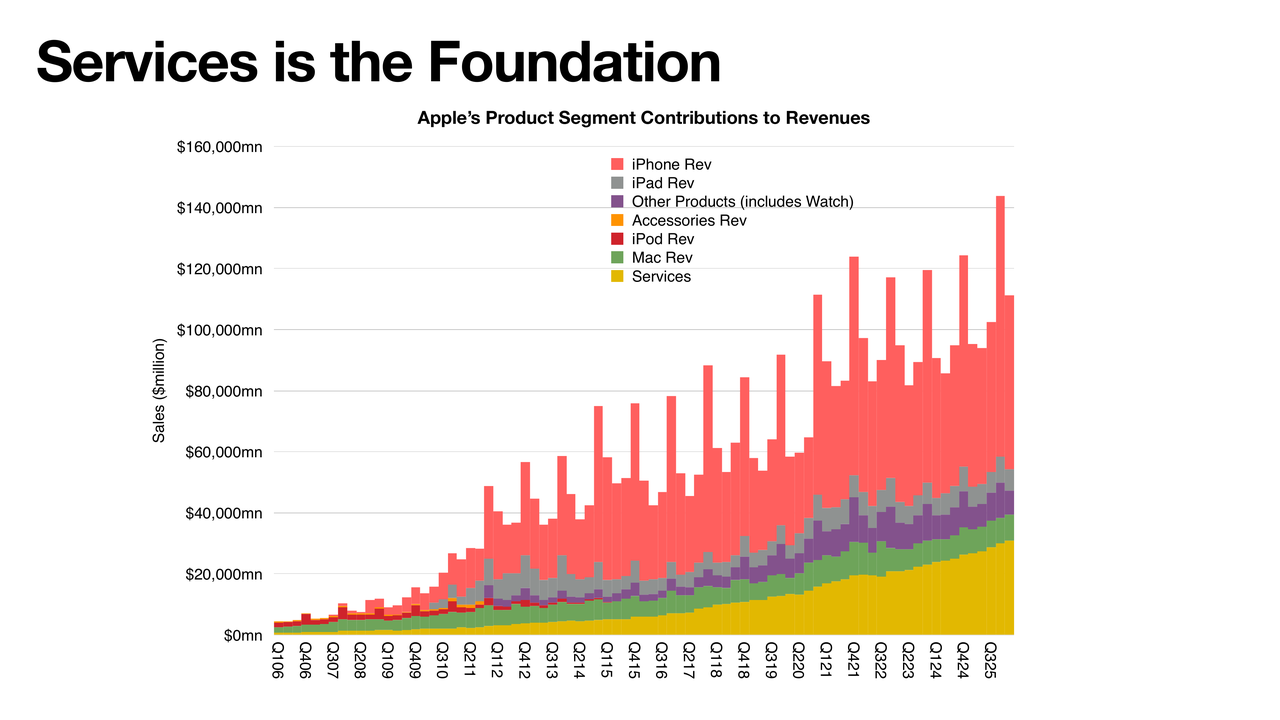
    We have to recognize Services has only been a story for the last 10 years. And arguably integration of software hasn’t been really all that important before 1998 when Apple brought Steve [Jobs] back and with him came NextStep, which was [an] operating system based on Unix. And that was much more robust and much more focused around software engineering than the original MacOS. Or, what I would say [constituted] version 1 of Apple, which began in 1970s until the 1990s.

    Culture in the sense of what are the priorities? What do we concentrate on and to what degree do we need to focus? They [management] repeat these things all the time. Focus, focus. What means this? It means saying no to many things, but it also means saying yes to the things where you can bring great things to bear. It’s where Apple has a unique advantage. And that means saying no to a lot of things.


    Nota Bene

    Tata Electronics’ workforce expands to 75,000 from 15,000 →

    Tata Electronics' rapid workforce expansion to 75,000, driven by strategic investments and acquisitions, positions India as a rising powerhouse in electronics manufacturing, rivaling China's model.

    If we add Tata and Foxconn, we are probably in the 200,000 range this year. The comparable China model is …

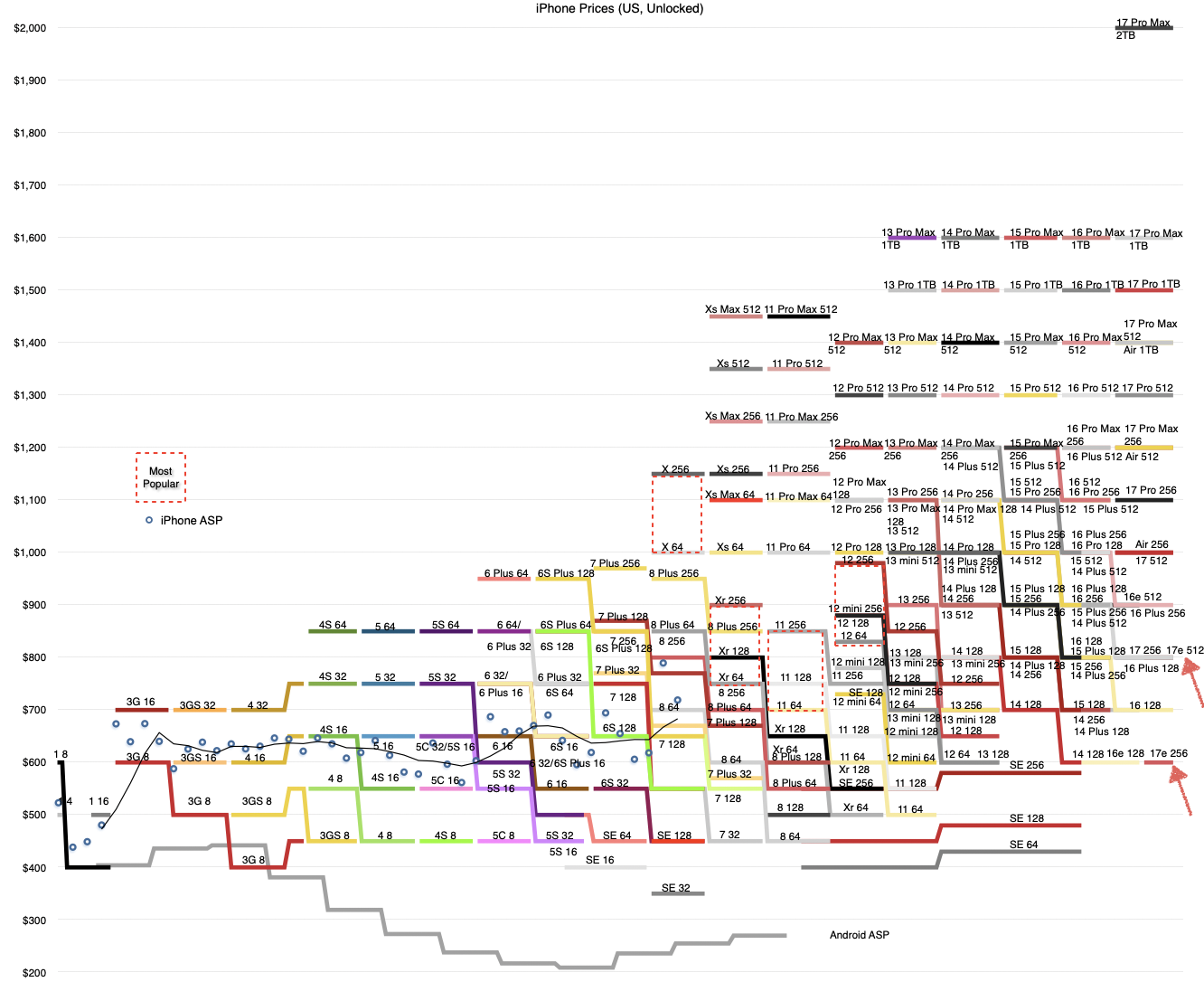
    Will Apple preserve iPhone 18 Pro pricing at 17 Pro levels?

    Will Apple preserve iPhone 18 Pro pricing at 17 Pro levels? →

    Apple maintains iPhone prices amid rising Android costs to boost market share, leveraging a two-track model to balance accessibility and profitability.

    There is always a huge surprise when Apple does the same thing it always does.

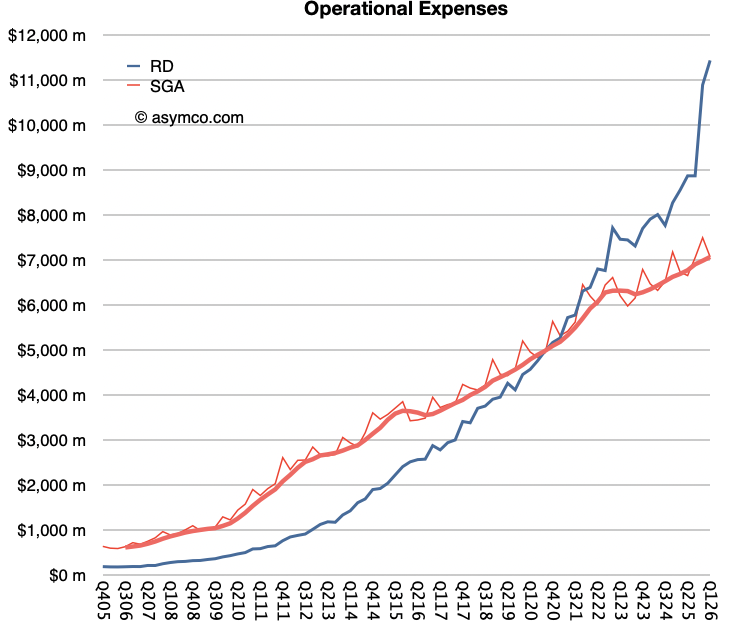
    Look at that R&D.

    Apple’s R&D investments top 10% of sales as AI race creates ‘sense of urgency’ →

    Apple's R&D spending surged to 10.3% of revenue, driven by AI advancements, while maintaining a distinct, less infrastructure-heavy capital expenditure strategy compared to peers.

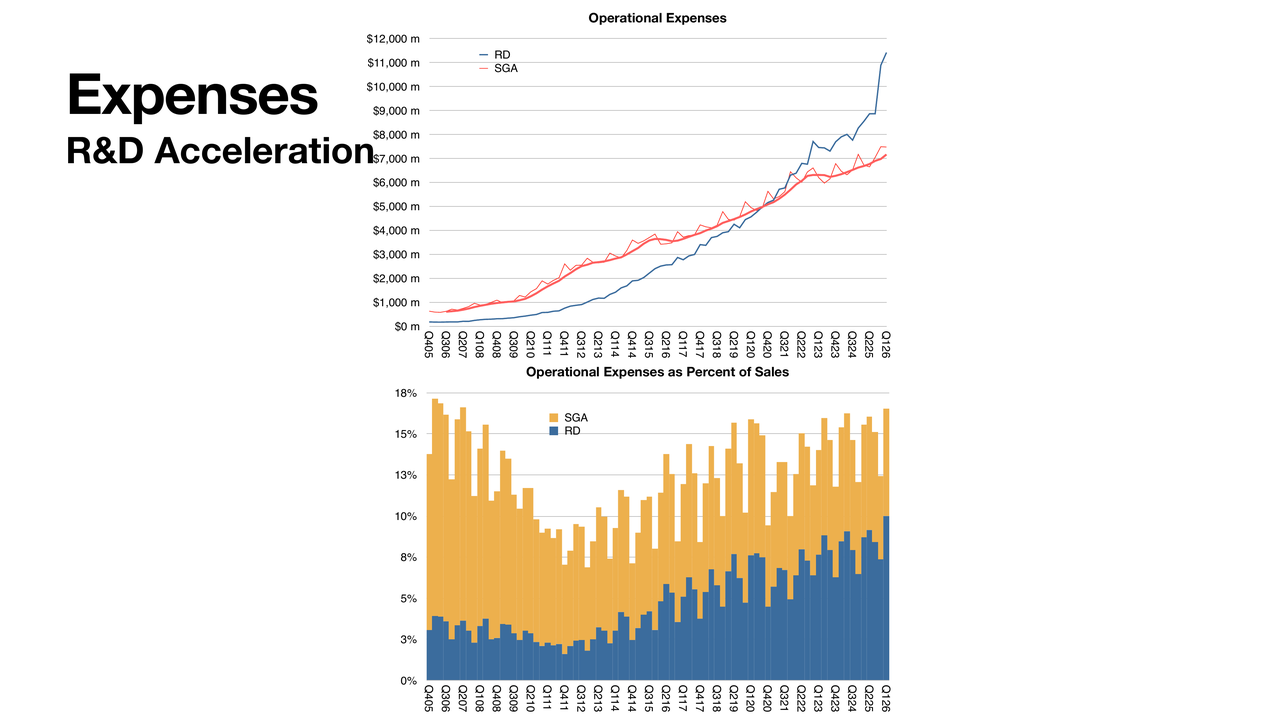
    Apple has been increasing its R&D spending from around 2% to 9% of sales on a 4-trailing quarter basis. It has overtaken SG&A which has remained around 7% since 2011.

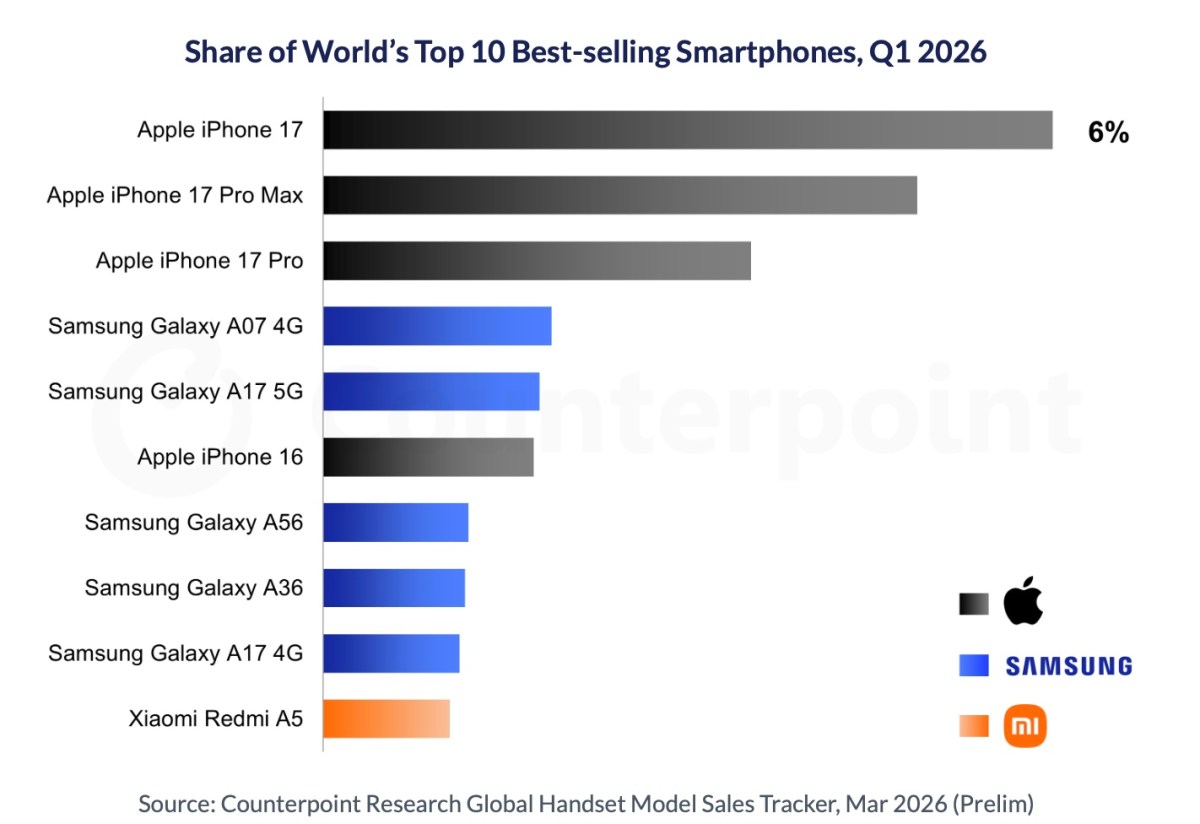
    iPhones where first, second, third and sixth most popular phones during the first quarter

    iPhones where first, second, third and sixth most popular phones during the first quarter →

    In Q1 2026, iPhone 17 dominated with 6% global sales, securing the top three spots, while Samsung's five models highlighted a record 25% market concentration amid component cost pressures.

    There are over 450 brands and over 6000 phone models in the market yet 10 models from 3 brands make up 25% of sales. The near future is harsh…

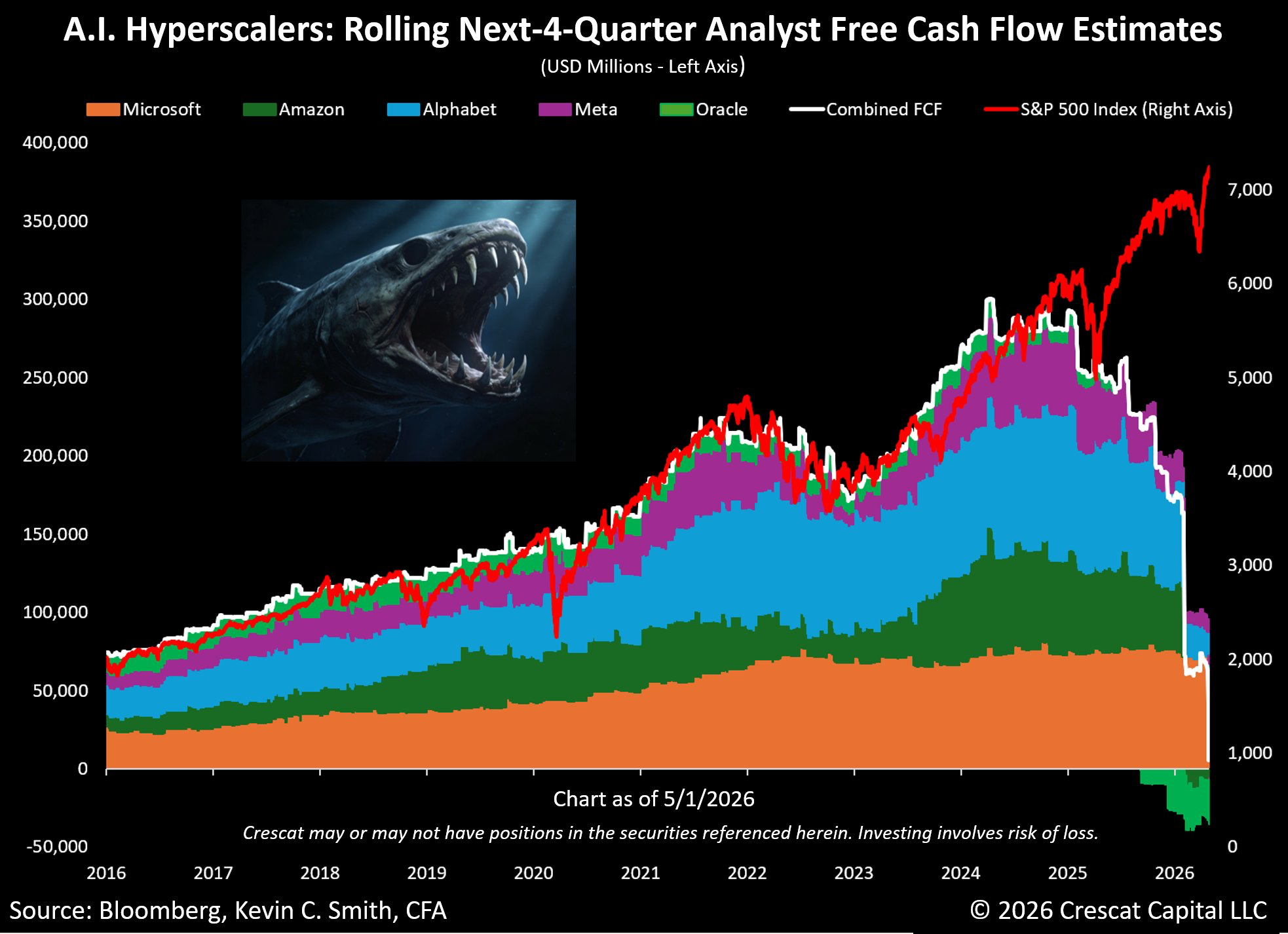
    Google’s free cash flow will hit zero next year →

    Tech giants like Alphabet, Amazon, Meta, and Microsoft are heavily investing in AI infrastructure, risking near-zero free cash flow in 2026, betting on future dominance despite current financial strain.

    Even before these future investments are considered, for the trailing twelve months Alphabet’s EV/FCF has his 73 vs. a P/E ratio of 29. If FCF goes to zero…


    Office Hours Q&As

    Big shoes to fill: will the haters spare John Ternus?

    Big shoes to fill: will the haters spare John Ternus? →

    Will John Ternus's tenure as Apple CEO will likely intensify criticism, echoing past scrutiny faced by Steve Jobs and Tim Cook, due to inherent public and media skepticism towards new leadership. →

    Why won’t Apple become a cloud company?

    Why won’t Apple become a cloud company? →

    Speculation on Apple's potential to revolutionize high-end computing by integrating powerful AI capabilities directly into personal devices, shifting focus from centralized cloud services to edge computing. →

    Why is Apple’s R&D run rate suddenly $40 billion/yr.? →

    About Apple's significant R&D increase, is it mainly hiring for AI testing infrastructure?. →

    Will Apple avoid giving their cash flow to Nvidia? →

    Jay Goldberg speculates that Apple may invest in developing its own server chips to reduce dependency on Nvidia, similar to moves by Google and Amazon. . →

    Margins or revenue: which matters more?

    Margins or revenue: which matters more? →

    Which is better? Gross revenue or gross margins?. →

    The great memory panic of 2026

    Is Apple an Enterprise Gatekeeper? →

    The potential legal risk for Apple in combining products and services centers on antitrust concerns, particularly the "gatekeeper" theory in Europe, which argues against bundling services by a dominant hardware platform to exclude competitors. . →


    Asymco One gives you full access to our research, analysis, and commentary. Subscribe with code BULLETIN for a discount.

    Feedback: Have questions or comments? Reach out to us at contact@asymco.com. We’d love to hear from you.

  6. Integration, culture and market creation

    Research

    The Asahi Shimbun Interview Part 1

    (Sibyl with Tabula Rasa) by Diego Velázquez, c. 1648

    Horace Dediu / Takeshi Narabe & Dylan Weir / Asahi Shimbun Interview, April 2026

    Takeshi Narabe
    On the secret of Apple's success, you have previously noted that the key to Apple's success was its ability to integrate hardware, software, and services to create products that are perfectly hired for a specific job to be done. You also highlighted how they moved beyond mere devices to lock customers into an ecosystem like iOS, iCloud and Apple stores. So this analysis is now very well known. So do you still think this is one of the biggest reasons of Apple's success?

    Horace Dediu
    Yes, we have to recognize Services has only been a story for the last 10 years. And arguably integration of software hasn't been really all that important before 1998 when Apple brought Steve [Jobs] back and with him came NextStep, which was [an] operating system based on Unix. And that was much more robust and much more focused around software engineering than the original MacOS. Or, what I would say [constituted] version 1 of Apple, which began in 1970s until the 1990s.

    Most people tend to think of Apple as one continuous story for 50 years. [But] it's at least two major stories. I would say pre-98 and post-98. And post-98, it's been so different. And it's much more, I would say, something [that can be studied] as a theory.

    I think in the first decades Apple was more, let's say, a story of people. There were people who were brilliant. There were people who were celebrated [as they are] now. But the second half of Apple is much more about building a business that has longevity, [that] can last a long time. It's an unusual priority.

    I think for many companies in the world, they don't think about longevity. And that is why, even Tim Cook recognizes that it's the next 50 years that are more important [than the last 50 years]. So thinking about a century is really important and I think [that] is core to the current culture of Apple. Now, of course, this means, as you said, integration, and that is one of the key things. But fundamentally, beneath all that, there's this point about culture.

    Takeshi Narabe
    Culture?

    Horace Dediu
    Culture in the sense of what are the priorities? What do we concentrate on and to what degree do we need to focus? They [management] repeat these things all the time. Focus, focus. What means this? It means saying no to many things, but it also means saying yes to the things where you can bring great things to bear. It's where Apple has a unique advantage. And that means saying no to a lot of things.

    We know about the car business that they eventually rejected even though they worked on it for many years. I think ultimately that decision was based on a realization that they couldn't bring enough contribution. And that's not just an economic decision. Of course they could have made money. There are even phone companies in China that make cars today. But it isn't what they thought of as important.

    Takeshi Narabe
    All right, thank you. So you also mentioned to what extent do you attribute Apple's dominance to the ability to tap into non-consumption addressing latent demands that consumers themselves hadn't yet realized.

    Horace Dediu
    So this is also one of the keys indeed. i learned about this by listening to my professor Clayton Christensen, who observed that great companies not only compete effectively, but they also create their own markets. They create their own demand.

    [It's an] Extraordinary idea. And when you look at Apple, you do see that they use a different language. They talk about customers not asking for the product. But they also fundamentally build something that compels the user to buy it. When it was something that wasn't conceivable. Steve Jobs famously said, the customer hires us to find out what they want. So this is a fundamental thing.

    And there are many examples. And I think one of the struggles today, for example, is Vision Pro, a product that is very difficult to find how it's going to solve problems. But at the same time, it's an extraordinary product. I think the jury is still out on the Vision Pro, but there are many other examples where I think initially they thought things would go in one direction and they went in another direction.

    But even the iPhone, I like to repeat the fact that when the iPhone was introduced, Steve Jobs said it was three things. That it was a widescreen iPod, that it was an internet communicator, and it was a phone. But I point out that these days, those three jobs of being a music player, being a telephone, and being a browser, are not among the most popular things people do with it.

    So it's fascinating how they introduced it as a blank slate. [It was] software, written by third parties [that discovered the compelling uses], and it developed in its own ecosystem. That is also a very interesting lesson there.

    But it is fundamentally about really being humble. I think, again, it's a cultural trait, being humble and saying, maybe we don't know fully what to do, but to concentrate on quality and concentrate on doing at least something useful for people. And then later, new things will appear.

    —
    This is the first part of a series of excerpts from an interview with Asahi Shimbun newspaper on Apple & Innovation.

    Next in series: Part 2: The Story of Japanese Innovation

    Interview as published: 聞 Asahi Shimbun on Apple & Innovation

  7. Google’s free cash flow will hit zero next year

    Nota Bene · 8 comments

    The commodities strike back

    Alphabet generated $73.266 billion in free cash flow in FY2025, which sounds enormous until you look at what's coming. CEO Sundar Pichai has guided for 2026 capital expenditures in the range of $175 to $185 billion. For context, Alphabet's FY2025 operating cash flow was $164.713 billion. If capex hits the midpoint of that guidance range, it consumes essentially all operating cash the business generates.

    The trajectory has been accelerating hard. In 2023, Alphabet spent $32.3 billion on capex. In 2024, that rose to $52.5 billion. In 2025, it hit $91.4 billion, a 74% year-over-year increase. The proposed jump to $175-185 billion in 2026 would be another near-doubling. Q4 2025 alone saw capex grow 95% year-over-year to $27.9 billion.

    This dynamic is playing out across the peer group. Amazon already lived this story in 2025: FY2025 free cash flow collapsed 65.95% year-over-year to $11.194 billion as capex hit $131.8 billion. CEO Andy Jassy has guided for approximately $200 billion in capital expenditures across Amazon in 2026.

    Meta and Microsoft are spending aggressively too. Meta's FY2025 free cash flow declined 19.39% year-over-year to $43.6 billion against 2026 capex guidance of $115 to $135 billion. Microsoft's Q2 FY2026 capex alone was $29.9 billion, up 89% year-over-year.

    Patel's broader point is that tech insiders understand the technology better than financial markets, and that returns on AI infrastructure will ultimately justify the spend. The businesses backing these bets are not struggling — Alphabet posted Google Cloud revenue of $17.7 billion in Q4 2025, up 48% year-over-year, with a 31.6% operating margin at the Alphabet level. Full detail is in Alphabet's SEC filing.

    Whether it's applied enough is exactly what Patel is questioning. If you believe AI infrastructure is a winner-take-most game and Alphabet and Amazon are positioned to win it, the FCF compression looks like the price of admission. If you think the returns won't materialize at the scale management expects, zero free cash flow at a $1.7 trillion market cap is a very different conversation.

    Source: Yahoo Finance

    NB: Even before these future investments are considered, for the trailing twelve months Alphabet's EV/FCF has his 73 vs. a P/E ratio of 29. If FCF goes to zero…

    …EV/FCF goes to infinity. I've seen estimates that on a forward basis EV/FCF is already over 155. This order of magnitude will impact all the hyperscalers into the next year.

    At this valuation, the payback needs to pretty swift but it seems to me that not all will see the benefit. Indeed, the narrative seen above is that it's a winner take most market. If Patel thinks Alphabet and Amazon are positioned to win it then what happens to Microsoft, Meta, OpenAI, Anthropic and XAI/SpaceX?

    It could well be pyrrhic victory for the winners anyway as the battle is one of muscle (capital) rather than sustainable competitive advantage. Capital after all is a commodity, especially in today's global economy.

    It's remarkable that the greatest business stories al about raw resources (compute or components fueled by capital.) Along with energy, the zeitgeist seems to be "the commodities strike back."

  8. Is Apple an Enterprise Gatekeeper?

    Research · 1 comment

    Asked by David Emery

    Q: What's the potential legal regulatory risk to the Apple enterprise combining both products and services? You can make a case that services growth over top of the monopoly in hardware is an illegal monopoly. That seems to be the way regulators are going. And forcing a split between services and products could definitely damage Apple as a whole.

    Sure. So let me take a European — not just point of view, but sort of a language. The language is that of being a gatekeeper, and a gatekeeper has a responsibility not to exclude competitors, because if you're big enough as a gatekeeper, you effectively are a platform for millions and millions. And so it matters how many. It's not just a gatekeeper per se, but a gatekeeper with a sufficient audience. And the logic there is that you can't bundle your own services and therefore exclude — especially by putting yours as a default, then the others have a hard time competing.

    And that is an antitrust logic. May or may not agree with it. I certainly don't, but I'd say it's a clear argument when seen through this gatekeeping phrase.

    Now, the difference — what you're asking is in business. Well, that doesn't fall under the same restriction. Usually, because antitrust is about consumer protections. There's a lot of businesses which get into complex deals that are tolerated because it doesn't affect the mass population. Now, of course, collusion and other things are still illegal. But I think you get a little bit more of a pass if you're solving the problem for businesses. There's one reason why Microsoft got away with what they were doing for so many decades. It's only when, in the late 90s, consumer personal computing became so prominent that there arose an antitrust argument about bundling everything into the operating system that got them into trouble.

    So I think Apple's bundling hardware and services for business users is probably going to be okay for a while. I would just say it's a question of quantity rather than the logic at this moment, so I wouldn't worry about it yet.

    But there are ways around it. Even if you do want to worry about it, there are ways around it which basically deal with providing provisions for alternatives, and that's what Apple's done to comply over and over again. Bending over backwards, providing alternatives, providing options. But then nobody uses those options, because they're far more complicated.

    The law is futile on this, because it doesn't take into consideration user satisfaction. It doesn't take into consideration the ease of things as opposed to the existence of things. It's nice to have options, but if it's complicated and annoying and expensive, you don't use the options. And so they have a very crude mechanism to try to enforce some utopian view of economic benefit. It just tends to create unnecessary penalties for consumers and producers, and as a result, they're just tripping over themselves. It just leads to all kinds of dysfunction.

    Quality is what Apple's always said — quality, experience, ease of use. And bureaucracies are not oriented around either quality, efficiency, or delighting anything. It's incompatible with all of the work people do at Apple. And so it ends up being a net negative, overall, in my opinion.

    This was one of the questions asked by the participants in Asymco's May 2026 Office Hours live Q&A sessions, open to Asymco One subscribers.
    See also: May 2026 Office Hours

  9. Margins or revenue: which matters more?

    Research

    Asked by Dave Emery

    Q: If you had to choose only between expanding gross margins or gross revenue, which one would you choose?

    Always top line, always. There's the only thing that matters. The ultimate measure is the customer. But the next best thing you have is the customer's purchase. You want to maximize the number of customers, and you want to maximize their satisfaction, and if you do that, then you will get good top-line revenue. Then, if you manage your house well, then you do so at a margin, at a good margin. But nothing matters more than getting as many happy customers as you can get. The creation of the customer is the purpose of the firm.

    We didn't get an update on the 2.5 billion actives, but we do get that once a year, unfortunately, no faster than that. We don't get an update on subscriptions either. Maybe, again, if I were to appeal to John, it's give us more data. I know he's an engineer. He knows the value of numbers. But the data that's given to us is out of a mountain of data that Apple has. We're getting a couple of crumbs. And they're chosen carefully. And I think the reason they've chosen to tell us these things is because they're saying that's what they think matters, and we should also probably keep an eye on these things. And that's all I did with Active Devices.

    You got to keep an eye on this. Measure the firm accordingly. It just so happens to be the old adage from Deming that the value of the firm equals this. I don't know if Apple believes that, but they do tell us these numbers, and that seems to be what they measure themselves by.

    This was one of the questions asked by the participants in Asymco's May 2026 Office Hours live Q&A sessions, open to Asymco One subscribers.
    See also: May 2026 Office Hours

  10. iPhones where first, second, third and sixth most popular phones during the first quarter

    Nota Bene · 4 comments

    Concentration into top 10 now highest ever.

    Apple’s iPhone 17 was the world’s best-selling smartphone in quarter one of 2026, capturing 6% of global unit sales, according to Counterpoint Research’s latest Global Handset Model Sales Tracker.

    The iPhone 17 Series captured the top three spots, while Samsung Galaxy A Series was most represented with five models in the top 10. The top 10 smartphones contributed 25% of global unit sales, the highest quarter one concentration ever, according to Counterpoint. This was driven by sustained demand for the iPhone 17 series, alongside pressure on Android manufacturers in mass-market segments as the ongoing memory shortage pushes up component costs, adds the research group.

    Source: Apple World Today

    NB: There are over 450 brands and over 6000 phone models in the market yet 10 models from 3 brands make up 25% of sales. The near future is harsh…

    RAMmageddon will collapse the low end market concentrating the top 10 even further. Three vendors will make up 40% of the market and five will be 50% at least. Over 100 brands may not survive taking out perhaps 1000 models.

    The situation in profits will be even more stark with Apple probably capturing 100% of the available profits in the industry.


    Daring Fireball visitors: $250 off Annual Asymco One subscription when you use code DF260515 in the next 3 day. Subscribe →

  11. Apple's R&D investments top 10% of sales as AI race creates 'sense of urgency'

    Nota Bene · 3 comments

    Don't confuse R&D with CapEx

    Apple’s R&D spending hit 10.3% of revenue in the March quarter, as the the tech giant ramps up investments in artificial intelligence.

    The increase puts Apple closer to the rest of megacap tech on R&D, though the iPhone maker is still taking a very different approach when it comes to capital expenditures, according to CNBC. R&D spending was up from 7.6% in the prior period and 9% in the same quarter a year earlier. While sales jumped 17%, the fastest rate of growth for any quarter since 2021, R&D climbed twice as quickly, increasing almost 34% from a year prior, according to CNBC.

    “That’s a sign that Apple is seeing a sense of urgency around new AI products,” said Gene Munster, managing partner at Deepwater Asset Management.”

    Horace Dediu, founder of Asymco, agreed that a major question is where all that spending is going. Much of the increase, he said, is likely tied to talent, teams and experiments in training and modeling, rather than the kind of large-scale data center deployment underway at the hyperscalers. But he also said Apple is pushing across hardware, investing in silicon, optics, batteries, materials, sensors and smaller form factors.”

    "AI is an obvious candidate, but R&D is not capex," Dediu said.

    Excerpt From Apple's R&D investments top 10% of sales as AI race creates 'sense of urgency' by MacKenzie Sigalos, Jennifer Elias, CNBC

    Source: CNBC

    NB: Apple has been increasing its R&D spending from around 2% to 9% of sales on a 4-trailing quarter basis. It has overtaken SG&A which has remained around 7% since 2011.

    This is a big departure from where the company was during the Steve Jobs era and the acceleration seems to be continuing. An increase to 10% seems very likely this year with a run rate of $40 billion/yr.

    This level of R&D used to be associated with companies like Microsoft and Google which had dedicated laboratories. The question is where does this spending go to?

    AI is an obvious candidate but R&D is not CapEx. Although some capital equipment is part of the spend, much of this is talent related as it’s recurring. My assumption is that there are many projects that are both hardware and software (e.g. Apple Silicon and AI). Fundamentally the power of this budget is affecting the organizational behavior with, as we have seen, the ascent of engineering leadership.

    AI is expensive but so is silicon and so are the components going into smaller form factors. They are pushing on many fronts: optics, batteries, materials, sensors and silicon.

    AI spending is teams and experiments in training and modeling. It would cost a lot more to deploy these at scale and as much as this is a lot of spending, it’s not nearly what super scaling requires.

    The late 90s to early 2000s period was defined by revenue contraction and financial distress. It wasn’t so much an increase in R&D as a decrease in revenues. In those days Apple built products on a shoe string. Literally a handful of people were tasked with scoping out new products. The iPod was Tony Fadell and a few others. Safari effort started literally with one hire. I don’t think that era is comparable to what we are seeing today. There must be thousands of engineers allocated to R&D right now.