China’s smartphone sales declined 16% year-over-year (YoY) around the May Day holiday, mainly due to higher memory-driven prices dampening upgrade demand, according to new data from Counterpoint Research.
However, Apple grew 3% YoY during the May Day period, although it experienced a typical sequential slowdown as the iPhone 17 lineup entered a more normalized demand phase amid intensified competition, notes the research group.
Counterpoint says Apple is going through seasonality with competitors offering launches in April. The iPhone 17 lineup entering a more normalized demand phase following a robust six-month run.
NB: May Day holiday is a substantial 5 day sales event. The iPhone was up against a set of new product launches but still managed to grow while the market declined. It's a remarkable story. Apple guided to similar growth for the June quarter as for the March quarter. Signals are coming in that this is not a fluke.
NB: Do alternative app stores provide similar fraud prevention Analysis? Does the European Union review these analyses to determine how their citizens are protected. In the alternative, is the EU benefit analysis of users end at arbitrary market access metrics? I don't hear much about alternative App Stores and their popularity. Quelle surprise!
Judd • 00:00 Tim Cook got to go to China on Air Force One. Horace gets to talk to me. This is Asymmetric, Horace. There's a lot to talk about. You recently wrote that something terrible might be coming. I do not normally think of you as Chicken Little, but is in fact the sky falling, Horace? Are we about to see a crash? Horace • 00:23 I didn't suggest it was happening, but I said, are we facing a crash? "Is there a crash coming", I think was the title. And this is a topic that's just been a worry for a long time, because we've seen the surge in the market value of so many companies.
But as I said many months ago, on a PE basis, it doesn't look so bad. But then we should ask, is that basis not valid? We should be looking at another basis, perhaps, because the PE ratio is not the whole picture. And so I'm putting out a series of posts. Because you see, the problem is this. There are some topics that are, let's say, not simple, and you feel like you should dive in, but you feel like you might leave the audience behind. And my struggle is to make it simple so that everybody can follow along, but without making it simplistic. Judd • 01:32 Heavy lies the crown. Horace • 01:34 Well, it's not that hard. It's just that sometimes you need to do five steps instead of just one. And you see this process online, where people are trying to fit everything into one tweet, or even now a thread of tweets — and there's a lot of long-form stuff actually going on social media nowadays. But I don't think this topic requires a very long single post. I think it just requires a few baby steps strung together. So I don't want to necessarily — well, we could dive into it right now, but I'll summarize at least. So the problem with the PE is that it doesn't, first of all — remember, E is our friend. E is earnings. But it's also true that earnings are an opinion. Remember the old adage: earnings are an opinion, cash flow is a fact. And arguably I added to that by saying a share price is a fantasy. Literally, I mean it is a dream. Maybe I should say dream, not fantasy, because it could be a bad dream as well. But the fact is that earnings fundamentally are an opinion. They are a result of an accounting practice, an accounting convention — the so-called generally accepted accounting practice, GAAP. And what it means is you don't put into earnings things like capital expenditures, you don't put into earnings the fact that you have a huge amount of cash. So things to do with cash flow don't go there, and things to do with balance sheet don't go there. And both are important in evaluating the value of a company. E comes from the income statement, and it does not cover issues that are outside the income statement. And this is why a better measure — again, not a complete measure, but a better measure — is free cash flow, or FCF. And this is why years and years ago I said, because at the time the problem was people weren't valuing what was on the balance sheet of Apple, which was cash, huge amounts of cash — and so for that reason, even then, I suggested don't use PE, use free cash flow. Which, by the way, is the denominator, where the numerator is EV, or enterprise value, which includes debt and cash, or rather balances those out. So you divide — instead of doing the P over E, which is market capitalization over the earnings per share, you do it with the top being the EV or enterprise value, where you cancel out the debt, and then divide it by free cash flow. So that's as if you took not the market divided by the income statement, but you take the balance sheet divided by the cash flow statement, which is very interesting from an accounting point of view. So anyway, I don't want to belabor this, but what I'm going to do is explain in writing, and using examples — especially the so-called Mag 7, or even expanded to the top ten most valuable companies. Judd • 04:51 I look forward to that. My question for you right now, since we're here together chatting, is: you've long held that a PE of thirty-five is pretty much where Apple should be. It's fine. So in terms of free cash flow, what should that ratio be? What should that number be? Horace • 05:13 Well, they should be roughly the same. So here's the beauty of this: the EV over FCF — Judd • 05:17 So EV over FCF is 35. Horace • 05:20 If they're the same, so — I put it this way: if P over E equals EV over FCF, it means that there's no weird stuff on the balance sheet, there's no weird stuff going on with the cash flow. It's all pretty much — the income statement is the best measure of the business. And in those situations you're not playing games elsewhere. Or — well, not that they're games. It's just that there's nothing invisible to you when you're looking at the income statement. And that's a nice way of analyzing a company. The problem is today, with all the hugest companies in the world, which make up a disproportionate portion of the S&P 500 and a disproportionate part of the US economy and the growth and everything that's indexed to that — those few companies are out of whack. Their PEs are not at all equal to EV over FCF. In other words, there's stuff either on the balance sheet, or there's stuff going on in cash flow, which makes that PE ratio irrelevant. And this is what I have to expose. With Apple in the middle of it, showing how Apple actually conforms more or less to, let's say, an income-statement-driven view of its value, whereas the others are much more skewed, because so much of the money that's coming in is being spent on capex. Which means they are no longer — here's the catchphrase — they are no longer considered software or services companies. We're talking Microsoft, Google, Meta, Amazon. These are intellectual machines. They deal in software, they deal in non-tangible items. They deal with data. And yet they're investing today as if they're chimneys, boilers, forges, hammers, and our industrial-might giants, which require huge capex. There's nothing wrong with that. Sorry — there's a motorcycle. So the problem is — Judd • 07:40 But haven't Google and Facebook for a really long time — I mean, they've had their own data centers, they've spent a lot of money. This is much more than it's been, but this is not entirely new. Horace • 07:51 Well, it isn't, but the thing is it's way, way bigger than anyone anticipated. We're talking, on a combined level, at least half a trillion dollars being spent. It's moving the needle on everything in the whole economy. Caterpillar is having an amazing year. Energy companies are having an amazing year. We're bringing back nuclear reactors. We're bringing back water issues and energy issues, because these data centers are monsters. So what I'm saying is that if these companies that historically have been seen as income-statement businesses are now suddenly balance-sheet and cash-flow businesses, we cannot evaluate them strictly on the PE basis. Apple is the outlier. So Apple is the exception that proves the rule. Apple is still extremely consistent with respect to all these ratios, how it used to be. But all the others have gone way off. And by the way — I wrote a short note, a note of Bennett, which said basically that Google's cash flow is going to zero. Well, so is everyone else's. And what happens when they don't have even more cash flow is they're going to start borrowing. Which means not only are they destroying their cash flow, but they're going to be destroying their balance sheet as well, by putting a lot of debt in, in order to pay for these infinite data centers. So there's an interesting dynamic. I would say we're in uncharted waters, but we have to then put a little bit more effort into trying to figure out whether we're in a bubble or not, because this is the thing: all of that could be supported by enormous growth in revenue, enormous growth in profitability — and there is growth, tremendous growth. It's 50, 60, 70, 90% growth. But their investments are growing even faster. So this is why some people are grasping for ways to detect it. I've seen half a dozen indicators out there — everything from the Warren Buffett indicator, this or that, that things are out of whack. But all these indicators were dependent on the ratios of the past. We are in a situation — it's not like the dot-com era, it's not like the Great Recession, it's not like the Great Depression, it's not like all these previous bubbles and crashes. If you applied those metrics, many of them may be true today, but then you have other things that are actually even more important. So that's what the series is all about: we're going to try to get to the bottom of it. And I will propose at the end, this is the best way to think about a business. Judd • 10:35 What's your best guess right now? Horace • 10:37 So the way to look at it is: given the growth projected forward, how many years will it take you, as an investor, to get your money back? If you put down a hundred bucks on a share, or a portion of a share — let's say. I don't think anything's a hundred bucks anymore. So you buy a share in Google and — Judd • 10:56 How long's it gonna take? Horace • 10:59 Sorry? Judd • 10:59 A pair of pants is a hundred bucks. Horace • 11:01 Oh, well, you've gotta get your Dockers. But a hundred bucks invested today has a payback period based on cash flow and growth. So those are the two most important metrics. And the problem with the growth is: are you going to look at the last quarter and project it for the next five years? Are you going to look at the last year and project it for the next three years? So the whole thing depends on how much of that growth is sustainable. So all of this comes down to — okay, well, we don't know for sure, but let's play with some scenarios. And then you get a good idea: am I going to wait five years, ten years, twenty years? And in the case of Tesla, by the way, which is also among this group — it's an outlier. Its PE is 400. Even if it grew at 70%, it's not going to get back. And of course the sad truth of Tesla is it's actually contracting as a business. So it's actually the only one that is going negative in growth. And yet it's also the only one that's accelerating in PE. And so there's a huge anomaly. There's a huge elephant in the room — we talk about theory, and then it demonstrates — yeah, well, there's a robotic elephant. Or space robots. There's so much mystery, because that demonstrates also how sentiment, optimism, euphoria, and memes all play a part. So anyway — sorry, this is a bit, as they say, in the weeds. But I feel it needs to be done. Judd • 12:47 Yeah, well, let's put a pin in this. We look forward to seeing what you come up with. Please, as always, show your work. And we'll be paying close attention to your follow-ups to this. It's hard to not talk about AI. Would it be fair to say that services — which is becoming more and more the centerpiece of Apple's business — would it be fair to say that services is the most vulnerable part of Apple to AI, in the sense of — because services boils down to — Horace • 13:32 The US? Yeah, I get your question. Well, it's a great question, because I think there are a lot of hypotheses out there about how Apple could be disrupted by AI — and I use that term carefully and with knowledge. The scenarios which are disruptive to Apple would be not just for services but also the hardware itself: that the business would move away from what the user interfaces today for the consumer. But you don't actually think that. I do not. In fact, I think I can set that out. The underlying thesis is that we are visual machines, or visual animals. And as long as vision is involved, I think Apple's going to do very well. If you say, well, it's audio in the future, or something that is much more in the background, not the foreground — it's ambient. Computing becomes ambient, then there's no interface. If there's no interface, Apple has a hard time. But I just don't believe that future is likely. And we — I think we mentioned this before — the services aspect: now people are starting to wake up and say, wait a minute, actually services could get a big sustaining boost from AI. Just days ago there's been an idea put forward that Apple could launch an agent store. The way there's an app store, there could be an agent store. And what an agent is, as you would imagine, is like an entity that you hire to do things for you. And it's very possible that Apple could embody or integrate agents into its services, and that the discovery of agents, payments — all of the things that are related to the economics of AI — would go through Apple. And people are finally realizing that, yeah, as I've been saying for three years, distribution is just as important in the age of AI as it was in the age of software, as it was in the age of computers, or any other pieces of equipment that we have ever bought. So agents are possibly the embodiment of AI that are actually consumer-oriented. I hate to go back and forth on this, but the fact is the AI business is still mostly, right now, very few professionals are using it, and quite a few businesses are using it. But it's not yet consumer-driven. Maybe chatbots are, or entertainment, maybe companionship — but as I see it, no one's quite gotten the killer app. And that will probably be discovered through introduction via an iPhone. That's the platform for discovery and everything else. So I think many people now are starting to write — and by many I mean the analysts on Wall Street are starting to write reports suggesting, wow, AI could actually be very sustaining to Apple, to the point where it's going to ride the wave and be the one capturing a significant portion of the profits. I would even say it may even capture the majority of the profits, because it's at the intersection of the consumer and the device. And that's not going to change. And I think the attacks by OpenAI, to try to replace that device with whatever wearable Johnny Ive and company come up with, will fail. And I quote Johnny on this matter. Johnny Ive said, "I'm nothing outside Apple." He, and every other person who's left Apple who's smart enough, has said the same thing. And yet here we are with this idea that, oh, I'm just going to sell my services to an AI company. Anyway. Judd • 17:48 And what it feels like he might be doing is something that — I mean, it's touch-based, it's voice-based, and all those things are much slower than a visual interface. You also recently wrote about using the Apple Vision Pro outdoors, which I'm skeptical of, at least for me personally. I would not want to do that. Maybe I'll have no choice. But it's not something that is — Horace • 18:20 It's not going to be the device as you see it today. So the puzzle for me is — we have rumors now that Apple is doing glasses. Generally I don't comment on rumors, but it's obvious to me that there would be a wearable. What about a monocle? Yeah. Or — what is it called? A pince-nez? Yeah. But the problem with these devices is that maybe they're mostly — what I would say is — input devices, like cameras or other sensors reading things. There are also rumors of AirPods having cameras. The view of the future I have is that there will be wearables which have augmented reality and you could wear them all the time. That's not the case of the Vision Pro today. But I think if I were to imagine a future, theoretically it's possible to do that, and that would be fantastic. Anyway, back to the threats at hand. I think AI, for me — at least the version we have, which is not yet AGI — it's a nice extension. It helps with a lot of tasks, it improves some productivity, decreases other things. But it isn't disruptive yet. It might be disruptive to some type of work out there. So it's disruptive to people. But none of the players — okay, I take it back. There's a couple of companies out there that might feel it, and are being punished right now because of AI. One is Adobe; another would be so-called SaaS, or Software as a Service. You have companies essentially that are providing tools or tool chains, and those might be very easily replaced with the person who does those things but happens to be an artificial person. So if there's not that much value added with those technologies, then yes, they would be disrupted. But even they, I think, will bounce back. One of the issues is — especially with software — and I don't see a lot of conversation about this — people talk about vibe coding, and writing code very quickly and being very productive with programming tasks, but that doesn't take into consideration the maintenance of that. And the maintenance, as anyone who does software engineering knows, is not so much about how much code you write, it's how well that code can be managed, maintained, upgraded, and everything else. And that's the engineering part of software engineering. When something other than you writes something — even if it's a person — you're going to have to deal with that. This was a big problem when I was a student: you were told, comment your code for your own sake, so that when you go back to it you know what you did. But also, if you have to hand it off to somebody, it's more self-explanatory. And it was a very bad practice — almost an antisocial practice — to have cryptic code that nobody can read, therefore nobody can maintain, and you're just doing it to preserve your own job, so nobody can fire you, because nobody can fix whatever you wrote. That's just not considered good practice. And now do we have the equivalent of machines writing code, and they don't even know what they're doing? I mean, they're just basically copy-pasting a lot of things. And so they become spaghetti code, it becomes intractable. You can't understand what they did. And so it becomes unsupportable, unmaintainable, and that might cost you even more to rectify than if you had a human write it in the first place. So either machines get far better at creating code that is inherently supportable and they can explain themselves — but there's so many things wrong with this picture as far as the long-term things, right? Somebody wrote, saying, yeah, it may look cheap to write code, but you're going to get the invoice on maintenance years down the road, and you'll realize it wasn't cheap at all. So there's a lot of things about that, that I don't see disruption happening here. But there are some things. A lot of work, like legal, tax, or accounting — a lot of that — I've used it in these instances where it's a better search. A lot better to search with Gemini, for example, than it was with plain old Google. And I'm learning a lot of things. Although I'm a little bit cautious, because sometimes, as it says as a disclaimer at the bottom of every page, this is not always accurate — which is a worry sometimes. So anyway. Judd • 23:38 You know, Google wasn't always accurate either. So in all cases, buyer beware. You were saying something a minute ago in terms of having an agent store, and I'm not sure if you are a reader of Neal Stephenson, as I am. I don't know if I'm current — in fact, I know I'm not current — but a few years back he wrote a book called Fall, which was a follow-up to a book called Reamde. Fall takes place in an age where AI is very common, and this is the thrust of the story. But it's very common, and every family, if not every individual member of that family, has their own agent — to do things, process information, give them answers, tell them what to do, et cetera. Which to me leads to the ultimate form of reality being fragmented. So everyone is living in a completely different world based on their agent. Should there be a required agent? Like, if you live in Helsinki, should everyone have at least the Helsinki agent, so they know just the basics — so there's a basic frame of reference? Horace • 25:01 Yeah, but it's a huge problem, because we don't have a lot of shared experiences anymore, right? Even within the same family, people are not consuming the same content. It used to be at least there was one newspaper in the house, there's one TV set, and more or less everybody watched the same TV. And we ended up with a situation where, even when there's a common space, where people live together, people are looking at their own screens, and they're looking at a different reality. And then if that is intermediated by an agent who is essentially, let's say — rather than calling it an agent, I would say, let's say it was a personal assistant. And the personal assistant is like a gatekeeper. Chief of staff, whatever. And they are intervening even in the question of whom you meet, and what you choose to do. They kind of act on your behalf. So there's a lot of problems with that, because it's not just what you consume, it's also acting on your behalf in all aspects of life. It's kind of a little scary, if I'm honest. But let me put it through a different perspective, which is that already there's a lot of difference between people from different countries. It's fascinating to me, having lived in many countries, how different the perspectives are on very basic things. In many ways, by the way, we are also getting together more. And let me explain what I mean. The globalization phenomenon has meant that people are more aware of, let's say — Americans are more aware of the World Cup, for example, soccer, which was something nobody cared about. Europeans are more aware of American football, and they're sort of kind of aware of baseball. And at the same time, you have shared devices like Apple, the iPhone, you have shared brands — everybody knows about Nike. Americans will know about European cars, and vice versa. So at the commercial level, because businesses have grown to be global, products and brands have kind of become uniform. It used to be that you went to a different country and you couldn't see on the shelf anything you could recognize. They ate totally different foods, they had totally different tastes. But now you can kind of agree that, as far as packaged goods are concerned, there's commonality. And that has a lot to do with the globalization of business, right? The fact that I can get a banana in the middle of Finland — even though it's a tropical fruit — and the banana I get is as fresh as it is in Costa Rica. That's an incredible story. Judd • 28:24 Pretty close. Horace • 28:25 Well, it's green. I think — and by the way, all these bananas are genetically identical, because they're all clones, because they're all made from the same exact genetic material. And if that gets wiped out, then we have to reinvent bananas, if you will. So there's a lot of funny things that happen because we have these modes of transport — these ships and airplanes around the world that constantly tie us together. So we have that. That's a positive. But on the information side of things — Judd • 29:01 So we've got the same bananas, but completely different sources of news and information. Horace • 29:05 Right — the same bananas, but at the same time — oh, I'll give you another stupid example. Americans have baseball caps. Well, baseball caps are global now. But I can tell you, when I grew up in the 70s and 80s, nobody outside the United States wore baseball caps. Maybe Japan, because Japan, weirdly, was colonized by baseball. And yet this style of headwear was never seen. Everybody had different hats, different styles. You had berets, and you had fedoras, or bowler hats. And yet now there's so many things that are uniform — in some ways, boring as a result. We all kind of wear sneakers. We all look the same. We all dress the same. Probably the music is also very common. And the other thing — I'll give an example. Rap music. American music back in the 70s, 80s was well known because there was a global music industry. But people in Europe did not necessarily make a French version or German version of what would be a pop song. Let me put it the other way. ABBA was European. And ABBA wasn't all that resonant in the US — although it was enjoyed, it wasn't like our thing. People were much more into either rock and roll, or rhythm and blues, or Motown — American. Judd • 30:49 Well, America had a disco phase. Horace • 30:52 Sure, sure, but — there was, and it mostly came from Europe. But you also had indigenous American music that was enjoyed in Europe, but it wasn't felt that it was something that they produced themselves in the same way. You can do Motown in Europe, okay. So the thing is, though, today rap is universal, and it's from the Philippines to South Africa to Japan. That genre has caught on with everybody. Judd • 31:23 Who is your favorite Filipino rap group these days, Horace? Horace • 31:25 I have none, I'm sorry. I'm not aware of the individual acts. But what I'm saying is, I was observing it with youth behaviors — that they're acting very American here in Finland. At the same time, though, they don't understand a lot of American decision-making. They have no perception of student debt here. It's such a strange idea. Or medical bankruptcy. Judd • 31:54 Yeah. Horace • 31:56 The bottom line on this is that we can hear these stories about fragmentation, disassociation — but at the same time, there's a lot going on with unification of experiences. And most of all, think about your iPhone. Everybody in the world speaks iPhone. Everybody in the world recognizes and interacts with a computer the same way. And even before the iPhone, that was the case for computers in general, whether it was Microsoft or Mac. We — the Americans — invented how to compute effectively. And everything else in the world just completely disappeared. It wasn't that they didn't have it, they just disappeared. The French way of doing things, or even the Soviet Union had its own computers. But it's one of those things that we don't pay attention to very much, because — well, it's — Judd • 32:49 It's too obvious. What exactly do you mean by that when you say the American way to compute? Do you mean — because Apple and Microsoft dominate personal computing and they're American companies — or is there something — Horace • 33:02 First of all, the American computer is based on — I'll give you a very simple example — the byte. The byte is eight bits. Eight bits is enough to encode ASCII, which is the code for characters, and then you have the alphabet and the numerals. And the problem is, if Japan — let's have an alternate history. Japan wins World War II — Japan and China, maybe. Imagine that Japan and China together, with their kanji alphabet, would have come to dominate Asia, and then more and more of the world. Or Russia with Cyrillic — but Cyrillic is still a limited character set. The problem is you have fifty thousand kanji characters. You wouldn't be able to fit them in one byte. You would have to have a computer architecture that was bigger words, as they say. The layout on screen also — what happened with American characters on a screen is that you have eighty characters on the original terminals, eighty characters on an IBM punch card, and that was a line. And from that came the screen as we know it. Now, the form factor of the screen, the page layouts, the metaphors of Microsoft when it copied Xerox, and the Macintosh, the file folders — everything to do with layout on the screen was what an office looked like. All these things are, if not American, Western-centric. And the American keyboard is not the same, by the way. French keyboards are different. So you have all these weird things that were introduced by — Judd • 34:56 There's a croissant button. Horace • 35:00 The fact you have all these accents. But the thing is, the world adapted and internationalized what was effectively an American worldview, or compute view. And now, by the way, in AI it's the same thing, although it's English-led. The techniques can work in any language. But the leadership that comes from the United States, as far as AI is concerned, is — more or less people aren't questioning it. Who knows how it would have been different had it come from somewhere else? But I think the aspect of unified compute is not necessarily a counterpoint to the disunified cultures. In many ways we are much more alike culturally than we used to be. The Arabs in Syria — oh, to give you another example. If you go to Saudi Arabia — a friend of mine went there recently; I haven't been. I've been to Dubai, but I'm embarrassed to say I haven't been to Saudi Arabia. But if you go to places in the Middle East, it's burger joints. It's chicken joints. It's fries. It's ketchup. These are not what Bedouins ate. And probably there are restaurants that still serve indigenous cuisine, but they are one in a thousand, literally. So it's amazing to me how that American culture is everywhere. Maybe the Middle East is more skewed than, let's say, India. But still, the Indians know America very, very well indeed. Judd • 36:50 Not that I wouldn't love a traditional Bedouin feast, but a hamburger joint works pretty well. Horace • 37:00 It's exactly right. The economic models that scale, and that are replicable because of their inherent efficiencies and demonstrated value, are quickly adopted. What seems to be divisive, I would say, runs not on cultural lines, it runs much more on human nature being roughly divisible into several personality types. And then those divisions are amplified by the media you consume, and possibly by the agents in the future. And so you might be predisposed to lean one way or another politically — which, by the way, I think is one of these unspoken truths, that somehow there is a genetic component to political affiliation. And it's very difficult to actually get people to switch. Once they establish their — of course, there are the independents who claim that they switch, and probably independents are the majority — but nonetheless, there is — I think what algorithms discover, because they offer you things, and you react to things, and they offer you more of the things that you tend to dwell on — they immediately are able to characterize you based on your consumption. And then they create a dysfunction, because they then feed you things that exclude what other people see, and you become radicalized. And you can do this on very basic things, like cats and dogs. Cat lovers never see dog pictures, and then they grow up and say, oh, I hate all dogs. I'm exaggerating, but I think this idea of, we end up being divided — we're unified with the fact that we use the same computers, the same interfaces, possibly even speak the same language. A lot of people speak English. But then you divide yourselves — you divide into cat people and dog people. And the more you consume, the more you are the radicalized cat person. But do we want to talk about John Ternus at all? Judd • 39:25 Horace, who would win in a fight at their primes: Steve Ballmer on stage at a developers conference, or John Ternus preparing for a WWDC demo video, in a skin-tight t-shirt? Horace • 39:42 Easy. Ternus is going to completely crush Ballmer. Let me — oh, yeah. Look, Ternus was — Judd • 39:52 Ballmer is hyped up on all those sales figures and the developers — Horace • 39:55 All that — pulls a muscle, screaming, "Developers, developers, developers." He pulled a muscle on stage. Ternus — was he what, varsity in college? Swimming? The guy can take his team off and do hikes in the mountains. Swimming — I did swimming in high school. And swimming was — Judd • 40:17 That might help you if you're being surrounded by salmon, but — Horace • 40:22 We're talking about dolphins. No, dolphins can be very powerful. But look, swimmers — come on. Well, if anything, he can run away from him. Judd • 40:38 He'll need to run. I mean, he might have more endurance — that would be the thing. So I would say Ballmer has more brute strength, and Ternus has more stamina. So if he can evade for a little bit — Horace • 40:56 Could he do one of those kick turns in the water? I don't know. I'm a lover, not a fighter. I don't know how to evaluate fighting ability. Judd • 41:09 But I will say this about Ternus — I don't know if you're aware of this, but the company he worked at before Apple, which is, I guess, thirty-some years ago at this point, was a VR company. Horace • 41:21 Yeah. But that was his first job, and he was there only a couple of years. And I've read — Judd • 41:26 Isn't that exciting for all of you Apple Vision Pro aficionados? Horace • 41:29 Yeah, yeah. No, I think he knows that. He's got ideas there. He did something in grad school or undergrad to do with helping people who had some sort of disability — assistance, robotics or something, I forget. And then he went to a VR company, and that would have been like 25, 30 years ago, like you said. And then he went to Apple and has been there since. I think the first product he worked on was a cinema display, of which I have one, by the way — or had one, anyway. Tremendous product. But the thing I said about him is that I use the word engineer. He's like a real engineer, and he's an engineer who can connect with non-engineers — but "engineers" is too broad a topic. You can say, well, he's product, or he's R&D — but he's all of those things. I think it's important to get a person like that to retain talent. It's not just motivational. There's a big problem, I think, Apple has of turnover. Now, it's no bigger than any other company. But in the case of Apple, they need to keep people more than other companies. They need to have that loyalty, because things take a long time. So if the project you're on isn't going to see the light of day for seven years, it would be a pity if you have to switch over the team three times during those seven years. There's going to be big problems with continuity if there's turnover in product teams that are committed to long-term projects. So that's an issue that Apple has to contend with. And the way Steve dealt with it — I think this is where the questions of culture come in — I think Steve offered to his greatest people the chance to do their best work, and not to be distracted by politics, by management which has turf wars, or has an agenda. Managers have personal agendas, empire builders. And once that work is hopefully finished, then millions of people will use your product. I think these are the motivations of the engineer, of the creative and analytical type. And by the way, you could argue the same thing for someone who makes a movie. If you say to somebody, hey, come and work on my project, here's a bunch of money — but if you're working with this great team, and we have a great project, a great script, a great director, that movie could end up being seen by a billion people — you might say, you know, I'm going to give it my best. And forevermore I can reflect on that. And whatever I do in the future, the glory of that product will shine upon me forever. And that doesn't mean necessarily you get paid a lot because of it — probably not; probably you'll get a little bit of residual value from it. But you'll have that on your resume. And believe me, people are going to come out from everywhere asking to work with you, simply because you're glowing from the glory of that project. So I think — now, that sounds vain, but it's more than that, because I think the engineer devotes so much of their time, their life, early in their career, their education, their learning, and everything else — it's brutal. It's quite a challenging program to get through. And at the end you feel like, hey, I'm not going to use 10% of that capability — I hope not, otherwise I wasted all this effort. Secondly, I hope that I can make an impact, not just make money. And you can argue the same for a doctor. A doctor probably feels great if they get a nice job — maybe they're a lobbyist, maybe they work in compliance, maybe they end up in something else with their medical degree. But if you're a practitioner, and you end up saving people's lives — or, in the case of our friend Dr. Tommy Korn, he saved 23,000 patients' eyesight — I can't imagine how satisfying that is. Same thing for the creators of the Macintosh, right? And they say that's why he had them sign the inside of the case. You guys really made a miracle, and those people can be proud. So that's why I think Ternus — or JT, let's call him JT — I think he will offer this to the people working there, as did Steve, and as did Tim. But in the case of Tim, it was a secondary thing — no, that's the wrong word. It was through other people that he inspired, right? He would say, well, we have good people, and they'll inspire you. So I think that's the directness of JT's connection with the teams — that he was in the trenches with them, working on the same things, that he stuck it through 25 years, and now, as a result, he really made it big. Not that they're all going to be wanting to climb the ladder — that's also not necessary. But anyway, motivation and retention. Remember, we talk about satisfaction a lot. The satisfied customer is number one priority. Well, the satisfied employee is probably the number two priority. Satisfied employees at Apple are a really, really high priority. And I remember being asked years ago, what do you think keeps Tim Cook up at night? And I said: employee retention. It was true then, it's true now, and I think it's going to be true for JT as well. Judd • 48:10 So Steve Ballmer is six-five. I could not find a published height for Ternus, but he looks to be about the same height as Tim Cook, who's about six feet. So I think one-on-one, if it was like a bar fight, I think one-on-one Ballmer would have an advantage. But basically what you're saying is, more people in the bar would back up JT than Ballmer. Is that — Horace • 48:39 Well, yeah. And I think JT's going to — Judd • 48:41 He would inspire more people. Horace • 48:43 He's never going to be within reach. If Ballmer's got the reach, with the height, I think JT's going to dance around him and get him with a lateral move, whatever the term is. Judd • 49:04 A hook. Sure. Yeah. Horace, this has been fun. Thank you for taking the time. Thank you to everybody listening. We will be back again very soon on Asymmetric.
30% growth for the Premium segment; entry level (<$150) declining 19%. In a declining market. Apple seems to be booming.
Indonesia smartphone shipments declined 9% YoY in Q1 2026 as consumers delayed upgrades.
OPPO maintained its top spot during the quarter, despite a 24% YoY drop in shipments, helped by an expanded mid‑range portfolio that cushioned the impact of rising component costs.
Xiaomi led the market with a 21% share by leveraging entry-level upgrades and a stronger retail presence.
Samsung drove 8% YoY growth through stable supply management and premium S26 momentum.
Premium (>$600) smartphone shipments hit a record high with 8.3% share of the total market, while the entry-level tier (<$150) plummeted.
NB: The "Others" captured a 16% share in Q1 2026, up f…
…rom 8% in Q1 2025, primarily driven by Apple due to a low base in Q1 2026 when the brand faced a ban in Indonesia. Apple has been growing consistently since the ban was lifted in April 2025.
Apple’s rise also boosted the premium (>$600) segment. By price band, the premium segment stood out in Q1 2026, reaching its highest contribution on record at 8.3% of shipments and posting 30% YoY growth. This mix shift is already pushing ASPs upward, highlighting the continued momentum of premiumization, as brands prioritized higher tiers to offset weak consumer sentiment in the entry‑level segment. In contrast, the entry-level segment (<$150) saw a sharp 19% YoY decline.
Similar situation in Latin America and China (and probably India). This even before the memory crunch hits and crushes the low end.
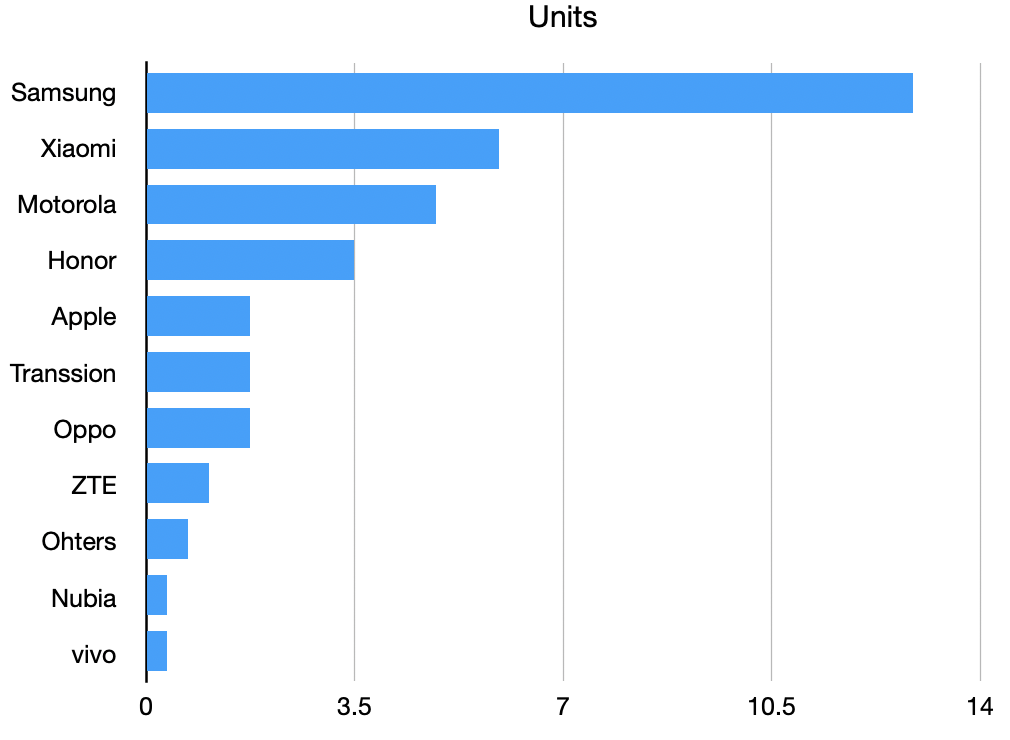
The Latin American smartphone market grew 3% year over year in 1Q 2026 to 34.8 million units, supported by proactive inventory accumulation and the delayed pass-through of rising memory costs. Omdia analyzes the market’s uneven vendor performance, as Samsung and Xiaomi strengthened their leading positions, while HONOR and Apple saw sharp growth supported by entry-level and premium demand, respectively.
Samsung led the region, shipping 12.9 million units (+9% YoY) and lifting share to 37%, its highest quarterly level since 1Q 2023, supported by strong performance of A‑series models across low‑end and mid‑high segments. Xiaomi held second, marking a sixth consecutive quarter of growth with 6.0 million units and 17% share, driven by double‑digit gains in Central America and Peru and solid traction of the Redmi Note 15 series in the mid‑high range. Motorola ranked third, contracting 5% YoY to 4.9 million units and 14% share, largely reflecting a 37% drop in shipments of US$100–US$200 devices, where G06 and G17 are key models. HONOR consolidated in fourth with 30% YoY growth to 3.4 million units and a 10% share, propelled by its Play 10 in the entry segment (below US$100), which approached half a million units sold for the first time.
Apple completed the top five with a 31% YoY increase, supported by an exceptional performance in Mexico (+80% YoY) and robust reception of the iPhone 17 series.
NB: Apart from Nubia(?) with 1% share, Apple was the fastest growing vendor in a flat market. Note the price points…
…The entry segment is below $100 and the next is $100 to $200. I doubt the average price is much above $200. The whole market was 34.8 million units suggesting Apple's share is 1.74 million units.
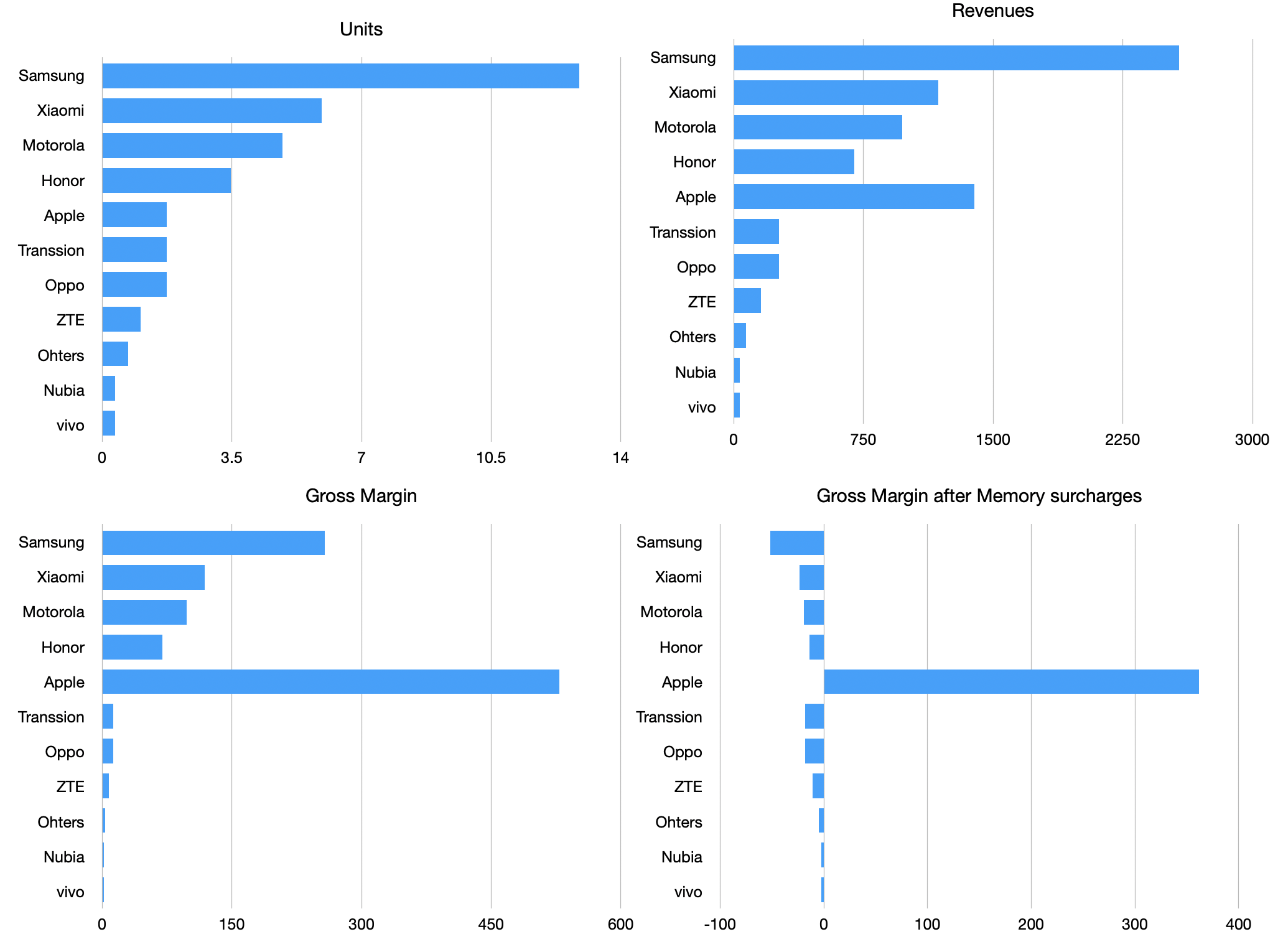
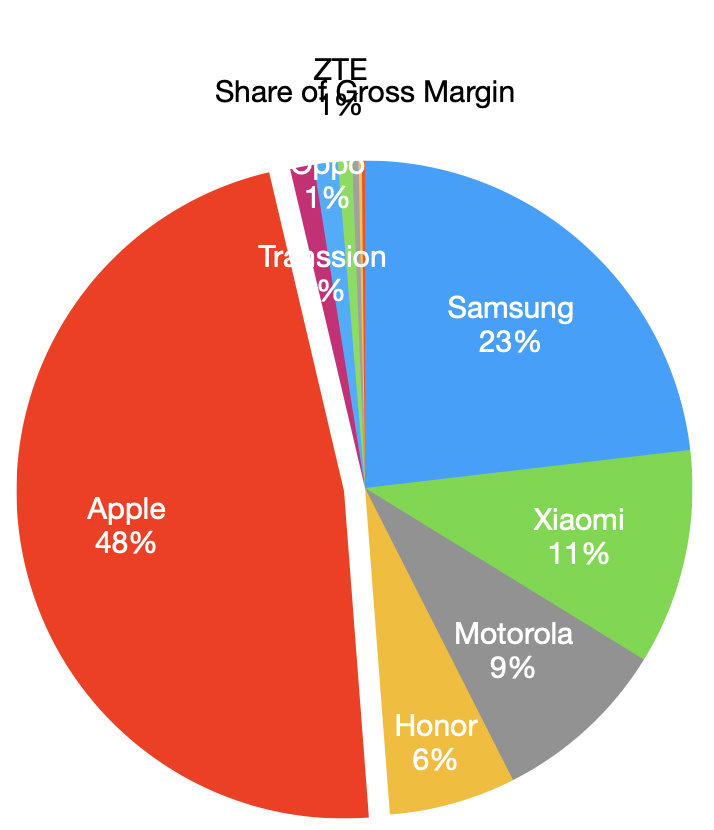
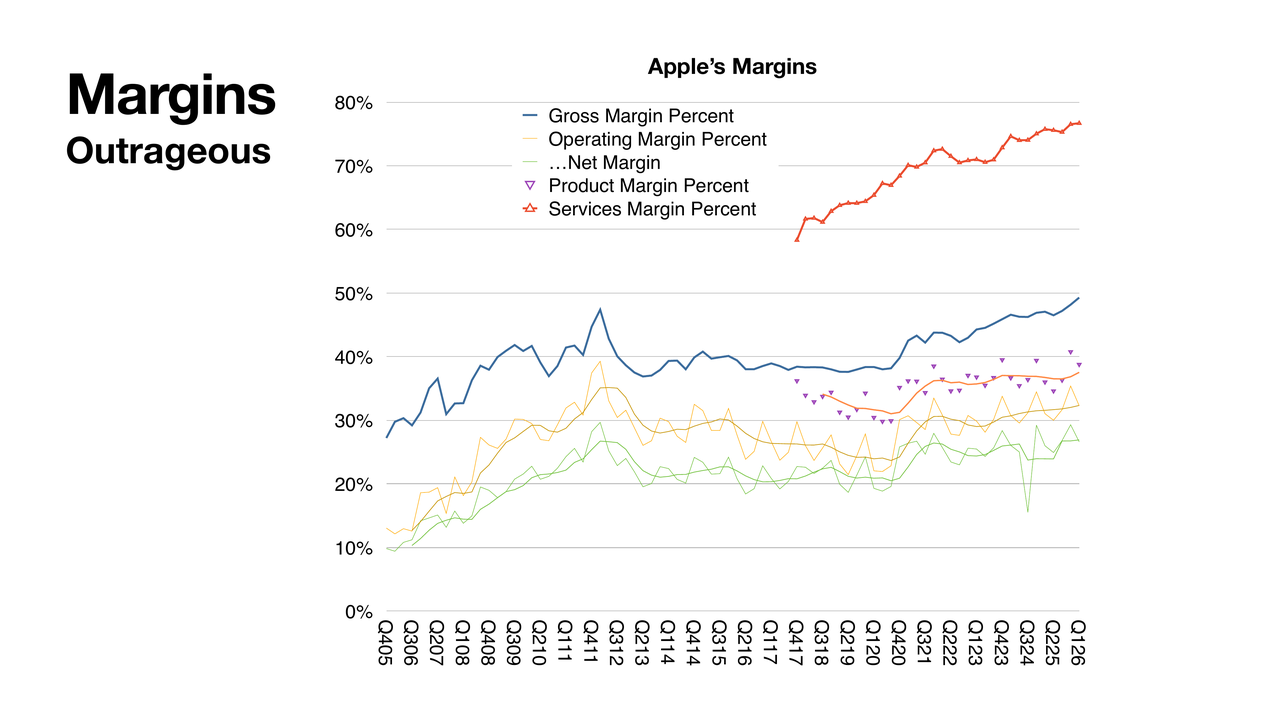
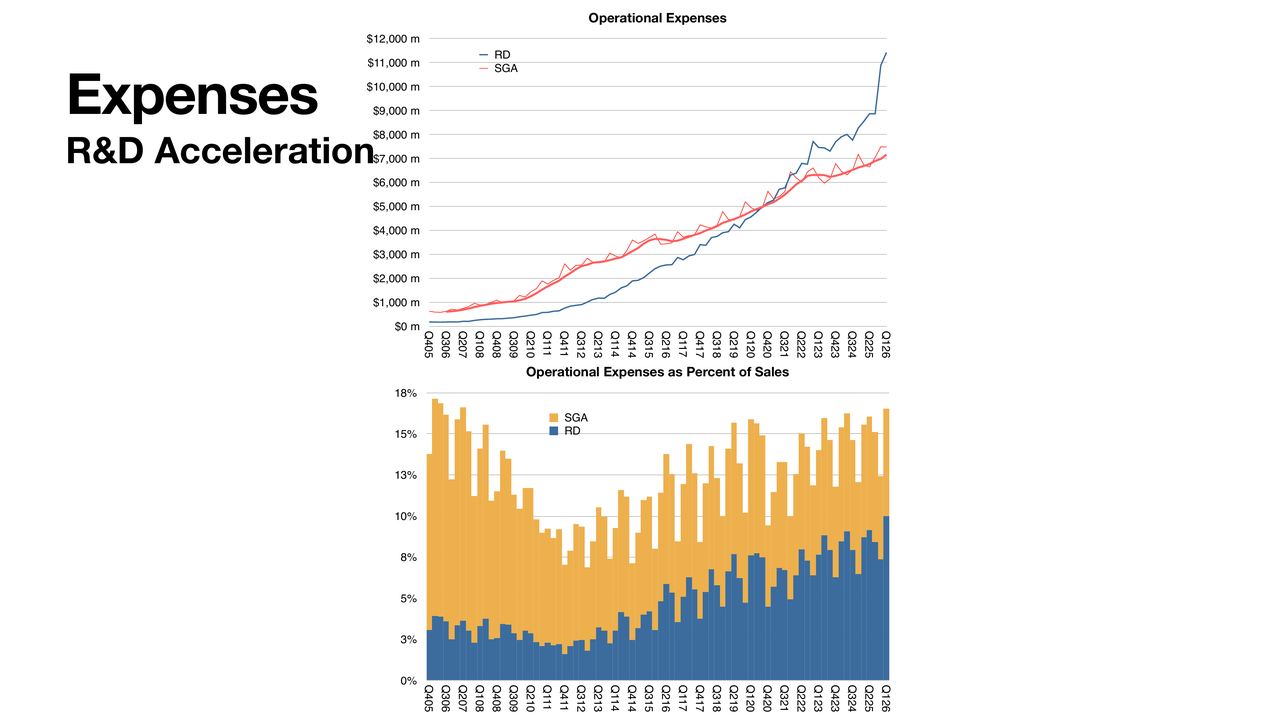
Given the data, the following graphs suggest how the available profits are allocated.
I took the liberty of estimating a change in gross margin as memory surcharges are taken into consideration (hence a future-looking estimate for next few quarters.) That is shown in the last graph.
At present, Apple captures about 50% of available gross margin in the sector.
Subsequent quarters might show Apple capturing 100% of the profits and a questionable sustainability of the market whereby all other vendors lose money on every phone they sell. Whether they continue to participate under these conditions remains to be seen.
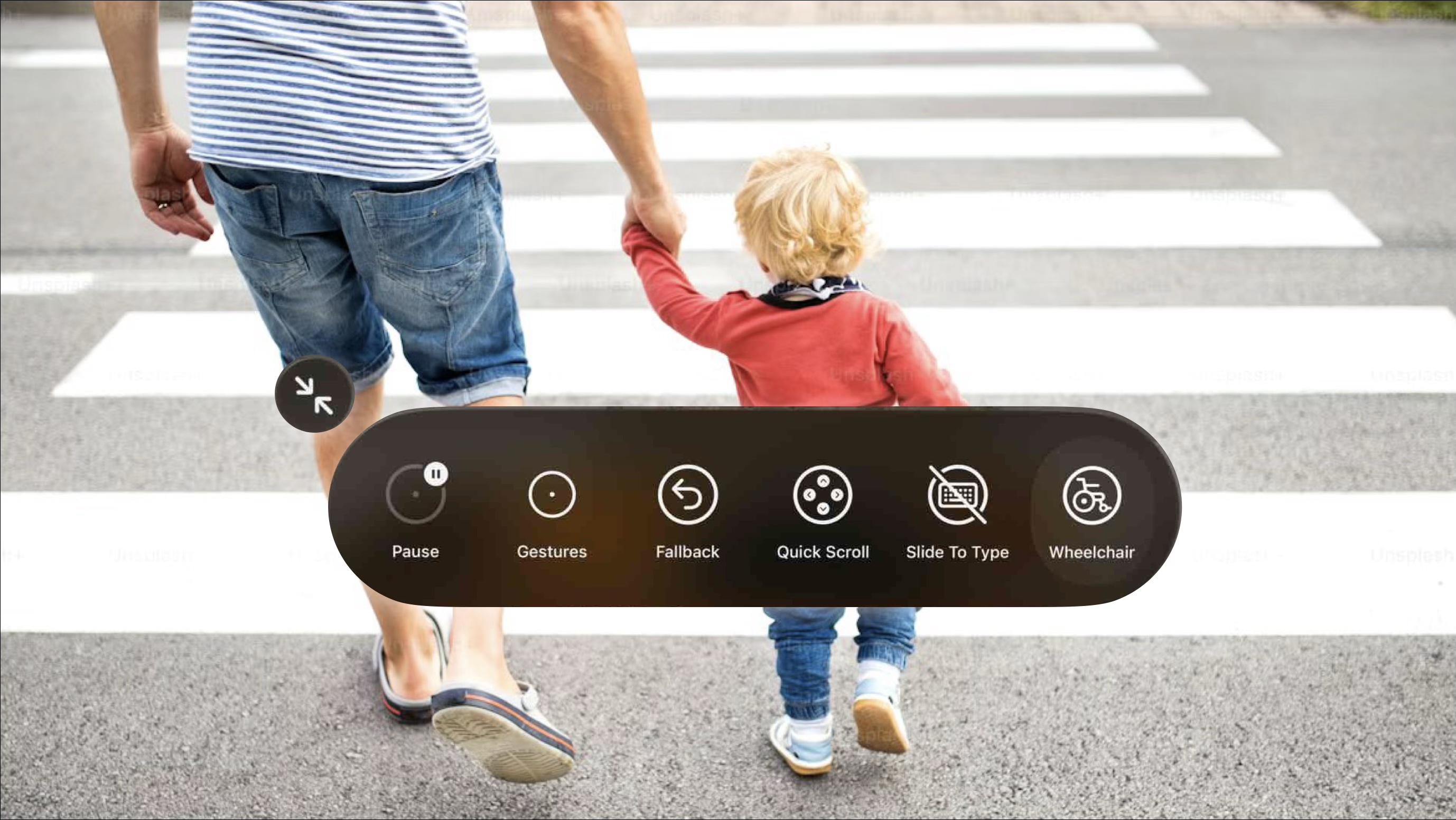
Apple announced new features for users to control power wheelchairs with Apple Vision Pro using their eyes. A new power wheelchair control feature leverages the precision eye-tracking system on Apple Vision Pro to offer a responsive input method for compatible alternative drive systems.
Also announced is on-device speech recognition whereby subtitles are generated privately and appear automatically for uncaptioned videos on iPhone, iPad, Mac, Apple TV, and Apple Vision Pro.
Moreover, Vehicle Motion Cues come to visionOS, which can help reduce motion sickness for people who use Apple Vision Pro as a passenger in a moving vehicle. Vision Pro will also support face gestures for performing taps and system actions, plus a new way to select elements with one’s eyes while using Dwell Control.
“The option to control my power wheelchair on my own is gold to me,” said Pat Dolan, founder of GeoALS and a member of Team Gleason’s patient advisory board, who has lived with ALS for 10 years. “With this new feature, Apple is developing life-enhancing technology for the people who need it most.”
NB: We have not yet arrived at WWDC yet Apple unveils huge new accessibility features powered by Apple Intelligence and reveals Vision Pro functions that will change lives. The Vision Pro remains the most remarkable machine I've ever seen or heard of. It is S tier.
Be sure to read the full release in the linked page from the Apple Newsroom. I chose to focus on the Apple Vision Pro portions but much more is being announced.
I chose the AVP because I had read some false claims made about it being deprecated. The latest announcement highlights Apple moving the product in yet another unforeseen direction: helping people with disabilities. To commit to this level of development speaks volumes.
Noteworthy is also in-vehicle use--something that until now has not seen much attention. I have tried motion cues with the iPhone. It's pure magic.
Medical professionals are paying attention even if the cynics aren't.
22% EPS growth is implied based on guidance. To review, "We expect our June quarter total company revenue to grow by 14%-17% year-over-year, which comprehends our best view of constrained supply. On iPad, keep in mind, we face a difficult compare driven by the launch of the A16-powered iPad in the prior year. We expect services revenue to grow at a year-over-year rate similar to what we reported in the March quarter after removing the favorable year-over-year impact from foreign exchange tailwinds. Keep in mind, during the March quarter, FX was a 2.5 percentage point tailwind to the total company growth rate, and for services, →
A Series on Valuation in the age of AI Apple recently hit an all-time high. Today the stock is trading at a P/E of 35. The P/E ratio is the current share price P divided by the last four quarters’ net earnings per share E. But we also have a pretty good idea of the earnings for the next quarter, ending June (now almost half-way completed). The guidance very clearly suggests that on a one Quarter forward basis the P/E ratio is 34. I’ve maintained for at least 15 years that a reasonable multiple for Apple is 35.
Stay tuned for upcoming Asymco One original research:
Why the most common metrics for valuation are insufficient — the problem with the P/E ratio
What are the alternatives that into consideration exceptional cash and capital expenditures — The EV/FCF ratio
How does the P/E ratio differ from EV/FCF and what does it mean if they diverge one way or another
How do the Mag 7 et. al. appear on these Metrics
How to complement snapshots like valuation ratios with the time series of fundamentals
Why payback measures are the ultimate measure of valuation
What are the current payback measures for the Mag 7 et.al.
Compare Apple to its peer group
Finally assess whether a collapse in confidence is imminent
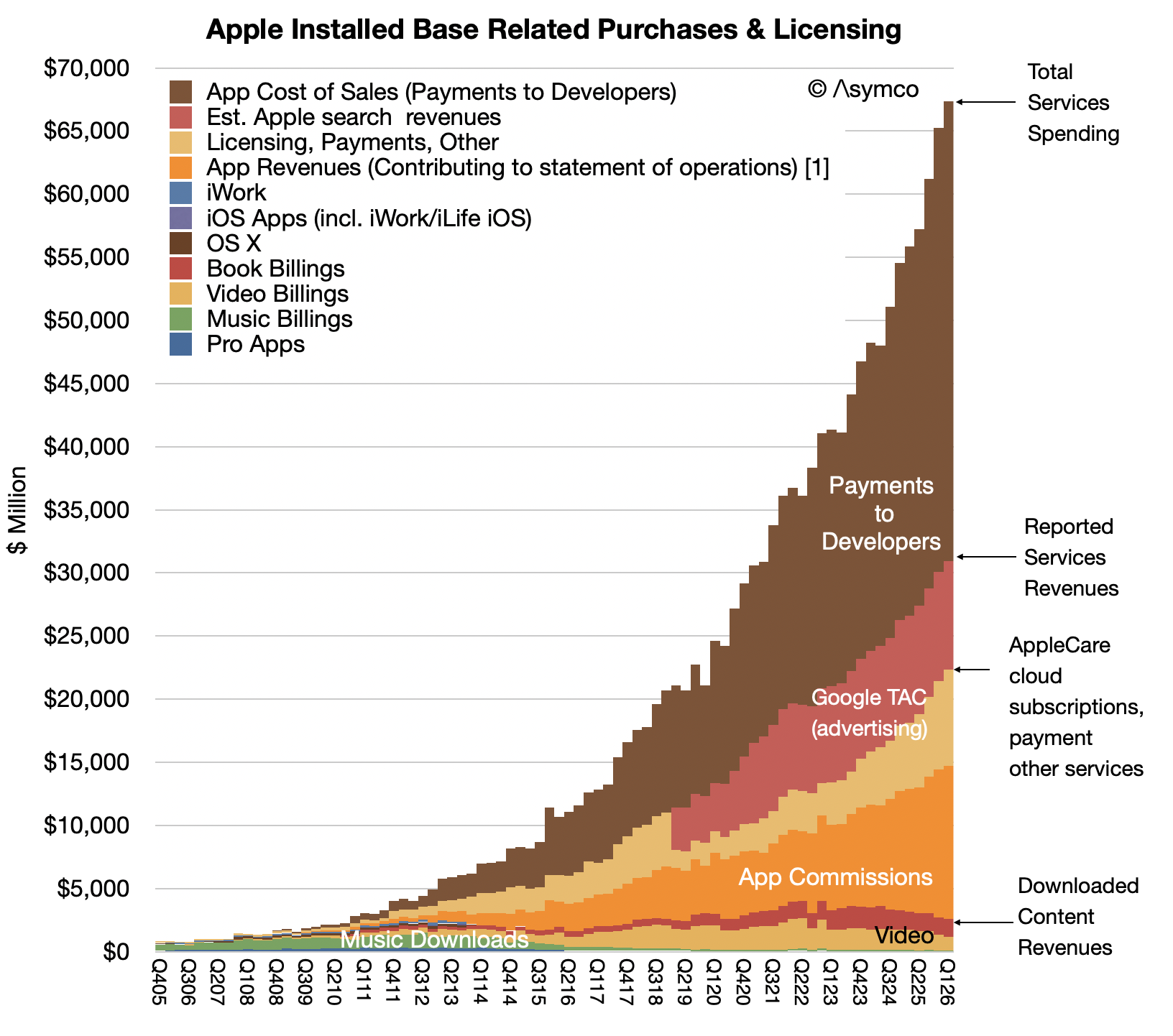
The Smartphone Market is Cracking → Apple takes 45% of revenue and nearly all the operating profit. Samsung makes more on memory than on phones, and Google is preoccupied with cloud and AI. The situation is hopeless for anybody but Apple, and market may break altogether next year. →
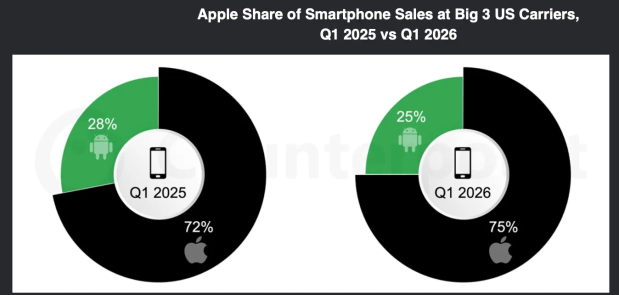
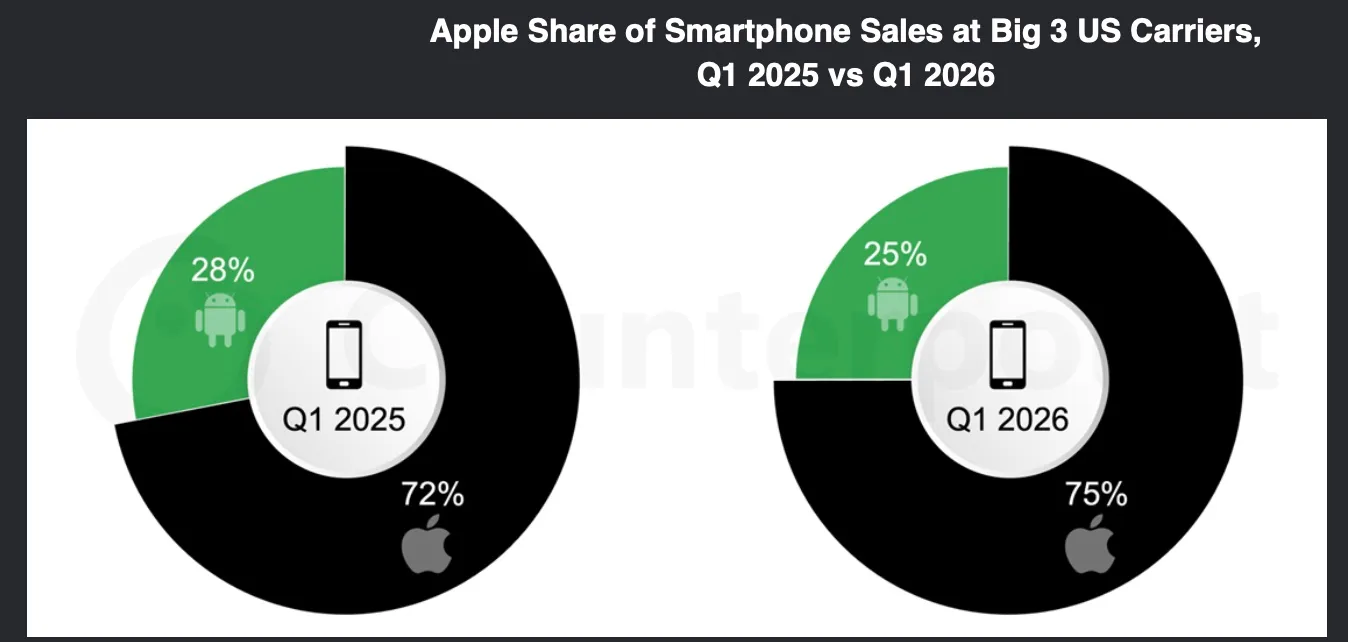
iPhone Share of US Big 3 Carriers reaches 75%, 77% with Verizon → At the low end, rising memory costs are consolidating prepaid around Motorola and Samsung. Smaller players are exiting. At the top, Apple held iPhone 17e pricing flat and doubled entry storage to 256GB; for manufacturers with thin hardware margins, this will be tough, perhaps impossible. A bifurcated market is emerging. →
Office Hour Q&As
The great memory panic of 2026 → Apple negotiates the base load on two-year lead times. The spike is at the margin, on variable spot supply. That is where the smaller suppliers live. Every semiconductor boom is followed by a bust. →
Will Apple Silicon Tackle Memory? → These commitments take years. Memory may come next, the way Qualcomm did. TSMC is the question after that. Capability is not willingness. →
What Are the Mobility Design Surfaces? → Public transport is shared. Micromobility is a heads-up experience. Cars are a lousy business, and the other modes offer almost no design surface. The opportunity is spatial computing outside interior spaces, where the entire world becomes the surface. →
Android down 14.4%. Small players getting crushed.
Apple’s quarter one (Q1) 2026 iPhone sales volume in the US was up 1.3% year-over-year (YoY), outperforming the country’s overall smartphone market.
That market declined 5.7% YoY, according to Counterpoint’s US Monthly Smartphone Channel Share Tracker. Apple’s share of volume grew by 4% YoY, as Android device sales declined 14.4% YoY.
On the impact of the delayed launch,Graham said, “The premium smartphone space in the US is highly consolidated compared to some other markets, with Apple, Google, Samsung and, to some extent, Motorola comprising the vast majority of sales here. When one brand delays a flagship launch, it opens a window of opportunity to fill that vacuum. Apple did just that.”
Apple grew its market share in each of the Big 3 US carriers. Its share grew the most at Verizon to 77% in Q1 2026.
“If Apple can avoid significant price increases and continue to outpace its peers in promotional dollars, it will be tough for Android manufacturers to keep up in the year ahead, said Klaehne.
NB: What are the dynamics of the US market? The split between Apple and the rest of the market seems to be starker than ever. It's ask if there is a K shaped market emerging…
Low-end weakness was mainly due to macroeconomic challenges. Lower-income households saw tax return increases year-over-year, but not as much as high-income households. These increases were offset by rising gas prices, and many consumers used the extra money to pay credit card bills. Consequently, more money transfers to lower-income households didn’t lead to the expected increase in smartphone sales in the prepaid segment, according to Counterpoint.
Amid lower overall sales, especially in the sub-$100 price range, prepaid channel marketing spend is concentrated on Motorola and Samsung. Other players like TCL and HMD have delayed model refreshes, exited the market, or struggle to compete with Motorola and Samsung’s marketing power. As a result, Motorola and Samsung increased their market share in most prepaid and national retail channels in Q1. Cricket (Samsung +6% points; Motorola +6% points) and Metro (Samsung +2% points; Motorola +7% points) saw significant YoY shifts.
Rising memory costs are expected to continue consolidating the low-end market in the US, impacting smaller players like Maxwest, Orbic, Blu, and white-label devices. This may lead to reduced portfolio diversity in lower price bands and further push lower-income consumers towards Samsung and Motorola options.
Meanwhile, Apple has maintained its pricing strategy, keeping the iPhone 17e pricing consistent YoY while increasing the entry-level storage to 256GB, even as competitors introduce price hikes. With this strategy, Apple draws more users into its iOS ecosystem, while placing service revenue growth over hardware profitability.
Counterpoint thinks this will lead to faster revenue growth through 2027. For manufacturers with smaller hardware margins, it will be tough. Perhaps impossible.
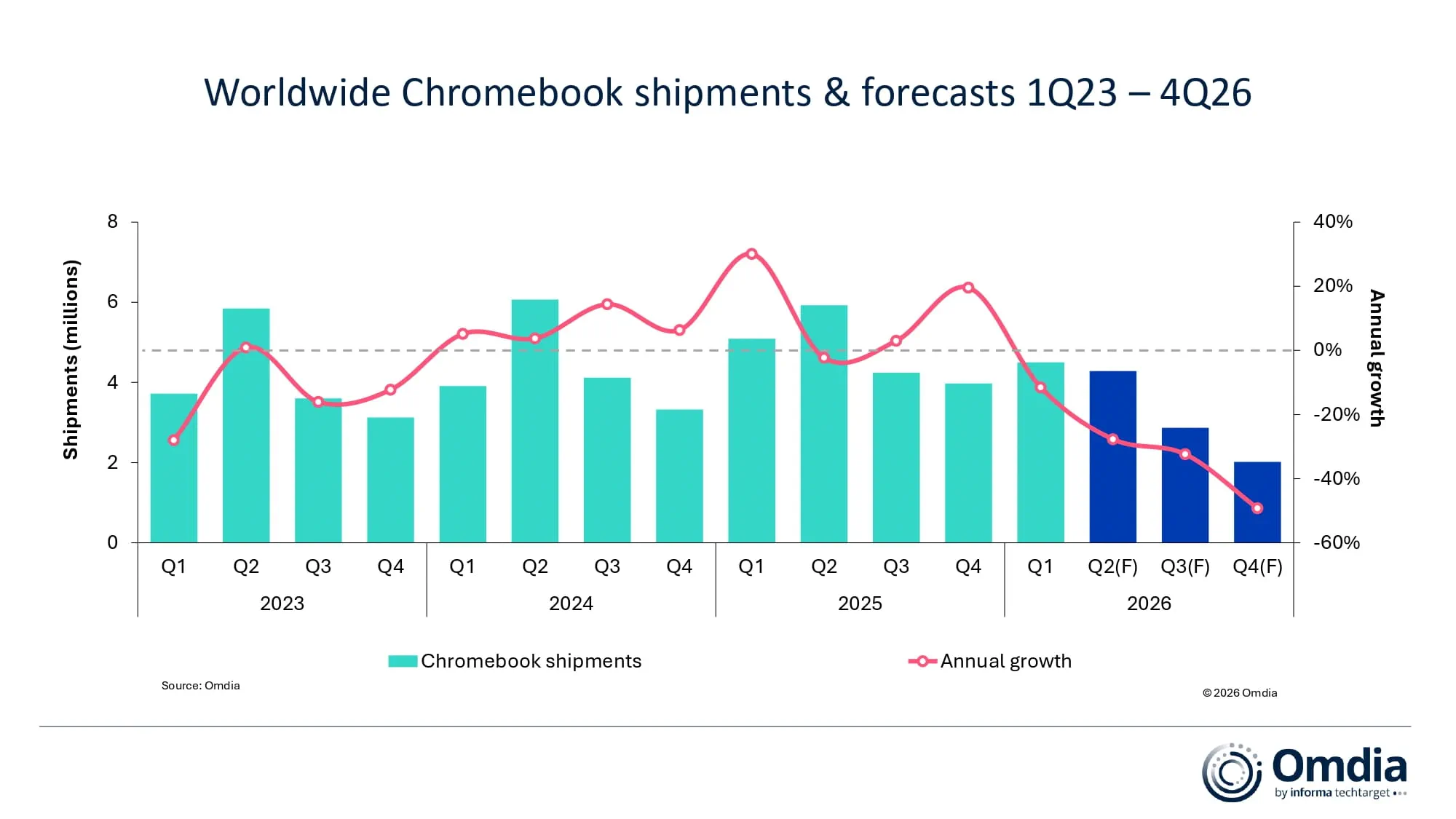
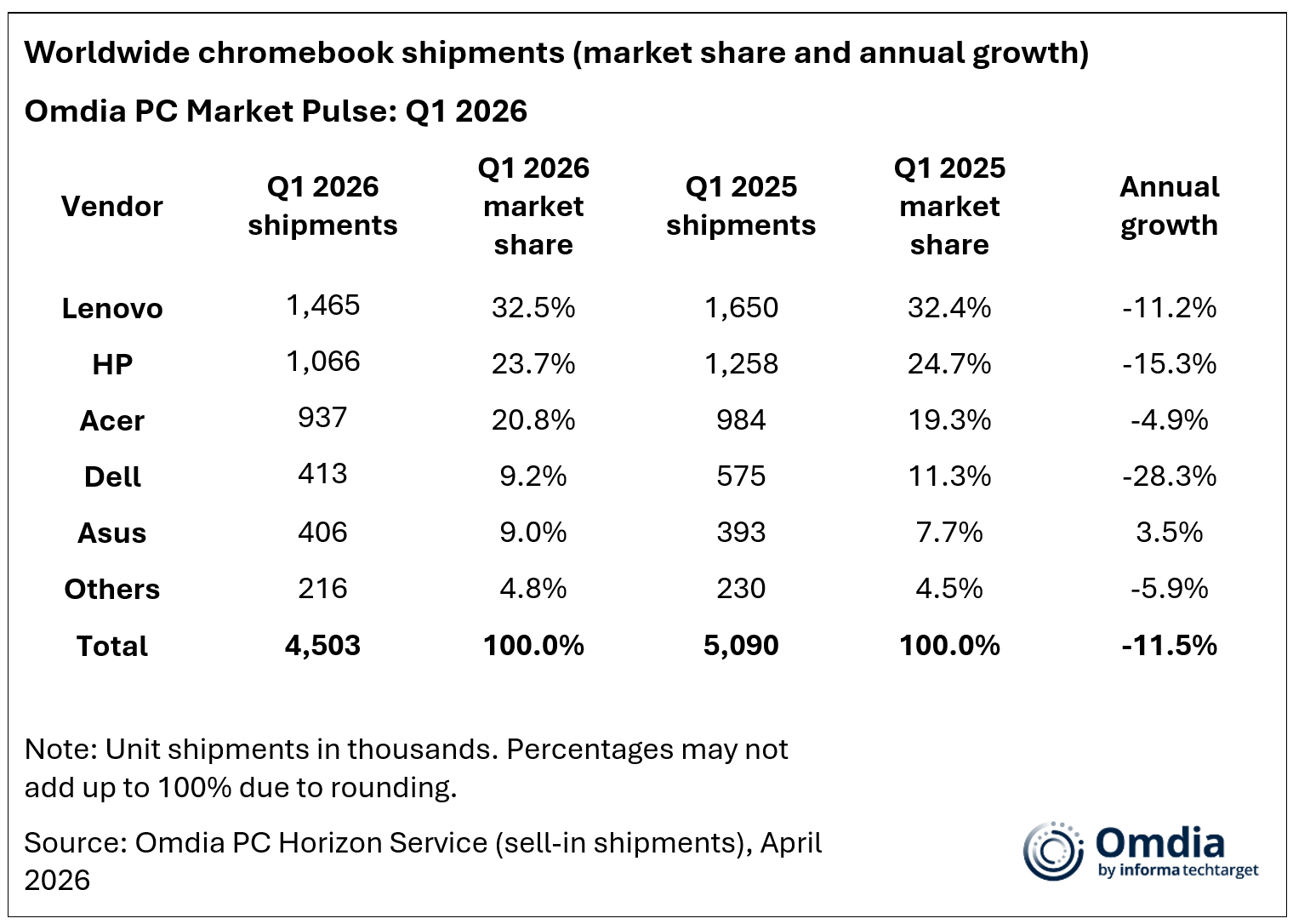
“Within the PC segment, Chromebooks are currently the most impacted category, with volumes declining significantly,” said Kieren Jessop, Principal Analyst at Omdia. “Production indicators point to a weak near-term outlook, and education-related deployments are increasingly being deferred until market conditions stabilize. Ongoing supply constraints are also expected to delay the second phase of Japan’s GIGA School Program 2.0. While the first phase - extended from end-2024 through end-2025 - was completed without major disruption, the current supply environment is likely to introduce delays in the next phase.”
All major Chromebook vendors faced challenges in Q1. Lenovo, which ranked first and was a key participant in Japan’s GIGA School Program alongside its subsidiary NEC, saw shipments decline 11.2% year on year to 1.5 million units as the first phase of deployments concluded. HP ranked second, shipping 1.0 million units, down 15.3% year on year. Acer placed third with 937K units, managing a relatively smaller decline supported by stable shipments in North America and increased shipments into APAC. Dell experienced the steepest decline among the top five vendors, with shipments falling 28.3% year-on-year to 413K units. ASUS, another key participant in Japan’s GIGA School Program 2.0, was the only vendor to record growth in Q1, with shipments rising 3.5% year on year to 406K units, accounting for a 9% market share.
NB: When the only type of buyer is a government agency and there's only a handful of them, things can turn scary bad very quickly.
The Chromebook market is undergoing a significant transition in 2026, transitioning from a budget-focused, education-dominant sector to a premium, AI-integrated landscape. While ChromeOS remains dominant in education, Google is introducing "Googlebooks" to compete in the premium, AI-powered laptop market, aiming to unify ChromeOS and Android experiences.
While traditional, affordable Chromebooks for schools continue, the new Chromebook Plus and incoming "Googlebooks" are shifting the market toward higher-end, Gemini AI-powered devices with premium processors.
ChromeOS holds over 60% of the education market, with 93% of US school districts planning to buy Chromebooks in 2025. The Omdia report cites prevalence in the Japanese market as well. However Omdia project dramatic slowing in the next three quarters.
Traditional Chromebooks will continue to exist for the budget sector, while "Googlebooks" are the pivot that Google is hoping to engage. The question is why is this necessary? It seems that the low-end market is contracting dramatically this year.
In this context the MacBook Neo steps in providing a no compromise personal computer vis-a-vis a network "cloud-connected" device. The Neo alone might ship 11 million this year. Projections are that in the same time frame about 10 million Chromebooks might ship.
Googlebooks are an unknown at this time but it seems they are necessary to try to shift a negative momentum for Google branded hardware.
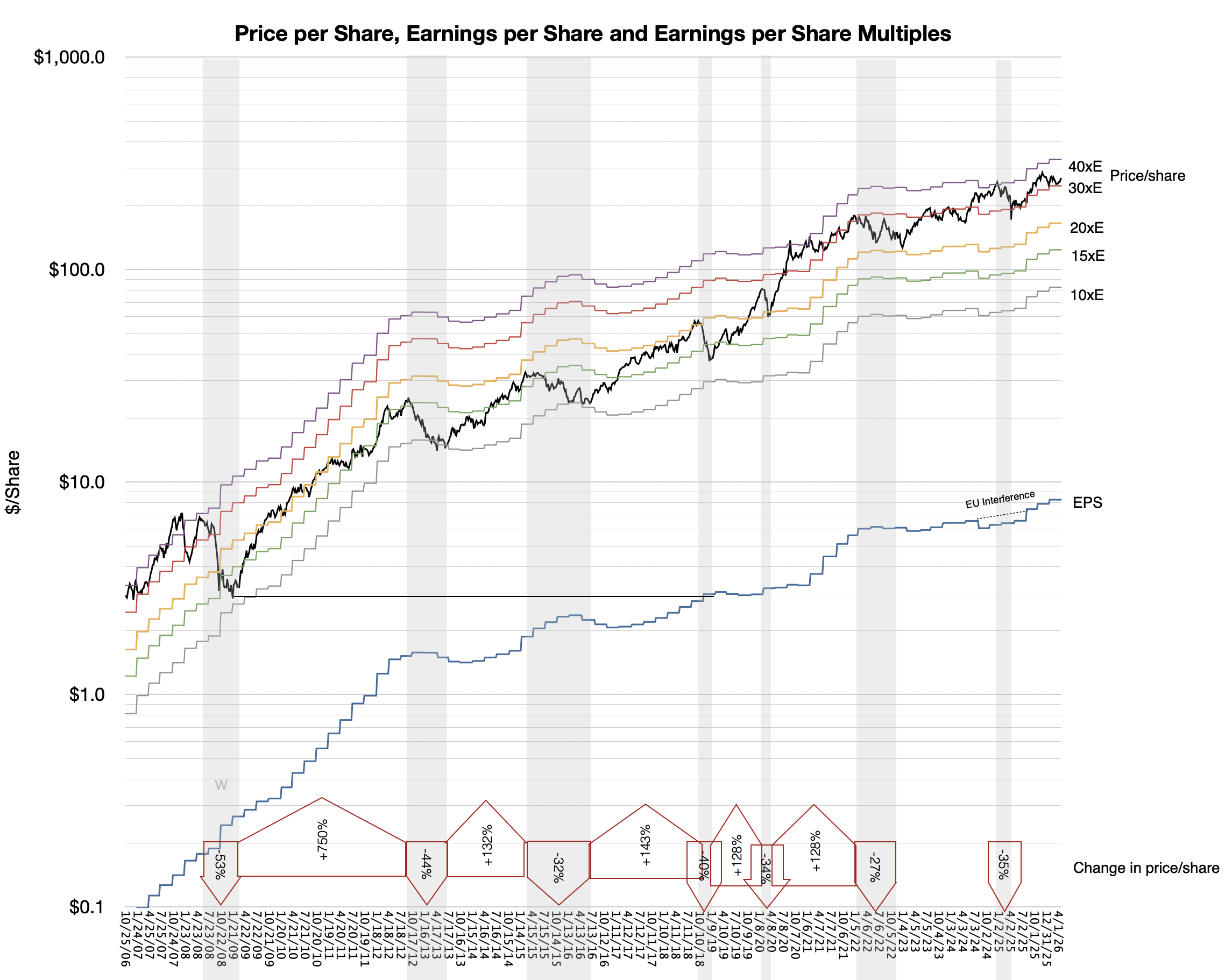
Apple recently hit an all-time high. Today the stock is trading at a P/E of 35. The P/E ratio is the current share price P divided by the last four quarters’ net earnings per share E. But we also have a pretty good idea of the earnings for the next quarter, ending June (now almost half-way completed). The guidance very clearly suggests that on a one Quarter forward basis the P/E ratio is 34.
I’ve maintained for at least 15 years that a reasonable multiple for Apple is 35. This was mainly because other large cap technology companies were also trading around that number. While at this ratio, if a company is growing at 22% it means that an investor will make their money back in about 10 years. Thereafter all free cash flows will go entirely to the investor’s pocket. That seems a reasonable return. It’s not a particularly risky bet to assume 20% growth for 10 years if you look at (a) history and (b) how many people in the world have not yet started using Apple products and (c) assess how well management is doing their job.
So by this measure, Apple seems to be reasonably priced. Historically it has not been reasonably priced but that is due to the disconnect between understanding the business and falling for the usual false tropes. The following graph shows the share price and where it fell between the bands of Earnings multiples. The grey areas represent periods of significant share price decline.
But much of the volatility of the stock is also due to overall sentiment collapse. That has happened on many occasions, most notably the 2008 financial crisis and “great recession.” (Another was the Covid crisis.) In these cases, regardless of underlying strength, the shares were available very cheaply.
Today perhaps we should ask if a bubble is forming due to exuberance around AI which is inflating the market in unsustainable ways.
There are four reasons why the current asset value explosion is different.
First, it is highly concentrated in a handful of names.
2005 S&P 500 top 10
% of the S&P index
2026 S&P 500 top 10
% of the S&P index
Exxon
3.1%
NVDA
7.8%
MSFT
2.5%
GOOG
7.3%
Citigroup
2.2%
AAPL
6.4%
GE
2.0%
MSFT
4.6%
Walmart
1.7%
AMZN
4.4%
BoA
1.6%
Broadcom
3.0%
J&J
1.6%
TSLA
2.4%
Pfizer
1.4%
META
2.3%
Intel
1.3%
Walmart
1.6%
AIG
1.3%
Berkshire Hathaway
1.5%
Total
18.7%
41.3%
Second it is fueled by equity not debt. Third, it involves disproportionate capital expenditure rather than M&A. Fourth it is accompanies by sharply growing revenues (though not as sharp as investment growth.)
In other words, whereas the equity value is growing rapidly, so is income and investment without leverage. This is a low-debt with high income scenario. Previous crises were high income with high debt (2008) or low income with low debt. (Dot Com).
That’s not to say that we have uniform fair equity values. We need to do quite a bit more due diligence to determine the state of the valuations precisely because we have unusual capital allocation strategies.
To cover this topic I’ll will break the analysis into multiple posts. They are:
Why the most common metrics for valuation are insufficient — the problem with the P/E ratio
What are the alternatives that into consideration exceptional cash and capital expenditures — The EV/FCF ratio
How does the P/E ratio differ from EV/FCF and what does it mean if they diverge one way or another
How do the Mag 7 et. al. appear on these Metrics
How to complement snapshots like valuation ratios with the time series of fundamentals
Why payback measures are the ultimate measure of valuation
What are the current payback measures for the Mag 7 et.al.
Compare Apple to its peer group
Finally assess whether a collapse in confidence is imminent
Please return to these pages in the next few days to read these posts.
Fundamentals are breaking; Profits evaporate; Competitors flee; Android logic questioned
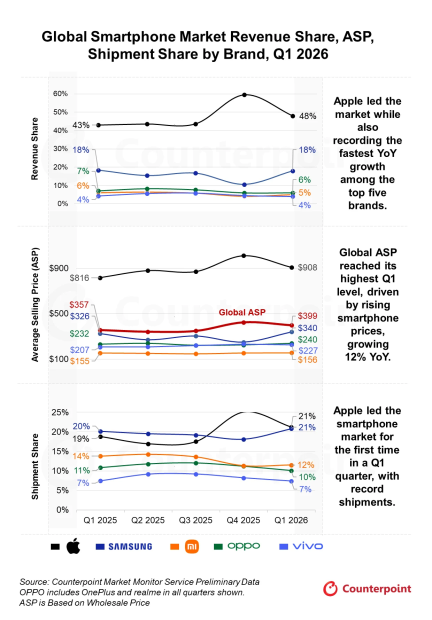
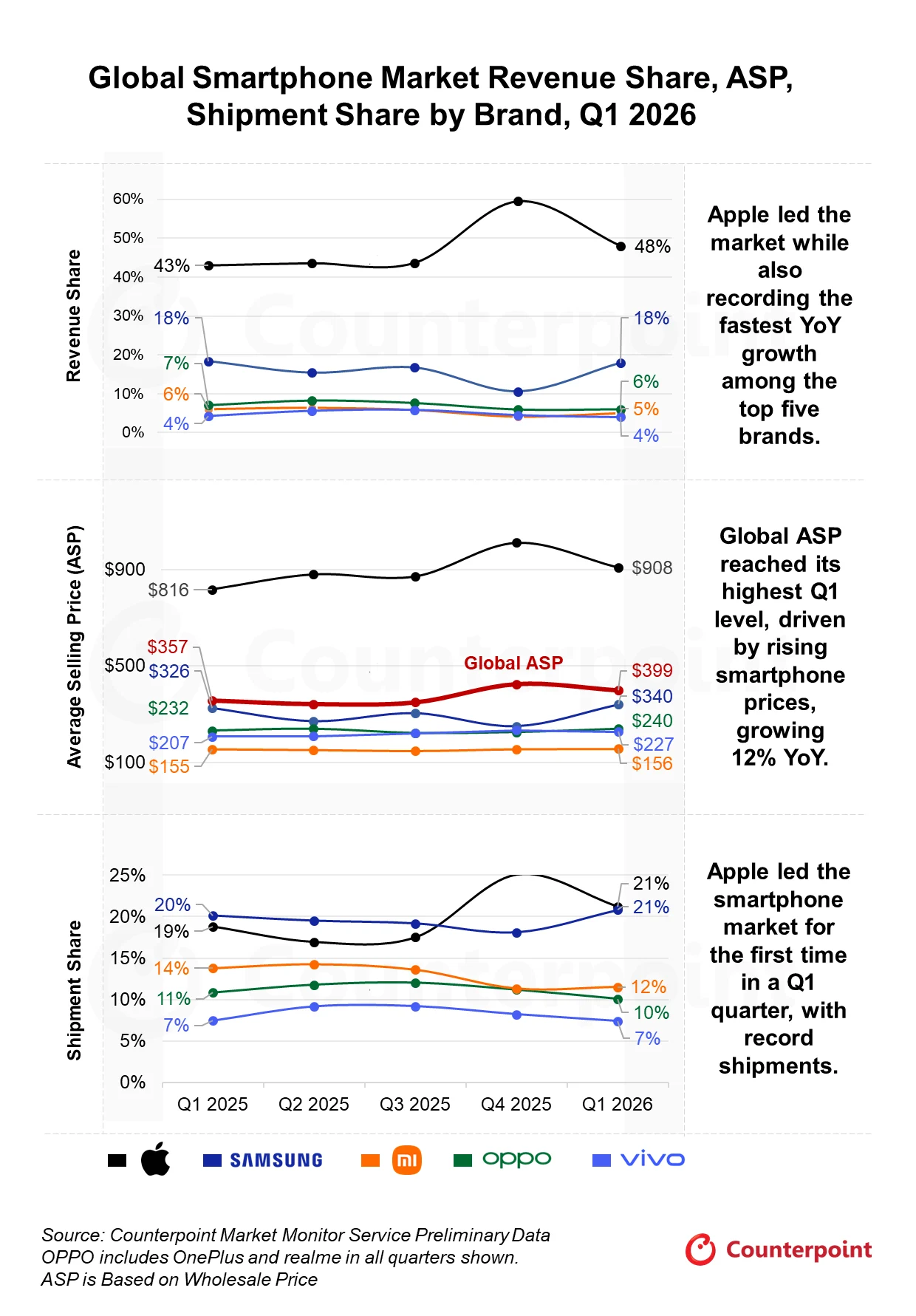
Apple’s revenue climbed 22% YoY in Q1 2026, registering the fastest growth among the top five smartphone brands while also hitting a first-quarter record high. Furthermore, the brand led the global smartphone market in terms of shipments for the first time in a first quarter, capturing a 21% share.
Commenting on Apple’s performance, Research Director Jeff Fieldhack said, “Apple’s growth was driven by sustained demand for the base iPhone 17 and iPhone 17 Pro Max, with a stronger mix of these models lifting Apple’s overall ASP by 11% YoY.
Unlike its peers, Apple mostly maintained stable pricing despite rising BOM costs, reflecting its ability to absorb cost pressures and remain insulated from the memory crisis, which helped strengthen its competitive position during the quarter. Regionally, Apple saw broad-based strength, especially across the Asia-Pacific region, driven by subsidies, promotions, and trade-in offers.”
The global smartphone market’s revenue grew 8% YoY in Q1 2026, driven by strong premium demand and pricing adjustments across major OEM portfolios amid rising Bill of Materials.
The average selling price (ASP) climbed 12% YoY to reach $399, supported by contraction in entry-level segments and price hikes across regions.
Apple led the global smartphone market in terms of value, recording its highest-ever first quarter revenue. Apple was the fastest growing brand with revenue up 22% YoY supported by relatively stable pricing compared to peers, despite broad-based price increases across the industry.
Samsung held an 18% revenue share in Q1 2026, with shipments reaching 21% of the total market, supported by portfolio optimization and strong response for the Galaxy S26 series.
The global smartphone market is expected to remain under pressure through 2026, and a substantial recovery is expected only in late 2027.
NB: The average sales price is up to $399 but Apple, with the largest share and fastest growth, reached $908? There's a lot more that does not make sense.
Apple is also projected to have 45% of revenue share and I reckon nearly 100% of profit share (on an operating margin basis). Samsung, the only substantial brand remaining, is now preoccupied with memory sales, which have allowed it to reach $1 Trillion in market capitalization. Management at Samsung must be asking themselves why compete with Apple on devices when they can make 100x the profit as a supplier of components. Especially as Apple is looking for an alternative to TSMC for fabrication (and flirting with Intel too.)
This all looks like a cornered market to me. That's not to say that capital will not still chase the smartphone dream, especially in China, but the situation is all but hopeless for anybody but Apple. Apple may take a few steps to lock this up next year with new portfolio strategy (e.g. iPhone Neo and Ultra bookends), new launch schedule and new pricing.
Google, meanwhile, is preoccupied with cloud and AI leaving a big question mark above Android. This is a slippery slope of evaporating hardware profits, dwindling platform investments and obsessions with the new shiny thing.
The smartphone market is cracking. It may break altogether next year. Stay tuned.