Asymco

Asymmetric Intelligence

Latest from Asymco

  1. Valuation in a time of AI

    Research · 1 comment

    Cash flow is a fact, earnings are an opinion and share price is a dream.

    A company's total worth is the number of outstanding shares multiplied by their value. This product is called the market capitalization or Market Cap.

    That's a simplification. If you want to be more accurate, you should take the Market Cap and net out cash and debt--these are not part of the future flows of cash that can benefit shareholders.

    More precisely, there is another measure called the Enterprise Value (EV) which is the total price tag of a company, representing what it would cost to buy the entire business and pay off its debts. EV = Market Cap + Total Debt + Preferred Stock + Minority Interest - Cash and Cash Equivalents.

    This is the precise and complete measure of the firm's value but we use the shortcut of Market Cap since In most cases the Preferred stock and minority interest are negligible and if cash equals debt then the result is EV =~ Market Cap. it's easier to calculate anyways as the shares outstanding and share price are easily available. Not so for EV.

    To get a sense of how much you're paying for the company it makes sense to divide the Market Cap by the company's Earnings so you get an idea of how many years it will take to get back your investment. When dividing both Market Cap and Earnings by the number of shares it becomes the famous P/E ratio or Price per share / Earnings per share.

    But if you want to be fully precise, instead of using Market Cap you should use Enterprise Value. In that case the denominator should be Free Cash Flow or FCF1. The ratio becomes EV/FCF. Free Cash Flow is a better measure than earnings because it takes into consideration depreciation, change in working capital and capital expenditures. It measures the actual cash a company generates after paying for its operating and capital expenditures.

    EV/FCF takes into consideration unusual situations such as huge amounts of cash or debt or capital expenditures which removes shareholder access to what the company "earns" on paper. This why the adage of "earnings are an opinion but cash flow is a fact" exists.

    I used EV/FCF years ago to value Apple because at a time when it held huge amounts of cash. This was before it began aggressively reducing its cash through its capital return program. The P/E ratio at the time was very low but excluding the cash, it was even lower. It was a huge red flag indicating that the company was being priced for liquidation, or as some analyst put it, priced like a steel mill going out of business. If at that time you did not believe that its demise was imminent you would have surely been richly rewarded.

    Today the anomaly that throws the P/E off is not Cash but CapEx. And it's not for Apple but for the other mega caps or AI "hyper scalers". Without worrying who is or isn't in the "Magnificent 7" I compiled the largest 10 market capitalization companies and looked at their P/E and EV/FCF ratios. At time of writing:

    CompanyMarket CapP/E RatioEV/FCF
    NVDA$4,014,456,963,07233.644.4
    AAPL$3,624,949,514,24031.330.3
    GOOG$3,304,174,911,48825.244.3
    MSFT$2,667,926,257,66422.535.0
    AMZN$2,157,182,320,64028.0297.0
    TSM$1,641,528,688,64030.650.0
    TSLA$1,333,163,982,848332.0225.0
    META$1,356,802,949,12022.832.6
    BRK-B$1,023,780,323,32815.344.1
    LLY$793,550,454,78438.6142.3

    As recently as six months ago, there was a lot of talk about an AI bubble. Back then I looked at the data then and by looking at the P/E ratios convinced myself that the valuations were not "bubble" level. They were in the mid-thirties. These were not historical high especially when considering the growth these companies were experiencing (over 30%). Since then prices have come down significantly.

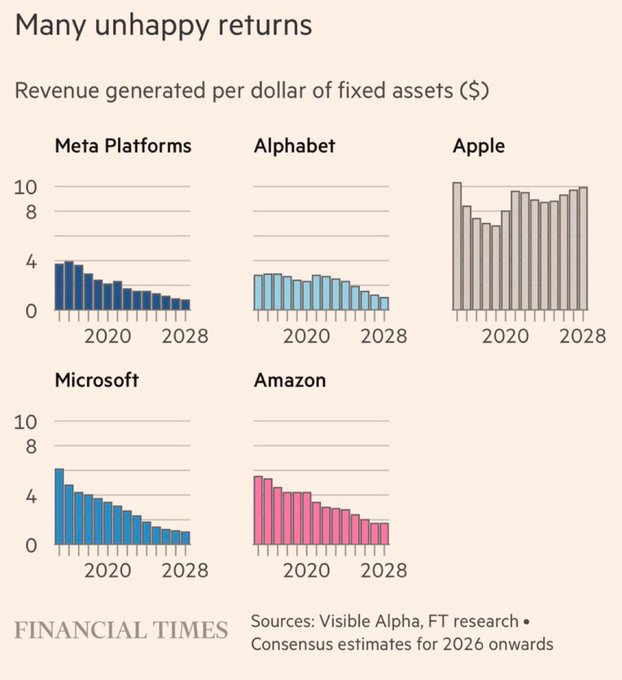
    This is as the CapEx elephant in the room has been making itself known and there is renewed alarm at the scale of capital spending. This is reflected in the EV/FCF number but not in the P/E number.

    The table above shows how much more elevated the EV/FCF ratio is relative to P/E for many of the companies. This "truer" measure of what you are paying as a share buyer is now reflecting in reduced share price and hence reduced P/E.

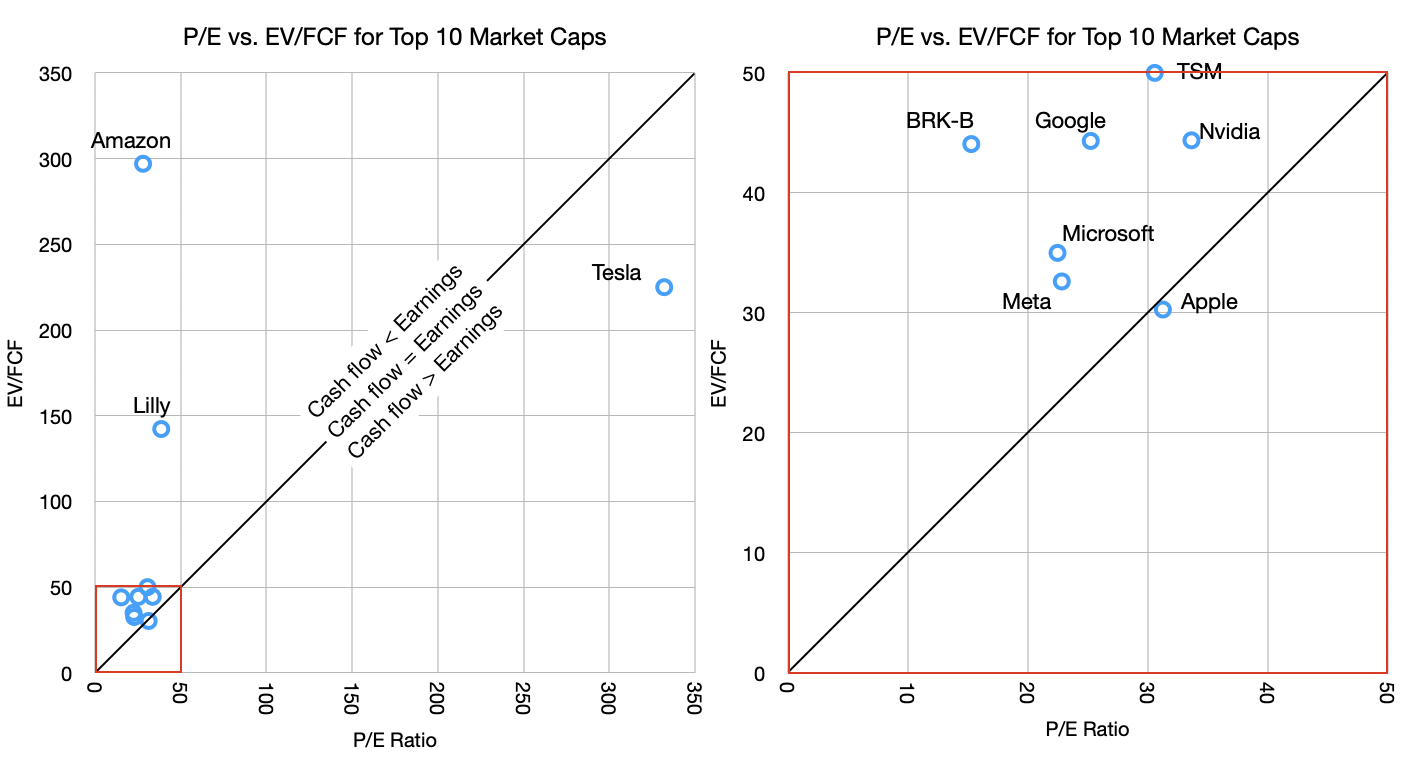
    Of course, this is not true for Apple. Apple's P/E ratio and EV/FCF are nearly identical. To see this more clearly I put together these graphs.
    Valuation in a time of AI

    The graph shows the P/E vs. EV/FCF for the companies in the table. The graphs are the same data but the one on the right is zoomed in on the lower left corner (note the red squares).

    The reason for the zoom is that there are three outliers. Tesla, Amazon and Lilly. Tesla has absurd valuation on both P/E (300 to 400 range in last 6 months) and EV/FCF while Amazon has an outrageous EV/FCF value due to abnormal capital spending. Basically, Tesla has negligible earnings (and negative growth) while holding astronomical share price and Amazon is spending far above its median on CapEx. Amazon's 10-year EV/FCF is much lower, at approximately 55.

    But let's ignore the outliers and concentrate on the other seven in the cluster. These are below 50 P/E and 50 EV/FCF thresholds.

    Note that I drew a diagonal line representing the equation of P/E = EV/FCF. This should, under normal circumstances, hold for most stocks. Just like Market Cap should roughly equal Enterprise Value so Earnings should equal Free Cash Flow.

    Most companies should not stray too far from this line. But what we are seeing, with the notable exception of Apple, is that most tech companies have cash flow far below earnings. This is again due to the CapEx elephant.

    The argument goes that this is a temporary situation with that capital being wisely deployed for returns from AI. Presumably, these companies will swing to the other side of the line, where cash flows will exceed earnings, compensating for the capex that was denied to the shareholders.

    This is where the old adage comes into play: Earnings are an opinion but cash flow is a fact. I added to that "and share price is a dream". Take the free cash flow and multiply it by a "dream" and you get the price the market sets. This dream is the multiple.

    What makes the AI "bubble" interesting is how it's not fueled by debt2 but by cash flow. Companies are turning over large portions (almost all and sometimes more) of their cash flows to investing in the dream of AI profits. All but one, of course.

    There is something obviously contrarian in Apple's strategy. Perhaps it's not Apple that is odd but rather there is groupthink on behalf of the others. The question of who's right will rest on whether it turns out that AI is going to commoditize quickly or perhaps never, whether AI turns out to be modular or integrated, whether AI exhibits disruptive or sustaining competitive responses, whether it's an infrastructure subject to regulatory corrosion or whether it will migrate to the edge and iterate freely, whether it's a new experience or simply better existing experiences, whether it creates new markets or just makes existing ones more efficient.

    These are not new questions. They have been applied to all software and hardware innovations of the last 40 years. We have a lot of history to inform us.

    Join me as we learn.

    1. To calculate FCF, look at the Income statement, start with earnings before interest and taxes (EBIT), add depreciation, subtract taxes and CapEx.
    2. There is some debt of course, but the scale is so immense and the risks so high that most lenders would not touch this type of investment.
  2. Asymco Bulletin 007 - Apr 5, 2026

    Bulletin

    Asymco Bulletin is a digest of all the work we have published for the week ending Apr 5, 2026.


    Podcast

    Apple at 50 – Ben Thompson interviews Horace Dediu

    Apple at 50: Ben Thompson of Stratechery interviews Horace Dediu → Horace describes his journey from Romania to becoming a leading tech analyst, highlighting his experiences at GTE Labs, business school under Clayton Christensen, and Nokia during the iPhone's birth. He emphasizes Apple's customer-centric approach and its potential to navigate AI challenges. Dediu also shares insights on his new paid service, Asymco One, and reflects on the importance of understanding market dynamics and customer satisfaction. He expresses optimism about Apple's future and underscores the value of deep, long-term analysis in tech forecasting. →


    Nota Bene

    Apple Maps Is Getting Ads. It’s Apple’s Riskiest Bet Yet → Apple streamlines business tools and cautiously enters Maps advertising. It's not Apple's riskiest bet yet. →

    Survey shows iPhone improved retention, purchase intent, growth in services, service pricing, product mix, foldable upside → Despite robust customer loyalty, service growth, and strategic hardware shifts bolstering margins, UBS's maintains neutral stance and $280 target. →

    Apple’s Business Strategy → Apple's enterprise growth is driven by its strong consumer base. Do new services like Apple Business suggest a new emphasis? →

    Melius highlights FCF while reiterating buy on Apple → In the AI era, valuation shifts from traditional P/E to EV/FCF, highlighting Apple's robust financial health and fair valuation amidst its significant product launches. →

    The iPhone 50 years from now – and why Apple won’t have AI execs → Rumors suggest the iPhone 70th anniversary edition might feature an innovative new camera system, while Apple CEO Tim Cook dismisses the idea of AI-led executives due to legal and functional constraints. →

    We know that Macs last longer in use. How much longer? → Macs and iPhones outlast Windows PCs and Android phones in enterprises, yet decisions are suboptimal. How long will that last? →

    Warren Buffett tries to justify his hypocrisy → Buffett's actions on Apple highlight a difference between his statements and his actions. →

    Apple Vision Pro users will be able to experience NASA’s Artemis II launch in immersive video

    Apple Vision Pro users will be able to experience NASA’s Artemis II launch in immersive video → Immersive experiences redefine our connection to events such as space exploration. →

    Mac market share to grow from 9% to 12% in 2026 → "Apple defies the 2026 notebook market slump with a strategic shift, poised for its largest share gain since 1991." →

    Analysis: Mac grew 16% and iPad grow 15% in China in the fourth quarter of 2025 → In 2025, Apple's Mac and iPad sales in China saw notable year-over-year growth, while looming 2026 market contractions hint at challenges. Apple might defy trend with new launches. →


    Office Hours

    The next Asymco Office Hours Live Q&A will be held on:

    Wed April 8 at 12pm ET / 9am PT
    Asymco.com/live

    Asymco One subscribers can sign up to attend the live Q&A with our own Horacle of Helsinksi.

    Conference details will be sent to participants with ample time before the call. Watch asymco.com/live for latest updates.


    Asymco One gives you full access to our research, analysis, and commentary. Subscribe with code BULLETIN for a discount.

    We appreciate your feedback! Have questions or comments? Reach out to us at contact@asymco.com. Looking forward to hearing from you.

  3. Asymco Office Hours Live Q&A with Horace Dediu: April 8, 2026

    Office Hours

    Mark your calendars!

    The next Asymco Office Hours Live Q&A will be on Wed April 8 at 12pm ET / 9am PT. Asymco One subscribers can sign up to attend the live Q&A.

    See latest Update

    Register for April 8 Office Hours to guarantee your spot.

    Office Hours Live Q&A is open to Asymco One subscribers.

    Contact us at events@asysmco.com if you have any questions.

  4. Warren Buffett tries to justify his hypocrisy

    Nota Bene · 5 comments

    Shameful.

    "I sold it too soon. But, I bought it even sooner, so," Buffett told CNBC's Becky Quick in an interview Tuesday on "Squawk Box" .

    Apple remains Berkshire Hathaway's largest holding even after the conglomerate trimmed its stake to $61.96 billion at the end of last year, according to InsiderScore.

    However, Buffett said Tuesday that he would continue to add to the position if it gets cheaper. He said the iPhone maker is not yet attractive even after falling more than 14% off its recent high, and dropping more than 6% this month. That's amid turmoil in the broader market, with both the Dow Jones Industrial Average and the Nasdaq Composite in a correction.

    "I'm very happy to have it be our largest holding," Buffett said. "I was not happy to have it be as large as almost everything else combined."

    "It's not impossible that Apple would get to a price, we would buy a lot of it," he added. "But not in this market."

    Buffett said the firm has made more than $100 billion in the stock pretax, and was favorable in his comments regarding Tim Cook's leadership of the firm over Steve Jobs.

    "Tim Cook has done better with the hand. Steve Jobs — he couldn't have done what Steve Jobs did — but Steve Jobs handed him a hand that Steve would not have done as well," Buffett said.

    "Tim was a fantastic manager, and he's a good guy, and somehow he gets along with everybody in the world," he added. "That's a technique I wouldn't have, for example, certainly my partner, Charlie Munger, wouldn't have had it."

    Source: CNBC

    NB: Warren Buffett said he sold Apple stock too soon but clarified he has no actual regrets. Buffett said it is better than any business Berkshire owns outright including its railroad, which is worth more in dollar terms but earns nowhere near the return on capital that Apple does. He also said his railroad might last longer than Apple.

    He said if Apple ever got cheap enough, he would buy a lot more of it. He owned a lot more of it priced a lot lower than what he would have to buy it back at. Complete nonsense.

    Also Warren Buffett:

    Quote: "Our favorite holding period is forever". Action: Trade Apple to realize gain.

    Quote: "Price is what you pay, value is what you get". Action: Trade Apple to make $100 billion pretax, mention that price determines decision.

    Quote: "At a healthy business, cash is sometimes thought of as something to be minimized as an unproductive asset that acts as a drag on such markers as return on equity" Action: Sell Apple and other equities and move $300 billion into unproductive cash.

    Quote: "Investors, of course, can, by their own behavior, make stock ownership highly risky. And many do. Active trading, attempts to ‘time’ market movements..." Action: time decision to trade Apple for cash on the basis of price, tax and market conditions.

    Quote: Apple is "probably the best business I know in the world," "we like to own businesses not stocks". Action: Convert Apple ownership into cash.

    Quote: "I'd love to own 100 percent" of Apple. Action: Sell 60% of Apple holdings.

    Quote: "I don't think of Apple as a stock. I think of it as our third business" Action: Sell Apple, move into unproductive asset cash.

    Quote: "I sold Apple too soon". Action: Also say that you don't regret it.

    Actions speak louder than words. The results will be felt by his shareholders.