Asymco

Asymmetric Intelligence

Industry

  1. Acer chairman predicts iPad market share

    Research · 30 comments

    Acer chairman J.T. Wang recently predicted that Apple’s share of the tablet market would decline precipitously as new rivals emerge, falling from nearly 100 percent to 20 to 30 percent.

    via Apple Will Retain At Least Half the Growing Tablet Market, Says Analyst | John Paczkowski | Digital Daily | AllThingsD.

    So let me get this straight: A PC vendor...

    • that did not consider building tablets because they failed to see an opportunity
    • that, once introduced, dismissed the iPad as a failure
    • that has no software assets to couple to an alternative offering
    • that cannot license software assets that compete because none exist
    • that does not understand what jobs the device is hired to do vs. what his current products do
    • that has no ecosystem to couple to an offering
    • that cannot market products any cheaper than the incumbent

    ...should be taken seriously when predicting share for products that do not exist?

  2. Adobe and Microsoft sitting in a tree

    Research · 16 comments

    Adobe is one of the last surviving desktop software companies. So is Microsoft. Consolidation happens when an industry matures and excess capacity and excess overhead can be squeezed out of the value chain, giving a temporary burst of earnings growth.

    So, in this way of thinking, recognizing that the sun is setting on desktop software, a merger of old schools of thought may make sense. Rather like Sun and Oracle or HP and Compaq.

    But then a lot of other things make more sense. Like both companies trying to expand into new growth areas. Like Microsoft talking to RIM or Adobe developing tools for HTML5. Adobe's cash cow products are not going anywhere without a deep reset. Same is true for Microsoft. They will both face these challenges whether standing alone or together.

    There would be nothing strange about a Microsoft Adobe merger, but there would be nothing great about it either.

  3. IBM Survey: The cell phone is no longer a gadget – it’s what IT is going to become

    Research · 3 comments

    “In all areas of software development, mobile computing is seen as the number-one hottest IT opportunity next year,” said Jim Corgel, an IBM general manager of independent software vendors and developer relations who was involved in the survey. “Not only will mobile spike to the forefront, but by 2015, respondents said it will dominate everything. The cell phone is no longer a gadget – it’s what IT is going to become.”

    via IBM Survey Says Mobile Apps Will Dominate Enterprise - Venture Capital Dispatch - WSJ.

    Developers are usually not very good at predicting specific business winners or losers (to prove this consider why developers don't spend their energy and earn their living picking tech stocks instead of writing code.)

    However, developers are very good at spotting long term technology trends. It was developers who championed the early internet and it was developers who saw potential in social networking. To see a survey of developers confirm that mobile devices will dominate IT, in contradiction to most incumbent strategies, is encouraging.

  4. The strategic tension inherent in the iPhone franchise

    Research · 25 comments

    I don't write product reviews and I don't pass judgement on individual products but I do own and test various products. For example I have the Android powered Samsung Galaxy 5 (GT-I5500) and the experience is, in my opinion, better than for recent Symbian phones but not as smooth as for Apple's products.

    But that's not what this article is about.

    It's about the price. The price for the Samsung is one third that of the iPhone 4 (both devices unlocked and sold in Europe with a 23% VAT). It was also purchased in a department store with as much hassle as buying a pair of gloves.

    When it comes to the product, it may be a fair trade-off: one third the price for one third the product. The specs are not only worse but the whole experience is rougher and cruder. But that "one third the product" may be just good enough for a large population of users who are now satisfied even with "one tenth the product". The price point should be evaluated as a valid threat.

    But Apple can respond. It's not like this is asymmetric competition. As the iPod shows, Apple can make money with low end products. Easily. Is this entry price point (€200 unlocked) something Apple should cover? My answer would be an unqualified yes.

    For operator distribution, the subsidized price combined with a high-end offering is by far the best marketing mix (price, promotion, positioning, etc.) However, for non-operator distribution, a lower spec unlocked device sold through tens of thousands of points of purchase (like the iPod, and soon, iPad) makes a lot of sense from a platform point of view.

    These two channels are often in conflict due to subsidy and exclusivity clauses. This conflict makes the decision to ignore the non-operator channel compelling. The economics for the operator channel are always going to trump the non-operator channel. But as the platform expands across geographies and income segments not covered by the operator-subsidized channel, these populations will need to be addressed.

    So this is the inherent strategic tension for the iPhone franchise: Whether to use the iPhone brand to enable ubiquitous mobile computing outside operator channels, or use iPod/iPad as a complementary but separate brand to engage in an orthogonal attack.

    I suspect the decision has been made. We will observe the consequences next year.
  5. The symmetry of share shifts in mobile phones

    Research · 49 comments

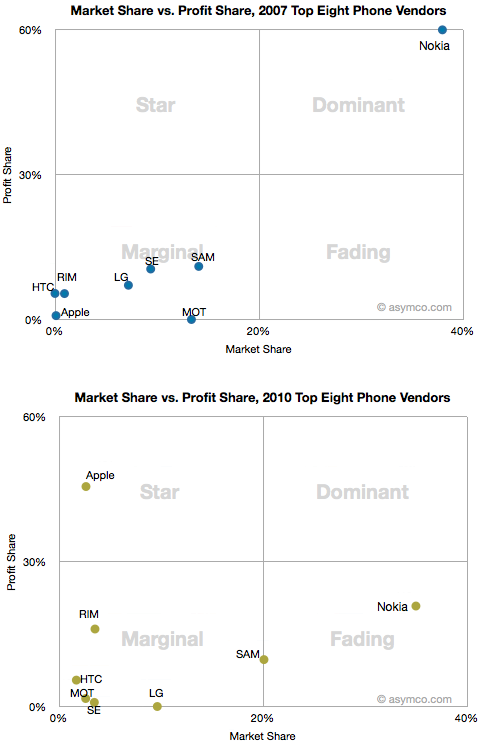
    Thanks to a reader's suggestion, I took another look at the profit and market share data from the mobile phone market overview posted last quarter. This time to compare the vendors on two dimensions at the same time.

    I plotted the vendors on share of market and share of profit axes in two different points in time: Q2 2007 and Q2 2010. I further broke the chart into four quadrants as shown:

    I chose to label the quadrants to indicate the possible categorization of the companies.

    • Dominant: large market share and large profit share
    • Star: low market share with large profit share
    • Fading: high market share with low profit
    • Marginal: low market share and low profit

    It's interesting to note the shift over the time period of the eight vendors. Whereas Nokia moved from Dominant to Fading, only Apple rose from Marginal to Star. The Marginal players dispersed their placement with Samsung moving laterally toward Nokia while RIM followed in the Apple trajectory and increased profit share while maintaining relatively low share.

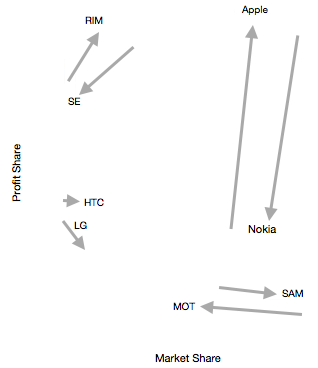
    Thinking about motion around these two dimensions could be reduced to a vector model. If each vendor is represented by an arrow showing direction and distance moved, we can compare each vendor vs. a symmetric competitor which might account for the loss or gain of share.

    The vectors can be paired as follows:

    Although the data does not contain all market participants, the shifts in share are quite closely conserved with the vector magnitude (arrow length) and angle (direction) paired. Note how Nokia and Apple swapped Profit without too much impact in Units volume. Similarly, RIM and Sony Ericsson traded profits and volumes quite symmetrically. Samsung also took volume while Motorola lost it. HTC and LG did not change positions dramatically.

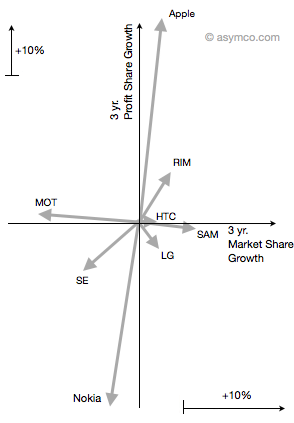
    Finally, moving all vectors to the same origin leads to this view of share gain/loss over three years in two dimensions:

    It becomes quite easy to see who the winners and losers are and by how much.

    This model is only an observation of the shifts in market power and is not conclusive about where share was gained or lost, however there is compelling symmetry which also matches the intuition of  observers.

  6. Ticonderoga sees over 15 million iPads in 9 months

    Research · 13 comments

    White contends iPad could be “one of the most coveted gifts” this holiday season; he sees the company selling 7.1 million units in the September 2010 fiscal year, with 19.9 million in 2011, and 25.8 million in 2012.

    The analyst said his target is based on 20x his interest expense/income adjusted calendar 2011 pro forma EPS estimate, plus net cash of $49.43 a share.

    via Apple: Ticonderoga Starts With Buy, Street-High $430 Target - Tech Trader Daily - Barrons.com.

    If Apple hits 5 million in the just ended September quarter and 7 million in the December quarter, we're looking at over 15 million iPads in nine months of sales. The iPhone took about 20 months to reach the same level.

    If the iPad is ramping up more than twice as fast as the iPhone, (aka the Jesus Phone) what does that make it?

    See also: iPad Death Watch : AAPLinvestors

  7. Is Android share of Web lagging iOS share of Web?

    Research · 12 comments

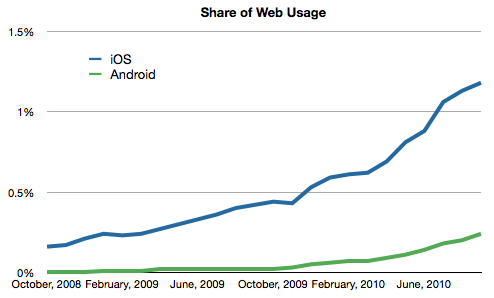
    Of all the public statistics about platform share, Share of web use must be the most important measure for Google. The more browsing people do, the more searching they do and if Google search is most likely for a platform then the more income Google derives from that platform.

    NetMarketshare.com has offered an insight into the split between Android and iOS as search platforms and it shows how iOS is still five times more likely to yield search revenue than Android. That multiple is likely to shrink as the gap narrows, but it still demonstrates the power of iOS to drive Google's bottom line. It's no wonder then why Google has renewed their default placement of Google search in mobile Safari (a guarantee they don't seem to share with all Android licensees.)

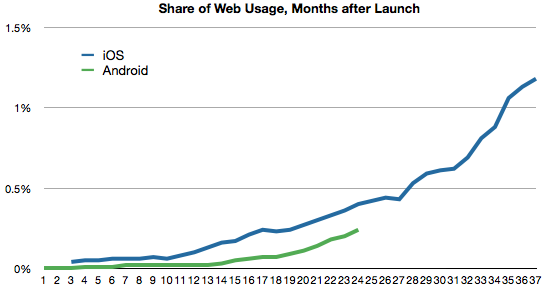
    But Android launched later than iPhone, so everyone should be asking how rapidly the share of Web has grown since the start of each platform. When iPhone launched in 2007 it was almost competing with mobile web non-consumption. The alternative mobile browsing experiences were so bad that it's hard to remember anyone putting up with them. A year later, the bar was set higher and Android filled a vast chasm of demand for mobile browsing for people who could not buy an iPhone.

    At the same point in the life of each platform, Android seems to be exploding in units sold. With this proliferation of Android licenses, it should be interesting to see if their unit share numbers are reflected in web share numbers. So far the story is not convincing. The growth in Web share is not pacing faster than iOS achieved at a similar point in time.

    So far, 24 months into the life of each platform, iOS leads by almost 50% higher share.

    iOS/mobile Safari has the advantage of iPod and iPad for distribution but that does not explain the relative lag of Android with respect to Web share as Android has a large number of SKUs.

    It may be too early to draw conclusions, but anyone trying to analyze Google's strategy with Android should be paying close attention to this.

  8. Android licensees: If you're not paying, you're being sold

    Research · 34 comments

    The latest litigation lollapalooza over Android reminds one of the old web adage that if you're not paying for content, you're the asset being sold.

    That's certainly one of the consequences of the Android licensing model. The mobile phone vendors with no software intellectual property are pawns in a game between IP holders. It's clear that Microsoft and Apple and Oracle (and perhaps Nokia) have IP issues with Google. But it's the licensee device vendors which are most often the accused. Whether Google indemnifies or not is an open question, but the evidence is that the vendors are exposed.

    The proof is in the fact that HTC is paying Microsoft for the use of Android. It's conceivable that Microsoft also asked Motorola for Android royalty payments but were rebuffed. It's also possible that since HTC is still a large scale Windows Mobile licensee, they were given a way out of the Android IP trap by Microsoft. We don't know if there were confidential deals between LG and Samsung on this issue (as they are both committed to the Windows Phone platform but shipping Android). In either case, Motorola may be forced to do the same and pay (Microsoft) for Android.

    It's understood that Google gains some value from Android but also has hidden costs from it as well. Now the licensees have to recognize their hidden costs of the platform as well. There is the IP tax but also the question of control over one's destiny. Google is selling the vendors as an asset class to advertisers. Is that a positive consequence for their brands?

  9. Microsoft suits target Android phones

    Research · 18 comments

    Microsoft Corp. said Friday it has filed patent-infringement lawsuits with the International Trade Commission and in the U.S. District Court for the Western District of Washington against Motorola Inc., targeting Motorola mobile phones based on Google Inc.’s Android software

    via Microsoft suits target Android phones - MarketWatch.

    This follows infringement suits by Apple against HTC targeting Android and by Nokia against Apple targeting GSM patents (with obligatory counter-suits, of course.)

    There was a time when Motorola was a key design win for Microsoft and their Windows Mobile in 2003 with the MPx series. In fact, Motorola still ships Windows Mobile devices like the ES400 and FR68. These are for industrial applications but there were many mainstream Motorola Windows Mobile volume products. The most famous perhaps was the MOTO Q in 2006.

    I'm sure part of the value pitch for Windows Phone is indemnification from IP infringement. Windows Phone will be the only licensed OS that offers this coverage and it's a non-trivial selling point.

  10. Is Google's income from the iPhone offsetting its losses from Android: Cataloging Google's non-Google Phones

    Research · 27 comments

    Google has created a partial list of phones that run Google services.

    Google Phone Gallery.

    I notice with interest that it's called a Google Phone Gallery not an Android Phone Gallery.

    What's more, there is a distinction of All Phones and Phones "with Google". Of course that implies that we can get a list of Google Phones "without Google" (or maybe more accurately, "with partial Google").

    To clarify, according to Google there are three categories of Android Phones:

    • Google Phones "with Google" have been optimized for use of Google Mobile Services, providing easy access to Search, Voice Search, Google Talk, Google Maps, Gmail, Sync, YouTube and Android Market (where available).
    • Google Phones "without Google" list includes Android phones that have the Android market, Search, Maps and Gmail. You can get this list by subtracting the Google Phones "with Google" from all the Google Phones.
    • Non-Google phones. Android phones that have no Android market or any Google services. You can get this list by taking a list of all Android phones (e.g. from pdadb.net) and subtracting all Google Phones.

    I would also add a fourth category of Google phones:

    • Non-Android phones that serve up Google services just fine.

    Since the list is not complete, I won't tally it here, but it suggests a large number of Non-Google phones is possible.

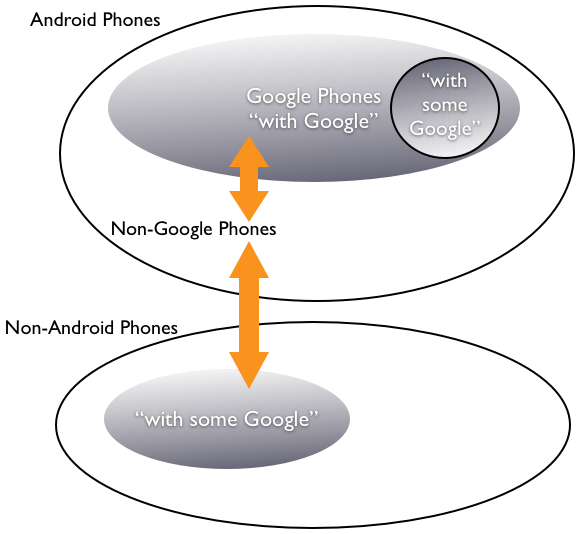
    [I drew the following Venn diagram to help explain the situation. The shaded areas are those which generate revenue for Google. The interesting struggle (marked with arrows) is between the non-Android Phones with some Google and the Android Phones without any Google.]

    Now the question that needs to be asked is: How many of the Non-Google Android phones are built to compete with Google (e.g. on Search, Voice, Maps, Media and App sales)? And a second question: How are the Non-Android phones "with some Google" competing with the Non-Google Android phones.

    In other words, from Google's point of view: how successful are companies other than Google at delivering Google services in spite of competition from companies with Android phones delivering services that compete with Google?

    The classic example being: how effective are iPhones with Google services at competing with Verizon Droid Android phones that deliver Microsoft services? In this scenario Apple is delivering value to Google shareholders while Verizon (using Android) is taking it away.

    Is this trade-off a net positive?

    In other words, is Google's income from the iPhone offsetting its losses from Android?

  11. Apple's segmentation strategy, and the folly of conventional wisdom

    Research · 5 comments

    This mindset is compelling because it is simple and familiar, but it also leads to blind obsequiousness.

    Historical edifices are held as indelible fact. "It's Microsoft v. Apple all over again." "There has to be one absolute, dominant leader." "Open will always prevail -- and should prevail -- over proprietary systems." "Market share matters above all else. Even profits."

    ...it helps to see the continuum of connected devices from the perspective of their means of mobility; namely, whether they are wear-able, pocket-able, bag-able or portable.

    [Apple] target specific user experiences, and build the product around that accordingly.

    via Apple's segmentation strategy, and the folly of conventional wisdom - O'Reilly Radar.

    Lots of concepts that readers of this blog should find familiar ground.