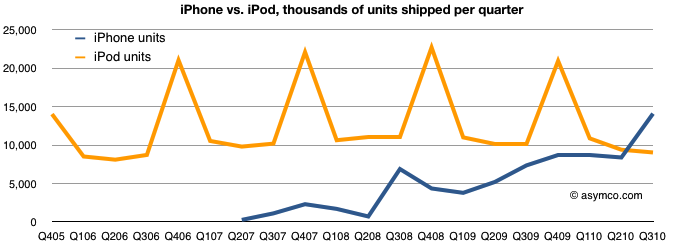
Another chart that speaks for itself. The iPod has been quite resilient as a product line but with both the iPhone and iPad embedding an iPod, cannibalization is happening.
The iPhone is now the new volume leader among Apple's devices.
The iPad was announced to a loud chorus of disapproval and disdain. It's easy to forget the overwhelming scorn and insult poured on the product for months before and after sales start. Analyst forecasts were comical. At this time it looks like all 12 month iPad unit forecasts will have missed by more than 100% (mine included).
As data on iPad performance was published for the first quarter's sales, the mood swung from ridicule to ridiculous.
Without regard to the growth of comparable products, analysts seem to have latched on to production figures which are notoriously inaccurate. The problem with production numbers is that they are only very loosely coupled with shipment numbers to customers. There are questions of work in progress inventory, finished inventory and the actual accuracy of reports. Production also follows a ramp and is not constant over time.
Another way to analyze a new product is to think about the distribution. Although late in the quarter some large distribution deals were made public, the channel did not have much time to be filled before the end of the quarter. Not only that but there is easily obtainable evidence that the iPad did not reach most international markets. Apple announced how they were rolling out a few countries every few months.
This trickle of international sales indicated to me that the iPad sales pump was not yet fully primed. My initial estimate was for in-line sales of 3.3 million which I aggressively increased to 5 based on some of the production numbers being mentioned.
This figure turned out to be 22% too high, but not as big an error as some of the other analysts.
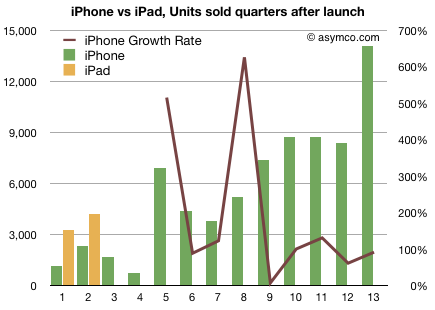
Another way to look at it is through comparable products. The nearest comparable product to the iPad is actually the iPhone. It was a similarly "revolutionary and magical" product launched with a similar constraint on production and distribution. It was also built and marketed by the same people. They've been down this road before and have honed the process from the iPod through the iPhone over a decade.
If we look at the iPhone and compare it with the iPad, we see just how popular the iPad really is. It may not follow the same seasonal pattern as the iPhone, but it will probably ramp in a similar way. In the following chart I also show the iPhone Growth rate (right scale).
The iPhone has been able to maintain over 100% y/y growth on average. I don't see a reason why the iPad can't repeat this pattern over the next three years.
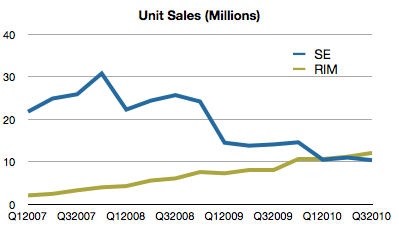
“Our third consecutive quarter of profitable results illustrates that Sony Ericsson’s overall performance is stabilizing. Our strategy to focus on the smartphone segment is succeeding and smartphones now comprise more than 50% of our total sales,” Chief Executive Bert Nordberg said in a statement.
The Verizon distribution for iPad is an unexpected development. Coupled with distribution through AT&T stores, and rapidly expanding retail points of purchase, it seems that the iPad is destined to be the most widely distributed product Apple sells. The iPod never reached operator points of purchase and the Mac is orders of magnitude more constrained.
What seems to be happening is that Apple is pulling out all the stops and going for unrestricted iPad distribution. This may also foreshadow unrestricted iPhone distribution next year. It may also portend a CDMA iPad (or at least an LTE version) next year.
If it happens all estimates for next year need to be revised sharply. I had been expecting 100% growth for the iPad and 50% growth for the iPhone. These might need to be increased to 150% and 100%.
The consequence could be that total iOS devices sold could top 150 million for calendar 2011.
"Media tablet hype around devices such as the iPad has also affected consumer notebook growth by delaying some PC purchases, especially in the U.S. consumer market. Media tablets don't replace primary PCs, but they affect PC purchases in many ways," Ms. Kitagawa said. "At this stage, hype around media tablets has led consumers and the channels to take a 'wait and see' approach to buying a new device."
Fascinating. I'd love to hear more about the non-iPad "media tablets" that delayed PC purchases last quarter. Maybe I don't get out enough.
But more to the point, let's combine the data from Gartner and the forecast for iPad.
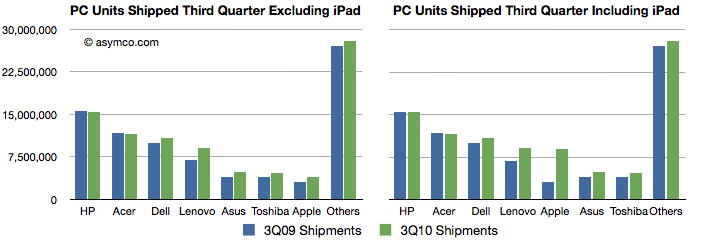
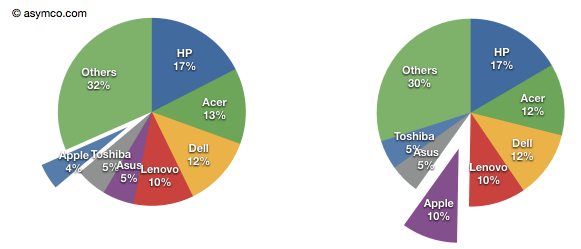
I show below the impact of the iPad on PC vendor sales. I'm using my own estimates of world-wide PC sales (you can see other estimates here (Apple 2.0))
The world-wide PC units shipped without and with iPad:
When including the iPad Apple goes from 7th to 5th ranked, and with 50% growth clearly within shot of top rank next year.
Now I look at PC unit shares:
With the iPad Apple goes from 4% share to 10% share. Again, within striking distance of number one or two in a year.
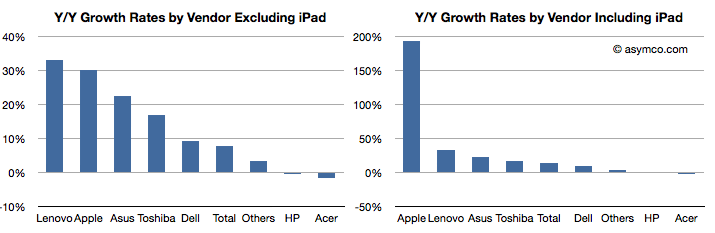
Finally, growth rates:
Apple's share growth goes from second to first but also several times higher than any of the others.
When Gartner spins the iPad as a "Media Tablet" it's clear that the device is disruptive. Reminds me of what Gartner thought about Smartphones four years ago.
I cannot think of a better endorsement for an investment than a snub from Gartner.
"Look, the world doesn't need another platform. Android is free and open; I think the only reason you create another platform is for political reasons. Why doesn't the whole world run with [Android]? They don't like the people who developed, or "not invented here [NIH]"
I note some irony in the suggestion that Windows Phone is superfluous when the acquisition of Android was an attempt to limit the growth of Windows Mobile. But that historical footnote is not entirely relevant here. The point Rubin raises is that WP is politically motivated. And by political he suggests two things: that there is mistrust of Google or NIH among potential licensees.
The NIH argument falls flat because anyone considering WP7 would also have NIH issues with Microsoft. So that really leaves only the question of trust.
Why would anyone mistrust Google when they offer operating systems software? How about these reasons:
It's clear that Microsoft is buying its way back into Mobile (it went so far as to pay incentives and guarantees to established developers to convince them to port existing apps or write new ones for WP7), but that is not a political ploy. It's just good old fashioned brute force.
The mistrust that Google earned for itself with operators, device vendors and potential content partners is rooted in its business model with Android. Hiding the costs of "openness" behind a veneer of freedom. In addition, putting forward competing products like Nexus One threaten the entire value chain.
I'd say the politics of Microsoft licensing are a lot more transparent. Redmond is the devil they know.
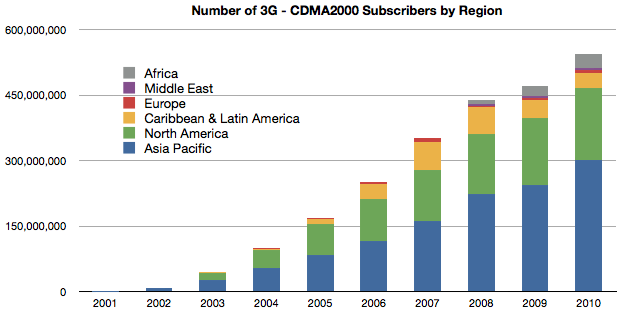
Now that NYT and WSJ were both tipped off about the coming of a CDMA iPhone, I think it's a safe bet. Is this significant? What is the CDMA addressable market?
CDMA2000 543 Million includes CDMA2000 1X & 1xEV-DO
CDMA2000 1xEV-DO 145 Million includes CDMA2000 1xEV-DO only
CDMA 547 Million includes cdmaOne, CDMA2000 1X & 1xEV-DO (includes non-3G)
For comparison, the GSM data for Q2 2009 is:
GSM 3,450, Million
WCDMA 256 Million
WCDMA HSPA 133 Million
It would be safe to assume that the iPhone will be able to address 543 Million additional users. They represent about 13% of all mobile subscribers but the increase in addressable base is about 16%.
The contact, says [Ticonderoga's] White, shipped more than 6 million parts to Apple during the third quarter of the year and expects to ship 7 million more in the fourth quarter.
Since Apple uses one unit of this particular component in each iPad, that adds up to shipments of 13 million iPads in the second half of 2010. For 2011, the contact believes Apple will sell as many as 45 million iPads
These numbers are not unreasonable. I expect about 35 million next year, though that could go up considerably depending on what we hear about last quarter. We only really have one data point so far meaning the data set is to double in a few days.
With the number of active Nokia service users now reaching 140 million worldwide, the company today announced that more than 200,000 people are currently signing up daily to Ovi, and that Ovi Store has reached the milestone of 2.3 million downloads per day. Available in more than 190 countries,
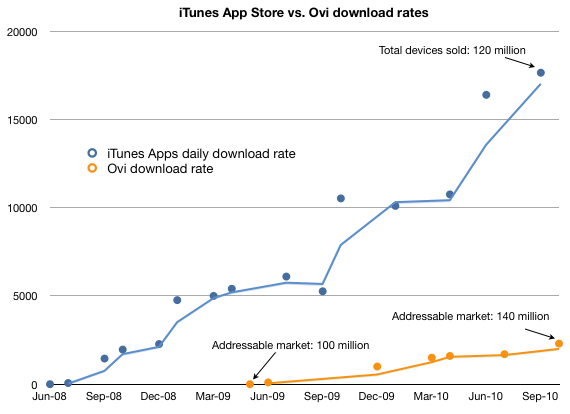
Nokia updated its tally of download rates so we can put the numbers side-by-side with Apple's iTunes.
The slope of the Ovi curve does not yet compel one to get excited over the platform's prospects in the near term. However to get a true picture, one needs to not only look at absolute download numbers but also the probability of any one user or device being used to download an app.
For this we need to note how the number of devices relates to the download rate. Apple announced recently that they sold 120 million devices running iOS. Not all those devices are still in use. If we remove 20 million from that total we get approximately 100 million iOS devices. Nokia, on the other hand, specified exactly how many devices can access the Ovi store: 140 million.
Therefore 100 million iOS devices download at a rate of 17.7 million per day while 140 million Symbian devices download at the rate of 2.3 million per day.
That puts the weekly download rate per device at 1.24 for iOS users vs. 0.12 apps (or whatever is the appropriate content item for Ovi) every week for Symbian users.
As the table below details, the rate of downloads per device for iOS is more than 10x higher. This is the more interesting number if you are a developer.
If someone can point me to Android Market download rate (historic and/or current) I can add it to the mix.
“I am sure there are things we could have done better and innovations we missed,” Ms. Suominen added. “But that happens to all companies. We have been very successful with some other innovations.”
She cited Nokia’s large patent portfolio and its 770 Internet Tablet, a compact, flat-screen device without a phone, released in 2005. It worked with a pen stylus and was made for Internet browsing but is no longer sold.
If I may suggest a better list of innovations for Nokia to stand behind:
The first GSM call in 1991 was made on a Nokia phone and a Nokia network
The first mass-market smartphone, the Communicator in 1998
First compact smartphone, the 7650 in 2002.
While these innovations and "firsts" happened many years ago, Nokia's ability to innovate is just as important at the low end. Nokia was the first company to address the lowest tiers of the market with over a billion customers served. This was no small feat and many observers faulted the strategy when it began in the middle of the decade.
I would not discount the difficulty and determination required in reaching those customers. Engineering a profitable low end product is as hard if not harder than engineering a high end superphone. More importantly, you have to find a way to distribute to these hard-to-reach customers and find ways to make the product useful, usable and affordable. Were it not for these efforts, the company would be facing collapse today, similar to the fate of Motorola or Ericsson: squeezed in the mid-range.
Blaming "culture" is nothing more than suggesting bad management. The culture of Nokia did not change between the few years when it was successful and the years when it was not.
The challenge Nokia faces is not complacency. It's that the business model for selling voice-oriented phones is diametrically opposed to the business model for selling data-oriented phones. In one case you cooperate with and sustain operators, in the other you compete with and disrupt them. It looks damn near impossible to do both with the same organization. Everything must be done differently. The real problem is that Nokia has not realized this and therefore can't build its own replacement.
Despite being based on Android, a Facebook phone would be competition for Google as much as it is for Apple. Google benefits from ad revenue tied to their search and other services which would likely be supplanted by Facebook services on a Facebook-based phone.