More than 400 000 new developers in past 12 months; 92 developers each top 1 million download mark; 1.5 million downloads of Qt software development toolkits
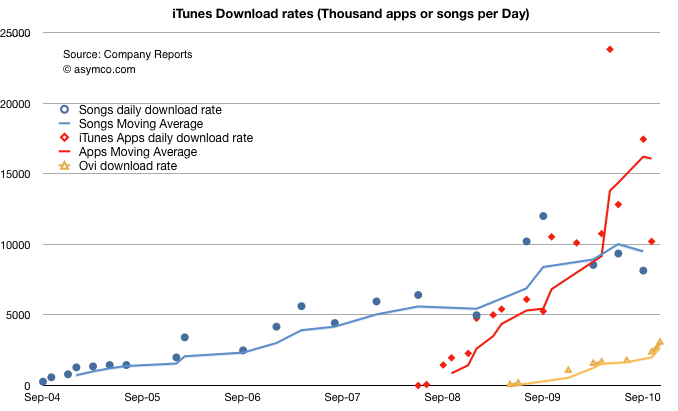
See the following chart comparing Ovi with iTunes Music and iTunes Apps download rates.
The last data point we have for iTunes App downloads was from October 18th when 7 billion total downloads were announced. The last update was around Sept 1st when 6.5 billion were announced. That comes out to about 10.6 million downloads per day. The previous interval suggested about 17.6 million/day.
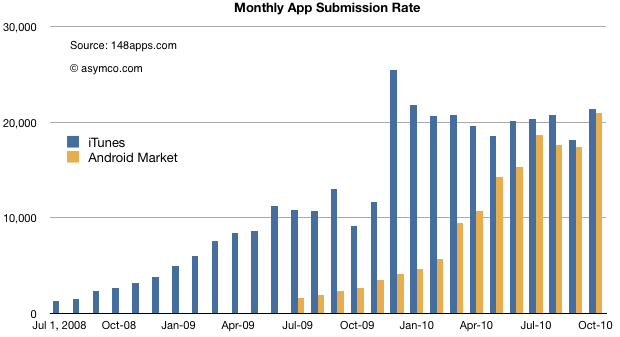
Thanks to 148apps.biz we know how many apps are being submitted to the App Store.
For the year so far the average has been almost exactly 20k apps per month. Toward the last half of last year, 10k/mo was the norm.
The total number of apps available is about to cross 300k though over 350k have been "seen" on the store at any one time. Almost 61k apps have been removed from the store.
There are about 61k unique app publishers.
Books has been the most popular category for some time (51k titles). This does not include books available through iBooks.
The Android Market is growing at approximately the same rate with androlib.com estimating 21k being apps added in October.
Samsung's mobile marketing lead for the country, Sitthichoke Nopchinabutr, also provided a surprise and hinted that the company might turn on Google and focus primarily on Windows Phone. About 15 to 20 phones based on Android, Bada and Windows Phone would ship in 2011, but the majority of them would use the Microsoft OS. For every 50 Windows devices, 24 would be Android models and just five would use the in-house Bada OS.
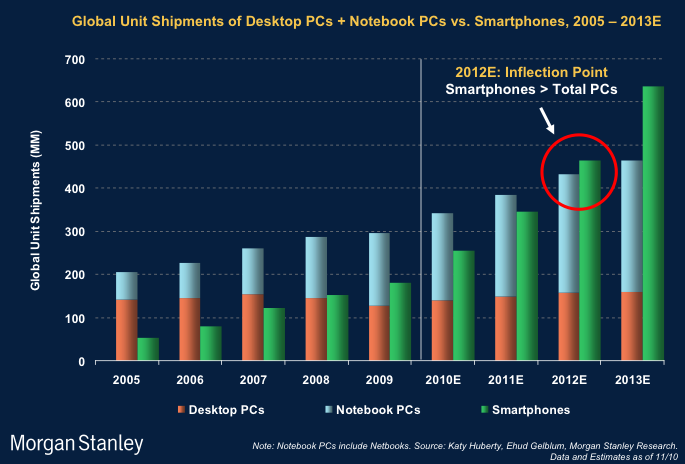
Morgan Stanley's Web 2.0 update came out yesterday and it's full of nice charts. Here is one:
Note that the expectation for smartphones to overtake all PCs (including netbooks) will happen when smartphones sell more than 450 million units per year.
In 2013 nearly 650 million smartphones are forecast to be shipped.
My estimate for the iPhone in that year is 180 million. That would give iPhone (excluding iPad and iPod) about 28% share. The last quarterly figure is around 17%.
Perhaps 180 million iPhones per year will be defined as failure by those who consider over 80% share as a threshold for success but I still think it will be a healthy business.
Even assuming a cut in ASP to about $350, Apple will still be able to get about $62 billion in sales from phones (a bigger number than 2009 total sales for the whole company).
I would also add that by the end of 2013 Apple will have sold about 470 million iPhones. Though many will be out of use by then, the installed base will not be small (I'd guess about 300 million). Including all iOS devices, 500 million is a credible estimated audience for developers.
It's entirely possible that Android variants, offshoots and forks will add up to a bigger number by then, but to pre-emptively declare the platform "war" won because the also-ran Apple will only have half a billion users seems disingenuous.
In other words, to differentiate and succeed in the mobile device space, you need to own a veritically integrated stack strategy — software, hardware and services — like the one Palm is now building out with the help of HP’s not inconsiderable resources
When mobile platforms are discussed, the conversation frequently turns to market share battles between Android and iOS. I've pointed out before that the problem with this reasoning is that market share in a market that's growing at 90% is a false measure of performance.
The more important measure is how much of the non-smartphone market is being taken by smartphones and how fast the whole phone market is growing. Competition with non-consumption is very different from platform warfare.
But even when discussing the rivalry between current platforms, the Blackberry and Symbian are often overlooked as contenders. Windows Phone and iOS come in and out of discussion only on the basis of press releases. The truth is however that Symbian, Windows, Blackberry are not going to disappear anytime soon. Why is that?
The reason is that when you stop framing the market as rivalry between platforms, you see that many buying decisions are driven by specific device value propositions or jobs that the products are hired to do. For many years smartphones were purchased because they had the best cameras or the best keyboards and users never downloaded any apps or even used data plans.
Later, smartphones were purchased because they allowed for browsing and gameplay. Very rarely did buyers opt for "iOS" or "Symbian". Most buyers don't even know what these words mean. Phones are rarely advertised according to their platforms. (As an aside, the mention of Windows in a PC ad is made possible by Microsoft funding, the same as "Intel Inside." So for platform recognition, someone needs to fund the promotion and that implies some revenue to justify it.)
To illustrate, consider the Blackberry: A product that continues to grow despite a completely different basis of competition from the large screen touch competitors. It comes down to being good at some very specific jobs. RIM continues to grow in certain markets like Latin America and the Middle East on the basis of BBM (RIM’s sales outside the U.S. climbed 94 percent last quarter from a year earlier.)
“A 15-year-old boy who likes a 15-year-old girl, sends her a BBM and he’s able to measure how important he is to her based on the speed of response after the letter turns to an R,” meaning it’s been read, he says. “No one else runs an end-to- end service plan like we do. That’s killer and is why it’s almost a social phenomenon.”
or
BBM is also popular in socially conservative Saudi Arabia where its speed -- messages are typically sent in less than two seconds, according to Morgan Keegan -- has made it a way for teenagers to communicate in a country where religious police bar unmarried couples from meeting in public.
You could argue that the other platforms also allow for free messaging (through free texting apps) but the combination of a low cost device, a data plan and attention to detail (like Message Read notification) gives the Blackberry an edge.
The general purpose smartphone that Google and Microsoft and Apple promote is still not the prevailing view of mobile usage for most buyers. One could also argue that many if not most Nokia smartphones are still being "hired" to do feature phone jobs.
The fact that all these devices are classified as smart and therefore competing misses the point that they are hired for different things.
The latest mobile phone estimates from Gartner made a startling claim that "Others" vendors increased share from 16% a year ago to 33%. Doubling share in a year is possible if you're at 1% share but to double from a base of 16% is sounding improbable. They allege that the "Others" now sell more phones than Nokia. And Others don't even include ZTE and Huawei, the prototypical low end challengers.
They emphasize this point in their discussion and state that the incumbent vendors are being pressured by these low end entrants. They go on to explain that the same set of vendors will probably use Android to enter the smartphone space.
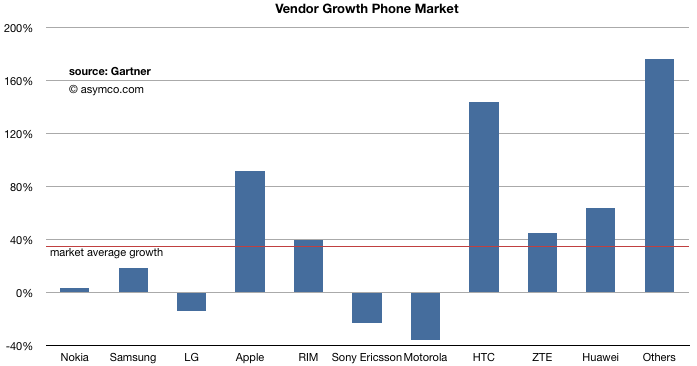
To illustrate, the growth of individual companies is shown here (all phones).
Also puzzling is that ZTE and Huawei did not share in this boom. They barely beat market growth and were growing at half of "Others". Until recently ZTE and Huawei were themselves Others, so the new vendors are truly unbranded "white box" vendors.
To put it in perspective, their year-on-year growth is astronomical: 176%, selling 87 million more phones this third quarter than last year's. This is equivalent to saying that a new company was born in the last year and has already become the second largest in the world. The growth in volumes is higher than the total units Samsung sold!
Mind the gap
Extraordinary claims require extraordinary evidence. Can we check what other analysts estimated and do some form of validation of the claims?
Yes we can.
IDC reports the same data and they only reported 340.5 million phones sold (vs. Gartner's 417 million). Excluding ZTE and Huawei the total share for "Others" in IDC would be about 20%.
20% share vs. 33% share is a big gap.
IDC and Gartner both agree on smartphones, so the difference is even more glaring when you consider the "non-smart" comparisons:
Non-smart phones:
Total Market: millions of units sold____
3Q2009______
3Q2010
Gartner
268
337
IDC
244
260
For added emphasis, I added a comparison of last year's quarter. Last year the Gartner total estimate was about 10% higher than IDC. This year they are 30% higher.
How could the difference in the total phones sold be so big: 77 million phones?
If Gartner is right, how could IDC miss 77 million phones. If IDC is right how did Gartner conjure up 77 million phones in one quarter? That number is nearly as big as all the smartphones sold (81 million). This is not within any margin of error for whatever sampling method they use.
Perhaps they need to clarify this because until they do, neither is credible.
--
Note: My own models are built from individual company public reports. The only data I depend on from IDC and/or Gartner is this total market size which allows me to back out what the "Others" are doing. If the total market estimates disagree so much, I'll be forced to throw out the "Others" all together.
[Wedge Partners analyst Brian Blair] also contends that Apple’s production forecasts suggest the company thinks it can sell 100 million iPhones next year. “While a staggering number any way you look at it, our checks reflect full calendar 2010 builds in the 48-50 million unit range,” he writes. “While this number can change and adjust downward or upward based on demand, we believe it is incredibly bullish that Apple feels it is possible that they could see nearly 100% year over year growth for iPhone in 2011 as this would mean that exiting 2011, Apple would have approximately 10% share in the global handset market.”
Apple is, in my estimate, likely to sell at least 47 million iPhones in calendar 2010. (16 million in the current quarter, or 85% y/y growth).
The 100 million in 2011 estimate assumes 100% growth on average. Is it really "staggering" to forecast another year of triple digit growth?
The history of growth is one indicator. There the news is good: the product has been able to sustain that level of growth for three years.
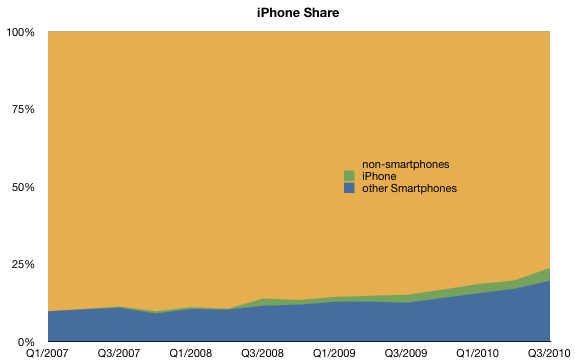
The second indicator is room to grow. Apple largest competitor is smartphone non-consumption. This competitor holds 76% share, but is rapidly losing share. Consider the the following chart:
I've heard the mantra that smartphones are not for everybody and that the vast bulk of consumers will opt for voice-oriented phones indefinitely, especially in low-GPD/capita countries.
To this I point out that there are no technical obstacles to implementing smartphone technology in all price points nor that there are any constraints on distribution, network technology rollouts or shortage of capacity to produce these products for all current mobile users (5 billion at last count). I also believe that user demand for this level of product utility will shift rather more quickly than supply.
So, in my mind, the headroom looks pretty good as well.
Lastly there is the question of alternative platforms. I'll get to that shortly.
A complete market overview will follow when all the top tier vendors report the last quarter, but in the mean-time here are some data that are available:
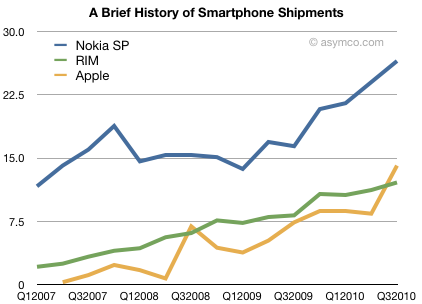
Smartphone volumes for Nokia, Apple and RIM:
Whereas Nokia is often criticized for being weak in smartphones, the fact is that they have grown at a decent rate over the last two years. In fact, they've opened a gap with RIM. Apple has increased share but it will take quite a while to overtake Nokia.
So why is Nokia's smartphone performance so under-valued? Partly it's because ASPs have been dropping. A lower price and lower margin is sometimes seen as a sign of weakness. But Nokia has had a strategy of expanding into more price brackets in their core markets (i.e. outside the US). Half of Nokia's smarpthones are sold through distributors not operators and probably end up being sold unlocked and unsubsidized. Price matters in those markets.
The other problem that Nokia takes a beating over is that their products don't get used as smartphones. Many are sold without data plans at all which makes one wonder what exactly makes their phones "smart". So many of these 100+ million/yr. smartphones are really hired to do a feature phone job. They're "overqualified" and thus underutilized. The statistics in terms of app downloads, browser and ad impressions all lag as a result. The ecosystem suffers.
Lastly, they are all but absent from the US. Due to accidents of history (CDMA) and various mistakes, Nokia never got a foothold in what turned out to be the most important mindshare market. A decade ago the US was a mobile data backwater, with lower data ARPU than Nigeria. It was not a market Nokia felt particularly deserving of investment. In hindsight, this was a big mistake.
But these knocks against Nokia still should not detract from the fact that they do sell a lot of Symbian phones. Distribution still matters as does having 600 operator customers. And in many parts of the world, Nokia is synonymous with mobile phone. Many of those buyers will migrate to future Symbian devices.
My mobile platform thesis has been that as long as penetration is not 80% and as long as operators are still in the value chain, mobile platforms will remain fragmented and split shares. The graph above shows exactly how that has evolved among the top three smartphone vendors.
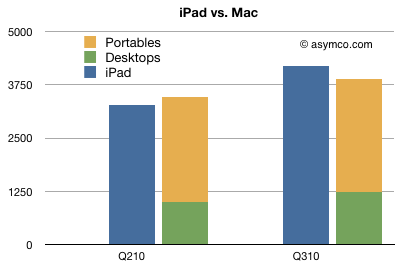
The iPad outsold the Mac after two quarters in the market. It's important to understand the effect the iPad is having on PCs. Data is trickling in that potential notebook buyers are "postponing" purchases due to the iPad. The netbook market has witnessed a significant slowing which has trickled down to the performance of everybody in the value chain, from Microsoft, to PC vendors, Intel, AMD and retailers.
So naturally we need to ask how it has affected the Mac.
The following chart shows how the iPad has outsold the Mac the past quarter. The iPad was on the market for six months while the Mac has been for sale for 322 months--a shocking achievement.
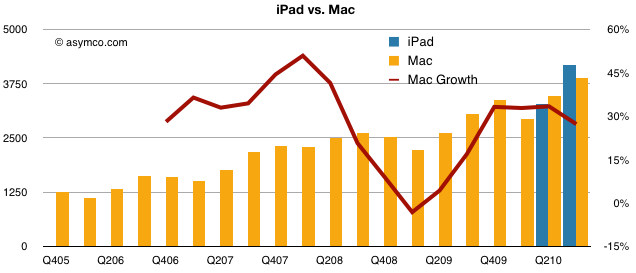
But the Mac has not slowed down. It grew faster than the overall PC market (units grew at 27.3% and revenues grew at 22%) as it has grown for most of the past 18 quarters.
The performance is also highlighted in the following chart showing the history of the Mac units by quarter over nearly five years. The Mac had a slowdown during the recession but the dip in growth in the last quarter does not seem significant.
So far Apple has sold 7.458 million iPads and there is still a quarter remaining in the calendar year. The highest forecast immediately after the launch of the product was 7 million.
For the record, in January I forecast 6 million units for calendar 2010 (and 10 million in first 12 months of sales).
All analysts polled grossly underestimated the iPad. My impression is that competitors are still in denial.