Analysts at Yankee Group recently boosted their forecasts for what they call a mobile app “gold rush,” saying that revenue from U.S. downloads alone would reach nearly $1.6 billion in 2010 and would hit $11 billion in 2014. Only six months ago, their analysis indicated that U.S. downloads would bring in far less — about $4.2 billion in 2013.
These attempts at forecasting are fraught with errors.
For the record, I've blown my estimates on this multiple times. The growth of the iPad will put another wrench in the works. I wonder how these "mobile" forecasts will change when the platform consists of a music player, a phone and a pseudo-computer.
An estimated one in five iPhone developers are companies founded specifically to create applications for the iPhone, according to the latest Flurry Smartphone Industry Pulse survey. That represents the second-largest category of developers behind only preexisting online companies, including giants like Google, Facebook and eBay. Those established brands take up 22 percent of the iPhone developer share.
Flurry argues that with 75 million units sold, the platform is reaching a critical mass where major brands being to take a dominant position in terms of position and sales rank.
This argument is suggesting that the platform will be a sustaining technological improvement to existing industries such as traditional media, online media, retail and traditional gaming.
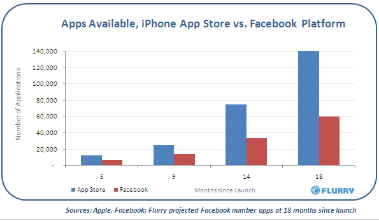
Since the App Store launched in July 2008, 35,000 unique companies have released applications, which translates to 58 new companies launching apps each day. This appears to be the largest amassing of 3rd party developer support by any development platform in such a compressed timeframe. For example, comparing the number of applications created for the Facebook platform to the App Store over their respective first 9 months, Apple boasted 25,000 apps to Facebook's 14,000. Comparing respective growth in apps after 14 months, Apple had widened its gap to 85,000 apps over Facebook's 33,000. At the App Store's 18 month mark, reached this January, the number of iPhone apps was reported to have exceeded 140,000 compared to 60,000 we estimate Facebook had reached over the same number of months. Apple now leads Facebook with over twice as many available applications. We believe the difference in growth rates can be attributed to the App Store providing better monetization possibilities for application developers than Facebook. Developers, like all rational companies, pursue markets where the path to revenue generation is clear.
The problem will be in using some comparable as a measure of reference. This is a problem because first, there is no equivalent product in history, second, there are few similar products that are pre-ordered and sold without user samples being available, and third it's being sold through a very limited channel (on-line Apple Store). Lastly, the number includes only delivered units vs. reservation for pick-up.
Nevertheless, the figure is intriguing. One class of comparable products might be new smartphone products from companies that were launching on new platforms.
One example is the Android G1--the first Android device. It sold 663k units in the launch quarter. Another is the Nokia 5800, Nokia's first touch capable device. It sold 536k units in the first quarter (up to 1 million in the first 3 months). Sony Ericsson's first Windows Mobile device was the X1. It sold 237k units in the first quarter of sales. The first Sense UI HTC device (the Diamond) sold about 1 million units. The RIM Storm, RIM's first touch device sold 1.6 million units. Finally the iPhone which sold 1.1 million units in the first full quarter of sales (about 1.4 million if we include the weekend sales that fell outside the first quarter).
The iPad does seem to be doing rather well relative to these products. Again, their figures were for a full 90 days of sales and were sold through physical retail channels in a variety of geographic markets.
I will be surprised if the number of units sold in Apple's CQ2 don't exceed 1 million. (Apple will book all these sales only on delivery which means they won't appear in CQ1 sales figures). This will probably mean better performance with a new platform than Nokia, Google, Sony Ericsson or HTC and perhaps better than the iPhone.
South Korea is considering banning access to the Android Marketplace to its residents if Google continues to offer game apps that are not approved by the country's regulator
Currently, South Koreans have a choice of two Android-powered smartphones that have access to the Android Marketplace, and more are due for release this year. There are about 4,400 games on the Android Market available to South Koreans, with all of them needing to be rated.
Apple has gone around the South Korean laws by not offering any gaming apps at its App Store for iPhones and iPod touch devices. South Korean developers put up locally approved games under the entertainment category in the App Store, however. Many South Korean iPhone owners create a second account outside of South Korea that does grant them access to games on the App Store as well.
Nearly 10,000 iPhone users were accessing the Microsoft employee email system last year, say two people who heard the estimates from senior Microsoft executives. That figure equals about 10% of the company's global work force.
Interestingly enough, the Mariposa bot is not the only malware I found on the Vodafone HTC Magic phone. There’s also a Confiker and a Lineage password stealing malware. I wonder who’s doing QA at Vodafone and HTC these days?
In the comments, Bustamante writes:
Regardless, I don’t think this has to do with factory settings, but rather with poor QA process of refurbished phones.
Starting in January, Apple launched a series of C-Level discussions with tier-1 handset makers to underscore its growing displeasure at seeing its iPhone-related IP infringed. The lawsuit filed against HTC thus appears to be Apple's way of putting a public, lawyered-up exclamation point on a series of blunt conversations that have been occurring behind closed doors.
Top-tier handset makers continued to avoid implementing multi-touch, but Apple could safely assume that they were hanging back to gauge Apple's response to Motorola and HTC. If there wasn't one, the OEMs would likely read the silence as a green light, especially after Google also moved to enable multi-touch on its Nexus One phone.
Even before the lawsuit, handset makers were having second thoughts about Google, which with the Nexus One had become a direct competitor. Now their faith in Android as the easiest and cheapest way to counter the iPhone has been shaken, says Reiner.
Therefore it’s entirely likely that HTC was singled out to disrupt the business logic of modular mobile software. HTC is the pioneer and the hub as the largest licensee for both WinMo/WinP and Android and the inspiration for hundreds of OEM/ODMs to make modular products.
... Other vendors looking at this licensing model might think harder about participating, and that may be the whole point.