An Office Hours question asked by Jared P., July 31, 2026.
Q: Will Apple continue developing the Vision Pro? Hopefully there's a growing community.
Absolutely. The more time goes by, the more I think it's evident that it's a project Apple is doing because they think it's worth doing. It's not motivated by the other product histories or anything. They feel this should be done.
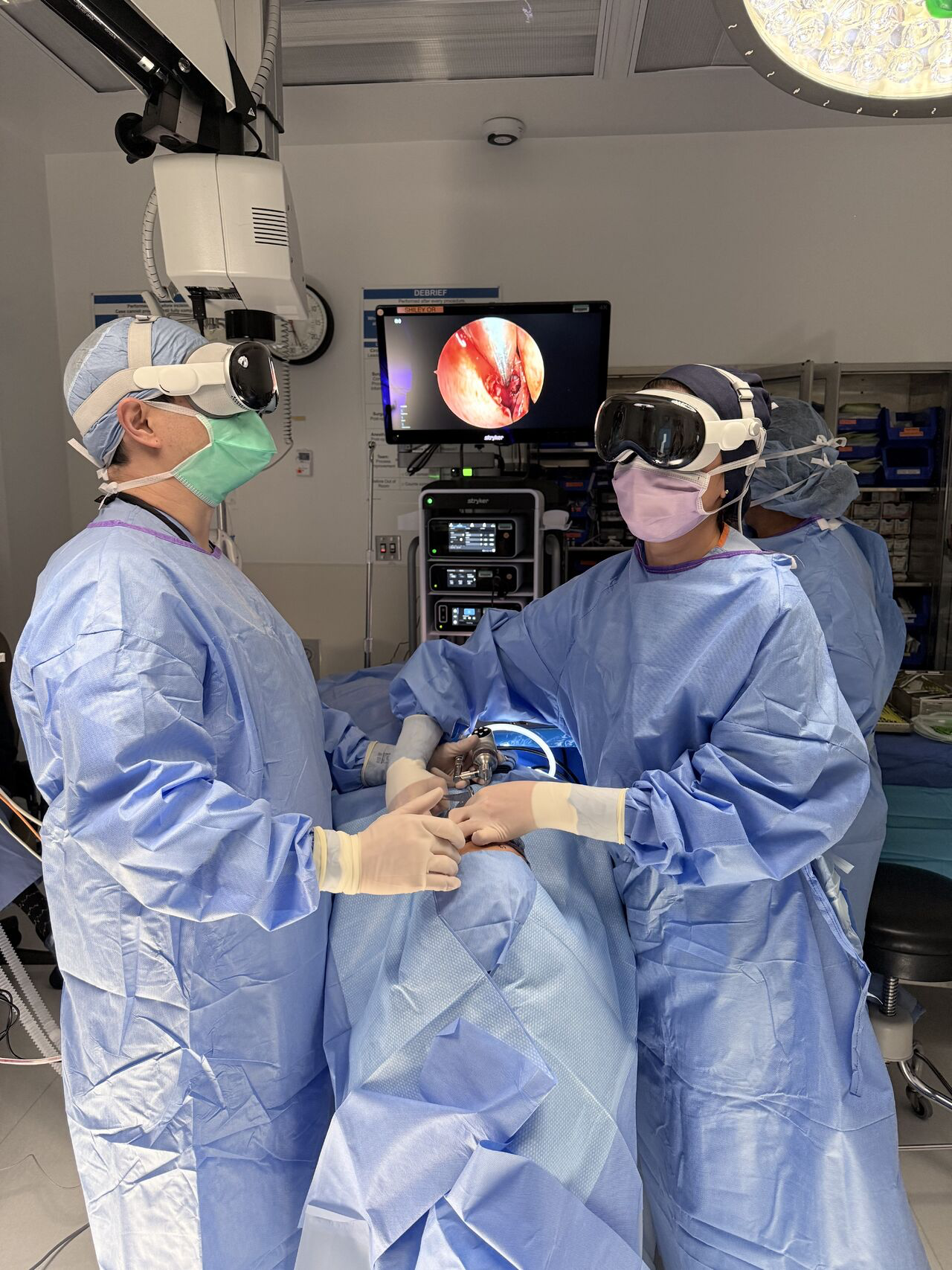
I'm not sure I can reveal, but I've been working with people in the healthcare world who use these products, and we have a paper coming out. It's amazing the way it transforms some of these professions. Some are in engineering, but some are in healthcare, particularly in surgery. When Apple is putting this out there and seeing residents with surgeons, it may learn from that, it may develop it, but I don't think it's a cynical move. I think they're just going to say: it's a good thing for surgeons to do this, and maybe that's why this product should exist.
Far more interesting — and I have written a piece about this — is plain old glasses. When you look at that market, they're probably folding a lot of the learning from the Vision Pro into a new form of wearables that are on your eyes. I'll give you a very simple example. You have a relationship with Carl Zeiss. Zeiss makes the drop-in lenses for the Vision Pro. Amazing how easy it is to put them in. Why? Because they're magnetic. Who's ever done a magnetic frame for glasses?
When the Apple Watch came, it was a tremendous innovation in the way the bands work. Bands were user-replaceable, in an instant, super easy to take on and off with the design of the loop. We forget that Apple changed the way watches are worn and put on, and the fact that you can create accessories for them. Now, for spectacles: the idea of a user changing lenses, the idea of perhaps even having those lenses be somehow magical. How much of that learning about behaviors with face-worn devices comes because of the research project that is effectively the Vision Pro?
Historically, they probably had these research projects internally. They would learn internally and launch ten years later. In this case, they decided to make the experiment global, and had their customers and developers identify killer applications. It's a very different approach. It's not something Steve would have done. The Vision Pro is following an emergent strategy, and people are not used to Apple doing emergent strategies in the wild. Not to mention the price point, not to mention it's not part of the Upgrade program. But I think they're going to keep it going and make improvements to it. Maybe the ultralight version has been put on hold while they develop the glasses — at least this is the rumor — and I don't find that alarming at all.
I think glasses are a huge opportunity. Glasses are bigger than watches — far bigger, it turns out. You should read the piece I wrote about EssilorLuxottica, one of the most incredible business stories ever, and how the industry of eyewear has evolved. It is ripe for, if not disruption, then transformation: injection of software, injection of sensing, injection of new technology. All of that is perfect for Apple. It hasn't been scratched by others yet, even though we have Meta in there. AI is going to also be sustaining it. My enthusiasm for the Vision Pro is becoming an enthusiasm for eyewear in general. Whether it includes displays or not is just a matter of time before we get to face-worn machines that are effectively ubiquitous. More people will wear a computer on their face than on the wrist — and maybe as many as will carry one in their pocket.
There's a lot of focus in glasses, with Meta and everyone else, on recording what you're seeing. But the job of putting cameras on this thing is not its purpose. Its purpose isn't to capture data. This is one of those things that also confused people when it came to smart speakers. I pointed out that a smart speaker is actually a smart microphone. Only Apple's entry bothered with the acoustics, bothered with making something that sounds great, and positioned it as a great speaker. It didn't succeed — there were other reasons for that — but everyone else approached the problem saying: we just want to listen to what everybody says when they want to ask something. They approached it as computational acoustics, which, by the way, is prevalent in all kinds of products today. The idea of spatial audio comes from it.
When it comes to wearables on the face, the job is going to be optics. When the Watch came out, they said: by the way, it's a timepiece. It took a lot of cues from timepieces, a very old category. So if you study eyewear, you have to study deeply what people are using it for. It isn't natural at all to use eyewear to take pictures. What's natural is to see better. The whole objective of eyewear is to give you clarity, not to collect information and process it in the cloud. So you pivot away from what the early versions of the products are. You listen to what the early entrants did and you get confused, because they all had the wrong jobs, or the wrong approach, or the wrong processes, or their own priorities. And you assume that what they did is what Apple's going to do. They're going to come at it a whole different way. Of course it can see — but to the extent that it can see, it helps you see. I really think they're going to position it as a great optical device, as they did with the Watch, saying it's a great chronograph.
Editor's Note: This was one of the questions asked by participants in Asymco's July 2026 Office Hours live Q&A session, held the day after Apple's FQ3 2026 earnings and open to Asymco One subscribers.
Subscribe to Asymco One for full access to this and other content.