Asymco

Asymmetric Intelligence

Technology

  1. 65% of Apple's sales came from iOS powered devices

    Research · 46 comments

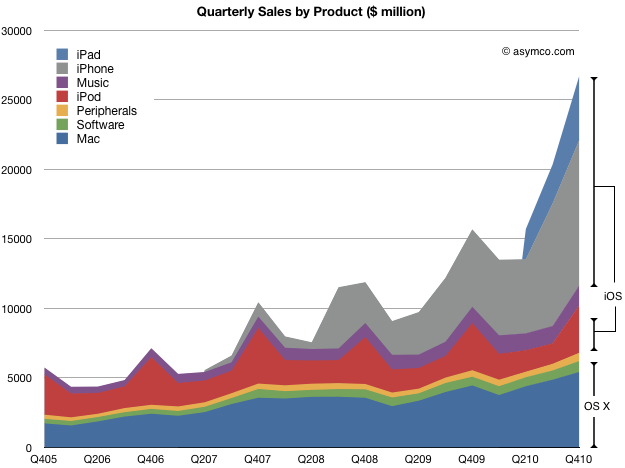
    The iPhone and iPad generated $15 billion of revenue last quarter. In addition, iPod touch generated about $2.3 billion, implying that iOS based devices were responsible for sales of $17.3 billion.

    To put that in perspective I drew this chart which shows not only the sales by products but a rough representation of share of the two OS variants Apple uses to power its products.

    iOS powered products (which did not exist three and a half years ago) generated 65% of all sales in the last quarter. OS X powered products generated 20% of sales. That's a noteworthy combined total of 85%.

    But software is even more important for Apple.

    The sale of OSX software (both the operating system and applications for it) accounted for another $786 million or 3% of total. In addition, I've put forward some evidence to suggest that the proportion of sales due to Apps in the Music store is nearly half, or another $600 million (a bit more than 2%).

    Therefore only 10% of Apple's sales were for products not directly powered by its vengeful operating system. That speaks volumes not only for the importance of software to Apple but for the cohesion of an extensible, flexible architecture that allows it to inhabit a portfolio spanning from a music player and an enterprise server.

    I recently answered a question on Quora on whether Apple is a Software, Hardware or Media company by saying it's all three.

    With 90% of sales dependent on a unique, proprietary operating system[1], perhaps the answer should have been different.

    ---

    1. I know that OS X has a large amount of open source. Proprietary, like Open is a partial definition.
  2. What Google can learn from John Sculley: How technology companies fail by placing their strategy burden on technology decisions

    Research · 107 comments

    And so we come to the question of Chrome and H.264. First off, it should be clear that video codecs are infrastructural technology[1]. They are commodity algorithms which are generally invisible to users. They are ubiquitous and are "shared" in the sense that they are available for licensing often without much in terms of cost.

    So they don't really offer strategic advantage to the adopter. Some may end up adding slightly more to a cost structure than others, but not in a way that determines strategy.

    Flash on the other hand is not infrastructural. It is not shared, it is not invisible to users, it is a brand, it has a significant business model and market value. It is sustaining to Adobe.

    So the argument I've heard against Google's decision is that they are using an infrastructural technology decision (a new video codec) to placate or sustain Adobe Flash, at the expense of Apple, a potential or perceived rival.

    If this was the plan, it would be a strategic mistake.

    The reason is that Flash will live or die on the basis of whether the business model is sustainable. That is decided by whether an integrated, proprietary technology is over-shooting and unable to adapt to a mobile computing future that demands modularity from components. If Flash is doomed, then its fate is inevitable.

    In other words, you cannot use an infrastructural technology to defend a sustaining, possibly over-serving technology.

    Which is why I don't think this was the motivation.

    I rather think that Google's decision is a misguided emphasis on technical details in lieu of engaging in a deep strategic re-evaluation.

    A RISCY BET

    To illustrate the way technology companies fail by placing their strategy burden on technology decisions, here is how John Sculley made a decision to go with PowerPC and how he lived to regret it.

    [Our best technologists] came back and they said it doesn’t make any difference which  RISC architecture you pick, just pick the one that you think you can get the best business deal with. But don’t use CISC. CISC is complex instructions set. RISC is reduced instruction set.

    So Intel lobbied heavily to get us to stay with them… (but) we went with IBM and Motorola with the PowerPC. And that was a terrible decision in hindsight.

    ...

    we totally missed the boat. Intel would spend 11 billion dollars and evolve the Intel processor to do graphics… and it was a terrible technical decision. I wasn’t technically qualified, unfortunately, so I went along with the recommendation.

    I would argue it wasn't a failure of technical knowledge--the technicians were right about the architectural advantages. It was a failure of strategy and understanding of innovation dynamics[2]. Sculley asked the wrong question. The question to be asked is not "CISC vs. RISC". Rather, it should have been: Is the architecture the relevant decision point or is it the choice of partner? The technologists put the architecture choice above the more strategically important question of whether Intel had the fuel to continue getting better even if saddled with sub-optimal architecture.

    That decision sounds very similar to what is being done today at Google. Increasingly, technology decisions are leading strategy. The question should not be "H.264 vs. WebM" or "HTML5 vs. Flash". Google should be asking itself if mobile computing will allow browsing to remain the predominant interface for internet consumption. If, as I suspect, it won't then no amount of browser tweaking will help. The browser is already infrastructural. It can't be the object of strategic focus.

    To get an idea of how this would work consider Flipboard. Flipboard turns the entire browsing paradigm inside-out. Instead of consuming social media inside a browser, the app presents it in a more natural magazine-like format.

    What will happen when that media becomes predominantly video? Flipboard will be far more influential to content producers and their decision on which codecs to support will lead adoption.

    By focusing on threats and byzantine standards machinations, rather than on broad, experiential learning, Google missed (yet another) next big thing.

    ---

    Notes:

    1. In  IT does not matter. Nicholas Carr introduced the concept of infrastructural technologies. Becoming Infrastructural is what happens after a technology overshoots the market and stabilizes into a commoditized ubiquity. It ends up being "shared" in the sense of being openly and sometimes freely licensed.
    2. To be fair to Sculley, the research on innovation theory that would have helped him had not yet been published.
  3. Is HTML5 a Flash in the pan?

    Research · 31 comments

    When Apple promoted HTML5 as an alternative to Flash, the value was said to be in being an open standard, and in having better efficiency for device-based execution.

    The problem is that there are no authoring tools for HTML5. Flash is popular because it's fairly easy to kick start the creative process. You buy the tools from Adobe for a few hundred dollars and begin to tinker. With HTML5 you need to be a programmer, read arcane documentation, search for sample code and manually integrate results into publishing systems. That's bush league.

    iAd Producer narrows the gap a bit.

    The bigger question that I struggled with is whether web apps are competitive enough. The absence of tools is a damning accusation that they aren't. Note that Apple is first introducing production tools for iAd, not for web apps in general nor web content in particular.

    So why isn't there an iWeb-like tool to allow consumers to design web sites (for MobileMe Galleries for example) which benefit from HTML5? At the other end of the spectrum, where are the Apple equivalents to Adobe's Flash Professional (with CS5 integration)?

    The tools for HTML5 are just not there. Tools are the first things needed to build an ecosystem. Is their absence due to a lack of demand or are there no skilled toolmakers outside of Adobe?

    When the market is failing to deliver a solution, I question the need for the solution in the first place. It's also worth while to follow the money: Adobe makes money only on the tools for Flash, not on distribution of content. For anyone to disturb Adobe's franchise, it's tools that need to be put forward as alternatives. Tools are not easy to build. Are the incentives simply not there?

    I hope iAd producer is the first in a series of tools from Apple to build an HTML5 ecosystem. Whatever the future of web apps is, it's coming very slowly. No wonder Flash is still a viable business for Adobe.

  4. IBM Survey: The cell phone is no longer a gadget – it’s what IT is going to become

    Research · 3 comments

    “In all areas of software development, mobile computing is seen as the number-one hottest IT opportunity next year,” said Jim Corgel, an IBM general manager of independent software vendors and developer relations who was involved in the survey. “Not only will mobile spike to the forefront, but by 2015, respondents said it will dominate everything. The cell phone is no longer a gadget – it’s what IT is going to become.”

    via IBM Survey Says Mobile Apps Will Dominate Enterprise - Venture Capital Dispatch - WSJ.

    Developers are usually not very good at predicting specific business winners or losers (to prove this consider why developers don't spend their energy and earn their living picking tech stocks instead of writing code.)

    However, developers are very good at spotting long term technology trends. It was developers who championed the early internet and it was developers who saw potential in social networking. To see a survey of developers confirm that mobile devices will dominate IT, in contradiction to most incumbent strategies, is encouraging.

  5. Unix's Revenge

    Research · 98 comments

    With QNX now firmly roadmapped at RIM and Android spreading among vendors like a virus, I wanted to point out that these operating systems share one ancestor: Unix.

    A technical triumph

    Technically Linux, which underlies Android, among others, is walled off from Unix from an IP point of view, but the philosophical and architectural lineage goes back to 1969's Unix. It was an amazingly well thought-out operating system which has stood the test of time mostly due to its modular architecture. It was not always clear that Unix would make it this far, and in many ways it was written off.

    There is some poetic justice in its comeback. Unix could have become a default for desktop computers. When Windows emerged from the shadow of DOS, Microsoft had the option to base NT on a flavor of Unix. But Bill Gates, no doubt motivated by license fee considerations, hired a group of developers from Digital Equipment Corporation and many elements of the NT design reflect earlier DEC experience with VMS and RSX-11. Microsoft went with that new architecture rather than Unix and that code lives on even in the current Windows 7.

    So Unix missed a chance to become the core of the desktop experience throughout the 1990's. It was relegated to the perilous high end: Sun workstations, servers and supercomputers. It seemed to be at a dead end. Fortunately, in stepped open source. Linux picked up the pieces and forged ahead to become a serious server operating system but never got beyond a toehold in the desktop.

    The death of Unix(tm) was also forestalled because of the efforts of others. Sun, IBM and even a startup called NeXT kept development alive. When NeXT was acquired by Apple, OS X was born and in 2000 Unix was once again on the desktop.

    Meanwhile, the Linux kernel also became device friendly and it was embedded into an increasing number of vertical applications while powering most of the new web servers that fed the dot com era.

    Now we've entered a new decade of devices where Unix(-like) operating systems will, on a CPU basis, probably out-install Windows. Not only is iOS based on Unix, but Android and MeeGo and even Bada are based on Linux as are QNX and WebOS. Google, Apple, HP, RIM, Samsung and Nokia are all now betting heavily on Unix or Unix-like implementations. The success is so overwhelming that there are really only two hold-outs: Microsoft and the rapidly depreciating Symbian.

    Value Chain Evolution

    There is more to this than a sentimental technology riches to rags to riches story. The history of kernel adoption is evidence of the evolution of value chains and the tension between modular and integrated business architectures. It also supports a hypothesis of why Microsoft could not respond to a tectonic shift of power.

    As a kernel, Unix was modular which allowed it to scale both down to devices and up to mainframes. It could conform to the applications above it (like being a server or being an embedded controller) and did so far more readily than Windows. In fact, Windows could not conform to applications outside its core PC and server domain.

    For Unix, the point of modularity was reached early in the 1990's and, through the Linux implementation, it allowed the lowest layers of the software to become commoditized (and free). This commodity status was actually what Microsoft tried to avoid by integrating Windows with the layers above it. This was a conscious and deliberate decision which also led to trouble with anti-trust regulators. The decision seemed to have paid off. Microsoft won.

    However, the very strategy which Microsoft used to maintain a monopoly caused its rigidity of response to a new, post-PC market. Unix fit right in with the new shift in the basis of competition: toward more personal, portable and conformable computing. Windows did not. Microsoft had to build a completely new OS to deal with devices (Windows CE has little if any shared code with Windows NT et. al.). The dual OS strategy continues to hobble Microsoft as each is stretched into new dimensions: the desktop Windows being dragged into the high end and into tablets while the device Windows is re-written to accommodate new input methods.

    The modular Unix just keeps conforming to new applications. It helps that it's open source but the open sourcing is a result of the modularity not the cause for it. So far, it looks like there is no stopping the revenge of Unix. It's been a long journey for Unix and I, for one, am cheering the comeback.
  6. Why Apple is on top today: the top 10 technology decisions

    Research · 91 comments

    As Apple overtook Microsoft in market cap and as Steve Jobs reminisced about some recent history, I thought I'd reflect on some of the decisions that brought Apple to the pinnacle of technology companies.  The criteria I used to select these is how improbable and hence courageous they were when taken and how much impact they have had on the industry. Since the impact of these decisions could not be felt for a long time, the courage required to act early is all the more remarkable.

    At the time they were made, none of these decisions did anything to move the stock price or cause great rejoicing. In fact, in many cases the decisions were ridiculed by those who should know better. Yet each one became a massive pillar of the foundation of Apple as it is today.  As you read through, think of the decisions that Apple competitors made or did not make in the same time frame.

    Top 10 Apple technology decisions of the 2000 decade in reverse order:

    • 10. HTML 5 (canvas). It was initially introduced by Apple for use inside their own Mac OS X WebKit component, powering applications like Dashboard widgets and the Safari browser. Still in its infancy, the canvas element is an Apple technology that promises to finally offer a credible Flash equivalent.  Remember that Flash is now over 10 years old and was incubated at a time when the Web was barely 1.0.  HTML canvas finally brings vector graphics to the modern era.
    • 9. H.264. The decision to support a standard video codec at a time when the industry was mostly arguing over whether Blu-ray or HD-DVD would win signaled a foresight that physical media was not long for this world.  The consequences are still being weighed as YouTube and other media sources are shifting their inventory to this format.
    • 8. iTunes. iTunes started as a personal music database, grew into a music and media store-front, a payment processing engine, device synchronization and updating center, and finally an application store.  It was forked into both a PC and a mobile version.  Without iTunes the iPod would have been just another MP3 player.
    • 7. WiFi. Implemented in Airport before the spec was finished, WiFi gave the laptop wings.  Think back to when you still had to plug a wire into a computer to have it communicate. PC's did not catch up in being wireless for years.  WiFi was even a rare feature on mobile phones when the iPhone shipped in 2007 with some operators (Verizon) banning it from their phones even in 2009.
    • 6. FireWire. Along with iTunes brought iPod to life.  Launched at a time when external drives required screwdrivers and a circuit board to install, FireWire made opening your computer case to expand it as common as opening the hood of your car to fix it.
    • 5. iLife. Did to user-generated media what word processors did to words and spreadsheets did to numbers. A singularly great reason to get a Mac.
    • 4. Portability. OSX migrated across three different CPU architectures in less than 10 years. Apple revealed that they built it from day one to be portable to different CPUs.  That took amazing foresight in the late 90s.
    • 3. WebKit. Speed and flexibility.  The biggest reason why we can surf on a phone today.
    • 2. Multi-Touch UI. Seven years in development and still sublime.  Starting down this road in 2003 must have seemed science fiction.  But, unlike other companies, Apple took this science experiment and went to market.  Steve Jobs said how he wanted a screen keyboard and how scrolling opened his eyes to making a phone. That took vision.
    • 1. OSX/Cocoa. The company's backbone.  Everything above hangs off OSX. Remarkably scaleable, portable, robust and reliable.  With roots going back decades, it's the canonical OS. Somebody should build a monument to it.
  7. What Happens When You Upgrade an HTC Hero to Android 2.1?

    Research

    HTC:

    TEXT AND PICTURE MESSAGES

    Text and picture messages will be deleted with this software update. You can back up text and picture messages by forwarding them to an email address.

    Open the Messaging application

    Tap and hold on the desired text or picture message

    Tap Forward

    Enter an email address then tap Send

    APPLICATIONS

    Applications will be deleted with this software update. You will need to re-download the desired applications from the Market after this update completes.

    Daring Fireball Linked List: What Happens When You Upgrade an HTC Hero to Android 2.1?.

    From the Hacker's Dictionary:

    kluge /klooj/

    [from the German `klug', clever; poss. related to Polish `klucza', a trick or hook] 1. /n./ A Rube Goldberg (or Heath Robinson) device, whether in hardware or software. 2. /n./ A clever programming trick intended to solve a particular nasty case in an expedient, if not clear, manner. Often used to repair bugs. Often involves ad-hockery and verges on being a crock.

  8. The Progress of the Platform

    Research

    The Progress of the Platform.

    On why there is a ban on intermediate layers of software development on the iPhone OS.

    But the reason isn’t technical. It’s partly business (Apple doesn’t want another company to control any important part of the iPhone platform), but it’s also in no small part grounded in aesthetics and the progress of the platform. Apple wants developers to do things the iPhone and iPad Way because they believe it will result in a better user experience and better designed apps. That’s an aesthetic, design-centered argument about how touch apps should be done. Apple has created tools customized to the iPhone and iPad; hell, they built a whole new touch-based operating system. They created a whole set of user interface metaphors that are supposed to be standard and system-wide, and they want developers to do things the new way not because Apple just loves power, but because they believe it’s necessary to force developers to think about the new world of touch-based computing correctly. All of this in service of giving users who are taking their first steps into touch-based computing a great experience.

    Developers who want to write software for the iPhone have to write iPhone-like software. To do otherwise will hinder the progress of the platform.

  9. The Mobile Web vs. the Objective-C Web

    Research

    At one point in time, J2ME (now Java ME) and WAP were the starting points for a discussion on mobile strategy and the web. Then, for a brief period of time, you talked about HTML/CSS. Now, for a growing majority of mobile strategies that don’t require a global presence on widely varying devices, the discussion begins with iPhone. Smart client is now iPhone app, and in many cases, the app is primary to the experience, not secondary to the browser. And iPad app may soon replace iPhone app as the starting point.

    Frankly, as the adoption rate of iPhone increases and if iPad follows suit, it will become increasingly difficult to argue in favor of a starting point other than iPhone OS. The NPR iPad app, for one, provides a much more pleasant user experience than NPR.org.

    via Cameron Moll: Designer, Speaker, Author The Mobile Web vs. the Objective-C Web.

  10. Apple: When Will They Build Their Own Mobile Search Engine?

    Research

    Apple: When Will They Build Their Own Mobile Search Engine? - Tech Trader Daily - Barrons.com.

    The opportunity here is not to do web search better than Google, but to find a way to index the information that lives on the iPhone ecosystem.  With potential for millions of apps and hundreds of millions of iPhones generating usage patterns a separate mountain of information is emerging independent of the current cloud.  The mobile cloud has different hooks and different relevance measures.

    Mobile search will be as much about new algorithms as about getting a new way to spider the data.

    It seems Apple is better positioned to leverage this emerging space than Google.