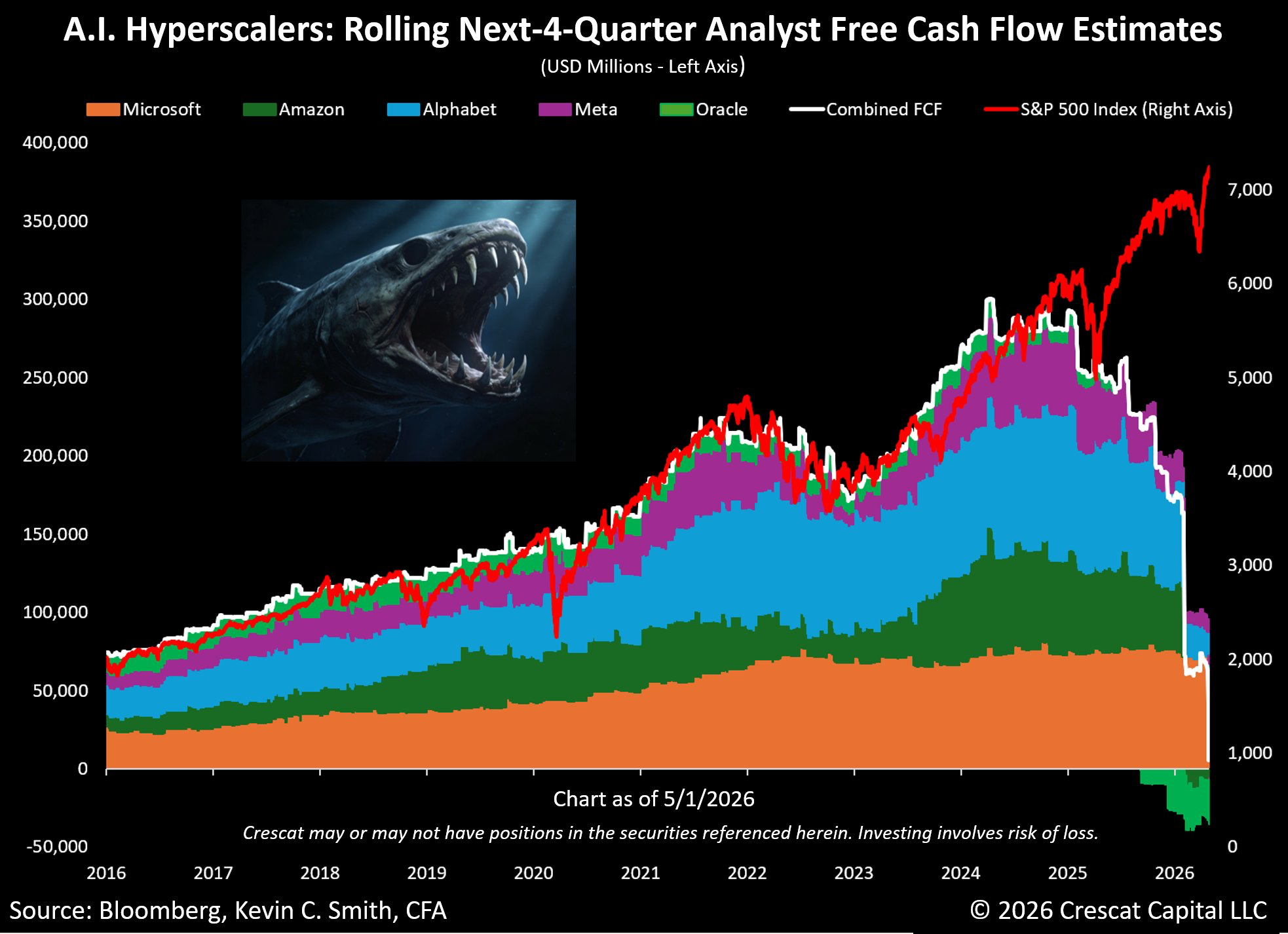
Alphabet generated $73.266 billion in free cash flow in FY2025, which sounds enormous until you look at what's coming. CEO Sundar Pichai has guided for 2026 capital expenditures in the range of $175 to $185 billion. For context, Alphabet's FY2025 operating cash flow was $164.713 billion. If capex hits the midpoint of that guidance range, it consumes essentially all operating cash the business generates.
The trajectory has been accelerating hard. In 2023, Alphabet spent $32.3 billion on capex. In 2024, that rose to $52.5 billion. In 2025, it hit $91.4 billion, a 74% year-over-year increase. The proposed jump to $175-185 billion in 2026 would be another near-doubling. Q4 2025 alone saw capex grow 95% year-over-year to $27.9 billion.
This dynamic is playing out across the peer group. Amazon already lived this story in 2025: FY2025 free cash flow collapsed 65.95% year-over-year to $11.194 billion as capex hit $131.8 billion. CEO Andy Jassy has guided for approximately $200 billion in capital expenditures across Amazon in 2026.
Meta and Microsoft are spending aggressively too. Meta's FY2025 free cash flow declined 19.39% year-over-year to $43.6 billion against 2026 capex guidance of $115 to $135 billion. Microsoft's Q2 FY2026 capex alone was $29.9 billion, up 89% year-over-year.
Patel's broader point is that tech insiders understand the technology better than financial markets, and that returns on AI infrastructure will ultimately justify the spend. The businesses backing these bets are not struggling — Alphabet posted Google Cloud revenue of $17.7 billion in Q4 2025, up 48% year-over-year, with a 31.6% operating margin at the Alphabet level. Full detail is in Alphabet's SEC filing.
Whether it's applied enough is exactly what Patel is questioning. If you believe AI infrastructure is a winner-take-most game and Alphabet and Amazon are positioned to win it, the FCF compression looks like the price of admission. If you think the returns won't materialize at the scale management expects, zero free cash flow at a $1.7 trillion market cap is a very different conversation.
NB: Even before these future investments are considered, for the trailing twelve months Alphabet's EV/FCF has his 73 vs. a P/E ratio of 29. If FCF goes to zero…
Why give all your cash to Nvidia? Why not make your own chips? Then why not sell them?
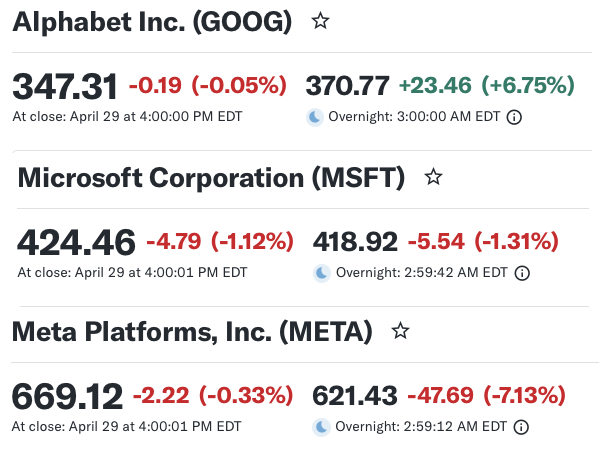
Google said that it plans to sell its custom Tensor Processing Units (TPUs) to select customers who will install the chips in their own data centers.
The move is a change from Google’s prior strategy, which saw it rent out TPU capacity to customers from its own data centers — and is yet another strike at AI chip king Nvidia.
The announcement, during the company’s Q1 earnings call, comes a week after Alphabet announced two new TPUs: its TPU 8t for AI training and TPU 8i for inferencing.
Alphabet didn’t disclose potential customers, but it signed a multiple-gigawatt agreement for next-generation TPUs with Anthropic earlier this month, with chips expected to begin coming online in 2027.
And according to The Information, Alphabet has also entered into a multibillion-dollar chip deal with Meta (META).
NB: Alphabet Q1 sales grew 22% to $110 billion, with Cloud up 63% to $20 billion. Operating margins grew by 220 basis points, with services and cloud operating margins both increasing y/y.
The search business continues to benefit from AI. AI overviews and AI mode are sustaining as search sales grew 19%.
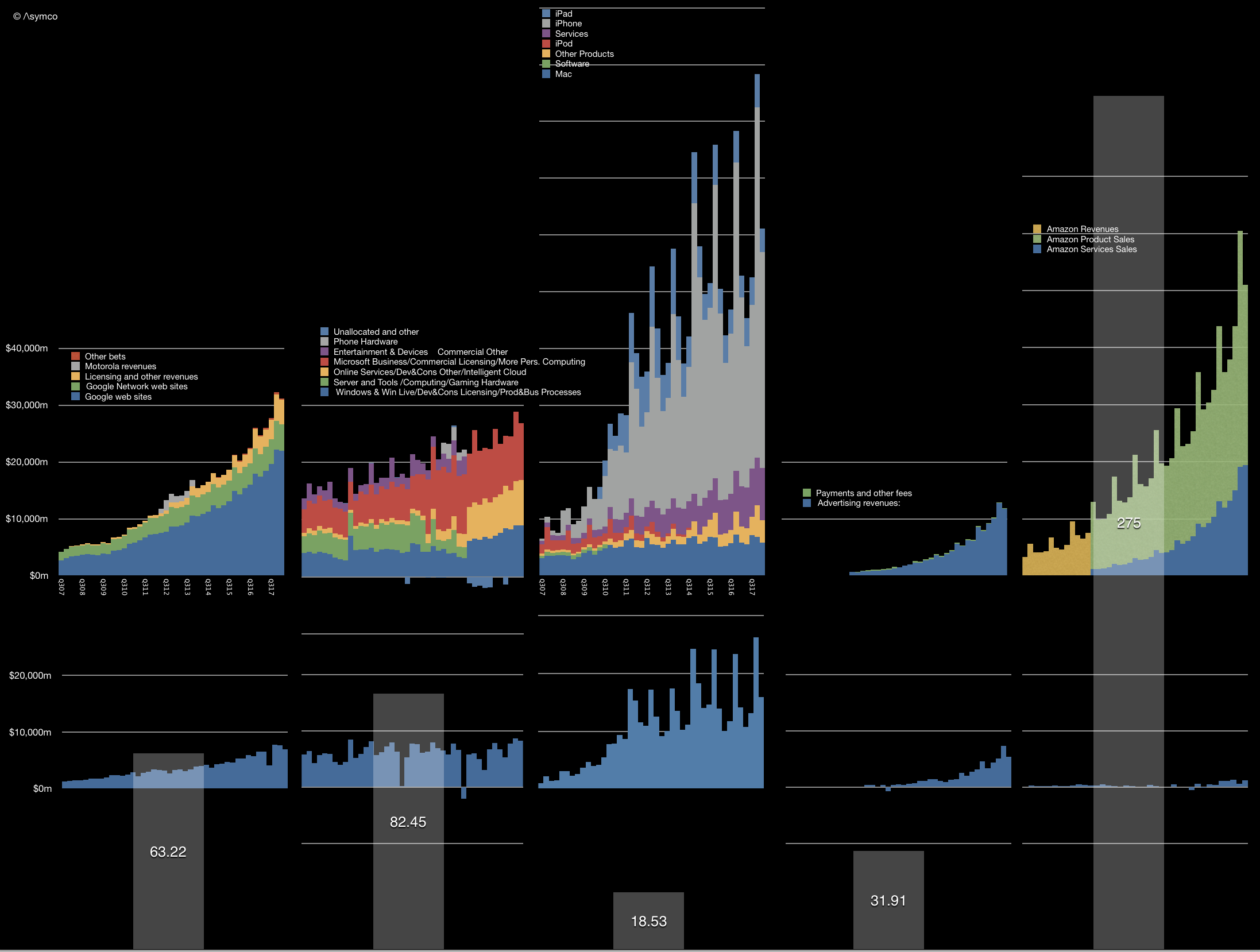
At the latest Apple Summit in Los Angeles the question of Apple's valuation was foremost on many minds. The illustration I used there to discuss valuation is shown below.
It shows the history of revenues (by reported segments) and gross margin for the five largest companies in the world by market capitalization. I have been publishing this illustration for five years ((initially with Samsung rather than Facebook because it was originally a set of "challengers" to Apple. The fact that with only one substitution the illustration turned into a view of the five largest companies in the world was a welcome surprise.)) in order to contrast the growth and perception of value between companies that might be considered comparable with Apple. Thus the graphs show the top and (near) bottom lines of the companies over an epoch of about a decade. ((This being the iPhone epoch))
In contrast with the histories above, there is a price set on the equities today. These prices are captured by the market capitalizations as follows:
Current market cap (billion)
Peak market capitalization (Billion)
Apple
$918
$955
Amazon
$844
$856
Alphabet
$810
$825
Microsoft
$780
$789
Facebook
$584
$589
Market capitalizations are interesting because they show perceptions of value. The traders in the equity are negotiating with each other on what the shares are worth and, as a voting system in a liquid public asset, share pricing is very representative of the perceptions about that asset. Representative because there are literally millions of decisions being made on a daily basis which determine this price.
The sales and profit data in the illustration above is about the past. In contrast the market engine is voting about the future. Any student of finance knows: the value of a company is the net present value of all future discounted cash flows (plus any current assets.)
So what would history have to do with it? What use is the trajectory?
This goes to a deeper question: How does history inform the future? What is the value in knowing previous performance when thinking about future performance? The common caveat in mutual fund prospectuses is "Past performance is no guarantee of future results". We are repeatedly warned of this because it is within our nature to look at history and recognize patterns. But beware! At least beware those whom you might entrust with your fortune.
But consider that it's conventional wisdom to also say that culture and preparation are the best ways to ensure a prosperous future. Ask athletes or coaches and they will say that practice and dedication lead to success. Sports fans know that a team or player with a record of success is more likely to succeed in the future. In this way sport is, in many ways, a simulation of reality. Which is why it's so popular: a metaphor of life teaches as well as entertains.
Knowing how to read ability as well as conscientiousness are keys to scouting talent. Again, it's not a guarantee, but in various fields of human endeavor the past does predict, with high accuracy, the future.
This relationship between past and future is what education is based on. We spend our lives preparing and training ourselves and our children and their children with the implicit hope that this leads to better outcomes for everyone. We establish a pattern of success because it is the best predictor of future success. Practice, learn, commit, defer satisfaction, trade time for knowledge, fight, lose and try again. These are the qualities we look for in the past of individuals when assessing their potential for the future. Culture is everything, we are told. Build a track record, we tell the young.
So what does this have to do with valuation?
We can't easily measure the cultures of persistence and perseverance in companies. Grit, guts, stoicism, fortitude, courage, the Finnish "sisu". These are not measurable in financial reports. Yet our language is as filled with words to describe character and our financial reports are empty of them.
It's left to investors to work it out. The exercise of relating the future to the past is the calculation of the ratio between Price (future) and Earnings (past). A high P/E ratio suggests repeated success from past success. A low P/E is a disbelief in a future repeating the past.
The P/E ratio thus allows us to say to what degree recent past performance is repeatable. I.e. how many `last years' can we expect in the future. A P/E of 1 means a company is worth what it earned last year. A P/E of 10 means it is worth ten years' proceeds. ((We could easily calculate P/E for more than one year but the default is one year.))
This P/E ratio is shown for the five companies above as the overlaid bars in the graph above.
Sure, you say, but it depends on the industry and circumstances. A future divorced of the past is more likely in an environment where there is rapid, chaotic change. The more volatility in fundamentals, the more uncertainty. Technology is changing rapidly and therefore it's quite possible that Apple's low P/E reflects this disconnect.
If so then what about its peers? Why would Apple be subject to different technological risk than other technology companies? All of the top five companies are considered "tech". Indeed, Apple is perhaps the least technologically oriented as it has a brand and consumer orientation. It operates hundreds of stores, and sells design as much as it sells algorithms. It fundamentally tries to deconstruct human needs and package those needs in products.
Alphabet, Microsoft and Facebook primarily don't "sell" to end-users. The revenues come from businesses in the form of advertising or licensing. They don't have support staff, interacting with people who buy what they use. They need to understand needs but they trade other things. And Amazon offers AWS to enterprises as its own unique product. Other than AWS it operates a marketplace, acting as an intermediary.
Apple is a consumer company depending on consumer tastes as a brand. This is more typical of a non-tech company in a boring business of consumer brands.
But it's not valued as either a tech company or a consumer company. Both have typically higher P/E ratios. In fact, Apple's P/E ratio is lower than the S&P 500 and has been below that level for almost the entire history of the iPhone, regardless of growth rate.
A track record of hit products and the stability of a brand seem to be of no value. Perseverance, consistency and stability are not valued. If it were an athlete with a track record of world-record performance and a spectacular reputation with the public, it would not be granted an above-average pay for its performance.
In the past I've argued anti-fragility as a cause. In the context of the other companies, Apple is at the center of perceived vulnerabilities and is thus perceived as vulnerable . The other four are at the center of no competition and perceived as invulnerable. And yet Apple, so far, has survived. So have the others, but apart from Microsoft, they are much younger. I argued that Apple exhibits anti-fragility and has unrecognized robustness. Perhaps Warren Buffet now agrees and this is encouraging to the thesis.
Yet, at an even deeper level, in Apple's valuation we see how culture is not valued. How the idea of character assessment is not applied to businesses. How ethos is unquantifiable and thus discounted. How markets, accustomed to weighing things, reflective of collective human judgement, demonstrate that we are woefully incapable of valuing that which matters most.
Oscar Wilde famously said that the cynic knows the price of everything and the value of nothing. Here's to the sentimentalist, because at the end of the day those who change the world know the value of everything and the price of nothing.
For the last few years, I've been proposing that the way to conceptualize Google is as two separate entities: Google A and Google B.
Roughly speaking Google A was the R&D ((Research and Development)) organization and Google B was SG&A ((Sales, General and Administrative)). You can find the operating expenses of running each of these organizations in the company's income statement. In the last quarter R&D was about $2.8 billion and SG&A was about $3.5 billion ((Sales and marketing was $2.1 billion and General and Administrative was $1.5 billion)). The two entities are further distinguished as follows:
Google A was led by Eric Schmidt and Larry Page and Google B was led by persons unknown, but mostly represented by the "Chief Business Officer" Omid Kordestani.
Google A spends money. Google B collects money.
Google B sends a check to Google A while Google A sends data to Google B (which then sells it on to advertisers and collects money).
Google A communicates frequently with optimism and enthusiasm about the future. Google B remains quiet.
Google A solves problems of humanity, Google B solves problems for advertisers.
Google A has users, Google B has customers (to whom it sells users.)
In summary, Google A is altruistic, Google B is pragmatic. Google A engages in research, Google B engages in commerce. Google A operates in a structure similar to a Bell Labs for the good of humanity ((Using a definition of Good as established by the founder)), Google B operates in a structure similar to AT&T and collects monopoly rents but without any government oversight.
This was an effective construct for analysis which explained to me much of how Google operated and how it made decisions. So what do we make of Google's new Alphabet? Is this a dissolution of the Google B/Google A dichotomy?
My initial answer is no. We don't have a change in this core structure. What we have instead is a split of Google A into Google A and Google A+.
A+ is the crème de la crème of the altruistic Google A. It's the stuff that really does not make money. It's the laboratory of Bell laboratories. It's the moonshot manufacturer. It's the incubator where hobbies are hatched. It's the funder of ventures.
After A+ is carved out, Google A and Google B remain exactly as they were, now under a new CEO. The previous CEO no longer has any day-to-day input in the running of Google A and is no longer soiled by association with Google B.
Alphabet is therefore the "holding company" of Google A+, Google A and Google B. I can only suppose that the separation of A+ from A (and the previous A from B) allows the founders to distance themselves even further from the purchase decisions which, through pricing signals, determine where value lies and how resources should be allocated. That must be a great relief.