Asymco

Asymmetric Intelligence

analyst

  1. Morgan Stanley resets Apple stock forecast ahead of earnings - thestreet.com

    Nota Bene

    Consensus estimates Apple to post about $138.4 billion in revenue and both GAAP and non-GAAP earnings per share (EPS) of around $2.67 for the December quarter. The numbers highlight at least an 11% year-over-year growth in EPS and revenue, but analysts are now tightening their margin forecasts despite favourable iPhone sales and AI roadmap.

    In a note, Morgan Stanley analyst Erik Woodring reiterated an Overweight rating and an unchanged price target of $315, but cautioned investors that Apple stock could “trade sideways to modestly lower after earnings.”

    The firm expects Apple to beat expectations, driven by stronger, more persistent iPhone demand. Woodring expects December-quarter revenue of about $80 billion, around 4% above consensus, and March-quarter revenue of $55.4 billion, about 8% above consensus, citing supply-chain checks and shipment data.

    He said iPhone 17’s “strength remains underappreciated by the Street.”

    Morgan Stanley sees cost assumptions as overly optimistic. The firm forecasts March-quarter operating expenses about 7% above consensus and a gross margin forecast 30 basis points below consensus, driven by rising memory costs.

    As a result, Woodring sees limited scope for positive EPS revisions for Apple, even with a revenue beat.

    Morgan Stanley also flagged potential downside risk to June quarter earnings, estimating EPS of $1.62 versus the consensus of $1.71, citing intensifying memory-related cost pressures. The firm also notes that Apple has historically underperformed the S&P 500 more in Q1 than in any other period.

    Looking ahead to 2026

    All things considered, Morgan Stanley believes Apple is positioned to outperform in 2026 as a wave of new products and AI-driven catalysts is set to shape the company’s growth trajectory. The firm particularly highlighted the relaunch of Siri in February and Apple Intelligence in June at Apple’s Worldwide Developers’ Conference (WWDC).
    Some notable introductions expected include its most “innovative iPhone in 10+ years (Foldable)“, plus the first smartphone powered by 2-nanometer chips, part of the iPhone 18 family.

    The firm sees greater benefits from share gains and higher average selling prices, with Morgan Stanley underscoring an EPS of $9.77 for FY2027, roughly 7% above Wall Street consensus.

    Read the original article →

    Our Take

    Earnings will be above consensus. All eyes will be on how margin guidance due to pressure from memory pricing. Every year it's another thing that is cause for drama. It never matters.

  2. Apple is Doomed, Revisited

    Research

    Before the iPhone launched in late 2007, Apple was trading consistently at a P/E ratio above 30. Here is a table for the P/E ratio on each Friday's closing price from May to August, 2007. The iPhone launched on June 29, 2007.

    Apple's P/E ratio around the iPhone launch
    DateP/E Ratio
    5/23/0731.5
    5/30/0731.6
    6/6/0734.1
    6/13/0733.7
    6/20/0734.6
    6/27/0733.6 (2 days before iPhone launch)
    7/11/0737.2
    7/18/0734.6
    7/25/0734.3
    8/1/0733.3
    8/8/0734.2
    8/15/0730.2

    Apple was not super powerful but it was not doomed either. It was a time when the iPod was dominant and the Mac was still alive. iTunes re-wrote the rules of the music industry and debate was raging whether Apple should be considered a media company. Platforms were not its strength but Steve Jobs showed he was still able to distort reality.

    These good times did not last. The first year of the iPhone was a period of minimal contribution from the new category with Apple still largely valued on the basis of the iPod. The predictions of failure for the new communications product, especially given its high price, were legendary. It wasn't until 2008 that the iPhone began accelerating and making a meaningful contribution to the bottom line.

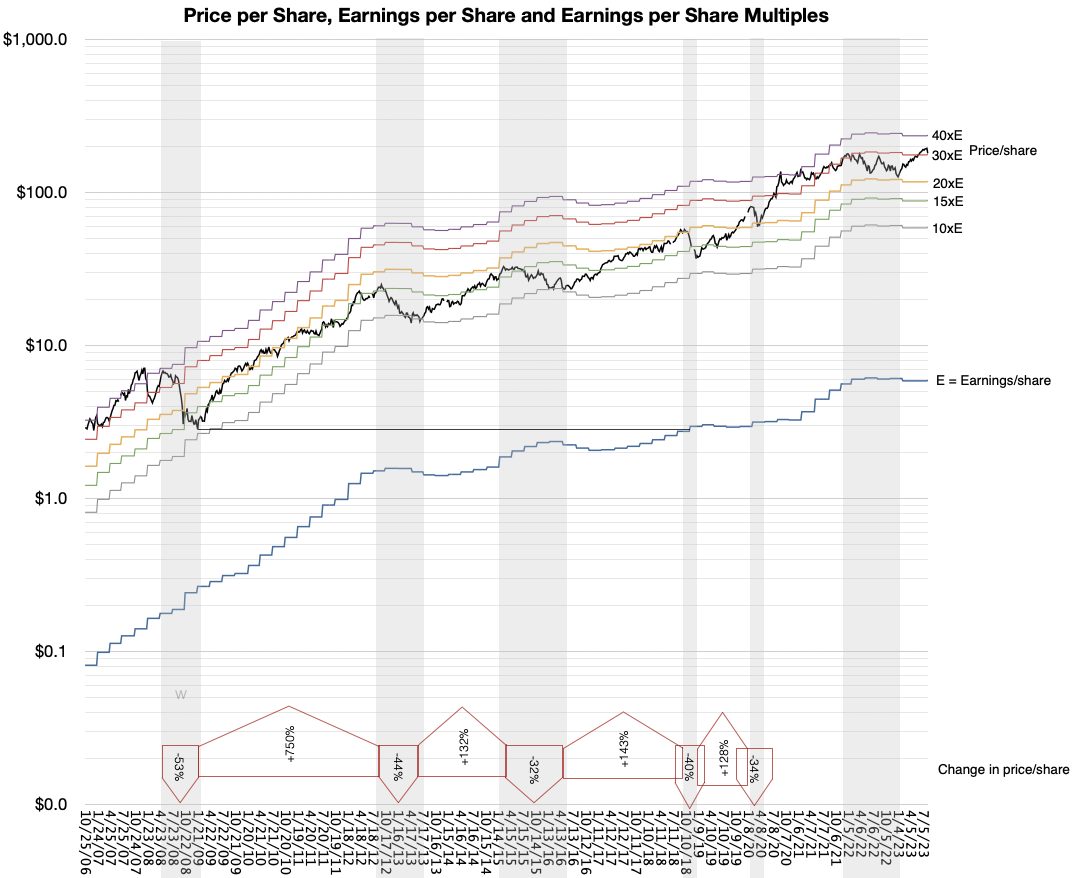
    It was then, in late 2008, that Apple's valuation broke. The P/E ratio fell from above 30 to nearly 10. The following graph shows the catastrophic 53% share price collapse coupled to the triple digit surge in earnings which led to the P/E ratio tanking.

    [The graph shows earnings per share for the trailing 12 months (blue line) and 10x, 15x, 20x, 30x and 40x that value (colored lines). The share price is the black line. The share prices are sampled every Friday. The graph is notably logarithmic. The grey shaded areas are periods of significant contraction. The percent drops/increases during these periods of contraction/expansion are shown in the annotation arrows near the bottom.]

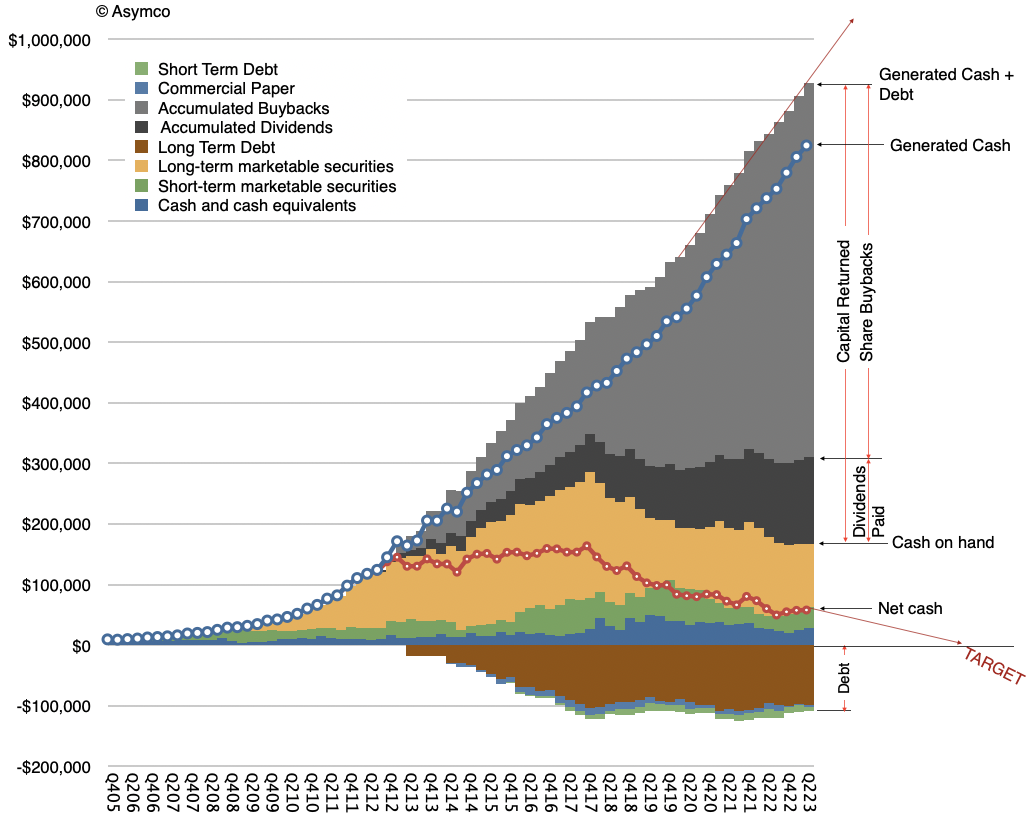
    The valuation remained broken for 12 years, between late 2008 and late 2020. This period being, arguably, the most remarkable wealth creation event in history of business. For evidence see the following graph showing the amount of retained earnings returned to shareholders building inexorably toward one trillion dollars. This is not share price appreciation but cash returns. [If you have evidence of a larger wealth-creation event do let me know.]

    The creation of $800 billion of shareholder wealth at fire-sale share pricing.

    As I explained throughout this period, motivation to dispose of shares which create immense wealth is explained by the fable The Goose That Laid the Golden Eggs but the question some are asking now is whether more wealth can still be created, and if so, can we expect Apple's valuation to collapse accordingly?

    I should note that during the long, dark years of wealth creation, other technology companies such as FaceBook, Amazon and Netflix, Google (so-called FAANG) and Microsoft enjoyed far higher multiples than Apple, sometimes 3x higher. This was not seen as abnormal by analysts because those companies were always assumed to have higher growth potential, with a diverse portfolio of opportunities while Apple's growth was perpetually in its past, based on one product.

    Paradoxically perhaps, since the Covid-19 pandemic Apple shares have enjoyed P/E ratio roughly equivalent to the other tech companies. For instance, peaking at 42 in January 2021, the P/E ratio has averaged about 27.5 since then. Simultaneously, diversified companies such as FaceBook (now Meta) and Netflix collapsed due to serious business model flaws (based on single sources of income) and Google (now Alphabet) and Amazon have slowed growth and are facing anti-trust scrutiny. Having lost any presence in mobile computing Microsoft has become entrenched in enterprise, finding new businesses in cloud and (possibly) generative AI. As a result of these reversals, the contrast between Apple and the mega-cap cohort has become fuzzy.

    So back to the question: does it make sense to price Apple in the 30x P/E or should it go back in the gutter at 10 to 20?

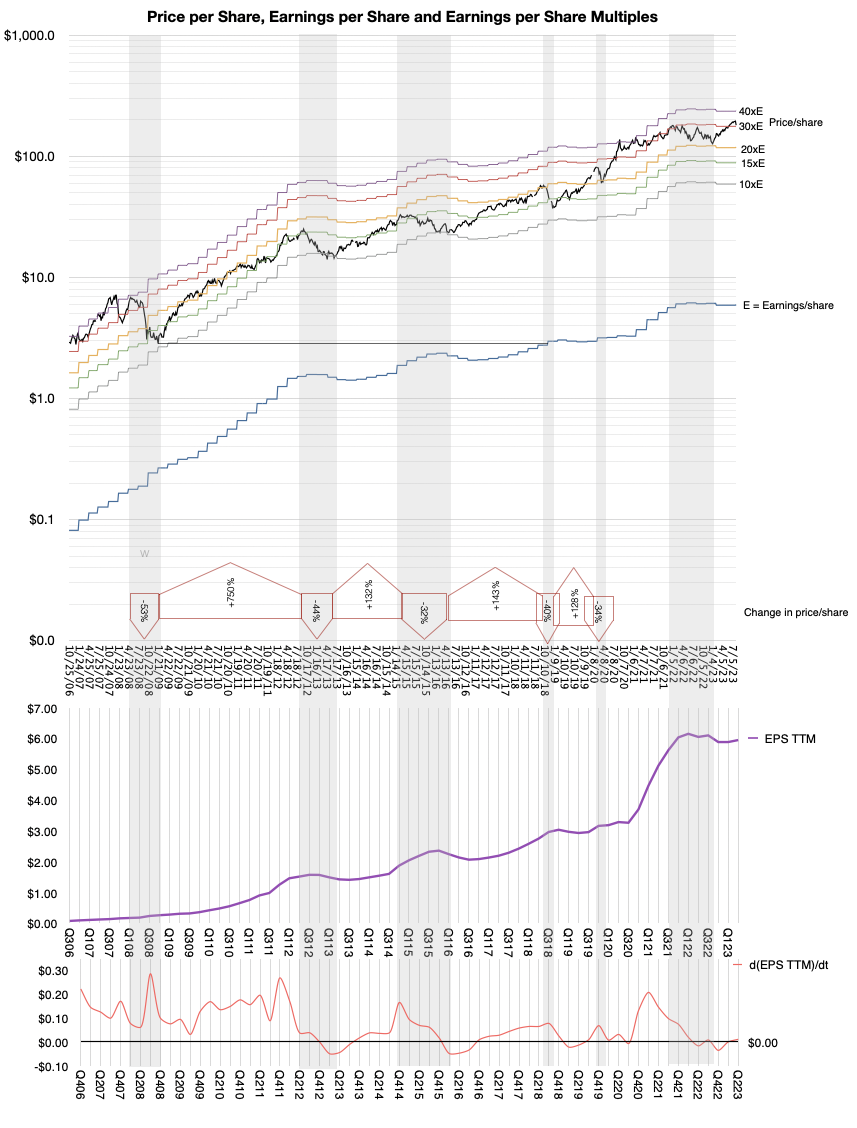
    I would argue that the big change in perception hasn't been the surge in earnings during Covid (see graph below). The big change is the realization that Apple is no longer about to go out of business.

    How could Apple not be going out of business?

    Remember that a P/E ratio in the teens is a clear signal from the market that the company is a questionable "going concern". This is parlance indicating doubt that the company will continue in its present form..

    What has changed since 2020 is that even though there were a multitude of crises—from war to pestilence—the eggs kept coming. Perhaps, perhaps, Apple was not doomed after all. In that time it managed to create 1 billion customers. Perhaps having 1 billion customers was a positive outcome. Perhaps counting iPhones during a single quarter was not the only way to value the company. Perhaps having 1 billion satisfied customers made it viable. Perhaps having 1 billion satisfied and loyal customers returning every year was interesting. Perhaps having 1 billion satisfied wealthy customers meant the end is not around the corner. Perhaps having 2 billion active devices in use was sustainable. Perhaps providing services to 1 billion customers using 2 billion devices delivered through 1 billion subscriptions made some sense. Perhaps having all this data in a linear graph made it predictable?

    Perhaps. Though Apple provided updates on these figures regularly, the questions everyone asked were still on unit shipments (which Apple stopped providing.) While Services grew at double digits and 70% margins the questions from analysts on conference calls persist on the iPhone and currency or production "headwinds". Perceptions take time to change. They are still changing.

    Maybe at this point it's time to agree that Apple's end will not come through being easily replaced by the competition (first Windows then Android, etc.) but by having access to its markets restricted. Being the only American company to have cracked the China puzzle, it's surely vulnerable there. And please don't mention India.

    Apple is no longer doomed because it's too weak. It's doomed because it's too strong.

    It seems that it's not too hard to believe the end is still near.

  3. Analyst, analyze yourself

    Research

    It's common knowledge that sell-side analyst price targets for stocks are not taken seriously. The evidence is simply that no public accounting exists for their historic performance. It would be trivial to grade performance but it seems nobody bothers to do it.

    It seems strange given the attention paid and repetition of these targets in financial media. When a "note" is published with an opinion and a target price the stock price can and does actually react. But why should it if there is no accountability?

    Well, not quite zero accountability. Philip Elmer-DeWitt publishes analyst estimates (example) diligently. These estimates are presumed to be 12 month targets, meaning that at the time when the estimate is published the target price is assume to be reached 12 months hence. He does grade the performance of these same analysts (and more) in predicting quarterly earnings and revenue estimates for the just-ended quarter.

    But an estimate for what *just* happened in the last 90 days is a lot easier than predicting how markets will react to all the information about a company 12 months into the future.

    So how hard can it be to measure performance on price targets vs. just-ended quarterly estimates?

    Here is my modest attempt: I note that Apple's share price today is trading around $298 per share. I also note that we can recover the estimates from analysts exactly a year ago. At that time Apple issued a rare warning that its own estimates for the fourth calendar quarter 2018, issued about 60 days earlier would be quite a bit different than what will be released (in 3 weeks).

    This compelled all the analysts to re-set their targets at the same time. What we ended up is a whole batch of January 3rd 2019 estimates for, presumably, January 3rd 2020.

    Well, January 3rd 2020 is tomorrow. How did the estimates hold up?

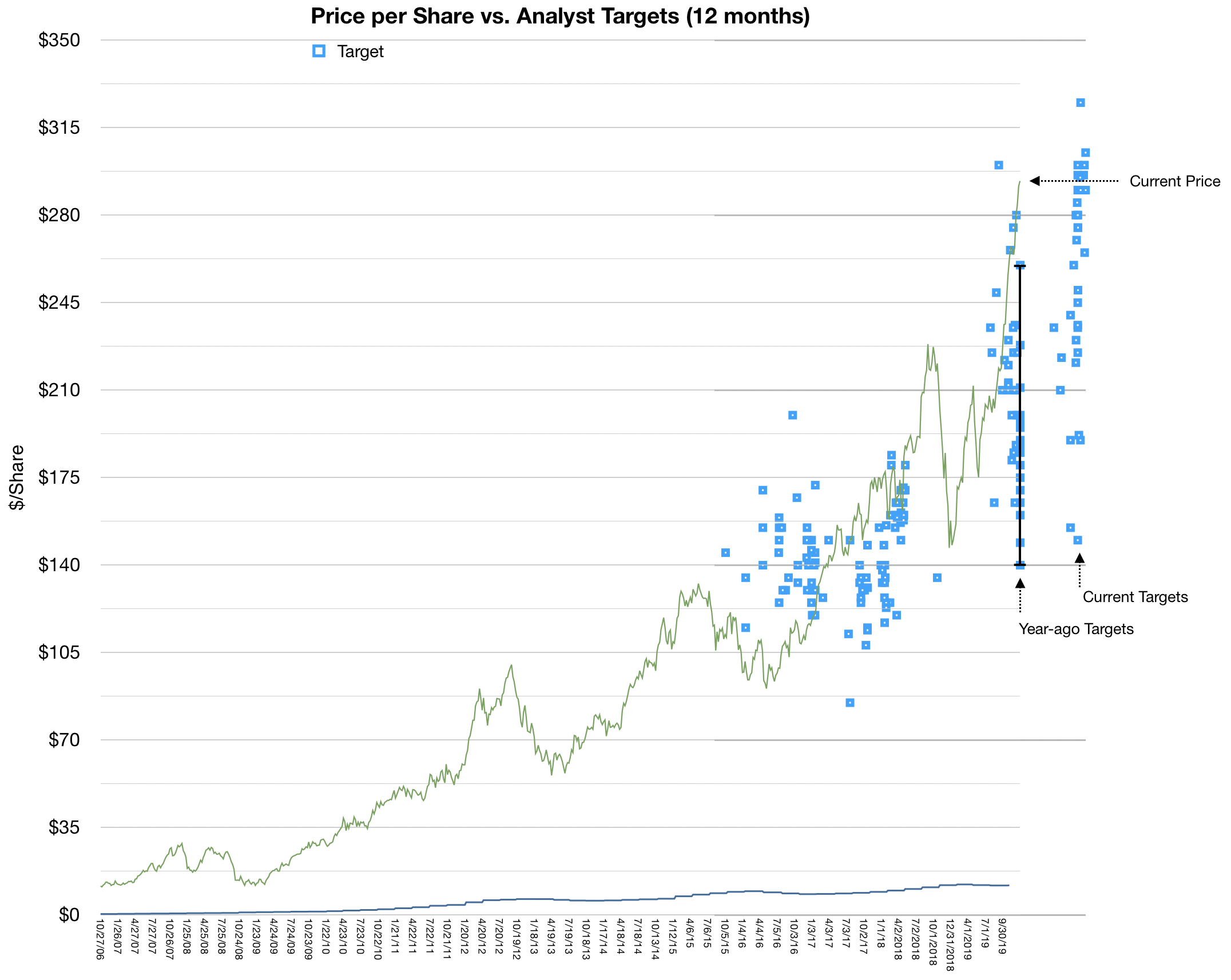
    The following graph tells the story:

    Apple Share Price vs. a sampling of Analyst Estimates, Past and Present.

    The green line in the graph represents the closing share price at weekly intervals (from about October 2016 until last week.) The blue dots represent various estimates. Note that they are 12 months since their issuance and that since estimates can come at any time the are not easily clustered.

    That is except last year and the "big reset" when the estimates all were issued on the same day. I highlighted the range with a vertical line. Note that the closing price last week was well above the highest estimate and that the lowest estimate ($140 is less than 50% of the current price).

    This is quite a big fail. Errors of 50 for a 12 month time frame are egregious.

    A few additional observations:

    The spread or variance of estimates is enormous. Far wider than what was the case 3 or 4 years ago. (I look forward to getting more data to perform this variance analysis). It's peculiar to me that a larger, more stable business, as Apple is today, is more difficult to predict. To see even today a range in targets between $150 to $350 is bizarre.

    Another observation is that very, very few targets were "accurate". That is anywhere near what actually happened. To find these rare successes, look for blue dots placed directly or near the green line. The chances of a correct target is less than what can be attributed to chance. Again, I look forward to a larger data set to see if there is any set of analysts that perform particularly well or particularly poorly.

    Again, we're not describing here predictions about the stock market in general, or of macroeconomic indicators. We're talking about predicting one single company's stock price in a 12 month period. A company that receives a great deal of scrutiny and which publishes a surprisingly large amount of data about itself.

    Now I don't want to suggest that there is a better way to predict share prices. I will not try to do so because although it might be easy to predict earnings based on overall company strategy, processes and team (all well known) the share price is that data multiplied by a random number called "sentiment". That sentiment can be summarized as the P/E ratio which wanders around aimlessly. I don't think I have any way to predict sentiment one second into the future, never mind one year.

    But even if I don't think there is a method to the madness of sentiment, it seems dozens of people find it necessary to claim that there is one. But if you do, then analyze yourself. What did you learn from the mistakes? What is the theory you're employing?

    And if you don't analyze yourself, then don't expect to be taken seriously.

  4. Traffic Acquisition Costs

    Research · 98 comments

    In June of this year Apple reported that it had paid a total of $100 billion to developers. That is the 18th such figure given in the 10 year history of App Store, making the progress of payments and hence revenue and spending easily trackable.

    The other regularly reported figure is the business segment revenue where App sales are currently allocated. Now called "Services" this omnibus segment includes many other sources of revenues such as:

    • Digital Content (Books, Music downloads, Video downloads--including TV shows and movies and movie rentals.)
    • AppleCare, Apple's extended warranty service.
    • Apple Pay, transaction fees
    • Apple Pro Apps, including Final Cut, Logic Pro, Motion, Aperture
    • Licensing including "Made for iPhone/iPad"
    • One-time settlements of various lawsuits.
    • Other Services revenues which include
    • Apple iCloud-related services
    • Music Match
    • Music subscriptions
    • Other third party subscriptions (commissions)
    • Third party licenses

    This combined Services segment is significant with $35 billion revenues in the last 12 months. This is quite a jump from 2016 when Services had crossed $25 billion. At the end of 2016 Apple said it expected Services revenue to double by 2020. With a growth rate since then of 25% the company is on track to reach its target one year early. ((To calibrate this consider that Facebook revenues for the last 12 months were $48 billion and it now has a market capitalization of $468 billion or 41% that of Apple whereas Services consists of about 14% of Apple's total revenues.))

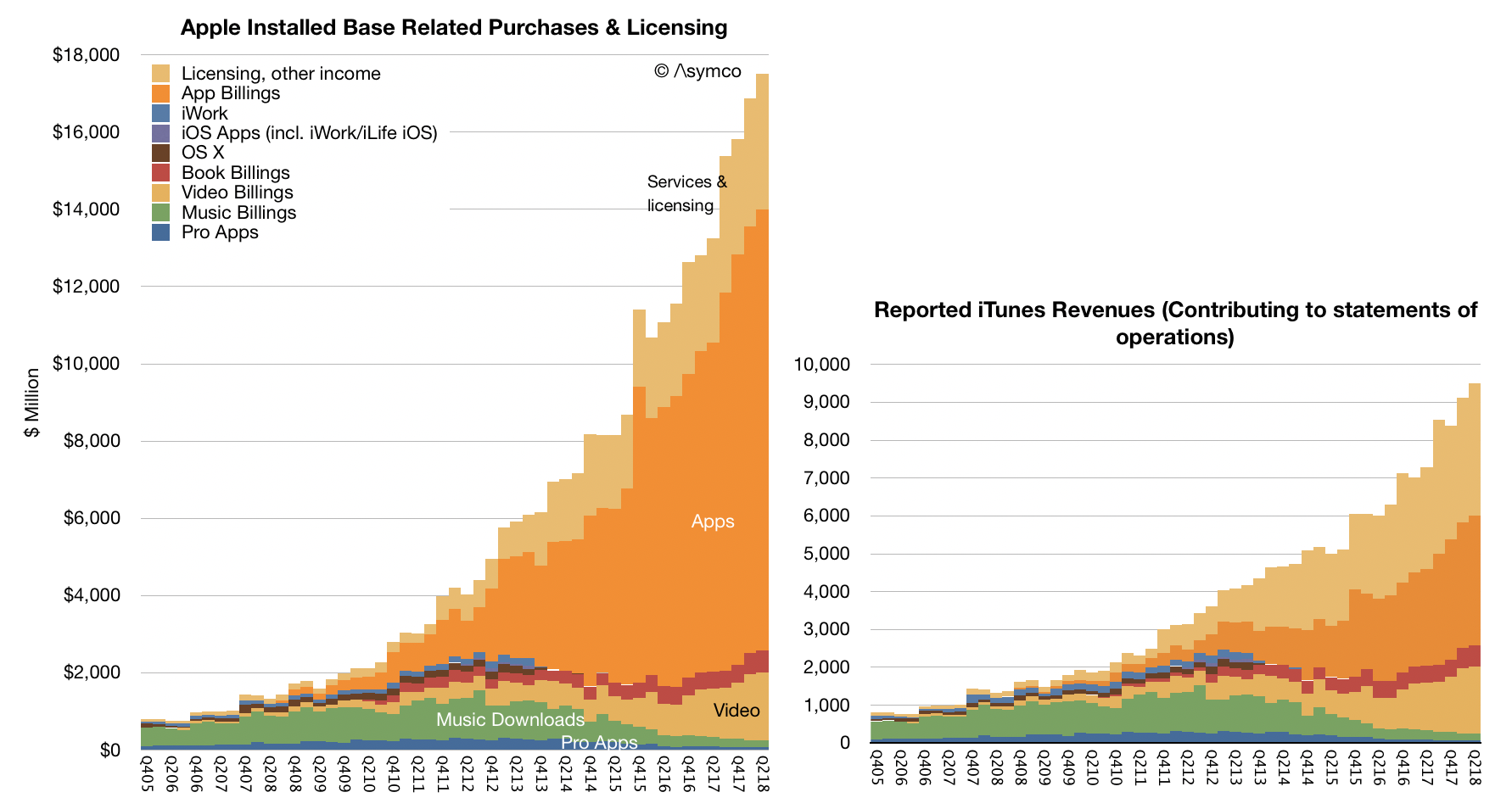
    Consumer spending on Apple services includes more than what it books as revenue since only the (typically) 30% of App Revenues is considered Apple's revenue. Including the payments to developers, Services generated over $65.5 billion/yr in billings. This will reach $100 billion/yr in 2 years. The difference between reported revenues and consumer spending is shown in the following graphs.

    I described the visibility into App Store revenues (which is the orange area in the graphs above) but the other sub-segments of Services are much more difficult to ascertain. Of special interest is Other Services which includes very high margin services. As part of that there is a peculiar source of revenues: Google.

    It's known that Google pays Apple for the default placement of Google search within Safari on iOS and Mac OS. That payment is registered by Google as a "Traffic Acquisition Cost" or TAC. TAC is essentially payment for distribution where what is granted by the distributor is access to queries (traffic.) This way Apple acts as distributor for Google. So, for that matter, does Firefox which also receives TAC payments.

    What is peculiar is that the amount of TAC paid by Google to Apple is becoming staggering.

    A few years ago Google was paying over 20% of its revenues as TAC. Recently that ratio rose to 23%. Bernstein analyst Toni Sacconaghi estimated that Google paid Apple $1 billion in 2014 as TAC and that payments to Apple were about $3 billion in 2017. Now Goldman Sachs analyst Rod Hall estimates Google could pay Apple $9 billion in 2018, and $12 billion in 2019.

    This is starting to look interesting but is it believable?

    My own estimate of Apple's Other Services (which includes TAC revenues) is a run rate of $15 billion for calendar 2018. This makes $9 billion (60%) from Google quite challenging but not impossible. The remaining $6 billion needs to account for Apple's own cloud and subscription service revenues.

    Does this make sense given Google's spending? TAC payments to distribution partners in Q2 were $3 billion. The $9 billion/yr assumption implies a $2.25B/quarter payment to Apple. That would be 75% of Google's distribution costs. That also sounds reasonable given the high utilization of iOS relative to any other platform.

    An increase to $12 billion for next year is also quite a claim but it certainly is possible. I don't have a basis for making this estimate but the assumption of growth leads me to conclude that the payments are tied to actual traffic generated.

    In other words the two companies have an agreement that Apple is paid in proportion to the actual query volume generated. This would extend the relationship from one of granting access for a number of users or devices to revenue sharing based on usage or consumption.

    Effectively Apple would have "equity" in Google search sharing in the growth as well as decline in search volume.

    The idea that Apple receives $1B/month of pure profit from Google may come as a shock. It would amount to 20% of Apple's net income and be an even bigger transfer of value out of Google. The shock comes from considering the previously antagonistic relationship between the companies.

    The remarkable story here is how Apple has come to be such a good partner. Both Microsoft and Google now distribute a significant portion of their products through Apple. Apple is also a partner for enterprises such as Salesforce, IBM, and Cisco. In many ways Apple is the quintessential platform company: providing a collaborative environment for competitors as much as for agnostic third parties.


  5. Glance: A Deep Look at Apple Watch

    Conference · 2 comments

    Bernard Desarnauts had a great idea a few weeks ago: the world needs an event to discuss Apple Watch. After recovering from the shock of not thinking of it first and then from the shock that nobody else had either, I immediately agreed and along with Ben Bajarin and Farshad Nayeri, we quickly rallied to organize and anchor this event: Glance: A Deep Look at Apple Watch.

    We had some big questions to answer:

    • What is the strategy for Apple Watch? Is it an object of beauty and desire, placing Apple in the "luxury sector" or is it a computer infiltrating what is otherwise a technology-free zone with utility in an asymmetric attack?
    • How can developers discover the killer jobs to be done? Beyond tentpoles what will the primary reasons people will use the watch? What does the data tell us so far? What can be observed from interviews?
    • Given the sales performance to date, what can we expect from the product? What is the addressable market? What will be the installed base? How quickly will it grow?
    • What is the platform strategy, especially with the cadence of OS releases? Is Apple treating this as a separate platform? Will it eventually become independent of the iPhone as the iPhone cast off its dependence on the Mac/PC?
    • What is the hardware strategy? What are the constraints from manufacturing, materials, battery life and screen space? What will be the replacement schedule? What is the role of modular internal designs?

    We realized that we did not have the answers. So we recruited a great cast of participants to help us:

    • Bob Moesta, the founder and developer of the theory of jobs-to-be-done marketing agreed to do a live interview to understand what jobs watches, and in particular Apple Watches, are hired to do.
    • Josh Clark, the premier UX designer who wrote Designing for Touch will explore the question of user experience in glanceable space.
    • Liza Kindred is considered the top expert on fashion tech–she’s writing the book on the future of commerce–brings keen understanding of wearables.
    • Abdel Ibrahim the most prominent blogger and writer on the topic of Apple Watch. Has forgotten more about the Apple Watch than you will ever learn.
    • Carolina Milanesi one of the most respected technology market analysts, now at Kantar and often quoted on all things Apple.
    • Greg Koenig, product designer at Atomic Delights will educate us on the atoms that make up the Watch.

    Investors who will participate in panel conversations:

    Special guest: Jean-Louis Gassée, former head of Apple Engineering, current VC and everything in-between will have a fireside chat with Tim Bajarin Legendary technology analyst who has been around long enough to see furthest ahead.

    We will explore Apple Watch as a very curious interaction between form and function, luxury and utility, exclusivity and ubiquity, tiny screens and big audiences, short attention spans, big data.

    We have developers, designers, investors, marketers and analysts contributing to what could be the biggest leap in computing since the smartphone.

    If you are interesting in becoming one of the innovators on this newest of platforms or planning a strategy to invest, or even (actually especially) if you are a skeptic, you can't miss this conference.

    Join us for Glance, a deep look at Apple Watch, downtown San Francisco, December 10, 2015.

    Early bird pricing is $495.

    If you miss early bird, and you're an Asymco reader, there is still a 30% discount.

  6. Podcast: The New Industry Analysts, Who Are They? (Part Two)

    Podcast

    Over the last couple of years we have been witness to the rise (and fall) of new research initiatives. What defines them, and what drives them to take on the market as they do? Hosts Thom and Derk Erbé are joined by Phil Fersht, Michael Coté, William Tincup and Horace Dediu. The panel drills down on new types of industry analysts and how they will change the IT research landscape.

    This is the second part of this podcast. The first part can be found here.

    Source: Podcast: The New Industry Analysts, Who Are They? (Part Two)

  7. Podcast: The New Industry Analysts, Who Are They? (Part One)

    Podcast

    Over the last couple of years we have been witness to the rise (and fall) of new research initiatives. What defines them, and what drives them to take on the market as they do?

    Hosts Thom and Derk Erbé are joined by Phil Fersht, Michael Coté, William Tincup and Horace Dediu. The panel drills down on new types of industry analysts and how they will change the IT research landscape.

    Source: Podcast: The New Industry Analysts, Who Are They? (Part One)

  8. Apple management answers questions on the market performance of Apple Watch

    Research · 10 comments

    Katy Huberty (Analyst - Morgan Stanley): You've said in the past that the watch may take longer to ramp given the new category and new interface to customers. Is that, in fact, playing out? Is the watch ramping slower than past product categories?

    Tim Cook (CEO): Katy, when you use the word ramp, do you mean from a -- I assume you're talking about supply?

    Katy Huberty (Analyst - Morgan Stanley): Yes. Pre-orders and first week in sales and any other data points that you track in terms of interest versus, say, when the iPad launched in 2010?

    Tim Cook (CEO): Let me talk about supply and demand and sort of separate those two. Right now demand is greater than supply. And so we are working hard to remedy that. ((This is still true today, three months later))

    We've made progress over the last week or so and we're able to deliver more customers an Apple Watch over the weekend than we had initially anticipated. We're going to keep doing that. […] So I'm generally happy that the -- that we're moving on with the ramp.

    It is a new product for us, and with any kind of new product, you wind up taking some time to fully ramp.

    Having said that, I think we're in a good position. And by some time in late June, we currently anticipate being in a position that we could begin to sell the Apple Watch in additional countries. And so that's our current plan. ((This has been achieved according to plan.))

    From a demand point of view, it's hard to gauge when you don't have product in stores and so forth. And so we're filling orders completely online at the moment.

    The customer response from people that have gotten theirs over the weekend have been overwhelmingly positive. And we're far ahead of where we expected to be from an application point of view.

    To give you a comparison, when we launched the iPhone we had about 500 apps that were ready. When we launched iPad, we had about 1,000. And so our internal goal was to be able to beat the 1,000 level and we felt -- we thought it would be great if we were able to do that by a little bit.

    And as I've mentioned before, we now have over 3,500 apps in the App Store for the Watch. And so we couldn't be happier about how things are going from that point of view.

    We are learning quickly about customer preferences between the different configurations. There's a much larger breadth of possibilities here for customers than in our other products. And in some cases, we called that well and some cases we're making adjustments to get in line with demand.

    But I'm really confident that this is something we really understand how to do and will do. And so I'm really happy where we are currently and happy enough that we're looking forward to expanding into more countries in late June.

    […]

    Gene Munster (Analyst - Piper Jaffray and Co.):  …question for Luca, in terms of any thoughts on what the margin impact from the Watch as that ramps over the next couple of years?

    Luca Maestri (CFO): Apple Watch is, not only a new product, but it's a brand new category with a lot of new features, a lot of new innovative technologies. And Apple Watch margins will be lower than the Company average.

    […]

    Toni Sacconaghi (Analyst - Bernstein): I just wanted to revisit the watch.

    Tim, I think you said when you were talking about your new products, you said we're, quote, very happy with the reception. And in response to a previous answer you said, relative to demand, it's hard to gauge with no product in the stores.

    I would say relative to other product launches where your commentary around demand was characterized by superlative after superlative, that assessment feels very modest. And part of the reason that I ask is, A, are we reading you right in terms of that? But if we look at consensus, consensus is expecting that Apple will ship more watches in its first two quarters than it did iPads, despite, as you said, very limited distribution in terms of only selling through your stores.

    So I'm wondering if you can talk a little bit about putting those demand comments in context, given that they do seem different from how you've characterized product demand for other products. And how, if at all, we should think about the modeling demand in the context perhaps of the iPad, which was your most recent significant new category? And then I have a follow-up, please.

    Tim Cook (CEO): I'm thrilled with it, Toni. So I don't want you to read anything I'm saying any way other than that. So I'm not sure how to say that any clearer than that.

    And in any situation, whether it's the watch or in the past on iPad or on iPhone, when demand is much greater than supply, it's difficult to gauge exactly what it is. And so, as you know, we don't make long term forecasts on here. We maybe forecasts for the current quarter. And so I don't want to make any comment about the consensus numbers.

    Honestly, I haven't even studied those. We've got enough to think about here.

    I feel really great about it. The customer response, literally from what I've seen, is close to 100% positive. And so it's hard to imagine it being better.

    -------

    Excerpts from Apple Earnings Report: Q2 2015 Conference Call Transcript, April 27, 2015.

  9. Selling Watch Sales Data

    Research · 22 comments

    There is no reliable information on Apple Watch sales. None of the analysts which follow Apple or the phone, computer or watch markets have any insight into this. The only source of information is Apple itself and they have made it clear that they don’t intend to provide watch sales data for competitive reasons. I did not and do not expect any information from Apple on watch sales. They have placed the product within the “Other” category specifically to make unit data hard to discern and have explained why they do so.

    The only estimate we have heard of is from a company that has no track record in market research and relies entirely on sampling of email receipts. I urge extreme caution when dealing with this type of data. We don’t know how representative these receipts are and how they are sourced or sampled. The methodology is not only unclear but it’s one not practiced by any other analyst. You would think that receipt sampling would be a phenomenal source of information about a lot of other products and yet we hear nothing about how predictive it is for anything except this particular new product as claimed by a company which never made any such prior claims.

    It’s also a sampling of (presumably) US-only customers at a time when the product is undergoing a gradual roll-out through multiple countries and multiple channels. Consider that if sales were constrained internationally then buyers would be trying to arbitrage through the US market, meaning there would be many e.g. Chinese buyers/brokers booking sales through US online stores inflating that channel’s initial volumes. Furthermore as physical retail stores begin to receive stock, online sales (which are what is sampled) should decline as buyers opt for the instant gratification (and the option to see the product in real life.) To see US-only online purchases drop after a period of pent-up demand and as store inventory becomes available is not interesting and says almost nothing about the product’s performance.

    The only way to be thoughtful about this new category is to understand the broad transitions underway in mobile computing. We are witnessing a pivot in human-computer interaction as significant as the initial iPhone launch.

    [As a rule, be very careful with the premise of data salesmanship. All data is false, some is useful. Data you have to pay for is less useful than data that has been peer reviewed.]

  10. How will we measure Apple's Watch success?

    Research · 55 comments

    It won't be easy. The company will not be reporting the Watch segment revenues or (presumably) unit sales and therefore we won't have an accurate unadulterated view of the business. In addition, the large number of products in the mix and wide price variance means that it will be difficult for analysts to determine demand and price.

    There is a hidden benefit to not having this data. All data is a creation and it tends to lead thinking in directions led by whatever is being measured (and whoever chose those measures and their motives). And yet without data there is no evidence and no credibility. In other words: You can't manage without measurement but you can't be sure what to measure.

    The analyst is then faced with a requirement to have good taste or at least judgement about what to measure. This judgement is based on experience and good theory. Given that, what could we measure to determine whether the Apple Watch will be a success?

    Here are some suggestions:

    1. Language. Measure whether "Watch" will come to mean "Apple Watch". "Phone" has come to mean not only "smartphone" but also all mobile/cellular phones and not just things used for calling but things used for all manner of information. This is a great test because the theft of semantics can only be accomplished through a degree of ubiquity of influential mindshare. Incidentally, the brand may well have been designed to do just that. ((It leaves open the question as to what watches as currently defined will come to be known as.))
    2. A measurable and significant reduction in the use of the iPhone. The Watch peels off uses from the iPhone and therefore the more it peels off, the less remains. However, that which remains will be more uniquely valuable to the incumbent. This is the process of carving and erosion that the PC experienced vs. mobile devices in general.
    3. An increase in the mix of large-screen iPhones. As iPhones are removed from pockets more rarely, the larger version might be more comfortable to carry and more useful to use for the immersive tasks that are outside the scope of Watch.
    4. An overall increase in iPhone sales beyond the foreseeable trajectory. This would suggest switchers from Android would be drawn to the platform purely for the value of the "accessory". Note that this is not inconsistent with the lower usage and higher spec mix measurements.
    5. Apps uniquely targeting the Watch. It's hard to imagine how this will develop as it involves millions of creative minds, but as smartphones created new economic value through the solving of new jobs to be done, the Watch should do the same. As a side-effect it should lead to new empires (or at least Unicorns) being formed around Watch use.
    6. Iteration. How quickly and deeply will the product be improved? Basic accessories like headphones and Apple TV have a leisurely update cycle. Smarter devices are faster. The cycle time of iteration should indicate how seriously Apple takes the platform and that itself should be fueled by positive consumer sentiment for the product.

    These indicators are vague and the data will be weakly signaled but in many ways it will be more meaningful than any financial performance figures.

  11. The greatest show on earth

    Research · 105 comments

    Dan Niles, a former analyst who is now a portfolio manager, said on a CNBC appearance that the WWDC event actually had nothing of any real meat for investors

    From Worldwide Developer's Conference Prompts Analysts to Raise Apple Price Targets - 24/7 Wall St.

    The "investors" that Dan Niles refers to are undoubtedly those who invest (or, more accurately, speculate with) money. But the audience for the event was an entirely different set of investors. These investors ((All nine million of them)) invest their passion, intellect and a substantial fraction of their lives with Apple.

    For them WWDC had a great deal of meat. Indeed, for them, it was probably the most significant event Apple ever staged.

    The path to realizing this is to imagine the world as the "D" in WWDC see it. Developers don't just build. Using an analogy of building or construction, they are architects and designers as well as contractors and craftsmen and artists as well as builders. And not of just of houses but of cities and communities. They see and think through tools and techniques for building and innovations in building materials. Innovations which allow them to imagine first and, later, to build new cities in ways that were never before possible.

    We were therefore witnesses to an event which was, in essence, a cement conference. A new building material was introduced along with the methods for using it and the tools for shaping it. Perhaps some observers expected to see skyscrapers and interstate highways presented, and thus were disappointed. But they should not have had such expectations. A cement conference is esoteric. It's about the rudiments which, when combined with imagination, ingenuity and a lot of work, generate livable spaces.

    A few spaces go beyond comfort and delight us. Fewer still enlighten and cause the sprit to soar.

    And yet it was still a cement conference.

    Perhaps the way to understand the show better would be to "play it backwards." Rather than the way it was presented, let us begin with the end:

    We were shown a new concrete formulation which when coupled with a new way of mixing, forming and curing can lead to increases in productivity of construction. This is especially true when producing shapes that are complex, intricate and built into modules.

    We were then introduced to some pre-formed kits that allow the materials to be combined for new uses such as flexibly shaped hospitals and gyms. And we would have to stretch only slightly to imagine how this might lead to better health and wellbeing.

    Then we were shown examples of new ways that this cement was used to create new work environments. We had a preview of "show homes" beautifully architected and designed. And these homes were seamlessly connected through new transportation networks and allowed for easier commutes.  Again, it did not take much to imagine how these workspaces and homes would lead to greater productivity and how other spaces could be built around them that made such a collection of communities a wonderful place to be.

    Some saw banks, and some saw art galleries and some saw warehouses, but all who were there were seeing a new world, populated by many loyal citizens.

    Perhaps not populated by all. Indeed, such a country is not for everybody, perhaps only a billion people could be resident and it would not be cheap to live there. But still, imagine.

    So this was the way I saw WWDC 2014. A cement conference cheered by cement enthusiasts but leaving Architectural Digest writers asking what the fuss was all about.