Apple the only major global smartphone vendor expected to gain share in 2026
A new global smartphone survey from Morgan Stanley points to record iPhone upgrade intent in 2026.
The AlphaWise survey shows next-12-month upgrade rates in the U.S. and China hitting “all-time highs,” which implies replacement cycles “accelerate to a 10-year low.”
Woodring writes that Apple is “the only major global smartphone vendor expected to gain share in 2026,” driven by “new and advanced features,” stronger device quality and broad upgrade eligibility.
He adds that iPhone switching rates are set to reach a 5-year high, underscoring the company’s relative strength.
By contrast, Android vendors face what Morgan Stanley calls “unprecedented memory cost inflation” that is likely to push device prices higher and “significantly dampen smartphone market demand.”
The bank says lower brand loyalty and greater price sensitivity will leave Android “more vulnerable vs Apple.”
As a result, Morgan Stanley cuts its 2026 global smartphone shipment forecast to 1.1 billion units, down from 1.3 billion previously, or -13% year-on-year.
It now expects Android shipments to fall 15% year over year, compared with just a 2% decline for Apple.
“Apple is moving into attack mode. They see the memory crisis as an opportunity to gain share,” said Francisco Jeronimo, Vice President at IDC. “All other smartphones in this price range will have to increase prices,” he added, noting that the shift could accelerate migration from Android to iOS, and from Chromebooks or traditional PCs to Mac devices.
The impact is expected to be most severe in the low-end Android segment, where profit margins are already thin. PC and Chromebook markets face similar challenges, with shipments forecast to decline by 11%.
Explore how Apple’s C1X modem performs in the real world, with Ookla Speedtest data from Q4 2025 showing the iPhone Air matching Qualcomm’s X80 download speeds while setting new latency benchmarks.
iPhone Air marginalizes competing slim form-factors. The iPhone Air has largely eclipsed the Samsung Galaxy S25 Edge globally, out-sampling it 3-to-1 in the U.S. based on Speedtest data, while the Edge remains statistically negligible in terms of adoption across European markets. South Korea remains the primary competitive exception, driven by strong home-market bias.
In 2024, the iPhone 16 Plus was the clear laggard of the range, capturing a mere 2.9% of the launch mix. By sunsetting the iPhone Plus and replacing it with the design-centric iPhone Air, Apple more than doubled the share of this roster slot to 6.8%. This suggests that “Slim” as a category successfully resonates with a segment of the market that “Large” simply did not.
Apple’s newest hardware cycle centered on a key question: could Apple’s first high-performance modem, the C1X, improve upon the original C1? Furthermore, could it match the industry-standard Qualcomm X80, without the thermal headroom of a “Pro” chassis. Despite its slim form-factor, the iPhone Air does include a vapor chamber to aid cooling, while its titanium frame also aids heat dispersion. Qualcomm remains a formidable incumbent with its X85 modem, which alongside MediaTek’s M90, will feature in newer Android flagship devices this year. Based on comparisons with the X80, our data suggests that Apple’s silicon has reached a critical maturity point, shifting the conversation from a performance gap to a strategic “equalizer” in real-world performance.
In a bold departure from its Big Tech peers, Apple sidestepped the $650 billion AI infrastructure spending frenzy. While Amazon, Google, Microsoft, and Meta funneled cash into data centers, bleeding cash flow and adding debt, Apple maintained a consistent $14 billion capital budget. This strategic choice reflects Apple’s belief that AI models are rapidly commoditizing, as evidenced by DeepSeek’s $6 million model rivaling $100 million counterparts. Instead of building proprietary models, Apple licensed Google’s Gemini, reserving the option to switch vendors as superior models emerge.
Apple’s genius lies in leveraging its ecosystem—2 billion devices transforming into a distributed AI powerhouse. Apple silicon on device enables local AI processing, bypassing the need for colossal server farms. This approach not only conserves capital but also amplifies customer loyalty, as Apple uniquely protects privacy. Ultimately, Apple bets on owning the customer experience, positioning itself to thrive regardless of infrastructure ownership. →
Apple's recent product launches, including the 17e and MacBook Neo, have sparked speculation about a strategic shift towards low-end markets. However, this view overlooks Apple's fundamental approach to market segmentation, which eschews simplistic price categorizations. Instead, Apple focuses on the "job-to-be-done," understanding that consumer purchases are driven by desired outcomes rather than affordability alone. This perspective reveals that performance and quality are crucial, transcending income levels. For instance, affluent individuals may opt for simpler devices, while budget-conscious consumers might invest in high-performance tools to meet specific needs, like content creation.
Historically, Apple has aimed to deliver superior experiences to a broad audience, refusing to compromise on quality with budget-friendly products like Chromebooks. While cost can limit access, as seen with the Vision Pro, Apple prioritizes profitability as a validation of its value proposition. The MacBook Neo exemplifies this ethos, leveraging efficient mobile chipsets to redefine laptop capabilities at a competitive price point. This innovation blurs the lines between mobile and traditional computing, underscoring Apple's commitment to crafting products tailored to diverse tasks. Ultimately, Apple's strategic depth, powered by Silicon advancements, positions it to serve an expansive global market by addressing a wide array of functional needs. →
Nota Bene
Rosenblatt Lifts Price Target on Apple by $1, Maintains Netural Rating → On March 5, Rosenblatt's Barton Crockett slightly raised Apple's price target to $268 while maintaining a Neutral stance, optimistic about Apple's budget product launches and steady high-end performance, despite trading at a modest premium compared to peers, as analysts foresee robust revenue growth for FY2026. →
How many employees does Apple have? What do they do? → Apple, despite its marketing reputation, is fundamentally an engineering powerhouse with nearly half its workforce dedicated to engineering roles, driving its substantial revenue growth and global employment expansion. →
First footage of X-Plane 12 on Vision Pro → X-Plane 12 on Apple Vision Pro leverages ARKit to seamlessly integrate physical controls into a mixed reality flight simulation streamed from a Mac, showcasing advanced professional-grade AR capabilities. →
iPhone production in India increases by 53% in 2025 → Apple's strategic shift to ramp up iPhone production in India by 53% last year, aiming not just to sidestep tariffs but to cultivate a vast new customer base, underscores a long-term vision mirroring its successful penetration of the Chinese market. →
China smartphone shipments fell 16% in Jan as Android inventory swells; iPhone stays healthier.
China's shipments of smartphones fell 16% in January, due in part to escalating inventory, which was in sharp contrast to Apple iPhones demonstrating a slight month-over-month decline in rolling six-month inventory days, according to data by Jefferies.
"Since our checks indicate smartphone sell-through in Jan. fell 22% (partly due to Chinese New Year timing), we estimate Android's rolling 6-month inventory days have risen by 26 (down by 3 days in Dec.), while iPhone is down by 2," said Jefferies analysts, led by Edison Lee, in a Thursday investor report.
The iPhone's healthier inventory reflects strong demand along with several months of shipment declines.
Jefferies also noted an increase in promotional discounts for Android phones in China as opposed to iPhones.
"Our tracking shows consistently limited promotional discounts on iPhones," Lee said. "PDD (PDD), being the most aggressive platform according to our tracking, has been offering only mid-single-digit discounts on the iPhone 17 series, while there has been no discount on Tmall. However, we saw double-digit % discounts across key eCommerce platforms on Android flagship models, including Huawei Mate 80, vivo X300, OPPO Find X9, and Xiaomi 17."
The average discount on PDD for Android flagship models has increased to an average of 24%.
"That shows the pressure for key brands to reduce inventories," Lee added. "However, as memory costs are skyrocketing, it would create more pressure for Chinese OEMs to cut shipments in order to rely on selling inventories and thus protect margin."
Latest data indicates 88% of teens own and intend to purchase iPhones, marking a decade-long trend of increasing adoption. This phenomenon transcends mere functionality; the iPhone has become a cultural icon, symbolizing status and identity.
Unlike other Apple products, such as Apple TV+ or Apple Music, which struggle for traction among teens, the iPhone's appeal is deeply woven into the social fabric, partly due to generational continuity—the children of early iPhone adopters are now loyal users themselves.
In contrast, social media platforms illustrate the fickle nature of tech usage among younger demographics. While Facebook remains prevalent among older millennials, Gen Z gravitates towards Instagram and TikTok, reflecting shifts in cultural preferences and digital behaviors.
For Apple, success in services like Music and TV+ hinges on leveraging existing family dynamics through bundling.
On the Q4 call, Tim Cook highlighted Greater China’s 38% year-over-year revenue growth, fueled by record iPhone sales, strong upgrade activity, and double-digit retail traffic gains.
Europe, however, drew little attention—despite generating more revenue for Apple than China. This is peculiar.
Europe’s smartphone market shows steady structural gains for iOS. Since 2018, share has risen from 24% to 39%, while Android has fallen from 74% to 60%—a 15-point swing equal to roughly 70 million additional users. With an installed base near 459 million users versus about 300 million in the U.S., Europe combines scale with affluence.
In sum, the pattern for Apple in Europe is not saturation but share transfer, signaling durable competitive strength in a mature market and an inkling of how all markets will eventually behave in maturity.
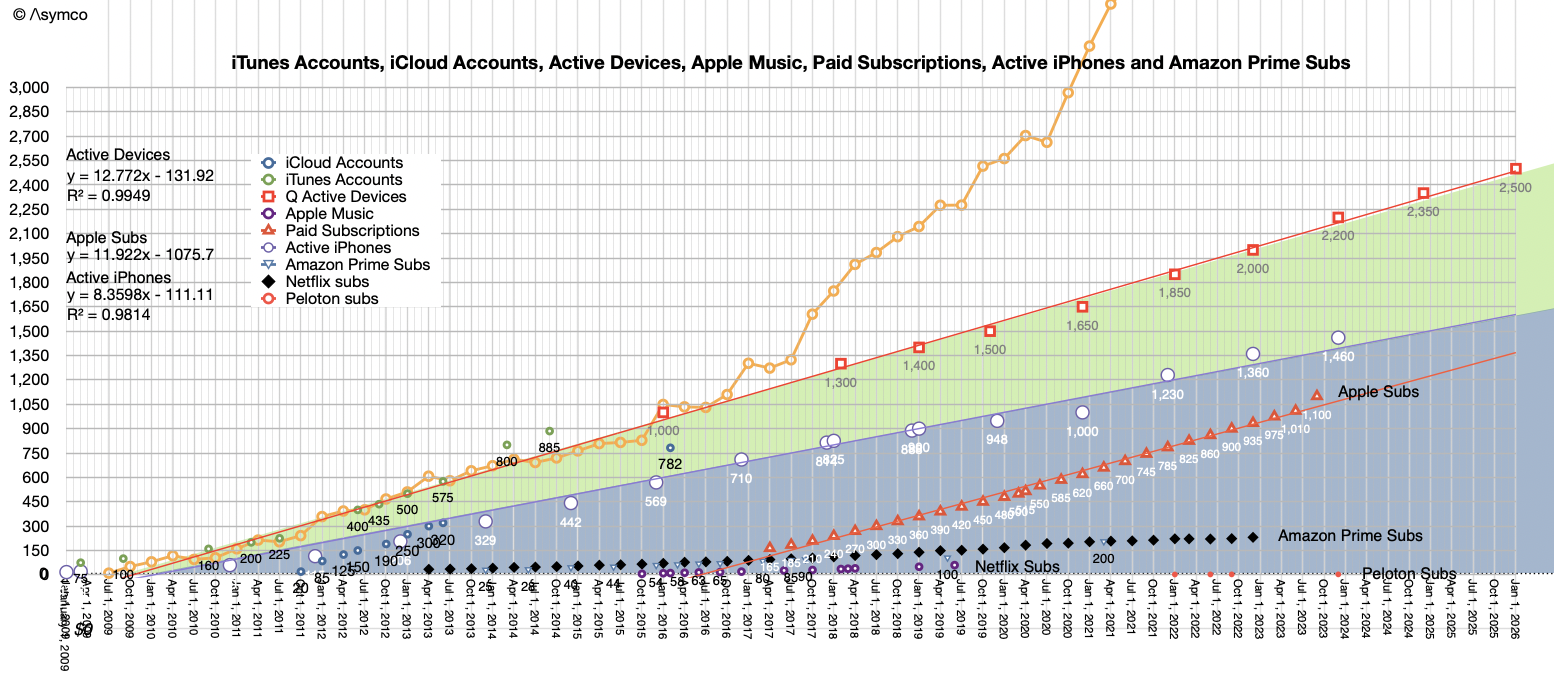
In the last quarter Apple reported 2.5 billion active devices. Of those, I estimate 1.6 billion are iPhones.
Using this as a base, I've created an iPhone installed base estimate looking forward to 2030, integrating Statcounter’s market share data, Ericsson’s global smartphone user forecasts, and BankMyCell’s smartphone install base.
The sources broadly align through 2025, though Statcounter’s historical iOS share (2017–2023) diverges somewhat, possibly reflecting Android’s heavier web traffic footprint due to usage patterns and bot activity rather.
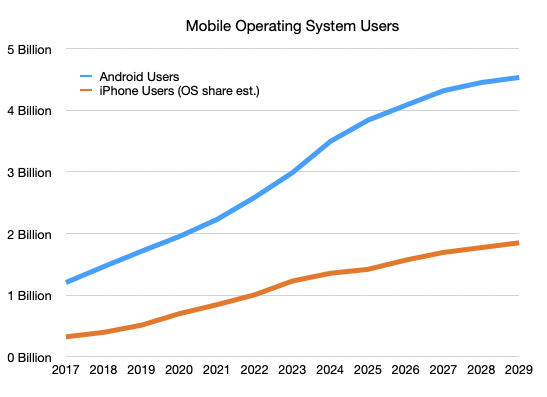
Taken together, the data points to iPhone nearing 2 billion active devices by 2030, consistent with overall smartphone adoption. Android’s projected rise toward 4.5 billion users signals continuing headroom.
If switching dynamics and monetization trends persist, Apple’s ecosystem could expand to 2.5–3 billion users by 2035, with growth thereafter driven by switching and increased engagement depth and value extraction per user.
Apple Announces Special Event in New York, London, and Shanghai on March 4 → Apple is hosting intimate, global "Special Apple Experience" events on March 4, 2026, likely unveiling new products like the iPhone 17e and M5-powered MacBooks, marking a fresh twist on traditional live-streamed launches.
Apple adds video experience to Apple Podcasts → The "pod" in podcasts originated from Apple's iPod, with the company popularizing the medium by integrating podcasting into iTunes in 2005, and continuing to innovate with features like video podcast support and dynamic ad insertion.
Dan Ives Says Apple’s AI Alone Could Be Worth $1.5 Trillion → Apple's unparalleled distribution through its vast user base offers a significant competitive edge for rapidly monetizing AI innovations, potentially adding $1.5 trillion in value.
While big tech burns cash on AI, Apple waits → As foundation models commoditize, Apple strategically curates top AI tech into its ecosystem, prioritizing user experience over engine development.
Secure the chips, absorb the costs, and grab more market share → Apple faces memory cost inflation potentially raising iPhone prices, yet its strong ecosystem and execution provide resilience, whereas competitors like Samsung may struggle more due to lesser volume leverage.
iPhone Emergency SOS via Satellite Helped Six Skiers Survive Tahoe Avalanche → Six skiers survived a deadly Lake Tahoe avalanche by using iPhone's Emergency SOS via satellite, highlighting its transition from luxury to essential. This feature enabled crucial communication with rescuers in remote areas lacking cellular service. The evolution mirrors mobile phones but faces slower adoption due to satellite bandwidth constraints.
Bankers complain that Apple has a tight grip on mobile payments → Canadian banks struggled to compete in the mobile wallet market, dominated by tech giants like Apple and Google, due to their risk-averse nature clashing with tech's innovation-driven approach.
The all new Asymco One
Introducing Asymco One Early Bird Pricing. → Asymco celebrates 17 years of insightful Apple analysis, launching Asymco One to guide stakeholders through Apple's evolving era with comprehensive content and community engagement. →
Introducing: Asymco One Office Hours → Join Asymco One's monthly Office Hours with Horace to get live insights on Apple's business and financials, with special editions during key events.
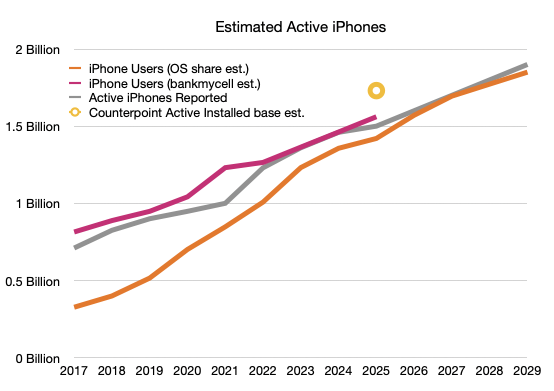
We have a firm hold on the number of active devices as well as the number of iPhones in use. This is due to Apple reporting the data. The latest active device count was 2.5 billion and the estimate for active iPhones is 1.6 billion.
This patters also allows us to forecast the active base pretty accurately as the growth is predicted by the tight fitting linear approximation.
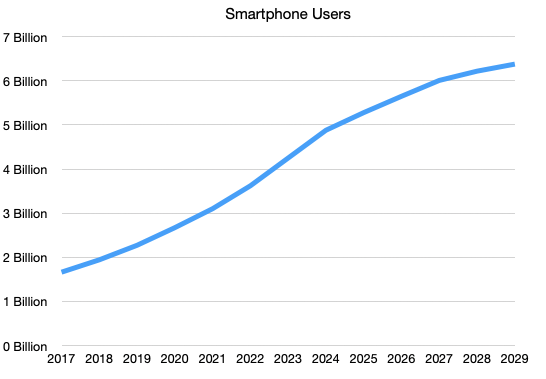
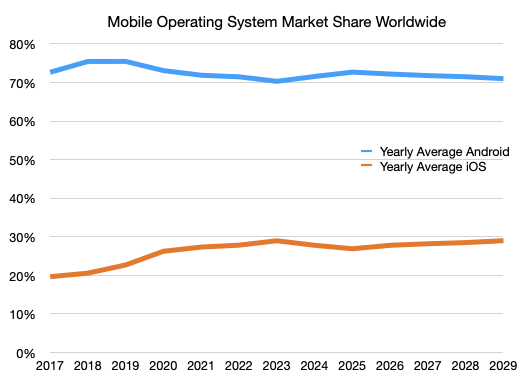
For more confidence it would be useful to confirm these predictions with different estimates. For this I turned to two additional sources: the Statcounter GlobalStats measure of Mobile Operating System Market Shares Worldwide coupled with Number of Smartphone Users Worldwide (forecast by Ericsson) and the Number of of iPhone Users from Bankmycell.
The total Smartphone Users history and forecast is shown below:
The Mobile Operating System Market Share Worldwide is shown below:
Multiplying these two yields the Mobile Operating System Users
The iOS users (orange line) can now be compared to Apple's own reported active device total (grey line) and the Bankmycell estimate as well as a derived estimate from Counterpoint (24% share of install base)
The graph includes forecasts from 2025 to 2029.
Discussion:
That, coupled with value captured per customer will determine the value of the firm.
Apple's performance in China is often noted and scrutinized. During the last quarterly earnings call Amit Daryanani asked:
... the other second question I have for you is maybe just touch on the China strength you folks had. I think this is very close to all-time high revenues you have had in China. What is driving the strength over here?
To which Tim Cook gave the following answer:
Greater China was up 38% year on year. It was driven by iPhone, where we set an all-time revenue record. So it was the best iPhone quarter in history in Greater China. It is driven by the customer enthusiasm for the iPhone 17 lineup. And I would tell you that during the quarter, traffic in our stores in China grew by strong double digits year over year. It was a terrific quarter. Our installed base reached an all-time high in both Greater China and Mainland China. And we set an all-time record for the upgraders, and we saw strong double-digit growth on switchers.
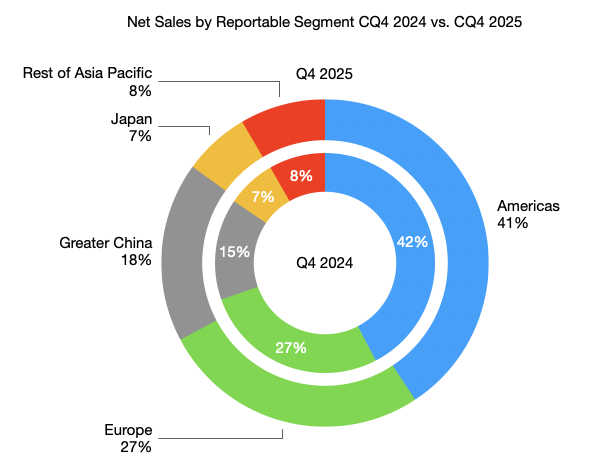
That's remarkable growth and every quarter we get this sort of discussion. But I don't recall ever there being a similar discussion about Europe. This is strange because, and the following graph shows, Europe is a bigger market for Apple than China.
Europe also grew, and at 12.7%, grew faster than the Americas and faster than Japan.
Regional Sales CQ4
2025
2024
Growth
Americas
58,529
52,648
11.2%
Europe
38,146
33,861
12.7%
Greater China
25,526
18,513
37.9%
Japan
9,413
8,987
4.7%
Rest of Asia Pacific
12,142
10,291
18.0%
So why is Europe not discussed. Management does offer some mentions:
Apple’s relationship with China has always been a point of worry for investors. Nine years ago Carl Icahn sold his entire stake in Apple due to China fears. In April 2016 Reuters reported that "Icahn had been a huge cheerleader of Apple, acquiring a stake in the company almost three years ago, repeatedly calling the investment a `no brainer.'" In an open letter to Apple Chief Executive Officer Tim Cook in May 2015, Icahn had argued that shares of the iPhone maker were worth $240 ($60 split adjusted), about 90 percent more than they had been trading. At $240 a share, Apple's market cap would be $1.4 trillion, Icahn asserted. But Icahn, who owned 45.8 million Apple shares at the end of 2015, said China's economic slowdown and worries about how China could become more prohibitive in doing business triggered his decision to exit his position entirely.
Icahn’s stake when he acquired the shares was worth nearly $3 billion and he sold it for about $5 billion. A $2 billion profit. But China worries kept him from holding until today when his shares would have been worth $36.6 billion, thus foregoing $31.6 billion in profit.
Leaving $31 billion on the table (not including dividends) seems a high price to pay for a misidentified anxiety on China.
The public reasoning was: "But you worry a little bit, maybe more than a little, about China's attitude."The Chinese government could `come in and make it very difficult for Apple to sell there … [They] can do pretty much what [they] want there,' Icahn said. Earlier [that] month, China shut down Apple’s iTunes movies and iBooks stores within the country, following Beijing's introduction of regulations in March 2016 imposing strict curbs on online publishing, particularly for foreign firms."
That was 2016. Today the concerns appear to be:
Slowing sales due to rising competition from Chinese brands
Slowing sales due to Chinese economic slowdown
Tariffs and other barriers to trade affecting pricing in the US
Geopolitical threats to supply chain, including processor manufacturing in Taiwan
Should today's investor worry about China more or less than Icahn did in 2016?
In the case of competition in China, we have to understand that China does not have a free market or "laissez-faire" economy. The clue would be the middle “C” in CCP which, importantly, has a monopoly on political power in China. In spite of an ideology hostile to private property and market economics, the fact that Apple not only is allowed to operate in China but also is the market leader in urban (read: wealthy) areas and indirectly employs millions of workers and empowers millions more developers should be seen as something of a miracle. It continues to operate only insofar as the CCP allows it to continue and the CCP is nothing if not calculating. Clearly, China has seen Apple’s presence in the market (both as producer and seller) as beneficial. One could argue about who benefited most but overall deals happen (and persist) because both parties benefit.
The competition has been improving lately, but when has it not?
Fundamentally, from the consumer point of view, the competition question is moot since the alternatives are not iOS. The iOS ecosystem is incredible from a value-generation point of view, and Android has been clearly contained as a threat. (A nostalgic footnote. Recent talk of Alphabet being forced to sell Android is a wonderful reminder of the question I asked many, many years ago: why should a search engine need an Operating System (or a browser), but more about this later).
Chinese macroeconomic worries are not new (see Icahn’s from 2015). In most economies cycles are natural but in China there has been such a long expansion (since at least the 1990s) that a slowdown is considered a huge threat to stability. A recession would be seen as an existential threat. The CCP intends to manage its way through economic stress—one of the defining aspects of their semi-controlled economy is that “the state knows best” and markets can and should be controlled. This won’t last but the consequences are not likely to be catastrophic. China’s economy is probably large enough to avoid sharp changes which gives management enough time to muddle through. I would not say that this worry is unwarranted but rather that the changes are gradual enough to allow for some strategic planning.
The Tariff question has been partly touched on in a previous post. But the flip-flopping on the topic suggests that it’s a bargaining method similar to holding a gun to your head while threatening someone else that if they don’t do what you ask for, you’ll pull the trigger. Then relenting when they say nice things. Then repeating it.
Tariffs do not affect the customer relationship with the brand.
In 2016 Icahn’s worries were not geopolitical (they were just political) but has the world become more unstable since? The Covid pandemic was the trigger for much of this instability and we are still dealing with the consequences globally. However the bigger forces behind global changes are demographic and the subsequent loss of growth in China (and Russia) are causing authoritarians to find external threats to stay in power.
This will not play out quickly. There are worries but we should consider China (and India, and Africa) as sources of non-consumption that can and will be addressed with production. So the worry here is again structural and slow-burning. I would argue decades in the making.
Not much has been said about the benefit to Apple of its China strategy. Many assume that lower costs and access to a large market are all that has been gained. But it’s much more complex than that. The access was not to a lower cost base but also a much more agile and flexible production infrastructure. The flexibility allows for a very tightly coupled value chain. The result is a reduction in inventory and a rapid time-to-market which is essential to Apple’s integrated product/software/service rhythm of yearly launches.
I’d argue that without the flexible, at-scale production system China allowed Apple would not have been able to succeed at reaching a billion highly satisfied users. The world would have been awash with cheap Android phones and very few iPhones, a repeat of the PC model where hardware was largely irrelevant.
The challenge of the future is to take this model globally and either transplant it to India and other places or to scale it in such a way that it can be distributed to many centers of production. Toyota famously not only created a product system that reduced cycle time and inventory but did it with 400 plants globally. I certainly hope that the Apple Production System will also be celebrated one day as the “machine that changed the world”.
Come learn more about the Apple Production System at the ACTIVE conference.
Are Apple and Google competitors or are they partners?
Prior to the launch of the Android operating system, Apple and Google collaborated on many projects. Google Search was predominant on Apple products including the (at the time) new iPhone. The iPhone also launched with support for Gmail and had native Google Maps and even YouTube. Google was a cornerstone supplier for the new smartphone.
After the launch of Android only a year later, the relationship changed. The two companies came to be viewed as mortal enemies. The perception that Android was disruptive to Apple—insofar as it undercut the pricing power of the new touch-based user experience—was universal. The "zero price" of Android and its licensing by all other phone makers suggested a competitive collapse was imminent for the fledgling iPhone. Android phones were far cheaper and "good enough." If not immediately, then with the resources of all phone makers and Google itself, Android would surely soon overtake the iPhone in performance along all dimensions. It took a great deal of courage to argue otherwise.
But, over time, the notion that the iPhone would continue to exist became more widely held. Holding on to a "premium" positioning, iPhone seemed to be have pulled a rabbit out of a hat, perhaps because of Steve Jobs' reality distortion field or because of magical marketing. Nonetheless, doubts over long-term growth persisted.
Having survived Android, Apple was still seen as vulnerable to a multitude of Google initiatives including Chrome and Chromebooks, a range of Google Pixel phones (enabled by the acquisition of Motorola and HTC.) The entry of Google wearables (enabled by the acquisition of Fitbit), Glasses, the Play Store, YouTube content, Google productivity apps, Google cloud, Google TV, Nest, Google Assistant and numerous other services were all cited as nails in the iPhone coffin. This is all before the age of Crypto a new generation of AIs came into fashion.
Throughout this period the iPhone continued to increase its audience, growing its base of users not only from smartphone non-users but also from so-called "switchers", that is, those who moved from Android to iOS. Apple has benefitted from this net positive switching for at least five years now as most of its addressable market has already adopted the smartphone. There are about 1.2 billion iPhone users and it's far more likely that a new iPhone user today arrives from the 3.5 billion Android users than from the 3.2 billion people who don't yet have any smartphone. That is because those who don't yet have a smartphone today are also likely to not yet have access to electricity, cellular networks or money.
Indeed, it is Android that seems to be in a precarious position. The ecosystem is bleeding not just high-end users but also from fragmentation. Chinese OEMs in particular deliver their own experiences and code bases, eschewing Google services altogether. Large OEMs such as Samsung are seeking to differentiate with their own experiences and ecosystems and accessories and chafe against Google's hardware offerings. Upgrade rates to new Android versions are poor. Support of hardware beyond a few years is lacking. But, most fundamentally, Google has not developed a business model that directly fuels development of Android.
Put simply, Android is not a profitable product. It's not designed to create revenues. It's designed to reduce costs.
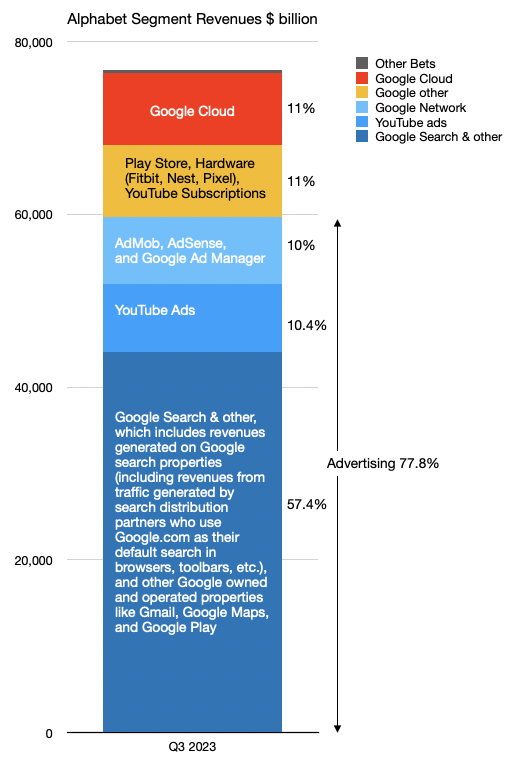
To understand this, we have to understand Google's business. It's not very complicated. Google's revenues in the last quarter are segmented as follows:
The colors above indicate the major categories. Blues are Advertising, yellow is "Other" and red is Google Cloud. Other Bets, consisting of research projects, is a 0.4% rounding error. Apart from Search which is about 60%, each major category is about 10%. Advertising as a business model is about 78%.
To Alphabet's credit, Advertising as a business model has been reduced from 94% a few years ago. Much of that credit goes to Cloud which is a B2B business and has completely different resources, processes and priorities than Search. The "one trick pony" label is less applicable to Google today.
Search however, and the ancillary properties, are still, by far, the largest sources of revenues and profit. Note that Android itself is missing from this mix apart from Play Store which is a direct Android extension. Play does contribute somewhat as part of "Other" but the OS itself is an enabler across all these categories.
While not directly producing revenues, what Android does is perhaps even more important. It helps reduce the amount Google has to pay to access its customers. Think of Search as a system which takes queries in and puts results out. These results are what advertisers pay for and the queries are what Google pays for. The output depends on the input. That input is harvested from many users. Access to those users is not free. The cost can be paid by building access directly (Android) or by paying for access to someone else's property (Apple, Windows, or Firefox). In old-school business terminology this is called distribution.
Distribution is often ignored or considered a superfluous "middleman" to be bypassed. But distribution is foundational to any business. It is, effectively, other people, outside your company, helping you sell your product because they have access to the customers. They get paid for that access, often with a percent of sales. Stores are distribution. Wholesalers are distribution. Resellers are distribution. Without distribution scale cannot happen. Distributors help both producers and consumers by creating access.
Access is also provided by what we call infrastructure. Just like you can't travel by car from your house to your destination without roads, all access to products and services is effectively infrastructure. If you own the infrastructure then you have to pay to build it and maintain it. If you don't own it you have to pay to use it. All infrastructure has value and all infrastructure has costs.
This all makes more sense when recalling the historic birth of Android. At the time (2006 to 2008) the worry for Google was that Microsoft's mobile operating system (Windows Mobile née Windows CE) would be licensed as was Windows. That is to say that all phone OEMs would take a license for a nominal fee and build Windows Mobile phones. Microsoft would thus dominate the mobile computing market the way it dominated the PC market (with market share above 95%). Microsoft would then ensure that Bing search was the default on all devices running Windows and Windows Mobile, thus blocking access to what was expected to be the next 3 billion users while capturing all search ad dollars ad infinitum.
If Windows Mobile were to dominate, Google would be denied distribution, at any price. It would thus be relegated to, at best, 10% market share of mobile search. This would be an existential crisis.
In this setting, Apple was an ally for Google. Apple was not a search engine provider and was very welcoming of Google search on a nascent Safari browser. Whereas Explorer would block Google search, Safari would offer default placement. Not for free, but for a reasonable cost. Google was a "go-to-market" partner for Apple and it was a symbiotic relationship.
However, the expectation of Google at the time was that Apple would be no more successful with iPhone than it was with the Mac: A fringe of "creative" or "fanboy" quirky oddballs. This was not just Google's expectation. It was everyone's expectation.
Android was built to counter a Microsoft mobile OS monopoly with a "zero cost" option vs. Microsoft's end-user-license model. Microsoft made money selling software. Both system software (Windows) and application software (Office.) Google would give away system software (Android) and services (Gmail and Docs) but make money on advertising.
A genius move. Phone OEMs would much rather pay zero of the OS on their phones than for the non-zero Windows Mobile license. [On a $200 retail cost phone (and thus $90 bill of materials) a $8 OS license is a huge cost.] Google's Android did indeed block Windows Mobile from getting a foothold in the post-PC era.
But it did so by taking some short cuts. Android itself was an acquisition in 2005 (for $50 million, with a keyboard interface) and, in response to the iPhone, a new touch user interface was developed. It so happened that this interface copied as closely iOS as Windows had copied the original Mac. This perceived theft was such an affront to Steve Jobs that he declared war on Google.
It was important to ask (as few did) why did Google need to develop an OS, only to give it away. Was its business that robust if it needed to expend enormous energy and capital to build an enabler? The answer is, of course, distribution.
Google was initially not paying for distribution as most people just typed "google.com" into their browsers. As the URL field became a search field, Google could still expect PC users to make Google.com their search bookmark, one click away.
But on mobile devices, the friction of the constrained interface meant that defaults mattered. Mobile was going to require new distribution economics. Devices were going to be in the hands of many more people, who, since they did not have full-size keyboards, would type less and who would interact in new (and very succinct) ways. One click away was one click too far.
With Android (and Chrome) Google set defaults for its services across the platform. If Android was the OS then Chrome would be the default. If Chrome was the default, then Google Search would be the default. For these Android-sourced queries, Google would not pay for distribution. Or, more precisely, would only pay to build and keep Android. Thus the more Android there was, the cheaper it was to obtain search queries for Google. Google had built its own highways: it owned the infrastructure that connected users to its services. These roads were for Android users. And what about iOS users?
Over a 15 year period the smartphone went from essentially zero to 5 billion users. It became so important to those 5 billion people that they keep it with them every waking moment, use it 100 times for a total of 5 hours each day. That adds up to 182,500,000,000,000 interactions a year and, as a result, it has changed behavior, politics and humanity itself.
Throughout this period, the relationship between Google and Apple changed. From being allies, to mortal enemies to, as we shall see, partners. We have to understand this new relationship that has emerged and its consequences.
The next post will explore the relationship in detail using the lens of the deal structure that exists. A deal which is not public and largely unexamined.
As I remember it, at least 10 years ago, I began to hear anecdotes from developers who built apps for both iOS and Android about their economics. The story is that they tended to have twice as many users using Android but that iPhone App Store revenues were roughly twice those of Google Play Store. From that I devised a rule of thumb that an iPhone user was about 4 times more valuable than an Android user. Half the users, paying 4 times as much means double the income.
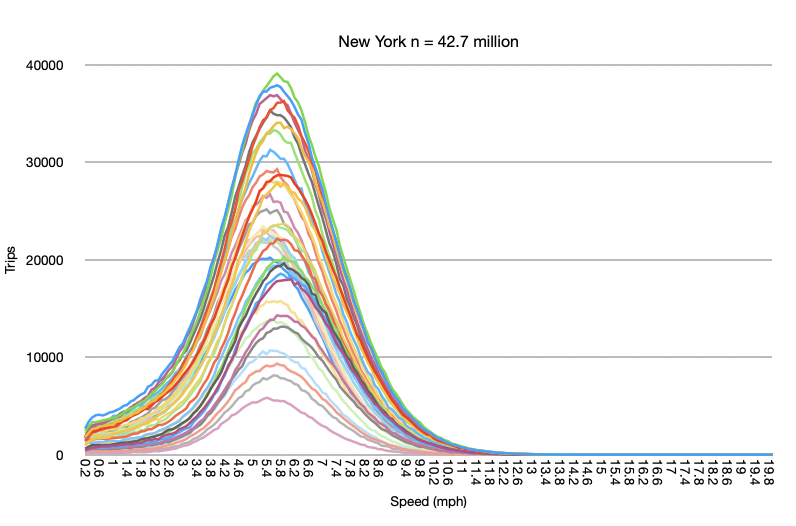
Over the years I came across a lot more data about market development (the diffusion of innovations) and market creation (the innovation process) and applied it to transportation. Along the way I also became more aware that figures of consumption and spending are not normally distributed. That it turns out that the governing function of much of human behavior is log-normal. That is, it is skewed rather than balanced or symmetric around an average. Classic examples are income distribution and the distribution of travel distances.
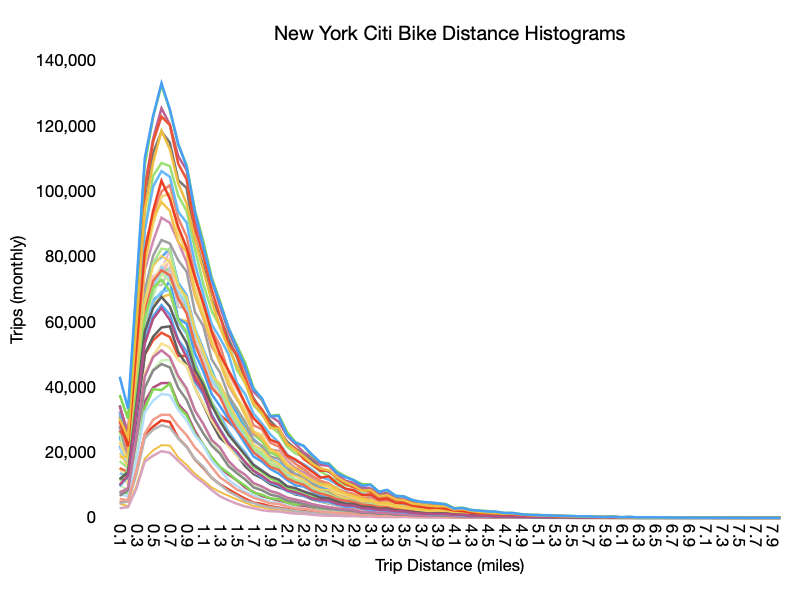
Consider the following diagrams: Trip Distances vs. Trip Speeds for New York Citi Bike travelers (n=42.7 million.)
The different lines represent different time periods spanning the months of the year.
The top graph shows that most trips are short, and the average distance is not the most common distance. The bottom graph shows that the average speed is the most common speed. The top graph is very accurately modeled with the log-normal function. The bottom graph is the classic bell curve of the normal or Gaussian function.
Income is log-normally distributed and so it has to be with services revenues. There must be a definite skew where there is a disproportionate spend by those who have more income. Thus segmenting or, to put it less kindly, discriminating customers properly is super important. Customer quality is just as important, perhaps more so, than quantity.
So let's revisit the question of user quality for online services.
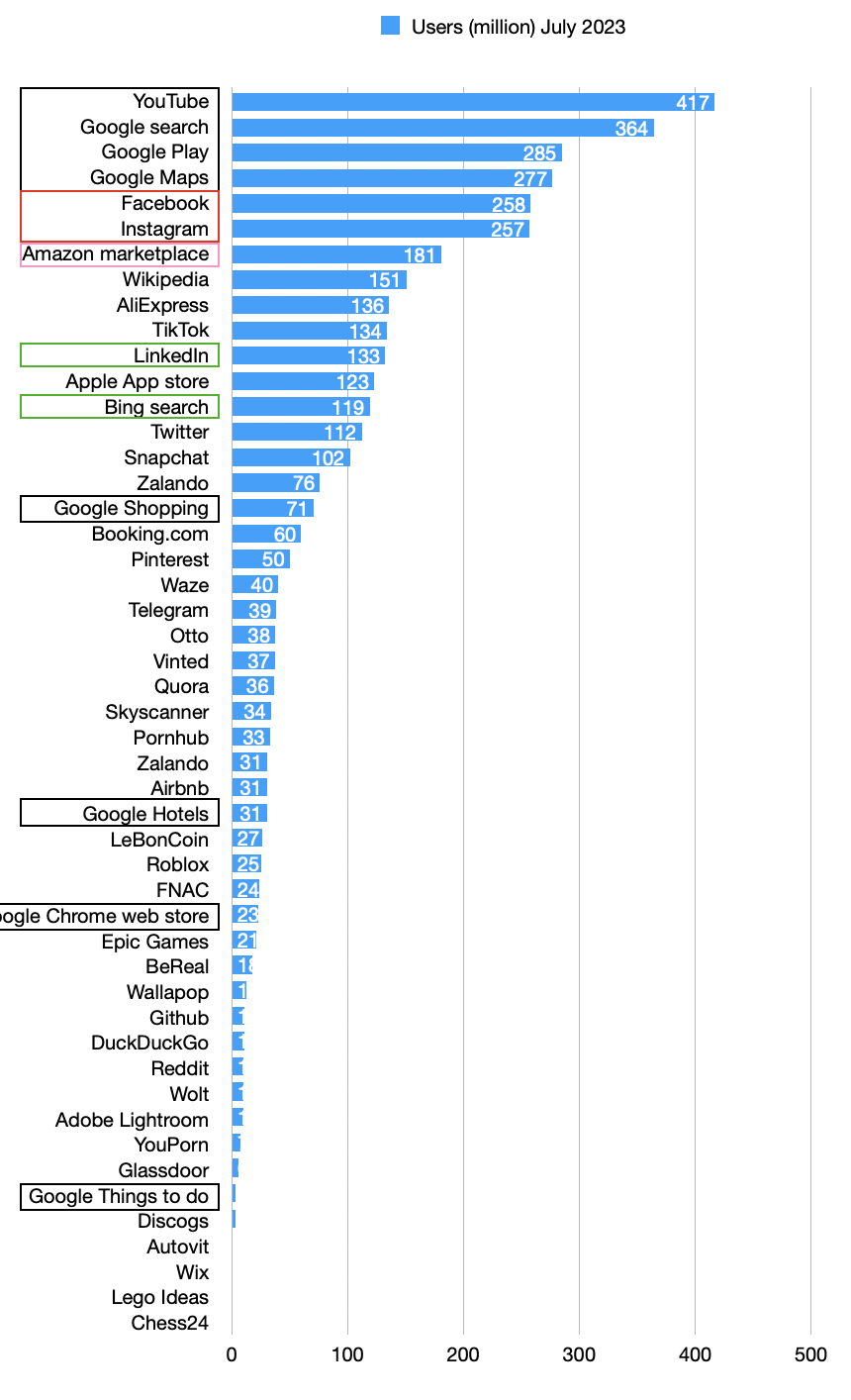
Unlike 10 years ago, there is a lot more data. The EU, for instance requires a report of the number of users on each platform.
The figures I want to focus on are those of Apple App Store and Google Play Store: 123 million and 284.6 million respectively. These are strikingly similar to the ratio of 2x between iOS and Android from my old anecdotes. However, if we look at global data, Apple claims 650 million active App Store users while Google claims 2.5 billion active users. That makes the global ratio closer to 4x Android. However, if we look at the US, the ratio is 167 million iPhone users vs. 144 million Android. In the US, iOS is a majority.
This is explained by income. The wealthier the user base the more iOS seems to be in use.
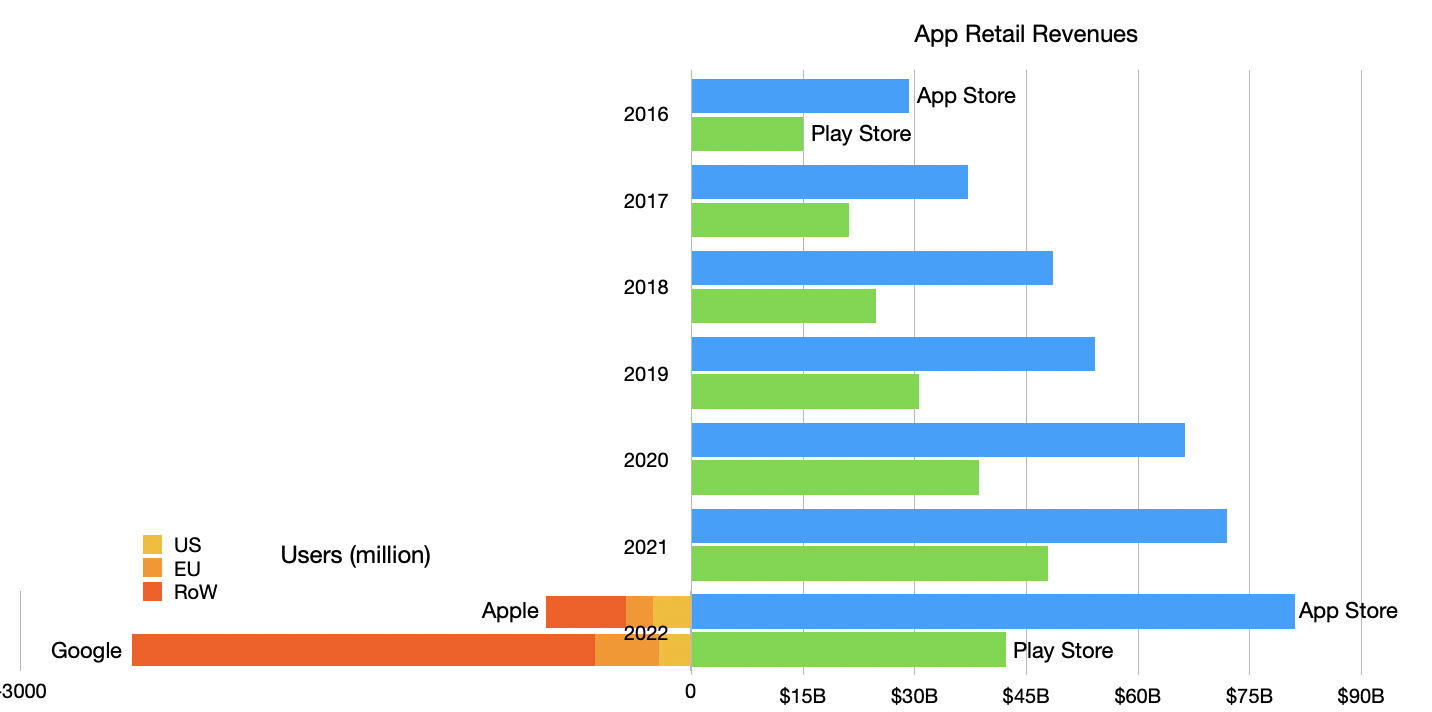
Now let's look at revenues for the platform stores.
On the right side is the history of retail revenues by year from 2016 to 2022 and split between Apple App Store and Google Play Store. Mirrored on the left is the number of users, also split by store but also by region, but only for 2022. [App Store revenues are my own analysis (with validation against other sources) and include billings not just Apple's own cut. Play Store revenues are from Business of Apps.]
The ratio between revenues has kept remarkably steady, with 2016 revenues at a Apple:Google ratio of 29:15 (1.93) and 2022 at a ratio of 81:42 (1.93).
The global user numbers are, as mentioned, 3.8 to 1.
[Aside: One sanity check on the data is that the 650 million App Store users is about half of my estimate of iPhones in use (1.2 billion). That might be alarming. Why are only 54% of iPhones in use paired with App Store use? However, if we take the sum of both App Store and Play store users (3.15 billion) and compare it with the total number of global smartphone users (6.92 billion), we discover that 45.5% of all smartphone users use some store. Adding Chinese Android stores we can see that the ratio of 54% for iOS is somewhat consistent.]
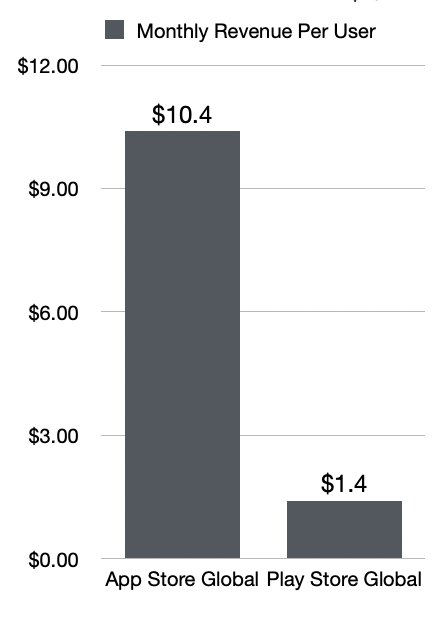
Thus we can compare the app revenue per user of the two platforms by dividing global revenue number by the global user numbers. The results are shown below:
I scaled the spending to a per-month basis.
So the picture becomes clearer. The iPhone customer is 7.4 times more valuable than the Android customer. This is more impressive than the 4x rule I had 10 years ago. The reasons are mainly that my anecdotes were from developers who sold products in the US or EU whereas expansion of smartphones to 7 billion global users has drawn in more lower spending customers.
But Apple's base has also grown to over 1 billion users (650 million store users). This highlights that Apple has effectively grown and discriminated customers effectively. It obtained not just 1 billion customers but the best 1 billion customers.
How to discriminate effectively is the holy grail of marketing. The naïve approach is to keep prices high. But that usually only results in a "luxury" branding and a small base that tends not to grow. The alternative "premium" approach is to offer functionality and multiple tiers and distribution options and financing and merchandising. There is no simple formula.
The bottom line is that Apple's approach is attracting 650 million $10/month app spenders. When we factor in additional subscription services, we get to the juggernaut that is Apple Services. This analysis has shown how difficult it is for anyone to come close to this quality of revenue.
As we look forward to Spatial Computing, the idea of increasing that spend from $10/month for a small glass rectangle in your palm to perhaps $100/month for an immersive 360-degree 3D experience does not sound too crazy.
But only if you can find those customers. I suspect Apple already knows who they are.
If you want to learn more and hear an in-depth discussion on this topic make sure you subscribe to the Asymetric Podcast on Supercast and Apple Podcasts.