On May 5th, I tried to fill in the blanks on Global smart phone OS shares | Asymco. I estimated that the shares for the mobile OS's were as follows (based on Canalys partial data):
Symbian (Nokia): 42%
Blackberry OS (RIM): 19%
iPhone OS (Apple): 16%
WinMo (Microsoft): 10%
Android (Google): 10%
WebOS (Palm): 2%
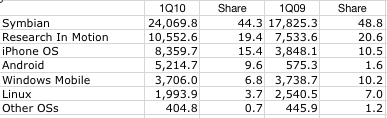
Now Gartner has published their sell-through estimates:
Symbian (Nokia):: 44%
Blackberry OS (RIM): 19%
iPhone OS (Apple): 15%
Android (Google): 10%
WinMo (Microsoft): 7%
Linux: 4%
Other OSs: 1%
My estimates were within 1 or 2 percent of actuals except for Windows Mobile where I over-estimated by 300 basis points.
British bank Standard Chartered is replacing the Blackberry, currently its standard corporate communication device, with the iPhone.
The process of migrating corporate email services from the Blackberry to the iPhone started about a month ago, said the spokeswoman, although she did not know how many of the Asia-focused bank's 75,000 employees used company-issued Blackberries or when the switchover could be completed.
In the free press release linked below Canalys reveals their estimates of vendor shares but not the OS shares for smartphones. However it's not hard to see the OS split due to the high degree of exclusivity of OS's to vendors.
For example, virtually all Nokia devices are Symbian powered, all RIM devices are Blackberries and all Apple devices are iPhone OS. Motorola is only shipping Android and HTC is the only top 5 vendor that now licenses more than one OS. Even HTC's portfolio is now heavily Android weighted.
We can carve out Palm (960k units shipped) from the "others" and we're left with mostly Windows Mobile. My estimate would be about 5 to 6 millionWinMo made it out.
That leads me to the following estimated OS shares:
Symbian (Nokia): 42%
Blackberry OS (RIM): 19%
iPhone OS (Apple): 16%
WinMo (Microsoft): 10%
Android (Google): 10%
WebOS (Palm): 2%
If anyone knows the actual Canalys OS shares, let me know.
"Officials at the WES 2010 keynote said that RIM has redesigned all of the core applications within the BlackBerry operating system. It also revealed that there are 41 million BlackBerry users, and 90 million BlackBerrys have been sold to date."
Apple already announced that they see 100 million iPhone OS devices sold by this summer. The installed base for iPhone OS devices is likely to be much greater than 40 million since most of the 85 million devices sold as of today were purchased less than 2 years ago. With the iPad and the iPod broadening the portfolio, the Apple mobile platform will grow more rapidly than RIM's leading to increasing network effects.
As previously stated, The App download rate increased to a record 10,753,000 per day during the last 90 days. That makes the download rate for the iPhone platform 10x that of the Blackberry Platform. The iPhone platform is nearing 100 million installed base. Blackberry is citing 20 million registered users. I think everyone is pretty clear on where this is going.
The iPhone represents nearly 90% of all non-laptop connections in Boingo’s airports. The iPad registered 5.4% of all device connections, while Android tallied 2.5%. Blackberry phones and iPod Touch MP3 players accounted for less than 2% each of total visits. Windows Mobile was less than 1%.
Remarkable statistics, through a narrow sampling. The above data represents all Wi-Fi enabled non-laptop devices in Boingo’s managed network, which includes 58 airports, the Washington State Ferries, and several sporting arenas and convention centers.
Elevation has since sold some of its preferred stock, but according to Palm's SEC filings, it still holds enough common and preferred shares to account for roughly 30% of the business.
Others who bought around the same time as Elevation are struggling with a 33% loss, and that's after accounting for a $9-per-share dividend.
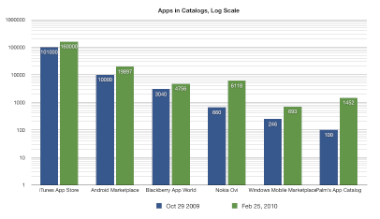
The last four months have seen tremendous app growth. Apple grew by 59k apps while Android added nearly 10k and Nokia added 5.5k apps to Ovi.
As a percent, Palm grew the fastest with 1,352%, followed by Ovi with 827%. The slowest growing was actually Blackberry App World with a mere 56% growth.
More curious is the popularity of certain categories. Games and Books are dominant in the App Store, while Personalization and Music account for more than half of Ovi (ringtones and wallpapers?)
Finally, in terms of catalog ranking overall, Ovi climbed the league table to third spot behind Apple and Android and overtaking Blackberry App World. Palm overtook Windows Mobile Marketplace which is now dead last with 693 apps.
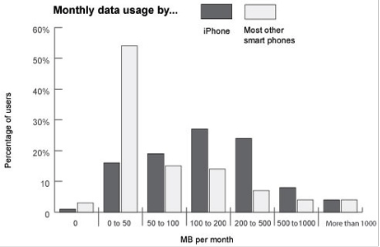
Consumer Reports announced this week the results of a study it commissioned assessing the monthly data usage for customers of Apple's iPhone and other smartphones. The data reveals:
On average, iPhone users consume 273 MBs of data per month. That compares with 54 MBs for consumer users of Blackberrys and 150 MBs for consumers who use other brands of smart phones, the Validas study found.
The disparity in data usage is particularly evident at low levels, where 80% of BlackBerry and 54% of "other" smartphone users consume less than 50 MB of data per month while only less than 20% of iPhone users maintain such low usage.
As I argued in the past, Blackberries should be considered feature phones. Doing so helps to understand both their limitations and their potential.
This categorization helps put into perspective the phenomenal growth RIM is able to maintain while not being at all competitive with other platforms by any measure of performance that defines the basis of competition in smartphones.
Being a feature phone means the Blackberry just needs to be better than a dumb phone, something it’s more than able to demonstrate to a prospective buyer.
It's time to re-evaluate the categorization of smartphones. The term has always been problematic. It loosely means a phone that runs an advanced operating system and has third party SDKs. There is no industry standard definition and some call it a converged device or a multimedia device. One analyst famously said that the iPhone did not count as a smartphone on launch because it was not open to developers.
I'd propose a different definition, not based on the attributes of the device, but the jobs that the device is hired to do. This is in a way, the same distinction between Facebook and MySpace. They are clearly hired to do different things by their users and as a result don't directly compete. When you do this job-based segmentation, you realize that iPhones, Android devices and Windows Mobile and Palm are fairly similarly used. Blackberry, however, does not match the profile. (Neither do most recent Symbian devices, though for different reasons.)
The most common jobs I can see in use with the first cohort of devices is (Comscore data exists to back this up)
browsing
social networking
applications/games
email
media consumption
navigation
The Blackberry has relatively poor utilization of any function except for email and perhaps social networking (though the latter is not likely in company-sourced devices). The focus on a large number of jobs to be done is what distinguishes smartphones from the more limited "feature phones". By this logic Blackberry is hired as a "feature phone".
It's also instructive to follow commentary among enthusiasts. It's fairly clear that this segmentation exists implicitly: Android, iPhone, Palm and WinMo are comparable while Blackberries are for a different demographic, different user, different usage.
Finally, there is the gut check. It's become clear to me that what users do with Blackberries is similar to what they do with voice phones: voice and messaging. Although additional functionality is available, it hardly gets used because it's hard to use.
But you may ask: so what? The reason this is significant is that smartphones are embryonic mobile computers with a clear trajectory for improvement. Feature phones are overshot voice phones which are likely to be disrupted by data-centric entrants.
On a different level, it also means that growth stats for the two product types are not comparable. Saying that the Blackberry is outgrowing the iPhone (or vice versa) is meaningless.
It also means that Blackberries, being an evolution of voice products, still have a huge growth potential with those customers which are looking for messaging as an improvement for their good enough voice products and for whom smartphones are over-serving.
So Dell is making Android mobile phones while Nokia is making Windows PCs. A curious confluence of poor management decisions.
Why is all this dilution of core competence happening? Average punditry would suggest it's all about "convergence" and the overlapping of mobile and until-recently-fixed computing.
Er, not quite.
The economics of plastic bits shipped in cardboard boxes has not changed. It's as lousy a business as it has always been, whether the plastic bits are small or large. Some would argue that the gross margins of mobile devices are higher than those of computers, but that's not true on average. The gross margin on average mobile phones is just as low (<10%) as it is on PCs. There are about the same number of competitors and rivalry and global marketplace.
If indeed, margins were the only story, why would Nokia choose to chase the low margin PC business while holding (albeit very tentatively) 50% global share in "smartphones"? Similarly, why would RIMM choose to chase the low end consumer business (link: Blackberry Pearl et. al.) while having the fat margins of thinly penetrated business devices to wallow in? Finally, why would there be hundreds (literally link: www.pdadb.net) Windows Mobile smartphone licensees, the vast majority of which don't manage to sell more than the 50k minimum volume licenses they are obliged to order?
The fact of the matter is that the money being chased by device vendors is not being paid for devices, but for the service plans those devices enable. More precisely, these businesses are concerned with capturing a share of ARPU uplift from mobile data services. As such, they are mostly offering hardware as enticements for the *change* in ARPU that mobile broadband creates. Success depends on the power of that hardware to compel users to switch to higher data service fees.
The first proponent in his "hardware as ARPU booster" was actually Microsoft back in 2003 when they entered the mobile OS market. One of their value propositions was that Windows Mobile would boost data ARPU. The reality was not so compelling however as WinMo turned out to be too awkward to use for most users and the power of the platform lay fallow. In reality, the first successful hardware ARPU booster was RIM. In the middle of this decade, RIM showed that a Blackberry user could be worth between $5000 and $8000 in NPV ARPU to an operator. For that juicy pie, RIM was handsomely rewarded with a small "cut" that boosted their margins to above 50% making them the most profitable device vendor on the planet.
The realization only began to set in about 2007 as every other vendor began applying resources to deliver ARPU boosters. Apple took note early and executed beautifully with the iPhone, mastering the "get paid for ARPU" game, and in the process capturing 50%+ gross margins and (depending on the quarter) up to 30% of all profits in the device industry.
To forecast how this game will be played and how sustainable this boosterism is, we need to segment or categorize the market according to ARPU. The way to visualize this is what I call the "wedding cake" model. Each cake layer represents the population of users in that ARPU segment and the thickness of that layer represents the delta of ARPU to the layer below.
The base layer is huge (billions of customers) and represents the prepaid voice market. The average "thickness" of this layer is about $10/mo.
The next layer is smaller and represents the postpaid voice market. The thickness is about $30, representing the "boost" over prepaid.
The next layer is smaller still and represents the postpaid voice+data market where the data is a-la-carte. This is typical of plans where the buyer pays separately for certain data services (e.g. email, navigation, etc.) and pays on a per-megabyte basis for browsing. The ARPU differential is about $20.
Finally the top layer is the unlimited data plan packaged with bucket voice and SMS. Here the ARPU differential is another $30.
At its highest, the cake is about $100/mo., though the width of the top layer and hence the population of paying customers at that price point is quite small relative to the other layers.
Now each layer is covered with a "frosting" which is the device hardware revenue. Obviously the frosting gets a bit thicker the higher the layer, but it's a relatively thin layer compared to the "cake" thickness. In the higher layers the trend is in fact to make the frosting as thin as possible (<$99 NPV or <$4/mo. for a 24 mo. contract.) The devices which enable the top layers are clearly more complex and expensive to make, but the end-user pricing is trending down. The trick is therefore to convince the operators to pay a piece of the "cake" to the device vendor in exchange for migrating users to these higher layers.