Recording and transcript of the June 9, 2026 Asymco One Office Hours, recorded the day after Apple's WWDC 2026 keynote. Horace Dediu shares his impressions of the event and takes questions from Asymco One subscribers.
Q: Will Apple evolve to make their own memory chips, or manufacture compute chips instead of just designing them? Will they go much more vertical?
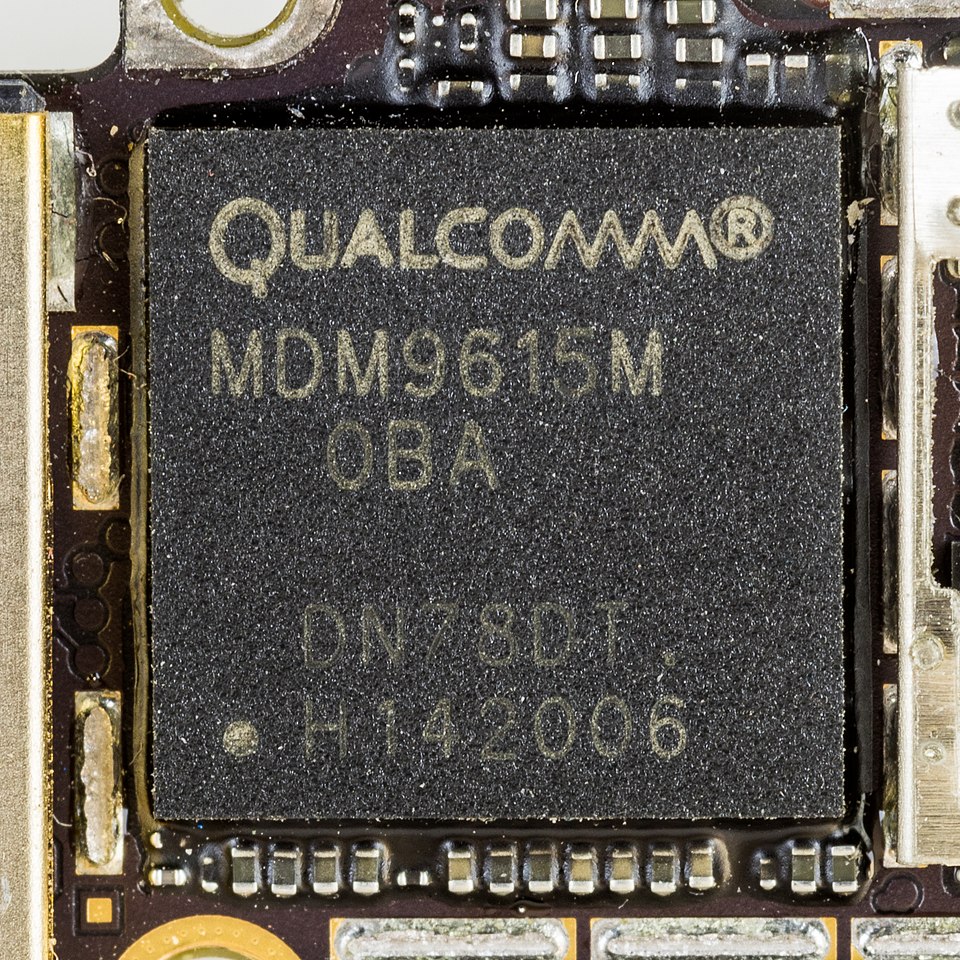
It's a possibility — capability is not willingness to do it. They're capable of doing it. They can become vertically integrated on all manners of silicon. I think the decision is a very careful one, because you have to commit years in advance. They did so, as I said, with Qualcomm. They needed to push that dependency out. I think memory may come next. And they need to figure out what they're going to do about TSMC as well, by the way, if you have a single supplier there.
But this is an ongoing thing. They're always re-evaluating it. And I'm not concerned, because nobody does this better. You see other companies' jealousy. You see other companies wanting to do what Apple did eight years ago with the A series. The fact that you can hire a team and become a chip designer — we hear about Tesla, Google, Amazon. I don't know — probably Microsoft's got a team, and probably Meta's got a team. So I just see these out of the corner of my eye and say, well, obviously, yeah, you can now hire a semiconductor team.
And one of the things about Srouji, by the way, that was making a lot of news, is that he got elevated to this position. Very likely he is getting a lot of inbounds, saying, hey, if you come and head this up for us, we'll give you half a trillion dollars. And the amount of money people are willing to throw at this is extraordinary. But again, he wasn't the first, he's not the last. There is an importance in good teams, but it is also important to have a deep bench.
This was one of the questions asked by the participants in Asymco's May 2026 Office Hours live Q&A sessions, open to Asymco One subscribers.
Q: Do you think Apple will start investing heavily in AI data centers?
There's rumors and actually statements from Apple saying that they're working on a server chip. Google has a server chip. Amazon's got a server chip. These are effectively aimed at Nvidia. And if you can make something, you tend to do it. Now, of course, there's some protection — Nvidia's got other special sauce, but their margin is everybody's opportunity. They have a huge margin. And everybody's writing huge checks. As I say, hyperscalers are just handing over their entire cash flows to Nvidia. And that means their shareholders' entire wealth is being handed off to Nvidia shareholders. So there's a transfer of wealth happening right now. Presumably, because we're going to get some benefit later, but if that's happening and people are irritated by it, they're going to find a way to do what Nvidia does.
And Apple, of course, can and will do that. Now, whether that'll get deployed at the edge or in Apple's own cloud — because they probably also don't want to write checks to Nvidia, and they'll say, well, we can do it, and we won't necessarily sell them, like Google wants to. They'll probably just use them themselves. And that's something certainly they're capable of.
The question I was always asking is how many are we talking about? Because if it's in the tens of millions, or even single-digit millions — for Apple, single digits. Is it worth it to develop your own designs? There's a limit to how many you can deploy. And probably you're going to have to replace them every so often, so there's a question about how much it costs to keep on the treadmill.
But it is an interesting question, and I think everybody's capable of doing what Nvidia's doing. But it's about execution, timing, delays. Look at what happened with the Qualcomm chip — how long it took Apple to finally deploy the communications chip relative to the amount of grief it had to deal with. First, of course, it moved out of Intel. It moved out of Qualcomm now, and now the question is, is it going to move out of the server supplier chain? And that's a complex decision. But again, Apple's not doing it because they want to be in that business. It's more that they want to avoid dependency.
This was one of the questions asked by the participants in Asymco's May 2026 Office Hours live Q&A sessions, open to Asymco One subscribers.
Asymco Bulletin is a digest of all the work we have published for the week ending May 3, 2026.
Editor's Note: Starting next week, we will be sending Asymco Bulletin to Asymco One subscribers only. You will still receive Updates when new posts are published per your notification settings.
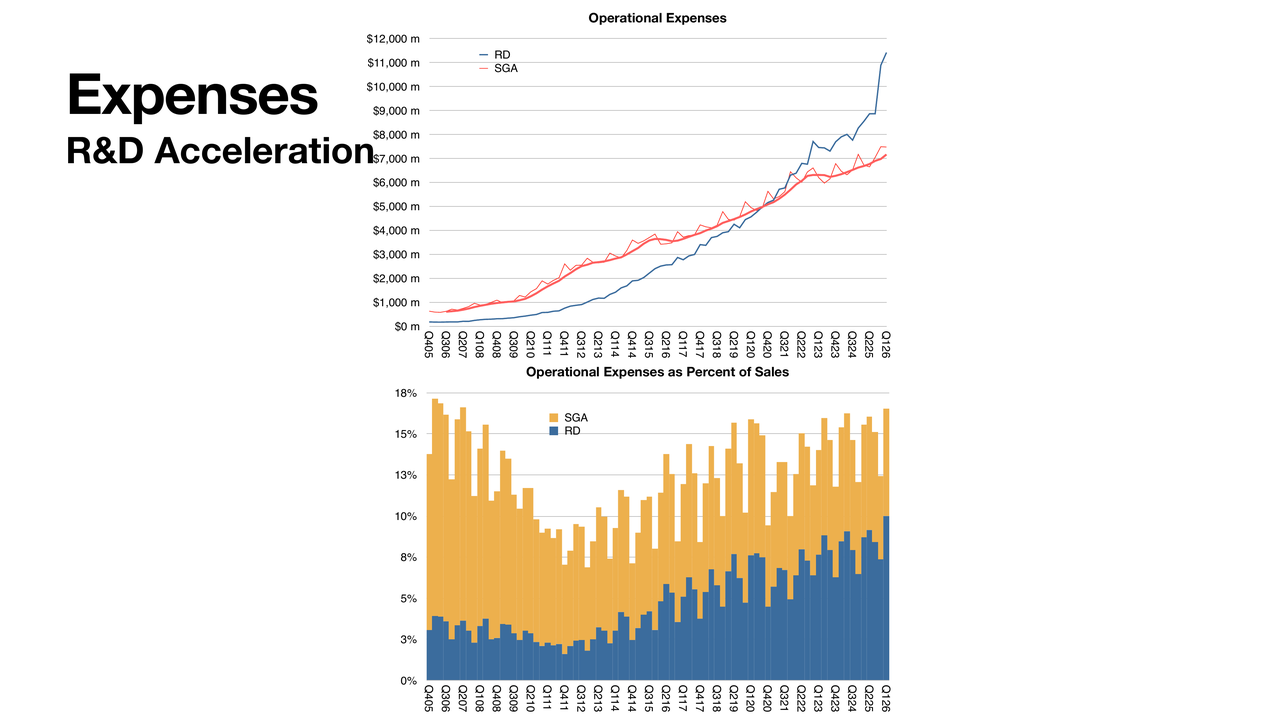
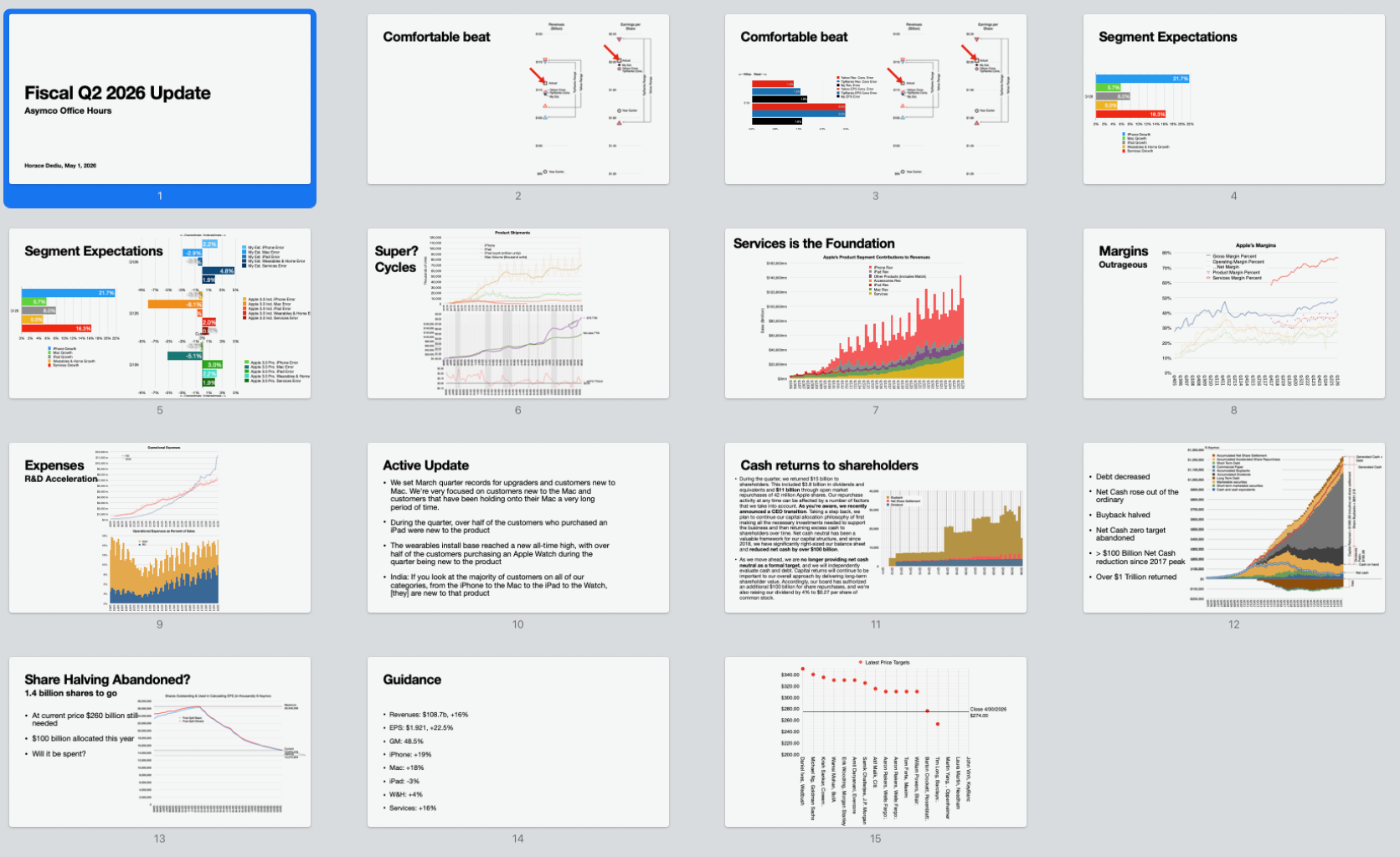
In Asymco One's May 1, 2026 Office Hours session, review of Apple's Q2 2026 earnings, segment growth: iPhone at 22%, Services at 16%, iPad at 8%, Mac at 5.7%, and wearables at 5%. Steady, foundational growth of Services, Gross margins reached nearly 50%, R&D spending surged, a shift in Apple's capital return strategy showing perhaps the hand of John Ternus. Guidance suggests 16% revenue growth, 22% EPS growth. Analyst sentiment turned positive post-earnings, with most price targets rising above $310. Apple's evolving identity as an engineering-centric company was the focus of many questions. →
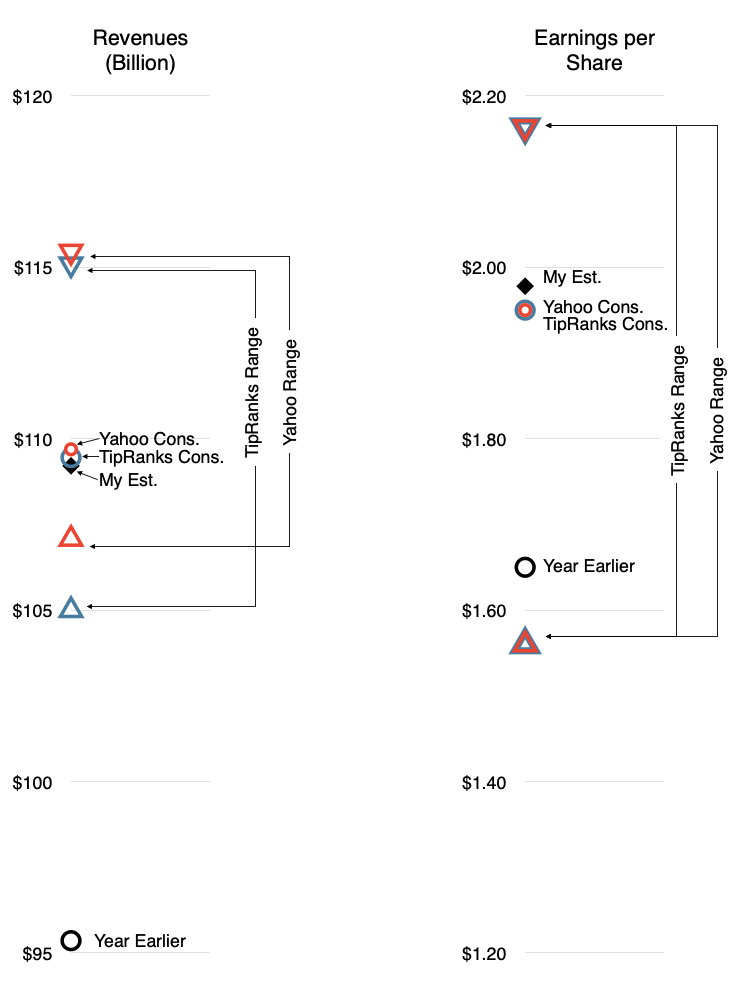
Revenue and EPS consensus, year-ago results and my expectations Yahoo Finance Yahoo Finance’s revenue estimate for Apple in Q2 stems from 31 analysts. As of April 25, the average estimate is $109.69 billion, with a low of $107.08 billion and a high of $115.37 billion. For the earnings per share estimate, 32 analysts put it at an average of $1.95. The low is $1.56 and the high is $2.16. TipRanks TipRanks also does its own analyst polling on Apple’s quarter. In its forecast as of April 19, its consensus is for a revenue of $109.45 billion, with a high of →
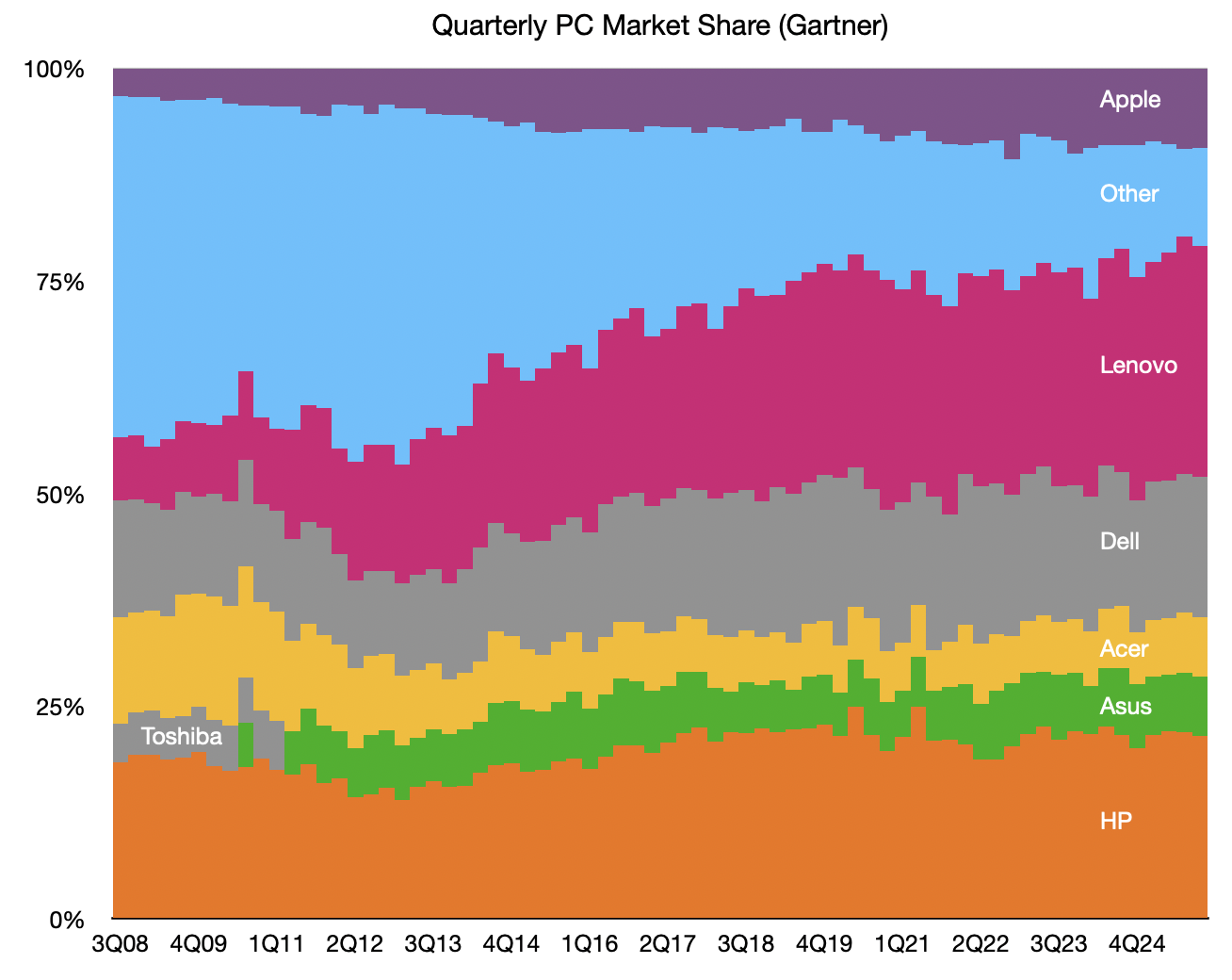
TD Cowen: 15% revenue growth, 10% growth guidance → Apple is projected to gain market share in both smartphones and PCs, driven by strong iPhone 17 demand and the new MacBook Neo, with anticipated revenue growth of over 15% in Q3 and positive sentiment ahead of earnings.
Morgan Stanley forecasts fiscal second-quarter EPS of $1.74→ Despite memory pricing pressures, Apple's strong iPhone sales, potential AI and foldable iPhone announcements, solid free cash flow, and favorable market conditions position it for better-than-expected earnings and a possible stock rise to $300 by September.
Is Apple borrowing Samsung’s Market Expansion Strategy?→ Bernstein SocGen maintains optimism on Apple's strategic pricing and ecosystem strength, forecasting EPS growth and potential market share gains, while Samsung faces smartphone profit challenges but thrives in memory.
Separately, it’s been reported that Samsung might see its first operation loss from its phone division, resulting in Apple capturing 100% (or more) of global smartphone profits. Simultaneously, Samsung is seeing huge profit gains from memory, even overtaking Nvidia’s profitability. This is remarkable…
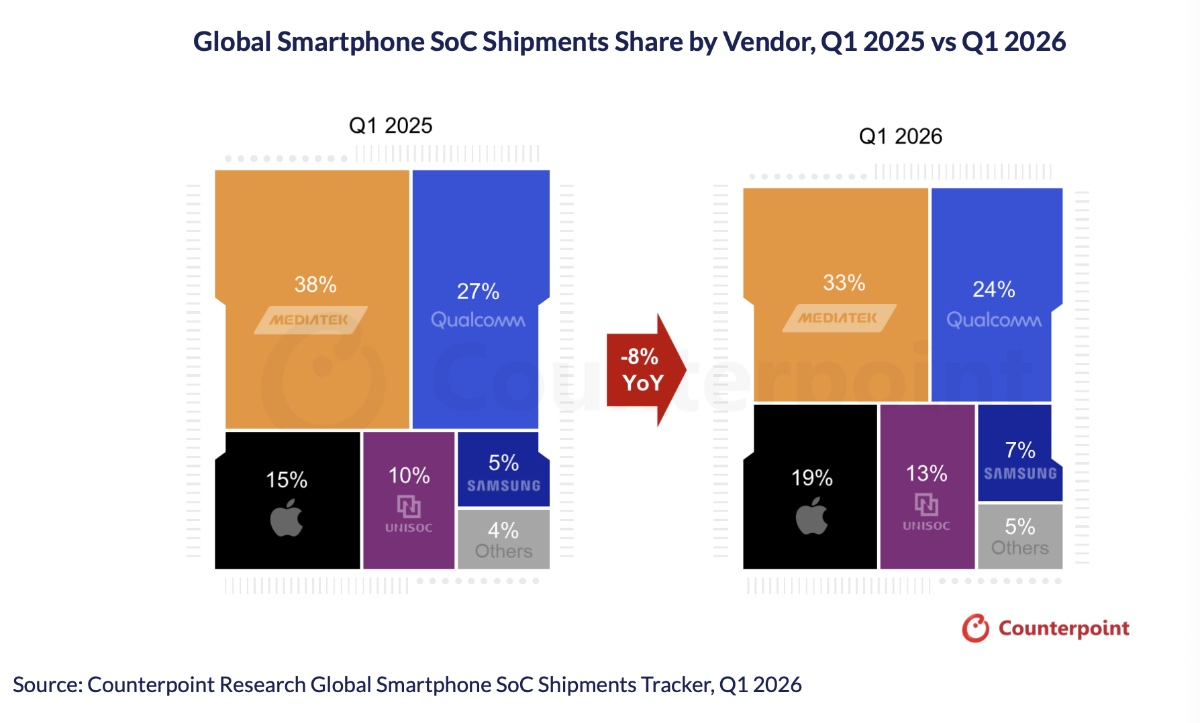
Apple share of the smartphone SoC market grew from 15% to 19% in Q1 → In Q1 2026, global smartphone SoC shipments fell 8%, but Apple thrived in the premium market by leveraging its efficient supply chain and passing costs to consumers, boosting its market share from 15% to 19%.
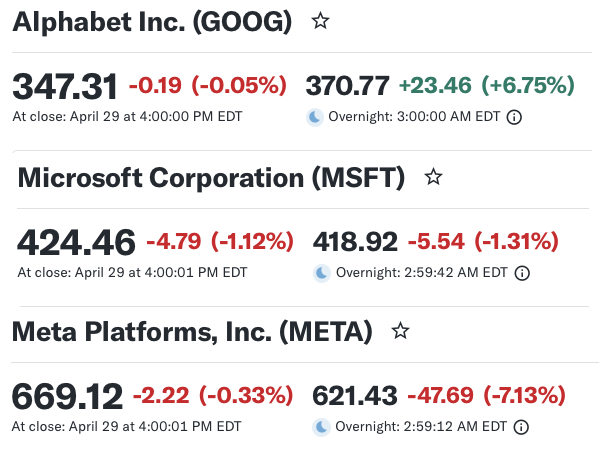
Google to sell TPU chips as Gemini shows returns → Why pour cash into Nvidia when you can craft your own cutting-edge chips like Google, and then turn that innovation into a lucrative side hustle by selling them to tech giants like Meta and Anthropic?
The Vision Products Group Expanding → Gurman's 2025 dissolution claim clashes with 2026's active Vision Products Group hiring spree. The Vision Products Group posted 14 new senior roles last week.
Why give all your cash to Nvidia? Why not make your own chips? Then why not sell them?
Google said that it plans to sell its custom Tensor Processing Units (TPUs) to select customers who will install the chips in their own data centers.
The move is a change from Google’s prior strategy, which saw it rent out TPU capacity to customers from its own data centers — and is yet another strike at AI chip king Nvidia.
The announcement, during the company’s Q1 earnings call, comes a week after Alphabet announced two new TPUs: its TPU 8t for AI training and TPU 8i for inferencing.
Alphabet didn’t disclose potential customers, but it signed a multiple-gigawatt agreement for next-generation TPUs with Anthropic earlier this month, with chips expected to begin coming online in 2027.
And according to The Information, Alphabet has also entered into a multibillion-dollar chip deal with Meta (META).
NB: Alphabet Q1 sales grew 22% to $110 billion, with Cloud up 63% to $20 billion. Operating margins grew by 220 basis points, with services and cloud operating margins both increasing y/y.
The search business continues to benefit from AI. AI overviews and AI mode are sustaining as search sales grew 19%.
Global smartphone system-on-a-chip (SoC) shipments declined 8% year-over-year (YoY) in quarter one (Q1) of 2026, according to Counterpoint Research’s latest Global Smartphone SoC Shipments Preliminary View report. However, it’s good news for Apple.
Counterpoint says the premium segment has remained relatively resilient, with higher costs largely passed on to end consumers. Meanwhile, the entry-level manufacturers are increasingly adopting lower-cost chipsets to keep smartphone prices competitive.
Qualcomm and MediaTek recorded double-digit declines in shipments. In contrast, Apple, Samsung, Google and UNISOC posted positive growth.
Apple saw its share of the global smartphone SoC market grow from 15% in the first quarter of 2025 to 19% in the first quarter of 2026. Some explanation: A smartphone SoC (System-on-a-Chip) is a single, integrated chip that combines all essential computing components—CPU, GPU, memory, and connectivity modems (5G/Wi-Fi)—into one unit.
Apple silicon is a series of proprietary, ARM-based systems-on-a-chip (SoCs) designed by Apple for its ecosystem, providing high-performance computing through a unified memory architecture and specialized components. They power iPhones (A-series), Macs (M-series), iPads, and wearables (S-series), focusing on superior power efficiency and security.
The MacBook Neo is turning the whole PC world on its head. Tip o’ the antlers to Horace [Dediu], who says:
…a doubling of the Mac user base is certainly a worthy and achievable goal over the next decade.
Now, before you sniff and say “Where were these customers when the Mac was dying? Where were these customers when we needed them? And where are we going to put them all now that they’re coming to the Mac? They’re not staying at my place. Kevin has much more room than I do and Kevin never does anything,” remember first that Kevin is still reeling from the heartbreak of psoriasis. So… you know. But also, while millions of people buying cheap Macs may not be the best thing for Apple’s margins, it does mean good things for Mac users.
Mac mini and Mac Studio orders are facing unusually long shipping delays, stretching up to 4-5 months. This could hint at an upcoming M5 refresh or supply constraints.
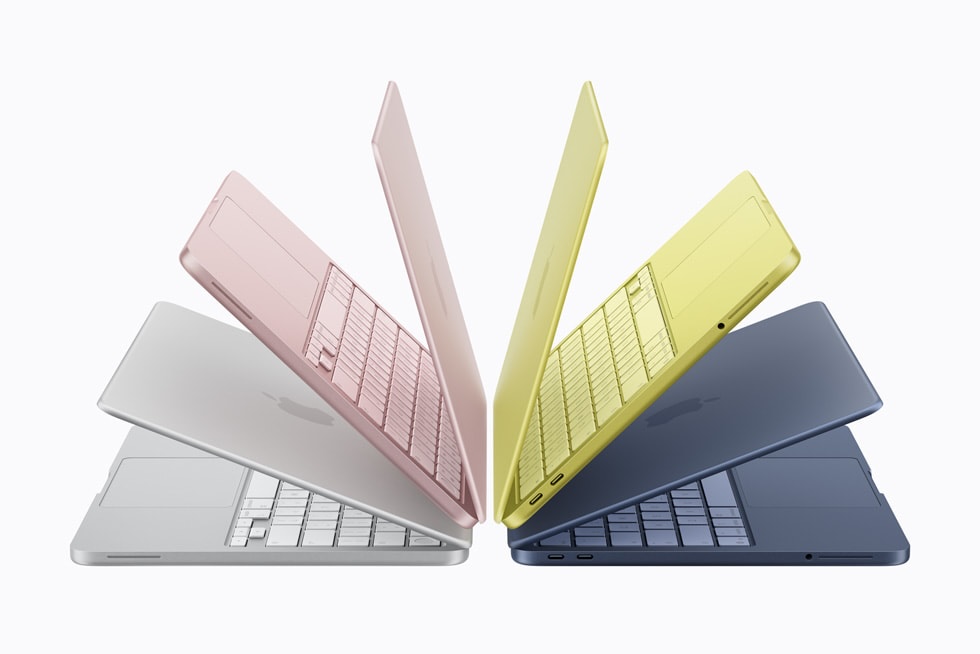
After a few months of delay, Apple refreshed the MacBook Pro and MacBook Air lineup with its new M5 family of chips in late February. The new M5 Pro and M5 Max chips bring a significant uplift in CPU, GPU and AI performance. The Mac Studio and Mac mini are also due for an M5 refresh, but it’s unclear when it will land.
The extended shipping delays of these Macs could be an early sign of that transition. Apple may be winding down inventory of current models ahead of the refresh. Or it could be struggling to keep up with demand. Despite their age, the Mac Studio and Mac mini are great for AI tasks.
In the US, the Apple Store currently shows a one-month delivery time for an M4 Pro Mac mini with 24GB of system memory. The shipping time jumps to a whopping 10-12 weeks if you bump the memory to 48GB.
In December, the company lost AI chief John Giannandrea, its top lawyer and a key design executive in a single week. Other recent headlines: “Apple faces unprecedented executive exodus”, “Apple rocked by executive departures, with chip chief at risk of leaving next.” “Apple home devices executive leaves for Finland’s Oura” “Lisa Jackson is set to retire late January 2026, while Kate Adams will retire in late 2026”. That’s just the names we hear about. They represent senior executives. But the harsh truth is that Apple lost tens of thousands of talented developers, marketers and mangers last year.
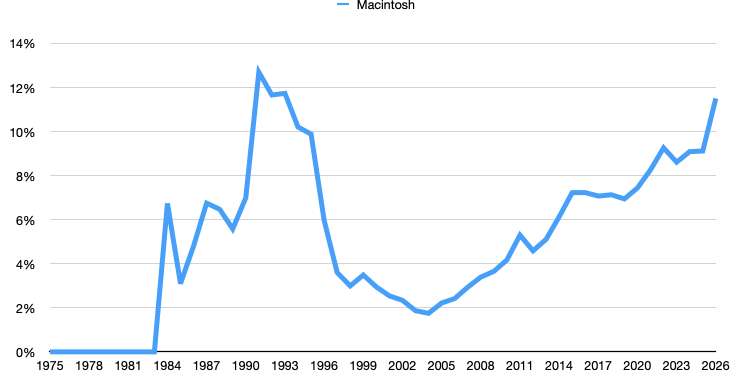
Almost 10 years ago I said “Managing the Mac product line must be one of the most challenging problems at Apple. That may not be obvious given the product’s success.” I pointed out that although the company grew the Mac into a redeemed and prosperous platform, “The big change in computing has not been a growing Mac vs. declining PC. It has been a huge surge in mobile device use vs. a decline in PC use overall.” It’s time to revisit this observation. First, a status update: The Mac is in its 42nd year...
How to read the history of the Mac and how to look at market share gains potential. Also: why the Mac has always been a cheaper alternative for buyers. →
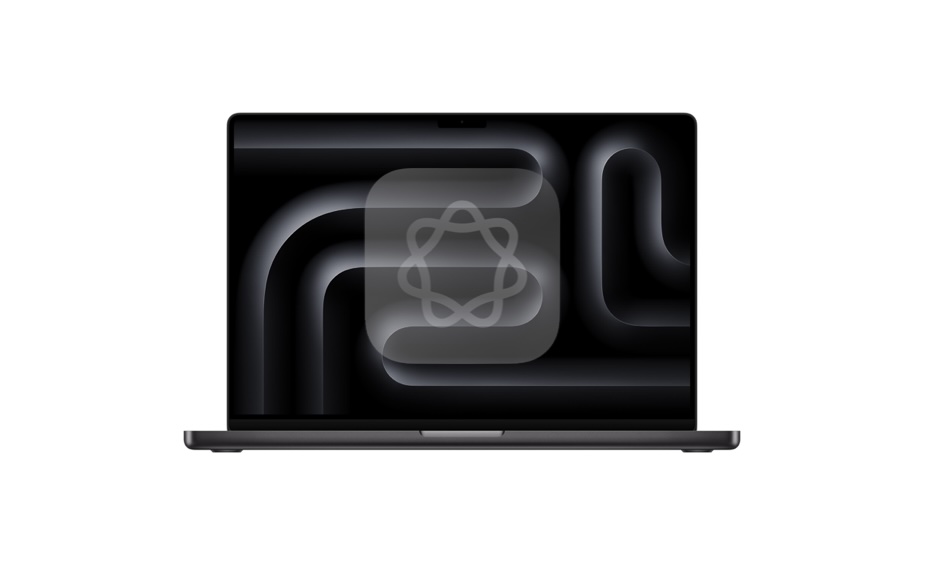
Running a data-center AI model on a MacBook → The article discusses how Apple's MacBook Pro, with its unique Apple silicon architecture, could revolutionize personal AI by enabling powerful AI models to run locally without relying on cloud data centers, potentially shifting the competitive landscape in Apple's favor despite current perceptions of lagging behind in AI advancements. →
Lobster Boil → "OpenClaw, a revolutionary open-source AI agent by Peter Steinberger, transforms personal computing by autonomously managing tasks across platforms, sparking a Mac Mini craze and hinting at a future where AI agents are integral to daily life." →
‘No Near-Term Catalyst,’ KeyBanc on Apple Stock → Near-term catalysts may not sway long-term investors, but if Apple's valuation seems steep, critique the pricing, not its promising 14% revenue growth forecast. →
Harmful chemicals found in popular headphones → Apple's AirPods Pro 2 and JBL's Tune 720BT topped the safety charts, while budget brands like Temu raised red flags for hazardous chemical exposure. →
When does Apple split its stock? → Apple's stock split history shows a pattern of adjusting high share prices to maintain accessibility, with splits occurring around $100-$650 thresholds, potentially hinting at a $300 minimum for future splits. →
The analysts see Qualcomm as a leader in smartphone processors, but noted the handset chip market has matured and faces potential headwinds, including higher memory prices and a decline in business from Apple. They added that the company faces the well-known imminent ~$7 billion to $8 billion loss of Apple business.
Apple has historically been one of Qualcomm’s largest modem customers, but the bank expects the relationship to wind down as the iPhone maker shifts to its own internally developed chips. “QCOM's modems will be completely phased out of iPhones by Fall 2027 as top customer Apple shifts to internal modems,” they wrote.
The report also highlighted a broader trend of smartphone manufacturers investing in their own semiconductor capabilities. Samsung has reduced Qualcomm’s share of processors used in its Galaxy lineup, while Chinese smartphone maker Xiaomi has committed about $7 billion toward internal silicon research and development.