Asymco

Asymmetric Intelligence

Dell

  1. Disruptive failure: How Acer Took Aim at Dell and HP and missed

    Research · 72 comments

    Two years ago:

    With new netbooks, laptops, desktops, and, yes, a smartphone, Acer CEO Gianfranco Lanci explains why he expects to soon overtake No. 2 PC maker Dell

    via Acer Boss Lanci Takes Aim at Dell and HP - BusinessWeek.

    Today Acer CEO and President Gianfranco Lanci resigned with immediate effect. Acer is in trouble. You can read more on Acer's current problems in the wake of the downward revision of its sales targets for two quarters here: Acer Should Overhaul Its Operation: Stan Shih | CENS.com - The Taiwan Economic News

    In a nutshell, whereas Acer under Lanci took aim at Dell and HP, it seems that Apple took aim at Acer. And whereas Lanci missed, Apple's aim was true.

    What is interesting here is that Acer had a very disruptive approach. They used the low end "netbook" concept to take share from incumbents motivated to move up-market.

    But what went wrong? Part of the answer is that "low end" does not just mean "cheap". Low end disruption is about also offering simplicity and performance along a new dimension or trajectory of improvement.

    Mobile computing could not be implemented as a low-end strategy because the modules available to portable computing could not be used to make it expand into new contexts of consumption. Windows and keyboards and all the input methods associated with portables could not be adapted to mobility. You could not use a netbook in places or at times when you did not use any other laptop.

    In addition the business model was not a good match. Low margins could not support development or new integration that could improve that which was not good enough. Acer did not have the means to tackle the problems of not-good-enough mobile computing. They did not build software and low margins meant that they could not even try to build software.

    Competitors also were motivated to respond. HP and Dell built their own netbooks which, arguably, were just as good (or, perhaps more accurately, just as bad) as Acer's. But more problematic was the fact that regular notebook prices dropped to netbook levels and the category came to mean "cheap" not "convenient".

    Finally, Acer's strategy did not have the time horizon necessary for true disruption. It takes many years to polish a product and nurture it up the trajectory. Acer was too impatient for growth and not patient at all for profit.

    Contrast this with Apple's tablet strategy:

    • It dealt with complexity of computing by removing it. This was not easy as simplification required a new platform altogether--something that portable computers could not benefit from.
    • It priced low but held on to margins because removal of complexity also reduced cost
    • The margins allow it to rapidly iterate on integrated development and improve the product
    • Competitors initially were not motivated to respond. They did not have the tools at hand to respond: no integrated operating system for PC vendors, no distribution for phone vendors.
    • Apple is also patient enough to wait for several product cycles. Even though demand is astronomical, the iPad still has a long way to go to become a new computing standard. Time is on Apple's side.

    Apple is effectively disrupting the PC with asymmetry. It contrasts with Acer's reliance on a sustaining, symmetric approach. The market was showing clear signs of over-service, declining margins, in-absorbable features and performance and complexity.

    Calling the winner in 2009 may have been tough given no iPad was visible, but knowing Apple's resources, processes and motivations should have guided observers to the right answer.
  2. Dell's devices head resigns

    Research · 8 comments

    Garriques will leave Dell at the end of January after nearly four years on the job. Prior to Dell, Garriques had been the mobile device chief at Motorola until early 2007.

    via Dell's Device Plan Reboots, Exec is Out - TheStreet.

    Here is how Ed Zander (the former CEO of Motorola) described Garriques soon after he left the company.

    ...Zander didn't have a lot of good to say about the former team running Motorola's cell-phone business. "The management in mobile devices made calls that were dead wrong," he said, referring not so much to massive price slashing on the popular Razr as to the slow-footed move into so-called 3G (for third-generation) multimedia phones. That particular slam was directed at a young guy named Ron Garriques, who headed that division, which is most of Motorola's business today, before high-tailing it out of Motorola just before the you-know-what hit the fan. Garriques today is part of the crack team turning around Dell.

    His move to Dell caused quite a lot of speculation that Dell was going to be a serious contender in the mobile device space (despite their previous failures).

    Apparently the launch of the Android-powered Streak was not enough to cement his future at Dell.

  3. Breaking Android: How Google's lack of control affects their value chain

    Research · 27 comments

    A few years ago I read a book called "Breaking Windows" which was the story of the DOJ investigation into Microsoft's abuse of monopoly. The book was written by a journalist who tried to summarize some of the findings from the published internal emails.

    One of the takeaways was the logic of Microsoft's entry into the Office market. The main internal justification was not that it would be a hugely lucrative new business, but that it was a necessity to the maintenance of the Windows business.

    The story was that Lotus, having a huge installed base, could (and did) arbitrarily refuse to upgrade their software to the latest Windows version and in so doing, could kill the franchise. Lotus owned the "killer app" and could hold Windows hostage. Users would rather keep their applications than upgrade a largely invisible OS.

    Another way to read this was that Microsoft needed to "vertically integrate" Windows so that it encompassed not only the OS but also the key applications that ran on the platform. A purely horizontal OS platform was obviously not viable as a business even back in the early 90s.

    What reminded me of this story was the news that Dell is launching a new smartphone in the US.  Called Aero, it will run Android 1.5, an ancient version released in April of 2009, 18 months ago.

    Now think about the idea of Adobe coming to market next week with a new version of Photoshop that ran only on Windows XP. Or even more poignantly, if Office were not part of Microsoft, seeing a *new* version of Word that only worked with Vista.

    Through an aggressive acquisition plan twenty years ago, Microsoft avoided this scenario. Google today is faced with the prospect that not only the devices (which sit on its OS) but also services and apps on top would choose to remain on old versions of Android. There is nothing to stop them from doing just that. Unlike Microsoft, Google does not enforce licensing terms for Android. It is at the mercy of the value chain.

    Couldn't Google crack down and deprecate Cupcake? It's not as easy as that. Not only do they not have license terms that permit that but in the phone business, development lead times are so long and global distribution can be so elastic that a low volume vendor like Dell has no choice but to sell multiple OS versions of their own products. Microsoft has almost the same problem with Windows Mobile, with a variety of given-up-for-dead Windows Mobile 6.5 powered devices still in the pipeline while Windows Phone 7 is imminent.

  4. Dell's running

    Research · 6 comments

    Once the pride and joy of the world's largest computer systems builder, consumer products now make up just 18% of Dell's total sales. That's probably a good thing in the long run, because this segment is notoriously margin-poor when compared to the less price-sensitive corporate computing market. I can't blame IBM for giving up on consumers years ago, and I think Dell should follow suit.

    via Make a Hard Left, Dell! (AAPL, CTXS, DELL, HPQ, IBM, MSFT, VMW).

    That's right. Flee upmarket Dell. Run, run.

    Quoting from the gospel:

    Step 2: Entrants grow and improve; incumbents choose flight. As disruptive attackers follow their own sustaining trajectories, they make inroads into the low end of the market or begin pulling less demanding customers into a new context of use. What happens when the disruptive entrant begins to make inroads? [...]

    Incumbents naturally choose flight. What looks highly attractive to the entrant continues to look relatively unattractive to the incumbent. The asymmetric motivation leads to incumbents naturally fleeing the low end. They cede that market to the entrant. [...]

    Remember, incumbents focus on delivering up-market sustaining innovations that allow them to earn premium prices by reaching undershot customers. They view flight as a positive development.

  5. 70 percent of college freshmen are entering school with Macs [Updated 2]

    Research · 2 comments

    Increasingly, companies are giving their employees a choice to either use Microsoft Windows PCs or Apple Inc.'s Macs, the analyst said. And, increasingly, employees are choosing Mac over Windows. To boot, Chowdhry said 70 percent of college freshman are entering school with Macs, up about 10 percent to 15 percent from a year ago.

    via Microsoft shares retreat after downgrade.

    Remarkable indeed.  I remember when in 2007 40% Macs was headline news at Princeton, having quadrupled from 10% in 2003.

    [Update] Chowdry’s estimate seems an exaggeration but Mac share on campus seems to be growing. The most current data shows a probable 50% penetration in private colleges (my estimation is 70% is accurate for Ivy League schools) but a probable 20% penetration at public schools.  Still way above retail share in the US (10%) and way above corporate share of practically naught.

    [Update 2] According to survey data from Student Monitor, among those who planned to purchase a new computer, 87% planned to buy a laptop. And among those students 47% planned to buy a Mac.
    47 percent of 87 percent is a lot more believable. The chart from Fortune Tech shows that intent to buy for Apple went from 14% to 47% since 2005.

    More data, some courtesy of Macobserver readers:

    Macs at Harvard:

    • 2005: 32% (of total computer purchases)

    Mac share at Princeton (freshman class):

    • 2003: 10%
    • 2007: 40%

    George Fox University provides a laptop as part of the tuition.  Here are their numbers for Mac usage:

    • 2006 1% (Actively discouraging Macs)
    • 2007 40% (Change in IT support policies)
    • 2008 100% (Only option offered)

    The U.S. Coast Guard Academy.

    • 2008: 0% (Dell)
    • 2009: 25% (15” Macbook Pro issued, incoming freshman subsidize half the cost and 100% of any optional upgrades including printer
    • 2010: 50% (plus juniors and seniors allowed to replace older Dell with Mac if desired, not sure the financial arrangement).

    University of Virginia (survey data):

    • 2001: 3%
    • 2002: 4%
    • 2003: 4%
    • 2004: 8%
    • 2005: 13%
    • 2006: 20%
    • 2007: 26%
    • 2008: 37%
    • 2009: 43%

    UC Davis:

    • 2006: 7%
    • 2009: 23%
  6. The reason Robbie Bach was fired

    Research · 37 comments

    Vague justifications about under-performance of Windows Mobile or cancelled Courier miss the whole point.  The chronic problems with Microsoft’s consumer businesses cited as causes for dismissal have roots in core processes and priorities which management changes will not address.  The failure of Zune was evident long ago. Windows Mobile has not been competitive with RIM for years, and failed to take significant share from Symbian, never mind iPhone. Tablets were the responsibility of the Windows team.  Kin is a rogue project based on a bone-headed acquisition. From a P/L point of view, Entertainment was mostly Xbox, which although deep in the hole over its lifetime, was starting to break even.

    No, the reason I believe Bach lost his head is that HP bought Palm.

    Bach lost a key account; in fact, he could be responsible for having lost the biggest account that Microsoft ever had.  Ballmer is a sales guy and he knows the importance of these relationships.  A customer like HP must be managed carefully and their strategy must be steered to fit with yours.  If HP felt they needed to go somewhere else for their mobile OS, it's a slap in the face, but if they buy the asset and IP and internalize a competing platform, then that is a dagger to the heart for Ballmer.

    Consider Google's seduction of Dell. Microsoft can tolerate Dell's affairs (Dell even fooled around with Linux back in the day.) But in contrast, HP is effectively filing for divorce.

    The blow could not have been more obvious and more cruel.

  7. Apple Ten Times more Profitable than Dell

    Research

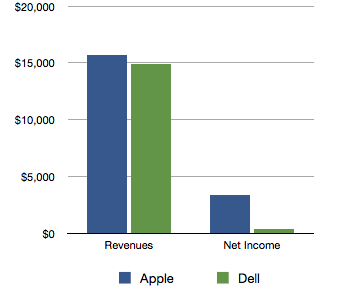
    Apple’s profit of $3.38 billion for CQ4 was slightly more than 10 times bigger than Dell’s $334 million on nearly equal Revenues of 15.7 billion and 14.9 billion.

    In other words, Apple kept about 20% of its income while Dell kept 2%. Also worth noting is that Dell’s gross margin onconsumer PCs was 0.2% while Apple’s Mac margin (mostly sold to consumers) was around 28%. So on consumer PCs Apple’s margin was 140 times higher.

    It should not be a surprise then that Apple is worth 6.5 times Dell.

    To recover some of its margins Dell is rumored to be readying its iPad competitor.

    I can’t wait.

  8. The Pocket PC Paradox

    Research

    Recent data from admob shows that Android OS share is highly dependent on a single vendor (HTC). (http://metrics.admob.com/wp-content/uploads/2009/11/AdMob-Mobile-Metrics-Oct-09.pdf page 7)

    There is an implied message in Android advocacy that once more licensees join in, volumes will be distributed among a broad set of companies benefiting from a healthy rivalry. This broad licensing will be a boon for volumes and for user choice and the platform itself will prosper.

    I'm going to argue here that there will be no healthy distribution of volumes or profits in the Android platform.

    History shows that volumes for an openly licensed mobile platform concentrate in the hands of a single vendor. To illustrate, I attached a list of all the devices which shipped (to date) with a flavor of Windows Mobile. The list includes 911 different phone models (search on your own on pdadb.net under the pdamaster tab--search criteria are on the last page of the PDF).

    The Windows Mobile platform "took off" and had hundreds of concurrent licensees in the middle of this decade. In spite of this wide adoption, one vendor captured 80% of the volumes for all instances of the platforms: HTC. Having started with the iPaq as a PDA and followed by being the first to market with a WinMo device, HTC dominated Windows Mobile volumes even when faced with literally hundreds of competitors. These competitors included all the big names: from PC vendors like HP, Dell and Toshiba, to cellular incumbents like Motorola, Sony Ericsson, Samsung, LG and every ODM and OEM in between. The reason HTC won is mundane: they have the experience and the distribution to make an impact and they iterate rapidly and are intimate with the details of making a tough-to-integrate product work. They basically worked their way up the value chain from a contract design shop to a branded top tier vendor.

    But if you exclude HTC, dividing the number of units of WinMo shipping at any given time by the number of licensed products in the market at that time, one gets about 50,000 units/licensee. Think about that: except for HTC, an average licensee could hope to ship 50k units for any phone they engineer and market. And they also need to prepay Microsoft the minimum license fee of $10/unit (approx) for a minimum order of 50k units or half a million dollars.

    This is actually a paradox. Put yourself in the shoes of a business manager at one of the potential licensees. Consider the situation where there are 200 competitors in a market all shipping undifferentiated products, and one competitor has 80% share. Would you want to be the 201st? Saying yes implies hoping to split the remaining 20% 200 ways or obtaining, on average, 0.1% share? But this is not a share of all phones, it's a share of that platform, which itself is, at best 10% of all smartphones which make up maybe 20% of all phones. So you are committing a few million dollars to pursue (.2*.1*.001=) .00002 of a market. That target is 3 orders of magnitude less than what Apple obtained in 2 years (without the margins). It never adds up unless you expect your entry to blow out of the 20% ghetto and take on the incumbents.

    As it turned out there were dozens upon dozens of business managers who opted to be the 201st (or 301st). Unsurprisingly, the result was that every Windows Mobile business plan failed (except that of HTC). Every decision to join this ecosystem on the device side was a value destroying decision, repeated 900 times.

    Why?

    I don't have an answer as to why so many are taken in by this. I have a hypothesis that it has to do with excess R&D capacity (e.g. idle engineers) that compels small companies to build product with no hope of market penetration, but I cannot prove it. They may also couple the low barrier to entry to the premise from the platform vendor that a no-name licensee could be the next Dell/Acer/HTC if the platform "takes off".

    Regardless of the cause, the proliferation of WinMo SKUs did nothing for the success of the platform overall. For consumer products, it does not matter what jockeying for position happens within the value chain if the end user/developer experience is painful and uncompetitive.

    Android will win or lose on the user/developer experience. It will not win or lose on the proliferation of licensees.

  9. Market Caps

    Research

    For reference, some selected current market caps:

    • Microsoft (MSFT) - $236.76B
    • Apple (AAPL) - $183.40B
    • Google (GOOG) - $173.97B
    • IBM (IBM) - $159.93B
    • Cisco (CSCO) - $138.60B
    • Hewlett-Packard (HPQ) - $114.26B
    • Intel (INTC) - $109.85B
    • Disney (DIS) - $54.31B
    • Nokia (NOK) - $48.24B
    • Research In Motion (RIMM) - $37.43B
    • Amazon (AMZN) - $40.34B
    • Dell (DELL) - $29.63B
    • Sony (SNE) - $29.10B
    • Yahoo! (YHOO) - $24.78B
    • Motorola (MOT) - $18.82B
    • Adobe (ADBE) - $18.23B
    • Palm (PALM) - $2.51B
    • RealNetworks (RNWK) - $564.74M

    The top 10 world-wide:

    1. Exxon Mobil Corporation 352.31B
    2. PetroChina Company Limited (ADR) 240.47B
    3. Microsoft Corporation 237.58B
    4. Petroleo Brasileiro SA (ADR) 220.19B
    5. BHP Billiton Limited (ADR) 204.30B
    6. HSBC Holdings plc (ADR) 199.98B
    7. China Mobile Ltd. (ADR) 199.09B
    8. Royal Dutch Shell plc (ADR) 195.76B
    9. Wal-Mart Stores, Inc. 195.27B
    10. Apple Inc. 183.57B

    Steve Ballmer is not worried, Apple is just a rounding error.