Recording and transcript of the June 9, 2026 Asymco One Office Hours, recorded the day after Apple's WWDC 2026 keynote. Horace Dediu shares his impressions of the event and takes questions from Asymco One subscribers.
Takeshi Narabe • 06:41 So you also compared [Apple] with the Japanese companies. Actually Japanese companies are very keen on marketing and doing some anchors many times. And I think [historically] they didn't know what consumers want. But you mentioned that is also […] their advantage […] because they only made what [management] wanted. But on the other hand, Apple exceeds the consumer's expectation or make a new market.
Horace Dediu • 07:37 The story of Japanese innovation is fascinating and I hope you give me a little bit of time to reflect upon this because I think it is also part of the story of Apple. I have a great admiration for the history of Japanese innovation. And it was something that, again, Professor Christensen taught me and made me appreciate.
Of course, during the 1970s, and maybe even earlier, but at least from the 70s onward, Japanese innovation was the world leader. It was in consumer electronics, it was in automotive, it was in many heavy industries, it was phenomenal. And the reason a lot of that happened was because Japan was constrained. Japan didn't have access to as much capital or as much land or as much resources as a lot of the industrial nations at the time. And those constraints taught it to be lean and efficient and how to think about "just in time", the Toyota production system, etc. And that wisdom came from a constraint.
As a result, Japan [began to] teach the world during the 90s and onward about how to do better manufacturing. And they taught Apple. Apple at the time was in awe. Steve Jobs was in awe of Japan. Nobody could come close. Also, Sony was a phenomenon. In fact, in interviews with executives; I was just watching an interview with [Jon] Rubinstein, who was at the time heading the iPod.… He said they were absolutely paralyzed with fear that Sony would beat them at this game. Even though [Apple] were by far the market leader, […] it wasn't Microsoft, it wasn't Motorola, it was Sony that was the worry.
Now, what happened? I think one of the things that Christiansen doesn't say--[which I do] because I come from a software engineering background--one thing that I think Japan didn't understand starting in the late 90s was the power of software. And I think it's a cultural problem. Software has a different culture fundamentally. The software engineers in general are like cats. You know, managers want to manage dogs because dogs are predictable and they tend to follow the instructions. People who do software tend to be very much more independent, but they need to be coordinated.
So it's a very difficult management problem, and it doesn't fit so well, perhaps, with corporate culture in Japan, at least at the time we're speaking of. And so one of the aspects, I think, that was critical in the late 90s was this, I would say, cultural crisis. By the way, it's also a problem in Europe. One of the reasons Europe did not succeed with software was precisely because of the cultural aspects as well.
But that's one element and I think it's not the only element but you address the question of customer understanding and this is very crucial as well. I think the Japanese were for many decades thinking that if you build good things, especially as they were better than what was in the market, then customers will buy. Simply focus on quality and the customer will decide eventually to switch.
That's a very logical decision, a very logical plan. And you don't have to worry too much about marketing and branding and all of these aspects, which are again, perhaps a cultural difference. Or you could hire someone to do that for you, but fundamentally the management inside Japan couldn't think in the same kind of marketing ways that American marketers would think.
But as far as the customer discovery problem, this is true. And it is something even American companies don't know how to do, or European companies don't know how to do. […] The way Apple suggested they do it (this is what they've told us,) is that they have to talk amongst themselves. They talk to each other as they did about the iPhone and said: "What do we dislike about our phones? How can we make them so more usable?"
And this fundamentally is because they always had this inquiry internally about why are things hard to use? Why can't we make things easy? Some of that is evident in Japan, but I think it wasn't thought of through the lens of interfaces. It was thought of more like being compact, being portable, being good [to the touch]. But it wasn't as much about how do you interact visually with something. A lot of things go into that. Obviously, you have to have a different sensibility about the two-dimensional display and so on. [1]
And so my point is that the Japanese weren't stepping back enough and asking these, what Christiansen would call, jobs-to-be-done questions. "What do people really want to accomplish with products", even if we haven't yet envisioned what they are? How do we work, how do we think about these design questions. Designers, by the way, say "we don't just make things look good. We think about how they are to be used". You know that philosophy of deeply understanding the user behaviors that is part of the Jony Ive philosophy. But it wasn't just him. It was before him and after him. [Apple designers] have been thinking the same way.
So it's a design philosophy. It's a real introspection, asking yourself, how should the world be? How should we improve the lives of people? And that's hard to really be very concise about. So I apologize, I'm [going on] so long about it. But it is part of the decision, part of the culture, again, of Apple, where they are looking at themselves.
Famously, by the way, this is another anecdote about Apple. It is that they don't do focus groups. They don't obtain that [product] knowledge by surveys. They don't obtain it by asking even indirectly what the customer wants or gathering loads and loads of market data. Lots of [research] companies will sell you market data and tell you all kinds of insights, cutting everything into demographics, into segmentations of various kinds.
The theory of jobs[to be done] is that usually you need to ask [only] five people. You don't need a large sample. You don't need to survey 10,000 people to find out that there's a desperate need for companionship. Should a machine be a companion? That's a very basic question.
A question which is, by the way, answered by AI. A lot of AIs are just hired as companions. But you don't discover this by surveying what people own today or what they're buying today, [or] what they ask for. You observe and you maybe do a little bit of inquisition on the spot and you just tease the customer's intentions.
I said many times, many of the best [product] ideas are taboo[2]. [For instance] People do things on social media which were once considered not just impolite, but sinful. You know, the idea of being vain is a sin. The idea of bragging and being boastful is considered sinful or [at least impolite]. And I used to say that all the social media can be segmented on the seven deadly sins that were part of the [moral] conversation centuries ago.
It was the church who would say these are bad things you shouldn't do them. Gluttony or covet thy neighbor. Every single social media is positioned precisely on [one] sin. Now, the discovery of this wasn't because Facebook surveyed what people do as sinful and provided it to them. Rather, they gave options and then the algorithm discovered it in a way. Apple [by the way] chose, I think [wisely], to stay out of there.
But you can see how the discovery of social media didn't come from a process of surveying people, asking them what would they like. They would have said "I want to have communications" or "I want to have cheap communications." They wouldn't say I want to send selfies, (which by the way didn't exist,) of myself doing everything all day long.[3]
What I was trying to say here was that the Japanese approach to the display of two dimensional information is different due to the writing style. Japanese visual layouts are denser and more information-rich--some would argue more beautiful. There is less of an expectation by the consumer for simplicity which implies an acceptance or even appreciation of complexity.
By taboo I mean unspoken prohibition, something implicitly forbidden or embarrassing. To which nobody would admit to or request.
Narcissism is an observed behavior predating Christianity and the 7 sins. It was named after the Greek mythological figure Narcissus who fell in love with his own reflection, popularized at least by Ovid before 8 AD.
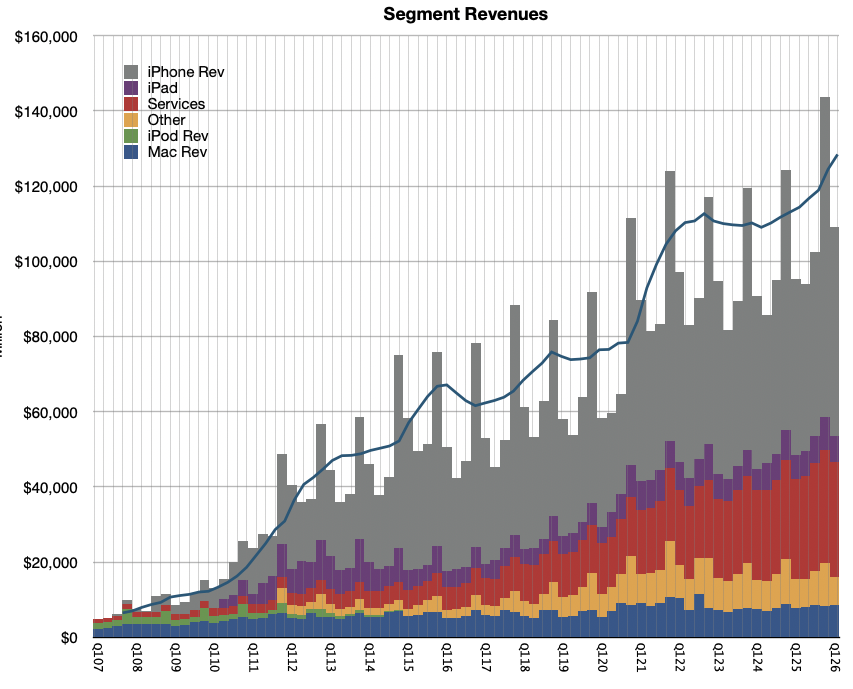
Revenues and growth rates for iPhone, Mac, iPad, Services, Wearables, plus Net Sales, Gross Margin, Operating Expense, Other Income and Expense, Tax Rate, Net Income, Share Count and EPS with a comparison to CFO guidance.
Ref. conference call's guidance, Kevan Parekh, Apple CFO: As we move ahead into March, I would like to review our outlook, […]. We expect our March total company revenue to grow by 13% to 16% year over year, which comprehends our best estimates of constrained iPhone supply during the quarter. We expect services revenue to grow at a year-over-year rate similar to what we reported in December. We expect →
In a recent interview Apple management was asked about AI, which is perceived as an area where Apple has been struggling. Greg Joswiak replied: We’ve been doing things with intelligence for many years, right? And gen AI allows us an opportunity to do that even more. So I’m excited about that, but boy, this is not a sprint. This is a marathon.
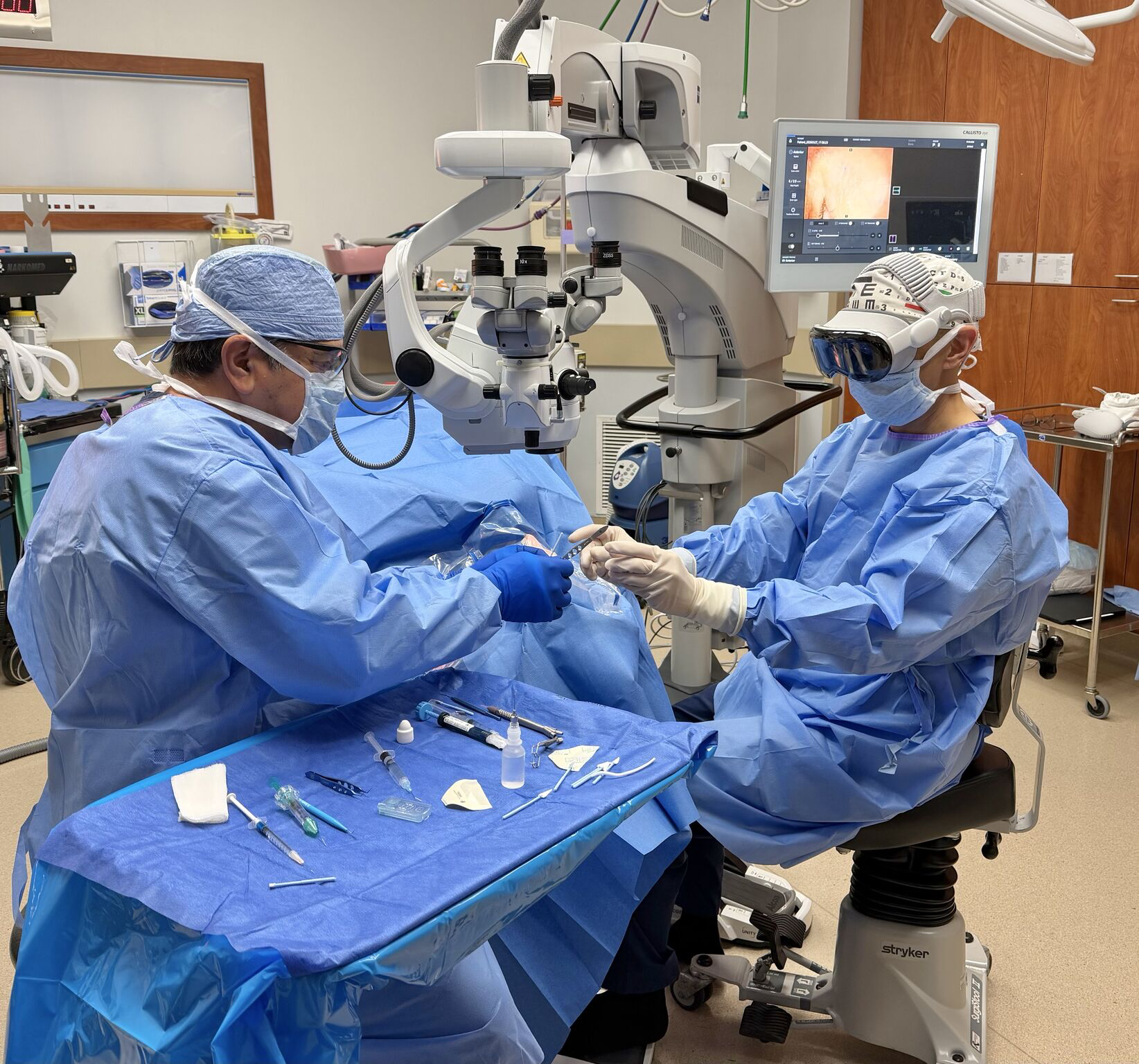
In contrast to AI, Spatial Computing is being largely ignored. It is however making significant leaps in utilization, especially in verticals. →
At just $3,000, the Studio Display XDR democratizes medical imaging, undercutting specialized monitors by up to 90% and revolutionizing healthcare accessibility.
The Studio Display XDR is priced at $2,899 with a VESA mount, and it is more affordable than many specialized medical imaging monitors.
It allows a new set of people to do what previously required only specialists to do and allows specialists to do more than they used to do. →
BofA slightly ups Apple's price target to $325, forecasting $113B revenue and $2.00 EPS for Q2, driven by strong iPhone sales and Services growth, slightly above my estimates of $110B and $2.00.
Q2 forecast update
My own estimates for Q2 revenues and EPS are $110B…
More to follow as we get closer to the earnings release date but this is a good preview. →
Apple's Mac shipments grew 5.4% to capture 11% market share in Q1 2026, driven by MacBook Air and Neo sales, with revenue estimates slightly differing from unit projections.
Apple growing at double market rate.
Omidia estimates that Apple reached a market shar…
…e of 11% with shipments growing 5.4% due to solid MacBook Air sales performance and the initial sell-in of the MacBook Neo.. This means 5.4% growth for Apple y/y. As I noted in my Office Hour yesterday, I adjusted my Mac growth from 0% to 6% based on the new products launched. This is an estimate of revenues not units but it might be pretty close. Omidia estimates 7,112 million units whereas I’m a little above 6 million. We seem to disagree on ASP. →
Amazon's acquisition of Globalstar boosts its satellite internet ambitions and strengthens ties with Apple, while highlighting the limited reach of space-based networks compared to terrestrial ones.
I assume Apple has wanted to steer clear of Starlink but it’s not clear that was a primary consideration in choosing Globalstar.
Starlink, considered the dominant player, serves about 11 million users. I would note that 11 million is 0.1% of the number of cellular subscriptions worldwide. →
iPhone users boast nearly quadruple the loyalty of Android counterparts, with actual annual switching rates favoring Apple slightly, despite inflated survey intentions.
I did a deep dive into the data and came up with graph above. The original report shows intention numbers which seem quite high. For instance, the net switching rate between iOS and Android is 10% in favor of Apple. This would imply that the entire user base would flip in 10 years. It would also imply…
I think actual net churn is 1.7% of the base each year. That’s still 100 million a year. For now it seems Apple is happy to maintain that rate. →
This episode of Asymco Office Hours covers a wide range of topics related to Apple, including geopolitical risks, financial performance, AI developments, and business strategy. The discussion is led by Horace Dediu and Gene Munster, with insights from industry experts.
The Studio Display XDR's medical image calibration feature received FDA clearance, which means radiologists are now able to use the display for viewing medical images. Apple marketing chief Greg Joswiak confirmed today that U.S. radiologists can connect the Studio Display XDR to a Mac running macOS 26.4 to use DICOM medical imaging presets.
The Studio Display XDR supports DICOM and has a Medical Imaging Calibrator for diagnostic radiology, so radiologists can view images without the need for a single-purpose medical imaging display.
Ben Thompson of the Stratechery interviews Horace on the Stratechery Plus Podcast to discuss Horace's journey to become an influential tech analyst: early career in research, business school under Clayton Christensen, and his time at Nokia during the rise of the iPhone.
The conversation further explores Disruption Theory in the context of both smartphones and AI, why Christensen misjudged Apple, and whether AI could challenge today’s tech giants. It also marks the launch of Dediu’s new paid service Asymco One and reflects his continued conviction in Apple Inc. at its 50-year milestone.
Asymco Bulletin is a digest of all the work we have published for the week ending Mar 8, 2026.
Editor's Note
It's been about a month since we launched Asymco One, and we are elated with the response from the community. Most recently, we held our first Office Hour, where we discussed the impact of Apple's latest products and answered questions in front of a live, Asymco One subscribers. We'd like to thank you for your support.
We continue to make improvements in how we create and deliver our content. Please bear with us while we renovate our infrastructure. Should you have any issues or have questions, please reach us at contact@asymco.com.
Since October 2023, Apple has been transparently reporting App Store user metrics across 27 EU nations, updating these figures biannually. This initiative spans a population over 450 million, offering a granular yet rounded down to the nearest million, potentially skewing figures slightly downward. To mitigate this undercounting bias, adjustments are factored into trend analyses.
Through three sampling intervals from 2023 through July 2024, a market landscape emerges. The aggregated data hints at subtle shifts and growth patterns. →
The iPhone 17e emerges as an incremental refinement—"the new low end, same as the old low end, but better." Apple has streamlined its lineup by axing the mid-memory "e" model, leaving us with two price points. This simplification might appear reductive, yet it strategically consolidates offerings while enhancing value. Notably, the base model's memory has doubled, a move that defies the prevailing DRAM scarcity narrative, suggesting Apple's adept supply chain management and perhaps a bit of market leverage.
By trimming excess and boosting core features, the 17e exemplifies a nuanced approach to product evolution. →
Nota Bene
Apple introduces iPhone 17e → Apple's iPhone 17e offers double storage at the same $599 price, boosting profit margins. →
Say hello to MacBook Neo → Apple launched the MacBook Neo, a budget-friendly laptop with premium features, priced at $599, amid concerns over shrinking margins in the Windows laptop market. →
We convened our first Office Hours on March 4 to review Apple's latest releases, where we answered questions from a live audience of subscribers, and dissected Apple's latest and strategies. Topics covered:
Don't ask me, my only monitor is an Apple Vision Pro
Studio Display XDR is the world’s best pro display, featuring a 27-inch 5K Retina XDR display with a mini-LED backlight, 2000 nits of peak HDR brightness, and a 120Hz refresh rate
GF Securities said a recent survey on the tech giant's supply chain suggests a “solid outlook.”
“Following the earnings call on Jan. 29, 2026, we did a supply chain research which indicates strong iPhone build momentum (incl. 2H26’s models) as well as cost management aiming to keep the starting selling prices of iPhone 18 Pro/Pro Max unchanged or at [a] similar level of iPhone 17 Pro/Pro Max,” analyst Jeff Pu wrote in a note to clients.
“Additionally, [the] Gemini partnership is to work on the Apple foundational model to power the Apple Intelligence, including the personalized Siri, which is the next key to watch in WWDC 2026.”
Pu reiterated his Buy rating and upped his price target [] on the back of higher 2026 and 2027 estimates.
Delving deeper, Pu said the upcoming fiscal third-quarter should see another “strong” iPhone build, with around 54M units, which would suggest a year-over-year acceleration. “For 2H26, we note that Apple is expected to launch 3 new iPhone 18 models (Pro, Pro Max, Fold), compared to 4 iPhone 17 models a year ago,” Pu added. “Yet, we expect a solid iPhone 18 build plan in 2H26 of 82m, compared to 89m of iPhone 17 in 2H25, despite [a] much higher [average] selling price. We attribute the key drivers to the new foldable model and Apple’s strategy of keeping iPhone 18 Pro/Pro Max pricing largely the same as that of iPhone 17 Pro/Pro Max by managing memory/display cost. That said, we expect a significant iPhone ASP increase in CY2H26 driven by mix.”
On the company's recent earnings call, Apple management, led by CEO Tim Cook, said revenue is expected to grow between 13% and 16% year-over-year.
Looking to the cost of the iPhone 18 Pro and Pro Max, Pu said the recent impact of surging memory prices should be manageable. “For DRAM, we believe Apple has been negotiating with Samsung Memory and SK Hynix to reach favorable deals, considering Apple’s support in the past memory downcycle and the likely capital investments,” the analyst explained. “For NAND, we estimate the cost to be up ~70% QoQ in F2Q and suppliers are asking for 50-60% QoQ in F3Q. Overall, we expect the BOM cost of memory to increase from 9- 10% in F1Q to 12-13% in F3Q. To partially offset the cost of memory price and 2nm A20 Pro, we expect efforts on other big items such as display, cameras, etc.”
The iPad was launched in April 2010, about three years after the iPhone. Followers of the company will know however that the iPad was designed first, starting sometime in the early 2000s.
The iPad was the prototype touch device because it's less constrained but also because Apple was, at its heart, a computer company and the iPad was a computer first, device second.
Concepts of tablets predated Apple's entry and go back to the 1990s. The idea of a "Tablet Computer" was envisioned by Alan Kay as the Dynabook as early as 1968. He famously remarked that if Apple were to build a tablet-sized iPhone it would "rule the world".
But has the iPad come to rule the world?
Ten years is not a long time—the Mac is now 36 and it's still kicking, Windows is only 25 years old—but already 500 million iPads have been sold.
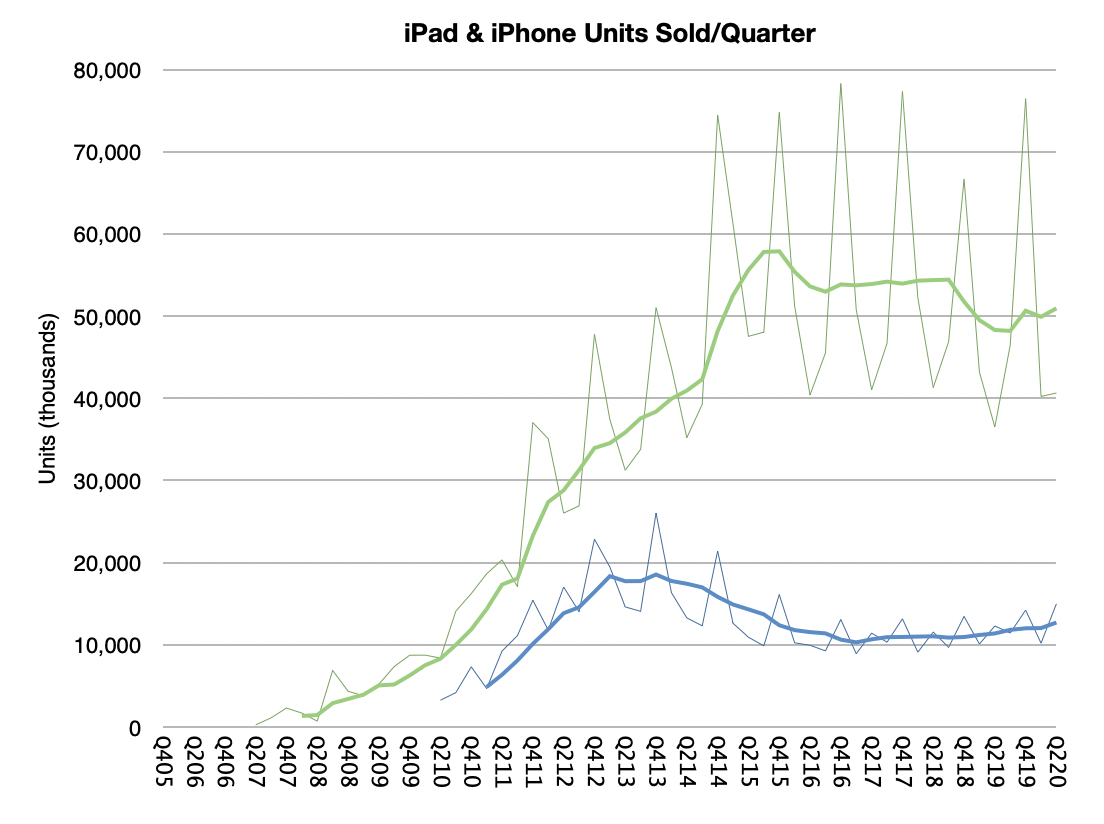
The sales history of the iPad in units is shown below in blue vs. the iPhone in green. (Note, values in last 8 quarters are estimated).
The story that did not pan out for the iPad is that the unit growth did not match that of the iPhone, which, in its first decade sold 1.2 billion units.
But that is because the iPhone and iPad differ in significant ways. Ways which were difficult to anticipate early on.
Difficult because internally the two are basically the same. Both share the same processors and architecture and (until recently) the operating system and user interaction model. They have a similar "bill of materials" (though prices are quite different, with iPhones typically more expensive.)
The main difference has been in the display size. As I noted early on, a few inches of display may not look like a big difference but it is qualitatively very different—as much as a bathtub and a swimming pool both contain water, the quantity of water changes dramatically what you can do with either.
As a result of its size, the iPad is more likely to remain at home; not stationary in one spot, but not "in-hand" at all times. That affects how long it lasts and the tasks it's assigned to do.
As a result, iPads stay in use longer, get passed on to new users and serve for many years. Their average life span is likely well over 4 years and 9 year old iPads are not uncommon. It's therefore very likely that the vast majority of all iPads sold are still in use.
So the true measure of success is not units sold but number of active (and satisfied) users. The iPad user base is probably around 400 million (about 27% of total active Apple devices.) The degree of activity is also telling and is reflected in the million apps built specifically for the platform.
400 million users makes for a healthy ecosystem, especially as the users tend to be willing to spend on apps and services, which in turn, attracts more investment from developers, which leads to more usage, and so on, in a virtuous cycle.
As with all aspects of Apple analysis, the qualitative is just as important as the quantitative, even more so. The quality of the users, the usage and the product is the pre-eminent assessment.
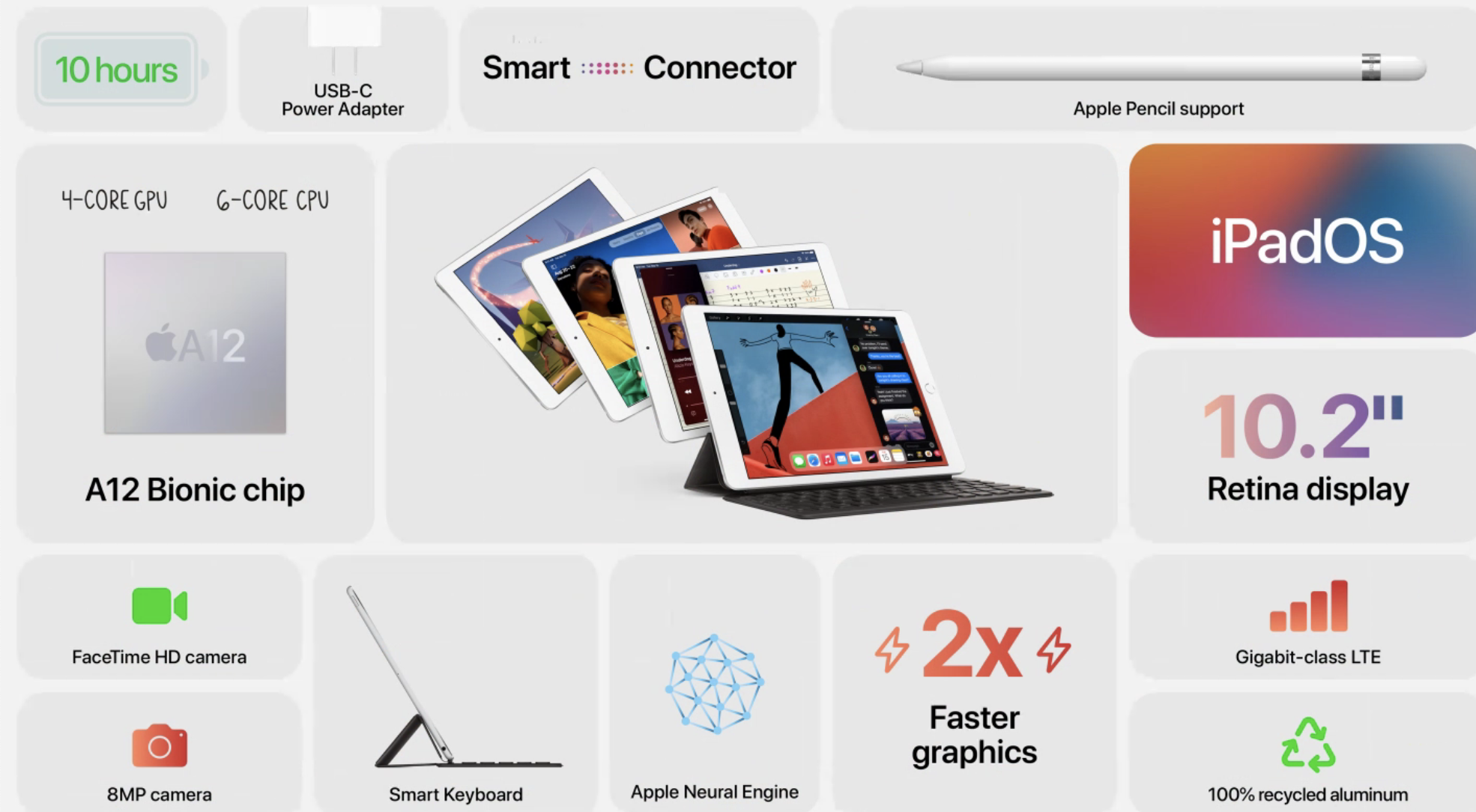
iPad users, usage and product make for a remarkable combination. On the product side, the Fall 2020 line-up is another leap forward. In particular, the price points, breadth of offering, accessories (mini, Air, Pro, pencil, Smart Keyboard, etc.) and the power across the board.
This year sees a performance jump in the middle of the line-up with the usual mind-boggling measurements (some beginning with "nano," and others with "tera".)
So where to for iPad now? What worlds remain for it to conquer? So far has found users in the three "E"s: Enterprise, Education and Entertainment. Pro usage is a niche that is growing in production, especially media. What many might say is that it needs to aim at replacing the laptop, or the PC in general.
It has not done that so far, much to the delight of naysayers. But this is not as big a failure as it might seem.
First note that the Mac user base itself is not nearly as big (110 million +/-10%). iPad could be 4x bigger in user base. The Windows base is larger at 1.2 to 1.4 billion but that resists frontal assault as it is deeply entrenched around enterprise workflows. It's also bereft of profit.
What iPad did do is create its own demand. It sits comfortably aside other platforms not in place of them. Most iPad users also have an iPhone and a PC or a Mac. I happen to have all those and more than one iPad. The iPad did something grander than kick the PC off its perch. It sat next to it and found life quite comfortable.
One of the most startling announcements during the WWDC 2013 was iOS in the car. The mockup that was shown seems to indicate the use of the car's in-dash display as an "external monitor" for an iOS device while control would come from inputs using Siri.
The technical details were not released so it's hard to know the protocol used to accommodate this interface. However it seems that it will be generic enough that a number of launch brands signed up for the launch. The list includes Honda, Mercedes-Benz, Nissan, Ferrari, Chevy, Infiniti, Kia, Hyundai, Volvo, Acura, Opel and Jaguar.
Is this a significant opportunity?
Before we get excited, it's important to note that this will likely take a very long time. It won't even begin until 2014 and the number of new models may trickle into showrooms quite slowly. Consider that the time it took for automakers to universally support external audio input (mostly the trivial line-in) was about a decade.
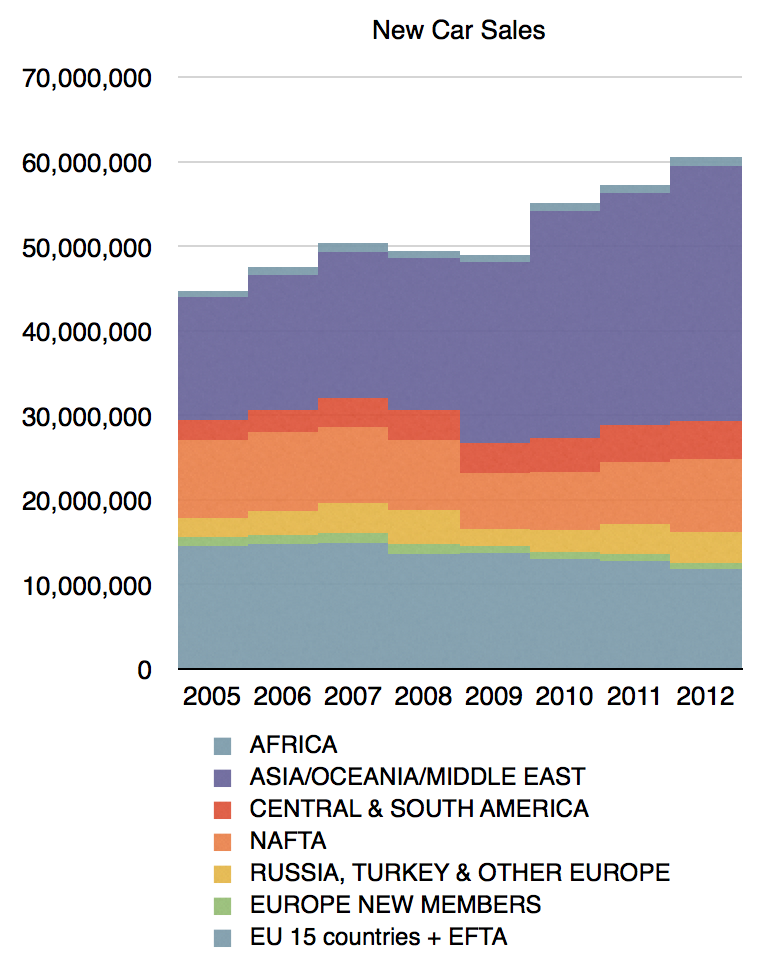
To also curb our enthusiasm we need to realize that the car industry does not produce many units. In 2012 there were over 60 million cars produced (with the following regional mix:)
In contrast, 60 million is about the number of phones sold every two weeks. In 2013 there will be more iPads sold than cars.
In particular the companies mentioned had the following production figures in 2011:
Honda (including Acura): 2.9 million
Mercedes Benz (Daimler): 1.44 million
Nissan (including Infiniti): 4.5 million
Fiat (Ferrari parent): 2.4 million
GM (Chevy, Opel parent): 9.1 million
Kia: 1.6 million
Hyundai: 6.6 million
Volvo: 315k
Tata (parent of Jaguar): 1 million
Including the parent companies and all vehicle types they produce, the total is about 30 million units, or about half of the world-wide production. Obviously, not many of the cars produced will have iOS in the car capability.
Therefore the total unit opportunity is not very significant, perhaps less than 10 million a year. Is there a per-unit cost that compensates for this?
This is harder to answer. The way Apple has been licensing accessory makers is through the MFi (Made for i) program. There used to be a flat 10% fee off of the retail price of the accessory sold. However, there may have been changes. The licensing fees are not public and it's quite possible that the price is a flat amount per unit and that it's a negotiable. It's hard to know what terms are being negotiated with automakers but my bet is that it's not likely to be a significant source of revenue per unit.
So the total revenue from licensing the "Made for iPhone" trademark to automakers won't be significant.
But it is significant for the car industry. The significance is that cars have finally risen to the role of being phone accessories. They have acquired the ability to participate in a computing ecosystem. During all these decades when the world has embraced the information society and intelligence has been embedded in the fabric of life, automakers have resolutely avoided being a part of it. Automotive information, connectivity and user experiences have remained in a Galapagos Syndrome-like isolation from reality. The reasons are rooted in the crisis of rigidity that plagues the industry, something I've touched on briefly in The Critical Path podcasts (e.g. Asymcar).
So this is a hopeful development. If.
If it actually moves at a slightly-faster-than-glacial speed.
If sufficient cars get display systems (billions are produced for the pockets of young and old, poor and rich; but cars have to be considered "luxury" to be graced with an LCD)
If standards are adhered to.
If all brands (which operate individually as autonomous divisions irrespective of group-level strategy) accept the notion.
If these and many other conditions are met, it would allow, finally, the migration of autos to the status of information appliances and, eventually, to being hired for jobs that are currently left undone.