Asymco

Asymmetric Intelligence

ecosystem

  1. The $85 Smartphone and the imminent extinction of non-smartphones

    Research · 136 comments

    In a recent article I made the claim:

    My bet is that by the end of 2012, it will be hard to find any branded phones which won’t run a smartphone

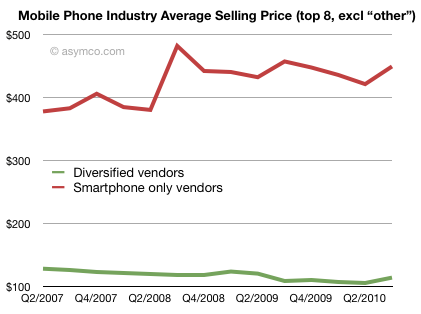
    I also showed how pricing has evolved over the last three years.

    Two days later an article in Fortune's Google24/7 blog highlighted the possible price points of low-end smartphones:

    I had a chance to speak with Jim Tran, VP/GM – Handset Line of Business for Broadcom, who was able to elaborate on the details of the new processor and what it meant for the industry.  Here are some of Broadcom's bullet points:

    The BCM2157 baseband, since it combines many functions on one chip, is able to run more efficiently, meaning less battery power will be needed than on current basic handsets

    Low-cost, low-power, 65 nm digital CMOS process means the silicon will be cheap

    The dual-core processors will run at 500-800mhz.

    Supports portable Wifi hotspot and Android 2.2 and up

    But the kicker is the price.  Tran says that phones made from the BCM2157 chipset will retail for under $100 and may dip as low as $75.  Those devices should debut in just 3-6 months (and we might hear about them next month at CES)....

    To be clear, That sub $100 price is not the cost of materials, it is the suggested retail price after the manufacturers (and carriers) have taken their profits.

    via 2011 will be the year Android explodes - Google 24/7 - Fortune Tech.

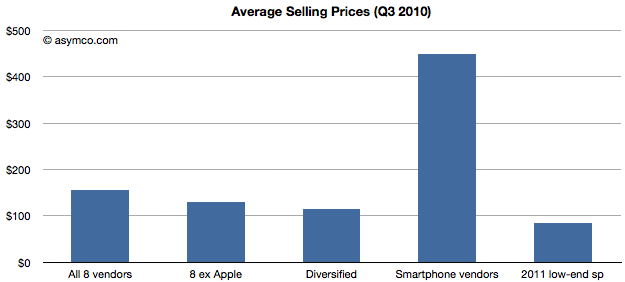
    My own data shows that the average selling price for the top eight phone vendors for Q3 of 2010 was $156. Smartphone-only vendors were charging $450 on average and diversified vendors selling both smart and non-smart phones were charging $144 on average.

    Nokia's ASP for its entire line-up was $88 (spread over about 84 million non-smart and 26.5 million smartphones).

    What strikes me about the claim from Broadcom is that a $100 retail price for a smartphone implies an ASP of about $85 or so (assuming $15 or a very modest 18% channel mark-up).

    That means that a smartphone could be built using this chip which would have nearly half the average price of all branded phones sold last quarter.

    It would also be priced cheaper than the average price Nokia charged for all its phones (75% of which were non-smart phones.)

    And this type of phone could be available not in three years in three months.

    The chart above shows how prices could collapse.

    Of course, low price is not the only condition for the widespread substitution of smart devices in vendor portfolios. But it does take away a significant objection. It no longer seems far-fetched to say that in another two years the price points for smartphones will be low enough to make them marketable in all markets. This may in fact be true next year.

    I suspect that non-branded vendors will lead the way and make these devices widely available in emerging markets. The question will then be entirely up to the branded vendors whether they will follow or will they try to market dumb phones vs. smart phones at similar price points. Will buyers opt for a branded device with no ecosystem or unbranded device with the Android ecosystem?

    It becomes harder to envision any reason why non-smart devices will earn positions in portfolios two years from now.

    Note that I'm not suggesting that the market for high-end smartphones is threatened yet--there is still a lot of innovation that still needs to happen to shape that market into one of mobile computing (vs. mobile phoning).

    Instead, what I am suggesting is that the bottom of the phone market is very vulnerable to becoming smart. This may sound like an odd sort of disruption, but it's a very sinister threat to companies who are in the business of selling brands and not platforms.

  2. Is HTML5 a Flash in the pan?

    Research · 31 comments

    When Apple promoted HTML5 as an alternative to Flash, the value was said to be in being an open standard, and in having better efficiency for device-based execution.

    The problem is that there are no authoring tools for HTML5. Flash is popular because it's fairly easy to kick start the creative process. You buy the tools from Adobe for a few hundred dollars and begin to tinker. With HTML5 you need to be a programmer, read arcane documentation, search for sample code and manually integrate results into publishing systems. That's bush league.

    iAd Producer narrows the gap a bit.

    The bigger question that I struggled with is whether web apps are competitive enough. The absence of tools is a damning accusation that they aren't. Note that Apple is first introducing production tools for iAd, not for web apps in general nor web content in particular.

    So why isn't there an iWeb-like tool to allow consumers to design web sites (for MobileMe Galleries for example) which benefit from HTML5? At the other end of the spectrum, where are the Apple equivalents to Adobe's Flash Professional (with CS5 integration)?

    The tools for HTML5 are just not there. Tools are the first things needed to build an ecosystem. Is their absence due to a lack of demand or are there no skilled toolmakers outside of Adobe?

    When the market is failing to deliver a solution, I question the need for the solution in the first place. It's also worth while to follow the money: Adobe makes money only on the tools for Flash, not on distribution of content. For anyone to disturb Adobe's franchise, it's tools that need to be put forward as alternatives. Tools are not easy to build. Are the incentives simply not there?

    I hope iAd producer is the first in a series of tools from Apple to build an HTML5 ecosystem. Whatever the future of web apps is, it's coming very slowly. No wonder Flash is still a viable business for Adobe.

  3. The iPhone is not superfluous, not easily copied, not revolutionary and not a premium product

    Research · 61 comments

    The release of the iPhone is rightly acclaimed as a watershed event in the history of telecom. It was a sensation. But it was also a product that was widely underestimated and dismissed. Even today expert opinion is divided. The critics of the product transitioned directly from labeling it a superfluous bauble to an obvious and copyable sustaining innovation. Advocates of the product describe it as revolutionary and dazzling with the potential for capturing significant profit share due to premium pricing and positioning.

    So which is it?

    I'll argue that it's none of the above. The iPhone is not superfluous, not easily copied, not revolutionary and not a premium product. What it is is disruptive.

    First, we have to quickly define disruptive potential.

    A product is disruptive if it competes with an existing, incumbent set of products on a new basis. It competes along a new measure of performance. That means it's either "low end" and hence cheaper, simpler, more modular and conformable, or it creates a "new market" where completely new measures of performance or quality are relevant.

    In both "low end" and "new market" disruptions the product is usually wrapped in a business model that insulates it from incumbent response due to inherent asymmetries. Incumbents will find the economics of the entrant product unattractive and will be motivated to ignore it or actively avoid copying it.

    The consequences of disruptive product entires are often catastrophic for the incumbents because, over time, the disruptor product vacuums up all the profits in the industry, robbing the incumbents of the fuel to respond by the time they become motivated to do so. In essence, the transfer of value to the new basis of competition happens so slowly that the threat is imperceptible until it's too late.

    If we look at this definition, it's startling that the iPhone does not seem to fit.

    As a phone, it's not cheaper, nor modular and hence not "low end". It did not create a new market.  As a phone, although it did recruit more regular phone users into becoming smartphone users, it was not the first or last phone to do so. Its phone business model was not a radical departure. It was not ignored by the mobile phone incumbents who reacted with various degrees of urgency and vigor. It was actively copied in every way from the UI to the ecosystem to the pricing model and distribution.

    The only thing that seems to have happened according to the disruptive formula was the transfer of profits from incumbents to Apple, at least temporarily.

    So the iPhone seems to be correctly classified as a sustaining innovation. Something that moves the phone market forward and which, except for a temporary misallocation of profits, will entrench the incumbents after they manage to copy it effectively.

    However, here is where we have to dig a little deeper.

    Market analysis easily becomes myopic when looking only at a market defined by a product. I've argued in the past that strategic insight comes from looking at products that cross over their market boundaries. Especially products that are hired to do different jobs than the same products in their categories. The iPod may seem like an MP3 player but it caused catastrophic profit collapse in multiple industries. It knocked out the CD business, it crippled the component audio system "Hi-Fi" industry, it razed the music retail business and affected the entire music value chain. It's still pounding at the gates of video and TV production. And, almost as a side-show, it crushed the Walkman.

    Even though it was a music player, the MP3 device market was the smallest target for the iPod. It turned out to be far more dangerous to ancillary industries. The reason is subtle: it competed as an integrated ecosystem. You hired the iPod to serve you music everywhere, not just in your living room. And it did the job in an integrated way from source to earbuds taking what was a hodgepodge of modular components built around analog music and smoothly integrated them to deliver music in new, non-consuming contexts.

    The lesson is therefore that when looking at the iPhone one has to look at ancillary industries not just at phones.

    Phones have always been a component in a wider inter-related telecom value network. Even today they are often called "terminals" in the industry meaning that they are the end points of a network. Similar to the PC, the iPhone enables a migration of intelligence away from the center toward the edge of the network resulting in a de-valuation of the network itself.

    I argue that the real disruption of mobile computing (i.e. iPhone) is made possible not by the smartphone technologies but by mobile broadband. Once broadband became mobile with 3G the smartphone could shift its focus (jobs it's hired to do) from voice to data. That shift is disruptive to incumbents because they built their businesses around operator distribution and operator service economics. With apps, mobile computing brings with it services which allow all communications to be independent of operators. Selling ringtones, maps, email and video-on-demand are all dead business plans today. But operators clung on to these hopes for many years and forced vendors to comply to this strategy.

    The incumbents relied so much on the telecom value chain, where the value flows from the monthly service charge, that they would not deploy technologies or business models that were asymmetric to operator business models. This is the root cause for Nokia and Samsung and Motorola and LG "missing the boat" on smartphones. All the vendors had the pieces of technology on their shelves. But when they took these technologies to their customers, the customers rejected the package.

    This is why entrants like RIM and Apple could easily gain a foothold and grow. They had modest volumes, sold new concepts like business email and new UIs with iconic designs, but did not go after the core business model. This is similar to how iPod/iTunes got a toehold with the record labels. By the time the disruption took hold, operators were addicted to the new high-ARPU being generated even though they were all pure bitpipe plans. A bird in the hand is worth two in the bush, so the new device brands stuck.

    Do the incumbents still have time to respond effectively? It's less and less likely. They cannot build the new computing ecosystem without the distribution power of operators. Note that iPhone 'clones' in Android are still sold via operators and that nobody is interested in making either iPod touch clones or iPad clones sold independent of the operator channel/subsidy model. This is not because of technical or economic reasons but because of a lack of distribution (and lack of integrated content).

    When you step back and look at the phone in the context of the network business model as well as the shifts in consumer jobs to be done you realize the potential is far greater than taking share from incumbents. The iPhone is not divided into a portfolio of different phones, but it's a part of a portfolio of new mobile computing products. It just happens to be the only one which still depends on the cellular operator distribution network.

    Seen as part of a new mobile computing paradigm and following the trajectory of the mainframe, mini-computer, PC and laptop, the iPhone is an essential, non-superfluous device for a vast population of new users.

    Seen as an integrated app ecosystem with strong network effects, it's not easily copied. Responses that only account for it as a glass and metal object of desire will fall way short of being competitive. As the hardware was always available to competitors, it's not a revolution in hardware or even in user experience.

    Most importantly, seen as a computing alternative merged with a communication appliance, it and its siblings are not premium products. The pricing and service structure around it make it seem a low cost alternative for solving the jobs it's hired to do.

    In other words, it is as disruptive as it gets.

  4. iPad lead seen as 'overwhelming'

    Research · 37 comments

    Chris Whitmore predicted 2.0 million iPads would be sold in 2010 soon after the product launched. (asymco | Analysts predict iPad sales)

    More recently, Chris Whitmore writes for Deutsche Bank:

    "We believe Apple's lead in the tablet market will prove difficult to close by the onslaught of competing products coming over the next several quarters," he writes in a note to clients issued early Monday. "Ultimately, we expect the slew of upcoming competition to fall flat from a user experience standpoint while struggl[ing] to materially undercut the iPad on price."

    How far ahead is Apple (AAPL)? According to Whitmore:

    12-18 months in content (see chart)

    2 or more years in terms of other media acquisition and integration via iTunes

    Untold dollars in terms of component pricing

    via iPad lead seen as 'overwhelming' - Apple 2.0 - Fortune Tech.
    Compare this fresh (re-)assessment with the following points I made in May of this year:

    The iPad comes with an even bigger value chain [than the iPod] bolted on: the App Store. Apple is flogging not just an “app player” but also a new way to develop and distribute software. If you cut “music” and paste “apps” you see the immediate parallel between iPod and iPad. The app ecosystem will quickly grow to be larger than the music ecosystem with the mobile software business already eclipsing the music business.

    ...

    So the iPad challengers face five daunting obstacles:

    Recognition of a threat from a seemingly benign product

    Execution on hardware against the best integrator on the planet

    Execution on software against a new UI metaphor fortress surrounded by a patent moat

    Integration of hardware and software to a sublime whole

    Re-building a value chain for which they have no handle vs. a broad and deep existing universe of app/content creation distribution and consumption enjoying logarithmic network effect value.

    asymco | Will Apple rule the iPad market? (part II)

    Welcome to the club, Chris.

  5. Will Apple rule the iPad market? (part II)

    Research · 12 comments

    Continuing from Will Apple rule the iPad market? | Asymco.

    The first claim is that

    it is unclear if [Apple] will end up dominating the market the way it has come to rule the digital music player market with the iPod.

    After hearing a thousand voices cry out that the iPad is nothing more than a bigger iPod touch (which, plainly, it is) it's amusing to read that its similarity with a sibling ends when it comes to market performance.

    Let me make one claim up-front: the iPad is more of an iPod than the iPod.

    The original iPod was successful because it had a significant integrated value chain bolted on. Apple disrupted music with a value chain, not a product. It changed the way music is bought, consumed and even how it is produced. It changed the economics from retail down to songwriting.

    This is why it came to dominate its market. Every competitor that took a run at it did so with a partial solution to the value chain. Often it was nothing more than a music player, and in some cases (e.g. Zune) it was bundled with some other pieces of technology, but poorly executed and too late.

    The iPad comes with an even bigger value chain bolted on: the App Store. Apple is flogging not just an "app player" but also a new way to develop and distribute software. If you cut "music" and paste "apps" you see the immediate parallel between iPod and iPad. The app ecosystem will quickly grow to be larger than the music ecosystem with the mobile software business already eclipsing the music business.

    A competitor launching a tablet device will have to somehow overcome the momentum of billions of downloads fed by hundreds of thousands of apps built by tens of thousands of developers for hundreds of millions of users.

    The iPod juggernaut pales in comparison to the iPad supernova. The iPod had no apps or dedicated developers. Its ecosystem consisted of a handful of music companies. The only thing that made it "sticky" was the tie-in with one type of content.

    The iPad on the other hand has a thousand other jobs to do for its users. It has a rich tapestry of functionality and a multi-dimensional (literally) user experience.  It's a platform. It's even powerful enough to impose new standards on the web itself and to suggest that search is a bygone activity.

    So to suggest that Asus or Dell will somehow build "iPad killers" sounds asinine. These competitors don't even grasp what the product is and what it's for.  Sony said they don't see a market for it. Microsoft, trapped in the innovator's dilemma and overshooting the market by miles, said they don't understand what the point is because users want full PCs.  Google asked what's the value of a big iPod. I could go on, but there was not a single company in the industry who recognized what they were looking at in January. Apple keeps a tight lid on new products so that competitors don't get a head-start on copying, but in the case of the iPad, advance knowledge would not have had any impact. Competitors look at the iPad and see nothing.  They'll only react once the market explodes and they start to feel belated pain.

    If, and it's a big if, they do recognize what an iPad is, their response cycle is going to be measured in years. On hardware, they were blown away with a product that had twice the power, half the bulk, twice the battery life with half the price of what they had on the shelf. They may catch up on hardware in a year or two and launch some sort of iPad-like assembly of components, but that is like making the first iPod killer in 2002.

    Then there is software. Their software supplier (Microsoft of Google) will have to build a platform that works. That will take years. Years during which the iPad will penetrate every geography, demographic and vertical market.

    Google might move more rapidly than Microsoft, but they will produce an open source poster child of a platform. Fragmented and rough around the edges to the point of looking like a hobby project. Their flea market store will also have the smell of fresh glue about it. Microsoft is so far behind the curve that I don't even think they will try to move the tiller.  Their view of the market was betrayed by the recently knifed Courier demoware. To suggest a challenge to the PC/Windows model inside Microsoft is a career-limiting move so don't expect their brightest to be lining up to propose new platforms to management.

    What about HP? Assuming they overcome the pitfall of NIH that kills 80% of integration efforts, they will still need to perform an enormous amount of heavy lifting to get WebOS to be a competitive experience on a tablet. Most opinions were that Palm came pretty close with a smartphone, but that was nowhere near enough to stay alive, never mind challenge iPhone.

    Then there is the ecosystem. Building it is just not something I can even begin to roadmap. What about developer tools, SDKs, frameworks and evangelism? With a Palm division, HP is the best positioned of the PC vendors but it has a chance at being a player as much as Creative did vs. the iPod, or needless to say, Palm vs. the iPhone.

    So the iPad challengers face five daunting obstacles:

    1. Recognition of a threat from a seemingly benign product
    2. Execution on hardware against the best integrator on the planet
    3. Execution on software against a new UI metaphor fortress surrounded by a patent moat
    4. Integration of hardware and software to a sublime whole
    5. Re-building a value chain for which they have no handle vs. a broad and deep existing universe of app/content creation distribution and consumption enjoying logarithmic network effect value.

    That does not even touch the logistics, sourcing, margin and pricing challenges of world-wide distribution of the whole value chain. Nor does it cover the lock-in of advertisers to new tools for creatives or the billions of daily views from a platform that is blindingly dazzling.

    To put it in the language of disruption, by the time the competitors launch symmetric attacks on the iPad, Apple will be the incumbent. And we all know that symmetric attacks never work against entrenched incumbents who have all the levers of power at hand to deploy in a withering counter-attack.

  6. Keeping it Real

    Research

    From the VP of marketing for the Limo Foundation:

    Growth within the siloed Apple ecosystem will actually stifle the grass-roots innovation

    It's interesting that this comment came on the day after Rob Glaser left Real Networks. Let's take a stroll down memory lane of Glaser quotes:

    (in 2003) “It’s absolutely clear now why five years from now, Apple will have 3 (percent) to 5 percent of the player market. … The history of the world is that hybridization yields better results.”

    “Apple’s (market) share will go down if they continue to do this. The only way to presently put songs on an iPod is to (buy) them from iTunes.”

    The (unforeseen) standard that emerged from the iPod is iTunes marketplace. It allowed Apple to establish itself as the premier and dominant merchant of all media including disruptive new media like apps. The iPod was "closed", "siloed" and "locked-in" users. But it worked and grew and grew to the point where it set the standard.

    The same arguments raised against the iPhone were raised against the iPod and Windows before it. Last I checked iPod had 70% share 9 years after the launch and Windows has 90% share 20 years after launch. iTunes sells more songs than any other retailer on the planet and more apps that anyone imagined possible.

    Perhaps this data bears repeating:

    • 140,000 apps - made by over 28,000 developers
    • Users downloaded an average of 3.7 apps each in December.
    • One Quarter of apps downloaded are paid. Average cost of $2.59/app.
    • Each iPhone user spends an average of $10/mo.
    • There are over 75 (est.) million active users
    • 200 million apps are being downloaded every month
    • $500 million in revenues each month. 70% to developers or $385 million

    All these numbers are increasing and accelerating. iPhone Platform Fastest Ecosystem Ramp in History.

  7. The Symmetry of Google and Microsoft in Mobile

    Research

    The question of Android viability goes deeper than the app ecosystem. In fact the ecosystem is itself dependent on the network effect of the platform. That effect is weak because the platform is not "tight" and is prone to fragmentation and its value cannot be communicated to end users. That is due to the lack of integration and consistency of purpose.

    Bottom line, the problem with Android was always that it was a reaction to Windows Mobile. It was symmetric in its approach to the market with the added value of being free. In that sense it's very successful. It might even gain all the share that WinMo used to have (about 14% of smartphones at its peak). But it will never rise above the nicheness of WinMo.

    I'm always amazed at the technocrati babbling classes' inability to spot causes. They go on and on about execution and never understand that execution is a resource not a strategy. Resources are fungible.

    I for one do not "hope that Android succeeds". It's a foregone conclusion that it will not. It's not a matter of hoping.

  8. Is Mobile Computing Good Enough?

    Research · 1 comment

    This new "mobile computing" use case that smartphones try to serve is not going to be satisfied with solutions that are built from modular components.

    The reason is simple: as the solutions are not good enough (because it's early days), they need to be improved. If they are to be improved, competitive pressure will compel those who try to do so as rapidly as possible. The fastest climb up the trajectory of performance will get the bulk of the benefits. Modular implementations are simply not fast enough in cycle time of iteration in comparison to the integrated approaches.

    This is why Apple will grow faster than Google, Nokia and Windows Mobile.

    How does this relate to the ecosystem?

    Many have been commenting that Google's (or Nokia's or Microsoft's) ecosystems are more "open" or "flexible" with respect to Apple's. And that in the long run that is the right architecture. That may be, however implementing loose ecosystems coupled loosely to modular devices and operating systems and services as a whole will not be competitive. They will be too late, too slow and too hard to use. They will be awkward to position and the benefits will be impossible to explain to end users. They will be sold through a distribution channel that is too long and with poor information feedback. Too many "vested" interests will dilute the product's reason for being. The pricing of the integrated player will cause poor economies for the modular cohort. I could go on but it suffices to say that the modular approach will fail to be competitive.

    Footnote: the arguments for the imminent explosion of Android are all based on a forecast from Ken Dulaney at Gartner. It was also Ken who in 2004 forecast that Windows Mobile will dominate business devices and that RIM would never gain share leadership. Here is why he is wrong now as he was wrong then:

    Ken and his peer group are implicitly and explicitly owned by the customers he tries to serve. What I mean is that Ken is hired by those who have the money but not the competence to think by themselves. His clients are the incumbent device vendors who are signaling to him that they will increasingly license Android (as they signaled that they will license WinMo before). He adds up all the signals he gets and multiples by random numbers to get a forecast. It's a supply-side forecast assuming "Porter's five forces" is still at work. In that sense, he is selling back to his clients what they've already told him. He is hired to validate their assumptions and that's what he delivers. Rinse, repeat.