Asymco

Asymmetric Intelligence

Google

  1. The perils of licensing to your competitors

    Research · 177 comments

    Google's acquisition of Motorola is clearly designed to be an acquisition of Intellectual Property rather than an entry of Google into the phone business, but the impact on the business will be felt in many ways.

    It is surely going to send some Android vendors scrambling. The situation is not without precedent however. The history of governance and ownership of Symbian shows how the licensing of platforms by licensor competitors leads to unintended consequences.

    Symbian was formed to be governed in a way very similar to the original Android via the Open Handset Alliance. The company was owned by a consortium of phone vendors.[1] The shares were not equally distributed however with Nokia holding a larger share (though not a majority).

    Although nominally involved in decision making, the smaller shareholders never felt entirely comfortable with the arrangement and over time some sold their shares and left the group even though they continued to license the OS.

    Eventually Nokia ended up acquiring the company outright and open sourced the code. However, by then the product was obsolete and the only licensee was Nokia itself.

    The lesson (and warning) was that a licensor that is also a licensee makes other licensees uncomfortable. The supplier is also a competitor. This is classic channel conflict and never ends well.

    Open or not, with or without equity, these arrangements are always unworkable.

    So Google's promise that

    "This acquisition will not change our commitment to run Android as an open platform. Motorola will remain a licensee of Android and Android will remain open. We will run Motorola as a separate business. Many hardware partners have contributed to Android’s success and we look forward to continuing to work with all of them to deliver outstanding user experiences."

    seems naive at best.

    --

    Notes:

    1. Before its outright purchase by Nokia in December 2008, Symbian Ltd. was owned by Nokia (56.3%), Ericsson (15.6%), Sony Ericsson (13.1%), Matsushita (10.5%), and Samsung (4.5%). The company's founder shareholders were Psion, Nokia, Ericsson, Panasonic/ Matsushita and Motorola. Motorola sold its stake in the company to Psion and Nokia in September 2003. Psion's stake was bought by Nokia, Matsushita, Siemens AG and Sony Ericsson in July 2004.
  2. Did Microsoft pay for the wrong Skype?

    Research · 51 comments

    When a company is acquired, the price paid is usually higher than what the company is worth. This is because there is a "control premium" that needs to be paid so that the acquiring company can control the destiny of the acquired company (while the seller loses that right). So the question has to be what does the premium (or excess cost) buy? What is the value of that control? What will be the new destiny? Whose destiny is changed?

    Clayton Christensen succinctly defined the value in any company as the sum of three constituent parts: resources, processes and business models. Market value can be nothing more and nothing less than these three things.

    An acquisition has to be positioned on one of these targets just like a product is positioned on a specific market. The problem with being deliberate about where the value lies is that once positioned a certain way, the integration team will begin to execute on that plan. This means that the thing you decided was worth most (e.g. resources) gets all the attention and the other potential sources of value (processes or profit models) are discarded.

    This argument reduces to there being three separate companies being available. The buyer pays for all but gets to keep only one.

    When you look at it this way you realize that the reason most acquisitions fail is that the buyer throws away most of the real value in the company.

    For example, when looking at Skype through Microsoft's eyes, they could be valuing it for its resources (employees, management team, customers, or intellectual property.) Or they could be valuing its processes (how it makes software and how it recruits customers) or it could be its business model (viral distribution, very low prices with wide distribution, plan to disrupt telecommunications). Each of these is a separate, mutually exclusive deal with separate integration plan and separate strategic justification. Each is targeting a separate Skype.

    If Microsoft were to pay a premium for Skype's resources then they will probably not make use of the processes or business models. There is some value in this Skype. Microsoft could use the customer base to sustain their existing businesses and to up-sell services.

    But what if the real value is not in resources but in the business model? A model which would allow for Microsoft to disrupt its core business. Perhaps Microsoft could use the Skype approach to creating new customers, eliminating its partner network and expensive direct sales force. This would be a different Skype. It would have the potential to transform Microsoft. Microsoft could become what Skype is now: a communications network or carrier that disrupts the way people use network operators.

    This type of value exists in Skype but its asymmetry with Microsoft's core would make it a very tough sell internally. A recent article pointed out that when Skype was up for sale last time, Google's acquisition was sabotaged internally by people who realized that peer-to-peer would be "incompatible" with the centralized architecture of Google's services. If not for the effort of certain individuals, Google might have ended up with Skype and destroyed it with internal antibodies.

    Chances are that Microsoft paid for Skype's customers and engineers but will not apply the innovations of viral peer-to-peer distribution or disruptive voice pricing. If that happens then perhaps Microsoft will pay $8.5 billion for the wrong Skype and telecom disruption will find another home.

    Notes:

    Adapted from an answer published in Capital.bg. My thanks to Adrian Georgiev for asking the right questions.

  3. A new era is only a new state of mind

    Research · 51 comments

    The following interview was conducted by Bruno Ferrari a writer about technology for EPOCA, the weekly magazine of Organizações GLOBO, the largest Brazilian media company on March 30 2011. The article (published in Portuguese here) is an edited subset of the following exchange.

    Q: In your analyses, you mention tablets as part of a new era, the “Post PC era”. Why do you think the PCs will be replaced by tablets?

    This is not quite correct. Post PC does not mean the end of the microcomputer. The way to think about it is this: The stone age did not end because we stopped using stones. Same with the iron age and the industrial era. The era of jet travel did not end automobile or even ship travel (though that changed to recreation rather than transportation for passengers.) Each phase of technology does not fully replace its predecessor. It offers a new set of solutions and perhaps a slightly different way of solving old problems. We'll still have PCs but we will use a new type of computer, an even more personal computer. The world still uses the microcomputer's technological ancestors.

    In terms of what new jobs will we hire the tablets to solve, they will vary greatly from what we used PCs for. Just like we used microcomputers for different things than we used time-shared minicomputers and mainframe computers. I expect social interaction, media consumption and entertainment will move from a PC to a tablet. New uses will emerge from the vast experiment that is the app phenomenon.

    Q: What are the new ways to interact with machines? With gestures? How will this change the market?

    Each major disruption of computing came from a new generation of input and/or output methods. Terminals (vs. punch cards) enabled minicomputers. The GUI enabled the rise of the microcomputer and touch is enabling the rise of the tablet. Perhaps this era will last decades perhaps only years, but there will be new input and output methods available. The world's research laboratories are filled with ideas from projection screens (from high brightness LEDs) to motion sensing (as implemented partly by Kinect) and even novel voice control methods. I believe that each major innovation will create a new wave of growth and, if coupled with a new business model, a new set of companies and platforms.

    Q: What are the main differences between PC and Post PC era?

    The main difference will be in the context in which the product will be used. Tablets and smartphones allow "computing" to be done in previously non-consuming contexts: while standing, while in the active company of others, while commuting or while lying back and relaxing. It will also allow more individual use. Like the transistor radio allowed teenagers to listen to rock-and-roll out of hearing range of their parents who had control over the family stereo, a truly personal computer will allow people to "escape" into a world of more intimate consumption and communication.

    Q: Do you think physical keyboards and mouse will be extinct?

    Even physical keyboards have been evolving dramatically. If you look back to the earliest IBM PC keyboards, they were mechanically complex and had a rich feel. Modern laptop keyboards are flimsy things with barely any feedback. Early PC keyboards were patterned after the needs of professional typists (aka secretaries). Current keyboards are designed around space constraints. Same with mice. They went from two to three to one to no buttons. With laptops we ended up with track balls,  little knobs in the middle of the keyboard or with trackpads. Users adjusted over time.

    What changed with tablets is the removal of an on-screen pointer. The pointer was there because the mouse/touchpad was one layer of abstraction for controlling what was on screen. Without a pointer you have direct manipulation. I'm sure many people who never used a mouse would find the direct method more intuitive and in a generation people will wonder how we put up with mice. Conversely, those who are used to a mouse will find it uncomfortable at first. Remember that in the 80s many keyboard experts found mice something that slowed them down.

    So I believe that people will adjust to a world without mouse pointers. I suspect children born today will grow up without ever using a mouse (or a phone with a wire permanently attached to the bottom).

    Q:  Apple has more than 90% of tablet market worldwide. Do you think Apple will be the leader of technology market in the next few years?

    The challenge for Apple is that they cannot serve the whole world. They can only grow so fast. On one hand we have their inability to meet demand and on the other we have alternative products which can. Market leadership may not be sustainable just because the market is so big and no single company can supply it. I do believe that Apple is not sitting on its hands however. Their culture promotes pushing forward.

    Q: At smartphone market, do you believe on a risk of a new duopoly, Apple-Google? Some analysis says that they’ll control the channel sales of software, content and hardware. The conclusion is companies like RIM, Nokia and HP (Palm) will not be able to keep up.

    Analysts differ in their opinions. IDC just released a forecast that shows Microsoft growing beyond iOS in four years. I don't try to make this type of prediction. At least not to a high degree of precision. I do believe that there will be more than two platforms. This is because the market is so large and so diverse and there are so many ways to reach customers (through operators, through retail stores, through online).

    Q: Can we compare the beginning of the tablets with PCs? Apple developed the interface and made ​​the first computers nice and easy to use. But Windows has allowed hardware manufacturers to invade the market, popularizing it. This will be repeated with Android? Or with other systems?

    Innovations are always copied. Even when protected by all sorts of laws or patents. What makes a company successful with innovation long term is to always keep innovating. Often coming up with the next big thing means damaging the old thing. That's hard to do for many companies so they don't do it and somebody else does. This is why great companies end up as formerly-great companies. As I pointed out above in the discussion about input methods, innovations are always bubbling up. As long as Apple takes these ideas and polishes them and brings them to market, they'll do all right.

    Q; How about Microsoft? Do you think the company will lose the podium in Post PC era?

    Microsoft already has lost its position as leader in personal technology. The end actually came in about 2000. Once Windows became "good enough" and did not crash so much, they have had a hard time finding something to improve. If you go back and watch every CES keynote that Microsoft presented since then it's been a litany of dead end ideas.

    Every major innovation since 2000 has been in consumer technology and that's never been an attractive business for Microsoft (with the exception of XBox which was really aimed at Sony and Nintendo without the intention of creating a new market.) Microsoft struggles not because they lack talent (engineering or management) but rather because their business model is relatively rigid. They make money through software licensing. You can see how that's a hard thing to sell to consumers ("I'm buying what?") Consumers tend to pay Microsoft through the purchase of another product. If the market demands hardware/software integration (like in a phone or tablet) or making money by giving software away (like Google), they struggle. This business model rigidity is present in almost all companies, so Microsoft is not uniquely troubled.

    Q: Most of the tablets will use mobile networks to connect to the internet. Do you think the world is ready with an infrastructure that supports this growth in access via mobile networks?

    This is a good question because the growth of mobile broadband is a major enabler (or constraint) on growth. Fortunately, the roll-out of mobile broadband is fairly predictable and it looks good. There are some challenges for operators long term in paying for the infrastructure, but they don't lack for financing today and the business case for more infrastructure seems to be very attractive. It will take time and it won't be even globally, but the incentives are clearly there. A lot of value is being created with mobile computing and much of that value will end up paying for the bandwidth.

    Q: How about the App Market. You posted recently a chart showing how fast developers are buying thickets for both Google and Apple developer events. You said that it is one signal of the Post PC Era. What will be the importance of apps on the next years. Do you think Apps market will be more important than hardware, content and OS market?

    Developers are one more sign that something big is happening. It's not the only sign and may not be the cause of the change, but it's yet another signal. But apps are a phenomenon that will result in something bigger than we can imagine. The way to think about apps is as a new medium, similar to the emergence of radio, television, cinema and even books. The app is a new art form as well as something that provides functional value. We don't know whether the app phenomenon will be tied to one platform or will evolve to something like HTML5, a common standard. But the value of having an app for everything is plainly evident. The economics, creative energy and dynamism of apps cannot be overestimated. I will write more about this subject as I think it's one of the most important consequences of the post-PC era.

    Q: What’s the destiny of the PC? Are they on their last years?

    Again, it's not so much that PCs will disappear any more than mainframes or servers have disappeared. What is more likely is that they will be used for isolated, focused jobs. The "end of an era" is the end of growth, not the end of existence. The PC has arguably reached end of growth in most developed markets. There is still strong growth in emerging economies but even there, much of that growth will probably be replaced with smart devices growth.

    Q: We had the Mainframe Era, the Terminal Era, the MiniPC Era, The PC Era and now we starting the PostPC Era. Do you imagine what Era we'll se after the tablets? When do you think is it going to happen?

    I don't try to be a futurist who can see with clarity technological change. I try to see the patterns of markets through the motivation of companies. With that in mind, my answer will be that large companies will acquire promising new technologies from start-up companies and implement products with global distribution. To see the future you therefore need to look at what small companies are doing today. I note that there is a lot of innovation in new communication methods (social media) and new input methods around gestures and display technology. I am skeptical about the power of voice controls.

    I'm most confident that there will be a re-definition of television, a "socialization" of almost all media. So I'll abstain from answering directly what happens after the Tablet Era. Perhaps something more personal and more of a companion than a tool.

  4. Is Android responsible for Apple's deep market discount?

    Research · 96 comments

    At last night's closing price Apple was trading at a P/E of 16.3. Excluding cash that ratio was at 13. On a conservative forward basis (my estimates) the stock is priced at less than 10 times next twelve months' earnings.

    These figures show a remarkable pessimism that has persisted around Apple for years. It was slightly, but not much, worse during the great recession. It persisted whether the company was growing at 30% of, as now, 95%.

    There are many hypotheses about why Apple's earnings and growth are considered worthless. They come and go with the whims of the age: recession, elitist, luxury branding, health issues, macro "headwinds", earthquakes, phantom competition.

    Lately it's become fashionable to blame Android. That's a curious thing to me, because Android has been discussed at length here and it has been shown to be, for the time being, benign. Apple has not "lost sales" to Android as it has been selling all it can produce. In some ways it's been a boon as a co-belligerent against non-consumption.

    The argument that the discount is in effect because of the future of Android has one first strike against it: the fact that the market does not often discount the distant future. Capital markets are notoriously incompetent in spotting disruptions and often reward those who are failing right up until the bitter end.

    But let's take the "Android hypothesis" (i.e. that Android is causal to Apple's share price) seriously and analyze it. How could the impact be measured?

    Since Apple is trading at a fraction of (a) historic multiple (b) multiple based on growth (c) comparable companies' multiples then we can assume that a "normal" valuation would be twice the current (i.e. a multiple of about 32). That would still be a discount to growth and history but it would begin to match some of the comparables. A doubling of the P/E would be a good start.

    But a multiple of 32 would imply a doubling of market cap, which means that the Android hypothesis is causing the evaporation of about $300 billion in future profits. So it stands to reason that it's responsible for a $300 billion destruction of Apple shareholder value.

    That's an interesting number since Google itself is only worth about $169 billion.

    The measurement then presents a remedy: If Apple bought Google (it already has a third of its value in cash) and it shut down Android, it could create $300 billion in value. If could even throw away all of Google and still walk out with a profit.

    Seems like a great bargain.

  5. iOS vs. Android: the tale as told by Wall Street

    Research · 90 comments

    Yesterday I wrote about the growth in Android vs. iOS. The two platforms' can be said to be enjoying healthy growth, though in markedly different patterns.

    The consequences of this growth are being felt across the telecom and computing industries. There are almost 300 million platform devices in use today that were not even dreamed of three years ago. Operators are transporting petabytes more data and dozens of phone vendors are scrambling to meet demand. There are tens of billions of app downloads and hundreds of thousands of apps being sold by tens of thousands of new app publishers. There is a lot of hay being made while the sun shines.

    But what about the poor saps that are funding the development? What about the shareholders of the companies behind these platforms. Are they being rewarded or punished?

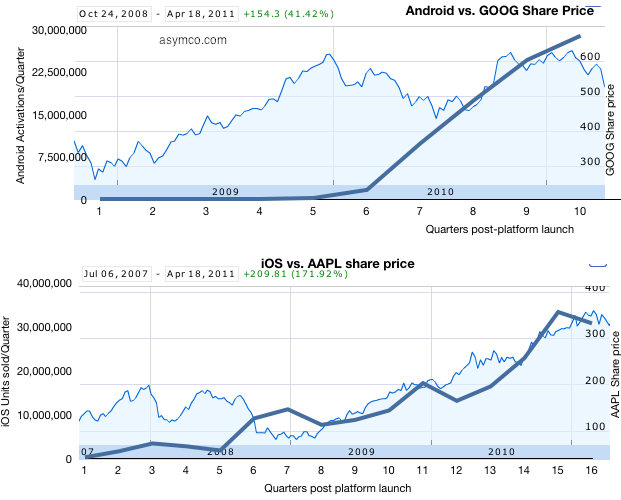
    The following charts tell the story:

    I took the platform growth data published yesterday and overlaid it on the share price data (source: Google finance). Each plot begins at the point in time when the respective platform was available in the market and ends today. There are two vertical axes: the left side axis shows "activations" or units sold and corresponds to the thick blue line; the right side axis shows share price and corresponds to the area chart. Overall date range and growth in share price is shown in the upper left corner.

    What can we interpret from this superimposition?

    1. Both Apple and Google shareholders saw share price appreciation during the two platforms' histories. Apple shareholders benefited more (+172% vs. +41%)
    2. Apple's share price appreciation seems highly correlated to iOS growth but Google's doesn't. Google share price had dramatic growth during 2009 while Android was moribund and was flat to down during 2010 when Android growth was explosive.
    3. We can also interpret the difference as Google's fortunes being far less dependent on mobile platforms than Apple's. Google has been subject to selling pressure this year due to corroding cost structures irrespective to platforms growth. Conversely, Google may not benefit from mobile computing as handsomely as Apple.

    Correlation is not causation and clearly there are many factors at work in share price changes but I think it's fair to say that Apple is obtaining fuel for growth with iOS while Google is in a more precarious situation with mobility--partly benefiting but partly threatened. The market behaves in bizarre ways in the short term but in the long term one can see logic and reason.

  6. The Android step function

    Research · 40 comments

    There is precious little data on Android units sold. There are estimates but no actual summary. Google themselves don't seem to know as they don't report sales, preferring to report "activations."

    Assuming that activations means "unique activations of new devices" then we can draw some equivalency between Google's reports and the reported units of iOS sold. There is some uncertainty with respect to iPod touch units, but that is not very big (estimates are drawn from Apple's reporting of overall iOS units at several points in time.)

    To estimate Android, I took the download rates currently available and placed them in the month when they were published. I then interpolated the data monthly and quarterly.

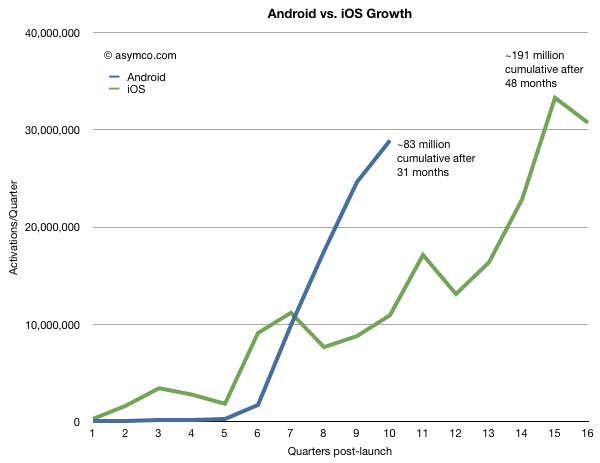
    To make the comparison more valuable, I chose to index the starting point at the launch of each respective platform and plot quarterly units (or activations). This way we can observe how the platforms ramped in growth and where they were at similar points in their lifetimes.

    The following graph results.

    There is likely to be more seasonality in Android data than is shown, but the impressive thing is that Android is running at three times the equivalent adoption rate for iOS at similar points in time. In fact Android is being "sold" as rapidly as iOS today even though iOS has been in the market about 15 months longer.

    Overall, cumulative units sold for iOS are still about twice as many but if Android will continue to grow as rapidly as it does now, it will likely overtake iOS in installed base in less than a year.

    One should be careful about drawing conclusions that this implies effective competition. Both platforms are growing very quickly. iOS is growing at at least 100%/yr and Android's second year was 65x bigger than its first. iOS growth is limited by the ramp rates of a limited portfolio of products. Android growth is limited by how quickly vendors can bring out products. Neither platform is demand constrained and hence they are competing for share of growth not for share of a fixed pie.

    Extrapolation is a dangerous game, but the chart above shows some predictability in Apple's curve whereas Android has a "step function" or discontinuous feel to it and that's a curious thing.

    Not so much for its lack of predictability but because it's so asymmetric to iOS.

    A dictum of classical physics states that in nature everything is continuous. However, in quantum physics everything is discontinuous. Both models of the physical universe have their uses.

    It should be noted that both business models represented above can also co-exist, at least for the foreseeable future.

  7. HTC and self-determination

    Research · 74 comments

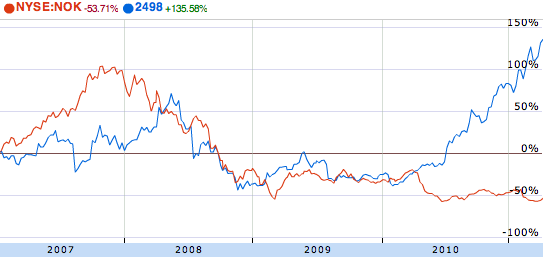
    HTC's market cap has just overtaken Nokia's. While market capitalization is a fickle thing, shifting with sentiment, this is still a remarkable feat. Nokia's market capitalization has almost halved in the space of a year while HTC has more than tripled from $10 billion to over $33 billion.

    If you roll back to 2007 and the start of the modern era of smartphones, you can see how the two companies stocks traded places:

    (source: Google finance)

    The recession was hard on everybody but HTC soared during 2010 while Nokia never recovered. Markets reward unforeseen growth and typically that means above-market growth.

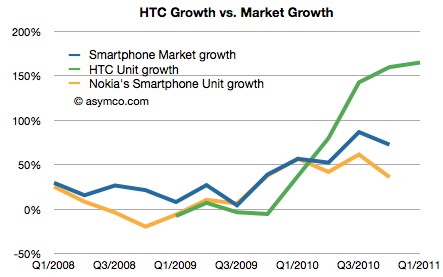
    That's reflected in the following chart (admittedly units and not profits, but pricing and margins for both have remained relatively steady.)

    As Nokia's growth lagged the market the stock was punished. As HTC's growth exceeded the market's growth, the stock was rewarded.

    But there are a few more observations to make:

    • HTC's smartphone business was under-performing the market for most of 2009. In fact, it was even in negative growth for three quarters.
    • The surge in growth coincided with HTC adding Android to its portfolio and given no other changes, seems to be causal.
    • Although not within the time range of the charts above, HTC had another period of rapid growth in the mid 2000s.

    A year ago HTC was making excuses and apologizing. Today they are more valuable than the largest phone vendors. All thanks to Android.

    But why no thanks to Microsoft?

    HTC was the primary Windows Mobile vendor a few years ago. They claimed at one point to have shipped over 80% of all Windows Mobile devices. They were also the leader in the Pocket PC franchise as they were the ODM behind the iPaq brand from HP/Compaq. HTC would not exist today were it not for Microsoft.

    The relationship is such that HTC is paying Microsoft for protection from (potential) Android IP infringements. HTC has also licensed Windows Phone though the relationship between Nokia and Microsoft must give them pause.

    But that's the whole problem. Those who live by the sword shall die by it. HTC was a Microsoft dependent and now they're a Google dependent. As the basis of innovation shifted, HTC was agile enough to make the transition. Perhaps they can execute a portfolio switch yet again as their upstream suppliers change whims or business models.

    But then again, as we saw with Windows Phone, perhaps not.

    If HTC wants to control its destiny it needs to control its suppliers. Now that its power and brand have grown, it needs software because in their market software is self-determination.

  8. Google vs. Android Part V

    Research · 145 comments

    When I began the series of posts on Google vs. Android I put forward some questions about the business logic of Google becoming an operating system supplier, especially as that role can be seen as being counter-productive to Google's strategy.

    I noted three strategy costs associated with a zero priced systems software bundle.

    1. A opportunity cost with other platform vendors, namely Apple who might retaliate against Google's core business.
    2. Versions of the software being usurped and modified to provide distribution to Google's competitors.
    3. Damage to Google's brand and positioning and negotiating power in relation with other members of their value chain.

    More fundamentally, Google-as-systems-software is asymmetric to Google-as-cloud-software and contradicts the value proposition that Google enables value in the web not in accessing the web. Android appears to be a nod in the direction that systems software still matters.

    In my numerous posts on the need for integrated development in the era of mobile computing, I also criticized any device vendor that chose to rely on a software stack from an external supplier as foolish. I claimed that they would end up creating uncompetitive products. I thus labeled Google's pursuit of them as ultimately futile.

    More than a year has passed since I began this critique of Android. It seemed quixotic as Android volumes exploded and a mad rush to the platform spun it into becoming the biggest mobile platform by units.

    However those costs did not go away. As the platform grew, they compounded. At first I wondered whether Google management was seriously considering the cost or whether it was giddy with the semblance of success.

    Well, finally, it seems that Google management has begun to acknowledge that these costs exist. In a recent Bloomberg story there are many claims that Google is reversing many of the operating principles of Android. Namely:

    • Restrictions on who gets what version of software when
    • Restrictions on what changes can be made to the software
    • Requirements for approval for source code changes

    These changes, if feasible, will affect the ecosystem dramatically. It will also reduce the second type of cost associated with the platform (the cost of enabling competitors.)

    Good news for Google then.

    There are still the other problems (disconnect from business model, loss of goodwill, damage to negotiating power). But there is actually a more sinister new problem brought about with the new crackdown: Android will no longer be disruptive.

    I also wrote a few posts (e.g. What has Android done for Apple?) where I claimed that Android has the power to accelerate smartphone adoption, especially in the "Wild East." The power of Android was with the little vendors--the ZTE and Huaweis of the world. They could finally make smartphones cheaply--almost as cheaply as voice phones--and not have to negotiate licenses and pay for software IP.

    It would be these smaller "unbranded" vendors that would really disrupt and, with them, Android would become ubiquitous for the billions of mobile broadband non-consumers.

    However, with the new policies, it's much harder for this to happen. Smaller vendors will look at the new hoops they have to jump through and probably say "no thanks." In a beauty contest, they don't look so good next to the big brands.

    They may turn to homebrewed versions of Linux or new forked Androids. This redefinition of openness will essentially remove Google from the disruptive trajectory of mobile computing.

    So we're back to the old question: Google vs. Android, who wins? If Android still has hidden costs to Google and, with its sheep's clothing cast aside, no longer offers significant distribution to the low end then how will Google benefit? The answer that there will be additional ad revenue does not cut it. That revenue would have come from placement deals with other incumbent platforms (just like Google manages to compete on PCs without having to provide its own OS).

    As Google figures this out, its licensees are at the mercy of the ensuing decision. Good luck with that.


  9. Disney (still) loves Android

    Research · 51 comments

    We removed the malicious applications from Android Market, suspended the associated developer accounts, and contacted law enforcement about the attack.

    via An Update on Android Market Security - Official Google Mobile Blog.

    It's great to see that Google is quick to call law enforcement to prosecute those who took advantage of its open(!) market. Now I wonder what Google will do about policing copyright infringement on the same market .

    In September I wrote a note about how some of the top applications in the Market seemed to be infringing on copyrights (and attempting to hide the fact). Today I went back and searched for "Disney". I was offered about 350 apps and I am pretty sure that none one of them is endorsed by Disney.[1]

    While there is a vast amount of copyright infringement on YouTube, Google is actively working with video content publishers to either compensate them or to take unlicensed content out. This after extensive legal maneuvering.

    I'm not sure how policing or licensing deals will be struck for content on the Android Market. Apps are content, but of a different sort. It's not so easy to scan for infringements. It's not easy to draw up a compensation contract. The revenue model is ad-based (by and large.)

    The fact that there seems to be little activity[2] to filter the material today indicates that it's not a burning issue for Disney. Could it be because Disney is unaware of the success of Android Market, or could it be that Android Market is not big or successful enough to become a priority at Disney legal?

    ---

    1. You can do the same search in iTunes and get about 120 iPhone apps, though at least half are clearly sanctioned with most of the rest being related to the parks franchise.
    2. There might be activity to police the copyrights as, unlike in September, there don't seem to be many infringing apps in the top seller or featured sections.
  10. The platform as a promise

    Research · 39 comments

    In a recent answer on quora, I wrote that I did not believe developers are tempted primarily by economic incentives when choosing which platforms to work on. I suggested that they hire platforms because of their star-making potential and that star-making value is not a something that money can buy. Using Hollywood as an example I suggested that subsidies decrease the perceived value of a talent-oriented platform.

    The notion that a platform signals meaning to developers led me to think about how mobile platforms signal meaning to consumers. I have a hypothesis that platforms can and should be treated as brands. This point of view allows platform orchestrators to develop a comprehensive market-driven strategy for platforms that transcends technical debate.

    First a word about what a brand is.

    Brands are vaguely defined. They are identities, names, symbols or attitudes or all of the above. Marketers struggle to define brand value because they are trying to encapsulate what they sell into a single symbolism. The problem is that there are vast varieties of things being sold. Every product or service has different meaning to buyers and it cannot be captured the same way. Because I cannot rely on a single definition I have to create a specific definition of brand to the context of mobile platforms.

    I choose to define brand in this context of platforms as the "promise of the platform". A platform is a promise that the products will function in ways beyond what's "written on the box"; that the product is extensible and has value provided by an ecosystem bigger than the original vendor.

    For example, although the iPhone is based on iOS platform, iOS is not the brand. "iPhone" encompasses the platform brand and it's a promise to users that they can expect apps and content and an extended flow of innovation to continue well beyond the initial purchase of the device. This brand value is attached to iPod touch and iPad even though it's not communicated as a unified platform. In other words, consumers don't look for "iOS inside" but the implicit value of "there's an app for that" covers all the products.

    When looking at platforms as promises or brands, we can observe how some are more powerful than others.

    Symbian or Series 60 was never marketed as a brand and Nokia users are generally unaware of what OS or platform their phone runs. Does Symbian make a promise of an "extended flow of innovation to the device" after the time of purchase? It's hard to make that promise when you can't communicate clearly anything but device specs.[1]

    Conversely, Android has become a strong brand. The Android label (and mascot) is frequently used by device vendors to signal platform brand value.

    How did Google achieve in a year this value with Android while Nokia continued to squander any brand goodwill around Symbian for a decade? The answer lies in marketing decisions. Nokia wanted to focus on the hardware as value (and the Nokia brand as the way that value is encapsulated). Google and Android OEMs wanted to lift their own device brands into becoming smartphone brands and attached the value of Android branding to them.

    Which brings me to the question of how to design platforms as powerful brands. Creating awareness of extensible value is the way to signal to developers and all members of an ecosystem that a platform is valuable. Apple did this very well with their iPhone ads which focused on the app value of the product. They showed the product in use and did not rely on metaphors. Developers saw other specific apps being advertised by Apple and it engendered huge star value in the platform. Every developer wanted a shot at being featured in an iPhone ad. The iPhone could and did make stars.

    But you can't make the great promise of the platform without the ensuring consistency, reliability and longevity. Fragmentation, malware, copyright infringement and arbitrary termination amount to the confiscation of platform value by the orchestrator. Poor custodianship results in the destruction of both ecosystem and end user value.

    --

    Notes:

    1. The lack of platform promise for Symbian may also explain why Nokia believes they can sell 150 million Symbian devices which have a deprecated platform. Those devices could be sold as feature phones, not platform products. The challenge for them will be to get a smartphone price for a feature phone product.
  11. Google and Apple as mobile co-belligerents

    Research · 94 comments

    The relationship between Google and Apple is an interesting one. It's enticing to declare them "at war" with one another, but that type of relationship does not account for the collaboration and partnerships they enjoy. To wit:

    • Google pays Apple for default Search placement on Safari. This means that Google treats Apple as a distributor.
    • We can presume that there is a deal between the two over Gmail and Maps on the iPhone as well.
    • AdMob is available on iOS without hindrance.

    The business relationships between the two companies are self-evident. However, I would suggest that there are more important strategic reasons why Google and Apple are in fact implicitly collaborating against a common goal.

    The concept of "co-belligerence" may describe the relationship: The state of fighting against a common adversary without a formal alliance and without a guarantee of non-agression against each other.

    The common adversary is the telecom industry. It's an industry being undermined by the technological change of mobile computing and its profits are up for grabs. Apple and Google have different approaches in implementing this change but in the end they dismantle and absorb profits from the same target.

    They are also benefiting each other. Apple benefits Google by creating user experience innovations which Google can rapidly copy. Google benefits Apple by increasing smartphone consumption--educating markets to the value of mobile computing and crippling the profitability (and thus the ability to innovate) of Apple's direct competitors.

    If I may belabor the point, it's like the concept of fast food. One company invents the fast food franchise process, another popularizes it and creates demand. Finally, the innovator comes in with a premium brand to split the market.

    Apple innovates in product innovation with Google as a fast follower. Google then innovates on distribution and penetration enabling Apple to follow with a skimming strategy.

    The end result is a more rapid and thorough profit evaporation from incumbents with corresponding condensation around the entrants.

    To visualize it further, consider what the market would look like if one or the other of the co-belligerents was not participating. Could Google have developed their software without the iPhone as a reference design? At the same time, as Android eliminates the opportunity for alternative software investments by competitors[1] could Apple have remained the only integrated vendor with a uniquely high profit margin?

    Of course, this is not a guarantee of success. New platforms may still take root and integration by HP may actually pan out. But the point I'm trying to make is that, for the time being, Google and Apple are not so much adversaries as comfortably busy winning against a rather weak common target.

    ---

    Notes:

    1. Consider how hard it is for OEMs to justify investing in their own OS post-Android. Consider the desperate status of Nokia who abandoned a broad ecosystem and the paucity of alternatives.