In a recent tally of mobile OS market share estimates from Canalys, the market was organized by OS vendors. The number of devices sold by operating system vendor includes as many OS's as each vendor may supply.
For example, Microsoft licensed two different OS's during the period: Windows Mobile 6.5 and Windows Phone 7. Nokia also offered multiple versions of Symbian, which have varying degrees of inter-operability.
Google's offerings include (as per footnote) OMS and Tapas platforms in addition to Android.
Fragmentation is not a new subject as OS licensing models have been ripe with it for as long as they existed.
What I want to draw attention to is the concept of Google as "vendor."
A vendor in the traditional supply chain model is a supplier that sells to an up-stream value-adding stage of the value chain. The word itself has as its root the word "vend" which means to sell.
But we know Google does not sell Android. And it's not just that Google builds a product and ships it for free.
There are no contracts associated with the transaction of downloading the Android source. No contract means no obligations, no warranties, no terms and no conditions. The product is not indemnified against litigation. There are no licenses, no support, no copyrights and no patent license granted.
The contract-less nature of Android makes it easy to distribute. It's one of the key reasons why distribution can grow at 600% a year--there is no distribution in the classic sense. The real disruptive advantage for Android lies in the removal of distribution costs (not just development costs). Google themselves admit that they have no idea who implements the software and how it's used.
Which makes the classification of Google as a "vendor" a misnomer. The notion of 'vending' something implies a contract. What Google does is write code and place it on an FTP server.
It's a wonderful way to save on SG&A (there is no sales, general or administrative expense.) But as everyone knows, there is no such thing as a free lunch.
By avoiding any contractual engagement with the authors of the source code, implementors are subject to independent litigation for IP violations. This is why HTC and Motorola are targets for Apple and not Google. Google is no more liable for writing Android than the author of a book on bomb making is liable for the bombs put into use [1].
Patent violation rests with implementation, not the writing of the idea itself.
Furthermore, Google cannot ensure Android users have any specific experience. They can't encourage upgrades, service models or any form of common UI. The experience, like the protection of property is the responsibility of the implementor.
Can Google change this approach with Android? Not as long as Android is open source. Can Google change Android from being open source? No, they don't own the source to Android. Nobody does.
---
Notes:
If the bomb making book was a copy of another, then the author is liable, which is the case being made by Oracle.
But in this forum I've been critical of their strategy. Though I'll be the first to admit that such criticism is not founded on data but on intuition, strategy is always made in a vacuum of data. It is just an unfortunate fact of life that we don't have data about the future.
But what data we do have is about the past and it shows the contrast between Apple and Google.
As a sample, let's look at the performance in the last quarter:
[nohang]
Growth
Google
Apple
Revenue
26%
70%
Earnings
29%
75%
P/E
24.13
18.57
[/nohang] Apple grew about 2.5x faster. The companies are in very different businesses, but the money they make is the same color. The investors have been paying attention:
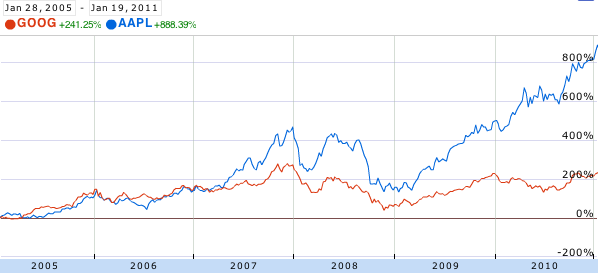
In 2005 and 2006, Apple and Google were neck-and-neck in terms of returns to shareholders. However, with the iPhone's arrival in 2007 the stocks diverged. Google gained 38% since January 2007 while Apple gained 300%.
However, going forward, the market is kinder to Google than to Apple, punishing Apple's 75% growth with a P/E of 18 (ex-cash 15) and rewarding Google's 29% growth with a P/E of 24 (22.5 ex-cash) . Although Google's P/E is proportionate relative to its growth, Apple's P/E implies deep pessimism.
But does Google's performance suggest management failure? Certainly not. It's been a great performance. Google is arguably at the top of its game. Market share of search has never been better.
Cracks in strategy are hard to spot. One hint is that most of Google's R&D efforts are defensive. Building browsers and mobile operating systems are methods to ensure they have distribution of search to as many screens as possible. These are expensive means to ensure channels are available for distribution. Expensive not only in terms of engineering costs but also in terms of relationships and opportunity costs.
But even a defensive posture is not sufficient for management change. What I think is the most serious failure is that for the past five years Google has not addressed the possibility of search itself becoming commoditized. Social media and app economies are asymmetric to search. They make money in different ways and appear to be less efficient or effective means to reach users, but they are growing. Facebook has overtaken Google in terms of page views and apps are a new interaction model for cloud-based content that does away with the indexing model Google champions.
The real condemnation of the leadership at Google is that there has been a failure to create entirely new disruptions. As the stock chart above confirms, Android and Chrome are, if successful, sustaining technologies for Google. That's not going to be enough.
And so we come to the question of Chrome and H.264. First off, it should be clear that video codecs are infrastructural technology[1]. They are commodity algorithms which are generally invisible to users. They are ubiquitous and are "shared" in the sense that they are available for licensing often without much in terms of cost.
So they don't really offer strategic advantage to the adopter. Some may end up adding slightly more to a cost structure than others, but not in a way that determines strategy.
Flash on the other hand is not infrastructural. It is not shared, it is not invisible to users, it is a brand, it has a significant business model and market value. It is sustaining to Adobe.
So the argument I've heard against Google's decision is that they are using an infrastructural technology decision (a new video codec) to placate or sustain Adobe Flash, at the expense of Apple, a potential or perceived rival.
If this was the plan, it would be a strategic mistake.
The reason is that Flash will live or die on the basis of whether the business model is sustainable. That is decided by whether an integrated, proprietary technology is over-shooting and unable to adapt to a mobile computing future that demands modularity from components. If Flash is doomed, then its fate is inevitable.
In other words, you cannot use an infrastructural technology to defend a sustaining, possibly over-serving technology.
Which is why I don't think this was the motivation.
I rather think that Google's decision is a misguided emphasis on technical details in lieu of engaging in a deep strategic re-evaluation.
A RISCY BET
To illustrate the way technology companies fail by placing their strategy burden on technology decisions, here is how John Sculley made a decision to go with PowerPC and how he lived to regret it.
[Our best technologists] came back and they said it doesn’t make any difference which RISC architecture you pick, just pick the one that you think you can get the best business deal with. But don’t use CISC. CISC is complex instructions set. RISC is reduced instruction set.
So Intel lobbied heavily to get us to stay with them… (but) we went with IBM and Motorola with the PowerPC. And that was a terrible decision in hindsight.
...
we totally missed the boat. Intel would spend 11 billion dollars and evolve the Intel processor to do graphics… and it was a terrible technical decision. I wasn’t technically qualified, unfortunately, so I went along with the recommendation.
I would argue it wasn't a failure of technical knowledge--the technicians were right about the architectural advantages. It was a failure of strategy and understanding of innovation dynamics[2]. Sculley asked the wrong question. The question to be asked is not "CISC vs. RISC". Rather, it should have been: Is the architecture the relevant decision point or is it the choice of partner? The technologists put the architecture choice above the more strategically important question of whether Intel had the fuel to continue getting better even if saddled with sub-optimal architecture.
That decision sounds very similar to what is being done today at Google. Increasingly, technology decisions are leading strategy. The question should not be "H.264 vs. WebM" or "HTML5 vs. Flash". Google should be asking itself if mobile computing will allow browsing to remain the predominant interface for internet consumption. If, as I suspect, it won't then no amount of browser tweaking will help. The browser is already infrastructural. It can't be the object of strategic focus.
To get an idea of how this would work consider Flipboard. Flipboard turns the entire browsing paradigm inside-out. Instead of consuming social media inside a browser, the app presents it in a more natural magazine-like format.
What will happen when that media becomes predominantly video? Flipboard will be far more influential to content producers and their decision on which codecs to support will lead adoption.
By focusing on threats and byzantine standards machinations, rather than on broad, experiential learning, Google missed (yet another) next big thing.
---
Notes:
In IT does not matter. Nicholas Carr introduced the concept of infrastructural technologies. Becoming Infrastructural is what happens after a technology overshoots the market and stabilizes into a commoditized ubiquity. It ends up being "shared" in the sense of being openly and sometimes freely licensed.
To be fair to Sculley, the research on innovation theory that would have helped him had not yet been published.
Thanks to David Chu for forwarding the data that made this possible and reader Narajanan for spotting the divergence in platform efficiency.
iOS and Android are both growing rapidly. According to Gartner, during the first three quarters of 2010, about 44 million iOS devices and 36 million Android devices were put into use. That's 80 million devices. An amazing achievement for two platforms that did not exist 3 years earlier.
But obviously not all devices are used the same way. Devices which have unused capabilities limit network effects for a platform and for the category of product in general. Question is: how can we measure the "smartness" of a device; how much more likely is a device to be used as a mobile computer vs. being a regular phone?
The best proxy I can think of is a measurement of browsing use. The smarter the device, the more browsing is a joy and the more it is actually done. Browsing leads to more data load on the network and creates a virtuous circle of revenues for the mobile computing value chain.
If we could measure the increase in browsing generated by each additional phone, we could compare whether one platform is better (specifically, more efficient) at generating value asymmetric to voice.
Fortunately we have data from Netmarketshare.com (see sources below) which attempts to track browser consumption and hence allows us to measure this variable. What we need to pair that with is the incremental increase in the installed base of devices.
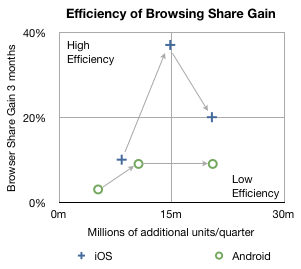
In the chart below I plotted how much browsing share increased for every phone sold by platform over the first three quarters of 2010.
The arrows indicate the sequence in time from Q1 to Q3. The vertical axis shows gain in share three months after the corresponding number of units shipped in the previous quarter on the horizontal axis. So, for example, the second circle means that in the second quarter approximately 10 million new Android devices created a gain of about 9% in browsing share. In the same quarter, 14.8 million iOS devices created about 37% gain in browsing share.
In the third quarter approximately the same number of iOS and Android devices shipped (iOS including iPads and iPod touch) but the browser gain was 20% for iOS vs. 9% for Android.
A line drawn diagonally from lower left to upper right (0,0 to 30m,40%) could represent the average gain in share per units sold--the sort of measure we're looking for.
Measuring that slope tells us that, on average, every million devices sold should generate a gain of 0.75% share[1]. I took the additional step of labeling two quadrants which are orthogonal to the expected trend. If browsing increases dramatically faster than 0.75%/million units then I call those devices sold as creating "highly efficient" browsing gain. If browsing increase lags dramatically below 0.75%/million units then those devices added share with "low efficiency".
So four data points follow the trendline down the middle of the chart, however, there are two notable outliers. Finding the causes for these outliers gives clues to what's happening with the platforms.
I believe the explanation for iOS's second quarter's extraordinary efficiency is that was the quarter when the iPad launched. It seems to have yielded a very strong spike and the trajectory of iOS improved even into the next quarter as those iPads continued to be in use. iPad seems to be a very effective way to gain browser share.
I also believe that the cause for Android's fall in efficiency in the third quarter was that it began to be sold in large quantities in the developing world. The third quarter saw a rapid acceleration of sales without a proportional increase in what was measured as sales in the US (and Europe).
Interpretation
If this trend continues, and there is no guarantee that it will, then a question could be raised about Android's value to, of all people, Google.
The core value of Android to Google is the increased use of browsing and hence search. All the other Google services and in-app ads are tiny opportunities in comparison to the potential of search on mobiles. One could argue that the raison d'être for Android since day one was to create browsing consumption. In that regard it's not as good at doing that as iOS is.
Perhaps Google can justify the under-performance of consumption of browsing (and hence search) on Android devices as benign since there is no marginal cost added to supplying Android to non-consuming devices.
But I wonder. There is the problem of opportunity cost: Those iOS devices that create more browsing activity are going to take more share. The more they do that the more Google will have to pay Apple for placement as the default search in mobile Safari.
It may be a stretch, and perhaps the data is wrong, but that's what this exercise is all about: how much can we learn from fragmentary data? Without a hypothesis there is no discovery.
-----
Notes:
Since these platforms have very low shares (less than 2% for iOS and 0.3% for Android by November) almost all the gains can be assumed to be against other browsers (e.g. Internet Explorer) and not against each other.
Update: the original Unit estimates excluded iPad and iPod touch which have since been added.
Since I spend most of my time thinking about what will happen, at the end of each year, rather than looking forward I like to look back to see how wrong I've been. The great thing about being wrong is that you learn something. Especially if you use a foundational theory to tie concepts together. Theory building is all about finding anomalies that adjust and improve it.
Fortunately, exactly one year ago, on December 30 2009 I wrote an article asking if Android was disruptive. It turned out to be the right question to ask for 2010.
What have I learned since?
My main argument in late 2009 was aimed at the reaction of the recently launched Nexus One. A product hailed as disruptive to mobile operators. I did not see it that way. In that respect I was right. The distribution juggernaut any phone platform faces stopped the Nexus One dead in its tracks.
I wrote:
Here’s the problem: since mobile broadband is by all accounts not good enough, it cannot be disrupted. Operators are very critical in building out this new mobile computing future and they are investing and will reap rewards. Bitpipe models will only emerge after 4G when there will be ubiquitous high speed networks and competition will shift away from coverage and more to price and convenience of plans.
What is happening instead of operator disruption is that mobile voice which is more than good enough is being disrupted. Businesses built around mobile voice (e.g. handset vendors who have not developed a viable business model around data) will simply evaporate and their profits will condense around entrants who have mobile computing platforms.
So the operators are as strong as ever. But the Android platform lived to fight on, regardless of the Nexus one. And it grew in ways I did not anticipate. I had expected integrated players to maintain a large share because they would be able to improve the product more rapidly than modular vendors (and assuming that the product needed improving).
Google is moving on this opportunity but they are not executing in a way that ensures they control the future platform due to the their being on the wrong side of the modular/integrated dichotomy.
So Android grew but it's not yet creating profits. It is perhaps laying the foundation for future profits and defending existing profits for Google but it is not yet a big profit center[1]. That is a cause for worry. Disruptors need to be hungry for profits and patient for growth.
I concluded:
Android will disrupt but I expect it will take 10 to 15 years. The life cycle of a new global network generation rollout is about 10 years. We’re in the middle stage of the 3G cycle that traces its beginnings to early this decade. 4G will take another 10 years.
Given what's happened this year does this forecast still hold?
Mainly yes. I stand by the notion that operators will be in the driver's seat for a few years to come. However Android has grown in an unexpected way: adoption by unbranded or relatively unknown vendors selling in emerging markets.
The Grey (market) Elephant in the room
Until 2010, it was very difficult to sell a phone without a recognizable brand. This is because brands helped overcome purchase anxiety for those buying a device for the first time. Brands mean trust and the lack of brand meant risk. Those who cannot afford to make purchase mistakes are more likely to lean on brands than the affluent.
But 2010 has seen a shift away from device brand value and more toward platform and function value. This shift was largely unforeseen and is very disruptive.
All those vendors are likely to adopt Android and in doing so will explode the low end of the market. They may even crush the branded voice-oriented market.
This growth can be slowed by operators but market forces will be very strong. These devices sell in grey markets and are often unlicensed, unbranded, untaxed and unregulated (and may even be illegal due to the absence of IMEI numbers).
So this is the real wild card for 2011: unbranded devices running Android could be the PC clones of the post-PC era. Will this phenomenon last or will the brands fight back? If they fight, the only weapon they could wield is innovation.
---
[1] Mobile efforts at Google are generating over $1 billion in revenues per quarter however these efforts include various other assets including AdMob which was acquired for $750 million. Furthermore, the headcount for Android and these other efforts is not small. I've heard as many as 3000 people are devoted to Google's mobile efforts.
Andy Rubin, the executive in charge of Google’s mobile software effort, said that international expansion lay behind the latest advance. Speaking in an interview with the Financial Times, he also predicted that a boom in sales in India, Brazil, Indonesia and other emerging countries would contribute to the fast growth rate for the foreseeable future.
Quoting independent research suggesting that Android has also come to account for half of smartphone shipments in China, Mr Rubin said that the open-source nature of the software had made it popular there. However, in the wake of Google’s dispute over censorship with the Chinese government, Android handsets shipped by China Mobile, the dominant supplier, do not carry the company’s search or e-mail services.
This was already confirmed by the data published here this morning.
Verizon alone or with the other US operators cannot account for the majority of Android volumes and anecdotal evidence points out that Europe is not contributing much more.
[ITG sent an explanation of their methodology and there is no indication that the data represents inside information.]
ITG Investment Research analyst Matthew Goodman is forecasting monthly sales record for all of Verizon's devices "based largely on our proprietary daily point-of-sale data from thousands of independent wireless retailers across the US."
Assuming the data is accurate, we are going to dive into it but I will state up-front that without confirmation, the conclusions below should be taken with a grain of salt. All statements should be read with a preceding "if the data is accurate..."
So, if the data is accurate, here is what I conclude [1]:
Verizon Has three strikes against them:
The iPhone has stolen their growth
They are facing the prospect of a single OS platform supplier
Android is not competitive vs. iOS
The iPhone has stolen Verizon's growth
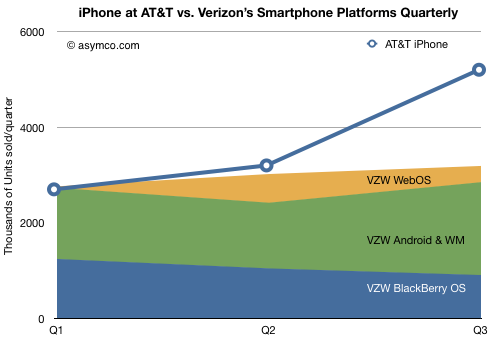
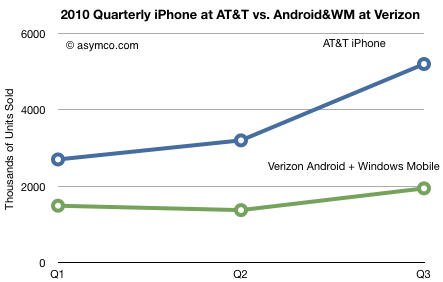
The chart below shows the performance of all of Verizon's smartphones vs. the iPhone at AT&T. The area chart shows how Verizon's volumes grew from 2.7 million in Q1 to 3.3 million in Q3. Not a bad story in itself. However, the iPhone at AT&T went from 2.7 million to 5.3 million in the same time frame. Relative to just the iPhone, Verizon has been underperforming over the last quarter.
Those additional 2.4 million iPhone/AT&T activations in Q3 could be due to replacements but the same could be said for Verizon's volumes. The fact remains that iPhone alone is nearly twice the volume of all of Verizon's smartphone activations.
Just to be clear, this is a direct, apples-to-apples comparison. AT&T and Verizon smartphone performance figures are highly comparable. The two operators are highly representative of the US market. AT&T and Verizon Wireless raked in 75% of all mobile data revenue in Q2 of 2010 and account for 62% of the U.S. wireless customer base.
In addition, Verizon enjoys a larger customer base (has 92.1 million subs vs. AT&T's 90.1 million.) Over the time frame of the data the overall market did not increase dramatically therefore the conclusion that AT&T's win is Verizon's loss is plausible.
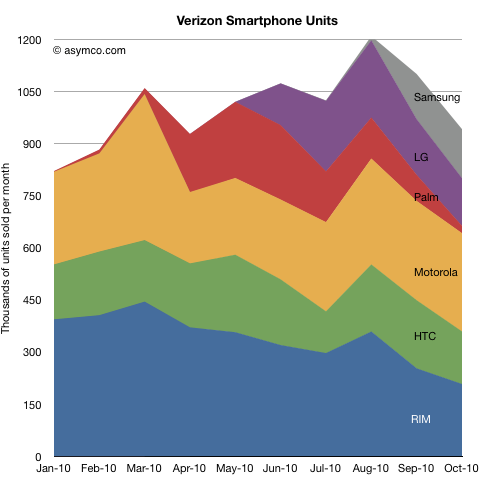
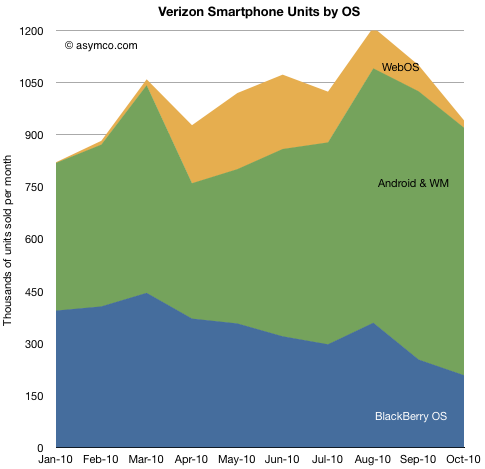
I used quarterly data so that iPhone at AT&T could be compared. But if we look at monthly data, the story gets worse:
These are absolute volume figures. You can see how RIM's fade was replaced to some degree by new vendors. However, growth hit a wall in August. Following widespread iPhone 4 availability, sales dropped. Coincidence? Perhaps, but the drop happened even with the addition of Samsung volumes.
That's strike one.
Verizon is facing diminished degrees of strategic freedom
The other notable is that even though Verizon doubled the number of vendors selling smartphones, it seems they are growing their smartphone base slower than the overall market.
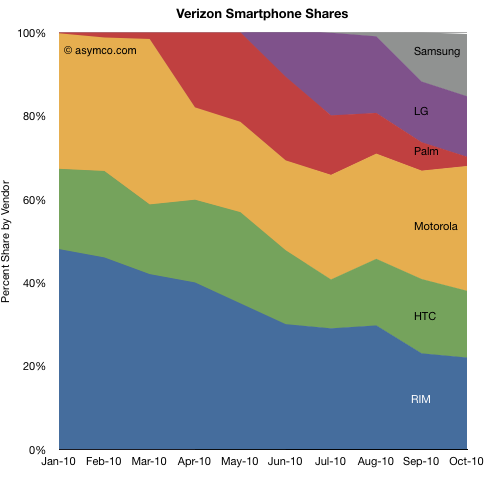
Consider each vendor's share is shown below:
From three vendors to six. Shares are roughly evenly split (except for Palm) but none of these vendors are able to drive volume growth.
Consider that Motorola Droid is outselling RIM. This should be rightly noted as amazing. It plainly shows the power of Android. However that power is not something Verizon will benefit from. Quite the opposite.
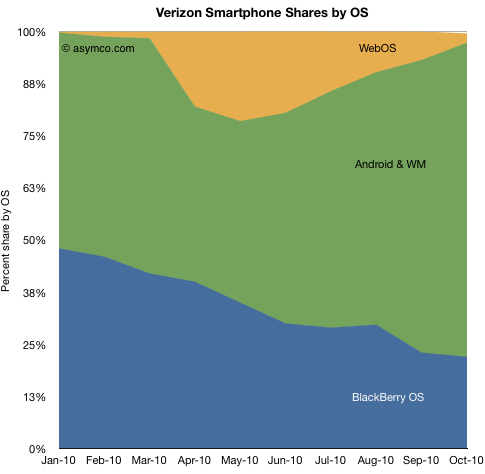
Consider the share map by units and share of each OS:
Android (and WM, though that's likely to be a very tiny part of the green area) made up 75% of all smartphones sold in October. It's possible that the share could grow to 90% as RIM continues to fade.
For Verizon this would be a serious problem. Although Verizon used to have a disproportionate share of RIM's products, that OS was not enabling an ecosystem like Google's. It was a product narrowly defined around messaging. Verizon is facing the prospect of a single OS supplier who may or may not maintain alignment with Verizon's core profit algorithm. If they diverge, Verizon's bargaining power will be strictly limited.
Strike two against Verizon.
Android is barely enough to keep the battle with AT&T from becoming a rout.
In an apples-to-apples comparison, in Q3 the iPhone at AT&T outsold Android at Verizon (remember, same addressable market) by a factor of 2.5. This is with a variety of devices and vendors thrown in the market. We hardly ever get to see this finely grained a comparison when looking at platforms.
I wrote this up as a lack of competitiveness. It may seem provocative, but I define competitiveness narrowly: the competition is for a purchase decision on equal terms. These purchase decisions are fiendishly complex to predict, but the data speaks: whether it's due to brand, visibility or performance and in spite of "antennagate" the iPhone is cleaning up.
That's strike three.
The devil they know
By 2009, Verizon was probably optimistic that they could head off AT&T (and Apple) at the pass. With the vast array of vendor Android roadmaps laid out in front of them they saw a way to stem the flood of defections. I think that optimism dissipated sometime this year and was replaced by a more dreadful prospect than what iPhone presented in 2007.
It is perhaps coincidental that the rumors of a Verizon deal with Apple seem to have started in earnest right after August. It's thin, circumstantial evidence, but the only evidence we have to corroborate the data above is that Verizon has been signaling more desperation.
Reading further into the data, I would say Verizon faced these problems and decided that they had to throw in the towel. Apple may be the devil, but so could be Google. Apple was predictably evil. But Google? The devil you know is perhaps better than the one you can't predict.
What's more, the devil Apple seems to be helping your worst enemy way too much and the unpredictable one does not seem to help all that much.
Final question: how many iPhones will Verizon sell
I think this data shows that Verizon has another reason to sell the iPhone. The underperformance of their smartphone franchise is not the only determinant, but it is perhaps another straw on the camel's back.
What would happen if (or more likely when) Verizon sells the iPhone? I believe they will sell them at the same rate as AT&T does.
The data shows that Verizon sold, on average, about 3 million smartphones per quarter during the first nine months. That's about 1 million a month. That was based on three platforms, six vendors and widespread promotion.
The iPhone sold almost 4 million a quarter over the same time period.
Verizon users bought smartphones at a lower rate than AT&T users bought iPhones. This is even though the two carriers have approximately the same subs base which churns very slowly. Since a mass-market product will appeal equally to statistically equivalent populations the product should be taken-up with similar vigor.
So the question is not whether Verizon can sell iPhones at the rate of 4 million a quarter. The question is only whether these 4 million will be in addition to the 3 million that are currently buying non-iPhones.
My guess is that the 3 million run rate for non-iPhones will drop, but not to zero.
The impact on the other vendors supplying Verizon may be strongly negative depending on the level of promotion Verizon puts on the product. That promotion budget is usually fixed as a percent of sales. What Verizon applies to iPhone will be taken out of what is spends on Droid. I have always said that operators will be motivated to balance their supplier power. The promotion budget is the primary instrument to meet that end.
On the other hand, the overall market will grow so 2010's 3 million/Q will be 2011's 6 million/Q. There is plenty of room for multiple platforms.
So my conclusion remains that iPhone will find at least 8 million new users with Verizon. The analysis above give me confidence to increase the upper bound to possibly 12 million.
Verizon striking out means they need to change the way they play. The iPhone is a new ball game.
------
[1] To assemble this discussion I used only the data provided in the article linked above and the officially published iPhone activation numbers from AT&T. Obtaining specific smartphone vendor volumes is a matter of reverse engineering the share chart and cross-referencing it to the table of vendor sales.
In the latest version of Android, Google shifted from bitmaps to vector rendering for maps. The shift is probably more a function of available processing power on the device than a strategic shift to position value on the device rather than in the cloud. Vector maps, which are much more efficient in terms of bandwidth and local storage, have been the choice for in-car navigators but Google has always been using bitmap tiles which are fetched from a server and delivered only if the device is using a data connection. The downside for vectors is that they require a bit more local processing power.
I doubt that Google's move to vectors is part of a shift to more app-centered/edge-of-network strategy.
How is this relevant?
Google has been riding a wave of re-centralization of value toward the center of the network as broadband made the cloud feasible. Keep in mind that Microsoft rode a wave of de-centralization as value moved to the PC and away from the mainframe. As intelligence was pushed to the edge, Microsoft accrued value from enabling the edge as a locus of productivity. This is no small thing.
Then came apps.
The supernova that is the App Store illuminated the possibility that apps are perhaps a "pushback" on the center. Like all good disruptions this was unforeseen: Apple built the store and the apps sold; by the billions. Apple joined the world in a scramble to react. Something profound was happening, but the very brightness of this explosive growth blinds us to what is actually going on.
My hypothesis is that there is a tug-of-war going on between the mobile cloud and the device-at-the-edge. Both will become better and neither is good enough. Technology roadmaps point to both higher availability of local storage/processing power as well as faster, cheaper and more ubiquitous mobile broadband. So technology insight by itself is not enough to give us a clue to the outcome.
What I would focus on is what is more natural for the user. Note that Twitter and Facebook both have better interfaces with their apps than they do with their browser interfaces. That and innovations in game interaction points out that apps are as much a disruption of UI metaphors as they are of the locus of power in the network. It would not surprise me if people end up spending a larger part of their lives tethered to device-enabled social media, "firing" the PC from the job of social interaction.
If we believe the app will grow as the preferred interface for the web (and I'm leaning in that direction) then the implications are potentially harmful to Google. Google does not "do" interfaces. Their strategic assumption has been that interfaces are commodities. The browser is the universal interface. Perhaps HTML5 will offer sustenance to the concept, but it's not a panacea. Web apps have a long way to go to become competitive with hand-crafted app UIs. (While web apps have been possible for iPhone since its inception, developers vote en-masse for apps and almost zero popular web apps exist. Ditto for Flash-to-app interface ports.)
This brings us to focus on the asymmetry of business models.
the App Internet
What we end up with is the "app internet": a potential disruption of the browser-as-interface and the re-integration of the user experience around the device. Because the iTunes store allows money to be attached to new interface innovations, developers follow and compete on better interfaces rather than on access to the back end. The asymmetry ensues from the fact that by attaching profit to the point where the user touches the screen, Apple took the basis of competition for developers away from the cloud.
In other words, the point where the electrical charge of the human skin is detected is suddenly the exact location of value capture from mobile computing.
Of course, Google is responding, but since they did not focus on seamless and curated experiences, developers are not seeing returns for investment in interfaces at the touch point. As a consequence, Google apps developers seek ad revenues. In turn, this is a road that leads to less innovation in interfaces and more innovation in network-dependent services.
I sense a distinct asymmetry in app trajectories between the platforms due to core business model choices. Asymmetric competition causes the great fortunes to be made and great fortunes to be lost.
According to Morgan Keegan analyst Tavis McCourt Chinese consumers purchased 8 to 10 million smartphones last quarter--implying 400% growth from the 2 to 3 million last year.
How quickly things change. According to McCourt, Android now represents nearly 50 percent of smartphone volume in the country, up from zero last year. And Apple’s iOS, while a niche player with less than 500,000 iPhones sold last quarter, is ramping up quickly, thanks to the successful launch of the iPhone 4 in the country last month.
The growth of Android is far beyond what a single company can engineer. It represents the effect of uncoordinated and uncontrolled distribution. Google does not have to market, license or write contracts for Android. It also does not necessarily benefit from this work. It enables excess device manufacturing and distribution capacity to embrace browser-enabled devices.
Android is clearly accelerating smartphone adoption and is competing very effectively with non-consumption. Without Android I doubt many of the Chinese manufacturers who are building more smartphones today would be doing it.
One question that remains with is whether Google will do anything to police the platform or leave it to run and splinter.
Another question is what will current Android users aspire to purchase for their next phone.
James Allworth, a Fellow at the Forum for Growth and Innovation at Harvard Business School writes:
Baidu,... has taken an even bolder approach. It's reportedly in negotiations with a number of smartphone manufacturers to remove all references to Google, and replace them with Baidu.
... Microsoft recently negotiated with Verizon that some of the Android phones that ship to Verizon customers will have Microsoft's Bing, not Google, as the default search engine. And the manufacturers are getting in on the act too: Motorola recently released a new phone, the Citrus, based on Android, but shipping with Bing.
Yes, it's Google's operating system. In both these instances, it counts as a "win" in the handset volume war against Apple, Microsoft, Nokia and RIM. But Google will not make a cent on this handset, despite having enabled its creation with Android. All the search revenue will flow to Microsoft.
Readers of this blog might find these arguments familiar.
Since February this year, I wrote four articles under the headline "Google vs. Android" documenting these contradictions in Google's strategy. There have been numerous other opinion pieces that described how Google's approach was not consistent with an innovation-based disruption.
I've also argued that there is strategic incoherence in building systems software and hardware while selling web services.
Android is powerful, but as Google is finding out, power can be very dangerous without control.
You really can’t stress this point enough: We’re a decade past Napster, but the music industry still runs on CD sales. In Warner’s case, digital now accounts for 25 percent of overall revenue.
What's even more amazing is that after ten years not a single industry participant has found a new job for which its product can be hired by consumers.
The music companies wait for Apple, Google, Spotify to "invent" some new consumption model from which they can extract a rent.