Asymco

Asymmetric Intelligence

Google

  1. Is Android fragmented by design?

    Research · 99 comments

    When I wrote about the absence of copyright enforcement on the Android marketplace, I was trying to point out that Google did not have the interests of copyright owners at heart. This attitutde is also apparent in many ways from the absence of desktop sync for Android (and hence the absence of discovery or acquisition of commercial media) to the absence of protection for the app developer.

    Moreover, recently Google TV was blocked from all major US TV content and Google faced litigation from copyright holders in print publications and before that for YouTube infringements and before that from newspaper publishers for Google News' unlicensed reuse of their content.

    Therefore it should not come as a surprise the following revelation that Android lacks any common DRM framework.

    The hurdle has been the lack of a generic and complete platform security and content protection mechanism available for Android. The same security issues that have led to piracy concerns on the Android platform have made it difficult for us to secure a common Digital Rights Management (DRM) system on these devices.

    Setting aside the debate around the value of content protection and DRM, they are requirements we must fulfill in order to obtain content from major studios for our subscribers to enjoy. Although we don’t have a common platform security mechanism and DRM, we are able to work with individual handset manufacturers to add content protection to their devices.

    Unfortunately, this is a much slower approach and leads to a fragmented experience on Android, in which some handsets will have access to Netflix and others won’t.

    via Netflix blog.

    But the absence is not just oversight. DRM is, by its nature, proprietary and, by necessity, "closed". DRM ultimately includes "secrets" which would always be revealed in open source. If Android is to be open source, then it cannot include a DRM framework.

    This leaves the problem of content protection up to the device vendors who must license schemes from various third parties.

    The upshot is more fragmentation.

    As John Gruber points out,

    More and more, I’m convinced that Android isn’t a single platform. It’s a meta-platform upon which handset makers build their own platforms.

    In other words, Android fragmentation seems to be not only impossible to rein in, but it may actually be by design. Google is doing nothing to stop the centrifugal force that is building up in its ecosystem. They have neither the means nor the incentives to control the spiraling.
  2. Google Nexus S

    Research · 52 comments

    Google Nexus S is real, gets leaked by Best Buy [U] | Electronista.

    Can you imagine Microsoft launching a Microsoft branded phone to compete with its Windows Phone licensees? When Microsoft launched the Zune, their licensing model (PlaysForSure) was quietly folded up.

    A Google phone makes little sense, but then again Google does not seem to care much about its ecosystem or relationships with Android device vendors. They even claim that they have no idea how many phones are being built using Android and, except for activations, have no way of measuring the number sold.

    From their point of view, if Motorola feels it's unfair to have to compete with a Google branded Samsung (or HTC) designed phone then too bad. There's lots of white label vendors lined up to make these with or without anyone's blessing.

    In fact, the biggest opportunity for Android growth seems to be the large unlicensed (and illegal) grey market which seems to be rapidly expanding.

  3. Android remains the only mobile OS still patterned after Microsoft's 2002 vision of the mobile value chain

    Research · 52 comments

    Belfiore wasn’t shy about criticizing Google’s Android OS. Even though Google currently dominates the mobile OS market, its strategy of licensing the Android OS to manufacturers is similar to Microsoft’s previous approach with Windows Mobile: It’s open-ended, and there are few restrictions on how manufacturers can use or modify the OS.

    As a result, Android is suffering from some of the same issues as Windows Mobile did: Android works better on some phones than others, manufacturers are shipping different versions of the OS on different phones, some Android phones are shipping with bloatware made by carriers, and some app developers complain that it’s difficult to make software because of the hardware and OS fragmentation.

    via How Microsoft Hit CTRL+ALT+DEL on Windows Phone | Gadget Lab | Wired.com.

    Android was initially an attempt to commoditize Windows Mobile with a symmetric but "free" alternative. The idea was to conform to OEMs and operator business models. This was directly copied from Microsoft's early 2000's playbook for entry into mobile.

    Trouble is that Microsoft realized their purely modular, operator and OEM centric approach was failing to be competitive on the user experience and decided to move into a more integrated approach, closer to Apple's integrated model.

    But while Microsoft dropped their vision, Android was still patterned after their approach.

  4. Re-framing the dichotomies: Open/Closed vs. Integrated/Fragmented

    Research · 31 comments

    Google likes to market itself as "Open" in contrast to "Closed" alternatives.

    Apple likes to market itself as "Integrated" in contrast to "Fragmented" alternatives.

    These dichotomies are judgmental and meant to portray "us=good" vs. "them=evil". Neither gets to the point of how the two companies are structuring their businesses relative to the mobile computing value chains and clouds the judgement of observers.

    I propose using a more informative and less judgmental distinction. It's a division defined clearly by Clayton Christensen in his classic "The Innovator's Solution" from 2003.

    He introduced the concept of interdependent vs modular systems.

    Interdependent systems have linkages between elements ranging from product components to the members of a product value chain. Essentially, the pieces communicate or interface via non-public or non-licensed protocols and have only specific partners (e.g. the iPod and iTunes).

    Modular product architectures, on the other hand, are similar to the concept of plug-and-play and resemble building blocks, consisting of standardized interfaces, enabling parts to be easily swapped in and out and multiple suppliers or partners to compete.

    Neither of these architectures is "good" or "bad". They are natural ways to organize according to what business model or point in the evolution of a technology you are at.

    Interdependent architectures are the only way to rapidly and competitively improve the performance of not-good-enough systems. Modular architectures are the only way to squeeze profitability from more-than-good-enough commoditized technology.

    Interdependent systems often lead to higher performance than modular systems because the system is optimized. Engineers can iterate more rapidly to squeeze the maximum performance from sub-systems by connecting them in ways that makes the best complete solution. In contrast, modular systems often lead to lower costs because there are a greater number of suppliers, since interfaces are standardized and pieces can be swapped in and out.

    Interdependency is often required to raise the performance of a new solution. In contrast, modularity is required to lower the cost of an overserving solution.

    Continued interdependency often drives the performance of that solution beyond that which the target market is willing to pay for. The target market then frequently turns to modular solutions which, at that point, often offer good enough performance along with modularity-driven advantages such as lower cost, convenience, or other benefits.

    So the question is not whether one is better than the other but when either one should be used.

    Modular architectures are often the solution when interdependent architectures prove too costly. Interdependent architectures are the solution when modular architectures are not good enough or can't solve new jobs that users discover they need to solve.

    Apple's value systems, priorities and processes are all tuned to interdependent architectures. Google's value systems, business models and competencies are all tuned to modular architectures.

    Apple solves the problems of new markets, Google solve the problems of over-served markets.

    So the winning[1] strategy depends on detecting where a product lies in its march up the performance trajectory. Before it's good enough, interdependent systems win. After it's good enough, modular architecture wins.

    So where is the smartphone on its evolution? If it's still early days, iPhone will keep growing. If it's saturating and improvements are neither valued nor used, then it's time for a modular approach.

    Place your bets now according to your vision.

    ---

    By winning, I mean capturing the bulk of the profits in the industry.

  5. Escape from license-land: Measuring phone vendor commitment to licensed mobile platforms

    Research · 29 comments

    Windows Phone had its day in the sun yesterday. After discarding its previous seven-year effort with Windows Mobile, Microsoft started with a clean sheet of paper. However, whereas the software has been re-built, the business model has not. WP is still a licensed operating system whose primary customers are mobile phone vendors. With Symbian mostly out of the picture, WP becomes only the second viable commercially licensed mobile OS, after Android.

    So with two licensed platforms in the running, how do we measure success in the licensing business? Units sold to end users is one metric. But that data will have to include the performance of vendors and operators and other distributors. And it will take a year to do valid comparisons. The only indicative metric we have available today is how many devices have been committed by vendors.

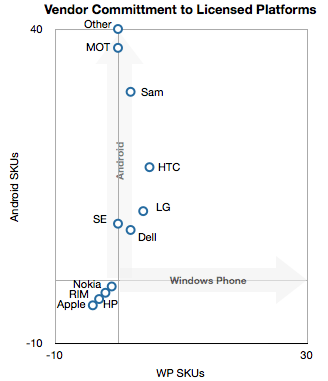
    As WP is out of the gate with device announcements, we can actually measure this. We can plot each vendor's commitment to various platforms as an early indicator of strategic success. To that end, here's the methodology: I took all smartphone vendors and tallied how many SKUs they have announced or leaked for either the WP or Android platforms (source: pdadb.net). I then plotted each vendor on two "commitment axes" (see notes below).

    The more to the right a vendor lies, the more committed they are to Microsoft's platform. The more to the top a vendor lies in the chart, the more committed they are to Google's platform. The vendors which don't have any licensed products lie below the origin.

    What we can observe is that Microsoft has pulled several, though not all vendors partially to its side. The level of commitment is not yet very high and it has not likely reduced their commitment to Android. In other words, points are moving to the right but not (yet) down.

    Framing the platforms this way helps us discuss how the market might evolve with these questions:

    1. Is Microsoft's re-entry going to peel vendors away from Android. In other words, will points move down as well as to the right.
    2. Is there motivation for some vendors to move to their own platforms like the non-committed? We've shown that profits accrue disproportionately to the vendors below the origin. As a result, is the pool of available top tier vendors going to shrink?
    3. Will vendors commit to single platforms or maintain this split OS loyalty strategy? Will we see LG migrate to WP exclusive and will Others remain exclusive in Android?

    I'll throw out my predictions to start:

    Microsoft's strategy is aimed at top tier vendors more than to the "others". This is due to a lesson they learned with Windows Mobile: having a ton of SKUs does not guarantee a healthy ecosystem (a lesson that Android has not acknowledged as true). There are positive and negative consequences. The positive is that Microsoft control the experience better, create a better brand and can participate in an effective dialogue with operators. The negative is that they are going to deal with a diminished licensee pool.

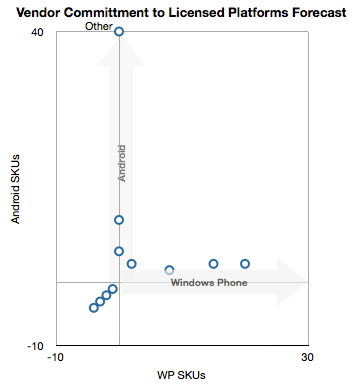
    On the second question my prediction is that vendors are going to move "down and to the left" away from the licensing model. If they can't go direct to that quadrant, vendors will consolidate portfolios around one licensed platform. The distribution of commitment I forecast will look like this:

    Maintaining multiple platform development teams is expensive. Branding is also confused. The upside is that you get to play the operator's divide-and-conquer game of platform dilution (aimed at the non-licensing players in the lower left corner).

    In particular, Samsung, with Bada, is likely to find ways out of license-land. Sony Ericsson may stick with Android and LG may move to Windows exclusively. That really leaves only HTC and Dell as licensees with multiple licenses.

    This axial alignment is not a healthy thing if you are a platform vendor. Having one or two dedicated customers means the power of the buyer is much higher and their wishes become your command.

    Which leaves only one true prize in the game: the "others". Android is clearly the darling of "Others" who are being shunned by Microsoft. Can "Others" become the lever for Google to pry open the market? History and the tangled web that is operator distribution does not point in that direction.

    ------

    Notes:

    1. I considered products announced only since Jan 1, 2010
    2. I did not consider any Windows Mobile legacy commitments
    3. "Other" vendors are off the scale with over 100 SKUs but represented as having 40 SKUs so as to be kept on chart
  6. What did Andy Rubin mean by saying WP7 was created for political reasons?

    Research · 24 comments

    In an interview with PCMag, Rubin said,

    "Look, the world doesn't need another platform. Android is free and open; I think the only reason you create another platform is for political reasons. Why doesn't the whole world run with [Android]? They don't like the people who developed, or "not invented here [NIH]"

    I note some irony in the suggestion that Windows Phone is superfluous when the acquisition of Android was an attempt to limit the growth of Windows Mobile. But that historical footnote is not entirely relevant here. The point Rubin raises is that WP is politically motivated. And by political he suggests two things: that there is mistrust of Google or NIH among potential licensees.

    The NIH argument falls flat because anyone considering WP7 would also have NIH issues with Microsoft. So that really leaves only the question of trust.

    Why would anyone mistrust Google when they offer operating systems software? How about these reasons:

    It's clear that Microsoft is buying its way back into Mobile (it went so far as to pay incentives and guarantees to established developers to convince them to port existing apps or write new ones for WP7), but that is not a political ploy. It's just good old fashioned brute force.

    The mistrust that Google earned for itself with operators, device vendors and potential content partners is rooted in its business model with Android. Hiding the costs of "openness" behind a veneer of freedom. In addition, putting forward competing products like Nexus One threaten the entire value chain.

    I'd say the politics of Microsoft licensing are a lot more transparent. Redmond is the devil they know.

  7. Is Android share of Web lagging iOS share of Web?

    Research · 12 comments

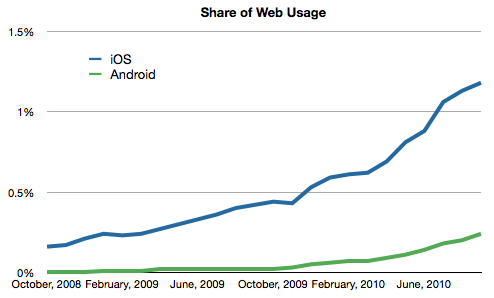
    Of all the public statistics about platform share, Share of web use must be the most important measure for Google. The more browsing people do, the more searching they do and if Google search is most likely for a platform then the more income Google derives from that platform.

    NetMarketshare.com has offered an insight into the split between Android and iOS as search platforms and it shows how iOS is still five times more likely to yield search revenue than Android. That multiple is likely to shrink as the gap narrows, but it still demonstrates the power of iOS to drive Google's bottom line. It's no wonder then why Google has renewed their default placement of Google search in mobile Safari (a guarantee they don't seem to share with all Android licensees.)

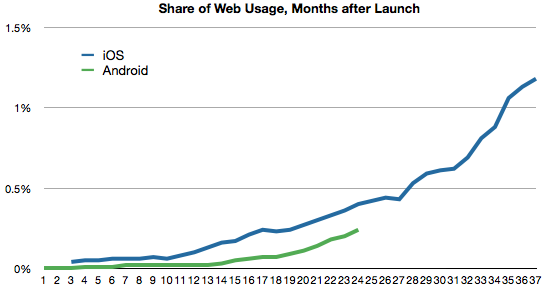
    But Android launched later than iPhone, so everyone should be asking how rapidly the share of Web has grown since the start of each platform. When iPhone launched in 2007 it was almost competing with mobile web non-consumption. The alternative mobile browsing experiences were so bad that it's hard to remember anyone putting up with them. A year later, the bar was set higher and Android filled a vast chasm of demand for mobile browsing for people who could not buy an iPhone.

    At the same point in the life of each platform, Android seems to be exploding in units sold. With this proliferation of Android licenses, it should be interesting to see if their unit share numbers are reflected in web share numbers. So far the story is not convincing. The growth in Web share is not pacing faster than iOS achieved at a similar point in time.

    So far, 24 months into the life of each platform, iOS leads by almost 50% higher share.

    iOS/mobile Safari has the advantage of iPod and iPad for distribution but that does not explain the relative lag of Android with respect to Web share as Android has a large number of SKUs.

    It may be too early to draw conclusions, but anyone trying to analyze Google's strategy with Android should be paying close attention to this.

  8. Android licensees: If you're not paying, you're being sold

    Research · 34 comments

    The latest litigation lollapalooza over Android reminds one of the old web adage that if you're not paying for content, you're the asset being sold.

    That's certainly one of the consequences of the Android licensing model. The mobile phone vendors with no software intellectual property are pawns in a game between IP holders. It's clear that Microsoft and Apple and Oracle (and perhaps Nokia) have IP issues with Google. But it's the licensee device vendors which are most often the accused. Whether Google indemnifies or not is an open question, but the evidence is that the vendors are exposed.

    The proof is in the fact that HTC is paying Microsoft for the use of Android. It's conceivable that Microsoft also asked Motorola for Android royalty payments but were rebuffed. It's also possible that since HTC is still a large scale Windows Mobile licensee, they were given a way out of the Android IP trap by Microsoft. We don't know if there were confidential deals between LG and Samsung on this issue (as they are both committed to the Windows Phone platform but shipping Android). In either case, Motorola may be forced to do the same and pay (Microsoft) for Android.

    It's understood that Google gains some value from Android but also has hidden costs from it as well. Now the licensees have to recognize their hidden costs of the platform as well. There is the IP tax but also the question of control over one's destiny. Google is selling the vendors as an asset class to advertisers. Is that a positive consequence for their brands?

  9. Is Google's income from the iPhone offsetting its losses from Android: Cataloging Google's non-Google Phones

    Research · 27 comments

    Google has created a partial list of phones that run Google services.

    Google Phone Gallery.

    I notice with interest that it's called a Google Phone Gallery not an Android Phone Gallery.

    What's more, there is a distinction of All Phones and Phones "with Google". Of course that implies that we can get a list of Google Phones "without Google" (or maybe more accurately, "with partial Google").

    To clarify, according to Google there are three categories of Android Phones:

    • Google Phones "with Google" have been optimized for use of Google Mobile Services, providing easy access to Search, Voice Search, Google Talk, Google Maps, Gmail, Sync, YouTube and Android Market (where available).
    • Google Phones "without Google" list includes Android phones that have the Android market, Search, Maps and Gmail. You can get this list by subtracting the Google Phones "with Google" from all the Google Phones.
    • Non-Google phones. Android phones that have no Android market or any Google services. You can get this list by taking a list of all Android phones (e.g. from pdadb.net) and subtracting all Google Phones.

    I would also add a fourth category of Google phones:

    • Non-Android phones that serve up Google services just fine.

    Since the list is not complete, I won't tally it here, but it suggests a large number of Non-Google phones is possible.

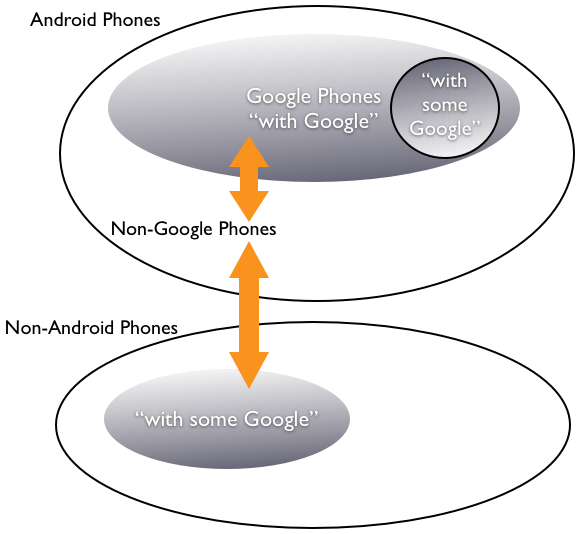
    [I drew the following Venn diagram to help explain the situation. The shaded areas are those which generate revenue for Google. The interesting struggle (marked with arrows) is between the non-Android Phones with some Google and the Android Phones without any Google.]

    Now the question that needs to be asked is: How many of the Non-Google Android phones are built to compete with Google (e.g. on Search, Voice, Maps, Media and App sales)? And a second question: How are the Non-Android phones "with some Google" competing with the Non-Google Android phones.

    In other words, from Google's point of view: how successful are companies other than Google at delivering Google services in spite of competition from companies with Android phones delivering services that compete with Google?

    The classic example being: how effective are iPhones with Google services at competing with Verizon Droid Android phones that deliver Microsoft services? In this scenario Apple is delivering value to Google shareholders while Verizon (using Android) is taking it away.

    Is this trade-off a net positive?

    In other words, is Google's income from the iPhone offsetting its losses from Android?

  10. Apple's growth vs. top ten largest tech companies

    Research · 10 comments

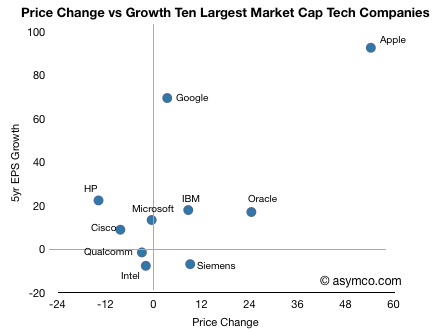
    In the last article I described growth vs. P/E and price change for the largest "ultra-large cap" companies, of which Apple features prominent.

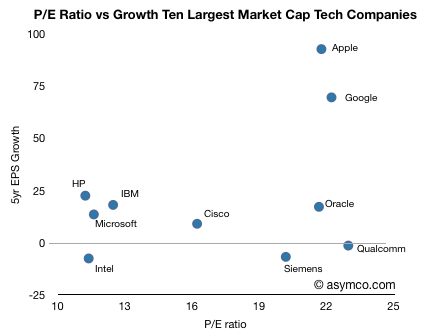
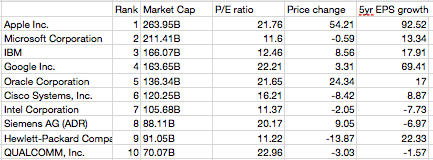
    In this article I take the same analysis to the top ten largest technology companies (by market cap, see table at bottom).

    In this comparison, Apple no longer has the largest P/E ratio. Qualcomm, Google and Oracle are all at similar levels of valuation relative to earnings, however Apple's growth outstrips them, only with Google in the same quadrant.

    Note the "Wintel" cohort consisting of Intel, Microsoft, HP clustered around the Low growth, low valuation quadrant in the lower left (coincidentally co-located with IBM). Oracle, Qualcomm and Siemens show high valuation with low long-term EPS growth. Cisco is somewhat on the fence.

    When comparing how the market has rewarded growth through share price appreciation, the correlation to growth is much better. Google seems under-rewarded.

    Data follows: