Despite being based on Android, a Facebook phone would be competition for Google as much as it is for Apple. Google benefits from ad revenue tied to their search and other services which would likely be supplanted by Facebook services on a Facebook-based phone.
Much of what I write is structured around theories of strategy and management. The word theory gets a bad reputation among managers because it's associated with the word "theoretical" which connotes impractical. But a theory is a very practical thing because it's a statement of causality. Causality means you don't have to collect experimental evidence on whether when you jump out of a window you fall or not. There is a theory about gravity which you can use to your advantage.
So even though they scorn talk of theory, managers use theory all the time. Whenever a rational manager takes any action, it's predicated on a theory already in their head. Whenever they put forward a business plan they are employing a theory that if they do these things they will be successful.
The problem is that much of what passes for business debate is the stacking of theories on either side of an argument. Unfortunately most of these theories are not much more than anecdotes. To say that "open always wins" is a theory but it's usually backed only by one or two examples without a list of counter-examples. That's not to pick on "open" as there are many more deeply flawed theories (e.g. the stupid manager theory of business failure) which have no evidence whatsoever to support them and all the evidence in the world to disprove them and yet they retain the highest popularity.
So the problem with management "science" is that most managers are not aware of what theories they are employing, treating them more like intuition or some God-given insight. They also don't know whether or to what extent their theories are good or bad. They also don't have access to a body of data that supports or challenges their theories. Business data is often locked away even from employees of the company producing such data. It's buried so effectively that it's often forgotten and has to be re-generated every time a new management team takes over. Corporations effectively kill self-knowledge and lack any institutional memory.
To illustrate the effect I can offer personal testimony. When working at my last job I spent a great deal of salaried time collecting data and presenting it. Much like what is presented in this unsalaried blog. The difference is that when a "work product" was done (almost always in the form of Powerpoint slideware), it would be released to the audience which requested it. This audience could be as small as one person or as large at a few dozen. But once consumed by the audience, the product had a half-life of about a week. It would be literally forgotten in a month. Now this could be used to one's advantage as every few months a smart analyst could dust off some old product and re-release it to the amazement of another audience or even to the same audience who had forgotten. Taken to extremes, you can envision a Dilbert-like scenario where the analyst is like Wally who has a perpetual salary for repeating ancient knowledge.
The reason this model for analysis fails is because information is rationed in corporations. The transmission, dissemination, storage and consumption of information is intentionally constrained. This makes the work of an analyst nearly useless. I finally became disillusioned with the process when, at one point in time, having worked on one piece of analysis for two weeks on the premise that it would be presented at a high-level meeting, my time slot got bumped off the agenda due to scheduling issues. My work was never presented to anyone.
It was at that time that I realized that my "work product" was non-essential to the meeting anyway. It was, for the lack of a better word, executive entertainment. So, naturally, realizing that I was really an entertainer I resolved to become better at it. That led me to target not those who request the work, but the largest audience possible because they would give me better feedback. I began to blog internally.
Calling analysis entertainment may sound flippant, but at a more core level, it's actually an enlightened way to see the process. Steve Jobs is an executive but his skill at entertaining an audience is what makes him an effective communicator with huge consequences to his firm. In olden days CEOs were lauded for their problem solving skills, then for their sales skills, but now they need to be "charismatic" and therefore entertaining.
This blog is an experiment in the opening of business theory and the open exchange of insights. In doing so I take a look at keeping the work relevant by making it approachable, illuminating and, yes, entertaining. So I went from a salaried producer of analysis for a small and forgetful audience to an unsalaried producer of analysis for a large audience in a format that encourages memory. A company was paying a lot of money for something that it ignored. I now receive no income for work that is (hopefully) ravenously consumed. I rather like this more.
When I started this blog I chose a word "asymco" which did not exist and had exactly zero hits on Google search. Now I'm glad to see that "asymco" has 77,300 results on Google search. I am grateful to all who have helped in making this possible and I'm looking forward to further collaboration.
What do Palm, Kin, Nexus One, and the Simon have in common?
Beside being market failures, it's the fact that they were efforts by large companies that had no business in smartphones. What's more important is that the motivation for participation was not well thought out.
HP, Microsoft, Google and IBM tried (or are still trying) to capture a piece of the hardware revenues from smartphones, but their results were dismally poor. It turns out that with the exception of RIM, HTC and Apple, there have been no smartphone entrants which have succeeded against the incumbent voice phone makers.[1] Furthermore, Apple is the only large technology company to succeed. Studying the efforts that the successful entrants undertook shows that (1) it takes a very dedicated effort, led from the top, and (2) it takes a lot of capital or a lot of time. Those who tried and failed were not dedicated to the concept at a high enough level and were not patient enough for growth.
I think the real motivation to enter the market is rooted in vanity: appealing to the need management to feel a part of something new and important. If you are an ambitious internal champion skilled in political maneuvering, it's fairly easy to appeal to this vanity in order to secure funding for these efforts.
This string of vanity-induced failures is not likely to end anytime soon. No doubt Dell will keep trying with the Aero, and we might see the PC companies rush in again as they did with PDAs.
We also hear today of the evolution of INQ's product (INQ Social Mobile) into some sort of Facebook phone. However, is the Facebook phone project a vanity phone? Maybe, but the counterpoint is that this is not likely to be a smartphone. It's more likely to be a feature phone and, as such, it's not attempting to be something so grand or vain.
The real comparison might be to the Kindle. A specific, purpose-product built by the most motivated and best-positioned service provider. The Kindle has had some (unspecified) amount of success because it was developed to light specs and with a well-established distribution channel (amazon.com).
So although the motivation might be more sound, the challenge for Facebook will be the same as for Google: distribution. At the end of the day, without operator support the product will still remain a niche.
[1] I note here that Android and Windows Mobile are not phones but platforms and this article deals specifically with hardware.
France Telecom-Orange CEO Stephane Richard has invited the heads of Vodafone, Telefonica and Deutsche Telekom (T-Mobile) to Paris on 8 October to discuss the development of a common operating system for mobile devices. He told Le Figaro that mobile operating systems were the Trojan horse used by Google and Apple to establish relationships with mobile customers. The four operators have nearly 1 billion customers combined and the capacity to influce industry. The initiative could take several forms including a joint venture or a common apps development unit. He added that the operators aim to retake the reigns of innovation, rather than be followers.
In the interview Richard also stated that carriers have decided not to advertise the iPhone any more.
This attempt at operator cooperation in software has been tried before, but it predictably failed (does anyone remember Savaje?) Symbian itself was an attempt at mobile phone vendor cooperation on systems software. There are various consortiums for "open mobile OS" based on Linux (e.g. LiMO which started as a Japanese effort). Even the Open Software Alliance is a rubber stamp body rather than an attempt at development.
Although one can safely dismiss the potential of this effort on the basis of a lack of competence, the arrogance reminds one of the rigidity in response to the disruption under way. The fact that high-speed data networks allow operator disintermediation cannot be changed by "innovation" on systems software.
But the odd thing is why even bother. The solution to taking control over the user experience and services platform is straight-forward: each operator could fork a version of Android as their own and hire a team to integrate white label services. It's much more straight-forward than coordinating a joint effort. China Mobile have already done their own non-Google Android.
Android is an open platform. We saw at IFA 2010 all sorts of devices running Android, so it already running on tablets. But the way Android Market works is it's not going to be available on devices that don't allow applications to run correctly. Which devices do, and which don't will be unit specific, but Froyo is not optimised for use on tablets. If you want Android market on that platform, the apps just wouldn't run, [Froyo] is just not designed for that form factor.
How appealing are tablets that don't run any apps? Or content?
It still amazes me that a Google exec would say that it's acceptable that consumers are led to make purchasing mistakes with his product. Apparently any malfeasance is excusable in the name of openness.
That means no seamless integration with Gmail. No Google Latitude. No multitouch in the map app, either. And in place of the free and fantastic turn-by-turn Google Navigator app, Verizon installed its VZ Navigator service -- a feature which costs $10 a month to use.
It would be one thing for Verizon to set the default search and map app to Bing with the option to switch back to Google. But it's utterly inexcusable for Verizon to destroy the possibility of a switch without the user having to root the device and, under Verizon's company policies, void their warranty. And on top of that, repeatedly charge you for a sub-par service instead of keeping the gold standard of navigation apps for free.
And as bad as that is, there's now a rumor that Verizon will be doing this again. On every single one of its Android devices.
After speaking with a Verizon representative about the Bing debacle on the Fascinate -- who also lied about the existence of a search alternative -- The Droid Guy contacted two Verizon tipsters who told him that the carrier "is dropping the Google Search from all future Android Devices and offering Bing in it's [sic] place."
Regardless of motivations, the restriction if broadly applied would have Verizon reneging on its pledge to support the openness of Android and reflects a wider trend of the OS being artificially restricted by carriers. Most US providers are disabling Android 2.2's tethering support in favor of their own, and AT&T has banned non-Market Android apps under the pretext of security. The moves paradoxically leave Apple's iPhone more open in some areas, as its users can choose Google, Bing or Yahoo for search and don't have first-party apps deliberately hidden or broken.
Verizon, unfortunately, is also what ruins the phone. Or, rather, what it’s forced Samsung to do to the phone, which you could sum up in a word: Bing. Bing is the default—and only—search engine on the Fascinate. A Google Android phone. In the search widget, in the browser, when you press the search button. Bing. No, you can’t change it. There’s no setting for it, and the Google Search widget that you can snag from the Market is blocked (or at least very carefully hidden). Being unwittingly forced into Verizon and Bing’s conjugal relationship is infuriating on its own, but the implementation also feels like the sloppy hack that it is.
Android is “open”, but who it’s open for, primarily, are the carriers. (Somehow I doubt we’ll see any Windows Phone 7 devices where Google is the one and only search option.)
The primary defense of Google's Android strategy is that it's beneficial in driving traffic to Google's services/properties. This is by no means a certainty. To the contrary, it seems likely that the Android experience will be defined by operator back-room deals.
Coupling a lack of control over the platform, the revenue streams, the user experience, the potential banishment of AdMob from iOS and an attack on Google's brand, Android is currently winning the war with Google.
However, my money long term remains with Google. They can and will eventually beat Android. Perhaps with Chrome.
[Footnote: if anyone wonders why Verizon, Google's best friend in mobile, is gutting Android, you need to remember an exclusive five-year deal Microsoft struck with the carrier to provide search and advertising services on the phone. Microsoft was rumored to pay $500 million for the opportunity.]
I went to the link below to look at some of the apps. I clicked Top Free tab and scanned through the featured apps. As Google puts it: "This is a showcase for some of the featured and top ranked applications and games available on Android Market".
A few years ago I read a book called "Breaking Windows" which was the story of the DOJ investigation into Microsoft's abuse of monopoly. The book was written by a journalist who tried to summarize some of the findings from the published internal emails.
One of the takeaways was the logic of Microsoft's entry into the Office market. The main internal justification was not that it would be a hugely lucrative new business, but that it was a necessity to the maintenance of the Windows business.
The story was that Lotus, having a huge installed base, could (and did) arbitrarily refuse to upgrade their software to the latest Windows version and in so doing, could kill the franchise. Lotus owned the "killer app" and could hold Windows hostage. Users would rather keep their applications than upgrade a largely invisible OS.
Another way to read this was that Microsoft needed to "vertically integrate" Windows so that it encompassed not only the OS but also the key applications that ran on the platform. A purely horizontal OS platform was obviously not viable as a business even back in the early 90s.
What reminded me of this story was the news that Dell is launching a new smartphone in the US. Called Aero, it will run Android 1.5, an ancient version released in April of 2009, 18 months ago.
Now think about the idea of Adobe coming to market next week with a new version of Photoshop that ran only on Windows XP. Or even more poignantly, if Office were not part of Microsoft, seeing a *new* version of Word that only worked with Vista.
Through an aggressive acquisition plan twenty years ago, Microsoft avoided this scenario. Google today is faced with the prospect that not only the devices (which sit on its OS) but also services and apps on top would choose to remain on old versions of Android. There is nothing to stop them from doing just that. Unlike Microsoft, Google does not enforce licensing terms for Android. It is at the mercy of the value chain.
Couldn't Google crack down and deprecate Cupcake? It's not as easy as that. Not only do they not have license terms that permit that but in the phone business, development lead times are so long and global distribution can be so elastic that a low volume vendor like Dell has no choice but to sell multiple OS versions of their own products. Microsoft has almost the same problem with Windows Mobile, with a variety of given-up-for-dead Windows Mobile 6.5 powered devices still in the pipeline while Windows Phone 7 is imminent.
Does it not strike everyone as odd that a company whose business is in the cloud also needs to peddle systems software...even devices?
It's like a philosopher at a conference trying to convince the audience of his idea requiring that they use a certain type of pencil to take notes. And only he can give you that pencil.
This should lead to serious questions: Firstly, maybe you don't need to take notes, secondly perhaps you don't use a pencil and thirdly why his pencil?
Analogously: Firstly, Google services don't need specific devices to be used because they're designed around web standards. Secondly, they don't need specific client software or APIs either and, thirdly, they certainly should not need specific systems software. Like the philosopher, Google does not charge for their pencil, but that's beside the point.
You can only conclude that either the philosopher's is a scoundrel or his idea is not that good.
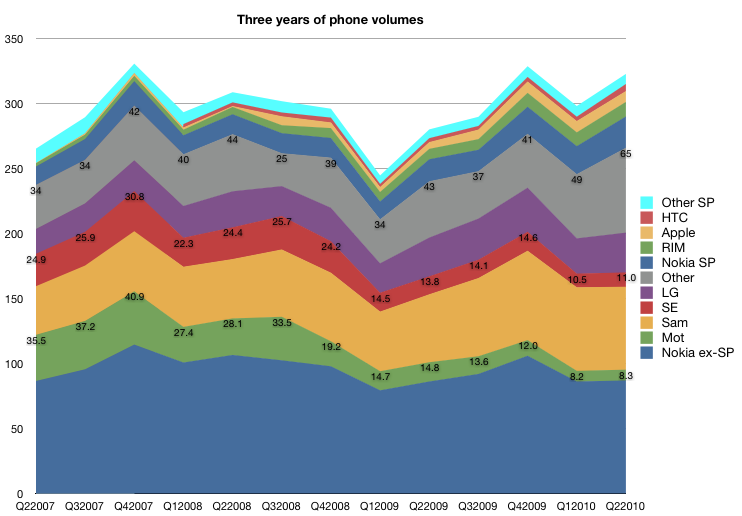
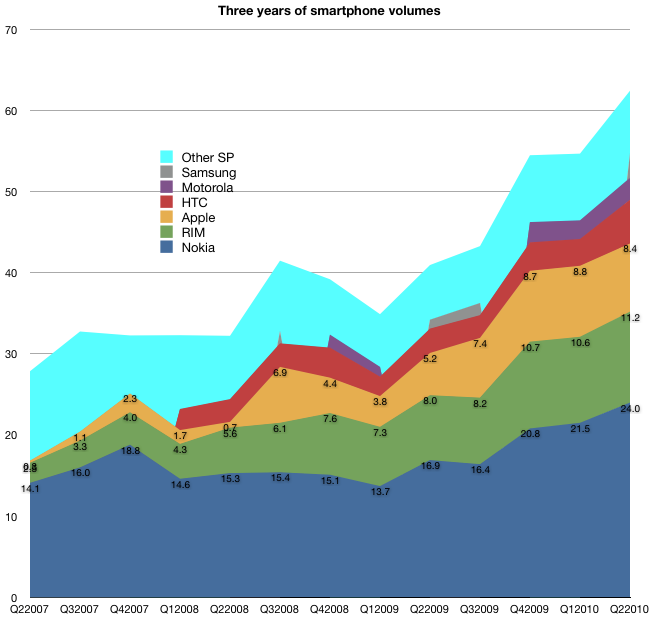
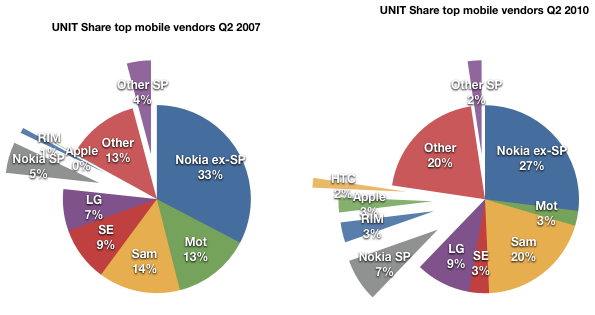
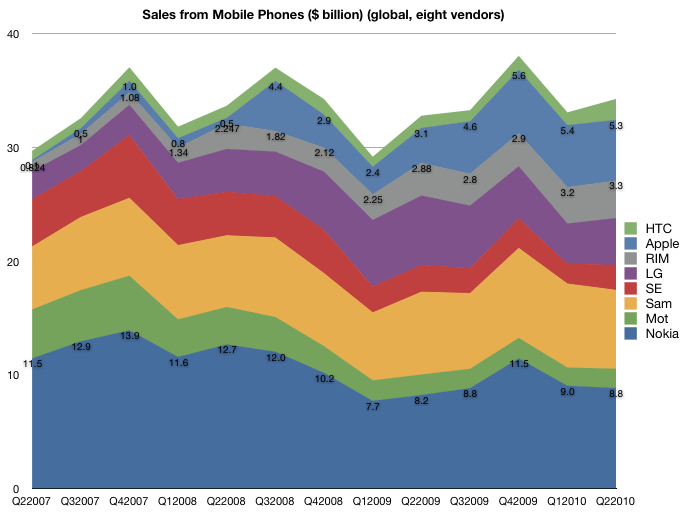
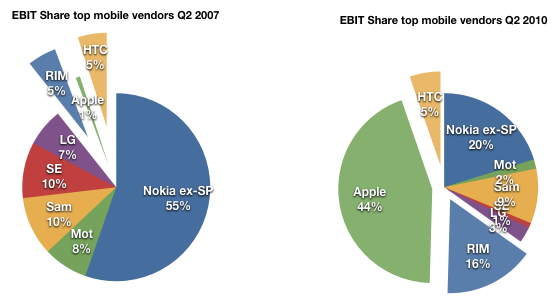
I did not include all vendors for various good reasons. The first survey (market share) did include an "others" category that made the volume data complete, but in the financial data sets, I chose to include the top 7 vendors that make up 80% of device volumes.
One noteworthy vendor that was not included was HTC. HTC is an important vendor for several reasons:
it's a pioneer in smartphones having made the first Windows Mobile devices and the first Android devices
at one point it sold 80% of all Windows Mobile devices
even if it did not brand its devices, it was the name behind many re-branded or white-label operator branded phones
it has a brand of its own today and is expanding its reach
HTC has been around building devices since 2001 and so it would be a pity to exclude them from any analysis of the effect of iPhone on the market or any discussion on the effect of smartphone disruption on feature phones.
The challenge with HTC was that historically their branded devices and white label devices were not reported by the company separately. This matters because white label devices are valued differently. Typically these devices are not marketed by the original manufacturer so SG&A is not applied to their cost base. Operating margins, ASPs and hence profitability is not directly comparable with other OEMs.
But HTC has recently changed its reporting. Thanks to a reader I discovered that, since 2008, HTC has been listing its ASP and Operating Margin making direct comparisons possible. I still don't have all the data, but enough to add HTC to the analysis.
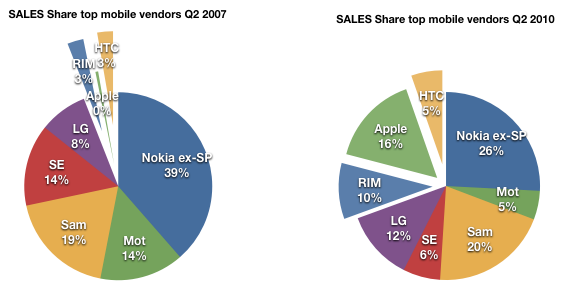
So, here are the 5 industry performance criteria, now with eight vendors listed.
Volumes
Note that HTC volumes start in 2008.
The volume of units HTC sold has been increasing at about the rate of market growth.
As a result, HTC's share has not increased as dramatically as those of the other smartphone entrants.
Sales
A similar story in the sales picture. Although a consistent performer, the growth has not matched that of RIM and Apple.
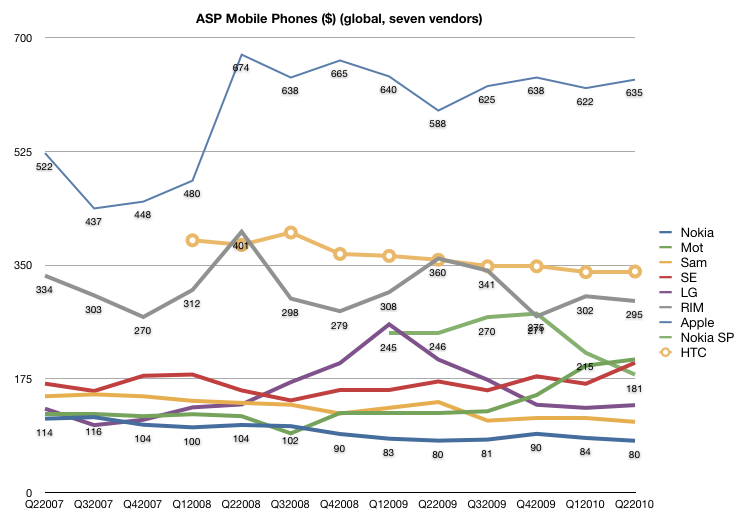
ASP
The pricing story is also a mixed one. Although HTC lies between RIM and Apple in price, the erosion is more consistent with RIM and the rest of the industry.
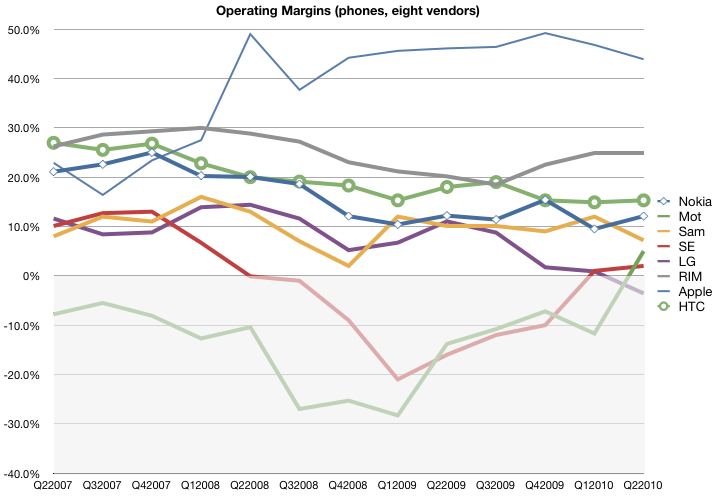
Margin
The margin story is also not as positive as one might expect. The margins for HTC started out above Apple and RIM but have dropped to closer to industry average. This is not what one might expect from an exclusive smartphone vendor.
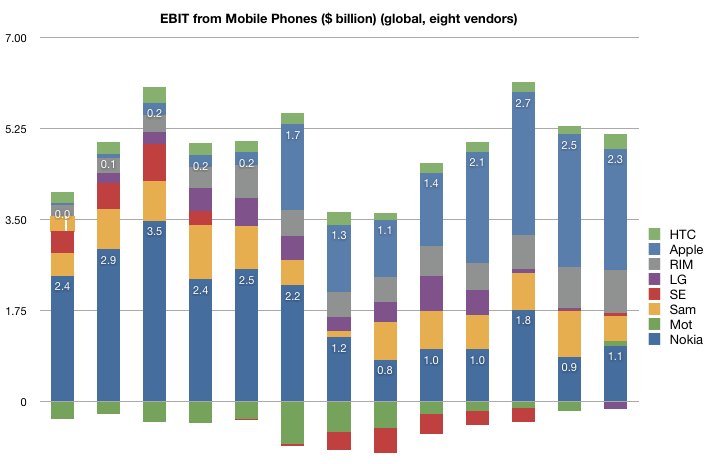
Earnings
The share of earnings has remained unchanged at 5% over the period of iPhone presence. It's perhaps a credit to HTC that they did maintain their position in the market with the massive change that has come to pass.
However, here we also have to ask if HTC is riding a disruptive wave.
When I wrote the last series, my definition of “loser” was a company that had faced a long series of operating losses and has no viable software assets of its own, making it vulnerable to Android (and Windows Mobile). Motorola first, Sony Ericsson second and LG now coming into the picture. Nokia is not a loser in this sense since it has remained profitable and does maintain an investment in software. Same with RIM and Samsung (now with Bada). When/if they do have the near death experience, they might opt for the Android lifeline (flimsy as it is).
However HTC does not fit the mold of either "winner" or "loser". It's the Goldilocks company, not too hot, not too cold.
But I would add that HTC is not an example of a winner because of its adoption of Android. HTC’s dependence on Windows Mobile made their move to Android the most desperate of all. Unlike the larger OEMs, who had their low end devices to fall back on, they are completely dependent on a smartphone OS vendor. When WinMo was showing the first signs of crisis in 2007, they were the first to flee to Android (think of why they would risk the wrath of Microsoft for something so fragile as Android in 07). They are also trying hard to escape the dependence by building up their own UI (SenseUI) and I would not be surprised if they move to their own OS in the future. Being associated with Android does not confirm them as "winners" but in fact, shows their vulnerability.
What does this all say about Android?
Again here my thesis is that Google chose to sustain the industry rather than try to upend it. I don't judge their motives, but the fact is that with Android, Google is not in a position to disrupt telecom. There were high hopes dashed with the Nexus One and hearts broken with net neutrality and now there are patent wars to be fought. Android, with its licensees, is still at the mercy of operators.