
Asymco

Asymmetric Intelligence

Google

  1. Android's Pursuit of the Biggest Losers

    Research · 170 comments

    The mobile phone market is intertwined with the telecommunications industry which is vast and there are numerous competitors which are much more dynamic and better capitalized than the moribund PC or music player vendors. It’s also a regulated and fragmented global market with 1.2 billion units and 5 billion consumers—far greater than any of the markets Apple played in for its first 30 years.

    Nevertheless, the iPhone has had a huge impact on the industry. To show just how much of an impact, I dove in and pulled over 500 data points on three years’ financial performance of seven competitors responsible for 80 percent of units being shipped today. The time frame covers the iPhone’s participation in the market so it allows for “before-and-after” comparisons.

    I divided the findings into five articles:

    1. Unit Volumes. The evolution of market share.
    2. Revenues. The shift in where dollars are spent.
    3. Selling prices. The tale of ASP erosion.
    4. Operating margin. Profitability ratios over time.

    Now I turn my attention to draw a bottom line from all the data above, namely the operating earnings (EBIT or Earnings before Interest and Taxation).

    The first chart shows the EBIT from the top seven vendors of mobile phones since the quarter when the iPhone launched. I annotated Nokia and Apple's bars to give perspective.
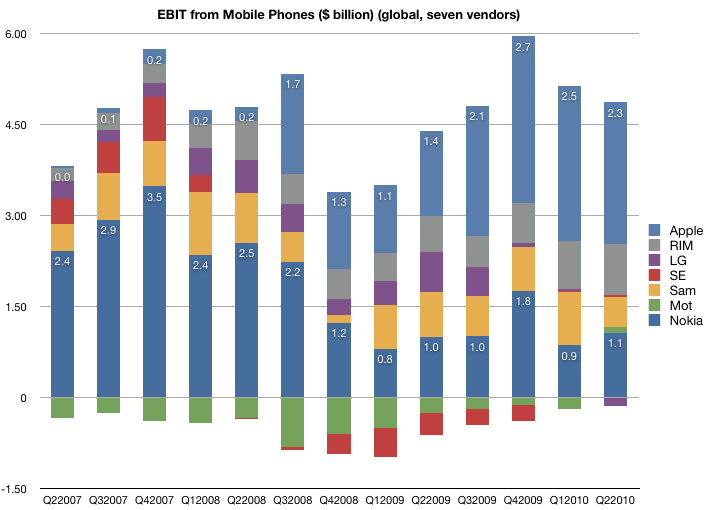
    The total available profits in the industry dipped to a bit under $4 billion at the trough of the recession, and have recovered to nearly $6 billion in the holiday quarter last year. However, not all vendors are profitable. As you might expect from looking at the operating margins, Motorola and Sony Ericsson have been generating losses for most of this time period. They have both reached profitability in the last quarter, though at very low levels and after having lost a large part of their sales. LG has turned negative this past quarter after being a modest earner for some time. Samsung has maintained a fairly even consistency in its profit capture, though with its expanding market share, it seems to have come at the cost of pricing.

    Finally, looking at the pure smartphone vendors RIM and Apple, the picture is nothing short of astonishing. This before-and-after share-of-available-profit chart shows that the two entrants went from about 7% profit share to 65% in three years.
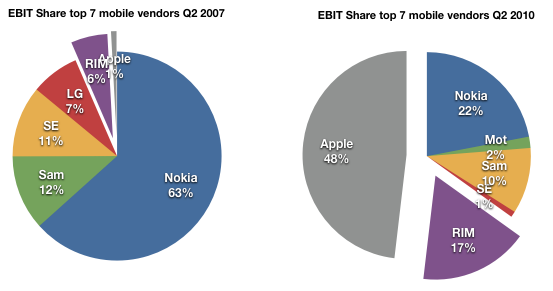
    Apple in particular is capturing about half of the available profits with three percent of the units. It dwarfs all the other vendors, more than double the nearest (Nokia). All that in three years and with the added burdens of only three models, a recession and limited distribution.

    What does it all mean?

    Here are my conclusions, enumerated:

    1. The lack of a real response. The recurring theme in this series of articles has been that giant multinational incumbents in a vast and rapidly growing industry, enjoying all the advantages that size and incumbency, have had their profits taken from them. And they don't seem to have put up much of a fight.
    2. It's all wealth transfer. Note the total amount of profit available has not increased markedly; this is not about incumbents growing the pie. Two thirds of what should have rightly been theirs moved from the incumbent shareholders to the entrant shareholders.
    3. Speed. This shift of profit occurred over an unprecedentedly short period of time.  Three years is no more than two product cycles in the industry and it's an order of magnitude faster than what happened historically to other industries.
    4. Disruption is the diagnosis here. The incumbents were caught in the headlights. Disruptive innovation leads to asymmetric competition and this is what we just witnessed. History has shown that the shift of profits is usually the last stage of disruption and is usually irreversible because the change in business models cannot happen at the rate of change of profit transfer.

    Which leads me to one final point.

    When analyzing the potential for challengers to the new winners, the most cited is Android. Can Android affect this redistribution of profit once again? And to whom?

    If Android is to become the dominant platform, does it depend on the success of its licensees? Who are these licensees and what are the chances that they will be able to align their businesses to what Android offers (a new revenue model based on services and advertising).

    One problem I see is that Google is making a bet on those same vendors who are now squeezed in the middle of that last pie chart: Samsung, LG, Motorola and Sony Ericsson. Nokia, Apple and RIM will certainly not take the OS over what they already have as it dilutes their differentiation and margins. That means Android is aligned with the biggest losers in the industry.

    So how likely are these disrupted ex-giants to recover and take Android forward? My bet: slim to none. Android does not offer more than a lifeline. It is not a foundation for long-term profitability as it presumes the profits accrue to the network and possibly to Google. Profit evaporation out of devices to Google may be a possibility at some time in the future, but only if the devices don't need too much attention to remain competitive. But because they're still not good enough (and they won't be for years to come), it's certain that attention to detail is what will be most important to stay abreast of Apple.[1]

    So here we have the real challenge to Android:  partnership with defeated incumbents whose ability to build profitable and differentiated products is hamstrung by the licensing model and whose incentives to move up the steep trajectory of necessary improvements are limited.

    In other words, Android's licensees won't have the profits or the motivation to spend on R&D so as to make exceptionally competitive products at a time when being competitive is what matters most.

    [1]: I would argue the same lack of symmetry with licensed software vendor Microsoft is what led the the failure of the same incumbents to make a dent in the industry with Windows Mobile [2003 to 2010].
  2. Preference of next device by current smartphone owners

    Research

    MacDailyNews - Yankee Groups Howe sets the record straight on Apple iPhone and Android devices.

    • No other manufacturer can claim nearly the loyalty of iPhone owners. RIM BlackBerry owners see a touch-screen device as the antithesis of their hard keyboards. However, even in this category, 23 percent of respondents plan to buy an Apple iPhone. We see similar results with all other mobile phone owners. In fact, 36 percent of Google-branded Android phone owners say they plan to buy an iPhone, surpassing the 32 percent of Google-branded phone owners who intend to buy another Android phone.

  3. Android vs. Google Part III

    Research · 2 comments

    Revised language for section 3.3.9 of Apple’s developer agreement, concerning the use of data collection:

    The collection, use or disclosure is for the purpose of serving advertising to Your Application; is provided to an independent advertising service provider whose primary business is serving mobile ads (for example, an advertising service provider owned by or affiliated with a developer or distributor of mobile devices, mobile operating systems or development environments other than Apple would not qualify as independent

    via Apple Makes Good on Steve Jobs’s Promise, Invites Other Advertisers. But What About Google’s AdMob? | Peter Kafka | MediaMemo | AllThingsD.

    Apple is stating that user data must be handled by organizations that are strictly independent.  If the ad service provider is part of an organization that either competes with Apple's devices or platform, it's not independent.

    AdMob would have been allowed to operate unhindered on iOS but AdMob as part of Google is not.

    Conversely, if Google were to abandon Android, the path to riches would be open again.  As shown several times already, by pursuing a mobile device platform Google strategically abandoned some significant revenue opportunities in exchange for some extraordinarily high costs.

    Readers of this blog should not be surprised.

  4. Was Quattro a bargain? Was AdMob a rip-off?

    Research · 4 comments

    Apple's announcement of $60 million booked revenues for iAd, of which 60% is meant for developers implies $24 million operating profit for the second half of 2010.  Assuming this rate doubles $100 million for 2011, it becomes clear that the acquisition of Quattro for $250 million is reasonable (2.5x gross earnings) and that the AdMob price of $750 million seems expensive.

    Now Google may have justification for the $750 million along the lines of income from non-Apple platforms, but the CPMs for Admob are a fraction (perhaps 10%) of what iAd is able to obtain.  Therefore, it's a pretty fair conclusion that Google did not get a bargain.

  5. Can Google buy consumer competitiveness? Can Apple be an ad giant?

    Research

    Daniel Eran Dilger in fine form after Apple became the world's largest technology company by market capitalization.

    These days, Apple’s primary competitors have all fallen down on their knees while clutching their gutted bellies...

    Who is left? Google, the paid search giant that backers hope will beat Apple in hardware and software platforms… despite Google being neither a hardware vendor (nor marketer nor retailer nor support provider) nor having any real experience in managing a software platform for consumers. Fans of Google suggest that the company will take on Apple by acquiring a competing version of everything Apple has built over the last decade: iTunes, a mobile platform, hardware expertise, user interface design savvy, development tools, and a user base.

    The problem is, they don’t also foresee that Apple could compete against Google in its own home territory of ads.

    via How Apple could slay Google at WWDC 2010 — RoughlyDrafted Magazine.

    The key assumption in the "Google can buy anything Apple already has" is that of the three things that make up a company (resources, processes and priorities) the only thing cash can buy is resources, and, in the tech world, even those are fragile things with legs that can walk out the front door.

    Google's "copy-paste" competitive approach vis-a-vis Apple falls down when you realize that Apple has been successful mostly because of its processes and priorities. It's well known that all of its vanquished competitors could (and did) recruit legions of Apple employees, elevating them to positions of responsibility, with naught to show for it. Grafting engineers and IP onto Google (or Nokia or Microsoft) cannot make it into an Apple.

    Conversely, through a risky, long and arduous path, Apple could become a Google. Success with ad-based search requires resources (mostly CapEx), algorithms and distribution. With the $42 billion (soon to be $100 billion) in the bank and eye-watering free cash flow, there are few no resources that Apple cannot buy.

    With iAd the world will witness an Apple that can make loads of money in Google's home turf, while Google burns cash and bridges with Android trying to defend its soft platform underbelly.  The irony is that Apple can knee-cap Google without even trying to do search. After all, Jobs said plainly enough: On a mobile device Search hasn't happened.

    Judging by the stock prices of the two companies, I suspect investors know this already.

  6. Global smart phone OS shares (part II)

    Research

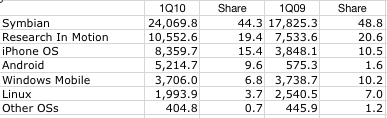
    On May 5th, I tried to fill in the blanks on Global smart phone OS shares | Asymco. I estimated that the shares for the mobile OS's were as follows (based on Canalys partial data):

    • Symbian (Nokia): 42%
    • Blackberry OS (RIM): 19%
    • iPhone OS (Apple): 16%
    • WinMo (Microsoft): 10%
    • Android (Google): 10%
    • WebOS (Palm): 2%

    Now Gartner has published their sell-through estimates:

    • Symbian (Nokia):: 44%
    • Blackberry OS (RIM): 19%
    • iPhone OS (Apple): 15%
    • Android (Google): 10%
    • WinMo (Microsoft): 7%
    • Linux: 4%
    • Other OSs: 1%

    My estimates were within 1 or 2 percent of actuals except for Windows Mobile where I over-estimated by 300 basis points.

    The analysis of Android vs. iPhone market shares (globally and within the US) which depended on this estimation does not change materially.

    The complete data from Gartner follows:

  7. Will Apple rule the iPad market? (part II)

    Research · 12 comments

    Continuing from Will Apple rule the iPad market? | Asymco.

    The first claim is that

    it is unclear if [Apple] will end up dominating the market the way it has come to rule the digital music player market with the iPod.

    After hearing a thousand voices cry out that the iPad is nothing more than a bigger iPod touch (which, plainly, it is) it's amusing to read that its similarity with a sibling ends when it comes to market performance.

    Let me make one claim up-front: the iPad is more of an iPod than the iPod.

    The original iPod was successful because it had a significant integrated value chain bolted on. Apple disrupted music with a value chain, not a product. It changed the way music is bought, consumed and even how it is produced. It changed the economics from retail down to songwriting.

    This is why it came to dominate its market. Every competitor that took a run at it did so with a partial solution to the value chain. Often it was nothing more than a music player, and in some cases (e.g. Zune) it was bundled with some other pieces of technology, but poorly executed and too late.

    The iPad comes with an even bigger value chain bolted on: the App Store. Apple is flogging not just an "app player" but also a new way to develop and distribute software. If you cut "music" and paste "apps" you see the immediate parallel between iPod and iPad. The app ecosystem will quickly grow to be larger than the music ecosystem with the mobile software business already eclipsing the music business.

    A competitor launching a tablet device will have to somehow overcome the momentum of billions of downloads fed by hundreds of thousands of apps built by tens of thousands of developers for hundreds of millions of users.

    The iPod juggernaut pales in comparison to the iPad supernova. The iPod had no apps or dedicated developers. Its ecosystem consisted of a handful of music companies. The only thing that made it "sticky" was the tie-in with one type of content.

    The iPad on the other hand has a thousand other jobs to do for its users. It has a rich tapestry of functionality and a multi-dimensional (literally) user experience.  It's a platform. It's even powerful enough to impose new standards on the web itself and to suggest that search is a bygone activity.

    So to suggest that Asus or Dell will somehow build "iPad killers" sounds asinine. These competitors don't even grasp what the product is and what it's for.  Sony said they don't see a market for it. Microsoft, trapped in the innovator's dilemma and overshooting the market by miles, said they don't understand what the point is because users want full PCs.  Google asked what's the value of a big iPod. I could go on, but there was not a single company in the industry who recognized what they were looking at in January. Apple keeps a tight lid on new products so that competitors don't get a head-start on copying, but in the case of the iPad, advance knowledge would not have had any impact. Competitors look at the iPad and see nothing.  They'll only react once the market explodes and they start to feel belated pain.

    If, and it's a big if, they do recognize what an iPad is, their response cycle is going to be measured in years. On hardware, they were blown away with a product that had twice the power, half the bulk, twice the battery life with half the price of what they had on the shelf. They may catch up on hardware in a year or two and launch some sort of iPad-like assembly of components, but that is like making the first iPod killer in 2002.

    Then there is software. Their software supplier (Microsoft of Google) will have to build a platform that works. That will take years. Years during which the iPad will penetrate every geography, demographic and vertical market.

    Google might move more rapidly than Microsoft, but they will produce an open source poster child of a platform. Fragmented and rough around the edges to the point of looking like a hobby project. Their flea market store will also have the smell of fresh glue about it. Microsoft is so far behind the curve that I don't even think they will try to move the tiller.  Their view of the market was betrayed by the recently knifed Courier demoware. To suggest a challenge to the PC/Windows model inside Microsoft is a career-limiting move so don't expect their brightest to be lining up to propose new platforms to management.

    What about HP? Assuming they overcome the pitfall of NIH that kills 80% of integration efforts, they will still need to perform an enormous amount of heavy lifting to get WebOS to be a competitive experience on a tablet. Most opinions were that Palm came pretty close with a smartphone, but that was nowhere near enough to stay alive, never mind challenge iPhone.

    Then there is the ecosystem. Building it is just not something I can even begin to roadmap. What about developer tools, SDKs, frameworks and evangelism? With a Palm division, HP is the best positioned of the PC vendors but it has a chance at being a player as much as Creative did vs. the iPod, or needless to say, Palm vs. the iPhone.

    So the iPad challengers face five daunting obstacles:

    1. Recognition of a threat from a seemingly benign product
    2. Execution on hardware against the best integrator on the planet
    3. Execution on software against a new UI metaphor fortress surrounded by a patent moat
    4. Integration of hardware and software to a sublime whole
    5. Re-building a value chain for which they have no handle vs. a broad and deep existing universe of app/content creation distribution and consumption enjoying logarithmic network effect value.

    That does not even touch the logistics, sourcing, margin and pricing challenges of world-wide distribution of the whole value chain. Nor does it cover the lock-in of advertisers to new tools for creatives or the billions of daily views from a platform that is blindingly dazzling.

    To put it in the language of disruption, by the time the competitors launch symmetric attacks on the iPad, Apple will be the incumbent. And we all know that symmetric attacks never work against entrenched incumbents who have all the levers of power at hand to deploy in a withering counter-attack.

  8. HP WebOS tablets, netbooks

    Research

    "During a conference call about HP's acquisition of Palm Wednesday, Todd Bradley, executive VP of HP's Personal Systems Group, said that there are "a lot of opportunities" with the purchase. Namely, he said, HP could use the WebOS mobile operating system as a touchscreen interface for new hardware such as a tablet or netbook.

    Palm CEO Jon Rubinstein and Brian Humphries, HP's senior VP of Strategy and Corporate Development revealed that HP plans to "double down on WebOS," which is considered the "prized asset" of the acquisition. The two reportedly mentioned the scalability of WebOS, implying that HP plans to bring the platform to multiple hardware form factors. HP even said it has already tested WebOS for its scalability."

    http://www.appleinsider.com/articles/10/04/28/hps_purchase_of_palm_could_lead_to_webos_tablets_netbooks.html

    Oh, and someone from HP also said they will still do business with Microsoft.

    Let's see...HP is adding its own mobile OS, HTC was hunting for its own mobile OS but is living on skinning, Palm made its own mobile OS and managed to escape oblivion, Samsung launched its own mobile OS, Apple has its own mobile OS, RIM has its own mobile OS and bought the kernel of another, Microsoft has its own mobile OS--really more than one, Nokia has its own mobile OS(s), and Google has its own mobile OS (plus Chrome). Chances are that Amazon is building its own OS as well.

    Only Microsoft and Google are still betting that licensing is going to be the way forward but each is hedging its bets: Microsoft with Kin and Google with Nexus One.

    Can anyone seriously suggest that the mobile computing industry is rapidly moving toward horizontal modularity or even consolidating like the Operators are hoping?

    Before you answer, consider also other horizontal players that are no longer with us: PalmSource, Symbian (and, give it a year, Windows Mobile).