Asymco

Asymmetric Intelligence

hardware

  1. The controversy of playing it safe: What's IDC's Smartphone Market Message?

    Research · 53 comments

    IDC released a new forecast for the worldwide smartphone market which included a long range forecast--all the way to 2015.

    Most people fixated on the share data in 2015. Not hard to do since whoever wrote the press release highlighted this flashy headline. Putting aside the three significant digits of accuracy on every data point and the hard to swallow declaration that a painfully underperforming (in more ways than one) Windows Phone will overtake iOS and BlackBerry to become the second largest platform by units/year in 2015, there is much more to the report.

    Using only the public data from the press release we can put together a pretty good picture of the transition being forecast and determine some of the (unstated) assumptions being made. It's these assumptions about the underlying market dynamics which illuminate far more than the falsely precise share data.

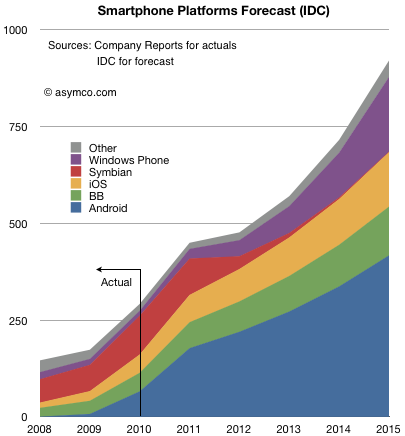
    The following chart shows both historic platform performance (which is detailed in the Asymco Interactive data sets on a quarterly basis) and the forecast based on the given compound growth rate published.[1]
    I see three main assumptions being made:

    1. Nokia (or more precisely Symbian) share will be swapped for Windows Phone. The transition period 2011 to 2015 shows approximately 150 million Symbian devices will be sold which is the stated goal for Nokia. IDC is making an assumption that the hardware vendors will roughly maintain their respective shares irrespective of platform dynamics and that Nokia will switch its share of users from one platform to another in a predictable way.
    2. iOS and BlackBerry will maintain share. Presumably this is also driven by hardware channel dynamics and relationships with carriers.
    3. Android will grow share slightly but the vast bulk of growth will come from market growth.
    4. Market growth is strong but undramatic.

    Overall this is not a controversial set of assumptions.

    Except perhaps that it assumes that the basis of competition in the market is unchanging. Of course it's well understood that the basis has shifted during the tumultuous 2007 to 2010 and forecasts made before the iPhone was launched sound absurd today.

    But IDC says that the unpleasantness won't happen again. From listening to the conversations going on today on this blog and elsewhere, their assumption that things will not change (again) is fairly deeply ingrained, indeed conventional wisdom. In that sense IDC is not taking any liberties with the future. The projections of current realities onto the future leads to this type of forecast and status quo defenders should be satisfied, if not rejoice.[2]

    However, there are a few more consequences of even this uncontroversial forecast which should make keen observers sit up and notice.

    If we look at more than the before and after snapshots and comfortable pie-splitting sound-bites there are some profound seismic things being implied.

    For example the entire market will be nearly 1 billion smartphones a year (in four years!). Even more startling, considering the "race to a billion" discussion we've been having, some of the platforms seem to be reaching that threshold rather quickly. The following chart shows the cumulative unit sales for the candidate platforms on a log scale:
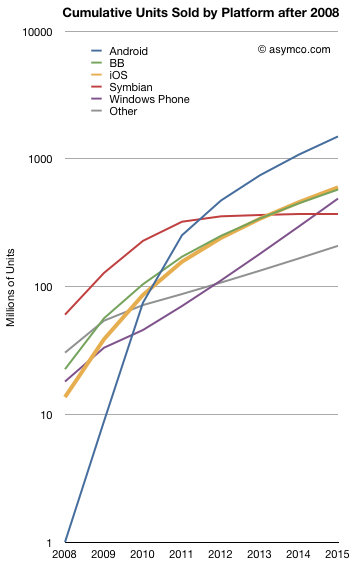
     

    Android is considered likely to break one billion units in five years post-launch. Windows Phone will sell nearly half a billion units and Blackberry will be well over that number.

    I tallied the cumulative platform unit totals below:
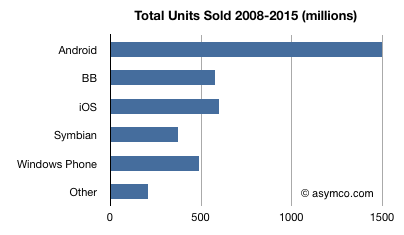
    No less than four platforms will have sold half-billion units by 2015. The suggestion that Android will "win" by having the most units sold seems as hollow as the suggestion that Symbian "won" by having the most users in 2008. Not so much because it will go on to lose them, but because there were plenty of viable alternatives for users to buy and developers to build for. Half a billion users cannot be easily ignored.

    So even "safe" assumptions can lead to astonishing results in this market. Namely, IDC is saying that the smartphone market will not have any platform losers.

    There is one more thing the report implies. If you look at the ranking of leading platforms (by units/year) in 2008,  2015 and, with a little extrapolation, 2016/2017 you get:

    Rank in 2008Rank in 2015Rank in 2016/2017
    SymbianAndroidAndroid
    OtheriOSWindows Mobile
    RIMRIMiOS
    Windows MobileWindows MobileRIM
    iOSSymbianOther
    AndroidOtherSymbian


    In other words, there is a complete reversal being projected. An almost perfect flip: those on top end up at the bottom and those on the bottom end up on top. That's about as controversial as it gets. Pretty impressive for a set of safe assumptions.

    --

    Notes:

    1. You should ignore the shape of the curve between 2011 and 2015 as it assumes the CAGR is applied to every year. Although the press release shows a CAGR, the actual report may include various fluctuation in yearly growth. The starting point of 2011 and the end result in 2015 however should be the same.
    2. If, on the other hand, you believe that exponential growth, rapid gains in communications speed, new breakthroughs in interaction with devices, and entrants winning with new business models are causes for a disruption, then perhaps extrapolation may not be the way to forecast this market.
  2. Understanding RIM's tablet platform app strategy

    Research · 135 comments

    Yesterday RIM reported their quarterly earnings. The results were mixed to slightly negative and the shares were down 10% in after-hours trading.

    I'll work through the smartphone market data at a later time but for now what I want to focus on is RIM's strategy which really means understanding RIM's intentions or their approach to the market. For that we have to go straight to the source: what management actually says. Trouble is, management often speaks in a jargon that is unfamiliar to people (sometimes unfamiliar to anyone outside the company).

    Strategy analysis involves translation. So here follows the interpretation of Jim Balsillie's remarks during the conference call (transcript sourced from Businessinsider.com).

    What Balsillie SaidMy interpretation
    First of all, what we announced is Gingerbread. This is not Honeycomb. I don't know what the number of Honeycomb apps is, but it's not very many. Whereas Gingerbread they've got lots of them.RIM will support Android apps in the PlayBook tablet. As there is not one Android, I need to clarify that RIM will not support Android tablet (Honeycomb) apps but Android phone (Gingerbread) apps. So RIM's tablet will support Android phone apps even though our tablet does not actually have a phone in it, but requires tethering to a BlackBerry for cellular data.
    You've got the volume of the handset apps, so if you're looking for the tonnage of apps, or some kind of long tail stuff, you've got it.This support means there will be many apps including apps that are not very popular. We don't like supporting unpopular apps. We like a few good quality apps but this approach allows us to offer all kinds of apps.
    At the end of the day, people are going to want performance.However, many apps will not run smoothly.
    You're just not going to get things like gaming and multimedia, you're not going to get the speed going through a VM interface. If you want content, or Flash type stuff, or you're looking at AIR-type, evolving web-type assets, that's what you're going to do.Games and graphics will not run well through emulation. For processor intensive experiences we will have native execution options or browser apps.
    There's no compromise here. You've got the tonnage of apps. And you've got the performance. Do I think the tonnage is overplayed? Yes.By supporting emulation of Android apps we can offer a large catalog of so-so apps while having a small portfolio of high quality native apps.
    But if you think it's about having a couple hundred thousand apps, there you goFor people who value large selections, they can go to one store.
    Do we believe it's about super high performance? YesBut for those people who value quality, they can come to our store.
    I'll just offer that observation that today broadly in the world without any specific comment on us or our competitors, there are multiple ecosystem patterns that need to be consideredBeside emulation and native we also think there are many other ways to deliver applications.
    Do we believe it's about full web fidelity? Yes.For example, Flash.
    These are concepts that were really relegated as not technically possible, which we're doing here. This is a no compromise environment.Because of Moore's law, Flash is becoming viable on a mobile device.
    If you want to work on Android, great. Do we think people will want to migrate web assets? YesThen there are browser apps.
    Do we think they're going to want super high performance native assets with the SDK? AbsolutelyWe will have our own native SDK.
    You think they're going to want to use their Flash based stuff for an offline Flash/AIR type environment? YesAnd support Flash.
    I'm just not interested in these sort of religious application tonnage issues.  I really think we put that issue to bed.We have a new platform but catalog sizes can no longer be used against us.
    And if you think the whole world's going to want to develop for Gingerbread, fine. Do I think that's going to happen? Then why is there a different environment for a tablet? And you know about the performance issues and you know about the app volume issues, cause it's tough. And that's why QNX mattersGoogle's ecosystem is fragmented, Android apps are not able to rely on competitive hardware and there is too much competition. That's why developers should target QNX (which is unfragmented, built on fast hardware and there are few apps on it).
    Is this stuff going to go more in the browser and HTML 5 and more native? These are going to be strong trends. But if you want these app players for different VMs -- and don't forget we have 25,000 BlackBerry 6 appsBrowser apps will increase in value and we also have legacy BlackBerry apps.
    So, at the end of the day, we believe this is going to be about performance. It's going to be about enterprise greatness.But we believe in a future with native applications running on QNX.
    Things like multi-threaded capability, symmetric multiprocessing. We believe it's about an uncompromised web. We believe it's about enterprise security. True multitasking, not with suspension -- and that matters because you're going to want to run these things in the background.Because QNX is a robust operating system with PC-like performance. It also supports a good browser.
    But I'm out of the religious war on tonnage, which I'm delighted.However, before QNX takes off, we will provide access to catalogs of apps which are built for other platforms.
  3. Lookout ZTE and Huawei: Here come NEC, Sharp and Kyocera

    Research · 29 comments

    Sony Ericsson, NEC and Kyocera are among the other Japanese handset makers also betting on Android as their path to international sales.

    via Japanese Phone Makers Look to Ride Android’s Surge - NYTimes.com.

    The Japanese positioning is based on the notion that current Android phones are not good enough and that they can bring "great hardware, great R&D and great engineers" to solve the existing problems with Android portfolio phones.

    That's an interesting observation by Google's own director of Android Global Partnerships. The idea that the market can still reward hardware innovation would also imply that Apple could benefit from that demand.

    So is the message that there is still room for device innovation?

    Perhaps not. Perhaps Android's pursuit of Japanese vendors (and vice-versa) is just evidence of the rush into smartphones by those possessing excess hardware R&D and manufacturing capacity and a deficit of software assets.

    It's still striking that there are hundreds of hardware vendors and supposedly "only two" platforms.

  4. The price of Windows Phone: Nokia's evaporating smartphone share

    Research · 61 comments

    In the last quarter Nokia sold 28.3 million Symbian phones. The average selling price was €156 or approximately $210. That price was down 17% year-on-year.

    According to the company,

    The 17% year-on-year decline in our converged mobile devices ASPs was mainly driven by general price erosion and an increase in the proportion of lower-priced converged mobile devices sales.

    ASP erosion has been a fact of life across all of Nokia's products for quite some time, checked only by the increasing mix of smartphones. However the smartphones it sells have been consistently positioned for lower price points. This is consistent with Nokia's long-term goal of serving "billions" of users.

    The trouble with the new strategy is that the Windows Phone product lines currently in the market are not likely to be priced in the $200 range. The reason is that the minimum specifications for Windows Phone 7 are:

    • Capacitive, 4-point multi-touch screen with WVGA (480x800) resolution
    • 1 GHz ARM v7 "Cortex/Scorpion" or better processor
    • DirectX9 rendering-capable GPU
    • 256 MB of RAM with at least 8 GB of Flash memory
    • Accelerometer with compass, ambient light sensor, proximity sensor and Assisted GPS
    • 5-megapixel camera with an LED flash

    These don't add up to a product that can be sold profitably at $200. The bill of materials is likely to be in that range (and one has to add $15 for Microsoft).

    So there are two possible implications for Nokia's new smartphone strategy.

    1. Windows Phone will be ported to lower spec/cost hardware to allow the traditional Nokian market growth model to continue and perhaps combat Android proliferation
    2. Nokia's smartphone portfolio will consist of high-priced products, and exclude mid-to-low price products.

    Option 1 is difficult to imagine. The user experience that Microsoft is putting forward as its differentiation depends on significant hardware which is unlikely to become very cheap very soon. It is an interesting exercise to think through however. What would we have to believe for this option to become real?

    Option 2 is more likely as Nokia conforms to this a new definition of smartphone as "high-end" only. This seems to be the default option given what is visible to observers today.

    If Option 2 is in fact the outcome of the new strategy, then it leaves Nokia very vulnerable to a low-end disruption (after it's succumbed to a new market disruption.) The $50 smartphone will be reality this year.

    Option 2 also most certainly guarantees that Nokia's current market share of 30% in smartphones is likely to be lost and never regained.

    Some might argue that's no great loss. After all, Apple does very well with low share and high prices. However, Nokia is almost religious about market share. The reason being that scale offers significant purchasing power and logistical leverage. It sustains a cost structure, distribution network and a business model that is central to the company's core competency. It's also presumably the reason Microsoft partnered with Nokia in the first place: volumes and wide distribution.

    So we're back to the old question: how does the new deal lead to a thriving ecosystem? Does it depend on vendors other than Nokia? If so how does Nokia benefit from the sale of Samsung phones?

  5. Nokia employs as many people to develop its smartphone software as Apple does to develop all its products

    Research · 106 comments

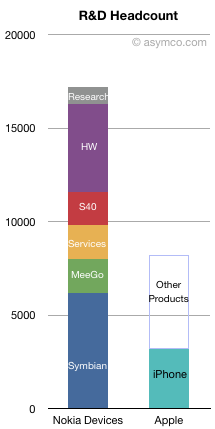
    In a recent post I pointed out that Apple's R&D was about 2.2% of sales in the last quarter. Bernstein took a look at the R&D for Nokia and presented a chart showing the difference between the mobile industry players in terms of total expenditure on R&D.

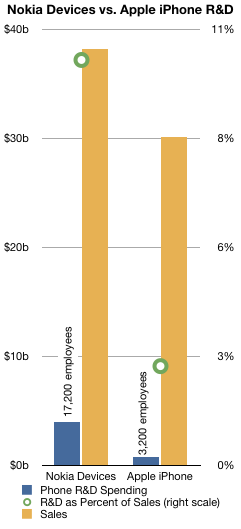
    I took inspiration from that to plot the Devices R&D for both Nokia and Apple over the entire 2010 period. I also compared that with sales and computed the ratio between R&D and sales.

    The result is shown in the chart on the left.

    Bottom line: Nokia spent 10.2% of phone sales in 2010 on phone R&D while Apple spent 2.5%.

    Bernstein goes on to argue that at least for Devices,

    Nokia spent $3.9bn in R&D in 2010, almost 3x the average of its peers, 31% of the industry's R&D total spending, for an output that we can qualify as visibly disappointing.

    To relate the $3.9 billion for Devices into head count, they estimate that Symbian projects employ 6,200 people; MeeGo and Qt 1,800; Services 1,800; and S40 1,800. Hardware headcount is assumed to be 4,700 and 900 more for fundamental research.

    So Nokia's total software headcount adds up to 11,600 people. Nokia smartphone headcount adds up to about 8,000.

    Applying a similar formula ($240k/employee[1]) to Apple's estimated iPhone R&D (from Bernstein's chart) yields a headcount of about 3,200 and a total Apple company R&D headcount of 8,200.

    So Nokia employs about the same number of engineers[2] for its smartphone software platforms as Apple does for all its product lines[3].

    In fact, Symbian alone may cost twice as much to develop than the iPhone (including the hardware).

    ---

    Notes:

    1. The cost per employee is obviously different between the companies as they operate in different countries. However there are enough sources of error in these estimates that they probably overwhelm the cost of living/tax differentials.
    2. I know that engineers are not all that R&D headcount covers, but let's assume that the mix of overhead is similar for the two companies.
    3. The total for Symbian + MeeGo is 8000 and the total for Apple overall is 8,200, however one can comfortably allocate 200 out of 900 researchers out of Nokia research to their mobile software effort.
  6. The iPhone is not superfluous, not easily copied, not revolutionary and not a premium product

    Research · 61 comments

    The release of the iPhone is rightly acclaimed as a watershed event in the history of telecom. It was a sensation. But it was also a product that was widely underestimated and dismissed. Even today expert opinion is divided. The critics of the product transitioned directly from labeling it a superfluous bauble to an obvious and copyable sustaining innovation. Advocates of the product describe it as revolutionary and dazzling with the potential for capturing significant profit share due to premium pricing and positioning.

    So which is it?

    I'll argue that it's none of the above. The iPhone is not superfluous, not easily copied, not revolutionary and not a premium product. What it is is disruptive.

    First, we have to quickly define disruptive potential.

    A product is disruptive if it competes with an existing, incumbent set of products on a new basis. It competes along a new measure of performance. That means it's either "low end" and hence cheaper, simpler, more modular and conformable, or it creates a "new market" where completely new measures of performance or quality are relevant.

    In both "low end" and "new market" disruptions the product is usually wrapped in a business model that insulates it from incumbent response due to inherent asymmetries. Incumbents will find the economics of the entrant product unattractive and will be motivated to ignore it or actively avoid copying it.

    The consequences of disruptive product entires are often catastrophic for the incumbents because, over time, the disruptor product vacuums up all the profits in the industry, robbing the incumbents of the fuel to respond by the time they become motivated to do so. In essence, the transfer of value to the new basis of competition happens so slowly that the threat is imperceptible until it's too late.

    If we look at this definition, it's startling that the iPhone does not seem to fit.

    As a phone, it's not cheaper, nor modular and hence not "low end". It did not create a new market.  As a phone, although it did recruit more regular phone users into becoming smartphone users, it was not the first or last phone to do so. Its phone business model was not a radical departure. It was not ignored by the mobile phone incumbents who reacted with various degrees of urgency and vigor. It was actively copied in every way from the UI to the ecosystem to the pricing model and distribution.

    The only thing that seems to have happened according to the disruptive formula was the transfer of profits from incumbents to Apple, at least temporarily.

    So the iPhone seems to be correctly classified as a sustaining innovation. Something that moves the phone market forward and which, except for a temporary misallocation of profits, will entrench the incumbents after they manage to copy it effectively.

    However, here is where we have to dig a little deeper.

    Market analysis easily becomes myopic when looking only at a market defined by a product. I've argued in the past that strategic insight comes from looking at products that cross over their market boundaries. Especially products that are hired to do different jobs than the same products in their categories. The iPod may seem like an MP3 player but it caused catastrophic profit collapse in multiple industries. It knocked out the CD business, it crippled the component audio system "Hi-Fi" industry, it razed the music retail business and affected the entire music value chain. It's still pounding at the gates of video and TV production. And, almost as a side-show, it crushed the Walkman.

    Even though it was a music player, the MP3 device market was the smallest target for the iPod. It turned out to be far more dangerous to ancillary industries. The reason is subtle: it competed as an integrated ecosystem. You hired the iPod to serve you music everywhere, not just in your living room. And it did the job in an integrated way from source to earbuds taking what was a hodgepodge of modular components built around analog music and smoothly integrated them to deliver music in new, non-consuming contexts.

    The lesson is therefore that when looking at the iPhone one has to look at ancillary industries not just at phones.

    Phones have always been a component in a wider inter-related telecom value network. Even today they are often called "terminals" in the industry meaning that they are the end points of a network. Similar to the PC, the iPhone enables a migration of intelligence away from the center toward the edge of the network resulting in a de-valuation of the network itself.

    I argue that the real disruption of mobile computing (i.e. iPhone) is made possible not by the smartphone technologies but by mobile broadband. Once broadband became mobile with 3G the smartphone could shift its focus (jobs it's hired to do) from voice to data. That shift is disruptive to incumbents because they built their businesses around operator distribution and operator service economics. With apps, mobile computing brings with it services which allow all communications to be independent of operators. Selling ringtones, maps, email and video-on-demand are all dead business plans today. But operators clung on to these hopes for many years and forced vendors to comply to this strategy.

    The incumbents relied so much on the telecom value chain, where the value flows from the monthly service charge, that they would not deploy technologies or business models that were asymmetric to operator business models. This is the root cause for Nokia and Samsung and Motorola and LG "missing the boat" on smartphones. All the vendors had the pieces of technology on their shelves. But when they took these technologies to their customers, the customers rejected the package.

    This is why entrants like RIM and Apple could easily gain a foothold and grow. They had modest volumes, sold new concepts like business email and new UIs with iconic designs, but did not go after the core business model. This is similar to how iPod/iTunes got a toehold with the record labels. By the time the disruption took hold, operators were addicted to the new high-ARPU being generated even though they were all pure bitpipe plans. A bird in the hand is worth two in the bush, so the new device brands stuck.

    Do the incumbents still have time to respond effectively? It's less and less likely. They cannot build the new computing ecosystem without the distribution power of operators. Note that iPhone 'clones' in Android are still sold via operators and that nobody is interested in making either iPod touch clones or iPad clones sold independent of the operator channel/subsidy model. This is not because of technical or economic reasons but because of a lack of distribution (and lack of integrated content).

    When you step back and look at the phone in the context of the network business model as well as the shifts in consumer jobs to be done you realize the potential is far greater than taking share from incumbents. The iPhone is not divided into a portfolio of different phones, but it's a part of a portfolio of new mobile computing products. It just happens to be the only one which still depends on the cellular operator distribution network.

    Seen as part of a new mobile computing paradigm and following the trajectory of the mainframe, mini-computer, PC and laptop, the iPhone is an essential, non-superfluous device for a vast population of new users.

    Seen as an integrated app ecosystem with strong network effects, it's not easily copied. Responses that only account for it as a glass and metal object of desire will fall way short of being competitive. As the hardware was always available to competitors, it's not a revolution in hardware or even in user experience.

    Most importantly, seen as a computing alternative merged with a communication appliance, it and its siblings are not premium products. The pricing and service structure around it make it seem a low cost alternative for solving the jobs it's hired to do.

    In other words, it is as disruptive as it gets.

  7. Law of conservation of modularity

    Research · 32 comments

    When I applied the modularity dichotomy to smartphone operating system there were several implications that came to light. One was the question of whether the market has reached the point where products were "good enough" and the speed of innovation became less important than price. Another was: will integrated vendors be able to hold on to a healthy share of growth against non-consumption?

    Now I bring up another implication of modularity: the concept of "law of conservation of modularity".

    Clayton Christensen illustrated this as follows[1]:

    If you are writing a software application to run on top of a platform, are you permitted to modify the platform to make your application run better?

    If the platform is interdependent, changing it could cause unintended side-effects and you will not be allowed to make them. If the platform is modular, changes are possible and you will have access to the code.

    The reason is not not political. It's that in the case of interdependence, the application has to be suboptimized and conform itself to the platform so that the platform could remain optimized (to its goals). The platform needs to remain optimized is because it needs to keep improving (since it's not good enough).

    In the case of modularity, the application can be optimized and the platform can conform itself to the application because the application needs to keep improving while the platform is good enough and does not.

    Conformability is what constrains up-market progress.

    This also holds in hardware architecture. This was plainly evident in the WinTel era. During that time the microprocessor and the operating systems had a proprietary and interdependent architecture even while Dell’s product has a modular architecture.

    So the microprocessor wasn’t good enough. That meant that the desktop computer had to have a modular architecture to conform itself in order to allow this to be optimized because the line widths on the circuit were not good enough.

    This is what is meant by conservation of modularity: one side or the other of an value chain boundary needs to be modular and conformable to allow what’s not good enough to be optimized. The key question is what's not good enough: the device or the platform (the whole or part?)

    How does this apply today in the post-PC era?

    If you think about it in a hardware context, because historically the microprocessor had not been good enough, then its architecture inside was proprietary and optimized and that meant that the computer's architecture had to be modular and conformable to allow the microprocessor to be optimized. But in a little mobile computer like the smartphone, it’s the device itself that’s not good enough, and you therefore cannot have a one-size-fits-all Intel processor inside of a BlackBerry or iPhone, but instead, the processor itself has to be modular and conformable so that it has on it only the functionality that the BlackBerry needs and none of the functionality that it doesn't need (hence the ARM modular architecture is dominant). So again, one side or the other needs to be modular and conformable to optimize what’s not good enough.

    Now today (and, I believe for some time to come) in smartphones, or in any situation where logic gets embedded in a system it’s the device itself that is not yet good enough and, therefore, you cannot back off the frontier of what’s technologically possible. It has to be optimized with a proprietary interdependent architecture. That means that the processor and the operating system inside of a Smartphone has to be modular and conformable to allow that to be optimized.

    In order for you to believe otherwise you have to convince yourself that smartphones, as a system, have reached the limit of what is technologically possible.

    [1] The source is a presentation by Clayton Christensen at  Open Source Business Conference in 2004

  8. Apple's Growth Scorecard

    Research · 14 comments

    Every quarter I try to score growth by top, bottom and product lines. As unforeseen growth is the only driver creating shareholder value, it's of paramount importance to measuring a company's performance.

    For Apple, the analysis is fairly straight-forward. There are relatively few product lines (seven including the iPad). I measure y/y sales growth and try to form a picture that is easy on the eyes and mind.

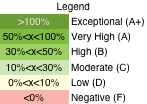
    The method I'm using now is color coding growth for each line according to the legend to the left.

    The table that follows shows each product plus the Net Sales and Earnings lines according to this color coding. I also added an average column for reference.

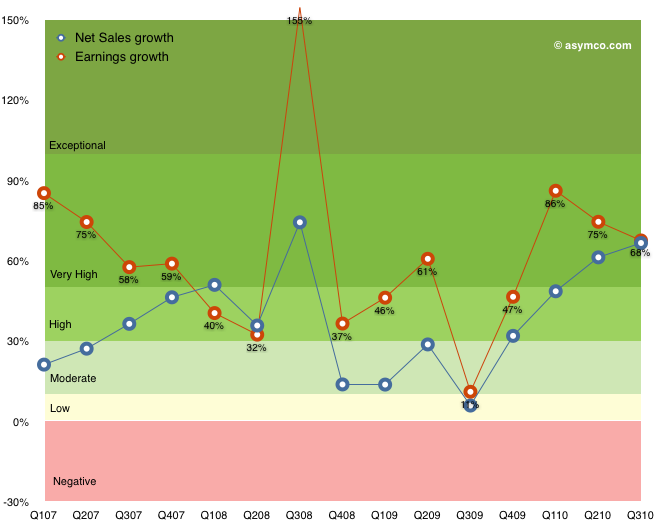
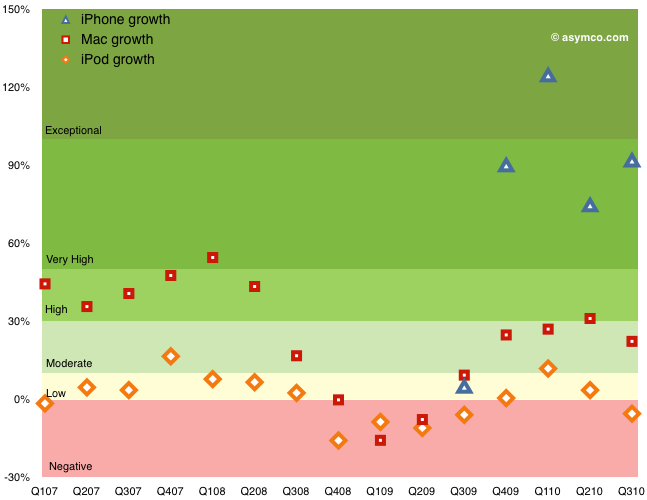
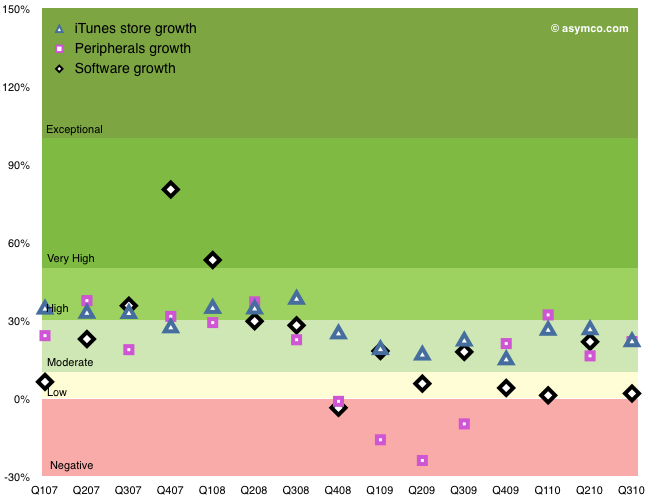
    The following graphs show the same data with color coding for the rates as they change over time. I broke the data into three charts: Top/Bottom lines, Hardware Products, Other Products.

    Discussion

    Hopefully this representation describes the company's growth without requiring too much explanation. Earnings growth, which determines ultimate value created is near all-time highs, well into the "Very High" (A) growth band. Apple have recovered from the Moderate-to-High (B/C) bands during the recession and are near the levels of 2007 when the company was trading at a P/E of 50 (today's P/E for Apple is 20). Sales growth broadly followed earnings growth.

    Within the products, the iPhone again shows exceptional performance. The growth during the first five quarters was (literally) off the scale (above 150%--see table for actuals). The average quarterly y/y growth has been 234%! Last quarter's 92% growth is very near the 100% threshold for exponential growth. This after three years in the market.

    The Mac growth is Moderate (B) and that may be because it was not a launch quarter for portables. The Mac underwent Very High (grade of A) growth for a period of 2008. The iPod shows weakness. The product has been in a Low-to-Negative  (D to F) band of growth since the iPhone launched. Clearly a mature product line but one which has been largely subsumed into the iPhone and iPad. The iPod touch is increasingly a large proportion of the iPod line.

    The non-hardware product lines are Low-to-Moderate growth products. The Peripherals business tracks very closely to the Mac business and dipped negative during the recession.

    Overall, the growth scorecard is in the "Very High" category, or a grade of "A", mostly driven by the iPhone and iPad. Whether this growth will be reflected in the share price is a question reserved for a future discussion.

  9. Visualizing Apple's Profitability

    Research · 26 comments

    After the last earnings report, many noted that Apple's gross margins dipped. Turley Muller noted in a letter to PED that the cause was probably the aggressive ramp in iPhone 4 production which broke new records at 14.1 million units.

    That may be. My estimate of iPhone margin shows it dropping to about 49% from the more usual 55% (sometimes even higher).  We'll never know exactly how much, but sometimes margins drop. RIM and Nokia are punished for drops in the GM percent so why shouldn't Apple?

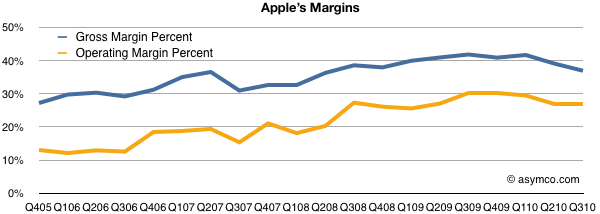
    However, there are some other factors to consider: the overall margin is currently historically very high. As the high-margin iPhone makes up more of the total product mix, the overall margin should be growing. And it is. The chart below shows the trend since 2005. GM was in the high 20's five years ago.

    Note however the other margin: operating margin. After taking the fixed costs into consideration (which we saw to be shrinking as a percent of sales), Apple's bottom line profitability has been rising slightly more rapidly than the GM. It has plateaued recently but not dipped significantly.

    Also note that there have been dips in the past from which GM expansion resumed. One such dip was at the launch of the first iPhone in 2007, though we can't be sure that was attributed to the iPhone itself or to other factors like that most cited by management: components costs.

    However, the bottom line profitability is only part of the picture. It would be instructive to look at which product contribute how much. You won't see this analysis often because the gross margin by product is not published by Apple and it takes quite a bit of guesswork to get there.

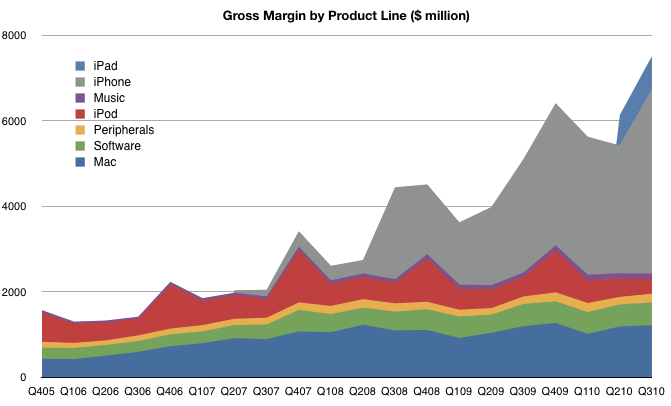
    I maintain product-level gross margins and compute the overall GM bottom-up. The product-by-product line profitability is based on several assumptions which I won't detail here, but those assumptions lead to the following contribution chart:

    There are several takeaways here:

    1. The iPhone is huge (57% of gross profits). It is far more important than most people assume. Without it, the company would not have materially grown EPS since 2007.
    2. The "Music" which includes iTunes revenues is tiny. Many people assume that iTunes is a large contributor to Apple's operating profitability but operating margins on the store are 10 percent. Peripherals add more to the bottom line than the iTMS/App Store. The benefit of the iTunes/App Stores is in the hardware sold.
    3. Software contributes more now than the iPod. This is completely under everyone's radar but Apple's software business has been growing and with 80% gross margins (assumed) it's a big part of the profit picture.
    4. The iPad margins are lower than the iPhone. As it grows in volume, the profit share will grow, but it's a long way from being the profit share leader.

    This picture should also be a warning to Apple's competitors. If they seek to grow shareholder value and shift profits away from Apple they need to see just how much of that profit is captured in hardware. At the same time, they need to realize that it's the non-hardware businesses which make the hardware so desirable. Like it's products, Apple's income statement is very inter-dependent.

  10. Which size really matters? Market Share vs Profit Share

    Research · 27 comments

    One of the most hotly debated subjects in the mobile phone business is the importance of market share. It's also a topic of lore in the PC industry. Briefly the two arguments are:

    • Market share matters more because it drives network effects which ultimately drive competition out of the market, creating the opportunity for monopoly rents.
    • Profit share matters more because profit is the only fuel that can drive innovation. Any macro downturn or shift in strategy can cause a company to cease investing in unprofitable projects.

    The old disruptor's adage: "Be hungry for profits and patient for growth" is challenged by the equally disruptive: "Grow share with lower prices in exchange for new revenue sources."

    There are many rich anecdotes to support each strategy, but how about some data? Fortunately we have some: the market and profit shares for vendors covering 80% of the world's largest technology market over a three year period. The vendors are a good proxy for the market, the time frame is long enough to cover seasonality and anomalies and the market is very big (over 1.2 billion devices) and very broad (world-wide).

    The only question is how to measure success. One measure is how various strategies benefit the asset owners, i.e. the share holders. Benefit to society, employees and consumers are very difficult to measure. But share holder benefit is easily obtained by measuring change in share prices.

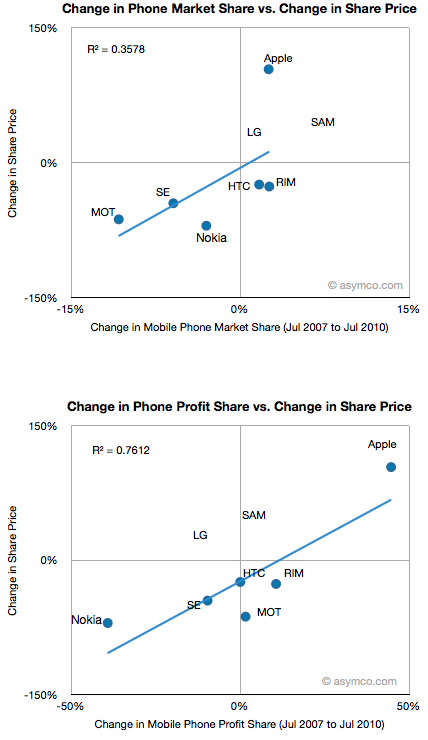
    So, here are two charts:

    1. The percent change in market share vs. percent change in share price for the top mobile phone vendors.
    2. The percent change in profit share vs. percent change in share price for the same vendors. (see note 1 for time frame discussion).

    I showed the R-squared value of the correlations. (See note 2 regarding LG and Samsung). At r-squared of 0.36 share price is not well correlated to market share while at 0.76 it is rather well correlated to profit share. To a financial analyst this would seem obvious. After all, share price reflects the present value of future cash flows which are clearly coupled to profit and hence to profit share growth. However, as many technology observers would point out, market share determined the success of Microsoft and Google, and to some degree Nokia.

    High market share can cause competitors to be starved of components or ecosystem developers. At the same time, high profit share can cause competitors to be starved of capital.

    What does this analysis add to the argument? Note that this data covers a hardware business. Is hardware relevant? It does not scale as rapidly and has a short shelf life. It's also notoriously difficult to distribute. However, outside of the service revenues for cellular voice and data, device hardware is the only pool of money that has any material dimension in the industry. It's also the pool of money with the highest margin in the industry. For the time being and the foreseeable future, hardware is the only business model worth anything in mobile computing.

    The data shows that in this particular but substantial market profit share is closely correlated to shareholder value creation. It also shows that profit loss is closely correlated with shareholder destruction. The dominant data comes from Apple and Nokia, which appear to be polar opposites in performance on both measures.

    In other articles I've shown how profits have shifted from incumbents to entrants in the smartphone disruption. This shift has resulted in direct benefit and loss to the owners of the two asset classes. To suggest that market share alone is a determinant of "success" in the device market must exclude the effect on shareholders and, ultimately, the management and employees of the companies concerned. The virtuous/vicious cycles will be fed by the profit variable more than any other.

    I don't think the market share argument holds water in this market and this data supports my belief. It may be that as value shifts over time away from hardware the benefit will shift as well, but business models alternatives to hardware have not emerged after ten years of experimentation. If anything, the idea of selling hardware as a way of capturing service revenue was pioneered by RIM and perfected by Apple. Nothing I've seen so far is challenging this model. Whoever attempts to siphon the device pool of money (which has remained fairly constant over the smartphone disruption) needs to solve system-wide problems like the dependence on the network and the life-cycle of portable electronics.

    ----

    Notes:

    1. The dates when performance was sampled are are July 1 2007 to July 1 2010. The latest quarter (3Q10) has not been included in this data as it has not been fully reported. The data will be updated with the latest quarter as soon as it's possible.
    2. For many competitors the share price is dependent on more than performance in the mobile phone market. In particular, LG, Samsung, Motorola and Apple have diversified product lines which affect their share prices. Two of those companies (LG and Samsung) are conglomerates and their share performance is dominated by businesses other than mobile so I did not include their data in the correlation measure (though their place on the chart is shown). Motorola and Apple's stock prices were, to a very large extent, driven by their mobile phone performance over the same period so their data is included in the correlation analysis. The other vendors have been primarily focused on mobile phones.
  11. iPad lead seen as 'overwhelming'

    Research · 37 comments

    Chris Whitmore predicted 2.0 million iPads would be sold in 2010 soon after the product launched. (asymco | Analysts predict iPad sales)

    More recently, Chris Whitmore writes for Deutsche Bank:

    "We believe Apple's lead in the tablet market will prove difficult to close by the onslaught of competing products coming over the next several quarters," he writes in a note to clients issued early Monday. "Ultimately, we expect the slew of upcoming competition to fall flat from a user experience standpoint while struggl[ing] to materially undercut the iPad on price."

    How far ahead is Apple (AAPL)? According to Whitmore:

    12-18 months in content (see chart)

    2 or more years in terms of other media acquisition and integration via iTunes

    Untold dollars in terms of component pricing

    via iPad lead seen as 'overwhelming' - Apple 2.0 - Fortune Tech.
    Compare this fresh (re-)assessment with the following points I made in May of this year:

    The iPad comes with an even bigger value chain [than the iPod] bolted on: the App Store. Apple is flogging not just an “app player” but also a new way to develop and distribute software. If you cut “music” and paste “apps” you see the immediate parallel between iPod and iPad. The app ecosystem will quickly grow to be larger than the music ecosystem with the mobile software business already eclipsing the music business.

    ...

    So the iPad challengers face five daunting obstacles:

    Recognition of a threat from a seemingly benign product

    Execution on hardware against the best integrator on the planet

    Execution on software against a new UI metaphor fortress surrounded by a patent moat

    Integration of hardware and software to a sublime whole

    Re-building a value chain for which they have no handle vs. a broad and deep existing universe of app/content creation distribution and consumption enjoying logarithmic network effect value.

    asymco | Will Apple rule the iPad market? (part II)

    Welcome to the club, Chris.