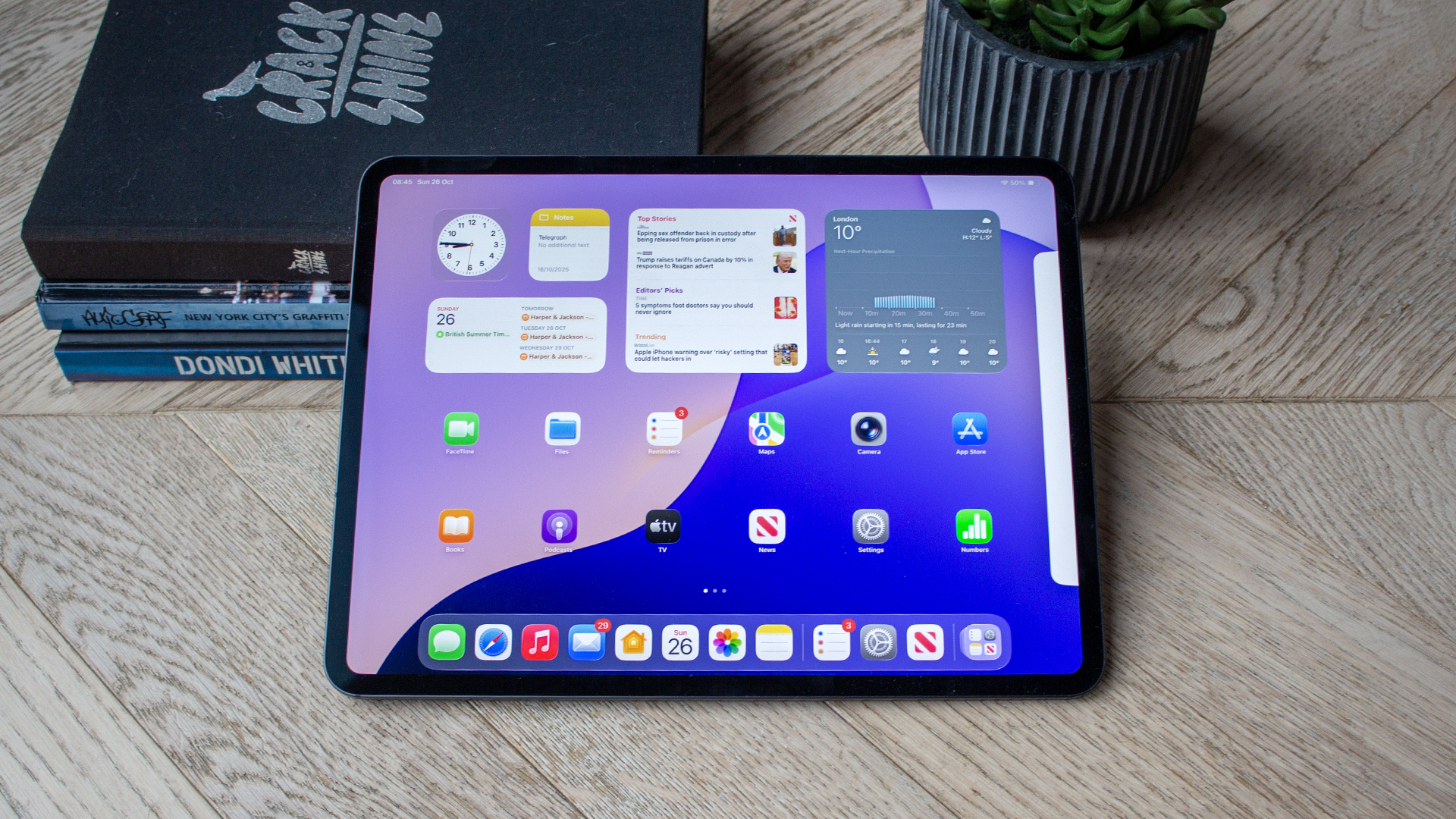
Apple’s top-line is benefiting from an expanding enterprise footprint. In the first quarter of fiscal 2026, the company saw strong adoption with Snowflake deploying more than 9,000 Mac devices while AstraZeneca rolled out more than 5,000 M5-powered iPad Pros to its pharmaceutical sales team. Mexico’s largest domestic retailer – Coppel – added MacBook Air to its growing fleet of more than 10,000 iPad devices.
In the trailing 12 months, Apple’s devices have been adopted by the likes of BMW Group (tens of thousands of iPhones), Capital One added MacBook Airs, while the Czech Republic’s largest bank, Ceska sporitelna, is using more than 5,000 iPhones in addition to its existing thousands of iPads and Macs. Other notable users include PayPal, Roche, and Thailand’s Siam Commercial Bank. Apart from iPhones, iPads and MacBooks, Apple Vision Pro is gaining adoption. Apple’s visionOS 26 introduced new enterprise APIs that empower companies to build their own spatial experiences. This is expected to further drive the adoption of Apple devices.
The company is now bringing Apple Business that combines built-in mobile device management, business email and calendar services with custom domain support. Apple Business can help enterprises grow their reach and connect with local customers across Apple Maps, Mail, Wallet, Siri, and more. Apple is set to introduce a new option coming this summer that will enable businesses in the United States and Canada to place local ads in Maps during key search and discovery moments. Beginning April 14, Apple Business will be available as a free service in the United States and more than 200+ countries and regions to new and existing users of Apple Business Connect, Apple Business Essentials and Apple Business Manager.
50 already? It seems only a blink of an eye since I wrote Apple at 40. Let's try copy & paste.
In Apple’s first 40 50 years it shipped 1,591,092,250 5,126,211,000 computers[1].
This shipment total is higher than any other computer company in its first 40 50 years. Actually there are no other PC makers that are 40 50 years old. One computer maker (IBM) is older but they only sold PCs for 24 years and what they still sell they don’t sell in high numbers.
That does not make Apple the top seller in a given year. Looking at only the Mac, Apple’s traditional form factor personal computer, Apple is fifth fourth in market share. If including the iPad, it was the top computer vendor in 2011 and, including the iPhone, it was first in 2009.
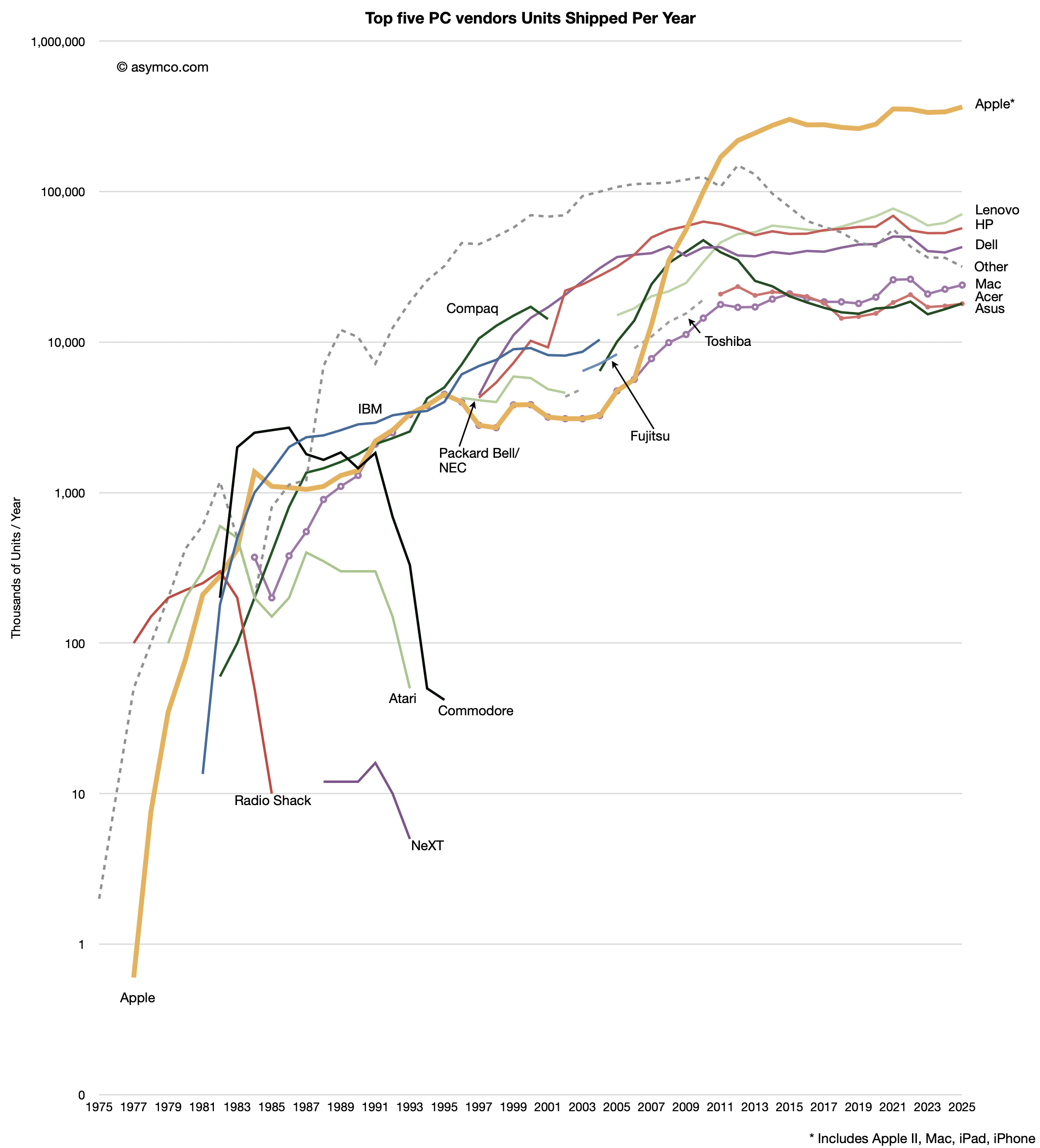
The following graph shows the top computer makers by units sold since 1975, a year before Apple was founded. (Click on the graph to see a higher resolution.)
Note that the graph is log scale and in multiples of 1000. Following the yellow Apple line we can see how it started with fewer than 1000 units shipped in its first year to today when it is shipping more than 1 million computers every day[2]. It's also quite remarkable to count how many other companies have come and gone in this top five list and imagine how many came and went in the "other" category.
Who remembers Atari, Commodore, Packard Bell, Compaq? Few said that they were doomed while they were in the running. Going back to Apple at 40,
After having a 40 50 year run and after selling more computers than all American and Japanese computer companies put together, how should we think about the next 40 50 years?
First, clearly Apple shifted from being a “computer company”. It has already changed its name to exclude the word “Computer.” That [came to mean that] it sells devices (which happen to also include computers.) We don't use computers to compute anyway. We use them to make decisions, keep track of things, speed things up and to communicate and to entertain.
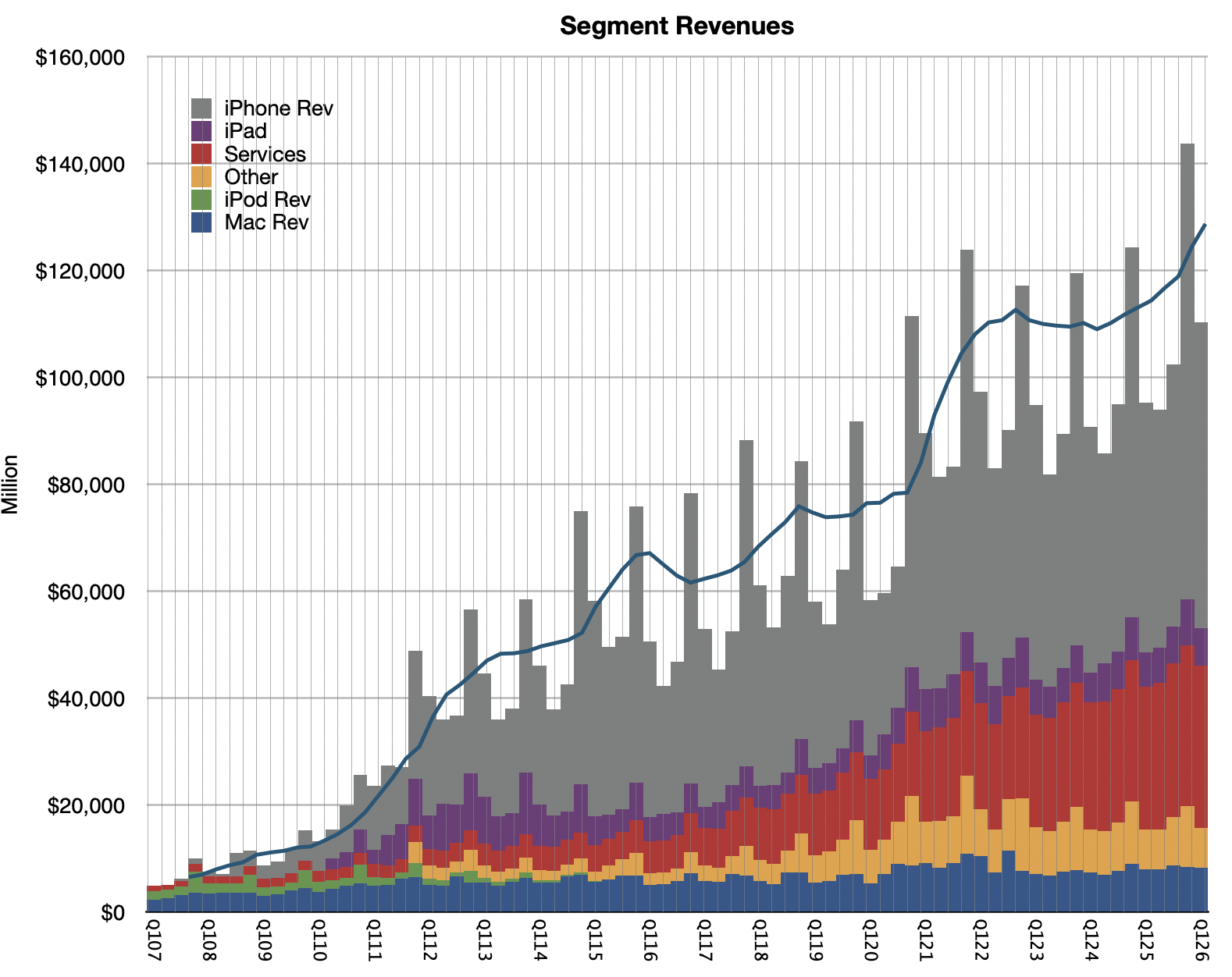
After convincing the world that it's a not just a computer company, the next challenge has been to convince the world that it's also not just a product company. It did so by launching Services as a group (formerly known as iTunes Software and Services) and then separating the financial reporting so that Services can be measured with its own gross margin. Year after year management emphasized Services growth in its commentary. Services has grown into the second largest segment, 26% of total revenues ($112.8 billion out of 435.6 billion in calendar 2025.)
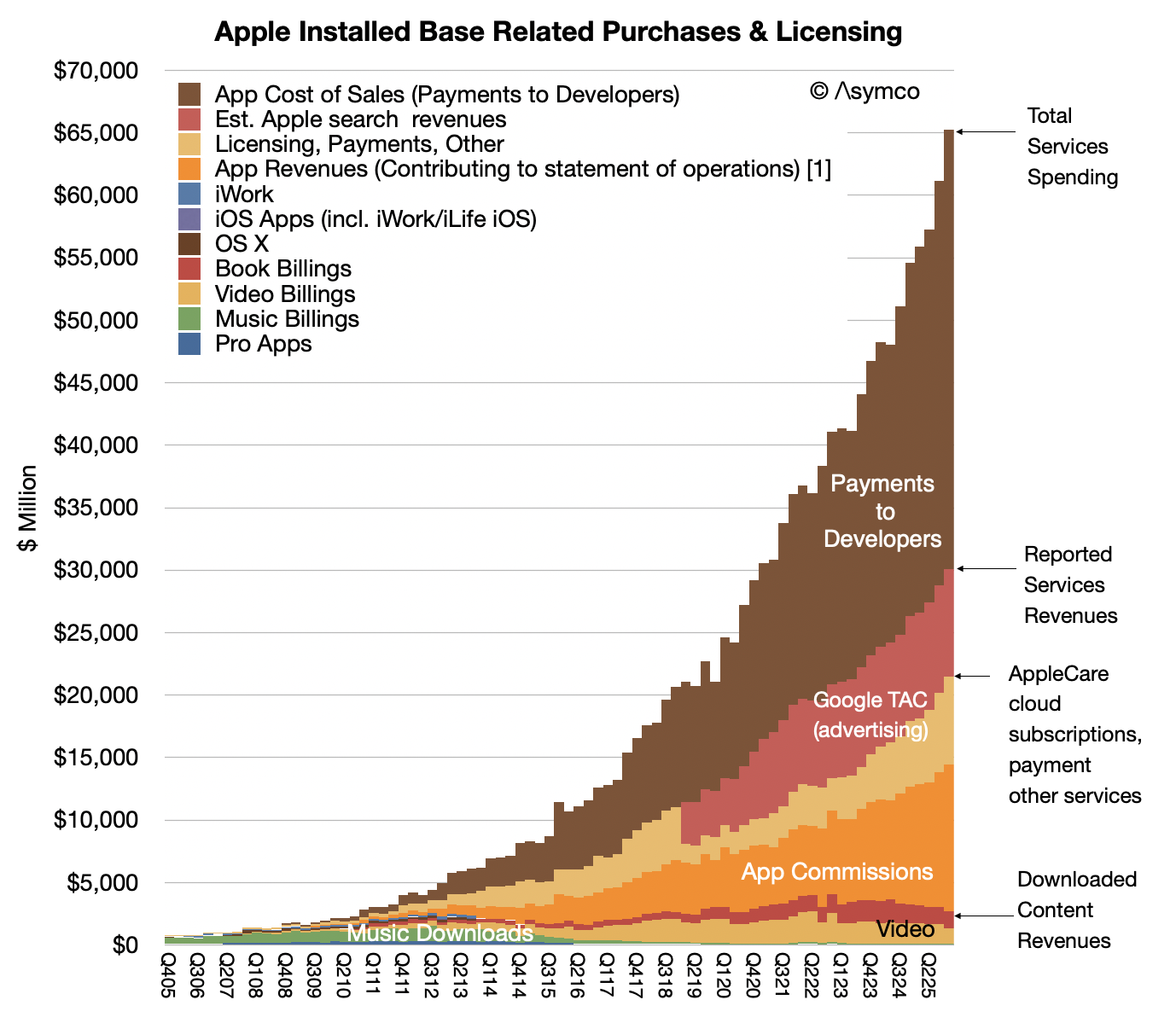
Services, if it stood alone, would be number 40 in the Fortune 500 list of largest companies by sales. It has been impossible to ignore it. Considering how much customers actually spend on Apps, Content and Services, the total is even bigger at $240 billion last year[3]. As a result, some, perhaps most, recognize Apple as a Products & Services company.
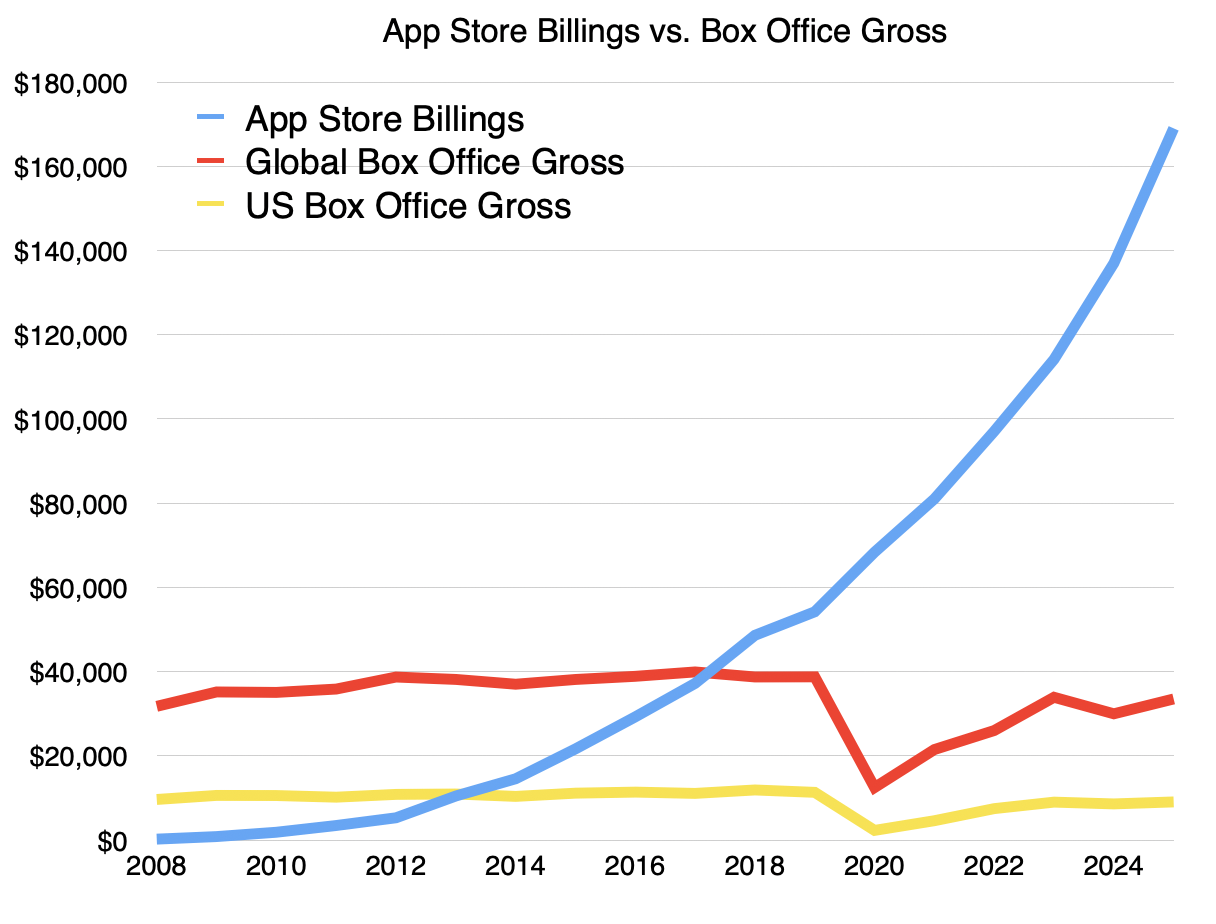
The App store alone attracts $169 billion in spending per year (2025) and that is now 5x what theatrical movie sales bring in world-wide.[4]
So if Apple is today at least a bundle of Products and Services then what will Apple be 50 years from now?
Again from Apple 40:
My simple proposal is to think of Apple as a customer creator. It creates and maintains customers. The more it creates, the more it prospers. The more customers it preserves the more it’s likely to persevere. This measure of performance for a company is not easy to obtain. It’s not a line item in any financial report.
The closest figure we have is that today Apple has one 2.5 billion active devices in use. It has around 1.1 billion users [5]. Using the devices as a proxy, we can say that this audience has more than doubled in the last decade.
So we know that at least Apple has created a large number of customers. Knowing total devices sold and number in use means that we can be sure that 63% of all the computers Apple sold are still in use. This means that most customers are recent customers. Are they going to come back?
If we then factor in the size and persistence of Apple’s audience (customer base) we might conclude that there are factors which will allow it to grow rather than shrink. My analysis based on public data shows that the customer base has been increasing steadily.
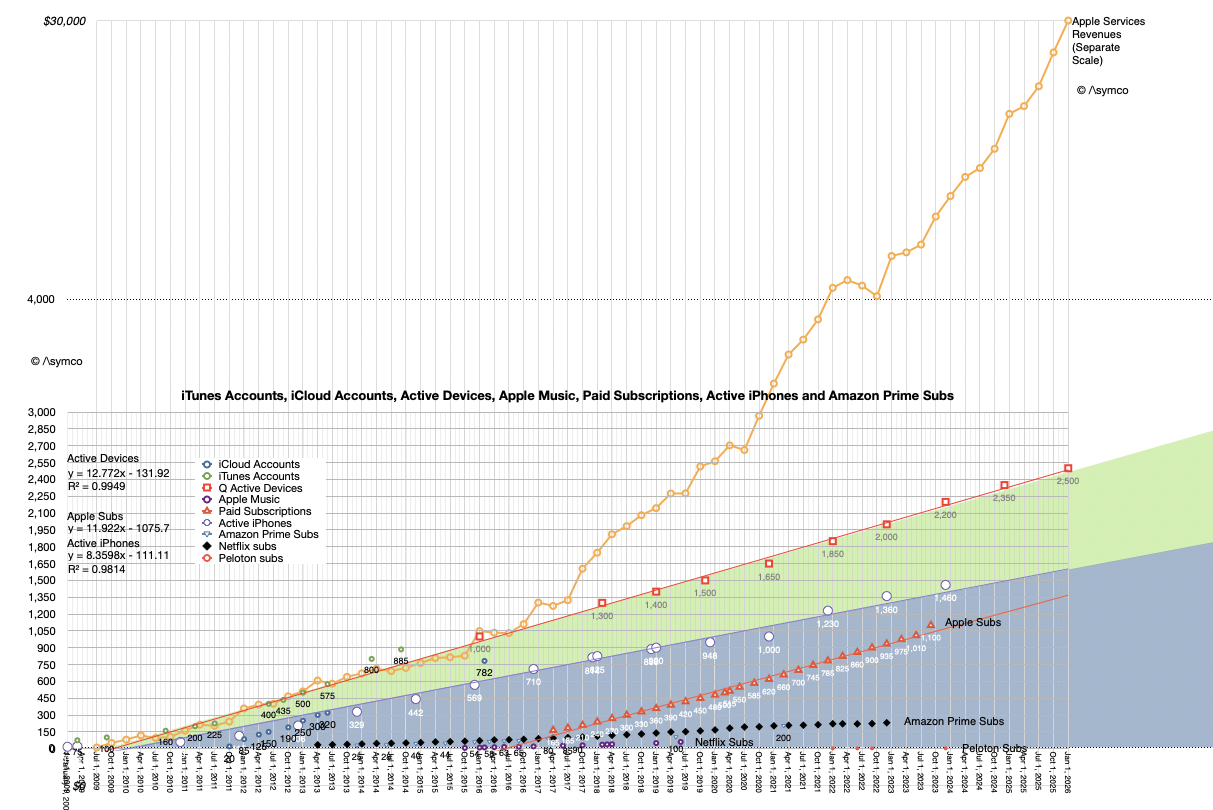
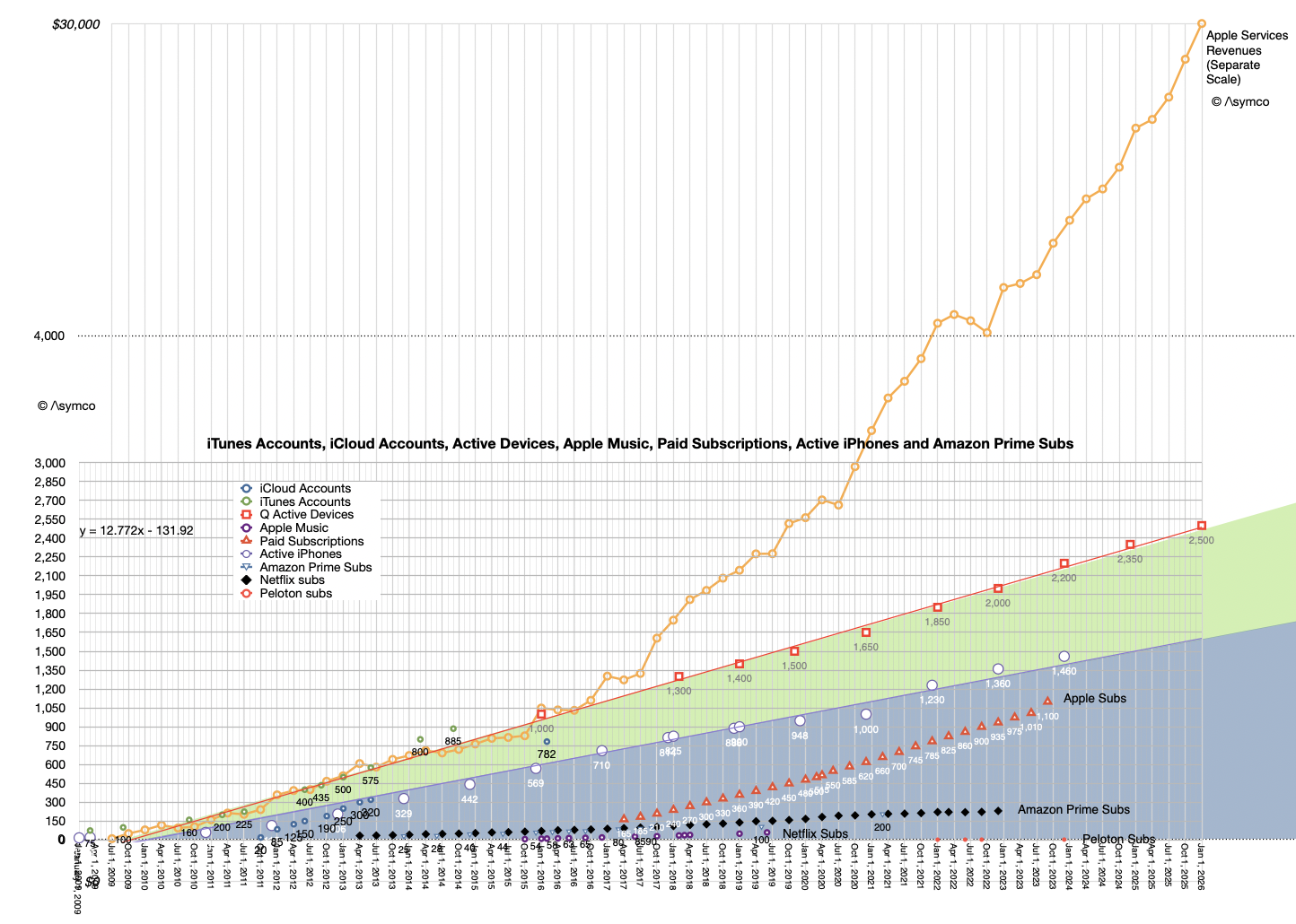
And here is a graph showing the size of device base and implications for subscriptions. services and comparisons with other consumer aggregators. Note the forward looking nature of a linear extrapolation of the historical data.
10 years ago, I continued:
Combining the history of customer creation and customer preservation with the value obtained from each customer implies that the next 40 years will be about creating another large tranche of customers whose willingness to spend on whatever Apple creates will be relatively unchanged.
We don’t know the limit. One billion was hard to imagine even one year ago. We might see two billion devices in short order. Perhaps not. Perhaps as we have a multitude of devices about us all day the number will become less meaningful. But if the number of middle class customers grows and as Apple keeps its products within their reach, there is no reason to think that there will be a reversal of the last 40 years in terms of customer acquisition.
This analysis contradicts the current perception of the company as reflected by its stock price. That price assumes the audience will wither ((With a P/E ratio of 11, without a change in revenue per user, the only justification would be the audience shrinking by more than 90% over the next 20 years.)) That is not insanity. It is what we could expect if Apple were unexceptional.
We did see 2 billion. We actually saw 2.5 billion. The assumption of a company in distress as reflected by the P/E ratio of 11 is gone. It's safe to say that Apple is exceptional.
But note that we are only 10 years into that 40 year forecast from a decade ago. Do we still feel confident that the company can last 30 more years given what we've seen so far? If one company could get through the next 30 I would say it is Apple. And if it is so then I think it will get through the next 50.
One more Thing
So, the plan is to make more of the same. It's more than enough.
Including Apple II, Mac, iPhone, iPad and iPod touch; excluding Apple Vision Pro, Apple TV and other iPods. Includes Q1 shipments estimated
2025 shipments were above 364.9 million excluding Apple Vision Pro, Apple TV, Apple Watch.
A Fortune 15 ranking. This would be the case if payments to developers were counted as sales but that is not the case for accounting reasons. As a result Services margins are an extraordinary 76%, on the order of a software only business like Microsoft Office.
As an aside, when I first started tracking this data it was early 2015. The App store had just overtaken US Box Office revenues and the outrage at my comparison and the skepticism that this sustainable was impressive. Much of the outrage was due to my choice of the headline "Bigger Than Hollywood". You can still read the 72 comments. App store billings are now nineteen times bigger than US Box office billings. I still stand by the idea that the App Store is Bigger than Hollywood. It is in fact bigger than many other forms of entertainment combined--more about this later
Stay tuned for a detailed exposition of this audience
After the flurry of new product launches this week, I've read a few comments suggesting that this is a new strategy for Apple, or a pivot of sorts. The premise is that the 17e and the MacBook Neo are new low-end products that are intending to compete in markets that have been either uninteresting or unattractive to Apple in the past. Thus the company is now turning to either addressing affordability, memory costs or competitive pressures.
The flaw with this argument is that there is an assumption that Apple segments its markets by price. The bigger assumption is that *all* markets are segmented by price. This is naive in the narrow and broad sense. If you ask me, any marketer that segments by price is not very good at their job.
Remember, when you segment, you are making an explicit causal statement describing a purchase decision. In other words you are specifying the reason people buy a product. Price segmentation suggests that the reason for any purchase is that it reflects what the buyer can afford. Rich people buy expensive versions of a product and poor people buy cheap versions of the same product. The problem is that I've known many poor people who buy expensive things (actually most luxury brands sell to the less affluent) and many rich people buy cheap things (shunning conspicuity). The correlation is poor and the causation is actually nonexistent. Most importantly, you are missing the ability to create any new products because "new" simply implies higher or lower price.
In the case of technology products, performance is also a factor. Here again, there might or might not be correlation between performance and price and customer income/net worth. Many people of means buy low performance products and many who are constrained financially will pay for performance. For instance, a non-wealthy aspiring YouTube influencer may very well purchase a high performance computer for video editing. And a millionaire pensioner could well opt for a MacBook Neo to communicate with grandchildren.
So what is causation for technology, or, for that matter, any product or service? The answer that comes closest is the "job-to-be-done". What outcome is desired and circumstances are present when a purchase decision is made? What are the forces pulling and pushing the decider? It might be tempting to generalize and say that the young are poor but it would be wrong to generalize that they don't demand performance.
Asymco Bulletin is a digest of all the work we have published for the week ending Mar 8, 2026.
Editor's Note
It's been about a month since we launched Asymco One, and we are elated with the response from the community. Most recently, we held our first Office Hour, where we discussed the impact of Apple's latest products and answered questions in front of a live, Asymco One subscribers. We'd like to thank you for your support.
We continue to make improvements in how we create and deliver our content. Please bear with us while we renovate our infrastructure. Should you have any issues or have questions, please reach us at contact@asymco.com.
Since October 2023, Apple has been transparently reporting App Store user metrics across 27 EU nations, updating these figures biannually. This initiative spans a population over 450 million, offering a granular yet rounded down to the nearest million, potentially skewing figures slightly downward. To mitigate this undercounting bias, adjustments are factored into trend analyses.
Through three sampling intervals from 2023 through July 2024, a market landscape emerges. The aggregated data hints at subtle shifts and growth patterns. →
The iPhone 17e emerges as an incremental refinement—"the new low end, same as the old low end, but better." Apple has streamlined its lineup by axing the mid-memory "e" model, leaving us with two price points. This simplification might appear reductive, yet it strategically consolidates offerings while enhancing value. Notably, the base model's memory has doubled, a move that defies the prevailing DRAM scarcity narrative, suggesting Apple's adept supply chain management and perhaps a bit of market leverage.
By trimming excess and boosting core features, the 17e exemplifies a nuanced approach to product evolution. →
Nota Bene
Apple introduces iPhone 17e → Apple's iPhone 17e offers double storage at the same $599 price, boosting profit margins. →
Say hello to MacBook Neo → Apple launched the MacBook Neo, a budget-friendly laptop with premium features, priced at $599, amid concerns over shrinking margins in the Windows laptop market. →
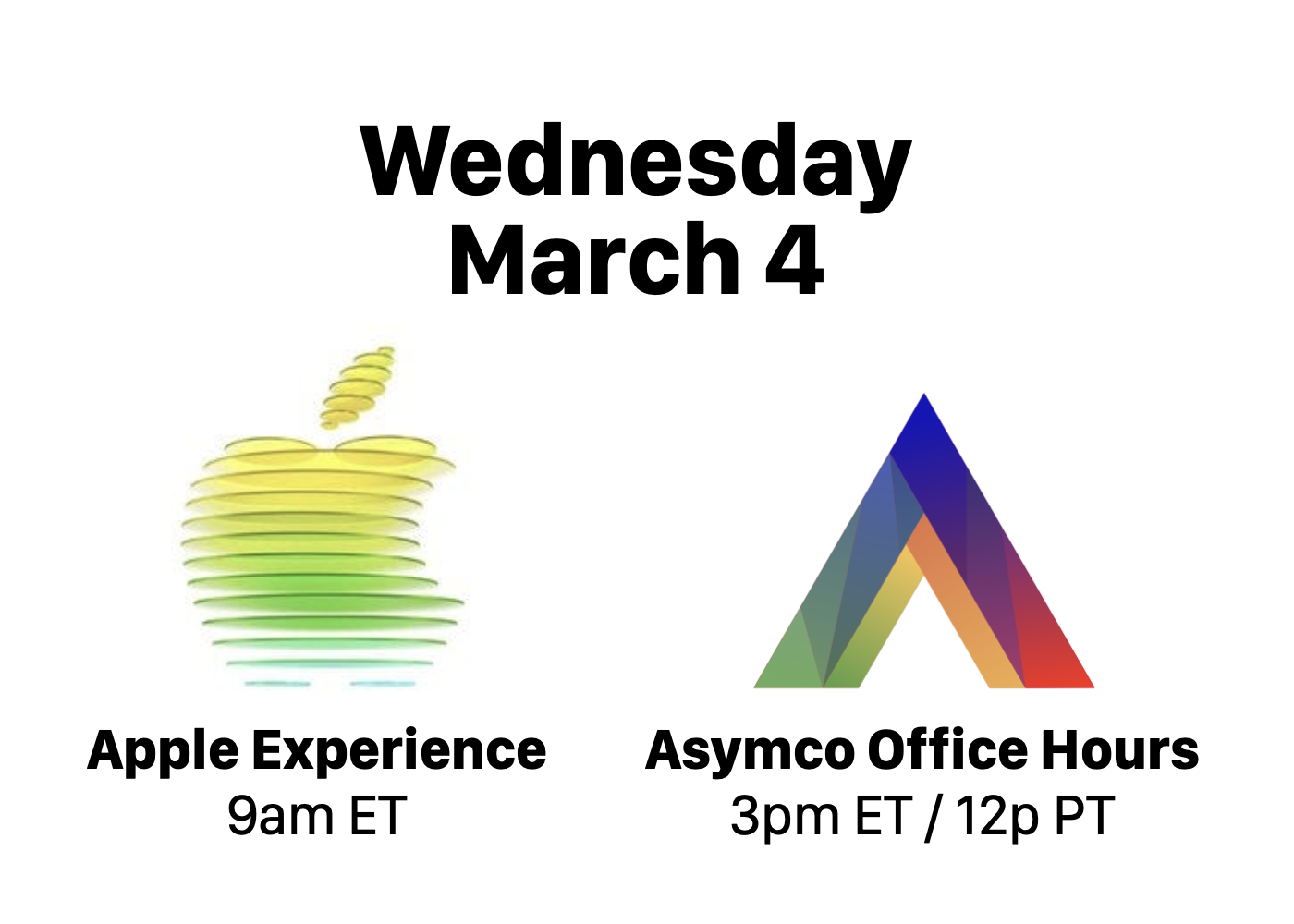
We convened our first Office Hours on March 4 to review Apple's latest releases, where we answered questions from a live audience of subscribers, and dissected Apple's latest and strategies. Topics covered:
Asymco Bulletin is a digest of all the work we have published for the week ending March 1, 2026.
Office Hours
Our firstOffice Hours interactive seminar and Ask Me Anything questions/answer session will be on March 4th, after, presumably all the new announcements Apple will be making during the week. I will be broadcasting to you en vivo y en directo from Paris.
Apple March 4 Special Event – Q&A → Join us for an exclusive Asymco One live Q&A on March 4 at 3pm ET to dissect Apple's latest business moves. →
Greater China (GC) is a specific reporting segment for Apple, encompassing Mainland China, Taiwan, Hong Kong, and Macao, with a combined population nearing 1.5 billion. This region is not just a significant contributor to Apple's revenue—accounting for 18% of net sales in Q4 2025—but also a dynamic landscape of technological adoption and consumer behavior. The smartphone user base in GC has surged from 690 million in 2016 to nearly a billion in 2025, with projections reaching 1.08 billion by 2029.
The iOS ecosystem within GC exhibits varied dynamics across its constituent regions. While Macao maintains a steady iOS share of around 60%, Mainland China and Taiwan show different trajectories. Analyzing these trends through mobile OS share data reveals iOS's ascent, suggesting robust potential for further penetration and user engagement. As Apple navigates this complex market, understanding GC's historical growth patterns and future prospects is crucial for capitalizing on emerging opportunities and sustaining its competitive edge. →
Nota Bene
Apple #1 phone vendor in Europe → Apple leads Q4 2025 with a 7% YoY shipment rise driven by iPhone 17, while Samsung follows with 4% growth; Xiaomi faces a 6% decline amid shifting regional dynamics. →
iPhone becomes India’s top single export item → In 2025, Apple's iPhone exports from India, driven by Tata and Foxconn plants and a robust supply chain, reached $23 billion, making smartphones the top export category. →
Apple’s App Store growth is reaccelerating → Apple's Services, beyond just the App Store, are poised for robust growth, driven by global market expansion and strong hardware demand. →
Here’s why demand for Macs has spiked → Mac lead times have surged to multi-year highs due to increased demand, notably impacting models like Mac Studio, MacBook Pro M4, and Mac Mini. →
A resource for AVP news → "AVP VIP offers a weekly, ad-free digest of tech news and insights, accessible to Asymco One members." →
Eddy Cue says Brazil is Apple TV’s second-largest market, talks Netflix-Warner merger → In an interview, Apple's Eddy Cue highlighted Brazil as the second-largest and fastest-growing market for Apple TV subscribers, while noting potential impacts from proposed streaming regulations and a possible Netflix-Warner deal. Specific user and device numbers were not disclosed. →
Today, Apple announced iPhone and iPad are the first and only consumer devices in compliance with the information assurance requirements of NATO nations. This enables iPhone and iPad to be used with classified information up to the NATO restricted level without requiring special software or settings — a level of government certification no other consumer mobile device has met.
iPhone and iPad previously received approval to handle classified German government data on devices using native iOS and iPadOS security measures, following an extensive evaluation by the Federal Office for Information Security (Bundesamt für Sicherheit in der Informationstechnik, or BSI). Now, iPhone and iPad running iOS 26 and iPadOS 26 are certified for such use in all NATO nations.
As part of this effort, BSI conducted exhaustive technical assessments, comprehensive testing, and deep security analysis, ensuring Apple’s built-in platform security capabilities met NATO nations’ exacting operational and assurance requirements.
“Secure digital transformation is only successful if information security is considered from the beginning in the development of mobile products,” said Claudia Plattner, BSI’s president. “Expanding on BSI’s rigorous audit of iOS and iPadOS platform and device security for use in classified German information environments, we are pleased to confirm the compliance under NATO nations’ assurance requirements.”
The approval marks a defining moment for Apple’s mobile platforms, as iOS 26 and iPadOS 26 are now listed on the NATO Information Assurance Product Catalogue in recognition of their built-in security capabilities.
NB:There is a "movement" or inclination to reduce or eliminate dependencies among European countries and companies on US technologies. This is due to the perceived and actual threat posed by the current US Administration...
If a cheaper MacBook with a less powerful chip excites you, then you’ll love what else Apple is expected to ship soon! The iPhone 17e is expected imminently, adding an A19 chip and MagSafe charging, something the horny one did not realize the 16e did not have. A new base model iPad and iPad Air are expected early this year, but will just be speed bumps of the existing models.
Apple today announced a "special Apple Experience" in New York, London, and Shanghai, taking place on March 4, 2026 at 9:00am ET.
Apple Announces Special Event in New York Feature Apple invited select members of the media to the event in three major cities around the world. It is simply described as a "special Apple Experience," and there is no further information about what it may entail. The invitation features a 3D Apple logo design composed of yellow, green, and blue discs.
It is notable that Apple is specifically using the word "experience," rather than "event." Unlike a full live-streamed event from Apple Park, the March 4 event in other cities is likely to be smaller in scale.
The announcement of several new Apple products is believed to be imminent, including the iPhone 17e, MacBook Pro with M5 Pro and M5 Max chips, eighth-generation, iPad Air, 12th-generation iPad, and more. A refreshed Studio Display and an all-new low-cost MacBook with the A18 chip are also possibilities, along with a new Apple TV and HomePod mini.
This "Apple Experience" could involve Apple's announcement of some of these products and provide an opportunity for the media to get hands-on with the new devices around the world.
NB: Providing live venues for a streamed event in New York, London, and Shanghai is a novel approach and clearly an evolution of the notion of event marketing that Apple pioneered. We look forward to seeing what is special and what a remote experience entails.
In 2010, one firm said the iPad “failed to convince buyers” after its unveiling because the number of people who said they were uninterested in the iPad nearly doubled. Small footnote to that survey that somehow didn’t make the headline: the number of people who said they _would_ like to buy an iPad tripled.
The Macalope’s favorite pundit gag of 2011 was lauding the Motorola Xoom because it had 4G connectivity and the iPad 2 did not. Case closed! Advantage: Xoom! Oh, well, except, ha-ha, small note, just a tiny thing, really: the Xoom didn’t actually have it, either. It was simply promised that, at some point in the future, you’d be able to mail your Xoom in to add 4G to it.
We are proud to report that we have a new record for our installed base with more than 2.5 billion active devices. -Tim Cook
2.5 billion active devices follows the announcement of 2.35 billion active devices a year ago, a growth of 150 million devices in one year. Let's examine some of the implications.
By my estimate, Apple sold about 250 million iPhones, 23 million Macs, 40 million Watches, 70 million iPads. Other devices including Apple TVs, Apple Vision Pro, Apple HomePods may add another 10 million units. Therefore the total number of "connected" devices sold is around 400 million/yr.
Adding 150 million to the active base in one year implies that 250 million devices are replacements, many surely are reused but also at least a third (37.5%) of units sold are expanding the base. This is reflected by management's occasional mention that "nearly (or, alternatively, over) half of customers who purchased a <product> being new to the product".
In the last quarter and for quite some time, <product> has been the Mac, the iPad and Apple Watch. If we use my estimates of units sold during the full year that means 17 million Macs, 20 million Watches and 35 million iPads were sold to new users. These add up to 72 non-iPhone new devices in use. That suggests about 78 million new iPhone users.
How does this compare to the following pattern:
The line to focus on is the red with square points. "Q Active Devices" is the history of what Apple calls "Quarterly Active" devices or those which ping an Apple server at least once a quarter. The data appears to be linear, or the growth is about 150 million per year at least since 2016. Historic data on the iPhone is also shown with a blue line. That is also consistent with about 100 million new iPhones in use every year. This is a bit higher than the 78 million bottom-up analysis of new users. I'd argue that Watch numbers may be a bit too high and perhaps iPad as well.
The mix is a matter of debate but overall this consistency allows for some confident forecasting.
The iPhone will reach 1.7 billion active users by this time next year.
There will be three billion active devices by early 2029.
Services, which is shown in the second graph is clearly correlated to active device growth.
The consistency in active device growth is far more important than device sales in a particular period and determines the value of the company.
Knowing this, here are some additional observations:
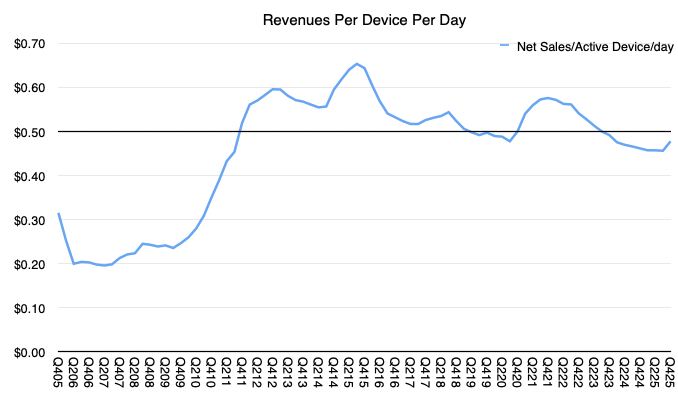
Yearly revenues per active device are $129, services revenues per active device are $45 for a total revenue per active device at $174/device/yr. That is equivalent to 48c/device/day. Data shows that daily revenues have been an average of 53c/device/day for 59 quarters. My rule of thumb is 50c/day per active device is a good estimate for Apple's revenues, and estimate that I have been holding for over 14 years.
There are additional implications. With a base of 1.65 billion iPhones, and knowledge of replacement vs. new-to-product/switcher growth what is their average lifespan and thus replacement rate and therefore what is the average selling price?