Tim Cook warns memory costs to be passed-on to customers
Apple will not absorb all costs of memory and storage chips, Tom Cook confirms.
“Unfortunately, price increases are unavoidable,” he said. “We’re doing our best to mitigate the huge increases that are being passed to us, and we’ve been trying to shield our customers from the increases, but the situation has become unsustainable.”
No further details were provided.
Tim Cook decided to issue this warning about the price increases in advance through the Wall Street Journal. This communication preempts by at least 2 months of the Fall launch event. Due to this, it's likely that price increases on current products might arrive well before then.
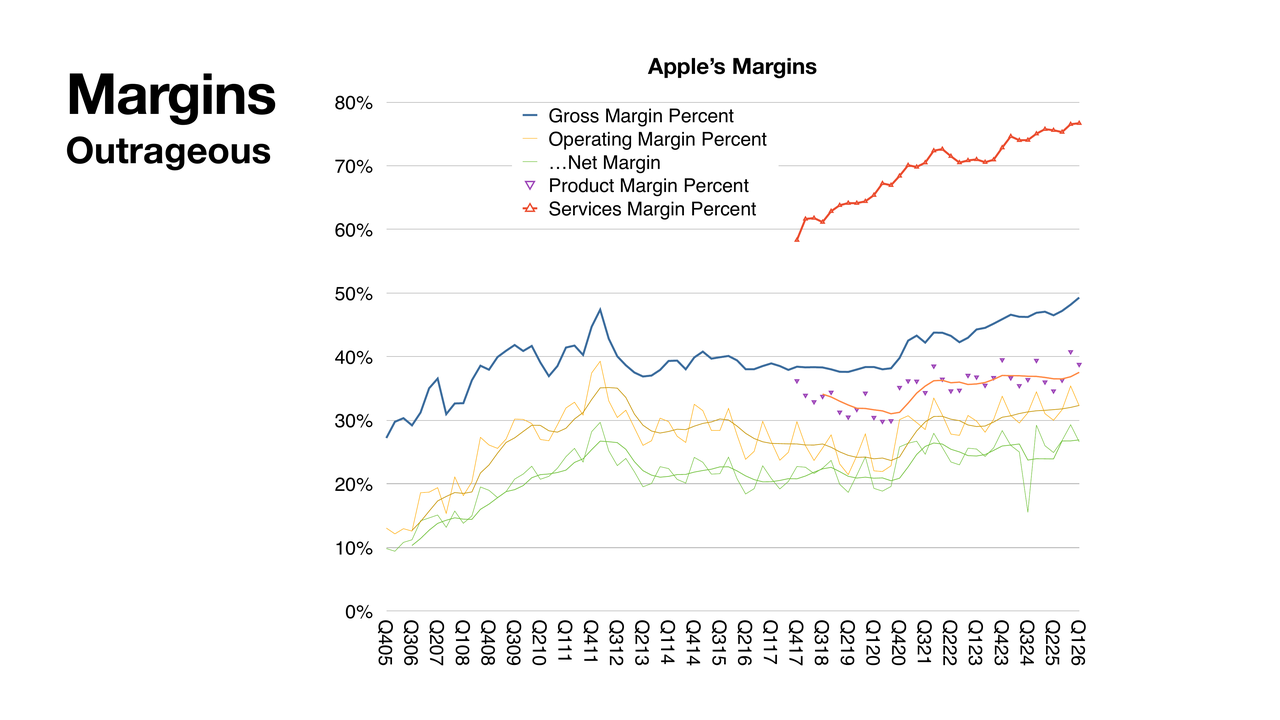
Recall that guidance for the current quarter (ending June) was issued in April which indicated growth and markings consistent with the last quarter (ending March). The current quarter ends in 12 days and I would assume price increases are likely right after that. The current quarter likely saw increased inventory builds as components in the supply chain purchased at prices set a few months ago were used up.
This has kept pricing and margins constant but at the last earnings call, Tim Cook warned that cost increases in memory were likely to impact "beyond the June quarter". Here is the exact quote:
...let me talk about memory specifically, which I think is the root of the question. And I'll go back to December for a moment and just walk you through the chronology. In the December quarter, we really had a minimal impact due to memory, and you can kinda see that in the gross margin results. We said it would be a bit more in the March quarter, and we did see higher memory costs in the March quarter, and they were partially offset by benefits from carry-in inventory that we had. For the June quarter, and what's embedded in the guidance that [CFO] Kevan went through earlier, we expect significantly higher memory costs. They are also partly offset by the benefit of carry-in inventory.
Then where we don't give color beyond June, I can tell you that beyond the June quarter, we believe memory costs will drive an increasing impact on our business. We'll continue to evaluate this, and as we've said before, we'll look at a range of options.
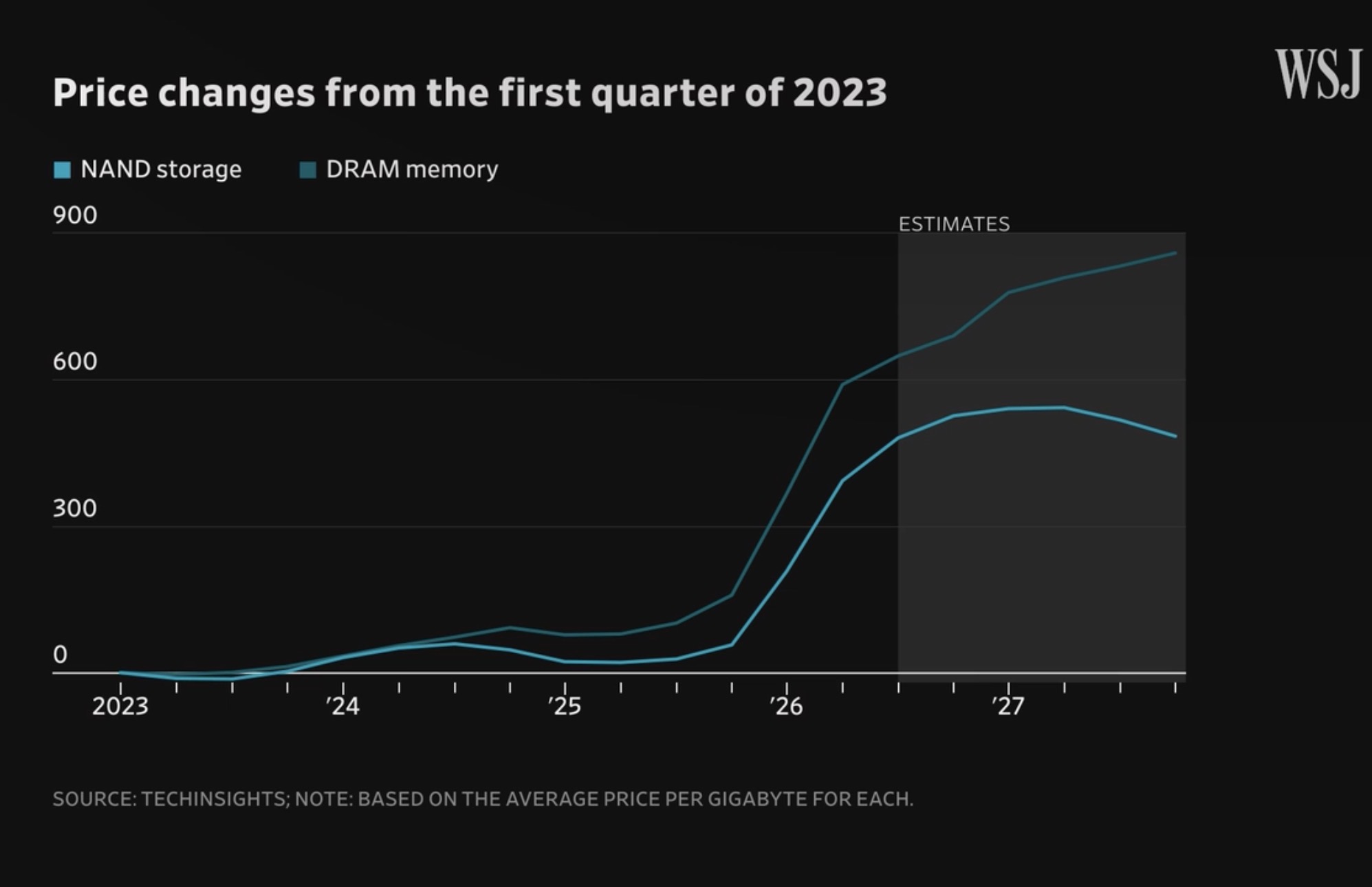
It seems the range options have run out. Tim did say that the situation was unprecedented and not seen in the 40 years he's been in the business. Analysts are busy trying to predict the trajectory of memory pricing.
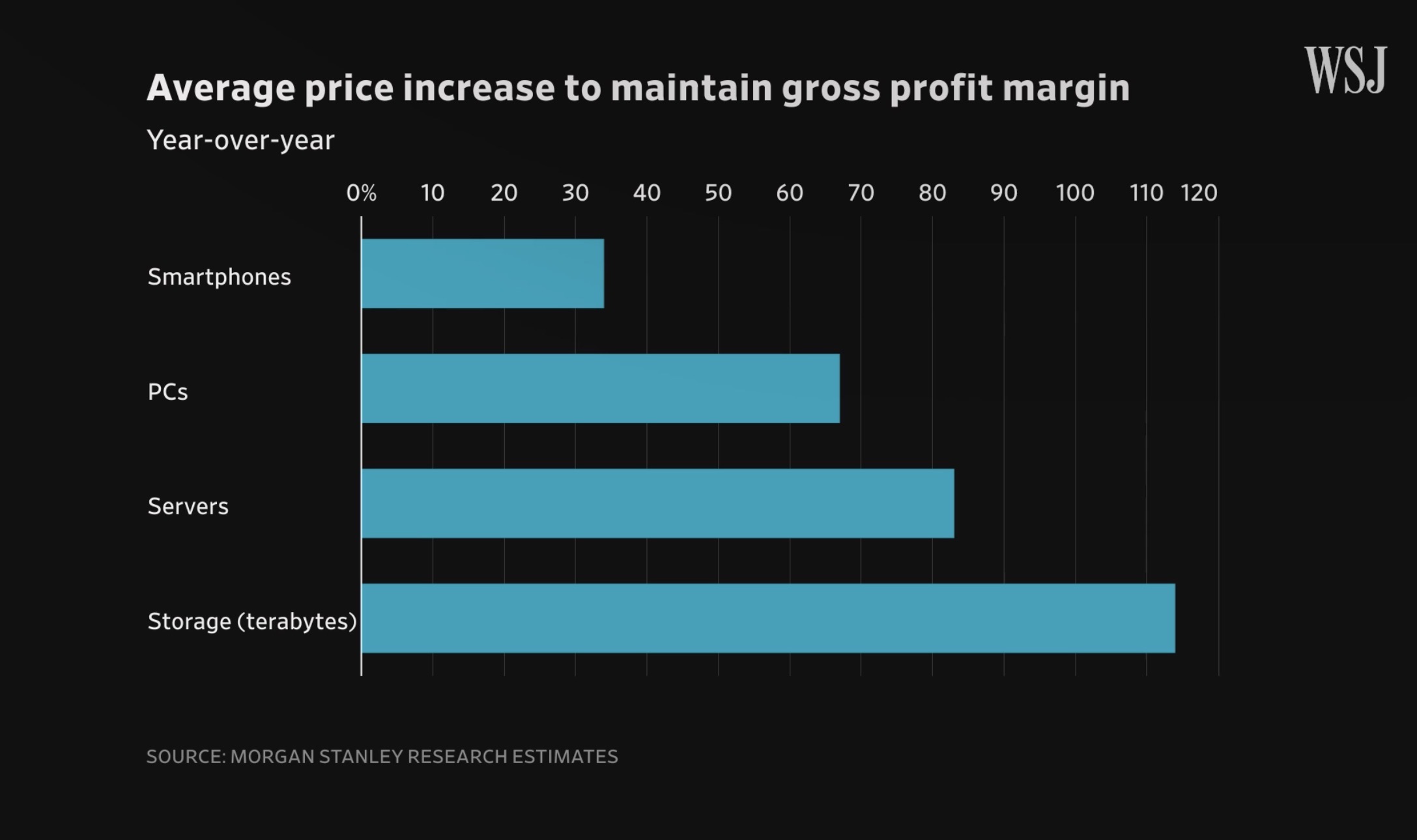
The Wall Street Journal states "Passing the higher cost on to consumers while maintaining its profit margin would add about $270 to the price of the next iPhone Pro model, estimates research firm TechInsights."
Recording and transcript of the June 9, 2026 Asymco One Office Hours, recorded the day after Apple's WWDC 2026 keynote. Horace Dediu shares his impressions of the event and takes questions from Asymco One subscribers.
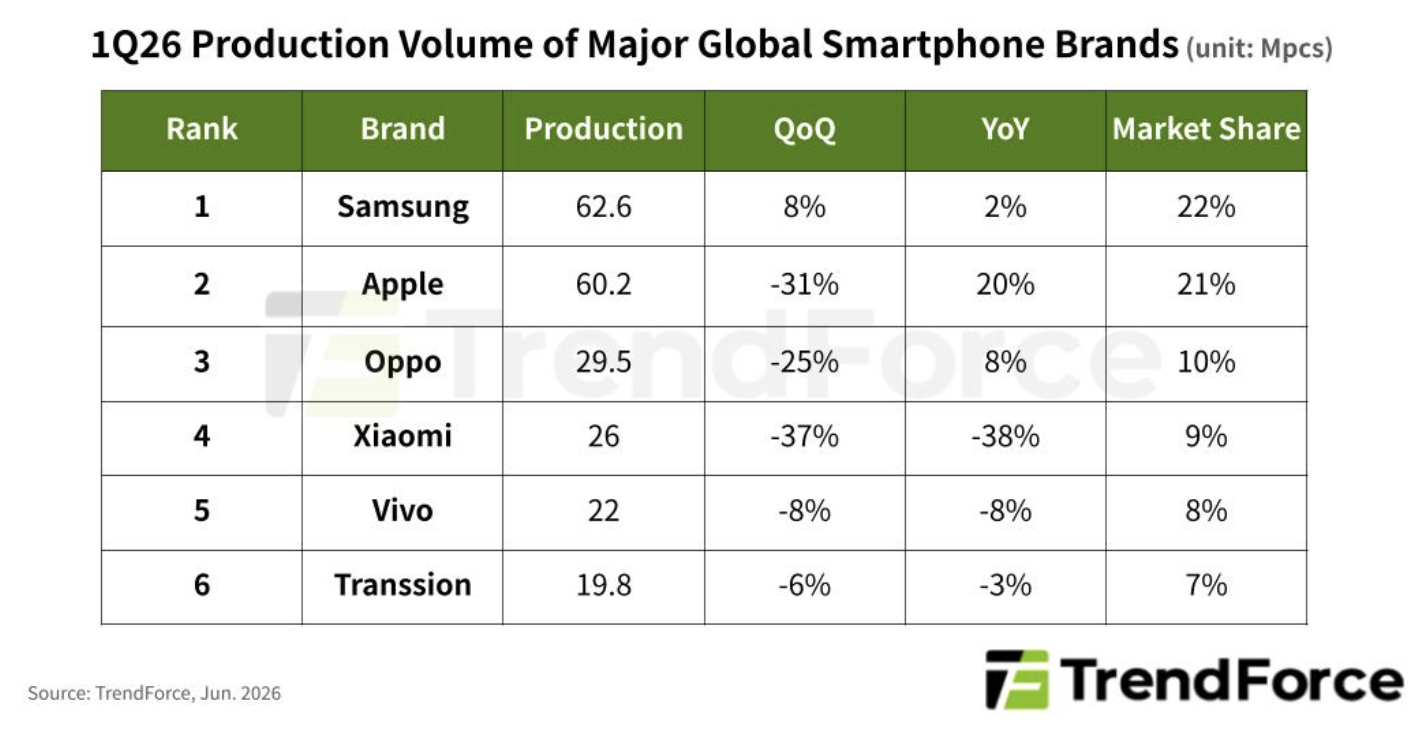
TrendForce’s latest figures reveal that global smartphone production reached around 284 million units in the first quarter of 2026, marking a 1.7% YoY decline. Despite a sharp rise in memory prices since the second half of 2025, the effect on production was minimal because brands still held inventories of cheaper memory components. Additionally, consumer expectations of higher prices in the future have helped sustain short-term demand, cushioning the impact of rising memory costs on production during the quarter.
However, as low-cost memory supplies are gradually exhausted and significant ongoing increases in memory prices reduce profits, most smartphone brands have begun adjusting production in the second quarter.
Looking ahead, TrendForce forecasts global smartphone production to decline approximately 16.2% YoY to 1.051 billion units in 2026. Under a more severe scenario, the annual decline could become even more pronounced if memory price increases remain elevated and brands are forced to raise retail prices repeatedly.
TrendForce notes that Samsung is relatively well-positioned to withstand the current cost inflation cycle thanks to strong financial backing from the broader Samsung Group and a sizable premium product portfolio. Nevertheless, its significant exposure to lower-end models remains a concern—particularly amid weakening consumer sentiment—making end-market demand a key factor to monitor.
Apple ranked second with its production of approximately 60.2 million units during the quarter. In addition to ongoing production ramp-up for new iPhone models, output was supported by the launch of the iPhone 17e, resulting in 19.7% YoY growth.
Compared with competitors that have already entered a margin-protection phase, Apple remains better positioned to absorb higher memory costs while maintaining profitability. TrendForce believes Apple is more likely to prioritize market share expansion during the current downturn as it lays the groundwork for future growth in recurring software and services revenue.
Xiaomi, Oppo, and Vivo focus on preserving profitability as production plans face greater uncertainty
First quarter production declined seasonally among the major Chinese smartphone brands, including Oppo (29.5 million units), Xiaomi (26 million units), and Vivo (22 million units). These three brands ranked third through fifth globally by production volume.
While all three delivered strong market share gains in previous years, surging memory costs are now weighing heavily on profitability, creating significant uncertainty around their 2026 production plans. As a result, production targets may be revised downward if cost pressures persist.
Transsion produced approximately 19.8 million units in 1Q26, roughly flat compared with the same period last year, placing sixth among global smartphone brands.
The brand has been particularly vulnerable during the current memory price supercycle given its smartphone portfolio is heavily concentrated in entry-level and budget segments—where profit margins are already thin. Limited access to low-cost component inventories has further amplified the impact.
NB: Counterpoint tracks sales, Trendforce tracks production. The production data may include inventory build-up not shown in sales while sales may include drawdowns not shown in production. The two analyses however agree on a market under significant supply-side stress. Profitability is a big concern and availability of components is critical. As noted previously in response to Counterpoint reports, the 2026 full year volumes will probably show the worst decline in decades.
Apple has cumulatively shipped over 450 million Apple Intelligence-capable iPhones till Q1 2026.
Apple has the largest number of smartphones with consumers which are capable of GenAI as compared to any other brand.
At WWDC ‘26, Apple needs to deliver a revamped Siri showcasing practical use cases, making a strong statement.
Although iPhone sales remain strong, competition is already moving ahead in terms of AI, and Apple must be ready to follow since Agentic AI has the potential to redefine the smartphone industry.
NB: Words like "needs", "must", "follow" contrast with minimal evidence of demand.
Effectiveness is a number. Efficiency is a ratio. No bank has ever accepted a ratio as a deposit. Counterpoint continues: "Although the lack of a more fully AI-featured Siri…
Takeshi Narabe • 22:44 Japanese companies always follow and concentrate on seeking additional functions so that is very in contrast to Apple so there is a growing concern that Apple might be falling into the same spec trap that runs parallel. Japanese firms you know focusing on incremental hardware improvements like you know iPhone's more thinner and thinner...
Horace Dediu • 23:34 It's true. But I will say to the defense of Apple, of course, they need to maintain some improvement. Otherwise, people may not consider buying it. They do think hard, though, about what needs to be improved. And many times they don't improve things that many people ask for. They'll say, "Oh, you need a refresh rate of hundreds of hertz." They don't bother with that. Or they [won't offer] more resolution, more than even the eye can see. They don't do that. But they'll do a lot with the camera.
And they'll probably do more. They do amazing things with audio. They do really, really interesting things as far as... Like face ID was something that was nobody asked for. But now it's a very, very useful thing. People recognize the value. So I do think there's a roadmap there that's kind of interesting.
But here's the bottom line, you know, Christensen said, that the trajectory of what performance people expect is not as steep as the trajectory that companies can deliver. And that's why you overshoot. What Apple has been able to do, at least through the lifespan of the iPhone so far, is to cause people's interest in more improvements to rise a little bit.
And so the theory basically says that there is a flat trajectory to the user demand of performance. But my [observation] is that eventually you do drag people up, just like with non-consumption. People don't ask for a better camera, but once you give it to them, they're like, oh, yeah, I really want an even better camera.
[The performance demand] it created... I mentioned the short video TikTok format, It was the phone's camera that allowed [average] people to suddenly become filmmakers. And it allowed people to become "vanity machinery"[1]. It became all about vanity, all about selfies. And [as a result] you have to have a front camera and a back camera and you have to have editing software and you have to have a more powerful processor and you need a huge amount of storage when you're dealing with video.
So suddenly, the phone needs more and more and more. But the demand for video editing on a phone was created essentially from nothing. It was created by the supply of camera. And so, yes, that is a theory that you have a problem if you overshoot. But I think in the old days, a consumer electronics company would add buttons.
I was at Nokia for a long time, and we had buttons and buttons and buttons. We had one phone with over 100 buttons on it.[2] That wasn't very useful. So the idea of Apple is that they remove buttons. They make it even cleaner in that design, and they make it easier. So face ID is an example, and privacy is important.
By the way, that's another thing that they sold to people. If you think about it, nobody asked for privacy because everybody was okay with sharing. But the fact is, it's like the automotive industry has safety, and nobody asked for safety either. But you should deliver safety, you should protect the passenger. [Today] it's considered hygiene. [If] you don't have it, it's bad, but if you have it, nobody cares. But in the case of Apple, they're pushing on privacy.
So yes, it is a concern that you overshoot. However, one more defense of Apple is that they introduce these wearables. So if you take the AirPods, for example, again, not a product anybody asked for. And when they were first introduced, they were made fun of because it was [so funny looking.]
The AirPods are a very clever new product, [they are] an extension of the iPhone. They're not the iPhone per se, but we have a wonderful must-have accessory. I feel like I'm naked without taking my AirPods with me. The same with the watch. Another product extension. Again, it's an option. You don't have to have it, but once you have it, it becomes addictive.
There are many things on the watch, which again, from health reasons, from managing information that I only need to look at for a few seconds, all of those things. (I'll give you a simple example. I never check the weather on my phone. I only check the weather on my watch because it's there with the temperature always on the home screen. And if I want to learn more, I tap on it. I don't even know how to do it on the phone anymore. You know, I have to find the weather app and then scroll and things like that. Never do that anymore.)
So there are things you do now with accessories that the phone has essentially been disrupted by. But it's still at the heart of the network of Apple. It used to be the Mac was at the center. Now it's the iPhone. So again, this is cleverness.
I was a student of Christensen, and Christensen always thought that Apple was not disruptive, and that Apple would be disrupted by the low end. [I was not so sure.] I was a bit sensing that there was a disturbance in the theory because in many ways Apple's behavior is so atypical to a normal company. And most companies would do the wrong thing, but somehow Apple managed to not step on those mines, not to fall into those traps.
Why? I'm not quite sure. And we continue to have the discussion. I really think it's culture. I really think that they've solved the Innovators Dilemma. Not by reading a book, not by taking a university class, but by always being extremely nervous, extremely careful and extremely passionate and extremely paranoid. All of these things.
Which points out the vulnerability of Apple. If that culture breaks, if the management, the next generation doesn't know how to do it, then suddenly it might fail. Because it's held together by such a force that it's hard to write it down. It's public information actually, that they have Apple University, which is meant to teach internally how things are done to the next generation of managers.
So this is something they are trying to codify and to preserve. And that's an experiment, I would say, because it's not easy. But again, that's a self-critique, an introspection, looking at yourself and asking, why am I good? How do I make sure we continue? Few companies do this. Founder-led companies might, because the founder is the company, in a sense. The founder is the culture. The founder's personality is more or less how everything is done. So those companies, to speak of, let's say, Meta with Zuckerberg, even Google, and those companies, or Amazon a little bit with Bezos, although he's mostly gone.
[But], that's not an answer, because the founder doesn't last 50 years in that job. And as we talked about one century, no way is it possible. It's beyond the human lifespan.
The word I was looking for was "influencer" but "vanity machinery" came out. Perhaps that's a better term.
I had the Nokia Communicator in mind, which was a clamshell with a full (but tiny) keyboard plus a full numerical keypad on the outer shell. The idea of mechanical keyboards was not only popular with Nokia but with the RIM Blackberry as well.
Citi reiterated a Buy rating and a $315 price target on the stock in a research note. The nod of approval comes ahead of Apple’s week-long Worldwide Developers Conference, which begins June 8.
Analysts believe the headline at next week’s conference will be Apple’s long-overdue revamp of its digital assistant, Siri. Citi expects a new Siri app to resemble something like OpenAI’s ChatGPT chatbot while also serving as an AI assistant across applications on Apple’s operating systems.
“Siri will handle multi-step requests, understand personal data, analyze on-screen content, generate emails or messages using both web and device context, and surface rich card-based results for everything from news to calendar data, while also completing actions across apps and shortcuts,” predicted Citi analyst Atif Malik.
Apple will pair that overhaul with deeper AI integration across its Mac, iPad, and iPhone operating systems, Citi said. Examples could include more AI features in writing, search, and photo editing.
“Edge AI has not yet taken off, but its long-term potential is substantial as consumers and enterprises increasingly prioritize low-latency, privacy-preserving, and cost-efficient AI experiences over cloud dependence,” Malik wrote. “We believe a meaningfully upgraded Siri will be a key to unlock the potential.”
Strong demand for the Mac Mini, which can run AI agents like OpenClaw, shows how edge AI is already spurring more hardware sales. Extend that demand across phones and tablets, and Apple could be an edge AI winner.
Takeshi Narabe • 16:20 [Y]ou also mentioned about the Japanese companies, overshooting, performance oversupply was also one of the reason that Japanese electronics giants were outmaneuvered by Apple: the insistence on in-house component manufacturing and a critical absence of software and service-led business as you mentioned now.
Horace Dediu • 17:02 It's a tough one. I think I know what you're getting at, but I think the puzzle there is that you try to make things better and you think by making things better you're going to be more successful and that was another observation by Christensen that sometimes you if you listen to your customers they'll ask you to do things better because that's all [the customer] can imagine.
I think the canonical example for me would be the game consoles. [...]Every new generation was more powerful and the way [the platforms] would decide how to improve it would be by talking to their customers and who are the best customers?
They are those who spend the most on games and the most on consoles. and they would survey those [customers] and [the customers] would always say "we need more performance in terms of refresh rate or, I don't know, how many dimensions of performance there are in games--i'm not particularly a user.
So the problem is that it's not just Sony but Nintendo, Xbox, everyone in the gaming industry was listening to the gamers and the most prolific and demanding gamers were those who spent the most money.
But if you compare mobile gaming to console gaming, it was always worse on all those dimensions. But if you [instead] measure how much time people spend on on mobile games, initially it was quite small, but over time it grew and grew and the number of people using phones for gaming is in the billions. In contrast, the number of people using consoles saturated at most at 30 percent of households in the United States. I don't know what it is in every country and there are many still. That's an okay business but it's not measured in the billions of users and arguably those users are not the ones you want to listen to.
The only exception was Nintendo with the Wii, which actually tried to expand to non-consumers, tried to expand to elderly people (so that they can do some movement) with the product or to young children. And that was a brief moment of success in the incumbents. But I think fundamentally, even that too gets passed to the phone.
So this is a classic example. How Apple plays in this game is a very tricky one because...
AI-driven memory shortage continues to hammer sales; Android sales to drop 20%
According to analysis firm IDC, smartphone shipments are headed for a 13.9% decline in 2026, a downward revision from the 12.9% decline IDC had anticipated for the year in February. It would also mark the steepest drop in smartphone history, the company said.
“these pressures are compelling vendors to reduce shipments, raise prices and concentrate on higher price tiers — elevating smartphone [average selling price] to a record $550, up $100 from last year,” IDC senior research director Nabila Popal said in a statement.
“2026 will be a defining year for the industry as [a] new reality of structurally higher costs take hold,” she added. “For consumers, it means the era of ultra-cheap smartphones is over. For vendors, it means only those that can adapt their strategies to this new cost environment and sustain demand at elevated price points will survive.
The broader Android smartphone market is set to take the biggest hit, with IDC projecting a 20% year-over-year drop in shipments. Despite that, Samsung is expected to increase its market share in the space at the expense of smaller smartphone companies thanks to its midrange and premium device lineups.
Apple, the research firm said, is also expected to perform relatively well, with shipments forecast to fall 5.2% on the year, an improvement from a previously anticipated decline of 8.1%.
In its most recent earnings report, Apple announced iPhone revenue growth of 20% for the second consecutive quarter, thanks to its strong iPhone 17 lineup and improved sales out of China.
But CEO Tim Cook also warned of supply constraints due to both the memory shortage and the dearth of iPhone processors.
NB: I would add that Apple also announced that revenues for June quarter would increase at the same rate as they did for March quarter, thus for at least half the year the company will achieve 20% growth in iPhone sales. This is in sharp contrast to both what IDC and Omdia have been reporting.
Market contraction expected for second half of year.
Omdia reports that Europe (ex. Russia) smartphone market grew 2% to 33 million units in 1Q26.
Key vendor highlights from 1Q26 include
Samsung was Europe’s largest vendor as it grew 3% to 12.6 million units. Effective discounting of the Galaxy A16 4G helped Samsung boost volume, offsetting declines related to the delayed launch of the Galaxy S26, A57 and A37.
Apple grew 9% to 8.8 million iPhones, driven by robust iPhone 17 series demand in addition to benefiting from a wider mid-range coverage from the iPhone 15 and iPhone 16e. Noticeably, Apple’s strong results came despite lower and fewer discounts than in previous years.
Xiaomi retained third place despite declining 15% to 4.5 million units, as it was more immediately impacted by supply-side difficulties. However, Xiaomi’s ASP grew 21% compared with 1Q25, boosted by a record-strong Xiaomi 17 and 15T series performance, which drove year-on-year value growth despite the shipment decline. Premium sales were particularly strong in France, Germany, and Spain.
Motorola grew 17% to 1.9 million units, driven by rapid expansion in Spain and Portugal, alongside continued progress in France and Italy.
OPPO grew 9% to 1.3 million units, largely driven by its comeback in France alongside growth in Romania and Poland. With both realme and OnePlus now under its umbrella, OPPO is restructuring to optimize its portfolio and strategy with ambitions to strengthen its European position.
HONOR, ranking sixth, was the fastest-growing vendor among the largest players, with shipments increasing more than 60% compared to 1Q25. HONOR’s growth is underpinned by its portfolio being expanded further down the price-tiers.
"The average-selling-price (ASP) of smartphones in Europe surged to a record-high level of €580 in 1Q26," added Bjorhovde. "This was largely caused by lower availability of devices costing less than €200, which made up an all-time low of just 25% of shipments. Additionally, the high-end remained resilient thanks to Apple’s growth. The focus from both vendors and channel partners has shifted from volume to value to deliver results and operational sustainability. Many vendors who normally focus on the mass market segments are increasingly concentrating on the mid-to-high-end, hoping to benefit from less price-sensitive and upgrade-willing buyers."
[My emphasis]
"The first quarter of 2026 delivered beyond expectations, but the outlook remains bearish as the rapidly escalating memory bottleneck worsens," commented Bjorhovde. "Omdia forecasts shipments into Europe to decline 12% in 2026, but the majority of this will come in the second half of the year.
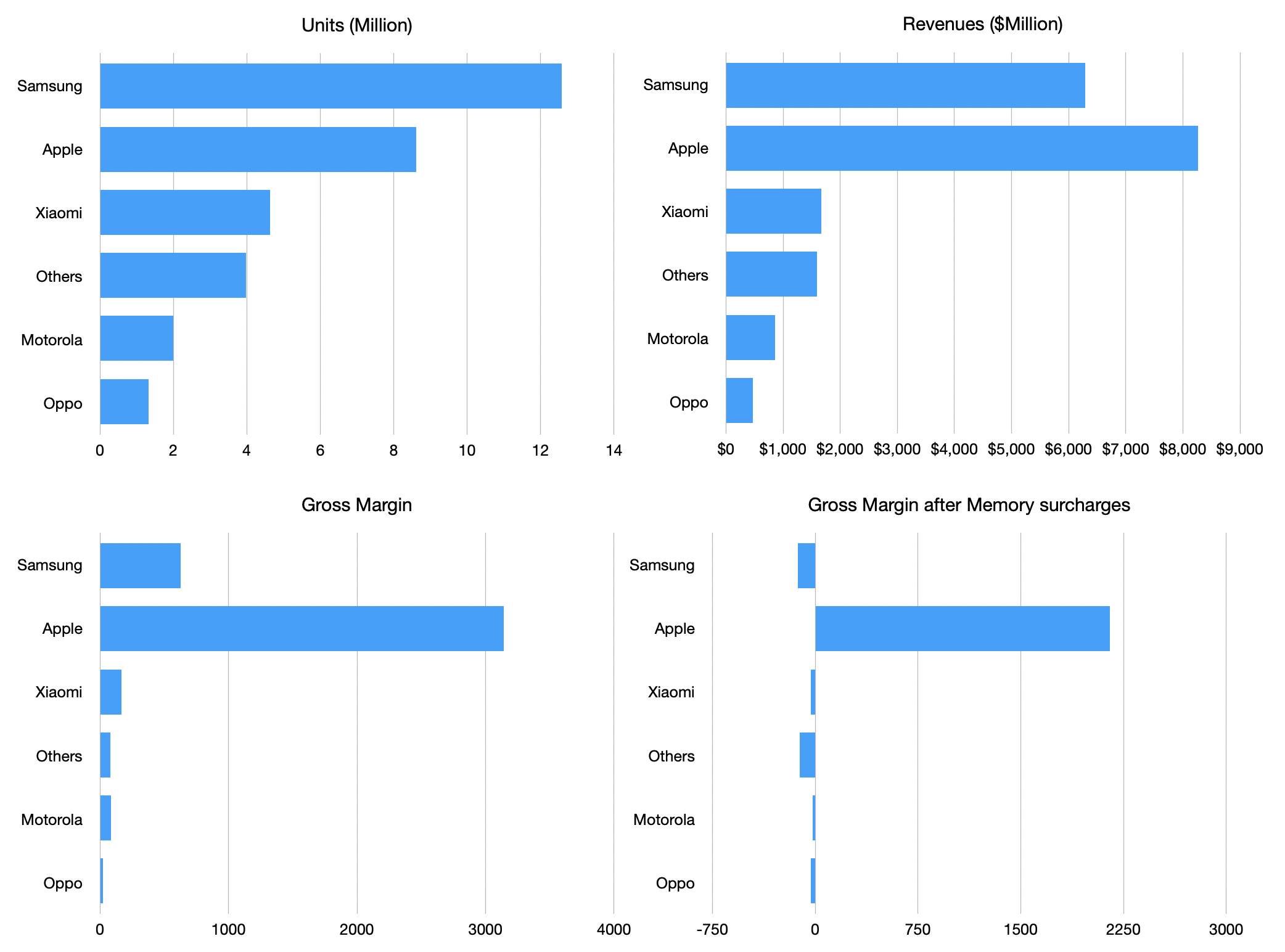
Applying average pricing per vendor and average gross margins gives the following picture of the market:
Apple currently captures 26% of unit volume, 43% of ...
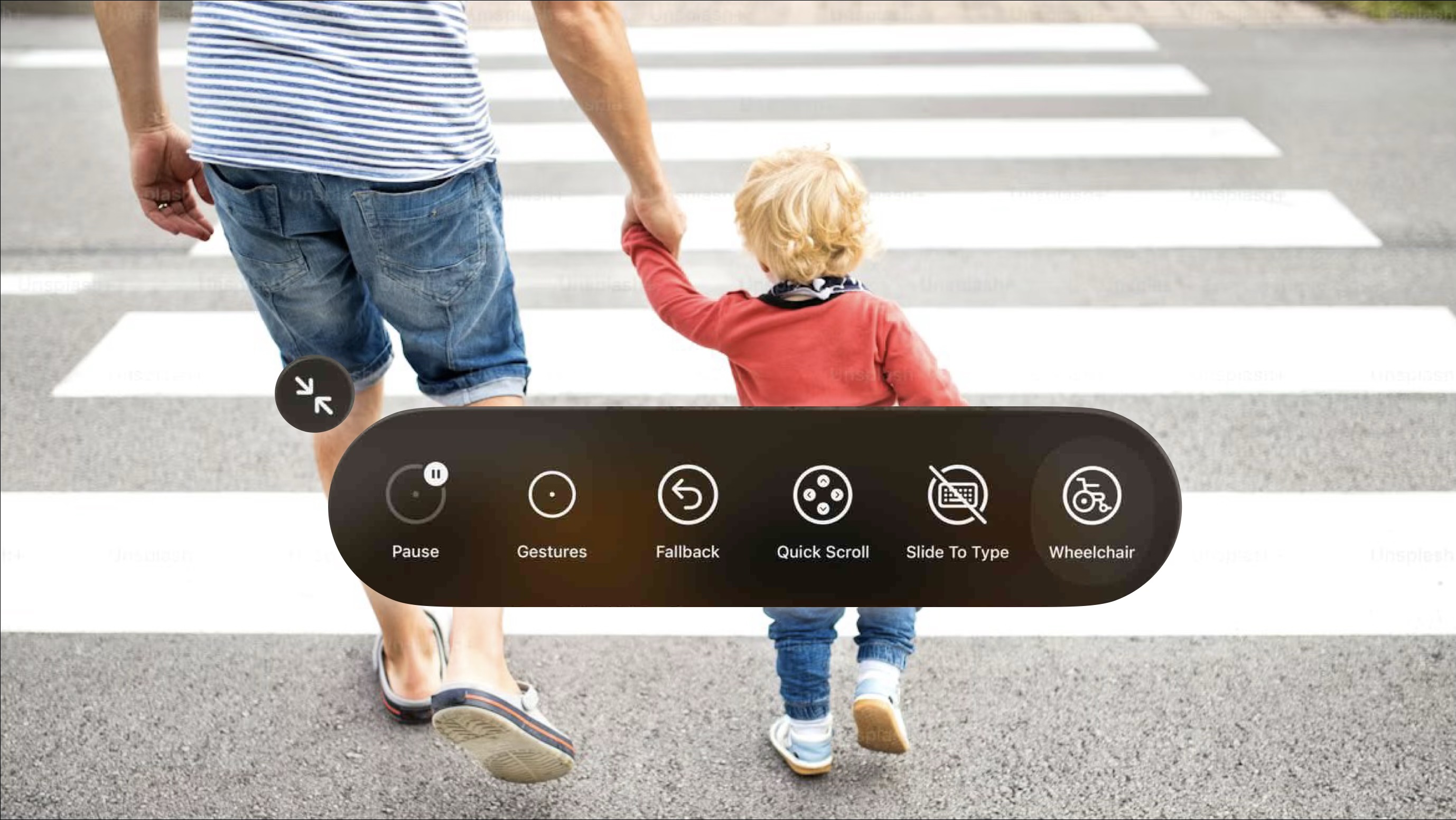
Apple announced new features for users to control power wheelchairs with Apple Vision Pro using their eyes. A new power wheelchair control feature leverages the precision eye-tracking system on Apple Vision Pro to offer a responsive input method for compatible alternative drive systems.
Also announced is on-device speech recognition whereby subtitles are generated privately and appear automatically for uncaptioned videos on iPhone, iPad, Mac, Apple TV, and Apple Vision Pro.
Moreover, Vehicle Motion Cues come to visionOS, which can help reduce motion sickness for people who use Apple Vision Pro as a passenger in a moving vehicle. Vision Pro will also support face gestures for performing taps and system actions, plus a new way to select elements with one’s eyes while using Dwell Control.
“The option to control my power wheelchair on my own is gold to me,” said Pat Dolan, founder of GeoALS and a member of Team Gleason’s patient advisory board, who has lived with ALS for 10 years. “With this new feature, Apple is developing life-enhancing technology for the people who need it most.”
NB: We have not yet arrived at WWDC yet Apple unveils huge new accessibility features powered by Apple Intelligence and reveals Vision Pro functions that will change lives. The Vision Pro remains the most remarkable machine I've ever seen or heard of. It is S tier.