According to GfK data in Denmark, during the first quarter of 2010 29% of phones sold were smartphones. In the second quarter, the share grew to 37%. In the third quarter, 51% of units and 71% of sales value was captured by smartphones.
Looking at September alone, Apple's share of the smartphone market was 34%. In terms of value share, 51% of all the dollars that consumers spent for smartphones, was spent on the iPhone.
In other words, in September in Denmark, iPhone captured 34%*51% = 17% of all units and 51%*71% = 36% of all mobile phone sales.
Rob adds:
iPhone 4 is now available on all (4) major networks in Denmark. iPhone 4 has not been advertised very heavily, whilst Android has received a lot of advertising. My experience travelling on public transport in Greater Copenhagen is that iPhone is everywhere, whilst Android and Blackberry is less prevalent.
To get a sense of how that compares with the global average, in the third quarter Apple's unit share was only 4.1% while sales share comes to about 17%. Seems like there is plenty of room for growth.
While Denmark is a small country (population: about 5.5 million) and it's not likely to reflect global patterns, it has been rated the happiest place on Earth.
In a recent but recurring lament I asked why Apple shareholders are not being rewarded for the company's growth. I pointed out that there is no fundamental reason why the company should receive such a low P/E multiple (about 18 ex-cash trailing and 10x forward while maintaining 70% earnings growth for over a year).
There were many objections in the comments. Most of them dealt with recent reasons why doubts might have arisen among investors: Android hegemony or some perceived lack of competitiveness leading to margin compression or some macro hangover from the recession.
In this article I argue that none of these objections hold water. My argument hinges on the fact that there is a precise date when Apple ceased being seen as an exceptionally valuable company and that date precedes any of the causes being suggested.
The day of disillusionment was almost exactly three years ago: January 14th, 2008.
How to pin down the date of disillusionment
Consider the following chart.
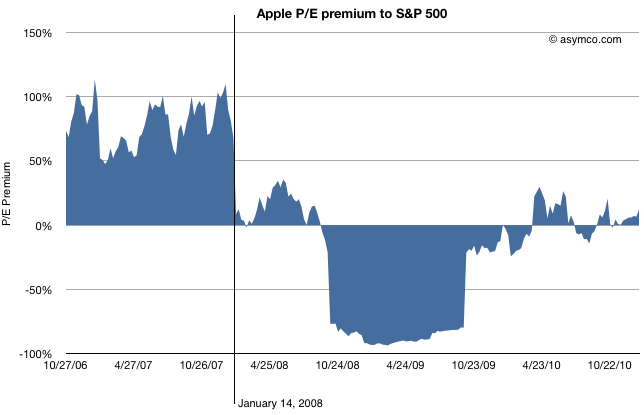
The blue area represents either a premium (above 0) or a deficit (below 0) of Apple's P/E (ex-cash) relative to the S&P 500 P/E. This is a re-imaging of a chart, first introduced in June 2010 when I first pointed out that Apple was being discounted relative to the S&P 500.
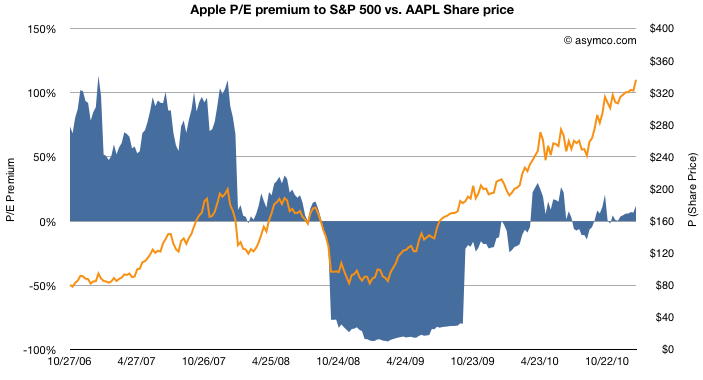
By measuring P/E I am focusing not on the stock price, which has grown nicely, but the ratio of the price relative to earnings, which hasn't (see the next chart below). P/E is a fundamental measure of potential (its reciprocal is the stock's earnings yield.) It is usually highly correlated to the company's growth. If that P/E is uncorrelated to past growth, there is some significant discounting of future growth. It's the most significant (and simplest) measure of "faith" in a company.
By measuring the company's P/E relative to an index of other large companies (S&P 500 P/E) we can assess whether the company's potential is being valued as extraordinary or whether it's being valued as ordinary. In other words we are measuring whether a company is "special".
The chart shows that until January 14th, 2008 the company was valued at a significant earnings premium--a P/E consistently 50% higher than the norm.[1]
Following the collapse (about 40% drop in share price but 100% drop in P/E premium), there was a small recovery followed by a huge trough in valuation. During the recession quarters Q308 to Q309 S&P earnings fell to zero or below. As a result of S&P earnings collapse the S&P P/E shot up astronomically (as E approaches zero, P/E approaches infinity). Apple's earnings dropped as well but remained positive throughout that period bottoming at 37% growth(!) in Q408. As a consequence Apple's P/E fell as low as 11 while the market's went well above 100 (122.41 peak). The P/E deficit for Apple went 80%: Apple was valued as basically worthless (3x cash).
After the earnings recession, the S&P P/E recovered close to historic levels but Apple's P/E did not. It's in-line with the S&P but does not obtain the 50% premium preceding the recession.
So we can establish that the day that Apple's potential was discounted was nearly six months before the onset of recession.
What other discounting factors can we discard?
How about earnings growth itself? Did the collapse foretell an earnings collapse?
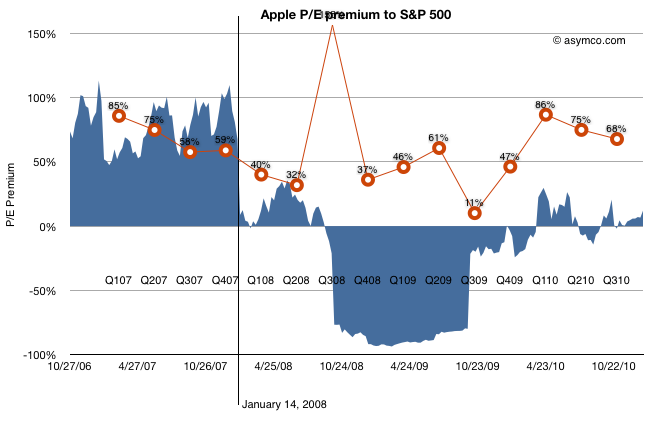
The chart above shows the P/E premium vs. earnings growth (in red). Although earnings growth began to slow soon after the 14th (earnings for CQ407 were not yet announced at that point), growth recovered six months later after the launch of the iPhone 3G[2]. Growth continued throughout 2009 and 2010 reaching new heights last year of 86%.
Still, the company received no premium to the S&P 500 P/E. Companies in the index averaged, at best, a quarter of Apple's growth in earnings.
What about Android? The first Android device did not ship until October 2008 (HTC Dream or T-Mobile G1). There were no appreciable Android volumes until 2009, one year after the drop in relative value and no talk of a threat until 18 months later.
The last objection to be put aside is that of margin compression.
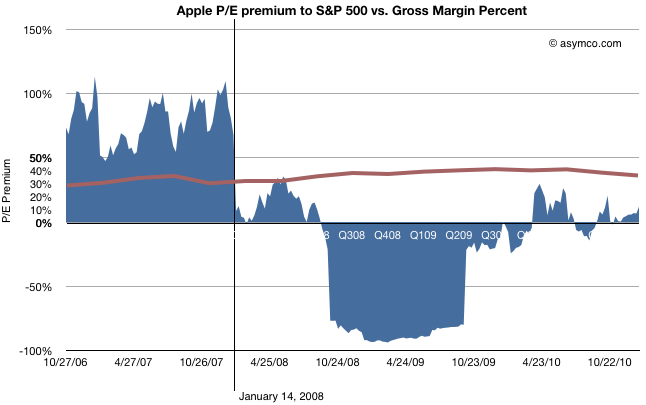
This last chart shows how margins (in brown) behaved during the same time period. They went up. The only slight decline took place during the last few quarters, after the launch of the iPad, long after the collapse.
Regardless of the adjustments with product launches, Apple's GM is the envy of the world and is not at all correlated with the loss of faith in the company.
So What happened on January 14, 2008?
Having led you this far in the story, I'm afraid I'm going to let you down at the end: The cause for the loss of faith is a mystery to me.
There is only one noteworthy event that took place on that date: Macworld 2008 (January 14-18). During the keynote, Steve Jobs introduced the Macbook Air (and Time Capsule and Leopard and pre-announced the iPhone SDK which, six months later led to the app supernova). I remember that day and I remember that the stock began selling off exactly at the point when the Air was mentioned. It has never been the same since.
Obviously, correlation is not causation. The Macbook Air need not be the cause for the loss of faith in Apple as an investment. Or can it? I'm hoping someone can explain this because to me it makes no sense. The product was not a home run but it did not do badly either and its current incarnation seems to be a hit. Whatever sins the original Air may have had have surely been expurgated by now.
Regardless the cause, the bottom line is that, in the eyes of investors, Apple stopped being "special" that day. Its valuation dropped to in-line the S&P and, given its growth, well below what a large growth company should be worth. The company's shares went into the bargain bin and are still there today.
---
[1] I should point out that the P/E ratio is based on post 2009 re-stated earnings. The restatement changed the P/E as the "E" changed. This was based on the abolition of subscription accounting for the iPhone. Although it may seem unfair to hold the market to this standard, restatement did not actually change cash flows which were transparent and visible to all, even to amateurs such as myself and the other unaffiliated analysts that published throughout this period. Earnings may be an opinion but cash flow is a fact. Valuation on the basis of cash flow should have yielded the same results as shown above.
[2] That quarter showed a y/y growth of 150% while the stock was in freefall. In fact, it was during that earnings day that Steve Jobs came on the conference call and pointed out the astronomic iPhone cash flow to an audience of analysts more concerned about their own jobs.
Given new information on subscriber growth and the relationship between Verizon and Apple, it's time to look back and assess how the conclusions are standing up.
The conclusions I drew were that Verizon had three strikes against them:
The iPhone has stolen their growth
They are facing the prospect of a single OS platform supplier
Android is not competitive vs. iOS
Did iPhone really hurt Verizon?
I pointed out that based on retail sampling data from ITG and what we know from AT&T own sales data, that iPhone at AT&T was outselling Android at Verizon by a ratio of 2.5 to 1.
The latest comScore data closely matches the assumed units of Android shipped by Verizon. Here's why: The comScore data shows the number of active users of each platform. So, for example, as the number of Android users at Verizon grew, it follows that the new users had to buy new Android phones. However, you can also sell more phones than just those for new users. Some phones are going to go to replace those of existing users.
When it comes to Android however, all the Verizon Android devices are pretty new, having been purchased less than a year ago. Replacements would only be sold for damaged or lost devices not covered by warranty.
So from comScore the change in subs at Verizon comes out to about 2.2 million and my original estimate was about 2 million. That's pretty close.
On the other hand, if you look at the chart, you'll notice that the number of iPhone users at AT&T grew by a similar amount (about 2 million). However, AT&T activated over 5 million. That means that about 3 million devices were upgrades. This makes a lot of sense since we know that iPhone is the bulk of AT&T smartphone users.
This is highly supportive evidence that iPhone at AT&T did indeed outsell Verizon Android by at least a factor of 2. Each of those phones came with a 2 year lock-in so indeed AT&T did manage to "steal" growth from Verizon.
Another data point in support of this conclusion was provided by Turley Muller in a comment. AT&T smartphones make up a significantly higher proportion of contract subs at 44% vs Verizon at 23%. Effectively, as a result of their sweetheart deal with Apple, AT&T got double the penetration of smartphones than Verizon since these devices are targeted only to contract subscribers. Those are high ARPU customers that either moved from regular voice plans or switched from other carriers.
So far, the first conclusion seems to be holding up pretty well.
Was Android a strategic constraint to Verizon?
Verizon revealed that they had been negotiating with Apple at least since 2008 and that they were testing the phone for a year. This is not as big a surprise as it may seem. Deals of this kind easily gestate for years. The commitment may not be made until the last minute.
Nevertheless, my point was about the fact that Android was making up to 75% of Verizon's smartphone volume in Q3. This might be a strategic constraint. But "so what?" you may say: AT&T's dependance on iPhone was even greater.
That's precisely my point though. As we've seen with the shift by Apple to multi-carrier distribution, AT&T is now facing serious constraints on growth and the share price is suffering. Although Verizon did not deal with Google as a direct supplier, they were at risk of having much of the IP on their network at least orchestrated by a company that was not always aligned with their strategic goals. Much the same predicament AT&T is facing now.
The tale of AT&T and iPhone does lend support to the premise that Verizon felt a bit too constrained by Android hegemony on its network.
Is Android Competitive with iOS?
This last point was supported by the data showing a widening higher sell-through rate for iOS vs. Android on comparable addressable markets. Although the data has been confirmed with survey data, there are issues with this interpretation. First, because the addressable base for iPhone is higher at AT&T with the post-paid contracts being more popular there, iPhone had an easier time getting sold. Second, because 3/5 of the phones were upgrades.
The jury is still out but the apparent pent-up demand (admittedly anecdotal) for iPhone on Verizon does seem to show that given similar pricing, and a similar demographic/geographic addressable market, people do prefer the iPhone.
comScore reported that 15.4 million iPhones were in use in the US as of November. (25% share of 61.5 million total smartphones.)
We also know that about 75 million iPhones were sold by November since the product launched. With about 17 million units older than two years, and assuming that half of those might still be in use and that all the iPhones less than 2 years old are still in use, we get an upper bound of 66.5 million iPhones in use globally.
That means 23% of all iPhones are in use in the US and that 77% are in use outside the US.
Can this be verified?
The sell-through data we have supports a slightly lower figure.
This might indicate that comScore surveys under-represent the iPhone or that device attrition/retirement is significant. However, the data does seem to imply that the US is no more than one third and perhaps as little as one quarter of the iPhone's user base. Perhaps with Verizon, that figure will grow. But at the same time, new international markets (like China) may continue to outgrow the US.
The 4:1 split could continue. After all, the US represents only 234 million out of about 5 billion mobile phone users globally--a mere 4.7%.
Motorola—like HTC—is thus a bellwether for makers of Android phones, whose sales have now caught up with those of the iPhone—about 300,000 a day worldwide. Some industry analysts doubt that it will be able to create a big market for its devices and make enough profits before cheaper providers move in. If they are right, the smartphone market may eventually become like that for personal computers: a handful of huge competitors with tiny margins. The difference will be that these firms will hail from around the world rather than being mainly American.
When I argued that the meek shall inherit Android, the profitability data was the core evidence. That argument, made in August, was:
So here we have the real challenge to Android: partnership with defeated incumbents whose ability to build profitable and differentiated products is hamstrung by the licensing model and whose incentives to move up the steep trajectory of necessary improvements are limited.
In other words, Android’s licensees won’t have the profits or the motivation to spend on R&D so as to make exceptionally competitive products at a time when being competitive is what matters most.
The surge in emerging market Android entrants has been the latest setback for branded Android vendors. What should be the long term strategy for companies like Motorola and Samsung?
Paradoxically, Motorola, being the weaker, has the best chance for successful recovery. The clue lies in both what Palm (now HP) and Microsoft did: starting with a clean sheet of paper and building their own platforms.
This might seem futile given the network effects that current platforms are gaining, and there is a big execution risk, but the alternative is no alternative at all. The big incumbents cannot fight against the clone makers.
Technically, building a new platform is not as daunting a challenge as it used to be. Palm, a small company, managed to do it in about 2 years. Microsoft, a large company, took 18 months. Google built theirs in about 2 years.
They all took advantage of existing code bases (Linux or Windows CE). They also rely on web standards for their APIs (.NET or Java or HTML5).
The challenge is bigger in attracting developers, though again, some core set of apps and developers can be obtained on the promise of brand power alone. Intel and Nokia is using this power for MeeGo.
Motorola's advantage today is its new autonomy and singular focus on mobility. It has hit the reset button. There is no better time to be courageous and there are no sunk costs to confuse investment priorities. Android was a necessary stop-gap measure and the Droid timing was very good (before the clones and before iPhone distribution expanded). However, now would be a good time to start building a Motorola platform for the future.
With a market share of 31.5 percent, Nokia is still the largest vendor of handsets in the Indian market, followed by Chinese brand G'Five with about 10 percent share, IDC said on Wednesday.
No, I haven't heard of G'Five either. The article goes on to say that there are 68 new vendors in the market accounting for 41% of total shipments. There were only five new vendors with a share of 1% in the first quarter of 2008.
It was not long ago that Nokia held over 70% of the Indian market. That market is now larger but the share for Nokia has dropped by half at least. The share was not lost to Samsung but to 63 new entrants. They managed to capture 40% of the market, roughly equal to what Nokia lost.
These new vendors will launch Android phones next year or the year after that. According to IDC, Android obtained 9.4% in the third quarter up from 2.9% y/y. The number of Android models went from 2 to 19 in the same time frame.
What does this mean for Your favorite mobile OS?
I'm sure many will use the Indian example as evidence of the inevitable ubiquity of Android. However, I would note that data networks are still very sparse in India and 3G has not reached a level of penetration that makes mobile broadband a common experience [citation needed].
The funny thing is that this lack of connectivity is not likely to be an obstacle to Android as it wasn't an obstacle to Symbian in the pre-3G era in Europe. More than half of Nokia's smartphones were selling without data plans in Europe well into 2009. Nearly all were selling without data in Africa, Middle East and India. Smartphones without data plans are just high end feature phones. They can be used for picture/video taking, listening to music/video, FM radio and, if they have a keyboard, for more productive text messaging. In emerging markets dual SIMs, FM radio and removable storage are killer features. Mobile browsing isn't.
A lack of broadband is however an obstacle to the iPhone. Here's why:
With the exception of those seeking "luxury" phones (a very small minority), the iPhone is too expensive in markets without subsidy. That's because the price Apple sets is very high (€630 or well over $800 at retail). This is not entirely because the product is inherently more expensive. Much of that extra cost is margin for Apple. What makes it popular is that much of that extra cost is paid by the operator who accounts for it as a subsidy. Don't pity the operator though. That subsidy is there for a reason: because the product entices users to data-oriented consumption at a higher monthly service fee.
The entire business model for the iPhone is to wrap a high-ARPU mobile broadband service plan with shiny metal and glass.
Put another way, an iPhone without a broadband connection is just a voice phone with an integrated iPod touch. You're better off getting a cheap phone and an iPod, or maybe an Android or Nokia phone.
When the iPhone 3G launched in India in 2008 with a price near $1000 it flopped. Many were quick to note that Apple did not understand the market. However few pointed out that the "3G" in the product's name was not just a marketing ploy. It was its Raison d'être.
To study the impact of iPhone in emerging markets you need to first plot out the penetration of mobile broadband.
Windows Phone 7 launched on 10 devices over 60 carriers in over 30 countries with 1.5 million of channel inventory in 6 weeks. Given the breadth of distribution, that number is not huge, amounting to less than 10k phones per operator.
Curiously, Windows Mobile was still selling in significant volumes last quarter. Maybe even higher than WP7 is selling now. In Q3 2009 Canalys reported 3.6 million WinMo units sold. In Q3 2010 Gartner estimated 2.3 million were sold through to end users. Even nine months ago Windows Mobile was running at 3.7 million units or over 1.8 million every six weeks.
Microsoft also announced they have 18,000 developers with 4,000 apps on the WP7 marketplace. That's one developer for every 83 devices in inventory.
our numbers are similar to the performance of other first generation mobile platforms...
We're comfortable with where we are, and we are here for the long run; Windows Phone 7 is just the beginning.
In terms of first generation platforms, I assume he is referring to Android and iPhone. That claim of similar volume growth is perhaps a bit too optimistic. However, he's very wrong about WP7 being the beginning for Microsoft's efforts in mobile. Not even close.
Microsoft has had mobile software products in the market for over a decade. In 2003 Gartner declared that Microsoft would sweep Symbian aside. In 2006 they were the odds-on favorites to win the mobile platform game on the basis of developer support.
Microsoft's Windows Mobile was selling more in 2003 than Microsoft's Windows Phone is selling in 2010. At the time, Microsoft also boasted of having a huge developer base (larger, in fact, than the number of users of the product; their .NET developer base being counted as mobile developers.)
Furthermore, prior to the launch of iPhone's App Store, Microsoft spokespersons scoffed at the idea that Apple could field a catalog larger than Windows Mobile which led with over 13,000 apps in August of 2008.
Dragging out these old figures isn't meant to deride Microsoft. They were not alone in failing to capitalize on early leads in mobile. Palm, Nokia, DoCoMo and Qualcomm all failed. RIM is arguably failing as we speak. Some have argued that Apple is also about to be undone by Android.
The point is that dramatic, violent change was possible even five years after foothold markets were established.
The question for today is: Is it still possible? Can a new platform still gain traction?
Microsoft is clearly betting that it can. Their seemingly quixotic attack on the market can only be justified on the basis that it's still early days. They must reason that un-penetrated markets are huge and that the existing platforms are not sticky enough to prevent switching.
At least one analyst agrees. IDC made the forecast that 32 million “Windows Mobile/Phone” devices will sell during all of 2011. I took issue with those forecasts at the time but if they deliver that volume they will get around 10% share, enough to stay on the map. If they don't then Microsoft will look more like Mobile Zune than Mobile Windows. The stakes are high.
So even though they may have airbrushed Windows Mobile from history, Microsoft's current strategy is a direct consequence of them having failed with a seemingly strong platform.
One of the most popular themes running through the mobile phone industry this year has been the unprecedented growth in Android adoption. I've argued that the adoption was initiated on the supply side by vendors and operators, but demand has certainly manifested itself.
Android is almost viral in the way it spreads. With no constraints on intellectual property, pricing, contracts, modification or terms of distribution, the incentives to push product out are phenomenal. It even works, mostly.
One hypothesis of the consequences of this viral adoption is that there will be a "commoditization" of smartphones with rapid price erosion to follow. This in turn might even lead to lower margins for Apple and RIM and most major vendors, including those selling Android itself.
In order to test this hypothesis, we need to look at what has been happening to prices. If prices have started tipping down at more than their usual rate then maybe commoditization is happening.
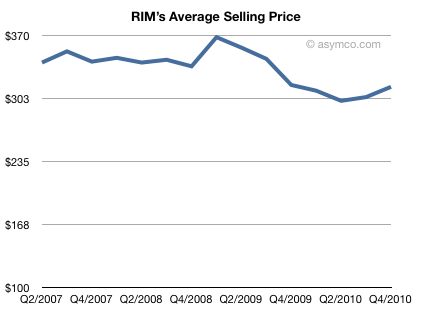
We can begin this test with the industry's canary in the coal mine: RIM. RIM has been struggling for growth in the very market where Android has been growing the fastest. Is RIM's pricing under pressure?
Interestingly, no. Their ASP (average selling price) decline, from an average of $350 to $310 in late 2009, came before the Android avalanche. During this year, the ASP has held steady, even rising in the last two quarters to $315 while Android activations reached 300k/day.
So I don't see a big problem with RIM, yet.
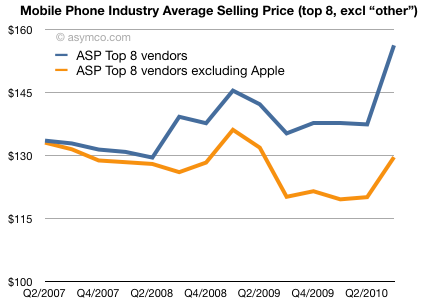
What about the industry as a whole? Can we see patterns that suggest imminent commoditization? Using the top 8 vendors (Nokia, Motorola, Samsung, Sony Ericsson, LG, RIM, Apple and HTC) and using volume-weighted ASP (total device sales divided by total units sold) we have the following chart:
Since the second half of 2007 the "industry ASP" (blue line) has actually increased. This is even though there was a huge recession in the middle of the time period.
This should be only slightly surprising. If you suspected that the iPhone may have a lot to do with that, you would be right. If you remove Apple from the mix, the second line (in orange) shows that the top vendors (ex-Apple) had some, but quite quite mild erosion (from an ASP of $133 to $129)[1].
This is far milder than what's been happening in the PC sector where prices are dropping catastrophically (According to NPD the average selling price of all Windows portable PCs has fallen from $659 in Oct. 2008 to $519 in Oct. 2009).
So Apple was a big contributor to the industry increasing its pricing power.[2] but even without Apple the industry has been holding on.
But is this just a lull?
Is Android going to stop the growth?
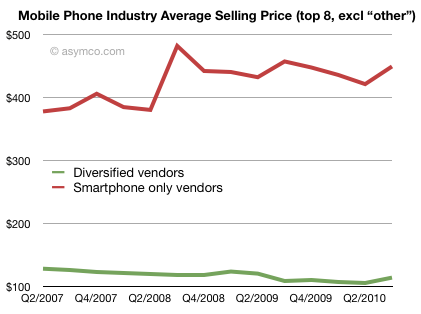
We can look at the pricing data one more way: If we separate the eight companies into two cohorts, the "diversified" vendors who sell both smartphones and regular phones vs. the "pure play" smartphone-only vendors, we get the following price history.
What is happening is that the diversified (Nokia, Samsung, LG, Sony Ericsson, Motorola) saw modest price declines (from $128 to $114) while the pure-players saw price appreciation (from $378 to $449). This is with the early impact of Android priced in. Unfortunately I don't have a chart showing non-smartphone prices in isolation, but I would be willing to bet it would be a significant negative slope.
In these two lines Android is not an independent variable. Android was adapted by some of the diversified vendors (all but Nokia), but in different ways. The thing is that Motorola and Sony Ericsson had great increases in ASP with Android. Among the pure-play vendors only HTC adopted Android and its performance is undistinguished vs. RIM which didn't.
So what, if anything, has Android done to pricing?
I argue that there is no evidence in the pricing data of a coming commoditization of smartphones. Android vendors were able to use the platform to move to higher pricing and the more they switched their portfolio to Android the more they got a better average price. At the same time those vendors who built smartphones without Android also saw strong price supports.
The only correlation with pricing power is whether you build smartphones or dumb phones. The more smartphones you build, the more price you can charge. This is regardless of platform.
The reason for this is that the smartphone market is growing so rapidly (90% y/y). There is limited direct competition between smartphones and a lot of competition between non-smartphones and smartphones--a battle smartphones are winning handily, irrespective of price. Smartphones seem to be what everyone wants.
So the real question that should be asked is:
Why do vendors bother making any dumb phones at all?
If you look at the third chart above you can see how attractive it must be for the diversified vendors to abandon the non-smart market to ZTE, Huawei et. al. Perhaps Nokia can still make a small profit there but to do so you need to run faster and faster toward extraordinarily low costs and prices. A point where phones cost less than everyday consumables. What keeps Samsung and LG in that game? Motorola and Sony Ericsson left once they hit profit warnings. Is that what it takes to drop what seems to be a loser business? I think not.
My bet is that by the end of 2012, it will be hard to find any branded phones which won't run a smartphone OS. Demand and supply of smartphones will race each other to overwhelm portfolio logic at the largest companies. The zero (visible) cost of Android will snowball this effect. What's even more provocative is that I believe the "others" will follow and abandon voice-oriented phones for smartphones almost immediately after the larger group.
I've long argued that the phone market should be studied as a whole because the competition is not between platforms but between smart and non-smart. Pricing is a leading indicator of what drives decision making inside vendors and it leads margin, and thence portfolio discussion. Android is expanding the market without crushing pricing. The margin expansion is what attracts more vendors and creates more demand. It's a virtuous cycle.
In a way, this is all good news--even for Apple. A world full of smartphone users is a better addressable market for iPhones than one filled with voice products. iPhone's traction was always in markets which had been seeded by some smartphones: the US with RIM and Europe with Symbian. Such a smartphone-soaked world will have better mobile broadband infrastructure, users with more demanding tastes and awareness of the value that a smart device can bring.
---
[1] The effect of "other" vendors not among the 8 listed is a big unknown. It's been estimated that they now make up as much as 30% of total volumes and that they are beginning to ship significant volumes with Android. Without visibility into that part of the market, we should be cautious. However, the eight vendors sampled here are still a significant cohort and the conclusions still appear reliable.
[2] This industry had, until 2007 suffered from chronic price erosion. Each sustaining innovation drove a mild burst of pricing power but it never seemed to last. From color screens to bluetooth, to 2.5G to 3G to MMS, to cameras to music playback, each hardware advance was not enough to keep the erosion away. The tipping point seems to be the iPhone and the shift to software as the component that drives price power.
[ITG sent an explanation of their methodology and there is no indication that the data represents inside information.]
ITG Investment Research analyst Matthew Goodman is forecasting monthly sales record for all of Verizon's devices "based largely on our proprietary daily point-of-sale data from thousands of independent wireless retailers across the US."
Assuming the data is accurate, we are going to dive into it but I will state up-front that without confirmation, the conclusions below should be taken with a grain of salt. All statements should be read with a preceding "if the data is accurate..."
So, if the data is accurate, here is what I conclude [1]:
Verizon Has three strikes against them:
The iPhone has stolen their growth
They are facing the prospect of a single OS platform supplier
Android is not competitive vs. iOS
The iPhone has stolen Verizon's growth
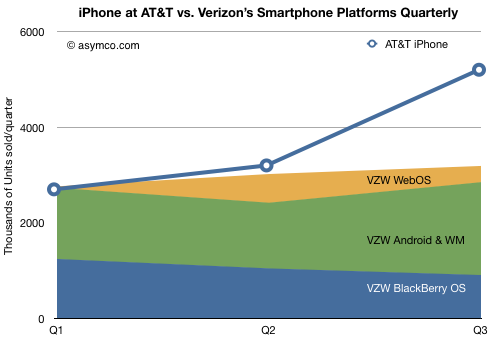
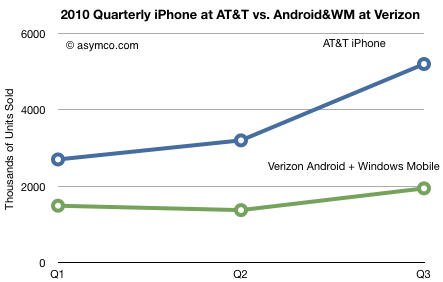
The chart below shows the performance of all of Verizon's smartphones vs. the iPhone at AT&T. The area chart shows how Verizon's volumes grew from 2.7 million in Q1 to 3.3 million in Q3. Not a bad story in itself. However, the iPhone at AT&T went from 2.7 million to 5.3 million in the same time frame. Relative to just the iPhone, Verizon has been underperforming over the last quarter.
Those additional 2.4 million iPhone/AT&T activations in Q3 could be due to replacements but the same could be said for Verizon's volumes. The fact remains that iPhone alone is nearly twice the volume of all of Verizon's smartphone activations.
Just to be clear, this is a direct, apples-to-apples comparison. AT&T and Verizon smartphone performance figures are highly comparable. The two operators are highly representative of the US market. AT&T and Verizon Wireless raked in 75% of all mobile data revenue in Q2 of 2010 and account for 62% of the U.S. wireless customer base.
In addition, Verizon enjoys a larger customer base (has 92.1 million subs vs. AT&T's 90.1 million.) Over the time frame of the data the overall market did not increase dramatically therefore the conclusion that AT&T's win is Verizon's loss is plausible.
I used quarterly data so that iPhone at AT&T could be compared. But if we look at monthly data, the story gets worse:
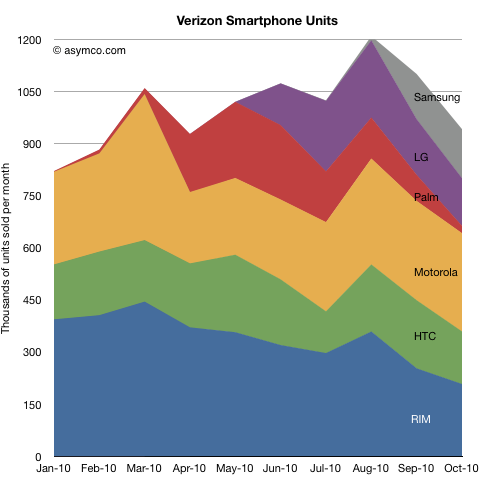
These are absolute volume figures. You can see how RIM's fade was replaced to some degree by new vendors. However, growth hit a wall in August. Following widespread iPhone 4 availability, sales dropped. Coincidence? Perhaps, but the drop happened even with the addition of Samsung volumes.
That's strike one.
Verizon is facing diminished degrees of strategic freedom
The other notable is that even though Verizon doubled the number of vendors selling smartphones, it seems they are growing their smartphone base slower than the overall market.
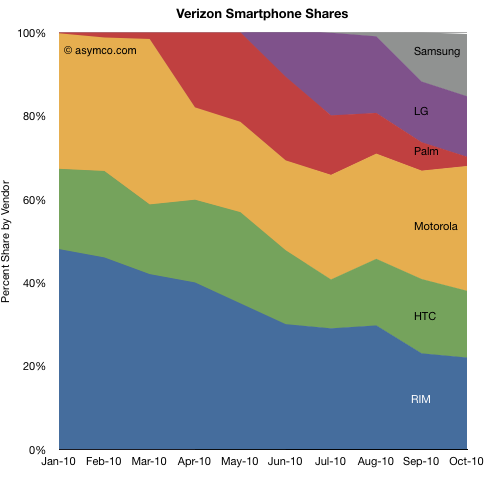
Consider each vendor's share is shown below:
From three vendors to six. Shares are roughly evenly split (except for Palm) but none of these vendors are able to drive volume growth.
Consider that Motorola Droid is outselling RIM. This should be rightly noted as amazing. It plainly shows the power of Android. However that power is not something Verizon will benefit from. Quite the opposite.
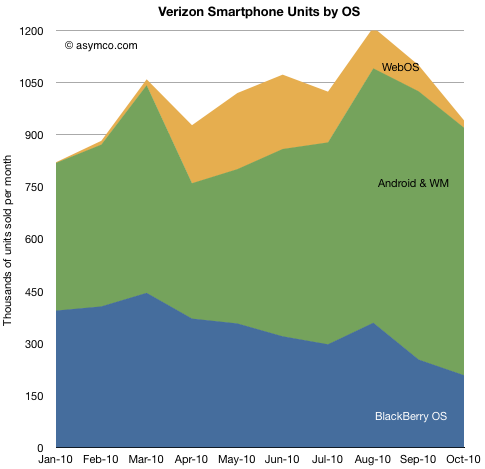
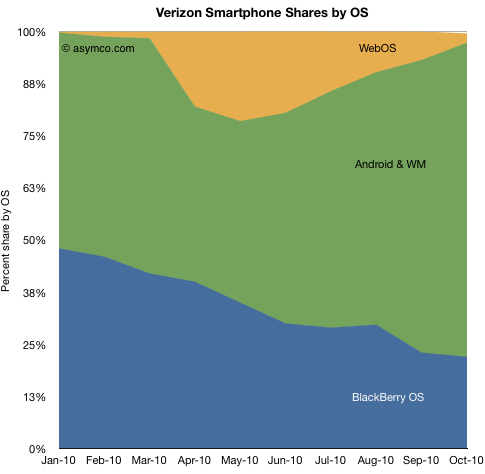
Consider the share map by units and share of each OS:
Android (and WM, though that's likely to be a very tiny part of the green area) made up 75% of all smartphones sold in October. It's possible that the share could grow to 90% as RIM continues to fade.
For Verizon this would be a serious problem. Although Verizon used to have a disproportionate share of RIM's products, that OS was not enabling an ecosystem like Google's. It was a product narrowly defined around messaging. Verizon is facing the prospect of a single OS supplier who may or may not maintain alignment with Verizon's core profit algorithm. If they diverge, Verizon's bargaining power will be strictly limited.
Strike two against Verizon.
Android is barely enough to keep the battle with AT&T from becoming a rout.
In an apples-to-apples comparison, in Q3 the iPhone at AT&T outsold Android at Verizon (remember, same addressable market) by a factor of 2.5. This is with a variety of devices and vendors thrown in the market. We hardly ever get to see this finely grained a comparison when looking at platforms.
I wrote this up as a lack of competitiveness. It may seem provocative, but I define competitiveness narrowly: the competition is for a purchase decision on equal terms. These purchase decisions are fiendishly complex to predict, but the data speaks: whether it's due to brand, visibility or performance and in spite of "antennagate" the iPhone is cleaning up.
That's strike three.
The devil they know
By 2009, Verizon was probably optimistic that they could head off AT&T (and Apple) at the pass. With the vast array of vendor Android roadmaps laid out in front of them they saw a way to stem the flood of defections. I think that optimism dissipated sometime this year and was replaced by a more dreadful prospect than what iPhone presented in 2007.
It is perhaps coincidental that the rumors of a Verizon deal with Apple seem to have started in earnest right after August. It's thin, circumstantial evidence, but the only evidence we have to corroborate the data above is that Verizon has been signaling more desperation.
Reading further into the data, I would say Verizon faced these problems and decided that they had to throw in the towel. Apple may be the devil, but so could be Google. Apple was predictably evil. But Google? The devil you know is perhaps better than the one you can't predict.
What's more, the devil Apple seems to be helping your worst enemy way too much and the unpredictable one does not seem to help all that much.
Final question: how many iPhones will Verizon sell
I think this data shows that Verizon has another reason to sell the iPhone. The underperformance of their smartphone franchise is not the only determinant, but it is perhaps another straw on the camel's back.
What would happen if (or more likely when) Verizon sells the iPhone? I believe they will sell them at the same rate as AT&T does.
The data shows that Verizon sold, on average, about 3 million smartphones per quarter during the first nine months. That's about 1 million a month. That was based on three platforms, six vendors and widespread promotion.
The iPhone sold almost 4 million a quarter over the same time period.
Verizon users bought smartphones at a lower rate than AT&T users bought iPhones. This is even though the two carriers have approximately the same subs base which churns very slowly. Since a mass-market product will appeal equally to statistically equivalent populations the product should be taken-up with similar vigor.
So the question is not whether Verizon can sell iPhones at the rate of 4 million a quarter. The question is only whether these 4 million will be in addition to the 3 million that are currently buying non-iPhones.
My guess is that the 3 million run rate for non-iPhones will drop, but not to zero.
The impact on the other vendors supplying Verizon may be strongly negative depending on the level of promotion Verizon puts on the product. That promotion budget is usually fixed as a percent of sales. What Verizon applies to iPhone will be taken out of what is spends on Droid. I have always said that operators will be motivated to balance their supplier power. The promotion budget is the primary instrument to meet that end.
On the other hand, the overall market will grow so 2010's 3 million/Q will be 2011's 6 million/Q. There is plenty of room for multiple platforms.
So my conclusion remains that iPhone will find at least 8 million new users with Verizon. The analysis above give me confidence to increase the upper bound to possibly 12 million.
Verizon striking out means they need to change the way they play. The iPhone is a new ball game.
------
[1] To assemble this discussion I used only the data provided in the article linked above and the officially published iPhone activation numbers from AT&T. Obtaining specific smartphone vendor volumes is a matter of reverse engineering the share chart and cross-referencing it to the table of vendor sales.
When comparing smartphone platforms it's tempting to consider the global market as unified and commonly addressable. However, when you look at individual countries some strange patterns of behavior emerge:
Indonesia, the fourth most populous country in the world (230 million people) loves Nokia's Communicator. It's the ultimate mobile status symbol.
Japan had one of the largest installed bases of Symbian phones. The version running in Japan is not compatible with versions elsewhere. Famous for its Galapagos mobile culture, the iPhone is changing what the Japanese consider the basis of phone performance.
The iPhone just became Korea's favorite smartphone even though hegemonic Samsung and LG are doing a roaring trade selling Android phones elsewhere.
The US has four incompatible 3G network technologies in widespread use. No widely distributed smartphone phone works with any two. Blackberry ruled supreme until AT&T started promoting the iPhone and Verizon started promoting Android.
Latin America loves BlackBerry. BBM is wildly popular as an SMS alternative.
Saudi Arabia loves BlackBerry. When face-to-face conversations are taboo, the BlackBerry is a social lubricant.
Australia loves the iPhone. Android is almost non-existent.
Italy has more smartphones per capita than the US. The majority are made by Nokia.
China uses two incompatible 3G technologies. The most popular (TDSCDMA) is not available anywhere else. WiFi was illegal in phones until this year.
Germany has a disproportionally large installed base of Windows Mobile
There are no Blackberries in Finland.
Although some of these idiosyncrasies may be cultural (like the Indonesian penchant for large devices) most of them are due to operator decisions. In some cases operators choose incompatible network technologies to protect from competition. In others they promote local vendors or price certain products out of reach.
Sometimes big bangs take place and demand explodes for "banned" technologies or vendors. However, it's just as easy to see how the pendulum can swing against free market choice.
Ultimately users and device vendors are at the mercy of operator decisions. In the long term operator control over platforms might diminish but it will take many years.
According to Morgan Keegan analyst Tavis McCourt Chinese consumers purchased 8 to 10 million smartphones last quarter--implying 400% growth from the 2 to 3 million last year.
How quickly things change. According to McCourt, Android now represents nearly 50 percent of smartphone volume in the country, up from zero last year. And Apple’s iOS, while a niche player with less than 500,000 iPhones sold last quarter, is ramping up quickly, thanks to the successful launch of the iPhone 4 in the country last month.
The growth of Android is far beyond what a single company can engineer. It represents the effect of uncoordinated and uncontrolled distribution. Google does not have to market, license or write contracts for Android. It also does not necessarily benefit from this work. It enables excess device manufacturing and distribution capacity to embrace browser-enabled devices.
Android is clearly accelerating smartphone adoption and is competing very effectively with non-consumption. Without Android I doubt many of the Chinese manufacturers who are building more smartphones today would be doing it.
One question that remains with is whether Google will do anything to police the platform or leave it to run and splinter.
Another question is what will current Android users aspire to purchase for their next phone.