
Asymco

Asymmetric Intelligence

iPhone

  1. Is Google's income from the iPhone offsetting its losses from Android: Cataloging Google's non-Google Phones

    Research · 27 comments

    Google has created a partial list of phones that run Google services.

    Google Phone Gallery.

    I notice with interest that it's called a Google Phone Gallery not an Android Phone Gallery.

    What's more, there is a distinction of All Phones and Phones "with Google". Of course that implies that we can get a list of Google Phones "without Google" (or maybe more accurately, "with partial Google").

    To clarify, according to Google there are three categories of Android Phones:

    • Google Phones "with Google" have been optimized for use of Google Mobile Services, providing easy access to Search, Voice Search, Google Talk, Google Maps, Gmail, Sync, YouTube and Android Market (where available).
    • Google Phones "without Google" list includes Android phones that have the Android market, Search, Maps and Gmail. You can get this list by subtracting the Google Phones "with Google" from all the Google Phones.
    • Non-Google phones. Android phones that have no Android market or any Google services. You can get this list by taking a list of all Android phones (e.g. from pdadb.net) and subtracting all Google Phones.

    I would also add a fourth category of Google phones:

    • Non-Android phones that serve up Google services just fine.

    Since the list is not complete, I won't tally it here, but it suggests a large number of Non-Google phones is possible.

    [I drew the following Venn diagram to help explain the situation. The shaded areas are those which generate revenue for Google. The interesting struggle (marked with arrows) is between the non-Android Phones with some Google and the Android Phones without any Google.]
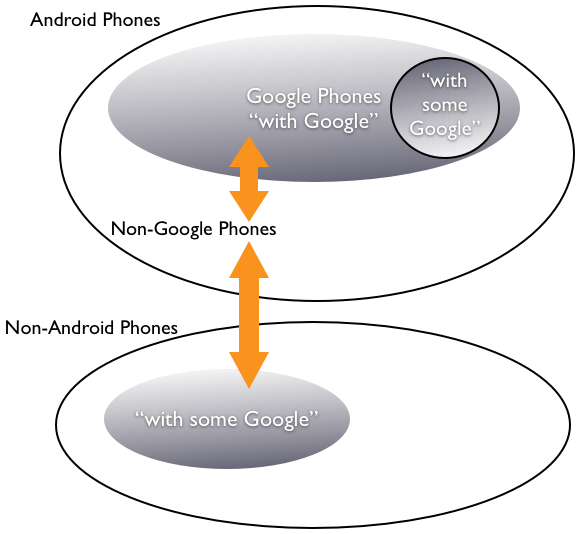
    Now the question that needs to be asked is: How many of the Non-Google Android phones are built to compete with Google (e.g. on Search, Voice, Maps, Media and App sales)? And a second question: How are the Non-Android phones "with some Google" competing with the Non-Google Android phones.

    In other words, from Google's point of view: how successful are companies other than Google at delivering Google services in spite of competition from companies with Android phones delivering services that compete with Google?

    The classic example being: how effective are iPhones with Google services at competing with Verizon Droid Android phones that deliver Microsoft services? In this scenario Apple is delivering value to Google shareholders while Verizon (using Android) is taking it away.

    Is this trade-off a net positive?

    In other words, is Google's income from the iPhone offsetting its losses from Android?

  2. Forecasting iPhone production and sales

    Research · 22 comments

    Analyst Jeffrey Fidacaro with Susquehanna Financial Group in a note to investors:

    1. Apple to build 3 million CDMA iPhones in December
    2. That would put total GSM and CDMA iPhone production for the quarter at between 21 million and 22 million.
    3. For the current quarter, Apple is set to build between 18.2 million and 18.4 million GSM-only iPhones.
    4. Expects Apple to sell a record 11.6 million iPhones in the fourth quarter of the company's fiscal 2010. 39 percent q/q increase[1][see UPDATE below]
    5. As for the iPad, suppliers were said to have plans to build 7 million units for the current quarter, a 56 percent increase from the previous three-month frame.
    6. Expects Apple to ship 4.75 million units into the current quarter, 45 percent growth q/q, to a total of 13.4 million units in calendar 2010.

    via AppleInsider | Suppliers say Apple will build first 3M CDMA iPhones in December.

    What I don't get from these numbers:

    • current quarter production: 18.2 million
    • current quarter units sold: 11.6 million
    • inventory at end of Q: 6.6 m units [I am assuming minimal inventory at start as iPhone 4 was just launched]
    • next quarter production: 21 million
    • next quarter units sold: ?
    • inventory at start + production = 27.6 million

    My own estimate is for more than 12 (and up to 13) million units will be sold this quarter. I think inventory of more than half of production is too high for Apple. They usually carry only about 10% inventory.

    My December quarter units sold may need revision but now stand at 14 million. If I substitute 14 million in the "?" above  then the inventory at end of December would be 13.6 million which would be nearly 100% of units sold--clearly unacceptable. Either production is too high or sales are too low.

    I am at 4.7 million iPads for the quarter an 13.9 million for the year. No major difference in opinion.

    ---

    [1] This forecast for 39% growth would make this quarter the second lowest growth quarter for the product. This makes is hard to believe because every launch quarter has usually been breaking records for growth. The 3G launch saw 516% growth and the 3GS saw 644%. To see 39% for the iPhone 4 makes me wonder especially as the comparable year ago quarter was not a launch quarter so growth should be off a low base. Last quarter, when the iPhone 4 was leaked and the channel was drained the product had 61% growth.

    Compare also to the Mac which had 33% growth last quarter. Are we to believe that launch quarter iPhone growth is barely higher than Mac growth?

    The figure of 11.6 million is also in-line with other analysts which seems to indicate another forecasting failure for the cohort.

    [UPDATE] I checked the figures and 11.6 million iPhones is equivalent to 58% growth y/y. The (now corrected) article was citing q/q growth. However, 58% growth is still the second lowest growth quarter for the product.

  3. Nokia's UK managing director resigns

    Research · 14 comments

    Nokia's Uk managing director Mark Loughran reckons that the Nokia N97 will prove superior to the iPhone due to its significantly better camera sensor, lower tariffs and its radical change in styling and especially form factor from the company's ex-flagship the Nokia N96.

    Loughran said: "The new iPhone is an evolution rather than a revolution and for people trying to decide whether to get a Nokia N97 or an iPhone, it comes down to a decision on performance and value for money."

    Loughran added: "the new iPhone seems to have the same design and colour, upgrading froma sub-standard two-megapixel camera to a still low 3.2 megapixel camera, and is probably a disappointment."

    Nokia General Manager Believes N97 Will Beat The iPhone

    Good times...

  4. RIM Quarterly update: just the numbers

    Research · 11 comments

    Noteworthy data (with my notes in parentheses.)

    • 12.1 million phones shipped, 11 million sold through (estimated iPhones for this Q range from 11 to 13 million)
    • Net subscriber account additions were 4.5 million which was lower than anticipated (41% of units sold through were to new subscribers which implies nearly 60% were to existing users)
    • Revenue grew 31% over the same quarter last year and GAAP earnings grew 76%.
    • The BlackBerry subscriber account base grew 56% year-over-year to over 50 million
    • RIM has shipped approximately 115 million handhelds to date. (note: 120 million iOS to date)
    • BlackBerries are available through over 565 carrier and distribution partners in approximately 175 countries and international markets (vs. 150 carriers and 88 countries for the iPhone)
    • Approximately 52% of revenue in the quarter was generated outside the United States and over 45% of BlackBerry subscriber account base is outside of North America. (70% of iPhones were sold outside the US through the first half of this year)
    • Torch was launched with one carrier but will expand to 75 next quarter
    • To date over 35 million BlackBerry Smartphones have downloaded App World at an average of over 1.5 million Apps are being downloaded every day which is up 40% sequentially (iOS apps are running at 17 million downloads per day)
    • Average selling price for RIM devices was $304 (vs. $600 for the iPhone)
    • Gross margin was 44.5% (upward of 50% for the iPhone)

    Research In Motion CEO Discusses F2Q2011 Results - Earnings Call Transcript -- Seeking Alpha

  5. Tight supply of iPhone 3GS?

    Research · 18 comments

    Just noticed that the Apple online store now says it takes 1-2 weeks to ship an iPhone 3GS. I think this just changed from 5-7 days shipping.

    Is Apple having supply problems again with the 3GS model?  Or perhaps Apple is saving supply for a China launch? Or using production capacity to make iPod touches?

    via tight supply of iPhone 3GS? | The Mac Observer Forums.

    The news today that Foxconn can only produce iPhones at the rate of about 4 million per month shows how constrained Apple's production is. Demand is far, far higher.

    The discussion about iPhone vs. Android share is usually framed around questions of demand or distribution, but may really be a question of production capacity right now.

  6. Smartphone market growing faster than expected

    Research · 9 comments

    IDC raised its 2010 smartphone sales growth forecast to 55 percent from 44 percent earlier. Citing booming smartphone demand it also lifted its forecast for overall cellphone market growth to 14.1 percent from 12.6 percent.

    via Cellphone market growing faster than expected -IDC | Reuters.

    Keep in mind the 55% growth figure when reviewing analyst forecasts for iPhone growth. If their forecast is less than that then it implies market share loss. When I suggested 50% compounded annual growth rate (CAGR) for iPhone going forward 3 years, there was a lot of skepticism but this market is growing faster than most people expected.

    I still believe that Apple can grow the iPhone at least as fast as the market.

    Here are the quarterly y/y growth rates for iPhone units since sales began:

    159% 516% 88% 90% 644% 7% 100% 131% 61%

    On a yearly basis:

    2007: 3.7 million

    2008: 13.7

    2009: 25.1

    2010 first half: 17.15

    2010 (my estimate): 44.4

  7. iPod touch made up 37.7 percent of all iOS devices sold so far

    Research · 13 comments

    On September 1st, Apple announced that 120 million iOS devices were sold to date.

    We know that there were 59.6 million iPhones sold through June (from SEC filings)

    We also know that 3.2 million iPads were sold.

    If we assume about 8 million iPhones and 4 million iPads were sold during August and July, the total number of iPod touch sold is 45.2 million.

    That is 37.7% of total units.

    In April I wrote that 41% of all iOS units sold were iPod touch to date.

    The expansion of iPhone distribution plus the addition of iPad as reduced the platform footprint for the iPod, but it's still a sizable chunk. More than one in three iOS units in use are non-cellular devices. As the iPad rolls that number could move toward 50%.

  8. Where are the iPod touch knockoffs?

    Research · 96 comments

    The latest iOS numbers and the new iPod touch launch demonstrate what a huge hit the iPod touch has become. It's safe to assume that about half of all iPods, or between 4 and 5 million units in the current quarter, are sold as touch versions.

    The iPod touch has been around about as long as the iPhone. It was launched three months after the first iPhone 2G, almost exactly three years ago. While the iPad has been in the market less than six months, a large number of potential competitors have been launched running Android and there seems to be a real rush to market. Six months is about as quickly as any hardware product can be reasonably engineered.

    So the question is why is the iPad being cloned while the iPod has remained in the market by itself?

    The value of the iPod is arguably as high with a healthy margin and consistent pricing. The volumes are comparable with tens of millions already sold so there is no obvious economic disadvantage to the iPod vs. iPad. Indeed, the iPod touch is a large (1.6) multiplier to the whole iOS platform. The demographics are very sweet too with a clear upsell opportunity.

    One explanation might be that the iPod is a music device and that market has been locked up with iTunes, putting up a huge barrier to entry. However during the music launch this month, there was almost no mention of the iPod touch as a music player while it was loudly touted as a game and app platform. Browsing and Facetime are also huge uses for the device.

    So in the iPod touch we have a mini iPad--ironically, the dig at the iPad was that it was nothing more than a large iPod touch.

    So if cloners are rushing to copy the iPad, why not its smaller incarnation?

  9. 20 Million iOS devices sold in about 2.5 months

    Research · 11 comments

    On June 7th, 2010, at WWDC, Apple announced that they will have sold 100 million iOS devices some time during June 2010. Today, September 1st, Apple announced that 120 million iOS devices have been sold.

    Assuming that 100 million was crossed half-way through June, then the additional 20 million units must have been sold during half of June, and all of July and August. That's approximately 20 million over 75 days or 267k units per day.

    Apple also announced that there are 230k new iOS activations per day which seems consistent given that they classify these as "new" activations.

    There is one huge implication of this figure:  Forecasts for iPhone, iPad and iPods may be too low. I had forecast 20 million units for the entire quarter (12.1 million iPhones, 4 million iPads and about 4 million iPod touch). The iPhone figure assumed 65% y/y growth at that looks way too low. There is still another month in the quarter meaning that the total could be 30% too low.

    I will be updating the forecast accordingly.