Asymco

Asymmetric Intelligence

iPhone

  1. AT&T does not pay a higher price for iPhone exclusivity

    Research · 6 comments

    In last year's third calendar quarter earnings call (October 20, 2009) Tim Cook was asked:

    “So when you go from exclusive to multiple, you don’t change the charge to the carrier?”

    Cook answered: “Correct.”

    In this year's third calendar quarter earnings call (October 18, 2010) Tim Cook was asked again whether the future iPhone non-exclusive subsidy will affect the iPhone revenues and again Tim Cook repeated that it won't.

    Chris Whitmore - Deutsche Bank

    And what is your experience then when you've gone non-exclusive from a subsidy and margin standpoint on the phone, have you had to give anything up in the past?

    Tim Cook

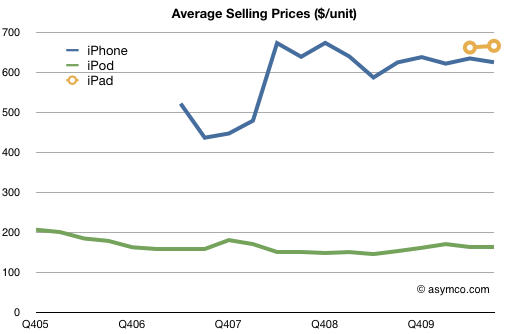
    We don't give specific information out on the margins. But I think you can look at our ASPs and see that they've generally stayed above $600, and that's despite opening up several markets from an exclusive market to a non-exclusive market.

    The recurring assumption that the loss of AT&T exclusivity will cause iPhone price erosion is wrong and has been evident in the sales data for over a year now. Not only did Cook state clearly that there is one price for iPhone to the channel regardless of exclusivity but the price data shows that as Apple moved to non-exclusives in many regions of the world, the ASP remained fairly constant:

    Over the period when the blue line has been flat, Apple moved a number of markets from exclusive to non-exclusive.  There are three main countries where iPhones have a contractual exclusive relationship. That is the United States, Germany and Spain. (China and Japan are exclusive due to network technologies). All these markets will go to non-exclusive next year. I don't expect any change in the ASP as a result.

    The final data point comes from AT&T themselves when they revealed the price they paid for the iPhone was roughly the same as the ASP shown above.

  2. iPad vs. iPhone: why we got the iPad forecasts wrong

    Research · 17 comments

    The iPad was announced to a loud chorus of disapproval and disdain. It's easy to forget the overwhelming scorn and insult poured on the product for months before and after sales start. Analyst forecasts were comical. At this time it looks like all 12 month iPad unit forecasts will have missed by more than 100% (mine included).

    As data on iPad performance was published for the first quarter's sales, the mood swung from ridicule to ridiculous.

    Without regard to the growth of comparable products, analysts seem to have latched on to production figures which are notoriously inaccurate. The problem with production numbers is that they are only very loosely coupled with shipment numbers to customers. There are questions of work in progress inventory, finished inventory and the actual accuracy of reports. Production also follows a ramp and is not constant over time.

    Another way to analyze a new product is to think about the distribution. Although late in the quarter some large distribution deals were made public, the channel did not have much time to be filled before the end of the quarter. Not only that but there is easily obtainable evidence that the iPad did not reach most international markets. Apple announced how they were rolling out a few countries every few months.

    This trickle of international sales indicated to me that the iPad sales pump was not yet fully primed. My initial estimate was for in-line sales of 3.3 million which I aggressively increased to 5 based on some of the production numbers being mentioned.

    This figure turned out to be 22% too high, but not as big an error as some of the other analysts.

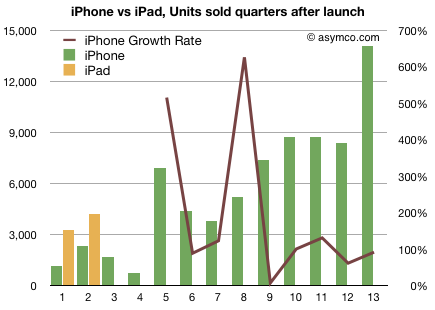
    Another way to look at it is through comparable products. The nearest comparable product to the iPad is actually the iPhone. It was a similarly "revolutionary and magical" product launched with a similar constraint on production and distribution. It was also built and marketed by the same people. They've been down this road before and have honed the process from the iPod through the iPhone over a decade.

    If we look at the iPhone and compare it with the iPad, we see just how popular the iPad really is. It may not follow the same seasonal pattern as the iPhone, but it will probably ramp in a similar way. In the following chart I also show the iPhone Growth rate (right scale).

    The iPhone has been able to maintain over 100% y/y growth on average. I don't see a reason why the iPad can't repeat this pattern over the next three years.

  3. CDMA iPad and the 150 million iOS devices next year

    Research · 52 comments

    The Verizon distribution for iPad is an unexpected development. Coupled with distribution through AT&T stores, and rapidly expanding retail points of purchase, it seems that the iPad is destined to be the most widely distributed product Apple sells. The iPod never reached operator points of purchase and the Mac is orders of magnitude more constrained.

    What seems to be happening is that Apple is pulling out all the stops and going for unrestricted iPad distribution. This may also foreshadow unrestricted iPhone distribution next year. It may also portend a CDMA iPad (or at least an LTE version) next year.

    If it happens all estimates for next year need to be revised sharply. I had been expecting 100% growth for the iPad and 50% growth for the iPhone. These might need to be increased to 150% and 100%.

    The consequence could be that total iOS devices sold could top 150 million for calendar 2011.

  4. Daring Fireball Linked List: Andy Rubin Talks Android

    Research · 29 comments

    What value have the carriers brought? Seriously. What software on Android phones have the carriers added that’s any good at all?

    Things you don’t hear iPhone users say: “Man, this iPhone would be even better if my carrier could ‘add value’ to it.”

    via Daring Fireball Linked List: Andy Rubin Talks Android.

    Good questions.  I would seriously like to hear any answers to these questions as I have never used any of these operator software phones.

  5. Adding CDMA increases iPhone addressable market by 16 percent

    Research · 18 comments

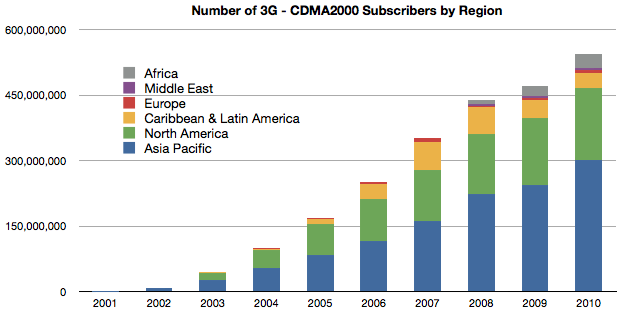
    Now that NYT and WSJ were both tipped off about the coming of a CDMA iPhone, I think it's a safe bet. Is this significant? What is the CDMA addressable market?

    Here is a chart showing  for the "CDMA 3G" subscribers (source: CDMA Development Group.)

    (includes CDMA2000 1X, 1xEV-DO Rel. 0 & 1xEV-DO Rev. A )

    Here are the data for various subsets.

    • CDMA2000 543 Million includes CDMA2000 1X & 1xEV-DO
    • CDMA2000 1xEV-DO 145 Million includes CDMA2000 1xEV-DO only
    • CDMA 547 Million includes cdmaOne, CDMA2000 1X & 1xEV-DO (includes non-3G)

    For comparison, the GSM data for Q2 2009 is:

    • GSM 3,450, Million
    • WCDMA 256 Million
    • WCDMA HSPA 133 Million

    It would be safe to assume that the iPhone will be able to address 543 Million additional users.  They represent about 13% of all mobile subscribers but the increase in addressable base is about 16%.

  6. The cognitive illusion that is iPhone n-1

    Research · 28 comments

    How do you think about the iPhone 3GS after the iPhone 4 is out? I have a hypothesis that it's not what it seems.

    The standard logic is that the 3GS (which I will call the n-1 where n is the current phone version) is a lower-priced leftover that covers a lower price point and expands the market.

    I think it's designed to give the illusion that the iPhone 4 is actually more desirable steering more potential buyers to the new (nth) phone.

    To illustrate I'm going to call upon the wonderful example given by behavioral economist Dan Ariely at the TED talks.

    Imagine I give you a choice: Do you want

    • (a) "a weekend to Rome, all expenses paid" or
    • (b) "a weekend in Paris, all expenses paid"?

    They are different but compelling choices. Perhaps a survey would find these two choices equally popular.

    Now imagine I added a third option to these two that nobody wanted:

    • (c) having your car stolen.

    It seems a strange choice, because how could having your car stolen in this set influence anything? Obviously (a) or (b) would be the only compelling options. But what if the option for having your car stolen was not exactly like this. What if the third option was

    • (a-) "a trip to Rome, all expenses paid but no free coffee with breakfast."

    Given that you can have Rome with coffee, why would you want Rome without coffee? It's an inferior option just like having your car stolen.

    But, the moment you add Rome without coffee as an option, Rome *with* coffee becomes more popular and people choose it much more often. Having Rome without coffee makes Rome with coffee seem superior, not just to Rome without coffee but even to Paris.

    Adding (a-) to the set of choices (a) vs. (b) makes choosing (a) much more likely.

    He goes on to describe a subscription offer from The Economist which, by inclusion of an inferior option, steered people to choose a more expensive option.

    My point here is that I hypothesize that the iPhone n-1 (Rome without coffee) is an inferior option to the iPhone n (Rome with coffee) and that it steers more people to choose iPhone n not just over iPhone n-1 but over the competition (Paris). Of course the inferiority of iPhone n-1 is offset by its lower price, but I put it that the difference of $100 is not that great in the eye of most users when they see the difference with the new model. The price difference does not make the iPhone n-1 look all that great. It's still Rome without coffee.

    We don't have precise stats to prove that iPhone n-1 is ignored as an option, but the ASP numbers never seem to drop. They seem to indicate that the overwhelming number of iPhones sold are the top of the line. Therefore the presence of an inferior option does not dilute the average selling price, but, in fact, increases overall volumes of the top product.

  7. The strategic tension inherent in the iPhone franchise

    Research · 25 comments

    I don't write product reviews and I don't pass judgement on individual products but I do own and test various products. For example I have the Android powered Samsung Galaxy 5 (GT-I5500) and the experience is, in my opinion, better than for recent Symbian phones but not as smooth as for Apple's products.

    But that's not what this article is about.

    It's about the price. The price for the Samsung is one third that of the iPhone 4 (both devices unlocked and sold in Europe with a 23% VAT). It was also purchased in a department store with as much hassle as buying a pair of gloves.

    When it comes to the product, it may be a fair trade-off: one third the price for one third the product. The specs are not only worse but the whole experience is rougher and cruder. But that "one third the product" may be just good enough for a large population of users who are now satisfied even with "one tenth the product". The price point should be evaluated as a valid threat.

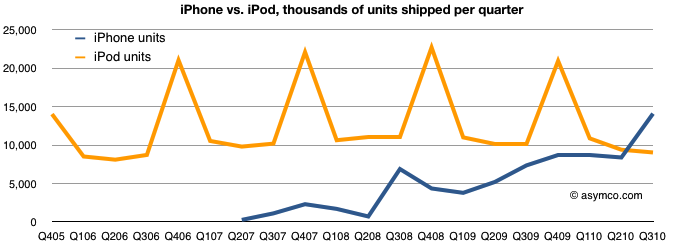
    But Apple can respond. It's not like this is asymmetric competition. As the iPod shows, Apple can make money with low end products. Easily. Is this entry price point (€200 unlocked) something Apple should cover? My answer would be an unqualified yes.

    For operator distribution, the subsidized price combined with a high-end offering is by far the best marketing mix (price, promotion, positioning, etc.) However, for non-operator distribution, a lower spec unlocked device sold through tens of thousands of points of purchase (like the iPod, and soon, iPad) makes a lot of sense from a platform point of view.

    These two channels are often in conflict due to subsidy and exclusivity clauses. This conflict makes the decision to ignore the non-operator channel compelling. The economics for the operator channel are always going to trump the non-operator channel. But as the platform expands across geographies and income segments not covered by the operator-subsidized channel, these populations will need to be addressed.

    So this is the inherent strategic tension for the iPhone franchise: Whether to use the iPhone brand to enable ubiquitous mobile computing outside operator channels, or use iPod/iPad as a complementary but separate brand to engage in an orthogonal attack.

    I suspect the decision has been made. We will observe the consequences next year.

  8. Ticonderoga sees over 15 million iPads in 9 months

    Research · 13 comments

    White contends iPad could be “one of the most coveted gifts” this holiday season; he sees the company selling 7.1 million units in the September 2010 fiscal year, with 19.9 million in 2011, and 25.8 million in 2012.

    The analyst said his target is based on 20x his interest expense/income adjusted calendar 2011 pro forma EPS estimate, plus net cash of $49.43 a share.

    via Apple: Ticonderoga Starts With Buy, Street-High $430 Target - Tech Trader Daily - Barrons.com.

    If Apple hits 5 million in the just ended September quarter and 7 million in the December quarter, we're looking at over 15 million iPads in nine months of sales. The iPhone took about 20 months to reach the same level.

    If the iPad is ramping up more than twice as fast as the iPhone, (aka the Jesus Phone) what does that make it?

    See also: iPad Death Watch : AAPLinvestors

  9. Updated estimates for Apple's fourth quarter earnings

    Research · 12 comments

    We expect revenue to be about $18 billion compared to $12.2 billion in the September quarter last year. We expect gross margins to be about 35%...

    We are targeting EPS of about $3.44.

    via Apple Inc. AAPL Q3 2010 Earnings Call Transcript.

    I've updated my estimates from the July forecast as follows:

    • iPhone units: 12.2 13 million (65% 77% growth)
    • Macs: 4 million (30% growth)
    • iPads: 3.3 5 million
    • iPods: 9.4 9.7 million (-5% growth)
    • Music growth: 26.7% 25%
    • Peripherals growth: 21% 15%
    • Software growth: 8%
    • Total sales: $19.0 $20.5 billion (56% 69%y/y growth)
    • GM: 42.3% 40.4%
    • EPS: $4.78 $5.00 (73% 81% y/y growth)

    The main news items that affected the changes in estimates were:

    1. iPhone continues to be supply constrained.
    2. iPad supply nearly matching demand though not yet rolled out in all markets
    3. new iPods look compelling though offset by back to school promos

    Follow other estimates at Deagol's site:
    Deagol's AAPL Model: Fiscal 4Q 2010 Final Estimates

  10. Is Android share of Web lagging iOS share of Web?

    Research · 12 comments

    Of all the public statistics about platform share, Share of web use must be the most important measure for Google. The more browsing people do, the more searching they do and if Google search is most likely for a platform then the more income Google derives from that platform.

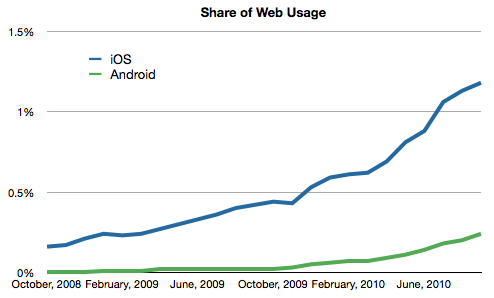
    NetMarketshare.com has offered an insight into the split between Android and iOS as search platforms and it shows how iOS is still five times more likely to yield search revenue than Android. That multiple is likely to shrink as the gap narrows, but it still demonstrates the power of iOS to drive Google's bottom line. It's no wonder then why Google has renewed their default placement of Google search in mobile Safari (a guarantee they don't seem to share with all Android licensees.)

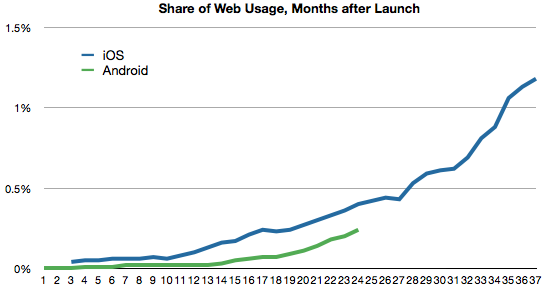
    But Android launched later than iPhone, so everyone should be asking how rapidly the share of Web has grown since the start of each platform. When iPhone launched in 2007 it was almost competing with mobile web non-consumption. The alternative mobile browsing experiences were so bad that it's hard to remember anyone putting up with them. A year later, the bar was set higher and Android filled a vast chasm of demand for mobile browsing for people who could not buy an iPhone.

    At the same point in the life of each platform, Android seems to be exploding in units sold. With this proliferation of Android licenses, it should be interesting to see if their unit share numbers are reflected in web share numbers. So far the story is not convincing. The growth in Web share is not pacing faster than iOS achieved at a similar point in time.

    So far, 24 months into the life of each platform, iOS leads by almost 50% higher share.

    iOS/mobile Safari has the advantage of iPod and iPad for distribution but that does not explain the relative lag of Android with respect to Web share as Android has a large number of SKUs.

    It may be too early to draw conclusions, but anyone trying to analyze Google's strategy with Android should be paying close attention to this.