But seriously, how long has it been? Five months with no iPads on hand? Now if only they had enough iPhone 4's.
Here is the situation in Korea:
SEOUL (AFP)--South Korea's KT Corp. (KT) said tens of thousands of people jammed its website Wednesday, as it began to take pre-orders for Apple Inc.'s (AAPL) iPhone 4.
KT Corp., the country's sole distributor for the gadget, said in just four hours more than 70,000 people put their names down for the popular smartphone after its online shop opened.
"Our online shop server was jammed instantly as too many clients placed orders simultaneously," KT spokesman Jin Byung-kwon said.
"So far, the number of orders for the iPhone 4 exceeds well beyond that of the iPhone 3GS," he said.
The mobile phone market is intertwined with the telecommunications industry which is vast and there are numerous competitors which are much more dynamic and better capitalized than the moribund PC or music player vendors. It’s also a regulated and fragmented global market with 1.2 billion units and 5 billion consumers—far greater than any of the markets Apple played in for its first 30 years.
Nevertheless, the iPhone has had a huge impact on the industry. To show just how much of an impact, I dove in and pulled over 500 data points on three years’ financial performance of seven competitors responsible for 80 percent of units being shipped today. The time frame covers the iPhone’s participation in the market so it allows for “before-and-after” comparisons.
Now I turn my attention to draw a bottom line from all the data above, namely the operating earnings (EBIT or Earnings before Interest and Taxation).
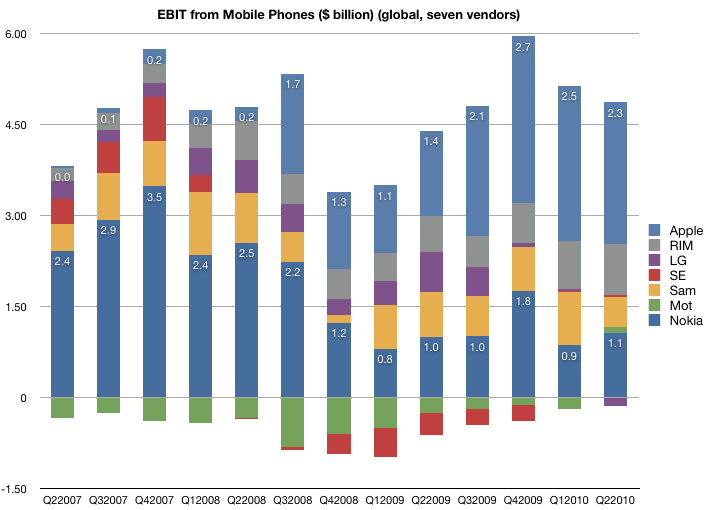
The first chart shows the EBIT from the top seven vendors of mobile phones since the quarter when the iPhone launched. I annotated Nokia and Apple's bars to give perspective.
The total available profits in the industry dipped to a bit under $4 billion at the trough of the recession, and have recovered to nearly $6 billion in the holiday quarter last year. However, not all vendors are profitable. As you might expect from looking at the operating margins, Motorola and Sony Ericsson have been generating losses for most of this time period. They have both reached profitability in the last quarter, though at very low levels and after having lost a large part of their sales. LG has turned negative this past quarter after being a modest earner for some time. Samsung has maintained a fairly even consistency in its profit capture, though with its expanding market share, it seems to have come at the cost of pricing.
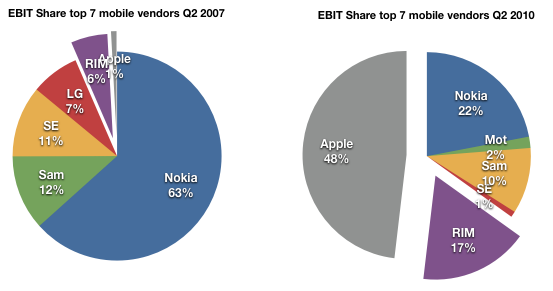
Finally, looking at the pure smartphone vendors RIM and Apple, the picture is nothing short of astonishing. This before-and-after share-of-available-profit chart shows that the two entrants went from about 7% profit share to 65% in three years.
Apple in particular is capturing about half of the available profits with three percent of the units. It dwarfs all the other vendors, more than double the nearest (Nokia). All that in three years and with the added burdens of only three models, a recession and limited distribution.
What does it all mean?
Here are my conclusions, enumerated:
The lack of a real response. The recurring theme in this series of articles has been that giant multinational incumbents in a vast and rapidly growing industry, enjoying all the advantages that size and incumbency, have had their profits taken from them. And they don't seem to have put up much of a fight.
It's all wealth transfer. Note the total amount of profit available has not increased markedly; this is not about incumbents growing the pie. Two thirds of what should have rightly been theirs moved from the incumbent shareholders to the entrant shareholders.
Speed. This shift of profit occurred over an unprecedentedly short period of time. Three years is no more than two product cycles in the industry and it's an order of magnitude faster than what happened historically to other industries.
Disruption is the diagnosis here. The incumbents were caught in the headlights. Disruptive innovation leads to asymmetric competition and this is what we just witnessed. History has shown that the shift of profits is usually the last stage of disruption and is usually irreversible because the change in business models cannot happen at the rate of change of profit transfer.
Which leads me to one final point.
When analyzing the potential for challengers to the new winners, the most cited is Android. Can Android affect this redistribution of profit once again? And to whom?
If Android is to become the dominant platform, does it depend on the success of its licensees? Who are these licensees and what are the chances that they will be able to align their businesses to what Android offers (a new revenue model based on services and advertising).
One problem I see is that Google is making a bet on those same vendors who are now squeezed in the middle of that last pie chart: Samsung, LG, Motorola and Sony Ericsson. Nokia, Apple and RIM will certainly not take the OS over what they already have as it dilutes their differentiation and margins. That means Android is aligned with the biggest losers in the industry.
So how likely are these disrupted ex-giants to recover and take Android forward? My bet: slim to none. Android does not offer more than a lifeline. It is not a foundation for long-term profitability as it presumes the profits accrue to the network and possibly to Google. Profit evaporation out of devices to Google may be a possibility at some time in the future, but only if the devices don't need too much attention to remain competitive. But because they're still not good enough (and they won't be for years to come), it's certain that attention to detail is what will be most important to stay abreast of Apple.[1]
So here we have the real challenge to Android: partnership with defeated incumbents whose ability to build profitable and differentiated products is hamstrung by the licensing model and whose incentives to move up the steep trajectory of necessary improvements are limited.
In other words, Android's licensees won't have the profits or the motivation to spend on R&D so as to make exceptionally competitive products at a time when being competitive is what matters most.
[1]: I would argue the same lack of symmetry with licensed software vendor Microsoft is what led the the failure of the same incumbents to make a dent in the industry with Windows Mobile [2003 to 2010].
After ASP, Sales, and Unit Volumes we look at the three year history of operating margins for the seven most significant mobile phone vendors (Nokia, Samsung, LG, Motorola, Sony Ericsson, RIM and Apple).
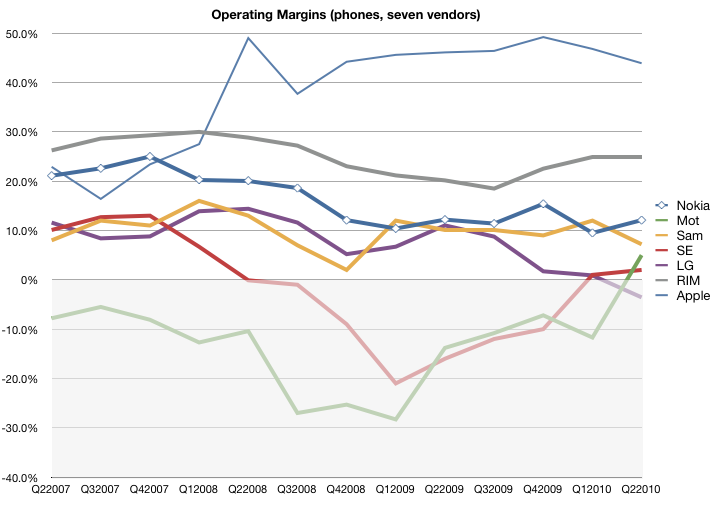
The following chart shows the OM from mobile phone sales. These figures are as reported by the companies with the exception of Samsung and Apple. Samsung reports OM for its telecommunications unit as a whole and we have to assume that it's largely accurate for mobile phones. Apple does not report margins for its iPhone but it's possible to estimate gross margin percent for the iPhone and then subtract its overall OPEX as percent of sales. This assumes that OPEX is allocated to the iPhone in proportion to sales, which is the best assumption we can make at this time.
The data shows that the iPhone has been considerably more profitable, due mostly to a high ASP, than other vendors. Motorola and Sony Ericsson have been "underwater" with respect to margin for much of the time period, with LG recently dipping into the red.
Nokia's margin erosion is a source of significant angst but note that it has just reached Samsung's historic level (around 10%). LG, long seen as an up-and-coming vendor who took over the number three spot from Motorola is shown to have done so with moderate-to-low profit margins.
Overall, the phone incumbents have an unweighted average operating margin of 4.5%, down from 8.6% three years ago. In contrast, RIM and Apple have an average OM of 34%, up from 24%. In other words, profitability has halved for the volume leaders while it has increased nearly by half for the entrants.
This goes a long way toward explaining the "smartphone gap" which is being filled by Android. As vendors see their unit growth, ASP and operating margins under pressure from low end disruptors, there is a tendency to flee to the high end that smartphones represent. Android offers an irresistible siren's song.
The key bit: “At the critical juncture […], when they should have gone for market share, they went for profits.” I think this encapsulates Jobs’s philosophy since taking over Apple in 1997. Take the high end of the market first, establish a brand and presence, then steadily start to expand.
I've long argued that Apple is in the phone business to win significant share (i.e. greater than the share they have had in the PC business). Since the phone market is vast (1.2 billion phones sold in the last four quarters) iPhone volumes must be as well.
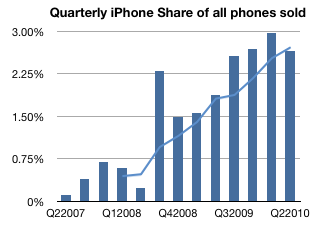
So how has share evolved, and what can we expect? This is a graph of quarterly share for iPhone including a four period moving average:
The trend is clear to see. With seasonal variation due to the launch cycle, the share is likely to increase over 3% and keep going. How far can it go? That's a strategic decision for Apple's management. If we are to take Steve Jobs' word that their plan is not to be a niche player in any market they target then I have to conclude that Apple is aiming above 10%.
The volume expansion in the US due to the end exclusivity is only the latest in a series of distribution deals that Apple has brought to bear: International expansion, dropping exclusivity in other countries and broadening the portfolio (including earlier models in current line-up) are all natural and obvious moves in a broader market push.
Pricing might be considered another lever that Apple could use, though that seems unnecessary today.
I conclude that growth in iPhone sales of 50% per year seems entirely possible for the next few years. Such growth would allow Apple to reach 10% of the world's 3G subscribers by 2013. That would still be only 4% of all phones and 20% of smartphones.
Japan and Korea have further 3G reach but use it significantly less.
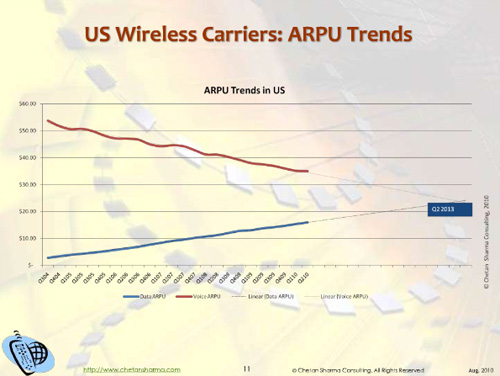
His findings support notions that Android and iPhone are controlling data use in the US. The iPhone's current exclusive home, AT&T, and Android-favorite Verizon both make up 75 percent of American data use
Is there any surprise that in the country where the iPhone and Android are most popular there is the highest data usage even though it has one of the poorest mobile data infrastructures in the developed world?
What does that say about the importance of the device (and not the network) to the adoption of data services.
There are implications about the relative power shift between operators and device vendors. Within the mobile value chain, as mobile data overtakes mobile voice, the economics and value propositions will shift. The motivation of participants will begin to diverge and a schism will occur.
The iPad units numbers were not a surprise (except perhaps to some of the professional analysts who do not read Apple's press releases). Among the more accurate (amateur) analysts, the range was from 3.2 to 3.45 million with an average of 3.32. My estimate of 3.3 million was the mode of the distribution.
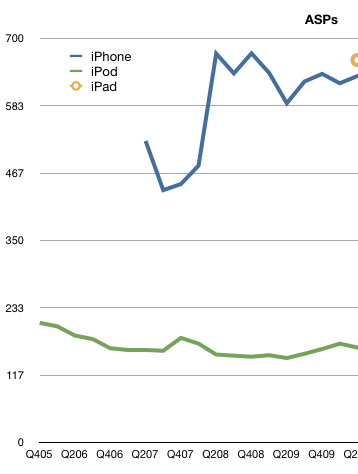
Apple sold 3.270 million in the first ever quarter. The ASP came in at $662.39, below my expected $700 but higher than the iPhone.
The only unknown is the gross margin. Given the overall GM and the other products' margins, I am backing out a 33% margin for the quarter. I had expected 40% but the lower margin may be a result of launch quarter issues (shipping and allocation of stock) and perhaps a lower target margin for the product. It should be noted that the iPad margin sits between the Mac and iPod (around 30%) and the iPhone (around 60%). The iPad is a new category that sits between the Mac and iPhone in terms of usage and it seems it sits also half-way in terms of margins. Going forward, I'm still modeling a 40% GM for the iPad.
Overall, I estimate the iPad added $717 million of operating profit to Apple's bottom line. Not bad for a product that was almost universally panned on launch day.
Calling the iPhone this quarter was going to be a challenge. This was a transition quarter where an old lead model would be replaced with a new one. The launch of the iPhone 4 was going to affect the volumes, but nobody could predict how. We've had a few such quarters and they were volatile. The number of sales days varied and the distribution of the old product was much different. The problem was compounded by the leak of the prototype and the uncertainties of launch day logistics. My forecast had been 8.5 million units.
In the event, 8,398,000 iPhones were sold. This included 1.7 million iPhone 4s which means about 6.7 million 3GS phones sold. That's quite remarkable given the end-of-cycle timing. 8.7 million 3GS were sold in Q2 which means the sell-in was down only about 2 million for the transition.
The even more remarkable story is the average selling price. It came in at $635.15. The iPhone has ranged from $437 to $674 ASP over the last three years (see chart). This figure places it near the top of the range, a great performance for the end of a product cycle quarter.
I estimate gross margin at 56%, a drop from the more typical 60% due to iPhone 4 launch. With revenues of $5.33 billion and cost of sales of $2.2 billion, Apple created operating profit of $3.13 billion--we'll take a look at that number relative to other vendors later.
Growth year-on-year were 74% for revenues and 61% on units. For a transition quarter, these numbers are spectacular. For comparison, during 2009's transition quarter (Q4) revenues grew at 5% and units 7%. Furthermore, according to Apple's management, iPhone unit sales in the June quarter were running 90% above the year-ago period prior to the company draining thechannel ahead of the iPhone 4's release. In the December and March quarters, unit sales were 100% or more above prior-year results. This means that 100% growth is sustainable though going forward I'm keeping forecast at 65% growth.
Seventy percent revenue growth cannot be seen as anything other than a sign of rude health.
• No other manufacturer can claim nearly the loyalty of iPhone owners. RIM BlackBerry owners see a touch-screen device as the antithesis of their hard keyboards. However, even in this category, 23 percent of respondents plan to buy an Apple iPhone. We see similar results with all other mobile phone owners. In fact, 36 percent of Google-branded Android phone owners say they plan to buy an iPhone, surpassing the 32 percent of Google-branded phone owners who intend to buy another Android phone.
"Apple sold 3.47 million Macs during the quarter, representing a new quarterly record and a 33 percent unit increase over the year-ago quarter. The Company sold 8.4 million iPhones in the quarter, representing 61 percent unit growth over the year-ago quarter. Apple sold 9.41 million iPods during the quarter, representing an eight percent unit decline from the year-ago quarter. The Company began selling iPads during the quarter, with total sales of 3.27 million."
Asymco.com is now touch friendly. Visit this site with an iPhone for a touch optimized experience. Mobile theme is WPtouch.
This posting is also made using the WordPress app for iPhone and geotagged with my approximate location. At this location one has to do with only Edge and no broadband (or electricity or running water). Fortunately the iPhone and iPad can be charged from a boat battery via a regular car charger.
2010.Realization that iPhone is a threat from new dimensions (user experience). Planning begins on reshaping the software base as a market-driven (not technology-driven) asset (5 year cycle). Apple begins to be evaluated as a competitor in devices and services, although still not compliant with current market definitions.
I wrote these words a year ago based on observations made three years ago. My expectation was and still is that Nokia does not quite understand what they are competing for and what the competition actually consists of.
On Friday Anssi Vanjoki wrote that "The fightback starts now." He seems to contradict my timeline which has the "fightback" starting in 2014.
How do we settle this? Let's turn to the claims:
In the article he says they sell 2 in 5 smartphones on the planet, yet, he turns around and says that Nokia is now the challenger in that space. He says Symbian is the way forward on smartphones, yet he says MeeGo is the way forward on 'connected devices'. He writes that he is obsessed with getting Nokia to being number one in high-end devices (presumably by volume or sales or profit) but a recent survey by third-party tool developer Appcelerator shows 90 percent of developers surveyed said they were interested in the iPhone while 81 percent expressed interest in Android; for Symbian and MeeGo, the related figures were only 15 percent and 11 percent, respectively.
I'm not ready to revise my timeline. The fightback begins in 2014.