Asymco

Asymmetric Intelligence

iPhone

  1. Apple's supply problem

    Research · 12 comments

    With the iPad still unavailable three months after its launch and with only 1.7 million iPhones available for purchase in the first three days, Apple's inability to meet demand is surfacing as its most immediate and glaring problem. This problem merits the deployment of some of the cash Apple is hoarding.

    As I wrote in May, Apple's next billion users are in waiting. However, to serve them in a timely manner requires a new approach to product launch and ramps.

    Apple has imposed upon itself a yearly product cycle for the iPhone and the iPod [and, probably for the iPad].  This is a brilliant move because it keeps the product fresh without having it seem disposable.  It also keeps competitors within its turning radius. However, the challenge is that the distribution network has to be filled rapidly and drained rapidly to maximize availability. This gets harder and harder as the volume grows. Imagine having to manufacture and ship into the channel a billion devices in less than a quarter.

    This year's iPhone 4 launch was heavily over-subscribed.  If Apple had enough supply, launch sales could have gone as high as 2.5 million, one analyst believes. Apple admitted mis-diagnosing demand and problems arose during the reservation process. There were insufficient units for pre-order, never mind for users walking into stores.  The shocking thing is that three months on, the iPad is still unavailable to impulse buyers who might want to pick one up with their iPhone.  This despite the fact that most of the world does not have any purchase option.

    Now I ask what will happen next year?  Supply may balance with demand by October and strains will show again around Christmas.  Then what?  The iPhone 5 will be getting prepared with another 50% to 100% growth in demand.  How will June 2011 and June 2012 look?  Will Apple have 4x the supply of iPhones and iPads needed to maintain growth?

    There are various solutions possible, but if Apple wants to maintain the product cycle, the event marketing and the "reveal" that builds brand value, it needs to change the way it manufactures.  By investing in automation, locating plants near to buyers and by integrating suppliers into production, it can get the quantum leap in supply it needs.  These are capital-intensive solutions, but Apple's capital is underemployed.  I see no better use for the rapidly-building cash pile.
  2. Asymco estimates for Apple's third fiscal quarter

    Research

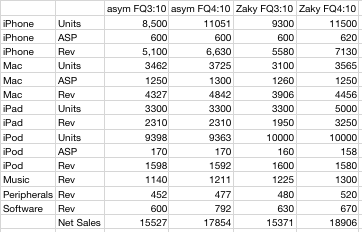
    The third fiscal quarter is at an end and it's time to estimate performance.  Andy Zaky has kicked off earnings season with his detailed accounting of what could be a $63.5 billion year for Apple.

    I put forward below my estimates side-by-side with Zaky.  I come in at $62.6b for the year, differing by just under $1b or 1.6%.

    His numbers are certainly within what I would consider a margin of error of mine.

    My estimate for iPhones this quarter are lower due to possible slowing of sales before the iPhone 4 launch.  My Mac numbers are higher based on some early estimates of industry pick-up. I concede that my FQ4:10 iPad estimates are low, but sticking with them for now.

  3. Android is a BlackBerry killer

    Research · 2 comments

    Much has been made of the potential for Android to reduce the growth of iPhone. The iPhone seems to be doing very well and continuing to be supply rather than demand constrained.

    RIM however seems to be under significant pressure.  A Goldman Sachs analyst first pointed this out in her last report and placed a "Sell" on RIMM.  The fact is that most of RIM's sales are in the US on the carriers other than AT&T.  In those very same carriers, Android is being pushed hard as a customer retention strategy, so iPhone is pressuring RIM only indirectly through Android.

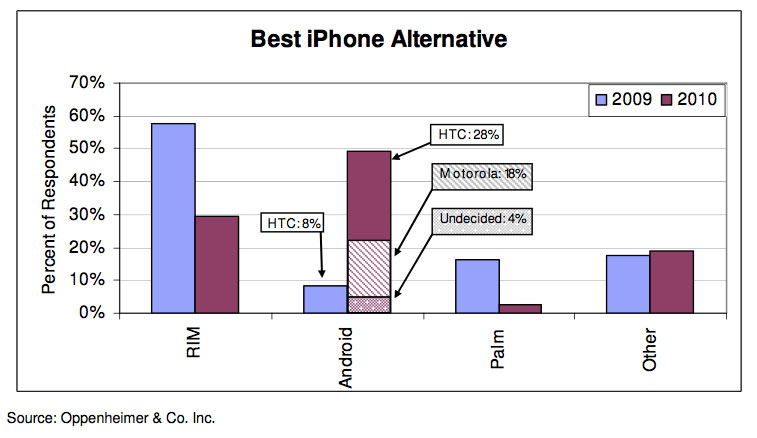
    The evidence is also in survey data.  In the graph below, we see how iPhone buyers are considering Android as the most credible alternative to the iPhone whereas they considered BlackBerry the best alternative a year ago.  In terms of vendors, what RIM lost HTC gained.

    One can only wonder what will happen when the iPhone enters unrestricted distribution in the US.  The results in other markets speak for themselves.

    AppleInsider | Apple's recurring revenue stream: 77% of iPhone 4 sales were upgrades.

  4. RIMM near 52 week low

    Research · 1 comment

    RIMM shares dropped more than 5% after hours after company reported "light" units and a 20% rise in profit with a 24% rise in revenue.

    RIMM sold 11.2 million units (of which 4.9 million were new subscribers and the rest replacement units--a deterioration in replacement rate). This represents 43% growth. The unit growth is nearly double the revenue rise implying a lower ASP ($300--half the iPhone) and margin (45.4%).

    RIM passed another milestone: 100 millionth BlackBerry was sold during the quarter. We've noted before that Apple will also pass its 100 millionth iOS device this month. RIM sold 20 million units as of October 2007, right on the heels of the iPhone launch. That means that iOS grew 100 million to BlackBerry OS growing 80 million in the same time frame.

    So why are shares at a P/E of 13? 20% EPS growth would be respectable numbers, but the smartphone market is growing faster than that. The implication is that RIMM is losing share and everyone is expecting that loss to accelerate.

    Simona Jankowski from Goldman Sachs repeats her Sell rating. “RIM has now missed top-line expectations for three of the last four quarters, in our view demonstrating the building competitive pressures on its business from the iPhone and more recently from Android,” she writes. “We estimate that net subscriber additions in North America declined on a sequential basis, which we attribute primarily to the success of Android-based phones, such as the Motorola Droid and the HTC Incredible at Verizon.”

    Research In Motion Limited (USA): NASDAQ:RIMM quotes & news - Google Finance.

  5. YLE: Nokia's smartphone share crumbles in Finland

    Research

    Roughly translated:

    Nokia is rapidly losing share in the smartphone market in Finland. The iPhone is becoming a large part of the market.  Sales grew in the first quarter but a growing slice of revenues is going to Nokia's competition.  iPhone share of the Finnish smartphone market has not been previously disclosed but Sonera Sales Director Juha Koivuniuemi reveals it to be more than 20 percent.

    Nokian asema murenee huippupuhelimissa myös Suomessa | Talous ja politiikka | YLE Uutiset | yle.fi.

    I should mention that I had previously estimated iPhone share at 17% in January.

    Reminds me of another phenomenon: the iPhone in Japan.

  6. Why I think Apple wants everybody to have an iPhone

    Research · 15 comments

    In recent entries I asked: Can the iPhone reach 10% of the world’s 3G subscribers? and  Can iPhone reach 20% of global smartphone market?

    These were rhetorical questions designed to demonstrate that a growth rate of 50% (compounded) over three years was clearly possible through reduction to absurdity of alternative scenarios.

    The question of iPhone as iPod vs. iPhone as Mac businesses is at the crux of any investment in Apple today and the key strategic question facing Apple and all its competitors.  Anyone holding or considering buying AAPL shares should answer this question for themselves.

    To the top-down market share scenarios above I add the following, more direct, signals Apple has made regarding their iPhone-for-all strategy:

    1. The fact that they entered the market at all.  When they were building iPods, Apple came to understand that to be a device company means to be a phone company.  The device business is much more sensitive to volume (i.e. economies of scale) than the PC business. Nokia proves this point every day.  You can’t be in the device business with low volumes and stay profitable for long. This is because you can't get component pricing low enough to sustain margins that can afford you R&D sufficient to differentiate your product.  Therefore you cannot stay in the phone business with low volumes (see Palm).
    2. Apple repeatedly signaled that they will not permit a pricing umbrella for their products.  Although the product seems priced highly now it’s only because that’s what the market can bear and because of the possibility of taking a cut from service revenues.  The iPhone is not as expensive as it might seem relative to other smartphones, it just has a huge gross margin (50% at least).  Apple can keep their costs low through volume but they can also tweak pricing down if they need to.
    3. The platform approach.  Apple is putting in an enormous effort to orchestrating a mobile platform.  This is the most obvious signal.  Platforms are expensive to build. If the cost to build a mobile phone is x, the cost to build a mobile platform is 10x.  Platforms are expensive to maintain but generate enormous rents if volumes are built and users are retained.  The platform’s value grows as the n*log(n) of the number of users (Metcalfe’s law).
  7. iPhone 4 ASP is $600

    Research · 2 comments

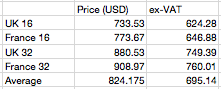
    As a footnote to the unlocked iPhone 4 story, it's worth noting that the average Apple store pricing for UK and France is around $824 (assuming equal blending between the two countries and between the two models).  Excluding corresponding VAT leads to an approximate ASP of $695.

    Operators probably get a slightly better price so my estimate for the iPhone 4 ASP of $600 seems reasonable with potential upside based on product and regional mix.

  8. Can the iPhone reach 10% of the world's 3G subscribers?

    Research

    In a previous article I asked what it would take for the iPhone to reach 20% of the world's smartphone market? (answer: 50% growth).

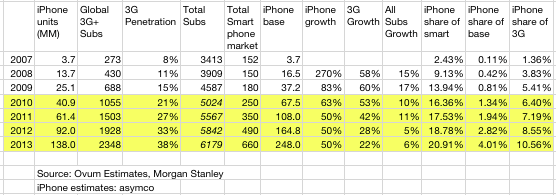
    Now I take a look at the whole market measuring three underlying quantities:

    1. the number of total wireless subscribers world-wide
    2. the number of 3G subscribers
    3. the number of smartphones sold every year 2007 to 2013

    The forecast for 2013 is:

    1. total subs: 6.2 billion
    2. total 3G subs: 2.4 billion (38% of all WW users)
    3. 660 million smartphones sold in 2013

    I also computed the installed base of iPhones based on units sold per year according to the following schedule: 100% of iPhones in use during first year, 75% in use after second year, 50% in use in the third year, 25% in the fourth and 0% in the fifth and after.

    If the iPhone can sustain 50% growth then the following are possible in 2013:

    1. 4% of world’s users using an iPhone (248 million iphone users)
    2. 10% of 3G users are using the iPhone
    3. 21% of smartphones purchased are iPhones
  9. Can iPhone reach 20% of global smartphone market?

    Research · 3 comments

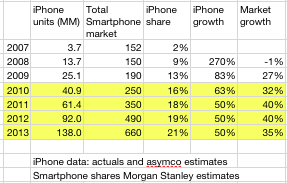
    On a yearly basis, iPhone has been growing at 270% in 2008,83% in 2009 and 130% so far this year.  The growth has been faster than the growth of the smartphone market during the same time.  As a result, the market share of the iPhone has increased from 2% in 2007 to 13% in 2009.

    The question now is: What is the required growth rate for iPhone to maintain growth in share as the overall market grows?

    Taking market estimates from Morgan Stanley, I tried to fit an iPhone growth rate which would result in a 20% share for Apple by 2013. This rate turns out to be a conservative 50%/yr.  Any growth beyond 50% would result in well over 20% share for the iPhone.

  10. The iPhone at three

    Research · 4 comments

    The end of June will mark the third anniversary of the market release of the iPhone. When it arrived in June 2007, anticipation for the product was significant with high consumer awareness and expectations--though the 10 million/yr. target for 2008 was met with skepticism by many.

    The iPhone launched on June 29th 2007, with only a few days remaining in the quarter. 270k units were sold in that quarter and that was considered a solid start. When the company reported earnings a few weeks later (July 18th 2007) the company's stock price jumped to $140 a share.

    As a sign of optimism in the company's prospects, the P/E ratio showed that the company was expected to reach 35% growth (35 P/E).

    Was this optimism warranted?

    A huge world-wide recession started only six months after the iPhone launched and, by some accounts, it is still lingering today. That meant the company faced decreasing consumer spending and constrained markets world-wide. The recession was expected to challenge Apple's premium positioning across all its product lines. The optimism from 2007 seemed exuberant. Where do we stand today?

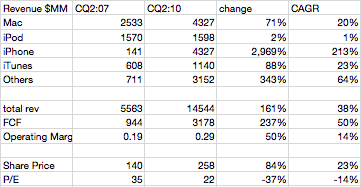
    This table shows the actual values of the iPhone's 2007 launch quarter vs. the estimated values for Apple's income statement exactly three years later.

    Free cash flow grew 237% or at a compounded 50%, significantly above the 35% that the P/E of 2007 would have suggested. The exuberance of 2007 turned out to be pessimism.

    Although we don't know what the share price will be come July, as of today the share price has grown at less than half the rate of FCF growth: 84% or 23% compounded. As a result the P/E dropped from 35 to 22.

    It's remarkable that growth expectations today are lower than they were at iPhone's birth even though the company outperformed those expectations through an unforeseen economic crisis.